display Peugeot 308 2014 Owner's Guide
[x] Cancel search | Manufacturer: PEUGEOT, Model Year: 2014, Model line: 308, Model: Peugeot 308 2014Pages: 400, PDF Size: 10.05 MB
Page 101 of 400
99
3
Comfort
308_EN_CHAP03_CONFORT_ED02-2013
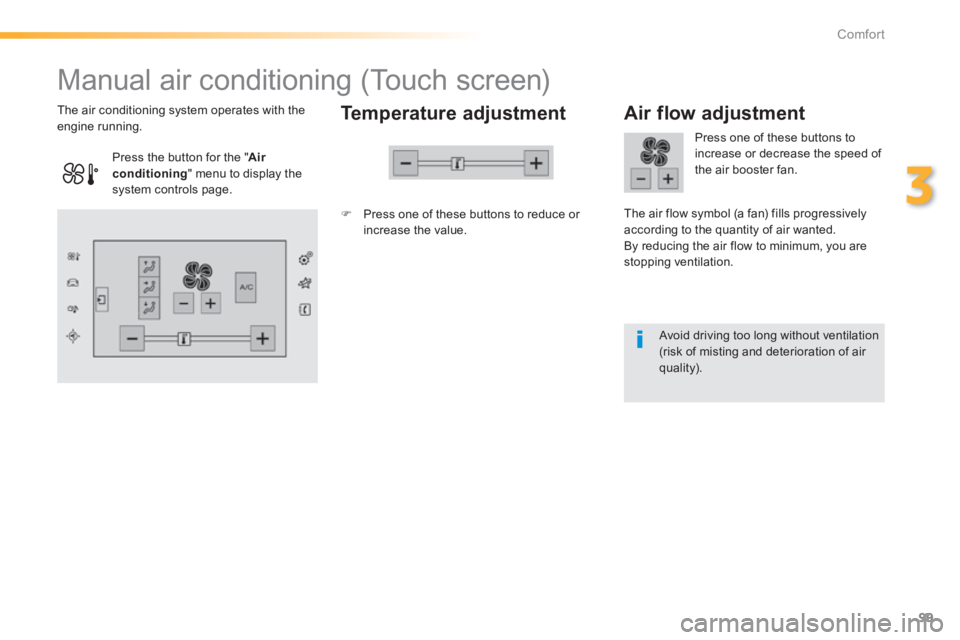
Manual air conditioning (Touch screen)
Temperature adjustment
Press one of these buttons to reduce or increase the value.
The air conditioning system operates with the engine running. Air flow adjustment
Press one of these buttons to increase or decrease the speed of the air booster fan.
The air flow symbol (a fan) fills progressively according to the quantity of air wanted. By reducing the air flow to minimum, you are stopping ventilation.
Avoid driving too long without ventilation (risk of misting and deterioration of air quality).
Press the button for the " Air conditioning " menu to display the system controls page.
Page 103 of 400
101
3
Comfort
308_EN_CHAP03_CONFORT_ED02-2013
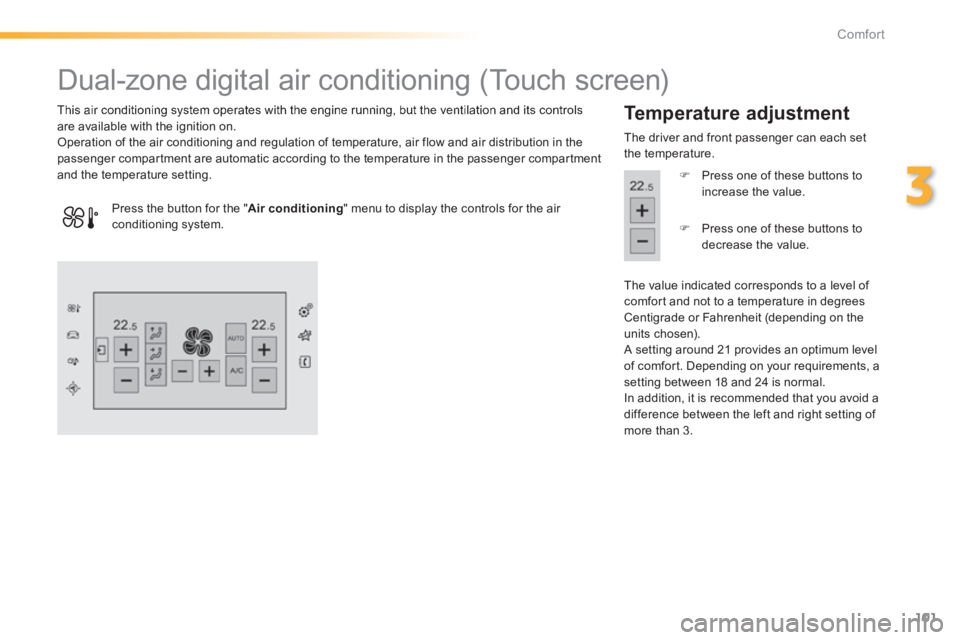
Dual-zone digital air conditioning (Touch screen)
This air conditioning system operates with the engine running, but the ventilation and its controls are available with the ignition on. Operation of the air conditioning and regulation of temperature, air flow and air distribution in the passenger compartment are automatic according to the temperature in the passenger compartment and the temperature setting.
Temperature adjustment
The driver and front passenger can each set the temperature.
Press one of these buttons to increase the value.
The value indicated corresponds to a level of comfort and not to a temperature in degrees Centigrade or Fahrenheit (depending on the units chosen). A setting around 21 provides an optimum level of comfort. Depending on your requirements, a setting between 18 and 24 is normal. In addition, it is recommended that you avoid a difference between the left and right setting of
more than 3.
Press the button for the " Air conditioning " menu to display the controls for the air conditioning system. Press one of these buttons to decrease the value.
Page 104 of 400
102
Comfort
308_EN_CHAP03_CONFORT_ED02-2013
In cold conditions and when the engine is cold, to limit distribution of cold air in the passenger compartment, the air flow will change gradually until the comfort setting is reached. On entering the vehicle, if the interior
temperature is much colder or warmer than the comfort value setting, there is no need to alter the value displayed in order to reach more quickly the required level of comfort. The system compensates automatically and corrects the temperature difference as quickly as possible.
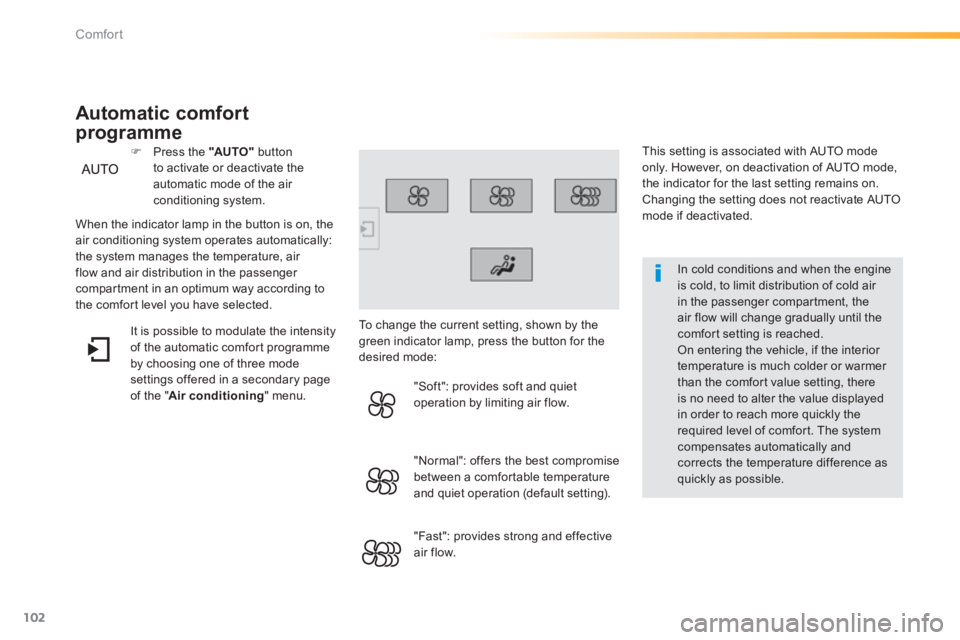
This setting is associated with AUTO mode only. However, on deactivation of AUTO mode, the indicator for the last setting remains on. Changing the setting does not reactivate AUTO mode if deactivated. When the indicator lamp in the button is on, the air conditioning system operates automatically: the system manages the temperature, air flow and air distribution in the passenger compartment in an optimum way according to the comfort level you have selected.
Press the "AUTO" button to activate or deactivate the automatic mode of the air conditioning system.
Automatic comfort
programme
To change the current setting, shown by the green indicator lamp, press the button for the desired mode:
"Soft": provides soft and quiet operation by limiting air flow.
"Normal": offers the best compromise between a comfortable temperature and quiet operation (default setting).
"Fast": provides strong and effective air flow.
It is possible to modulate the intensity of the automatic comfort programme by choosing one of three mode settings offered in a secondary page of the " Air conditioning " menu.
Page 105 of 400
103
3
Comfort
308_EN_CHAP03_CONFORT_ED02-2013
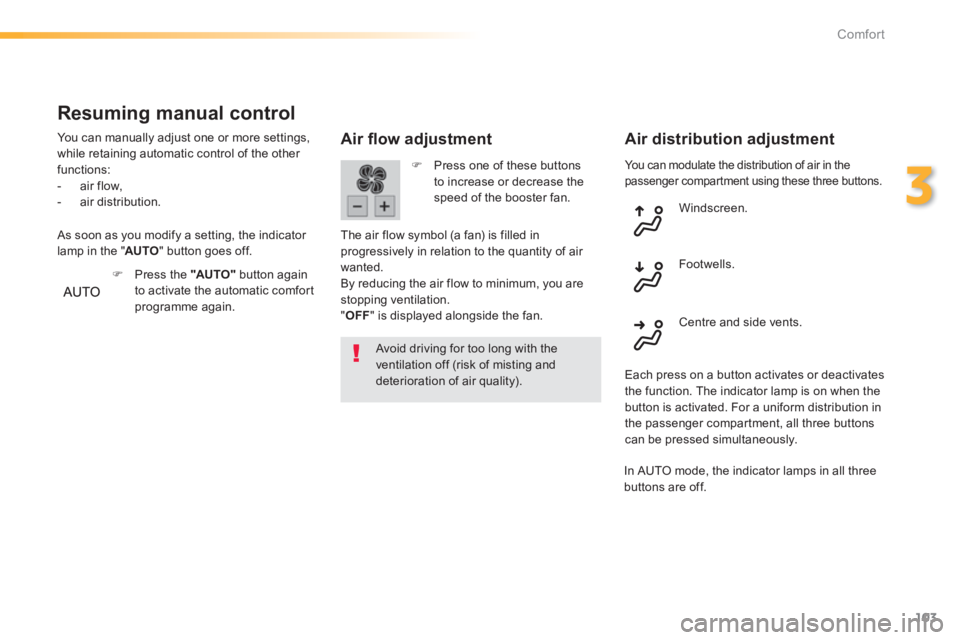
You can modulate the distribution of air in the passenger compartment using these three buttons.
Air fl ow adjustment
Avoid driving for too long with the ventilation off (risk of misting and deterioration of air quality).
Air distribution adjustment
Press one of these buttons to increase or decrease the speed of the booster fan.
The air flow symbol (a fan) is filled in progressively in relation to the quantity of air wanted. By reducing the air flow to minimum, you are stopping ventilation. " OFF " is displayed alongside the fan.
Windscreen.
Centre and side vents.
Footwells.
Each press on a button activates or deactivates the function. The indicator lamp is on when the button is activated. For a uniform distribution in the passenger compartment, all three buttons can be pressed simultaneously.
Resuming manual control
You can manually adjust one or more settings, while retaining automatic control of the other functions: - air flow, - air distribution.
Press the "AUTO" button again to activate the automatic comfort programme again.
As soon as you modify a setting, the indicator lamp in the " AUTO " button goes off.
In AUTO mode, the indicator lamps in all three buttons are off.
Page 110 of 400
108
Driving
308_EN_CHAP04_CONDUITE_ED02-2013
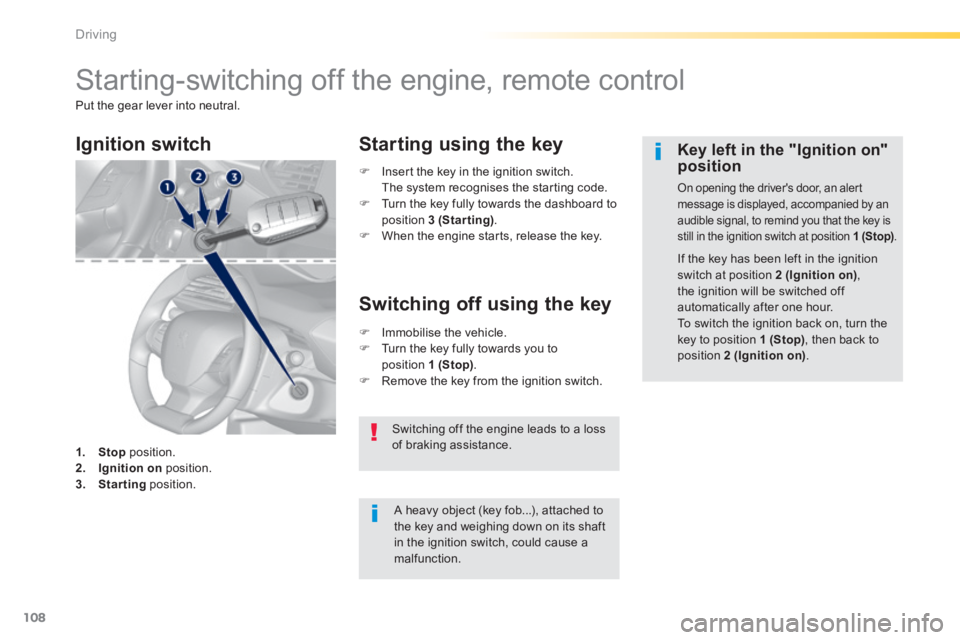
Starting-switching off the engine, remote control
Put the gear lever into neutral.
A heavy object (key fob...), attached to the key and weighing down on its shaft in the ignition switch, could cause a malfunction.
Key left in the "Ignition on" position
On opening the driver's door, an alert message is displayed, accompanied by an audible signal, to remind you that the key is still in the ignition switch at position 1 (Stop) .
If the key has been left in the ignition switch at position 2 (Ignition on) , the ignition will be switched off automatically after one hour. To switch the ignition back on, turn the key to position 1 (Stop) , then back to position 2 (Ignition on) .
Ignition switch
1. Stop position. 2. Ignition on position. 3. Starting position.
Starting using the key
Insert the key in the ignition switch. The system recognises the starting code. Turn the key fully towards the dashboard to position 3 (Starting) .
When the engine starts, release the key.
Immobilise the vehicle. Turn the key fully towards you to position 1 (Stop) . Remove the key from the ignition switch.
Switching off using the key
Switching off the engine leads to a loss of braking assistance.
Page 111 of 400
109
4
Driving
308_EN_CHAP04_CONDUITE_ED02-2013
For Diesel vehicles , in sub-zero temperatures the engine will not start until the pre-heater warning lamp has gone off.
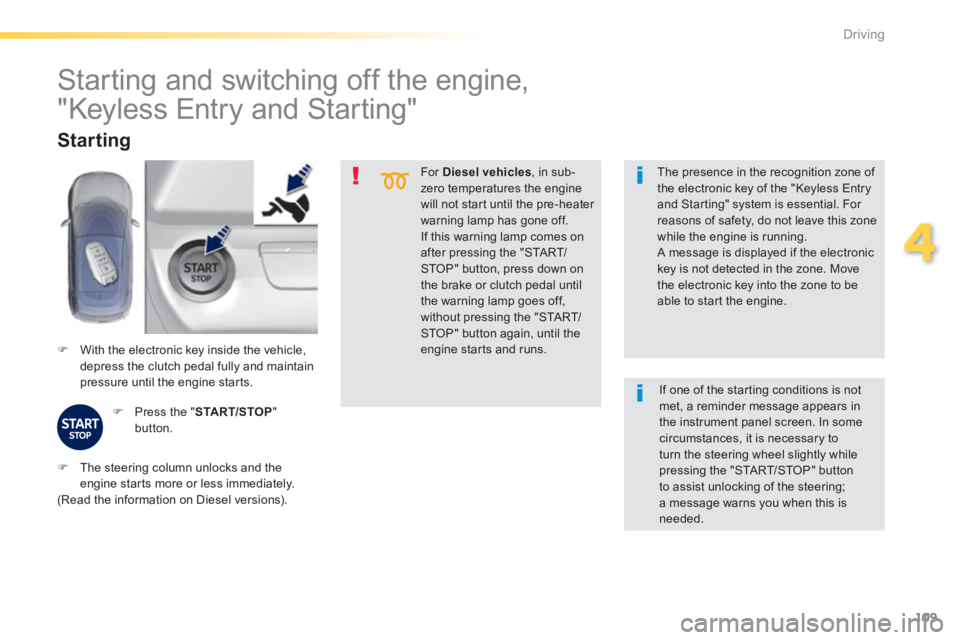
If this warning lamp comes on after pressing the "START/STOP" button, press down on the brake or clutch pedal until the warning lamp goes off, without pressing the "START/STOP" button again, until the engine starts and runs. With the electronic key inside the vehicle, depress the clutch pedal fully and maintain pressure until the engine starts.
Starting
Press the " START/STOP " button.
The presence in the recognition zone of the electronic key of the "Keyless Entry and Starting" system is essential. For reasons of safety, do not leave this zone
while the engine is running. A message is displayed if the electronic key is not detected in the zone. Move the electronic key into the zone to be able to start the engine.
Starting and switching off the engine,
"Keyless Entry and Starting"
The steering column unlocks and the engine starts more or less immediately. (Read the information on Diesel versions).
If one of the starting conditions is not met, a reminder message appears in the instrument panel screen. In some circumstances, it is necessary to turn the steering wheel slightly while pressing the "START/STOP" button to assist unlocking of the steering; a message warns you when this is needed.
Page 117 of 400
115
4
Driving
308_EN_CHAP04_CONDUITE_ED02-2013
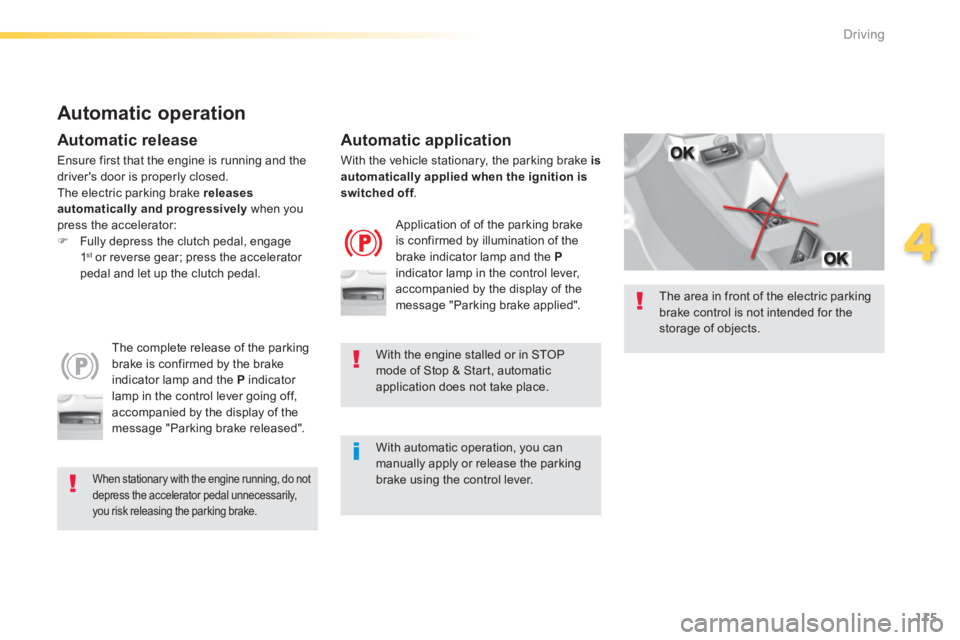
The area in front of the electric parking brake control is not intended for the storage of objects.
Automatic operation
Automatic release
The complete release of the parking brake is confirmed by the brake indicator lamp and the P indicator lamp in the control lever going off, accompanied by the display of the message "Parking brake released".
When stationary with the engine running, do not depress the accelerator pedal unnecessarily, you risk releasing the parking brake.
Automatic application
Application of of the parking brake is confirmed by illumination of the brake indicator lamp and the Pindicator lamp in the control lever, accompanied by the display of the message "Parking brake applied".
With the engine stalled or in STOP mode of Stop & Start, automatic application does not take place.
With automatic operation, you can manually apply or release the parking brake using the control lever.
Ensure first that the engine is running and the driver's door is properly closed. The electric parking brake releases automatically and progressively when you
press the accelerator: Fully depress the clutch pedal, engage 1 st or reverse gear; press the accelerator pedal and let up the clutch pedal.
With the vehicle stationary, the parking brake is automatically applied when the ignition is switched off . switched off . switched off
Page 118 of 400
116
Driving
308_EN_CHAP04_CONDUITE_ED02-2013
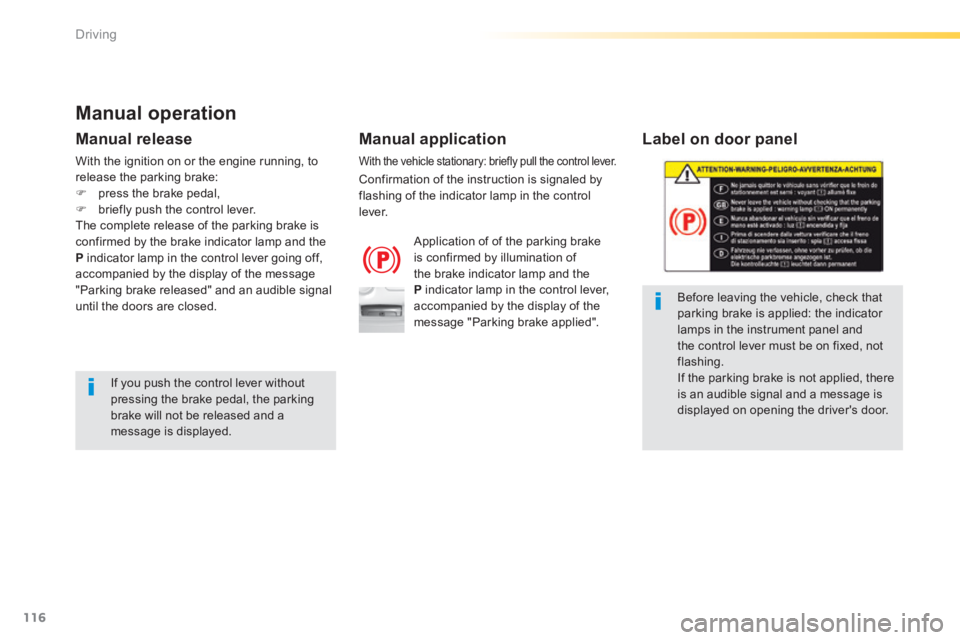
Label on door panel
Before leaving the vehicle, check that parking brake is applied: the indicator lamps in the instrument panel and the control lever must be on fixed, not flashing. If the parking brake is not applied, there is an audible signal and a message is displayed on opening the driver's door.
Manual operation
Application of of the parking brake is confirmed by illumination of the brake indicator lamp and the P indicator lamp in the control lever, accompanied by the display of the message "Parking brake applied".
Manual release
If you push the control lever without pressing the brake pedal, the parking brake will not be released and a
message is displayed.
With the vehicle stationary: briefly pull the control lever.
Confirmation of the instruction is signaled by flashing of the indicator lamp in the control l eve r.
With the ignition on or the engine running, to release the parking brake: press the brake pedal, briefly push the control lever. The complete release of the parking brake is confirmed by the brake indicator lamp and the P indicator lamp in the control lever going off, accompanied by the display of the message "Parking brake released" and an audible signal until the doors are closed.
Manual application
Page 119 of 400
117
4
Driving
308_EN_CHAP04_CONDUITE_ED02-2013
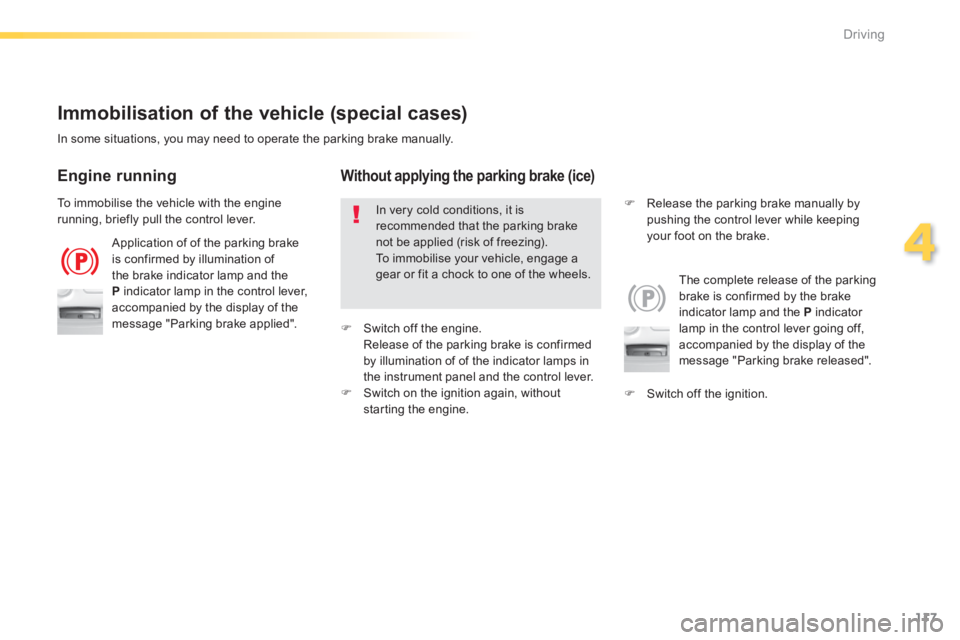
Immobilisation of the vehicle (special cases)
Application of of the parking brake is confirmed by illumination of the brake indicator lamp and the P indicator lamp in the control lever, accompanied by the display of the message "Parking brake applied".
The complete release of the parking brake is confirmed by the brake indicator lamp and the P indicator lamp in the control lever going off, accompanied by the display of the message "Parking brake released".
In some situations, you may need to operate the parking brake manually.
Engine running
In very cold conditions, it is
recommended that the parking brake not be applied (risk of freezing). To immobilise your vehicle, engage a gear or fit a chock to one of the wheels.
Without applying the parking brake (ice)
Switch off the ignition.
Release the parking brake manually by pushing the control lever while keeping your foot on the brake.
To immobilise the vehicle with the engine running, briefly pull the control lever.
Switch off the engine. Release of the parking brake is confirmed by illumination of of the indicator lamps in the instrument panel and the control lever. Switch on the ignition again, without starting the engine.
Page 120 of 400
118
Driving
308_EN_CHAP04_CONDUITE_ED02-2013
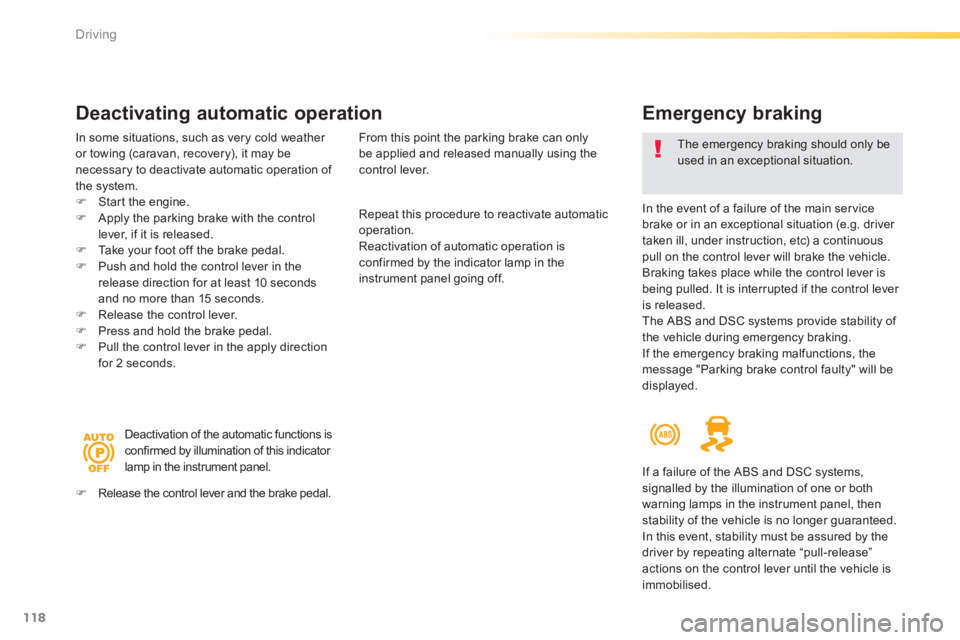
Emergency braking
In the event of a failure of the main service brake or in an exceptional situation (e.g. driver taken ill, under instruction, etc) a continuous pull on the control lever will brake the vehicle. Braking takes place while the control lever is being pulled. It is interrupted if the control lever is released. The ABS and DSC systems provide stability of the vehicle during emergency braking. If the emergency braking malfunctions, the message "Parking brake control faulty" will be displayed.
The emergency braking should only be used in an exceptional situation.
Repeat this procedure to reactivate automatic operation. Reactivation of automatic operation is confirmed by the indicator lamp in the instrument panel going off.
Deactivating automatic operation
In some situations, such as very cold weather or towing (caravan, recovery), it may be necessary to deactivate automatic operation of the system. Start the engine. Apply the parking brake with the control
lever, if it is released. Take your foot off the brake pedal. Push and hold the control lever in the release direction for at least 10 seconds and no more than 15 seconds. Release the control lever. Press and hold the brake pedal. Pull the control lever in the apply direction for 2 seconds.
Deactivation of the automatic functions is confirmed by illumination of this indicator lamp in the instrument panel.
Release the control lever and the brake pedal.
From this point the parking brake can only be applied and released manually using the control lever.
If a failure of the ABS and DSC systems, signalled by the illumination of one or both warning lamps in the instrument panel, then stability of the vehicle is no longer guaranteed. In this event, stability must be assured by the driver by repeating alternate “pull-release” actions on the control lever until the vehicle is
immobilised.