ignition Peugeot 308 2014 Repair Manual
[x] Cancel search | Manufacturer: PEUGEOT, Model Year: 2014, Model line: 308, Model: Peugeot 308 2014Pages: 400, PDF Size: 10.05 MB
Page 198 of 400
196
Safety
308_EN_CHAP06_SECURITE_ED02-2013
Seat belts
Front seat belts Rear seat belts
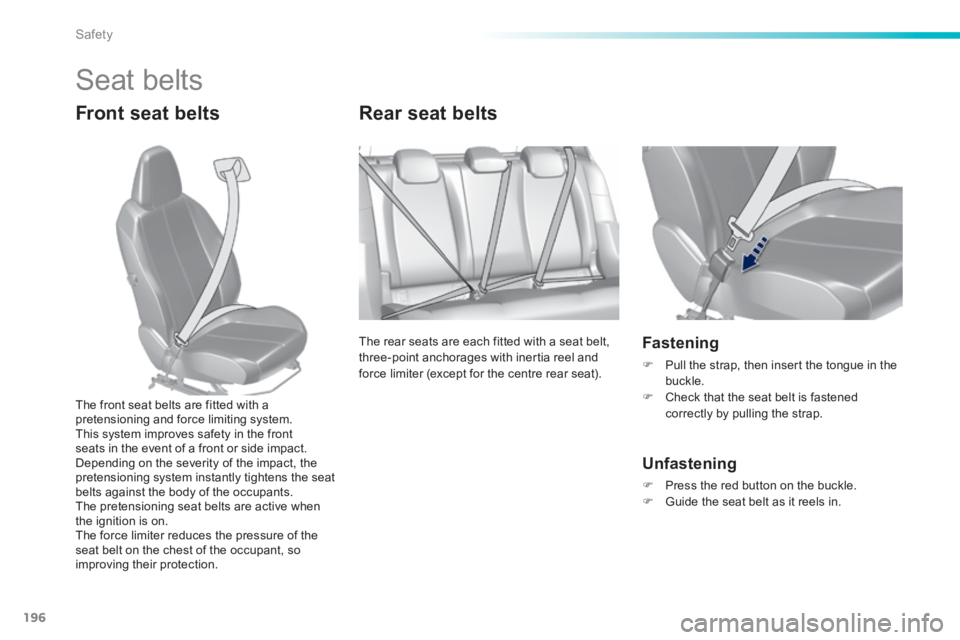
The rear seats are each fitted with a seat belt, three-point anchorages with inertia reel and force limiter (except for the centre rear seat).
Fastening
Pull the strap, then insert the tongue in the buckle. Check that the seat belt is fastened correctly by pulling the strap.
Unfastening
Press the red button on the buckle. Guide the seat belt as it reels in.
The front seat belts are fitted with a pretensioning and force limiting system. This system improves safety in the front seats in the event of a front or side impact. Depending on the severity of the impact, the pretensioning system instantly tightens the seat belts against the body of the occupants. The pretensioning seat belts are active when the ignition is on. The force limiter reduces the pressure of the seat belt on the chest of the occupant, so improving their protection.
Page 199 of 400
197
6
Safety
308_EN_CHAP06_SECURITE_ED02-2013
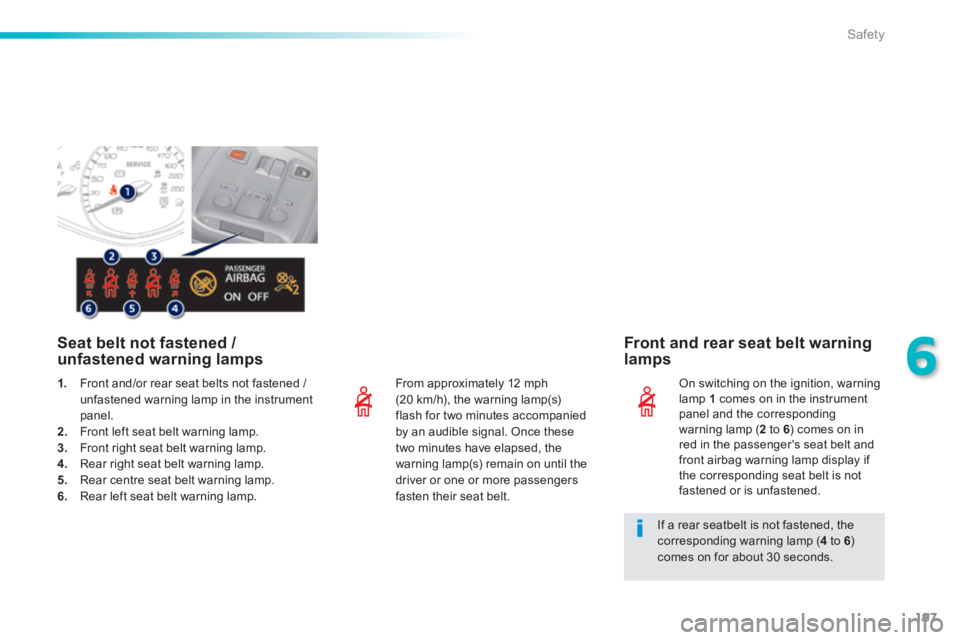
From approximately 12 mph (20 km/h), the warning lamp(s) flash for two minutes accompanied by an audible signal. Once these two minutes have elapsed, the warning lamp(s) remain on until the driver or one or more passengers fasten their seat belt.
Seat belt not fastened / unfastened warning lamps Front and rear seat belt warning lamps
On switching on the ignition, warning lamp 1 comes on in the instrument panel and the corresponding warning lamp (2 to 6 ) comes on in red in the passenger's seat belt and front airbag warning lamp display if the corresponding seat belt is not fastened or is unfastened.
1. Front and/or rear seat belts not fastened / unfastened warning lamp in the instrument panel. 2. Front left seat belt warning lamp. 3. Front right seat belt warning lamp. 4. Rear right seat belt warning lamp. 5. Rear centre seat belt warning lamp. 6. Rear left seat belt warning lamp.
If a rear seatbelt is not fastened, the corresponding warning lamp ( 4 to 6 ) comes on for about 30 seconds.
Page 201 of 400
199
6
Safety
308_EN_CHAP06_SECURITE_ED02-2013
Airbags
System designed to maximise the safety of the occupants (with the exception of the rear centre passenger) in the event of violent collisions. The airbags supplement the action of the force-limiting seat belts (with the exception of the centre rear passenger). If a collision occurs, the electronic detectors record and analyse the front and side impacts sustained in the impact detection zones: - in the case of a serious impact, the airbags are deployed instantly and contribute towards better protection of the occupants of the vehicle (with the exception of the rear centre passenger); immediately after the impact, the airbags deflate rapidly so that they do not hinder visibility or the exit of the occupants, - in the case of a minor or rear impact or in certain roll-over conditions, the airbags will not be deployed; the seat belt alone contributes towards ensuring your protection in these situations.
The airbags do not operate when the ignition is switched off. This equipment will only deploy once. If a second impact occurs (during the same or a subsequent accident), the airbag will not be deployed again.
Deployment of the airbag(s) is accompanied by a slight emission of smoke and a noise, due to the activation of the pyrotechnic cartridge incorporated in the system. This smoke is not harmful, but sensitive individuals may experience slight irritation. The noise of the detonation may result in a slight loss of hearing for a short time.
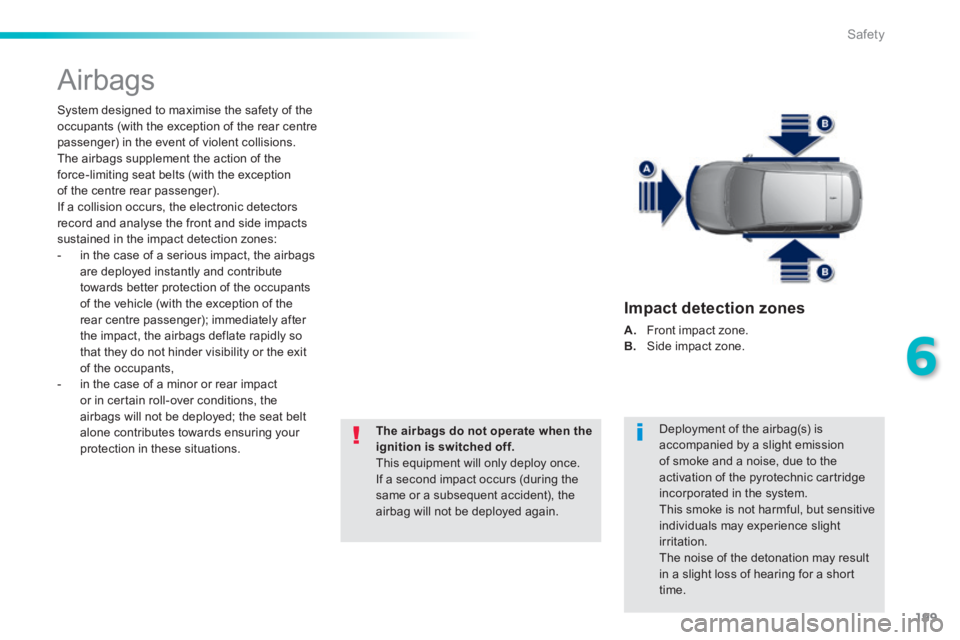
Impact detection zones
A. Front impact zone. B. Side impact zone.
Page 202 of 400
200
Safety
308_EN_CHAP06_SECURITE_ED02-2013
Deactivating the passenger's front airbag
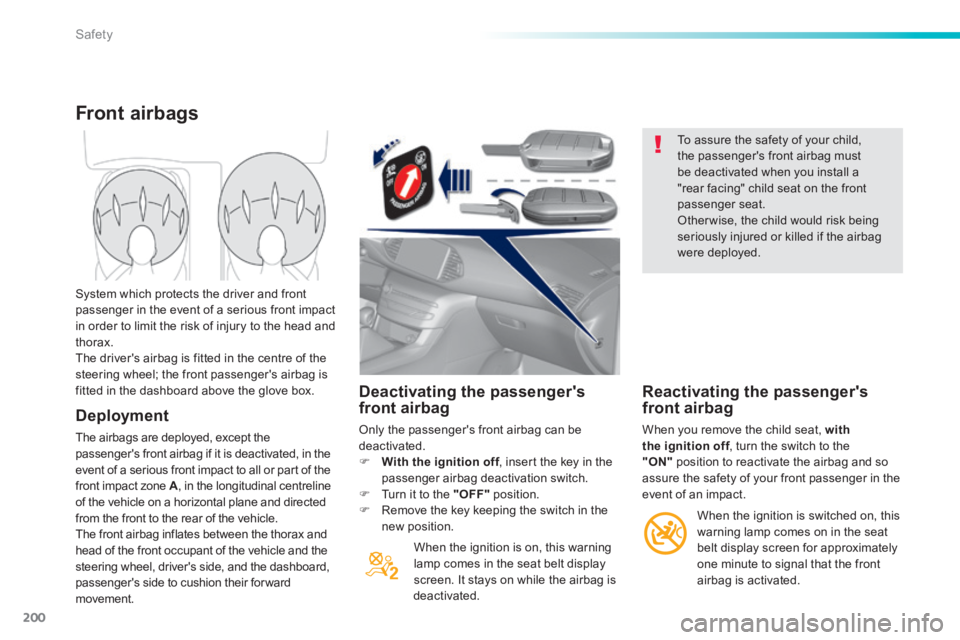
Only the passenger's front airbag can be deactivated. With the ignition off , insert the key in the With the ignition off , insert the key in the With the ignition offpassenger airbag deactivation switch. Turn it to the "OFF" position. Remove the key keeping the switch in the new position.
When the ignition is on, this warning lamp comes in the seat belt display screen. It stays on while the airbag is deactivated.
To assure the safety of your child, the passenger's front airbag must be deactivated when you install a "rear facing" child seat on the front passenger seat. Otherwise, the child would risk being seriously injured or killed if the airbag were deployed.
Reactivating the passenger's front airbag
When you remove the child seat, with the ignition off , turn the switch to the the ignition off , turn the switch to the the ignition off"ON" position to reactivate the airbag and so assure the safety of your front passenger in the event of an impact.
Front airbags
Deployment
The airbags are deployed, except the passenger's front airbag if it is deactivated, in the event of a serious front impact to all or part of the front impact zone A , in the longitudinal centreline of the vehicle on a horizontal plane and directed from the front to the rear of the vehicle. The front airbag inflates between the thorax and head of the front occupant of the vehicle and the steering wheel, driver's side, and the dashboard, passenger's side to cushion their for ward movement.
System which protects the driver and front passenger in the event of a serious front impact in order to limit the risk of injury to the head and thorax. The driver's airbag is fitted in the centre of the steering wheel; the front passenger's airbag is fitted in the dashboard above the glove box.
When the ignition is switched on, this warning lamp comes on in the seat belt display screen for approximately one minute to signal that the front airbag is activated.
Page 222 of 400
220
Safety
308_EN_CHAP06_SECURITE_ED02-2013
Child lock
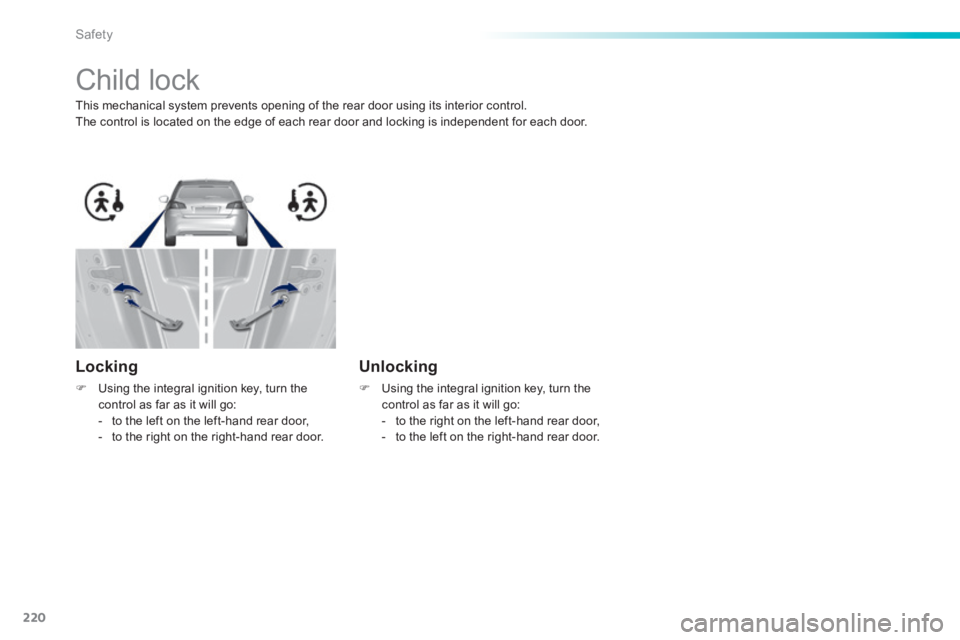
This mechanical system prevents opening of the rear door using its interior control. The control is located on the edge of each rear door and locking is independent for each door.
Locking
Using the integral ignition key, turn the control as far as it will go: - to the left on the left-hand rear door, - to the right on the right-hand rear door.
Unlocking
Using the integral ignition key, turn the control as far as it will go: - to the right on the left-hand rear door, - to the left on the right-hand rear door.
Page 225 of 400
223
7
Practical information
308_EN_CHAP07_INFO PR ATIQUES_ED02-2013
Repair procedure
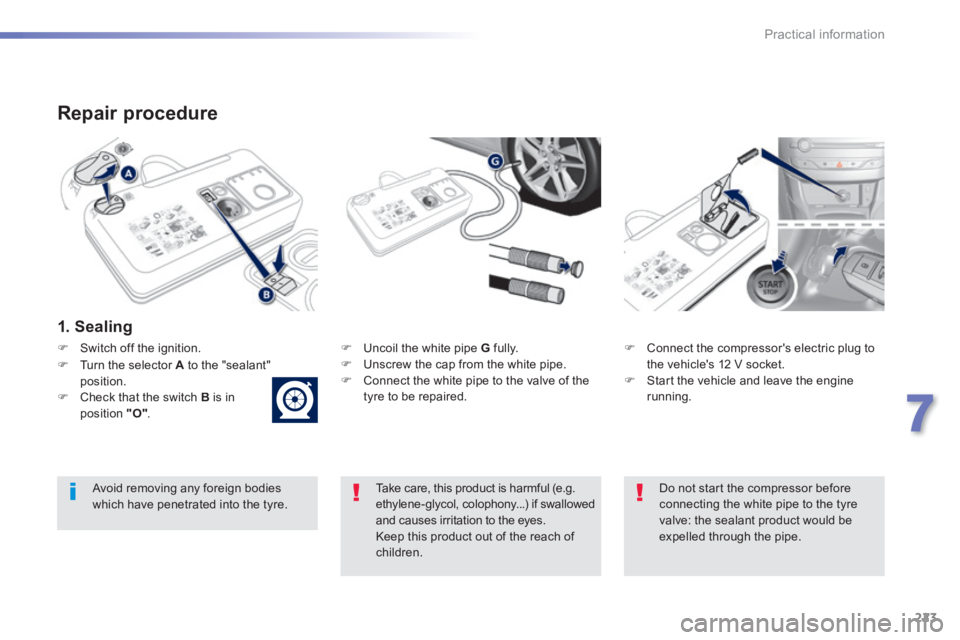
1. Sealing
Uncoil the white pipe G fully. Unscrew the cap from the white pipe. Connect the white pipe to the valve of the tyre to be repaired.
Connect the compressor's electric plug to the vehicle's 12 V socket. Start the vehicle and leave the engine running.
Take care, this product is harmful (e.g. ethylene-glycol, colophony...) if swallowed and causes irritation to the eyes. Keep this product out of the reach of children.
Avoid removing any foreign bodies which have penetrated into the tyre.
Do not start the compressor before connecting the white pipe to the tyre valve: the sealant product would be expelled through the pipe.
Switch off the ignition.
Turn the selector A to the "sealant" position. Check that the switch B is in position "O" .
Page 232 of 400
230
Practical information
308_EN_CHAP07_INFO PR ATIQUES_ED02-2013
Removing a wheel
Parking the vehicle
Immobilise the vehicle where it does not block traffic: the ground must be level, stable and not slippery. Apply the parking brake unless it has been programmed to automatic mode, switch off the ignition and engage first gear to block the wheels. Check that the braking warning lamp and the P warning lamp in the parking brake control lever come on. The occupants must get out of the vehicle and wait where they are safe. Never go underneath a vehicle raised using a jack; use an axle stand.
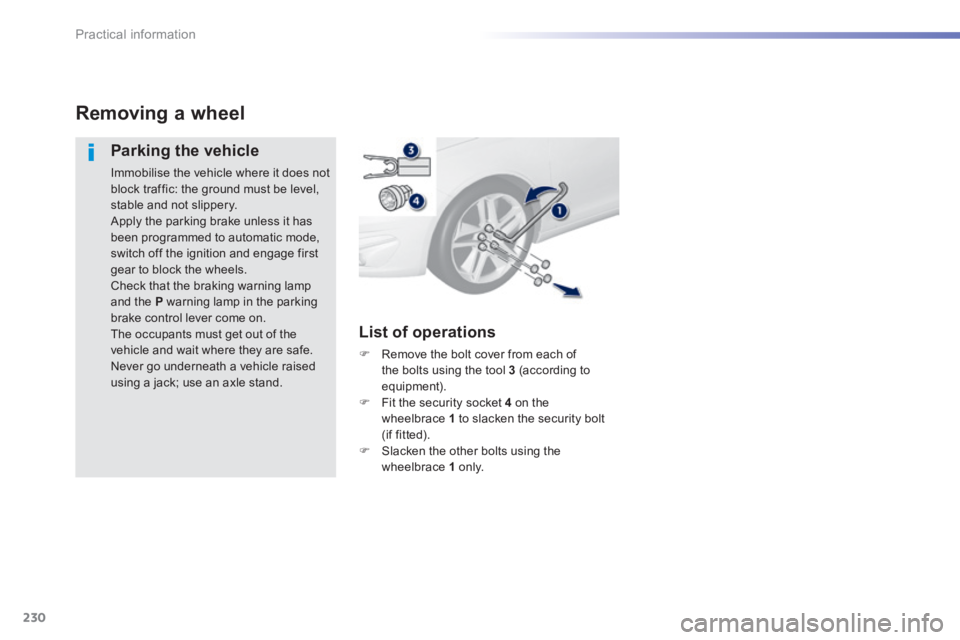
List of operations
Remove the bolt cover from each of the bolts using the tool 3 (according to equipment). Fit the security socket 4 on the wheelbrace 1 to slacken the security bolt (if fitted). Slacken the other bolts using the wheelbrace 1 o n l y.
Page 247 of 400
245
7
Practical information
308_EN_CHAP07_INFO PR ATIQUES_ED02-2013
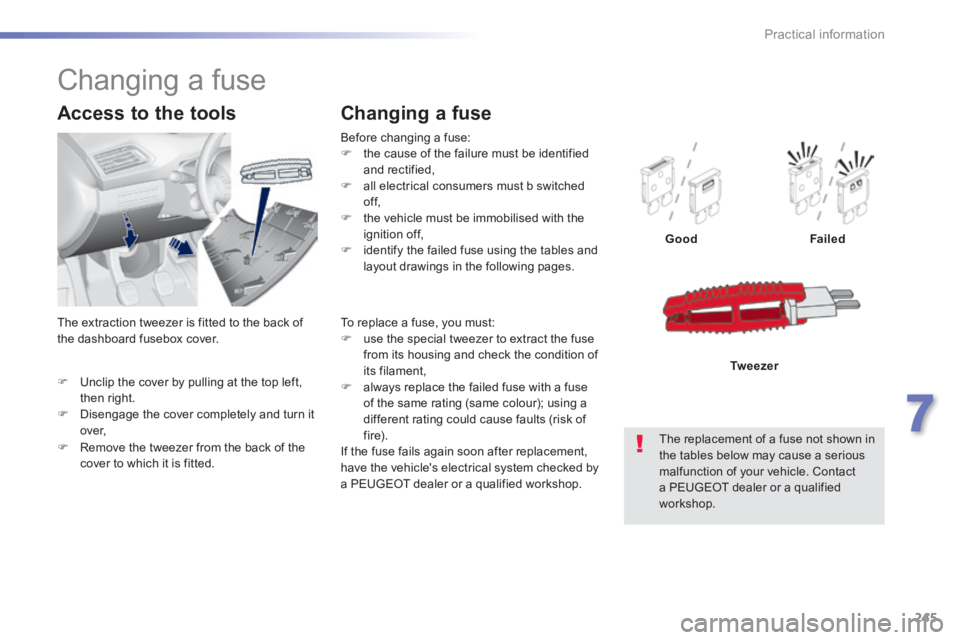
Unclip the cover by pulling at the top left, then right. Disengage the cover completely and turn it over,
Access to the tools
Before changing a fuse: the cause of the failure must be identified and rectified, all electrical consumers must b switched of f, the vehicle must be immobilised with the ignition off, identify the failed fuse using the tables and layout drawings in the following pages.
Changing a fuse
GoodFailed
The replacement of a fuse not shown in the tables below may cause a serious malfunction of your vehicle. Contact a PEUGEOT dealer or a qualified workshop.
Tw e e z e r
Changing a fuse
To replace a fuse, you must: use the special tweezer to extract the fuse from its housing and check the condition of its filament, always replace the failed fuse with a fuse of the same rating (same colour); using a different rating could cause faults (risk of f i r e). If the fuse fails again soon after replacement, have the vehicle's electrical system checked by a PEUGEOT dealer or a qualified workshop.
Remove the tweezer from the back of the cover to which it is fitted.
The extraction tweezer is fitted to the back of the dashboard fusebox cover.
Page 253 of 400
251
7
Practical information
308_EN_CHAP07_INFO PR ATIQUES_ED02-2013
12 V battery
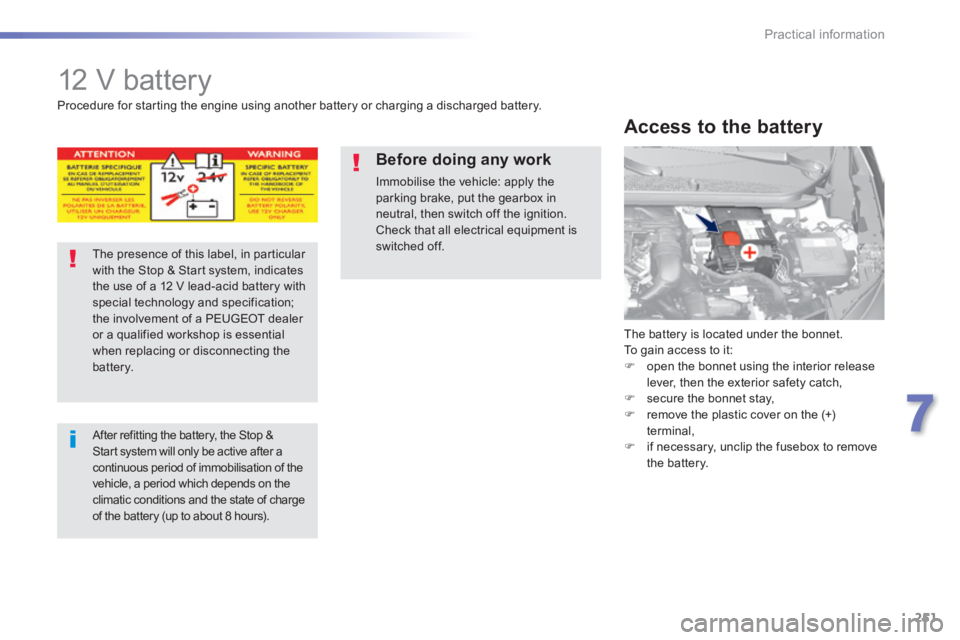
The battery is located under the bonnet. To gain access to it: open the bonnet using the interior release lever, then the exterior safety catch, secure the bonnet stay, remove the plastic cover on the (+) terminal, if necessary, unclip the fusebox to remove the battery.
Access to the battery
Procedure for starting the engine using another battery or charging a discharged battery.
The presence of this label, in particular with the Stop & Start system, indicates the use of a 12 V lead-acid battery with special technology and specification; the involvement of a PEUGEOT dealer or a qualified workshop is essential when replacing or disconnecting the battery.
After refitting the battery, the Stop & Start system will only be active after a continuous period of immobilisation of the vehicle, a period which depends on the climatic conditions and the state of charge of the battery (up to about 8 hours).
Before doing any work
Immobilise the vehicle: apply the parking brake, put the gearbox in neutral, then switch off the ignition.
Check that all electrical equipment is switched off.
Page 255 of 400
253
7
Practical information
308_EN_CHAP07_INFO PR ATIQUES_ED02-2013
Starting using another
battery
First check that the slave battery has a nominal voltage of 12 V and a capacity at least equal to that of the discharged battery. Do not try to start the engine by connecting a battery charger. Do not disconnect the (+) terminal when the engine is running.
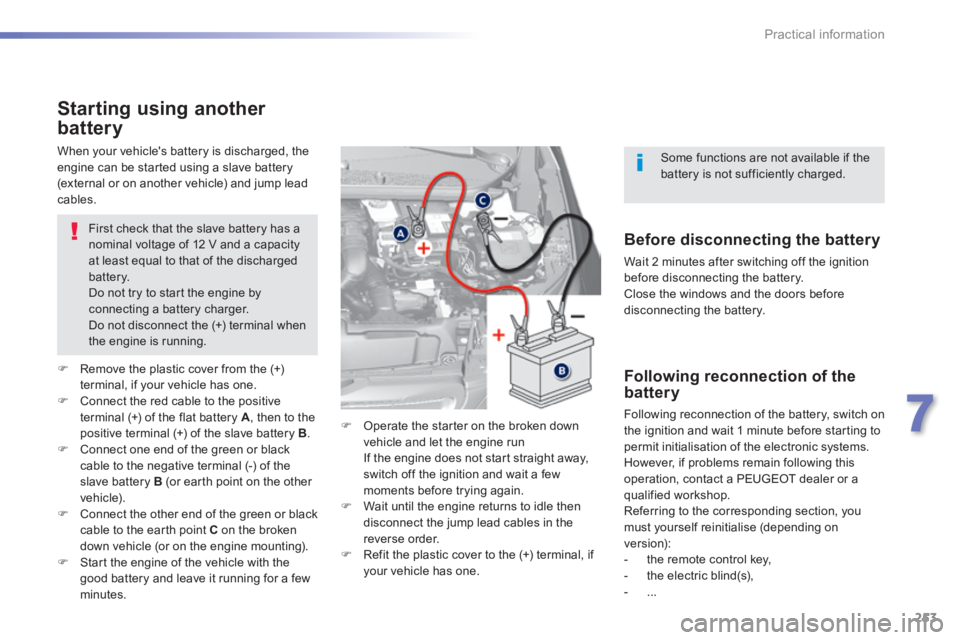
Remove the plastic cover from the (+) terminal, if your vehicle has one. Connect the red cable to the positive terminal (+) of the flat battery A , then to the
positive terminal (+) of the slave battery B . Connect one end of the green or black cable to the negative terminal (-) of the slave battery B (or earth point on the other vehicle). Connect the other end of the green or black cable to the earth point C on the broken down vehicle (or on the engine mounting). Start the engine of the vehicle with the good battery and leave it running for a few minutes.
Operate the starter on the broken down vehicle and let the engine run If the engine does not start straight away, switch off the ignition and wait a few moments before trying again. Wait until the engine returns to idle then disconnect the jump lead cables in the reverse order. Refit the plastic cover to the (+) terminal, if your vehicle has one.
When your vehicle's battery is discharged, the engine can be started using a slave battery (external or on another vehicle) and jump lead cables.
Before disconnecting the battery
Wait 2 minutes after switching off the ignition before disconnecting the battery. Close the windows and the doors before disconnecting the battery.
Following reconnection of the battery
Following reconnection of the battery, switch on
the ignition and wait 1 minute before starting to permit initialisation of the electronic systems. However, if problems remain following this operation, contact a PEUGEOT dealer or a qualified workshop. Referring to the corresponding section, you must yourself reinitialise (depending on version): - the remote control key, - the electric blind(s), - ...
Some functions are not available if the battery is not sufficiently charged.