ignition Peugeot 308 2014 Service Manual
[x] Cancel search | Manufacturer: PEUGEOT, Model Year: 2014, Model line: 308, Model: Peugeot 308 2014Pages: 400, PDF Size: 10.05 MB
Page 131 of 400
129
4
Driving
308_EN_CHAP04_CONDUITE_ED02-2013
Stop & Start
Operation
Going into engine STOP mode
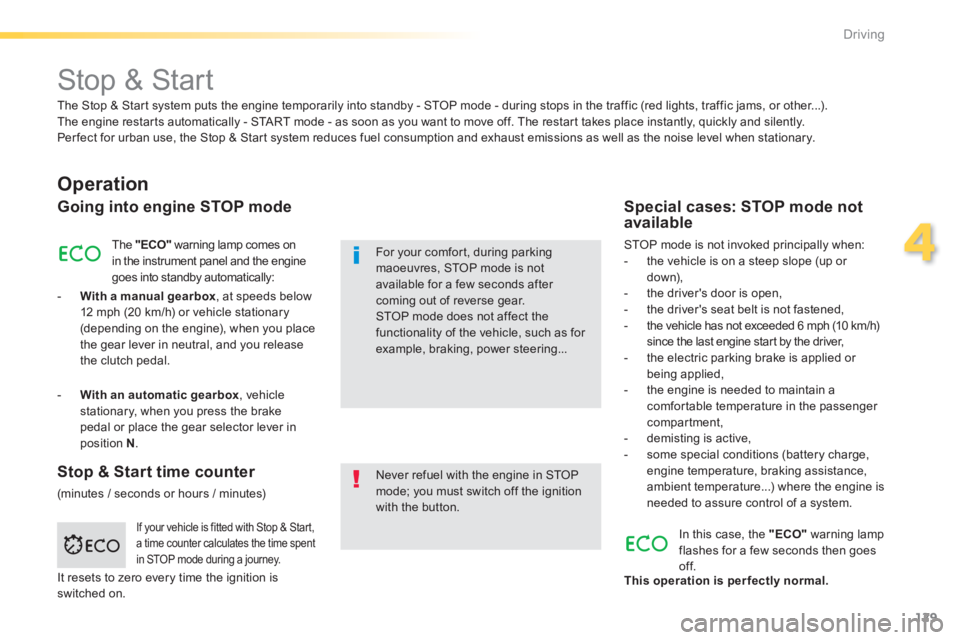
The "ECO" warning lamp comes on in the instrument panel and the engine goes into standby automatically:
- With a manual gearbox , at speeds below 12 mph (20 km/h) or vehicle stationary (depending on the engine), when you place the gear lever in neutral, and you release the clutch pedal.
Never refuel with the engine in STOP mode; you must switch off the ignition with the button.
For your comfort, during parking maoeuvres, STOP mode is not available for a few seconds after coming out of reverse gear. STOP mode does not affect the functionality of the vehicle, such as for example, braking, power steering...
Special cases: STOP mode not available
STOP mode is not invoked principally when: - the vehicle is on a steep slope (up or d ow n), - the driver's door is open, - the driver's seat belt is not fastened, - the vehicle has not exceeded 6 mph (10 km/h) since the last engine start by the driver, - the electric parking brake is applied or being applied, - the engine is needed to maintain a comfortable temperature in the passenger compartment,
- demisting is active, - some special conditions (battery charge, engine temperature, braking assistance, ambient temperature...) where the engine is needed to assure control of a system.
If your vehicle is fitted with Stop & Start, a time counter calculates the time spent in STOP mode during a journey.
In this case, the "ECO" warning lamp flashes for a few seconds then goes of f. This operation is perfectly normal.
The Stop & Start system puts the engine temporarily into standby - STOP mode - during stops in the traffic (red lights, traffic jams, or other...). The engine restarts automatically - START mode - as soon as you want to move off. The restart takes place instantly, quickly and silently. Per fect for urban use, the Stop & Start system reduces fuel consumption and exhaust emissions as well as the noise level when stationary.
Stop & Start time counter
(minutes / seconds or hours / minutes)
- With an automatic gearbox , vehicle stationary, when you press the brake pedal or place the gear selector lever in position N .
It resets to zero every time the ignition is switched on.
Page 133 of 400
131
4
Driving
308_EN_CHAP04_CONDUITE_ED02-2013
The system is reactivated automatically at every new engine start by the driver.
Reactivation
Press the "ECO OFF" switch again. The system is active again; this is confirmed by the switch warning lamp going off, accompanied by a message.
Operating fault
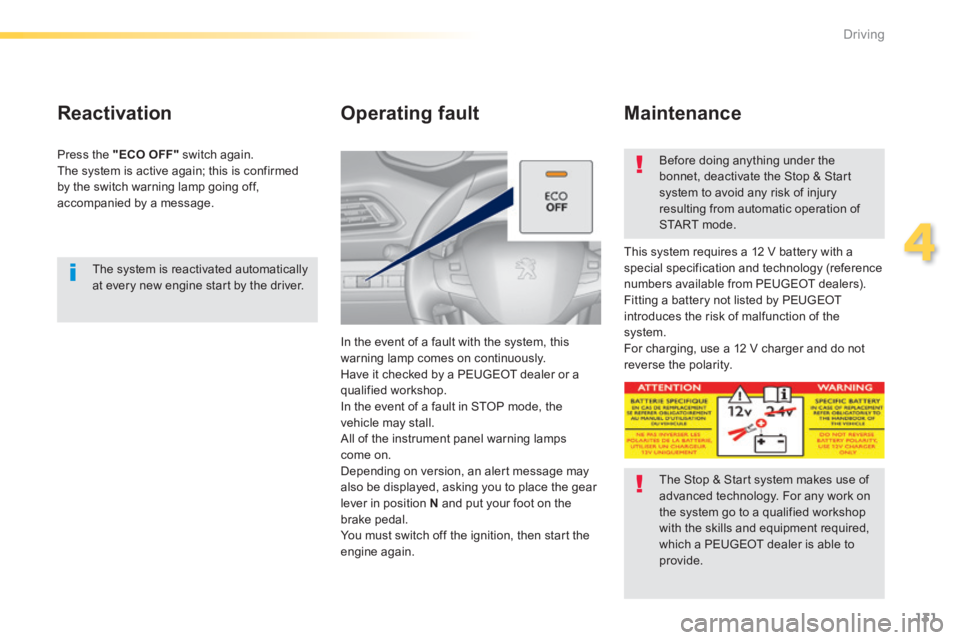
In the event of a fault with the system, this warning lamp comes on continuously. Have it checked by a PEUGEOT dealer or a qualified workshop. In the event of a fault in STOP mode, the vehicle may stall.
All of the instrument panel warning lamps come on. Depending on version, an alert message may also be displayed, asking you to place the gear lever in position N and put your foot on the brake pedal. You must switch off the ignition, then start the engine again.
Before doing anything under the bonnet, deactivate the Stop & Start system to avoid any risk of injury resulting from automatic operation of START mode.
This system requires a 12 V battery with a special specification and technology (reference numbers available from PEUGEOT dealers). Fitting a battery not listed by PEUGEOT introduces the risk of malfunction of the system. For charging, use a 12 V charger and do not reverse the polarity.
Maintenance
The Stop & Start system makes use of advanced technology. For any work on the system go to a qualified workshop with the skills and equipment required,
which a PEUGEOT dealer is able to provide.
Page 135 of 400
133
4
Driving
308_EN_CHAP04_CONDUITE_ED02-2013
Steering mounted controls
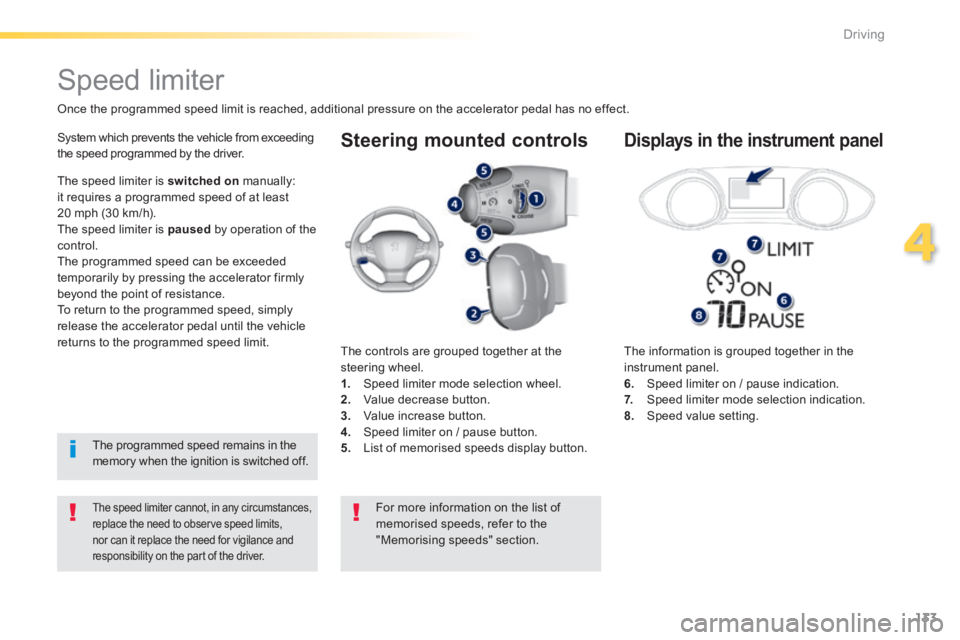
The information is grouped together in the instrument panel. 6. Speed limiter on / pause indication. 7. Speed limiter mode selection indication. 8. Speed value setting.
Speed limiter
Once the programmed speed limit is reached, additional pressure on the accelerator pedal has no effect.
The speed limiter cannot, in any circumstances, replace the need to observe speed limits, nor can it replace the need for vigilance and responsibility on the part of the driver.
System which prevents the vehicle from exceeding the speed programmed by the driver.
The controls are grouped together at the steering wheel. 1. Speed limiter mode selection wheel. 2. Value decrease button. 3. Value increase button. 4. Speed limiter on / pause button. 5. List of memorised speeds display button.
Displays in the instrument panel
The speed limiter is switched on manually: it requires a programmed speed of at least 20 mph (30 km/h). The speed limiter is paused by operation of the control. The programmed speed can be exceeded temporarily by pressing the accelerator firmly beyond the point of resistance. To return to the programmed speed, simply release the accelerator pedal until the vehicle returns to the programmed speed limit.
The programmed speed remains in the memory when the ignition is switched off.
For more information on the list of memorised speeds, refer to the "Memorising speeds" section.
Page 138 of 400
136
Driving
308_EN_CHAP04_CONDUITE_ED02-2013
Steering mounted controls
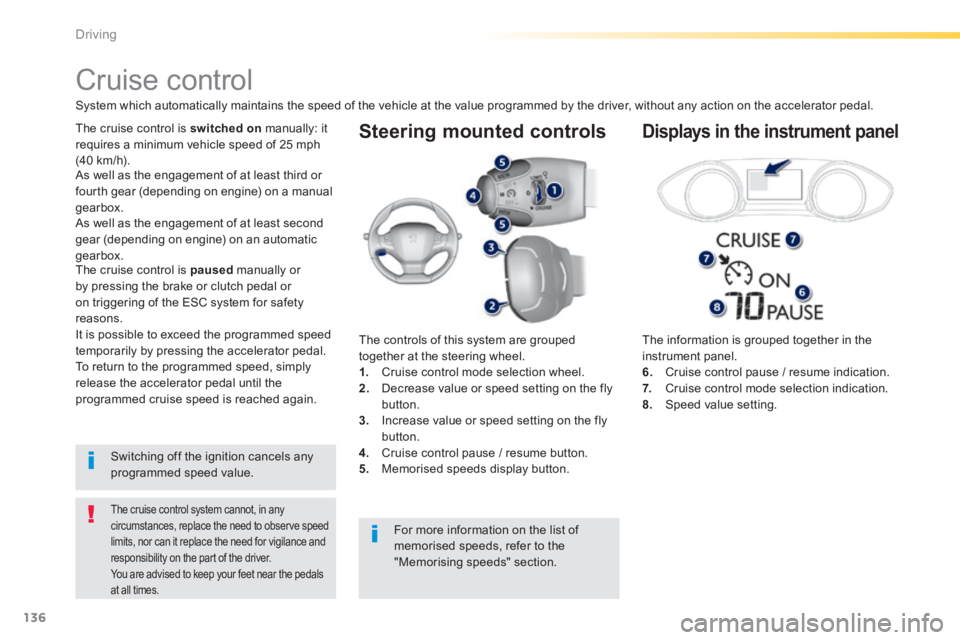
The information is grouped together in the instrument panel. 6. Cruise control pause / resume indication. 7. Cruise control mode selection indication. 8. Speed value setting.
Cruise control
System which automatically maintains the speed of the vehicle at the value programmed by the driver, without any action on the accelerator pedal.
The cruise control system cannot, in any circumstances, replace the need to observe speed limits, nor can it replace the need for vigilance and responsibility on the part of the driver. You are advised to keep your feet near the pedals
at all times.
The cruise control is switched on manually: it requires a minimum vehicle speed of 25 mph (40 km/h).
The controls of this system are grouped together at the steering wheel. 1. Cruise control mode selection wheel. 2. Decrease value or speed setting on the fly button. 3. Increase value or speed setting on the fly
button. 4. Cruise control pause / resume button. 5. Memorised speeds display button.
Displays in the instrument panel
Switching off the ignition cancels any programmed speed value.
The cruise control is paused manually or by pressing the brake or clutch pedal or on triggering of the ESC system for safety reasons. It is possible to exceed the programmed speed temporarily by pressing the accelerator pedal. To return to the programmed speed, simply release the accelerator pedal until the programmed cruise speed is reached again.
As well as the engagement of at least third or fourth gear (depending on engine) on a manual gearbox.
For more information on the list of
memorised speeds, refer to the "Memorising speeds" section.
As well as the engagement of at least second
gear (depending on engine) on an automatic gearbox.
Page 142 of 400
140
Driving
308_EN_CHAP04_CONDUITE_ED02-2013
The active cruise control is switched on manually, it requires that the speed of the vehicle be between 25 mph (40 km/h) and 90 mph (150 km/h).
General points
The active cruise control can be pausedmanually with the control, or automatically: - by pressing the brake or clutch pedal, - in the event of operation of the ESP, for safety reasons, - in the event of an action of the electric parking brake control, - when an inter-vehicle time threshold is reached (calculated according to the relative speeds of your vehicle and the vehicle in front and the inter-vehicle time setting chosen), - when the distance between your vehicle and the one in front becomes to small, - when the speed of the vehicle in front is to low, - when the speed of your vehicle becomes too low.
The active cruise control cannot in any circumstances replace the observation of speed limits, nor the the vigilance and responsibility of the driver. It is recommended that you always keep your feet close to the pedals.
Switching off the ignition cancels any programmed value, and the inter-vehicle time is reset to 2 seconds.
As well as the engagement of at least third or fourth gear (depending on engine) on a manual gearbox.
As well as the engagement of at least second gear (depending on engine) on an automatic gearbox.
If the cruise speed setting is above 90 mph (150 km/h), the active cruise control switches to normal cruise control mode (without automatic adjustment of the safety inter-vehicle distance).
Page 149 of 400
147
4
Driving
308_EN_CHAP04_CONDUITE_ED02-2013
Display of inter-vehicle time
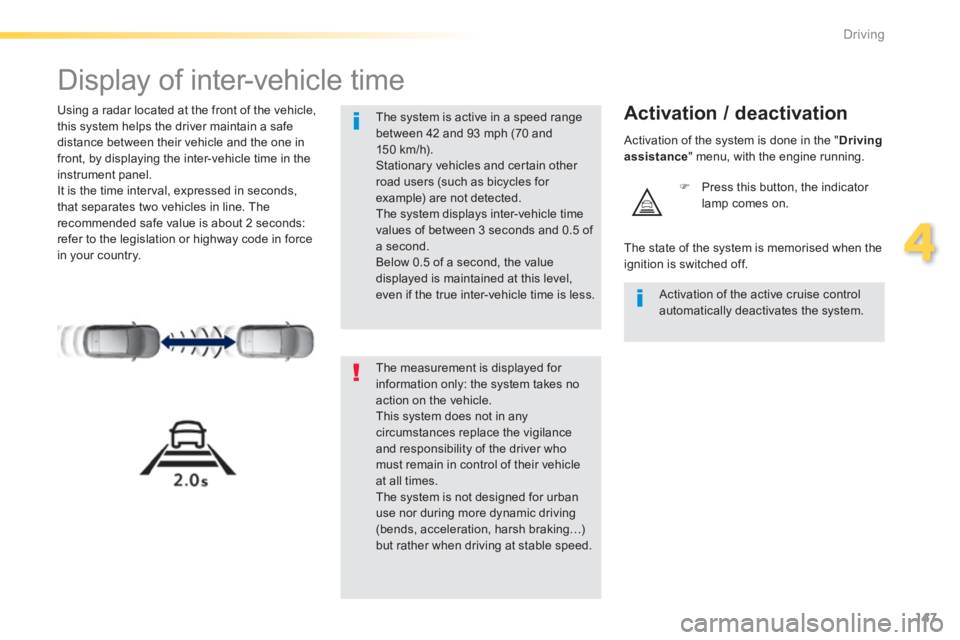
Using a radar located at the front of the vehicle, this system helps the driver maintain a safe distance between their vehicle and the one in front, by displaying the inter-vehicle time in the instrument panel. It is the time interval, expressed in seconds, that separates two vehicles in line. The recommended safe value is about 2 seconds: refer to the legislation or highway code in force in your country.
Activation / deactivation
Press this button, the indicator lamp comes on.
The measurement is displayed for information only: the system takes no action on the vehicle. This system does not in any circumstances replace the vigilance and responsibility of the driver who must remain in control of their vehicle at all times. The system is not designed for urban use nor during more dynamic driving (bends, acceleration, harsh braking…)
but rather when driving at stable speed.
The system is active in a speed range between 42 and 93 mph (70 and 150 km/h). Stationary vehicles and certain other road users (such as bicycles for example) are not detected. The system displays inter-vehicle time values of between 3 seconds and 0.5 of a second. Below 0.5 of a second, the value displayed is maintained at this level, even if the true inter-vehicle time is less. Activation of the active cruise control automatically deactivates the system.
The state of the system is memorised when the ignition is switched off.
Activation of the system is done in the " Driving assistance " menu, with the engine running.
Page 160 of 400
158
Driving
308_EN_CHAP04_CONDUITE_ED02-2013
To deactivate the system, press this button again; its indicator lamp goes off as well as the associated indicator in the instrument panel.
In the event of a fault, the warning lamp flashes then goes off.
Operating fault
Have it checked by a PEUGEOT dealer or a qualified workshop.
The system is automatically deactivated when towing with a towbar approved by P E U G E O T.
The system may suffer temporary interference in certain weather conditions (rain, hail...). In particular, driving on a wet sur face or moving from a dry area to a wet area can cause false alerts (for example, the presence of a fog of water droplets in the blind spot angle is interpreted as a vehicle). In bad or wintry weather, ensure that the sensors are not covered by mud, ice or snow. Take care not to cover the warning zone in the door mirrors or the detection zones on the front and rear bumpers with adhesive labels or other objects; they may hamper the correct operation of the system.
The state of the system remains in memory on switching off the ignition.
High pressure jet wash When washing your vehicle, direct the lance at least 30 cm away from the sensors.
Page 171 of 400
169
4
Driving
308_EN_CHAP04_CONDUITE_ED02-2013
The system is deactivated automatically: - on switching off the ignition, - if the engine stalls, - if no manoeuvre is started within 5 minutes of selection of the type of manoeuvre, - after a prolonged stop of the vehicle during a manoeuvre, - if the road wheel anti-slip regulation (ASR) is triggered, - if the speed of the vehicle exceeds the stated limit, - when the driver interrupts movement of the steering wheel, - if the driver presses the Park Assist control, - after 4 manoeuvre cycles, - on opening the driver's door, - if one of the front wheels encounters an obstacle.
The operation indicator lamp goes off in the instrument panel and a message is displayed accompanied by an audible signal. The driver should then take back control of the vehicle's steering.
Deactivation
If the system is deactivated during a manoeuvre, the drive should reactivate it manually to repeat the measurement.
The system is switched off automatically: - when towing a trailer, - if the driver's door is opened, - if the speed of the vehicle is above 42 mph (70 km/h). To switch the system of for a prolonged period, contact a PEUGEOT dealer or a qualified workshop.
In the event of a fault with the system, this warning lamp is displayed in the instrument panel and a message appears, accompanied by an audible signal.
Operating faults
In the event of a fault with the power steering, this warning lamp comes on in the instrument panel accompanied by an alert message.
Contact a PEUGEOT dealer or a qualified workshop.
Switching off
If the lateral distance between your vehicle and the space is too great, the system may not be able to measure the space. Anything projecting beyond the envelope of the vehicle (long or wide load) is not taken into account by the Park Assist system during a manoeuvre.
In bad weather or in winter, ensure that the sensors are not covered by road dirt, ice or snow. In the event of a fault, have the system checked by a PEUGEOT dealer or a qualified workshop.
The indicator lamp for the function flashes for a few seconds. If the fault occurs during the use of the system, the indicator lamp goes off.
Page 173 of 400
171
5
Visibility
308_EN_CHAP05_VISIBILITE_ED02-2013
The folding and unfolding of the door mirrors using the remote control can be deactivated by a PEUGEOT dealer or a qualified workshop.
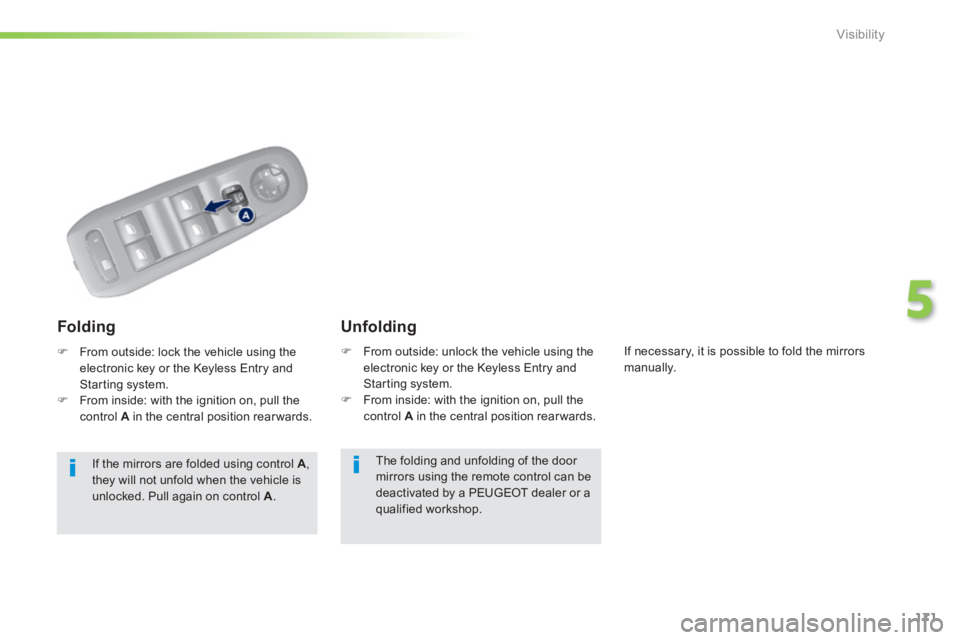
From outside: unlock the vehicle using the electronic key or the Keyless Entry and Starting system. From inside: with the ignition on, pull the control A in the central position rear wards.
Unfolding Folding
From outside: lock the vehicle using the electronic key or the Keyless Entry and Starting system. From inside: with the ignition on, pull the control A in the central position rear wards.
If the mirrors are folded using control A , they will not unfold when the vehicle is unlocked. Pull again on control A .
If necessary, it is possible to fold the mirrors manually.
Page 178 of 400
176
Visibility
308_EN_CHAP05_VISIBILITE_ED02-2013
In good or rainy weather, both day and night, the front foglamps and the
rear foglamps are prohibited. In these situations, the power of their beams may dazzle other drivers. They should only be used in fog or snow. In these weather conditions, it is your responsibility to switch on the foglamps and dipped headlamps manually as the sunshine sensor may detect sufficient light. Do not forget to switch off the front foglamps and the rear foglamps when they are no longer needed.
Lighting left on audible signal
An audible signal when a front door is opened warns the driver that the vehicle's exterior lighting is on, with the ignition off and in manual lighting mode. In this case, switching off the lighting stops the audible signal. With the ignition off, if the dipped headlamps remain on, the vehicle goes into "ECO" mode to avoid discharging the battery.
In some weather conditions (e.g. low temperature or humidity), the presence of misting on the internal sur face of the glass of the headlamps and rear lamps is normal; it disappears after the lamps have been on for a few minutes.
The lighting goes off when you switch off the ignition, but you can always switch it on again using the lighting control stalk.