warning light PEUGEOT 308 2014 User Guide
[x] Cancel search | Manufacturer: PEUGEOT, Model Year: 2014, Model line: 308, Model: Peugeot 308 2014Pages: 389, PDF Size: 22.92 MB
Page 141 of 389
8
Safety139
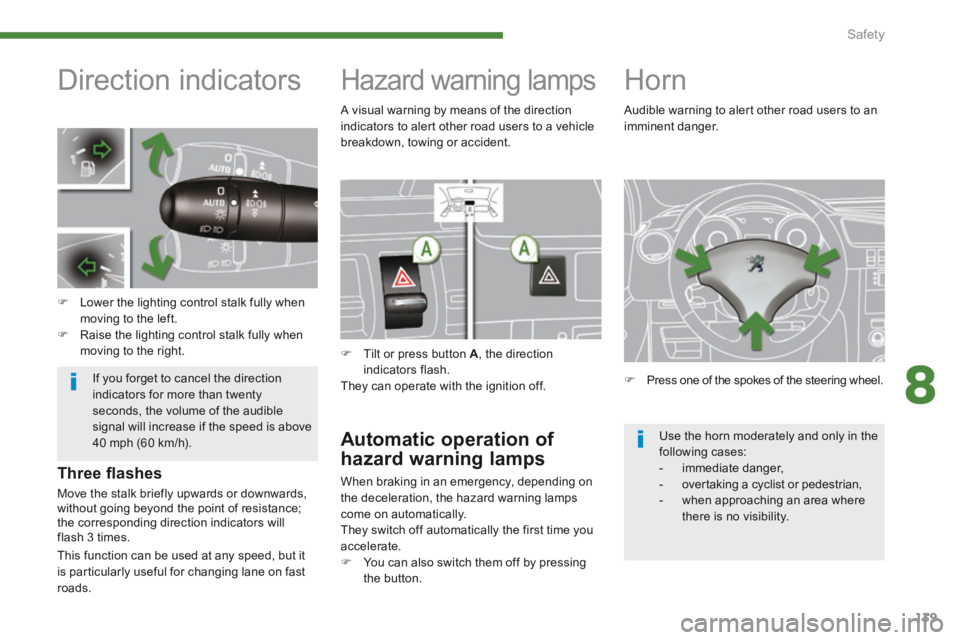
Direction indicators
Lower the lighting control stalk fully when moving to the left. Raise the lighting control stalk fully when moving to the right.
Hazard warning lamps
Tilt or press button A , the direction indicators flash. They can operate with the ignition off.
Automatic operation of
hazard warning lamps
When braking in an emergency, depending on the deceleration, the hazard warning lamps come on automatically. They switch off automatically the first time you
accelerate. You can also switch them off by pressing the button.
Horn
Press one of the spokes of the steering wheel.
Audible warning to alert other road users to an imminent danger.
Three fl ashes
Move the stalk briefly upwards or downwards, without going beyond the point of resistance; the corresponding direction indicators will flash 3 times.
If you forget to cancel the direction indicators for more than twenty seconds, the volume of the audible signal will increase if the speed is above 40 mph (60 km/h).
A visual warning by means of the direction indicators to alert other road users to a vehicle breakdown, towing or accident.
Use the horn moderately and only in the following cases: - immediate danger, - overtaking a cyclist or pedestrian, - when approaching an area where there is no visibility.
This function can be used at any speed, but it is particularly useful for changing lane on fast roads.
Page 145 of 389
8
Safety143
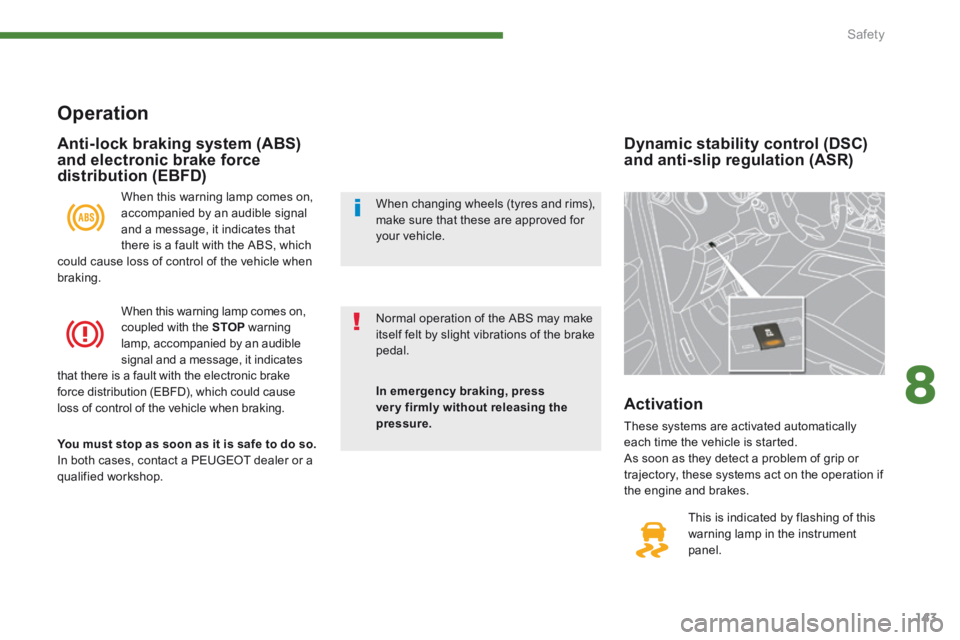
Dynamic stability control (DSC) and anti-slip regulation (ASR)
This is indicated by flashing of this warning lamp in the instrument panel.
Activation
These systems are activated automatically
each time the vehicle is started. As soon as they detect a problem of grip or trajectory, these systems act on the operation if the engine and brakes.
Operation
When this warning lamp comes on, accompanied by an audible signal and a message, it indicates that there is a fault with the ABS, which could cause loss of control of the vehicle when braking.
When this warning lamp comes on, coupled with the STOP warning lamp, accompanied by an audible signal and a message, it indicates that there is a fault with the electronic brake force distribution (EBFD), which could cause loss of control of the vehicle when braking.
You must stop as soon as it is safe to do so. In both cases, contact a PEUGEOT dealer or a qualified workshop.
Anti-lock braking system (ABS) and electronic brake force distribution (EBFD)
In emergency braking, press very firmly without releasing the pressure.
Normal operation of the ABS may make itself felt by slight vibrations of the brake pedal.
When changing wheels (tyres and rims), make sure that these are approved for your vehicle.
Page 151 of 389
8
Safety149
The driver must ensure that passengers use the seat belts correctly and that they are all restrained securely before setting off. Wherever you are seated in the vehicle, always fasten your seat belt, even for short journeys. Do not interchange the seat belt buckles as they will not fulfil their role fully. The seat belts are fitted with an inertia reel permitting automatic adjustment of the length of the strap to your size. The seat belt is stowed automatically when not in use. Before and after use, ensure that the seat belt is reeled in correctly. The lower part of the strap must be positioned as low as possible on the pelvis. The upper part must be positioned in the hollow of the shoulder. The inertia reels are fitted with an automatic locking device which comes into operation in the event of a collision, emergency braking or if the vehicle rolls over. You can release the device by pulling firmly on the strap and releasing it so that it reels in slightly.
In order to be effective, a seat belt must: - be tightened as close to the body as possible, - be pulled in front of you with a smooth movement, checking that it does not twist, - be used to restrain only one person, - not bear any trace of cuts or fraying, - not be converted or modified to avoid affecting its performance.
In the event of an impact
Depending on the nature and seriousness of the impact , the pretensioning device may be deployed before and independently of the airbags. Deployment of the pretensioners is accompanied by a slight discharge of harmless smoke and a noise, due to the activation of the pyrotechnic cartridge incorporated in the system. In all cases, the airbag warning lamp comes on. Following an impact, have the seat belts system checked, and if necessary replaced, by a PEUGEOT dealer or a qualified workshop.
Recommendations for children
Use a suitable child seat if the passenger is less than 12 years old or shorter than one and a half metres. Never use the same seat belt to secure more than one person. Never allow a child to travel on your lap.
In accordance with current safety regulations, for all repairs on your vehicle, go to a qualified workshop with the skills and equipment needed, which a PEUGEOT dealer is able to provide. Have your seat belts checked regularly by a PEUGEOT dealer or a qualified workshop, particularly if the straps show signs of damage.
Clean the seat belt straps with soapy water or a textile cleaning product, sold by PEUGEOT dealers. After folding or moving a seat or rear bench seat, ensure that the seat belt is positioned and reeled in correctly.
Page 184 of 389
182Driving
Stopping the vehicle
Before switching off the engine, you can engage position P or N to place the gearbox in neutral. In both cases, apply the parking brake to immobilise the vehicle, unless it is programmed to automatic mode.
Operating fault
When the ignition is on, the lighting of this warning lamp, accompanied by an audible signal and a message in the multifunction screen, indicates a gearbox malfunction. In this case, the gearbox switches to back-up mode and is locked in 3rd gear. You may feel a substantial knock when changing from Pto R and from N to R . This will not cause any damage to the gearbox. Do not exceed 60 mph (100 km/h), local speed restrictions permitting. Have it checked by a PEUGEOT dealer or a qualified workshop. This warning lamp may also come on if a door is opened.
Invalid value during manual operation
This symbol is displayed if a gear is not engaged correctly (selector between two positions).
You risk damaging the gearbox: - if you press the accelerator and brake pedals at the same time, - if you force the lever from position Pto another position when the battery is flat. To reduce fuel consumption when stationary for long periods with the engine running (traffic jam...), position the gear lever at N and apply the parking brake, unless it is programmed in automatic mode.
If the lever is not in position P , when the P , when the Pdriver's door is opened or approximately 45 seconds after the ignition is switched off, there is an audible signal and a message appears. Return the lever to position P ; the audible signal stops and the message disappears.
Page 185 of 389
9
183
Driving
The Stop & Start system puts the engine temporarily into standby - STOP mode - during stops in the traffic (red lights, traffic jams, or other...). The engine restarts automatically - START mode - as soon as you want to move off. The restart takes place instantly, quickly and silently. Per fect for urban use, the Stop & Start system reduces fuel consumption and exhaust emissions as well as the noise level when stationary.
Operation
Going into engine STOP mode
The "ECO" warning lamp comes on in the instrument panel and the engine goes into standby:
- with an electronic gearbox , at speeds below 4 mph (6 km/h), press the brake pedal or put the gear lever in position N .
If your vehicle is fitted with the system, a time counter calculates the sum of the periods in STOP mode during a journey. It rests itself to zero every time the ignition is switched on with the key.
Special cases: STOP mode not available
STOP mode is not invoked when: - the driver's door is open, - the driver's seat belt is not fastened, - the vehicle has not exceeded 6 mph (10 km/h) since the last engine start using
the key, - the electric parking brake is applied or being applied, - the engine is needed to maintain a comfortable temperature in the passenger compartment, - demisting is active, - some special conditions (battery charge, engine temperature, braking assistance, ambient temperature...) where the engine is needed to assure control of a system.
In this case, the "ECO" warning lamp flashes for a few seconds then goes off.
This operation is perfectly normal.
Never refuel with the engine in STOP mode; you must switch off the ignition with the key.
For your comfort, during parking maoeuvres, STOP mode is not available for a few seconds after coming out of reverse gear. STOP mode does not affect the functionality of the vehicle, such as for example, braking, power steering...
Stop & Start
Page 238 of 389
Practical information
236
Side wind
Take into account the increased sensitivity to side wind.
Cooling
Towing a trailer on a slope increases the temperature of the coolant. As the fan is electrically controlled, its cooling capacity is not dependent on the engine speed. To lower the engine speed, reduce your speed. The maximum towed load on a long incline depends on the gradient and the ambient temperature. In all cases, keep a check on the coolant temperature.
Braking
Towing a trailer increases the braking distance. To avoid overheating of the brakes on a long
mountain type of descent, the use of engine braking is recommended.
Ty r e s
Check the tyre pressures of the towing vehicle and of the trailer, observing the recommended pressures.
Lighting
Check the electrical lighting and signalling on the trailer.
If the warning lamp and the STOP warning lamp come on, stop the vehicle and switch off the engine as soon as possible.
The rear parking sensors will be deactivated automatically if a genuine PEUGEOT towbar is used.
Page 244 of 389
Technical data
242
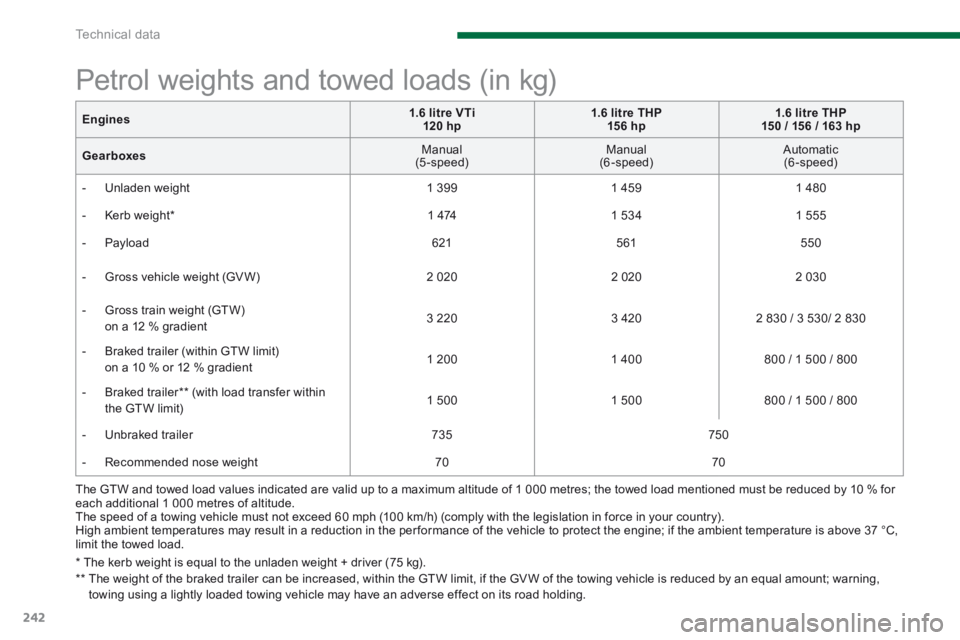
The GTW and towed load values indicated are valid up to a maximum altitude of 1 000 metres; the towed load mentioned must be reduced by 10 % for each additional 1 000 metres of altitude. The speed of a towing vehicle must not exceed 60 mph (100 km/h) (comply with the legislation in force in your country). High ambient temperatures may result in a reduction in the per formance of the vehicle to protect the engine; if the ambient temperature is above 37 °C, limit the towed load.
Petrol weights and towed loads (in kg)
* The kerb weight is equal to the unladen weight + driver (75 kg). ** The weight of the braked trailer can be increased, within the GTW limit, if the GV W of the towing vehicle is reduced by an equal amount; warning, towing using a lightly loaded towing vehicle may have an adverse effect on its road holding.
Engines1.6 litre VTi 120 hp1.6 litre THP 15 6 hp1.6 litre THP 150 / 156 / 163 hp
Gearboxes Manual (5-speed) Manual (6-speed) Automatic (6-speed)
- Unladen weight 1 3 9 9 1 4 5 9 1 480
- Kerb weight * 1 474 1 534 1 555
- Payload 621 561 550
- Gross vehicle weight (GV W) 2 020 2 020 2 030
- Gross train weight (GTW) on a 12 % gradient 3 220 3 420 2 830 / 3 530/ 2 830
- Braked trailer (within GTW limit) on a 10 % or 12 % gradient 1 200 1 400 800 / 1 500 / 800
- Braked trailer ** (with load transfer within the GTW limit) 1 500 1 500 800 / 1 500 / 800
- Unbraked trailer 735 750
- Recommended nose weight 70 70
Page 246 of 389
Technical data
244
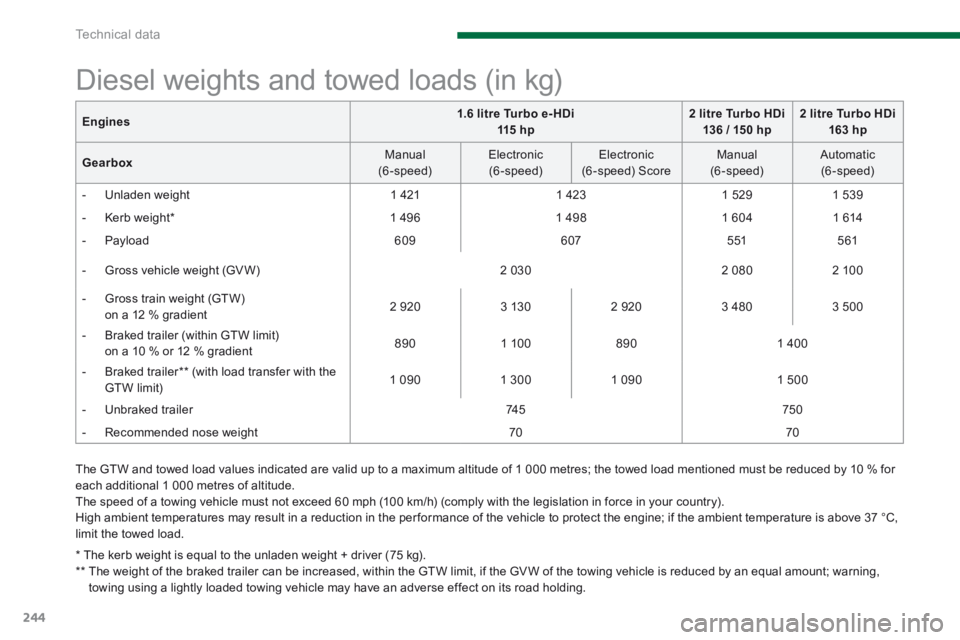
The GTW and towed load values indicated are valid up to a maximum altitude of 1 000 metres; the towed load mentioned must be reduced by 10 % for each additional 1 000 metres of altitude. The speed of a towing vehicle must not exceed 60 mph (100 km/h) (comply with the legislation in force in your country). High ambient temperatures may result in a reduction in the per formance of the vehicle to protect the engine; if the ambient temperature is above 37 °C,
limit the towed load.
Diesel weights and towed loads (in kg)
* The kerb weight is equal to the unladen weight + driver (75 kg). ** The weight of the braked trailer can be increased, within the GTW limit, if the GV W of the towing vehicle is reduced by an equal amount; warning, towing using a lightly loaded towing vehicle may have an adverse effect on its road holding.
Engines1.6 litre Turbo e- HDi 115 h p2 litre Turbo HDi 136 / 150 hp2 litre Turbo HDi 163 hp
Gearbox Manual (6-speed) Electronic (6-speed) Electronic (6 -speed) Score Manual (6-speed) Automatic (6-speed)
- Unladen weight 1 421 1 423 1 5 2 9 1 5 3 9
- Kerb weight * 1 4 9 6 1 4 9 8 1 604 1 614
- Payload 6 0 9 607 5 51 561
- Gross vehicle weight (GV W) 2 030 2 080 2 100
- Gross train weight (GTW) on a 12 % gradient 2 9 2 0 3 130 2 9 2 0 3 480 3 500
- Braked trailer (within GTW limit) on a 10 % or 12 % gradient 8 9 0 1 100 8 9 0 1 400
- Braked trailer ** (with load transfer with the GTW limit) 1 0 9 0 1 300 1 0 9 0 1 500
- Unbraked trailer 74 5 750
- Recommended nose weight 70 70
Page 247 of 389
12
Technical data245
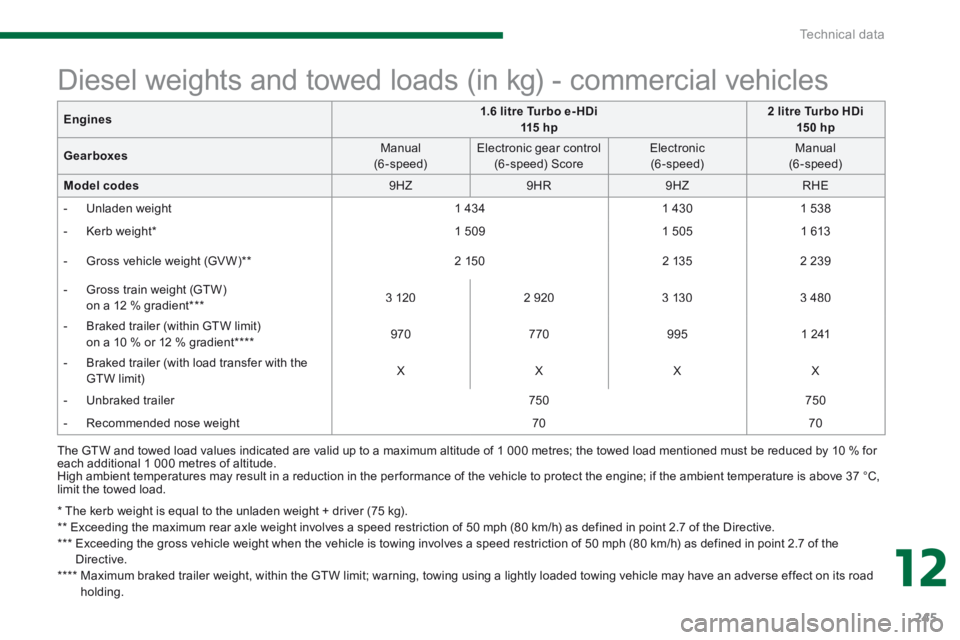
* The kerb weight is equal to the unladen weight + driver (75 kg). ** Exceeding the maximum rear axle weight involves a speed restriction of 50 mph (80 km/h) as defined in point 2.7 of the Directive. *** Exceeding the gross vehicle weight when the vehicle is towing involves a speed restriction of 50 mph (80 km/h) as defined in point 2.7 of the Directive. **** Maximum braked trailer weight, within the GTW limit; warning, towing using a lightly loaded towing vehicle may have an adverse effect on its road
holding.
Diesel weights and towed loads (in kg) - commercial vehicles
The GTW and towed load values indicated are valid up to a maximum altitude of 1 000 metres; the towed load mentioned must be reduced by 10 % for each additional 1 000 metres of altitude. High ambient temperatures may result in a reduction in the per formance of the vehicle to protect the engine; if the ambient temperature is above 37 °C, limit the towed load.
Engines1.6 litre Turbo e- HDi 115 h p2 litre Turbo HDi 15 0 hp
Gearboxes Manual (6-speed) Electronic gear control (6 -speed) Score Electronic (6-speed) Manual (6-speed)
Model codes 9 H Z 9 H R 9 H Z RHE
- Unladen weight 1 434 1 430 1 538
- Kerb weight * 1 5 0 9 1 505 1 613
- Gross vehicle weight (GV W) ** 2 150 2 135 2 2 3 9
- Gross train weight (GTW) on a 12 % gradient *** 3 120 2 9 2 0 3 130 3 480
- Braked trailer (within GTW limit) on a 10 % or 12 % gradient **** 9 7 0 770 9 9 5 1 241
- Braked trailer (with load transfer with the GTW limit) X X X X
- Unbraked trailer 750 750
- Recommended nose weight 70 70
Page 374 of 389
Alphabetical index
372
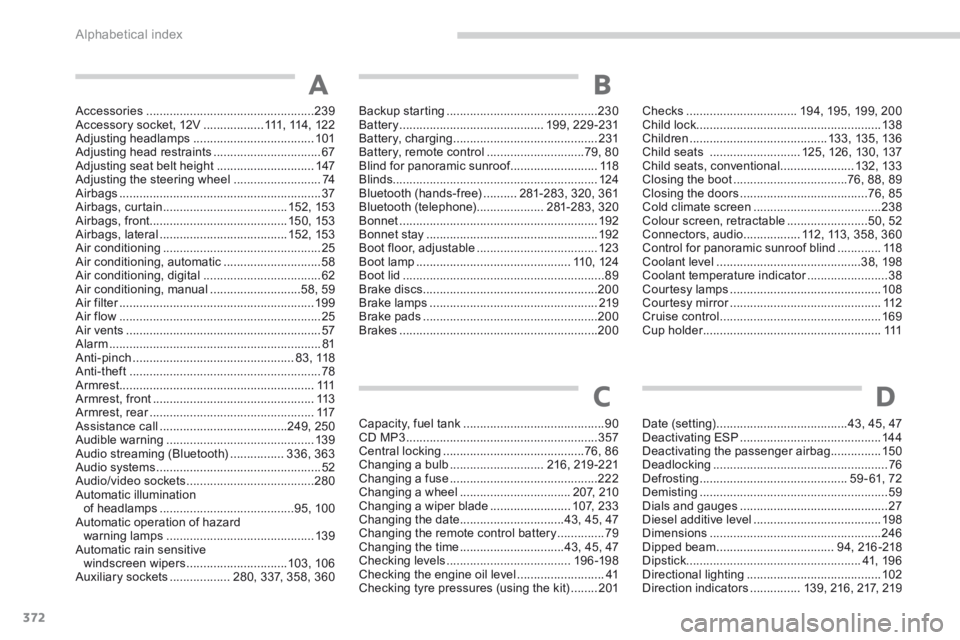
Accessories ..................................................239Accessory socket, 12V ..................111, 114 , 12 2Adjusting headlamps ....................................101Adjusting head restraints ................................67Adjusting seat belt height .............................147Adjusting the steering wheel ..........................74Airbags ............................................................37Airbags, curtain .....................................152, 153Airbags, front.........................................150, 153Airbags, lateral ......................................152, 153Air conditioning ...............................................25Air conditioning, automatic .............................58Air conditioning, digital ...................................62Air conditioning, manual ...........................58, 59Air filter ..........................................................Air filter ..........................................................Air filter19 9Air flow ............................................................25Air vents ..........................................................57Alarm ...............................................................81Anti-pinch ................................................8 3 , 118Anti-theft .........................................................78Armrest ..........................................................111Armrest, front ................................................113Armrest, rear .................................................Armrest, rear .................................................Armrest, rear117Assistance call ......................................249, 250Audible warning ............................................13 9Audio streaming (Bluetooth) ................336, 363Audio systems .................................................52Audio/video sockets ......................................280Automatic illumination of headlamps ........................................95, 100Automatic operation of hazard warning lamps ............................................13 9Automatic rain sensitive windscreen wipers ..............................103, 10 6Auxiliary sockets ..................280, 337, 358, 360
Backup starting .............................................230Battery ...........................................199, 229 -231Battery, charging ...........................................231Battery, remote control .............................79, 80Blind for panoramic sunroof ..........................Blind for panoramic sunroof ..........................Blind for panoramic sunroof118Blinds.............................................................124Bluetooth (hands-free) ..........281-283, 320, 361Bluetooth (telephone) ....................281-283, 320Bonnet ...........................................................192Bonnet stay ...................................................192Boot floor, adjustable ....................................123Boot lamp ..............................................11 0 , 12 4Boot lid ............................................................89Brake discs ....................................................200Brake lamps ..................................................219Brake pads ....................................................200Brakes ...........................................................200
A
Checks .................................194, 195, 199, 200Child lock .......................................................13 8Children .........................................13 3, 13 5, 13 6Child seats ...........................125, 126, 130, 137Child seats, conventional ......................132, 13 3Closing the boot ..................................76, 88, 89Closing the doors ......................................76, 85Cold climate screen ......................................238Colour screen, retractable ........................50, 52Connectors, audio .................112, 113, 358, 360Control for panoramic sunroof blind .............118Coolant level ...........................................38, 198Coolant temperature indicator ........................Coolant temperature indicator ........................Coolant temperature indicator38Courtesy lamps .............................................108Courtesy mirror .............................................Courtesy mirror .............................................Courtesy mirror112Cruise control ................................................169Cup holder .....................................................Cup holder .....................................................Cup holder111
Capacity, fuel tank ..........................................90CD MP3 .........................................................357Central locking ..........................................76, 86Changing a bulb ............................216, 219 -221Changing a fuse ............................................222Changing a wheel .................................2 0 7, 2 1 0Changing a wiper blade ........................1 0 7, 2 3 3Changing the date ...............................43, 45, 47Changing the remote control battery ..............79Changing the time ...............................43, 45, 47Checking levels .....................................19 6 -198Checking the engine oil level ..........................41Checking tyre pressures (using the kit) ........201
Date (setting) .......................................43, 45, 47Deactivating ESP ..........................................14 4Deactivating the passenger airbag ...............150Deadlocking ....................................................76Defrosting ............................................59 - 61, 72Demisting ........................................................59Dials and gauges ............................................27Diesel additive level ......................................198Dimensions ...................................................246Dipped beam ...................................94, 216 -218Dipstick ....................................................41, 196Directional lighting ........................................102Direction indicators ...............139, 216, 217, 219
CD
B