brake PEUGEOT 308 2014 Owner's Manual
[x] Cancel search | Manufacturer: PEUGEOT, Model Year: 2014, Model line: 308, Model: Peugeot 308 2014Pages: 389, PDF Size: 22.92 MB
Page 158 of 389
156Driving
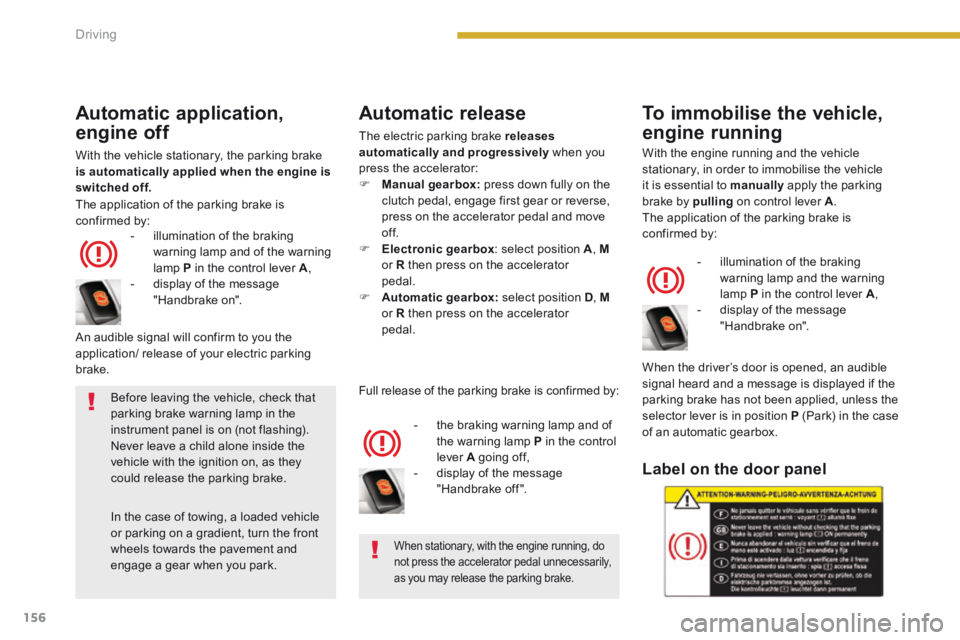
Automatic application,
engine off
With the vehicle stationary, the parking brake is automatically applied when the engine is switched off.
- illumination of the braking warning lamp and of the warning lamp P in the control lever A ,
Automatic release
The electric parking brake releases automatically and progressively when you press the accelerator: Manual gearbox: press down fully on the clutch pedal, engage first gear or reverse, press on the accelerator pedal and move of f. Electronic gearbox : select position A , Mor R then press on the accelerator pedal. Automatic gearbox: select position D , Mor R then press on the accelerator pedal.
- the braking warning lamp and of the warning lamp P in the control lever A going off,
An audible signal will confirm to you the application/ release of your electric parking brake.
Full release of the parking brake is confirmed by:
To immobilise the vehicle,
engine running
With the engine running and the vehicle stationary, in order to immobilise the vehicle it is essential to manually apply the parking brake by pulling on control lever A . The application of the parking brake is
confirmed by:
- illumination of the braking warning lamp and the warning lamp P in the control lever A ,
When the driver’s door is opened, an audible signal heard and a message is displayed if the parking brake has not been applied, unless the selector lever is in position P (Park) in the case of an automatic gearbox.
The application of the parking brake is confirmed by:
- display of the message "Handbrake on".
- display of the message "Handbrake off ".
- display of the message "Handbrake on".
Label on the door panel
Before leaving the vehicle, check that parking brake warning lamp in the
instrument panel is on (not flashing). Never leave a child alone inside the vehicle with the ignition on, as they could release the parking brake.
In the case of towing, a loaded vehicle or parking on a gradient, turn the front wheels towards the pavement and engage a gear when you park.
When stationary, with the engine running, do not press the accelerator pedal unnecessarily, as you may release the parking brake.
Page 159 of 389
9
157
Driving
Emergency braking
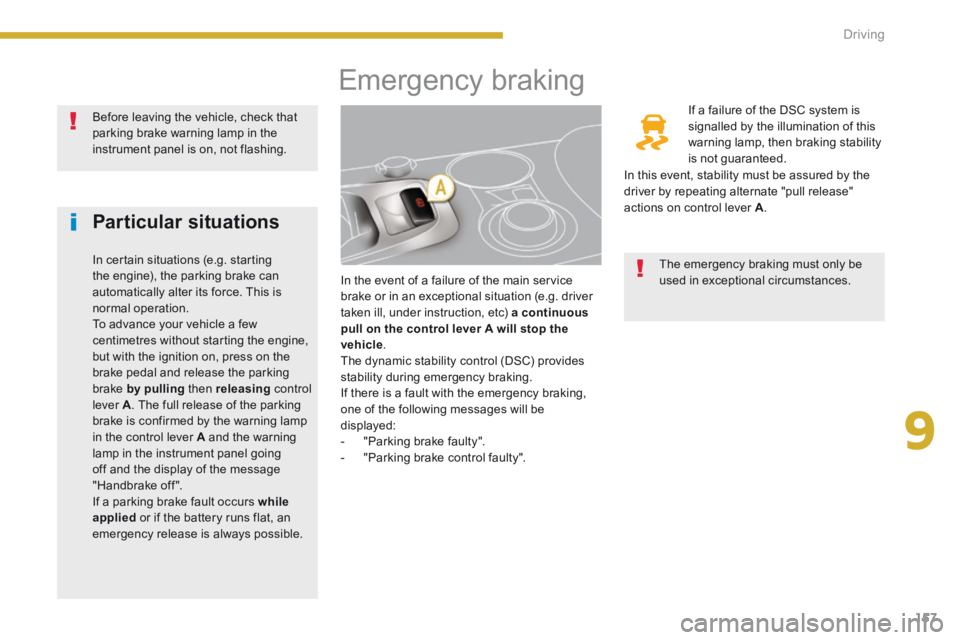
In the event of a failure of the main service brake or in an exceptional situation (e.g. driver taken ill, under instruction, etc) a continuous pull on the control lever on the control lever on the control leverA will stop the vehicle . The dynamic stability control (DSC) provides stability during emergency braking. If there is a fault with the emergency braking, one of the following messages will be displayed: - "Parking brake faulty". - "Parking brake control faulty".
If a failure of the DSC system is signalled by the illumination of this warning lamp, then braking stability is not guaranteed.
The emergency braking must only be used in exceptional circumstances.
Particular situations
In certain situations (e.g. starting the engine), the parking brake can automatically alter its force. This is normal operation. To advance your vehicle a few centimetres without starting the engine, but with the ignition on, press on the brake pedal and release the parking brake by pulling then releasing control lever A . The full release of the parking brake is confirmed by the warning lamp in the control lever A and the warning lamp in the instrument panel going off and the display of the message "Handbrake off ". If a parking brake fault occurs while applied or if the battery runs flat, an emergency release is always possible.
Before leaving the vehicle, check that parking brake warning lamp in the instrument panel is on, not flashing.
In this event, stability must be assured by the driver by repeating alternate "pull release" actions on control lever A .
Page 160 of 389
158Driving
Hill start assist
Operation
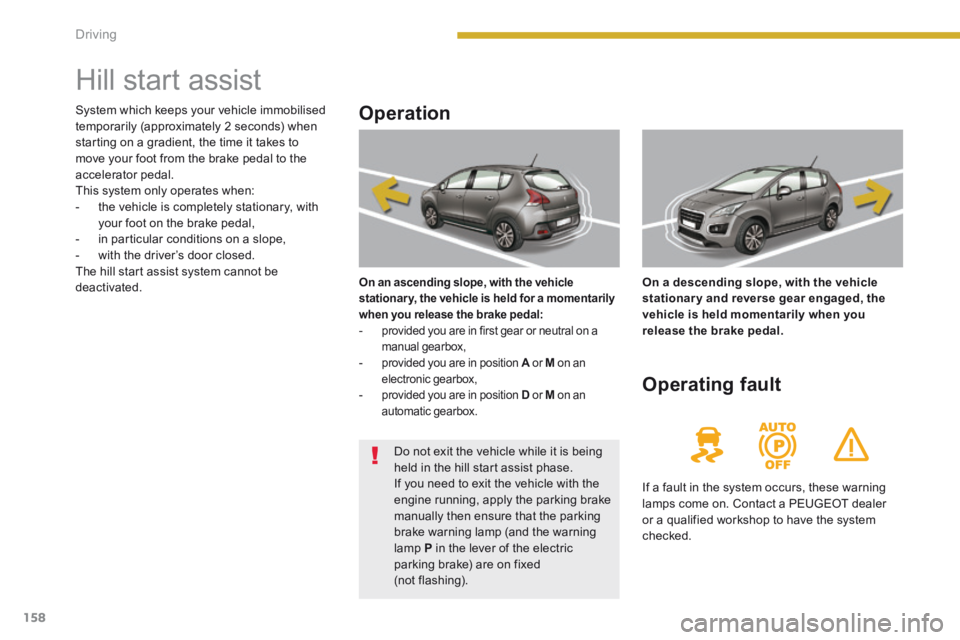
On an ascending slope, with the vehicle stationary, the vehicle is held for a momentarily when you release the brake pedal: - provided you are in first gear or neutral on a manual gearbox, - provided you are in position A or A or AM on an electronic gearbox, - provided you are in position D or M on an automatic gearbox.
On a descending slope, with the vehicle stationary and reverse gear engaged, the vehicle is held momentarily when you release the brake pedal.
Operating fault
If a fault in the system occurs, these warning lamps come on. Contact a PEUGEOT dealer or a qualified workshop to have the system checked.
System which keeps your vehicle immobilised temporarily (approximately 2 seconds) when starting on a gradient, the time it takes to move your foot from the brake pedal to the accelerator pedal. This system only operates when: - the vehicle is completely stationary, with your foot on the brake pedal, - in particular conditions on a slope, - with the driver’s door closed. The hill start assist system cannot be deactivated.
Do not exit the vehicle while it is being held in the hill start assist phase. If you need to exit the vehicle with the engine running, apply the parking brake manually then ensure that the parking brake warning lamp (and the warning lamp P in the lever of the electric parking brake) are on fixed (not flashing).
Page 161 of 389
9
159
Driving
Operating faults
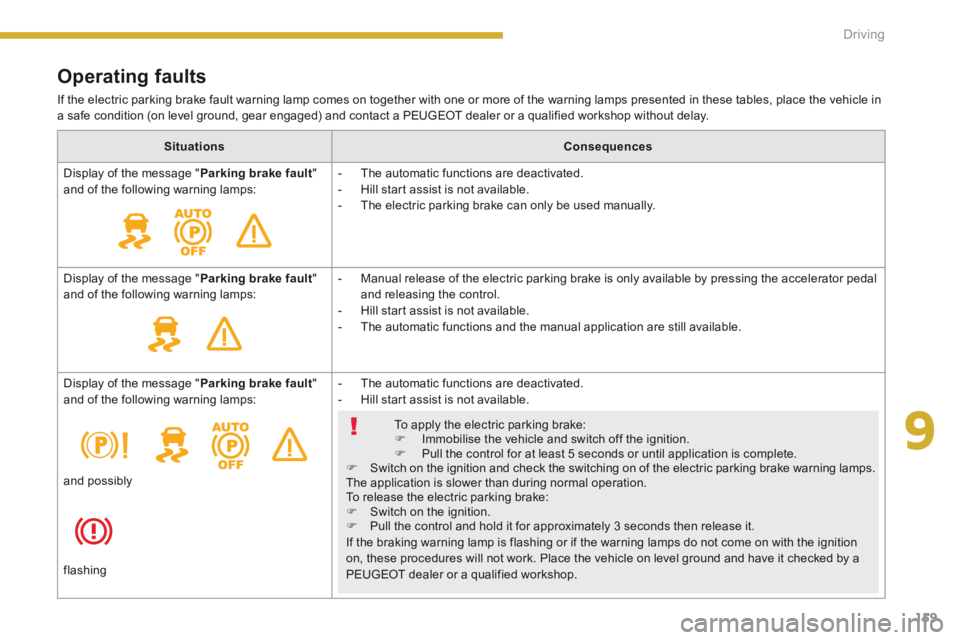
If the electric parking brake fault warning lamp comes on together with one or more of the warning lamps presented in these tables, place the vehicle in a safe condition (on level ground, gear engaged) and contact a PEUGEOT dealer or a qualified workshop without delay.
SituationsConsequences
Display of the message " Parking brake fault " and of the following warning lamps: - The automatic functions are deactivated. - Hill start assist is not available. - The electric parking brake can only be used manually.
Display of the message " Parking brake fault " and of the following warning lamps: - Manual release of the electric parking brake is only available by pressing the accelerator pedal and releasing the control. - Hill start assist is not available. - The automatic functions and the manual application are still available.
Display of the message " Parking brake fault " and of the following warning lamps: - The automatic functions are deactivated. - Hill start assist is not available.
To apply the electric parking brake: Immobilise the vehicle and switch off the ignition. Pull the control for at least 5 seconds or until application is complete. Switch on the ignition and check the switching on of the electric parking brake warning lamps. The application is slower than during normal operation. To release the electric parking brake: Switch on the ignition. Pull the control and hold it for approximately 3 seconds then release it. If the braking warning lamp is flashing or if the warning lamps do not come on with the ignition on, these procedures will not work. Place the vehicle on level ground and have it checked by a PEUGEOT dealer or a qualified workshop.
and possibly
flashing
Page 162 of 389
160Driving
SituationsConsequences
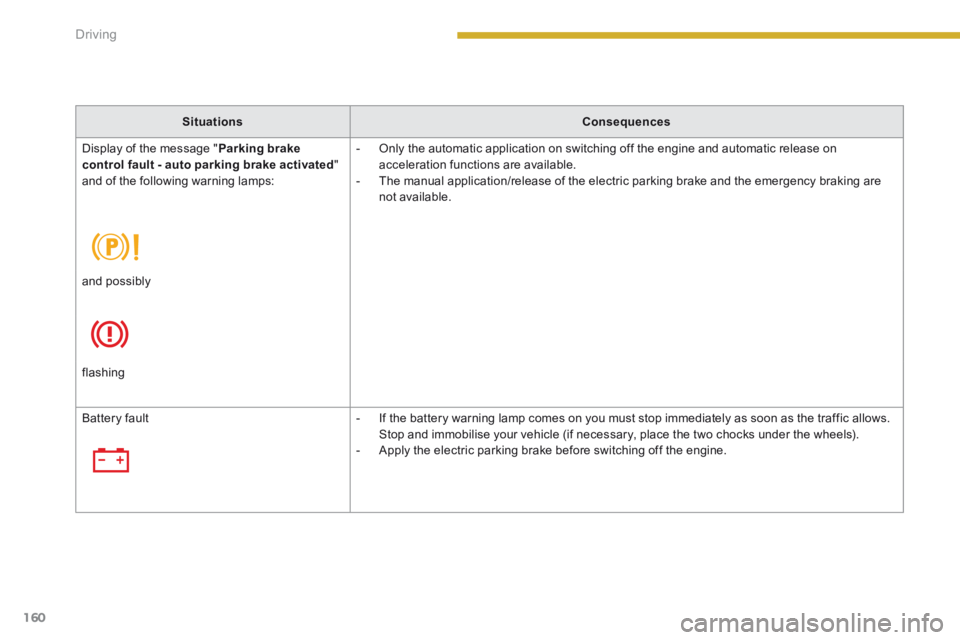
Display of the message " Parking brake control fault - auto parking brake activated " and of the following warning lamps:
- Only the automatic application on switching off the engine and automatic release on acceleration functions are available. - The manual application/release of the electric parking brake and the emergency braking are not available.
and possibly
flashing
Battery fault - If the battery warning lamp comes on you must stop immediately as soon as the traffic allows. Stop and immobilise your vehicle (if necessary, place the two chocks under the wheels). - Apply the electric parking brake before switching off the engine.
Page 171 of 389
9
169
Driving
Cruise control
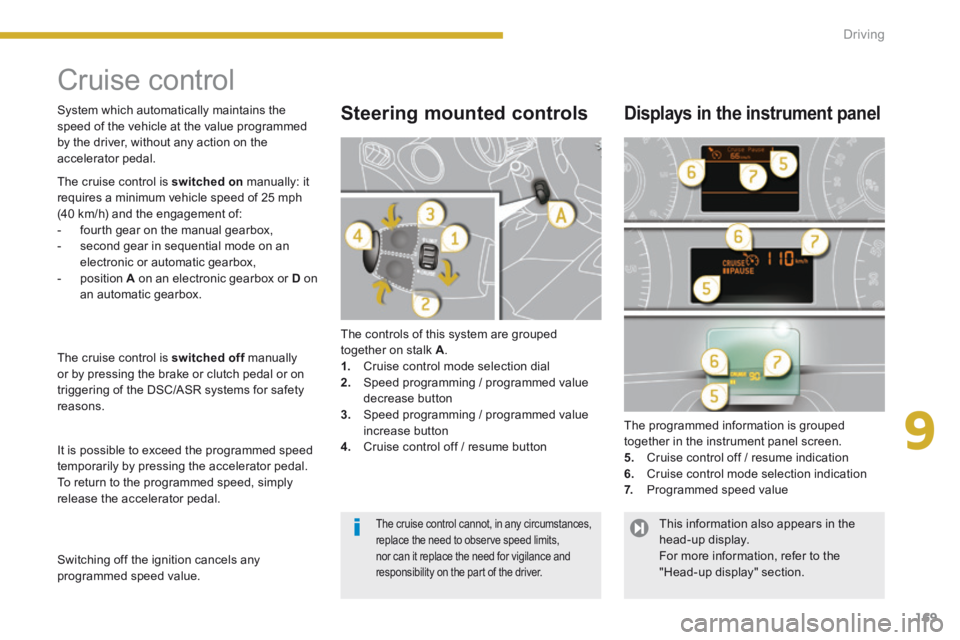
The controls of this system are grouped together on stalk A . 1. Cruise control mode selection dial 2. Speed programming / programmed value decrease button 3. Speed programming / programmed value
increase button 4. Cruise control off / resume button
The programmed information is grouped together in the instrument panel screen. 5. Cruise control off / resume indication 6. Cruise control mode selection indication 7. Programmed speed value
Steering mounted controls Displays in the instrument panel
The cruise control is switched on manually: it requires a minimum vehicle speed of 25 mph (40 km/h) and the engagement of: - fourth gear on the manual gearbox, - second gear in sequential mode on an electronic or automatic gearbox, - position A on an electronic gearbox or D on an automatic gearbox.
The cruise control is switched off manually switched off manually switched offor by pressing the brake or clutch pedal or on triggering of the DSC/ASR systems for safety reasons.
It is possible to exceed the programmed speed temporarily by pressing the accelerator pedal. To return to the programmed speed, simply release the accelerator pedal.
System which automatically maintains the speed of the vehicle at the value programmed by the driver, without any action on the accelerator pedal.
Switching off the ignition cancels any programmed speed value.
The cruise control cannot, in any circumstances, replace the need to observe speed limits, nor can it replace the need for vigilance and responsibility on the part of the driver.
This information also appears in the head-up display. For more information, refer to the "Head-up display" section.
Page 176 of 389
174Driving
Electronic gearbox
Gear lever
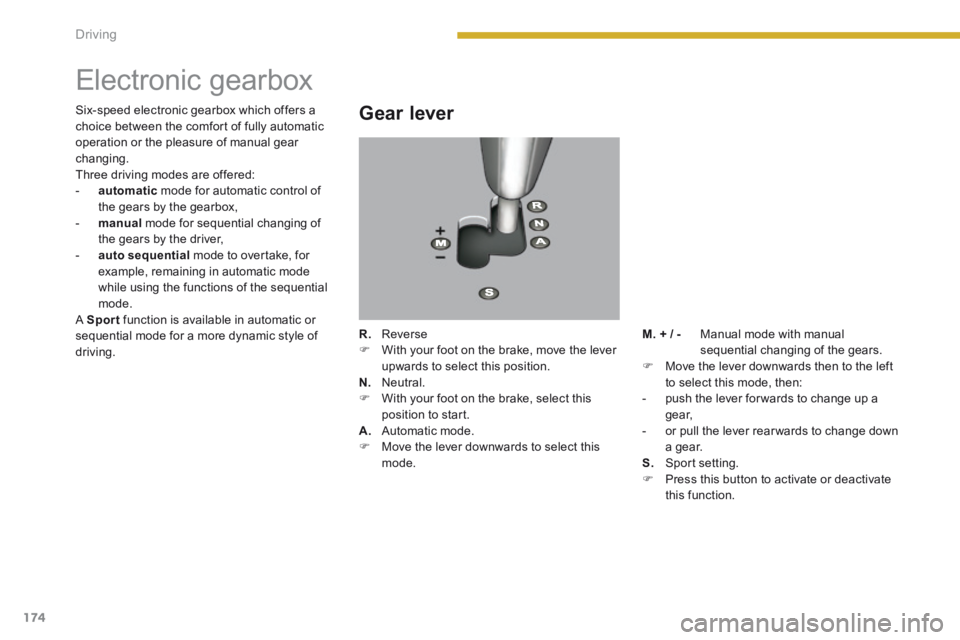
R. Reverse With your foot on the brake, move the lever upwards to select this position. N. Neutral. With your foot on the brake, select this position to start.
A. Automatic mode. Move the lever downwards to select this mode.
Six-speed electronic gearbox which offers a choice between the comfort of fully automatic operation or the pleasure of manual gear changing. Three driving modes are offered: - automatic mode for automatic control of the gears by the gearbox, - manual mode for sequential changing of the gears by the driver, - auto sequential mode to overtake, for example, remaining in automatic mode while using the functions of the sequential mode. A Sport function is available in automatic or sequential mode for a more dynamic style of driving.
M. + / - Manual mode with manual sequential changing of the gears. Move the lever downwards then to the left to select this mode, then: - push the lever for wards to change up a g e a r,
- or pull the lever rear wards to change down a gear. S. Sport setting. Press this button to activate or deactivate this function.
Page 177 of 389
9
175
Driving
Steering mounted controls
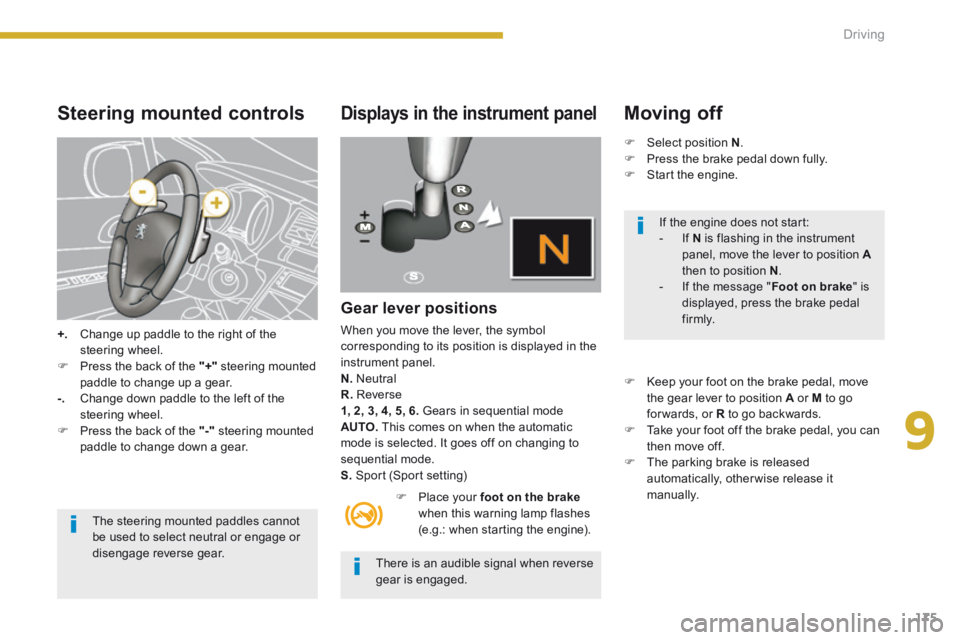
+. Change up paddle to the right of the steering wheel. Press the back of the "+" steering mounted paddle to change up a gear. -. Change down paddle to the left of the steering wheel.
Press the back of the "-" steering mounted paddle to change down a gear.
The steering mounted paddles cannot be used to select neutral or engage or disengage reverse gear.
Displays in the instrument panel
Gear lever positions
When you move the lever, the symbol corresponding to its position is displayed in the instrument panel. N. Neutral R. Reverse 1, 2, 3, 4, 5, 6. Gears in sequential mode AUTO. This comes on when the automatic mode is selected. It goes off on changing to sequential mode. S. Sport (Sport setting)
Place your foot on the brakewhen this warning lamp flashes (e.g.: when starting the engine).
There is an audible signal when reverse gear is engaged.
Moving off
Select position N . Press the brake pedal down fully. Start the engine.
Keep your foot on the brake pedal, move the gear lever to position A or M to go for wards, or R to go backwards. Take your foot off the brake pedal, you can then move off. The parking brake is released automatically, otherwise release it manually.
If the engine does not start: - If N is flashing in the instrument panel, move the lever to position Athen to position N . - If the message " Foot on brake " is displayed, press the brake pedal f i r m l y.
Page 178 of 389
176Driving
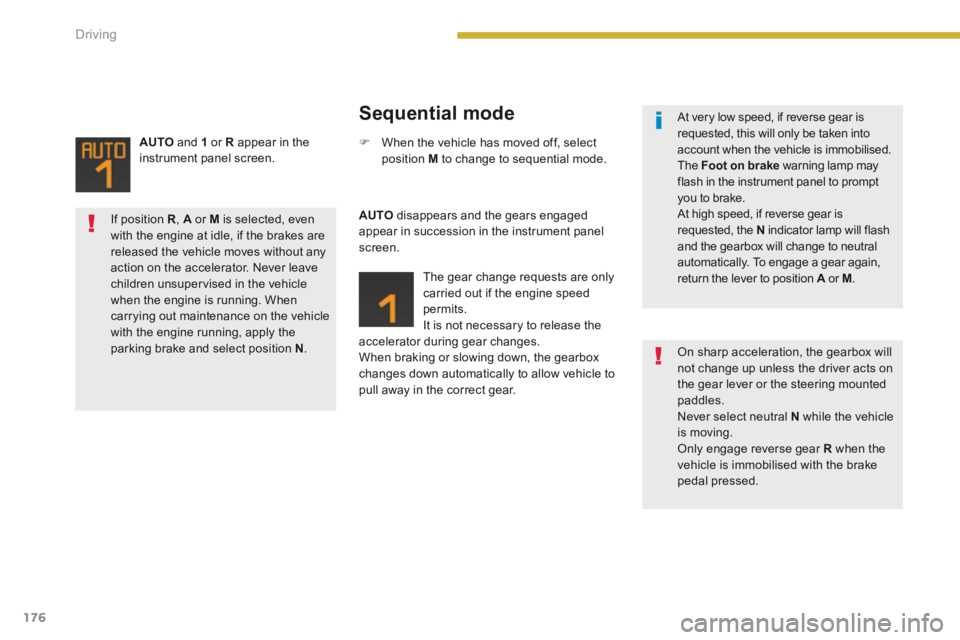
AUTO and 1 or R appear in the instrument panel screen.
Sequential mode
AUTO disappears and the gears engaged
appear in succession in the instrument panel screen.
The gear change requests are only carried out if the engine speed permits. It is not necessary to release the accelerator during gear changes. When braking or slowing down, the gearbox changes down automatically to allow vehicle to pull away in the correct gear.
When the vehicle has moved off, select position M to change to sequential mode.
If position R , A or M is selected, even
with the engine at idle, if the brakes are released the vehicle moves without any action on the accelerator. Never leave children unsupervised in the vehicle when the engine is running. When carrying out maintenance on the vehicle with the engine running, apply the parking brake and select position N . On sharp acceleration, the gearbox will not change up unless the driver acts on the gear lever or the steering mounted paddles. Never select neutral N while the vehicle is moving. Only engage reverse gear R when the vehicle is immobilised with the brake pedal pressed.
At very low speed, if reverse gear is requested, this will only be taken into account when the vehicle is immobilised. The Foot on brake warning lamp may flash in the instrument panel to prompt you to brake. At high speed, if reverse gear is requested, the N indicator lamp will flash and the gearbox will change to neutral automatically. To engage a gear again, return the lever to position A or A or AM .
Page 180 of 389
178Driving
Stopping the vehicle Operating fault
With the ignition on, if this warning lamp comes on and AUTO flashes, accompanied by an audible signal and a message in the screen, this indicates a fault with the gearbox.
Have it checked by a PEUGEOT dealer or a qualified workshop.
Before switching off the engine, you can choose to: - move to position N to engage neutral, - leave the gear engaged; in this case, it will not be possible to move the vehicle.
In both cases, it is essential that you apply the parking brake to immobilise the vehicle.
When immobilising the vehicle, with the engine running, it is essential to place the gear lever in neutral N . Before carrying out any work in the engine compartment, check that the gear lever is in neutral N and that the parking brake is applied.
It is essential to press the brake pedal when starting the engine. When parking, is it essential to apply the parking brake to immobilise the vehicle, whatever the circumstances.