brake PEUGEOT 308 2014 Service Manual
[x] Cancel search | Manufacturer: PEUGEOT, Model Year: 2014, Model line: 308, Model: Peugeot 308 2014Pages: 389, PDF Size: 22.92 MB
Page 217 of 389
11
Practical information215
Snow chains
In wintry conditions, snow chains improve traction as well as the behaviour of the vehicle when braking.
The snow chains must be fitted only to the front wheels. They must never be fitted to "space-saver" type spare wheels.
Take account of the legislation in force in your country on the use of snow chains and the maximum running speed authorised.
Advice on installation
If you have to fit the chains during a journey, stop the vehicle on a flat sur face on the side of the road. Apply the parking brake and position any wheel chocks to prevent movement of your vehicle. Fit the chains following the instructions provided by the manufacturer. Move off gently and drive for a few moments, without exceeding 30 mph (50 km/h). Stop your vehicle and check that the snow chains are correctly tightened.
Avoid driving on roads that have been
cleared of snow, to avoid damaging your vehicle's tyres and the road sur face. It is recommended that before you leave, you practise fitting the snow chains on a level and dry sur face. If your vehicle is fitted with alloy wheels, check that no part of the chain or its fixings is in contact with the wheel rim.
For more information on snow chains, contact a PEUGEOT dealer or a qualified workshop.
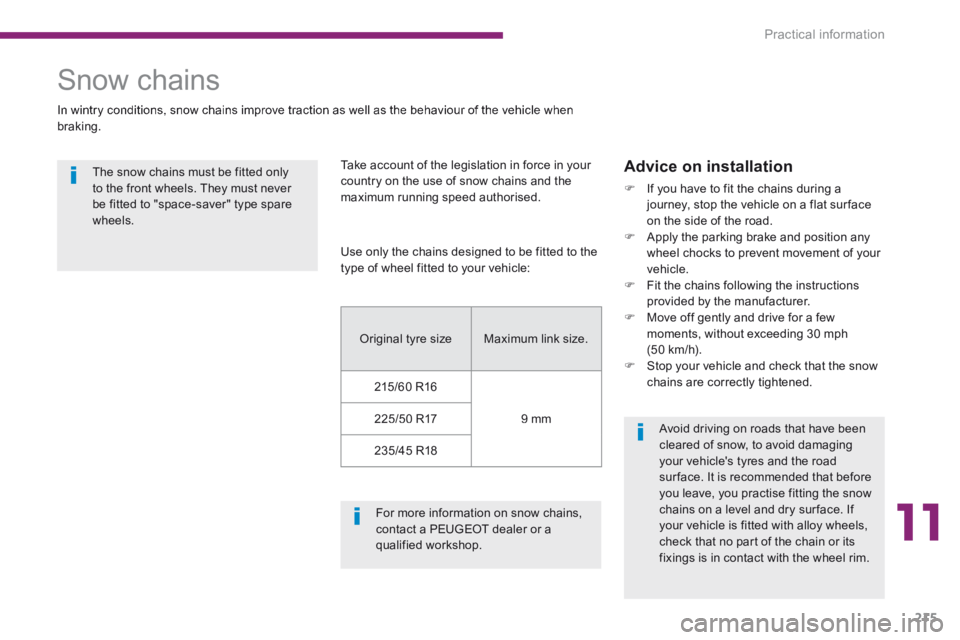
Use only the chains designed to be fitted to the type of wheel fitted to your vehicle:
Original tyre size Maximum link size.
215/60 R16
9 mm 225/50 R17
235/45 R18
Page 221 of 389
11
Practical information219
Rear lamps
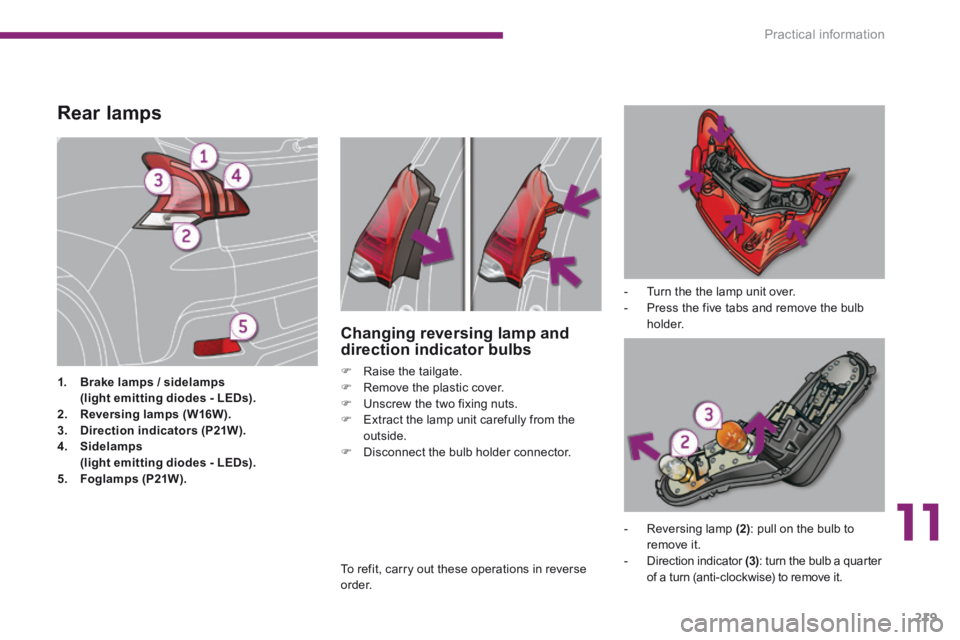
1. Brake lamps / sidelamps (light emitting diodes - LEDs).2. Reversing lamps (W16W).
3. Direction indicators (P21W).4.Sidelamps (light emitting diodes - LEDs).5. Foglamps (P21W).
- Turn the the lamp unit over. - Press the five tabs and remove the bulb h o l d e r. Changing reversing lamp and direction indicator bulbs
Raise the tailgate. Remove the plastic cover. Unscrew the two fixing nuts. Extract the lamp unit carefully from the outside. Disconnect the bulb holder connector.
- Reversing lamp (2) : pull on the bulb to remove it. - Direction indicator (3) : turn the bulb a quarter of a turn (anti-clockwise) to remove it. To refit, carry out these operations in reverse
o r d e r.
Page 222 of 389
Practical information
220
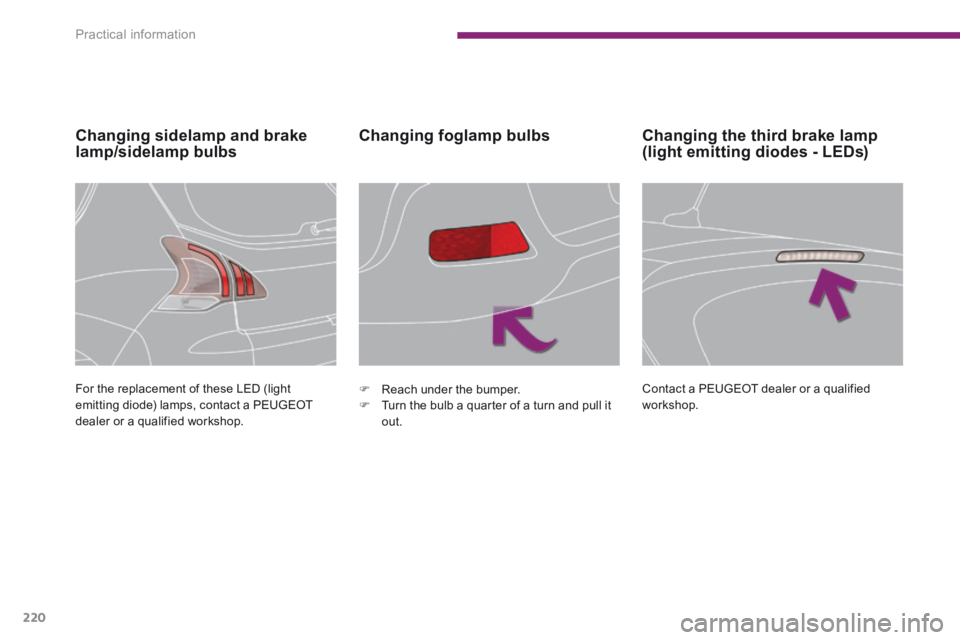
Changing sidelamp and brake lamp/sidelamp bulbs Changing foglamp bulbs
For the replacement of these LED (light emitting diode) lamps, contact a PEUGEOT dealer or a qualified workshop.
Reach under the bumper. Turn the bulb a quarter of a turn and pull it out.
Changing the third brake lamp (light emitting diodes - LEDs)
Contact a PEUGEOT dealer or a qualified workshop.
Page 228 of 389
Practical information
226
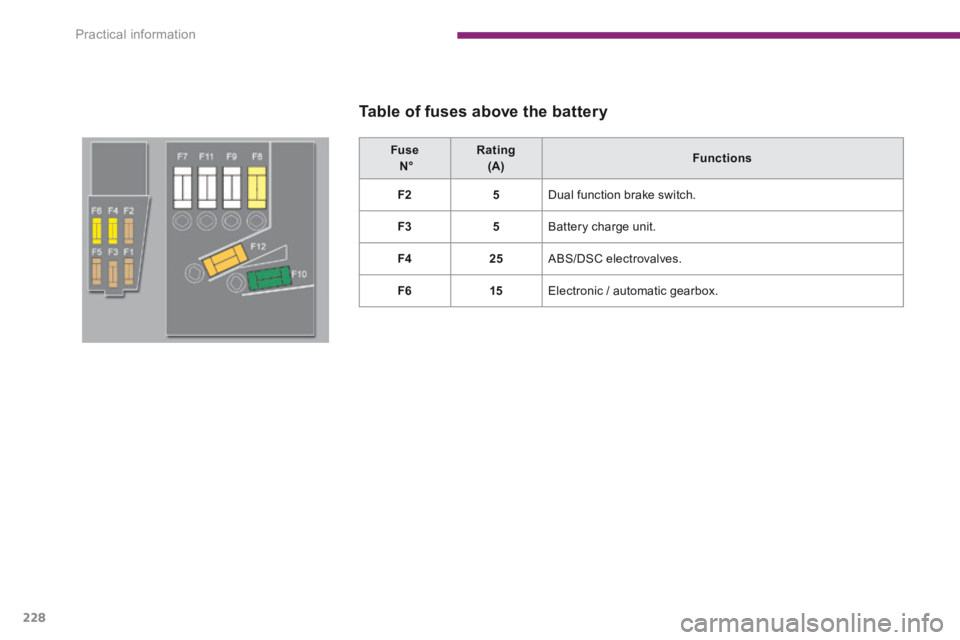
Engine compartment fuses
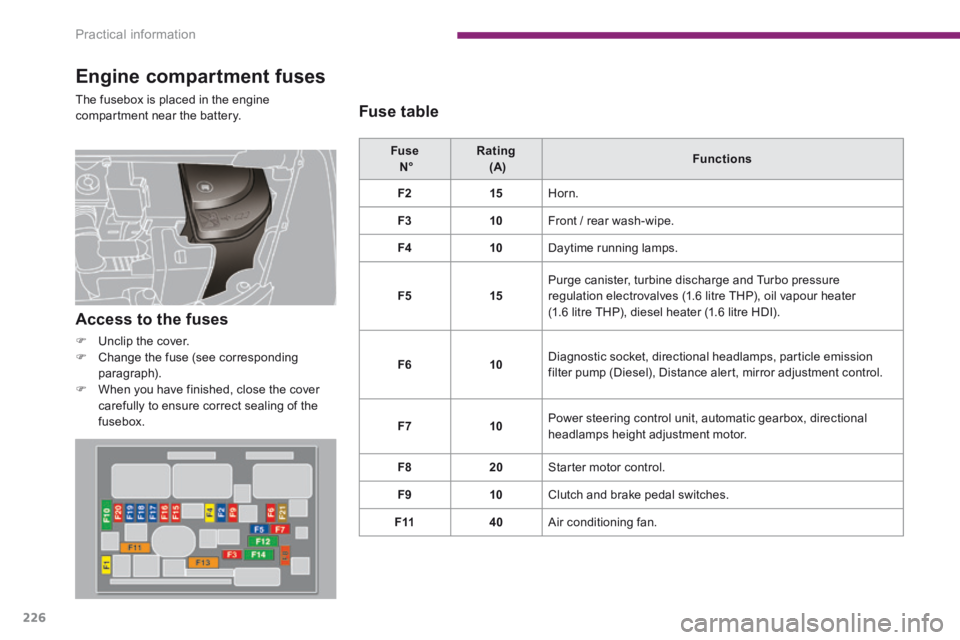
The fusebox is placed in the engine compartment near the battery.
Fuse N° Rating (A) Functions
F215 Horn.
F310 Front / rear wash-wipe.
F410 Daytime running lamps.
F515 Purge canister, turbine discharge and Turbo pressure regulation electrovalves (1.6 litre THP), oil vapour heater (1.6 litre THP), diesel heater (1.6 litre HDI).
F610 Diagnostic socket, directional headlamps, particle emission filter pump (Diesel), Distance alert, mirror adjustment control.
F710 Power steering control unit, automatic gearbox, directional headlamps height adjustment motor.
F820 Starter motor control.
F910 Clutch and brake pedal switches.
F1140 Air conditioning fan.
Access to the fuses
Unclip the cover. Change the fuse (see corresponding paragraph). When you have finished, close the cover carefully to ensure correct sealing of the fusebox.
Fuse table
Page 230 of 389
Practical information
228
Fuse N° Rating (A) Functions
F25 Dual function brake switch.
F35 Battery charge unit.
F425 ABS/DSC electrovalves.
F615 Electronic / automatic gearbox.
Table of fuses above the battery
Page 236 of 389
Practical information
234
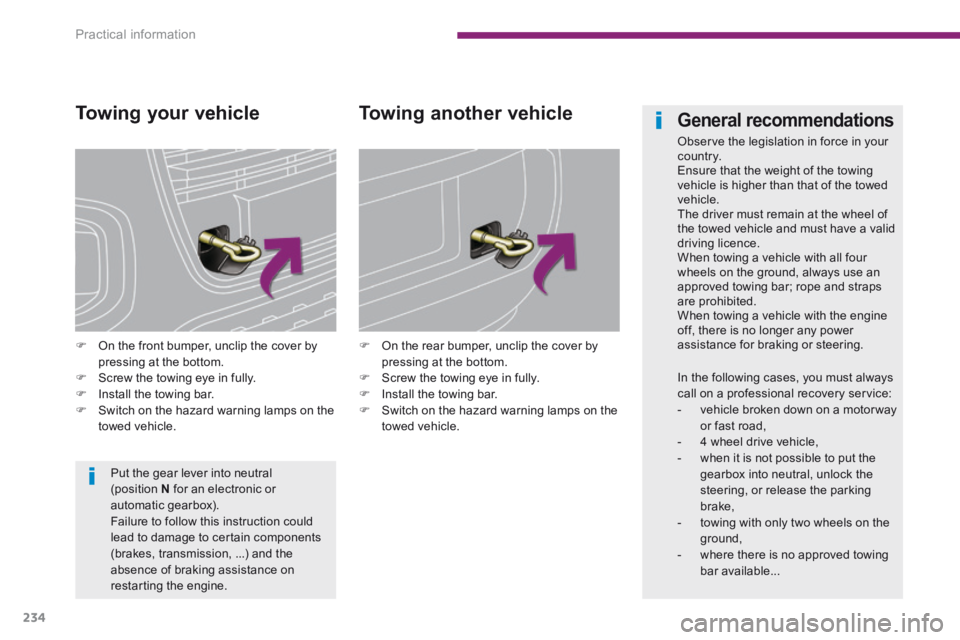
Towing your vehicle
On the front bumper, unclip the cover by pressing at the bottom. Screw the towing eye in fully. Install the towing bar. Switch on the hazard warning lamps on the towed vehicle.
On the rear bumper, unclip the cover by pressing at the bottom. Screw the towing eye in fully. Install the towing bar. Switch on the hazard warning lamps on the
towed vehicle.
Towing another vehicle
Put the gear lever into neutral (position N for an electronic or automatic gearbox). Failure to follow this instruction could lead to damage to certain components (brakes, transmission, ...) and the absence of braking assistance on
restarting the engine.
General recommendations
Observe the legislation in force in your c o unt r y. Ensure that the weight of the towing vehicle is higher than that of the towed vehicle. The driver must remain at the wheel of the towed vehicle and must have a valid driving licence. When towing a vehicle with all four wheels on the ground, always use an approved towing bar; rope and straps are prohibited. When towing a vehicle with the engine off, there is no longer any power assistance for braking or steering.
In the following cases, you must always call on a professional recovery service: - vehicle broken down on a motor way or fast road, - 4 wheel drive vehicle, - when it is not possible to put the gearbox into neutral, unlock the steering, or release the parking brake, - towing with only two wheels on the
ground, - where there is no approved towing bar available...
Page 238 of 389
Practical information
236
Side wind
Take into account the increased sensitivity to side wind.
Cooling
Towing a trailer on a slope increases the temperature of the coolant. As the fan is electrically controlled, its cooling capacity is not dependent on the engine speed. To lower the engine speed, reduce your speed. The maximum towed load on a long incline depends on the gradient and the ambient temperature. In all cases, keep a check on the coolant temperature.
Braking
Towing a trailer increases the braking distance. To avoid overheating of the brakes on a long
mountain type of descent, the use of engine braking is recommended.
Ty r e s
Check the tyre pressures of the towing vehicle and of the trailer, observing the recommended pressures.
Lighting
Check the electrical lighting and signalling on the trailer.
If the warning lamp and the STOP warning lamp come on, stop the vehicle and switch off the engine as soon as possible.
The rear parking sensors will be deactivated automatically if a genuine PEUGEOT towbar is used.
Page 244 of 389
Technical data
242
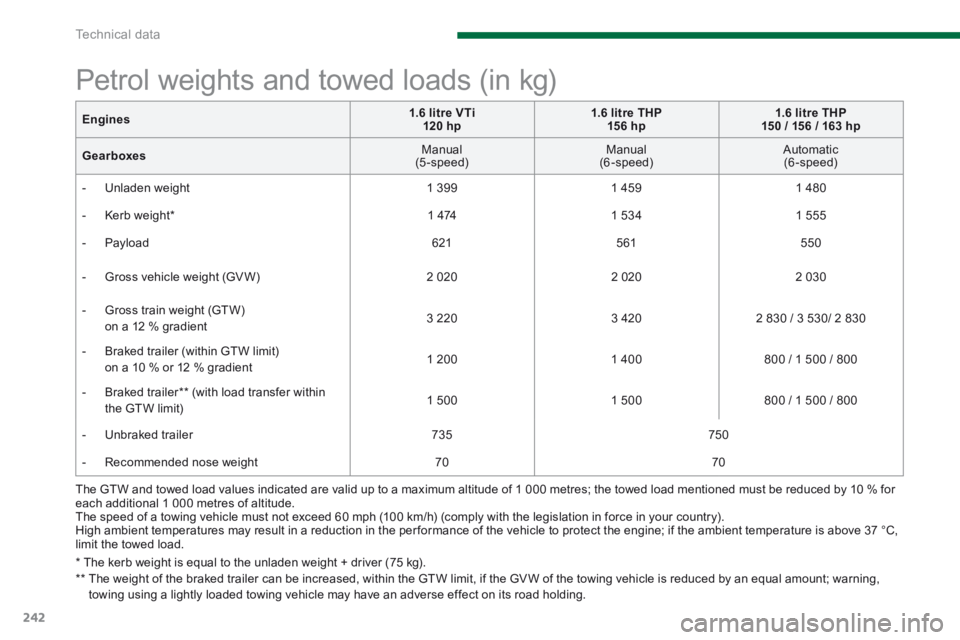
The GTW and towed load values indicated are valid up to a maximum altitude of 1 000 metres; the towed load mentioned must be reduced by 10 % for each additional 1 000 metres of altitude. The speed of a towing vehicle must not exceed 60 mph (100 km/h) (comply with the legislation in force in your country). High ambient temperatures may result in a reduction in the per formance of the vehicle to protect the engine; if the ambient temperature is above 37 °C, limit the towed load.
Petrol weights and towed loads (in kg)
* The kerb weight is equal to the unladen weight + driver (75 kg). ** The weight of the braked trailer can be increased, within the GTW limit, if the GV W of the towing vehicle is reduced by an equal amount; warning, towing using a lightly loaded towing vehicle may have an adverse effect on its road holding.
Engines1.6 litre VTi 120 hp1.6 litre THP 15 6 hp1.6 litre THP 150 / 156 / 163 hp
Gearboxes Manual (5-speed) Manual (6-speed) Automatic (6-speed)
- Unladen weight 1 3 9 9 1 4 5 9 1 480
- Kerb weight * 1 474 1 534 1 555
- Payload 621 561 550
- Gross vehicle weight (GV W) 2 020 2 020 2 030
- Gross train weight (GTW) on a 12 % gradient 3 220 3 420 2 830 / 3 530/ 2 830
- Braked trailer (within GTW limit) on a 10 % or 12 % gradient 1 200 1 400 800 / 1 500 / 800
- Braked trailer ** (with load transfer within the GTW limit) 1 500 1 500 800 / 1 500 / 800
- Unbraked trailer 735 750
- Recommended nose weight 70 70
Page 246 of 389
Technical data
244
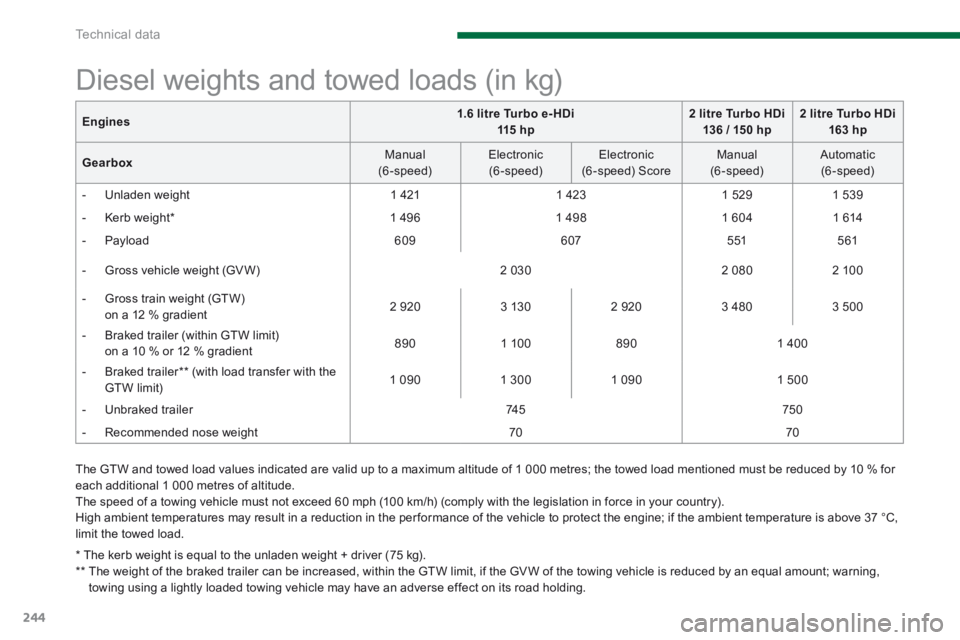
The GTW and towed load values indicated are valid up to a maximum altitude of 1 000 metres; the towed load mentioned must be reduced by 10 % for each additional 1 000 metres of altitude. The speed of a towing vehicle must not exceed 60 mph (100 km/h) (comply with the legislation in force in your country). High ambient temperatures may result in a reduction in the per formance of the vehicle to protect the engine; if the ambient temperature is above 37 °C,
limit the towed load.
Diesel weights and towed loads (in kg)
* The kerb weight is equal to the unladen weight + driver (75 kg). ** The weight of the braked trailer can be increased, within the GTW limit, if the GV W of the towing vehicle is reduced by an equal amount; warning, towing using a lightly loaded towing vehicle may have an adverse effect on its road holding.
Engines1.6 litre Turbo e- HDi 115 h p2 litre Turbo HDi 136 / 150 hp2 litre Turbo HDi 163 hp
Gearbox Manual (6-speed) Electronic (6-speed) Electronic (6 -speed) Score Manual (6-speed) Automatic (6-speed)
- Unladen weight 1 421 1 423 1 5 2 9 1 5 3 9
- Kerb weight * 1 4 9 6 1 4 9 8 1 604 1 614
- Payload 6 0 9 607 5 51 561
- Gross vehicle weight (GV W) 2 030 2 080 2 100
- Gross train weight (GTW) on a 12 % gradient 2 9 2 0 3 130 2 9 2 0 3 480 3 500
- Braked trailer (within GTW limit) on a 10 % or 12 % gradient 8 9 0 1 100 8 9 0 1 400
- Braked trailer ** (with load transfer with the GTW limit) 1 0 9 0 1 300 1 0 9 0 1 500
- Unbraked trailer 74 5 750
- Recommended nose weight 70 70
Page 247 of 389
12
Technical data245
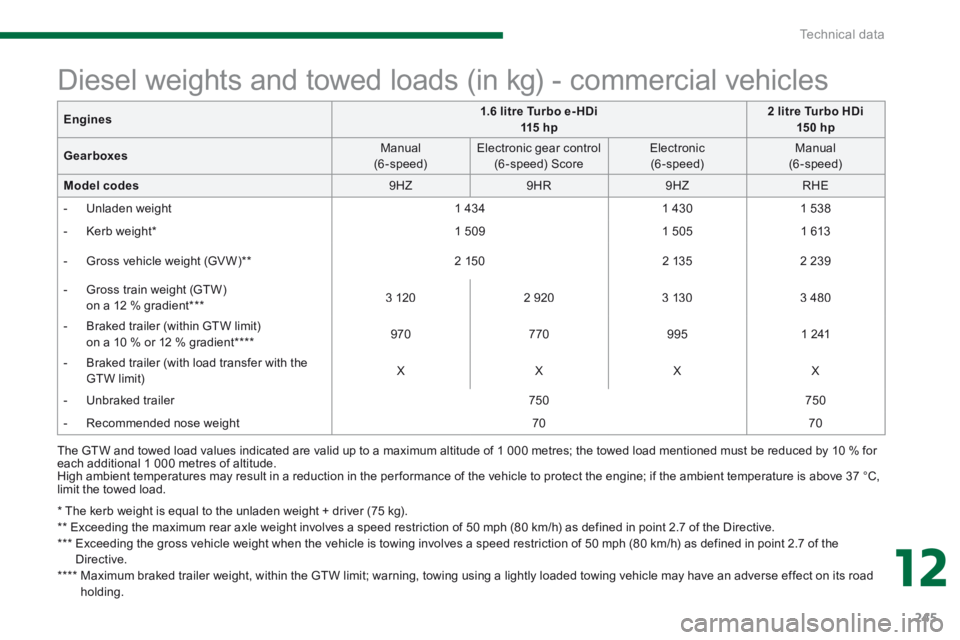
* The kerb weight is equal to the unladen weight + driver (75 kg). ** Exceeding the maximum rear axle weight involves a speed restriction of 50 mph (80 km/h) as defined in point 2.7 of the Directive. *** Exceeding the gross vehicle weight when the vehicle is towing involves a speed restriction of 50 mph (80 km/h) as defined in point 2.7 of the Directive. **** Maximum braked trailer weight, within the GTW limit; warning, towing using a lightly loaded towing vehicle may have an adverse effect on its road
holding.
Diesel weights and towed loads (in kg) - commercial vehicles
The GTW and towed load values indicated are valid up to a maximum altitude of 1 000 metres; the towed load mentioned must be reduced by 10 % for each additional 1 000 metres of altitude. High ambient temperatures may result in a reduction in the per formance of the vehicle to protect the engine; if the ambient temperature is above 37 °C, limit the towed load.
Engines1.6 litre Turbo e- HDi 115 h p2 litre Turbo HDi 15 0 hp
Gearboxes Manual (6-speed) Electronic gear control (6 -speed) Score Electronic (6-speed) Manual (6-speed)
Model codes 9 H Z 9 H R 9 H Z RHE
- Unladen weight 1 434 1 430 1 538
- Kerb weight * 1 5 0 9 1 505 1 613
- Gross vehicle weight (GV W) ** 2 150 2 135 2 2 3 9
- Gross train weight (GTW) on a 12 % gradient *** 3 120 2 9 2 0 3 130 3 480
- Braked trailer (within GTW limit) on a 10 % or 12 % gradient **** 9 7 0 770 9 9 5 1 241
- Braked trailer (with load transfer with the GTW limit) X X X X
- Unbraked trailer 750 750
- Recommended nose weight 70 70