tow Peugeot 308 2016 Owner's Guide
[x] Cancel search | Manufacturer: PEUGEOT, Model Year: 2016, Model line: 308, Model: Peugeot 308 2016Pages: 398, PDF Size: 9.38 MB
Page 140 of 398
138
308_en_Chap05_securite_ed02-2015
U Seat suitable for the installation of a child
seat secured using the seat belt and
universally approved rearward facing and/
or forward facing.
U(R)
As f
or U, the vehicle seat must be
adjusted to the highest and fully back
position.
X
Se
at not suitable for the installation of a
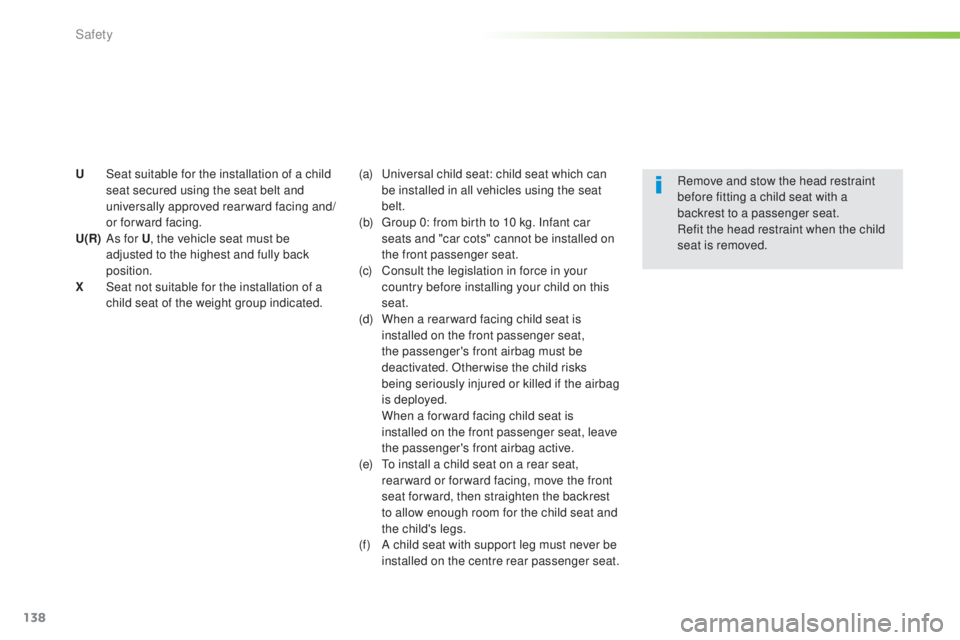
child seat of the weight group indicated. Remove and stow the head restraint
before fitting a child seat with a
backrest to a passenger seat.
Refit the head restraint when the child
seat is removed.
(a)
uni versal child seat: child seat which can
be installed in all vehicles using the seat
belt.
(b)
g
ro
up 0: from birth to 10 kg. Infant car
seats and "car cots" cannot be installed on
the front passenger seat.
(c)
Co
nsult the legislation in force in your
country before installing your child on this
seat.
(d)
Wh
en a rear ward facing child seat is
installed on the front passenger seat,
the passenger's front airbag must be
deactivated. Otherwise the child risks
being seriously injured or killed if the airbag
is deployed.
Wh
en a for ward facing child seat is
installed on the front passenger seat, leave
the passenger's front airbag active.
(e)
t
o in
stall a child seat on a rear seat,
rear ward or for ward facing, move the front
seat for ward, then straighten the backrest
to allow enough room for the child seat and
the child's legs.
(f)
A ch
ild seat with support leg must never be
installed on the centre rear passenger seat.
Safety
Page 142 of 398
140
308_en_Chap05_securite_ed02-2015
the incorrect installation of a child seat
i n a vehicle compromises the child's
protection in the event of an accident.
Observe strictly the fitting instructions
provided with the child seat.
to se
cure the child seat to the TOP TETHER
:
-
re
move and stow the head restraint before
installing the child seat on the vehicle seat
(refit it when the child seat is removed),
-
pa
ss the child seat upper strap over the top
of the seat backrest, centred between the
holes for the head restraint rods,
-
at
tach the upper strap to the ring B,
-
ti
ghten the upper strap.
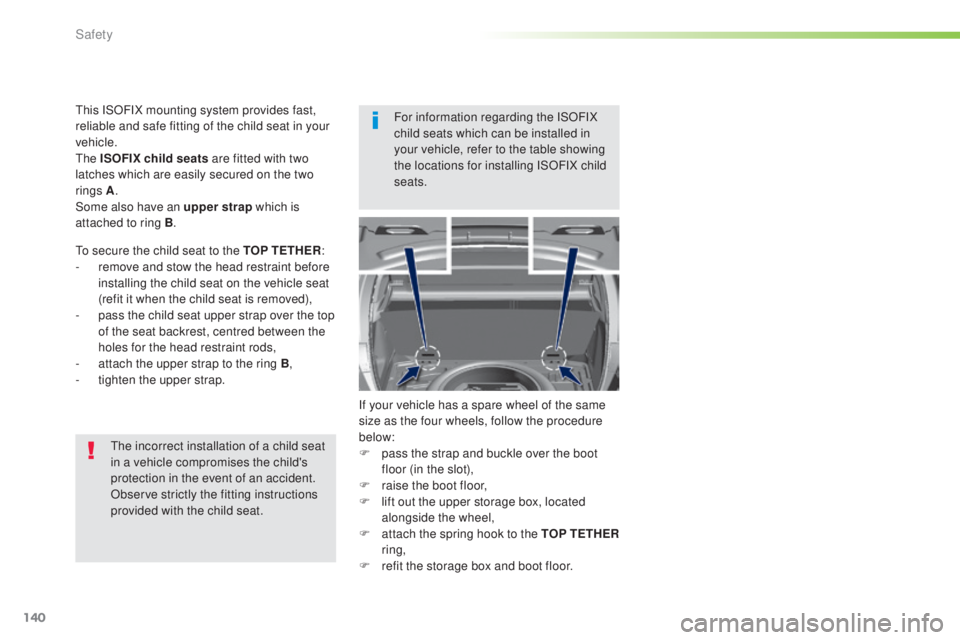
If your vehicle has a spare wheel of the same
size as the four wheels, follow the procedure
below:
F pa ss the strap and buckle over the boot
floor (in the slot),
F
ra
ise the boot floor,
F
li
ft out the upper storage box, located
alongside the wheel,
F
at
tach the spring hook to the TOP TETHER
ring,
F
re
fit the storage box and boot floor.
thi
s ISOFIX mounting system provides fast,
reliable and safe fitting of the child seat in your
vehicle.
the
ISOFIX child seats are fitted with two
latches which are easily secured on the two
rings A .
Some also have an upper strap which is
attached to ring B . For information regarding the ISOFIX
child seats which can be installed in
your vehicle, refer to the table showing
the locations for installing ISOFIX child
seats.
Safety
Page 145 of 398
143
308_en_Chap05_securite_ed02-2015
IUF Seat suitable for the installation of an
Is
ofix Universal seat, F or ward facing
secured using the upper strap.
IL- SU
Se
at suitable for the installation of an
I sofix S emi-Universal seat either:
-
re
ar ward facing fitted with an upper
strap or a support leg,
-
fo
r ward facing fitted with a support leg,
-
an i
nfant car seat fitted with an upper
strap or a support leg. For more information on the ISOFIX
mountings and the upper strap, refer to
the corresponding section.
X
Se
at not suitable for the installation of a
child seat of the weight group indicated.
(a)
Mov
e a seat without height adjustment
for wards by 1 notch from the mid
position for wards and backwards. A
seat with height adjustment must be in
the highest position.
(b)
t
he i
nstallation of an infant carrier on
one of the outer seats makes use of the
other two seats impossible.
(c)
A se
at with height adjustment must be
placed in the highest position. Move the
seat without height adjustment forward
by 5 notches from the mid-position
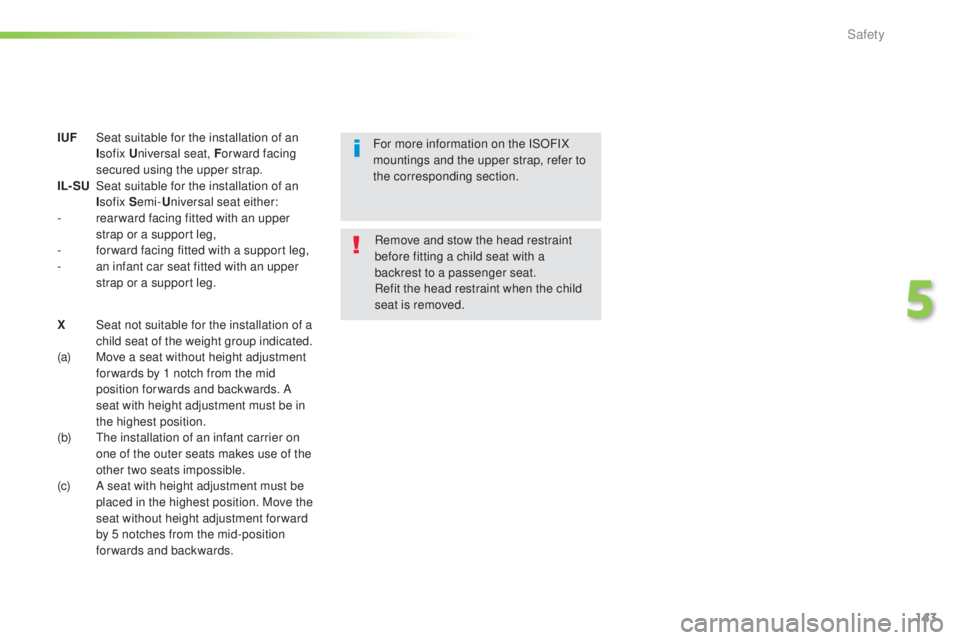
forwards and backwards. Remove and stow the head restraint
before fitting a child seat with a
backrest to a passenger seat.
Refit the head restraint when the child
seat is removed.
5
Safety
Page 146 of 398
144
308_en_Chap05_securite_ed02-2015
Child seatsInstalling a booster
cushion
Recommendations
the legislation on carrying a child on the
f ront passenger seat is specific to each
country. Refer to the legislation in force in
the country in which you are driving.
Deactivate the passenger's front airbag
when a rear ward facing child seat is installed
on the front passenger seat. Otherwise, the
child would risk being seriously injured or
killed if the airbag were deployed. For optimum installation of the forward facing
child seat, ensure that the back of the child
seat is as close as possible to the backrest
of the vehicle's seat, or in contact if possible.
the h
ead restraint must be removed before
installing a child seat with a backrest on the
passenger seat.
ens
ure that the head restraint is stowed or
attached securely so that it is not thrown
around the vehicle in the event of sharp
braking.
Refit the head restraint as soon as the child
seat is removed.
the i
ncorrect installation of a child seat in a
vehicle compromises the child's protection in
the event of an accident.
Check that there is no seat belt or seat belt
buckle under the child seat as this could
destabilise it.
Remember to fasten the seat belts or the
child seat harnesses keeping the slack in
relation to the child's body to a minimum ,
even for short journeys.
For the installation of a child seat using a
seat belt, ensure that this is well tensioned
on the child seat and that it is holding the
child seat firmly against the seat of your
vehicle. If your front passenger seat is
adjustable, move it forward if necessary.
At the rear seats, always leave sufficient
space between the front seat and:
-
a re
ar ward facing child seat,
-
th
e feet of a child seated in a for ward
facing child seat.
For this, move the front seat for ward and if
necessary straighten its backrest.
Children at the front
the chest part of the seat belt must be
p ositioned on the child's shoulder without
touching the neck.
ens
ure that the lap part of the seat belt
passes correctly over the child's thighs.
P
eu
ge
Ot r
ecommends the use of a booster
seat which has a back, fitted with a seat belt
guide at shoulder level.
As a safety precaution, do not leave:
-
on
e or more children alone and
unsupervised in a vehicle,
-
a ch
ild or an animal in a vehicle which
is exposed to the sun, with the windows
closed,
-
th
e keys within reach of children inside
the vehicle.
to pr
event accidental opening of the doors,
use the child lock.
tak
e care not to open the rear windows by
more than one third.
to pr
otect young children from the rays of
the sun, fit side blinds on the rear windows.
Safety
Page 149 of 398
147
308_en_Chap06_conduite_ed02-2015
When towing
Distribution of loads
F Distribute the load in the trailer so that the
heaviest items are as close as possible to
the axle and the nose weight approaches
the maximum permitted without
exceeding
it
.
Air density decreases with altitude, thus
reducing engine performance. Above
1
0
00
m
etres, the maximum towed load must
be reduced by 10
% f
or every 1
0
00 metres of
altitude.
Side wind
F take into account the increased sensitivity
t o side wind.
Cooling
towing a trailer on a slope increases the
t emperature of the coolant.
As the fan is electrically controlled, its cooling
capacity is not dependent on the engine speed.
F
t
o lo
wer the engine speed, reduce your
speed.
the m
aximum towed load on a long incline
depends on the gradient and the ambient
temperature.
In all cases, keep a check on the coolant
temperature.
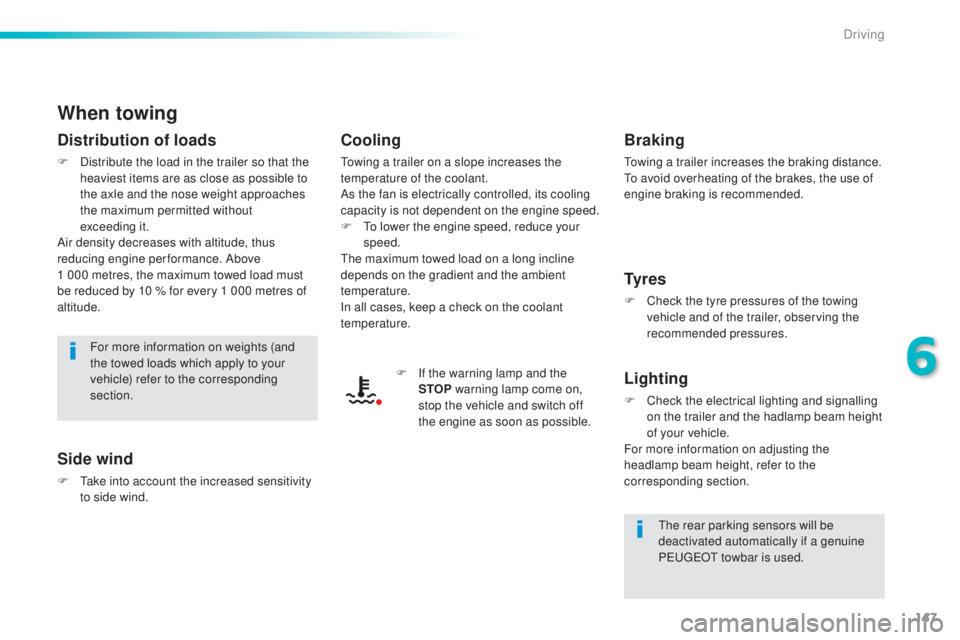
F
If t
he warning lamp and the
STOP warning lamp come on,
stop the vehicle and switch off
the engine as soon as possible.
Braking
towing a trailer increases the braking distance.to av oid overheating of the brakes, the use of
engine braking is recommended.
Ty r e s
F Check the tyre pressures of the towing
v ehicle and of the trailer, observing the
recommended pressures.
Lighting
F Check the electrical lighting and signalling
o n the trailer and the hadlamp beam height
of your vehicle.
For more information on adjusting the
headlamp beam height, refer to the
corresponding section.
For more information on weights (and
the towed loads which apply to your
vehicle) refer to the corresponding
section.
the r
ear parking sensors will be
deactivated automatically if a genuine
P
eu
ge
Ot t
owbar is used.
6
Driving
Page 152 of 398
150
308_en_Chap06_conduite_ed02-2015
Avoid attaching heavy objects to the
key, which would weigh down on its
blade in the ignition switch and could
cause a malfunction.
Switching off the engine leads to a loss
of braking assistance.
Key left in the "Ignition on"
position
If the key has been left in the ignition switch
at position 2 (Ignition on)
, the ignition will
be switched off automatically after one hour.
to sw
itch the ignition back on, turn the
key to position 1 (Stop) , then back to
position
2 (
Ignition on) .
Never leave the engine running in
an enclosed area without adequate
ventilation: internal combustion
engines emit toxic exhaust gases,
such as carbon monoxide. Danger of
intoxication and death.
In very severe wintry conditions
(temperatures below -23°C), to ensure
the correct operation and the durability
of the mechanical components of your
vehicle, the engine and gearbox, it is
necessary to leave the engine running
for 4 minutes before moving off. F Immo
bilise the vehicle.
F tur n the key fully towards you to
position
1 (
Stop).
F
Re
move the key from the ignition switch.
F
t
o lo
ck the steering column, turn the
steering wheel until it locks.
Switching off using the key
to facilitate unlocking of the steering
w heel, it is recommended that you
place the wheels in the straight ahead
position before switching off the engine.
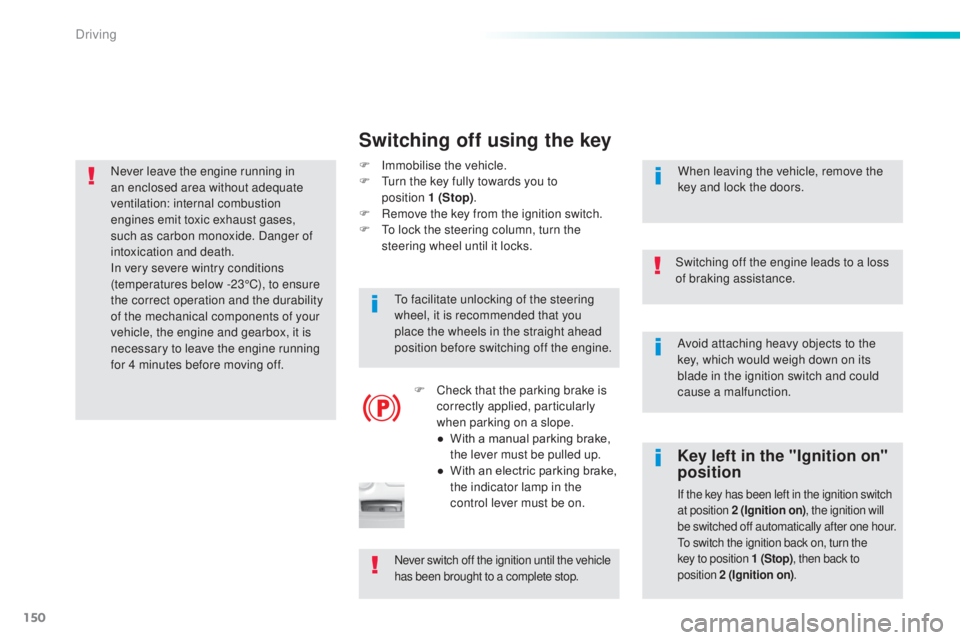
F
Ch
eck that the parking brake is
correctly applied, particularly
when parking on a slope.
●
Wi
th a manual parking brake,
the lever must be pulled up.
●
Wi
th an electric parking brake,
the indicator lamp in the
control lever must be on. When leaving the vehicle, remove the
key and lock the doors.
Never switch off the ignition until the vehicle
has been brought to a complete stop.
Driving
Page 157 of 398
155
308_en_Chap06_conduite_ed02-2015
electric parking brake
Never leave a child alone inside the
vehicle with the ignition on, as they
could release the parking brake.
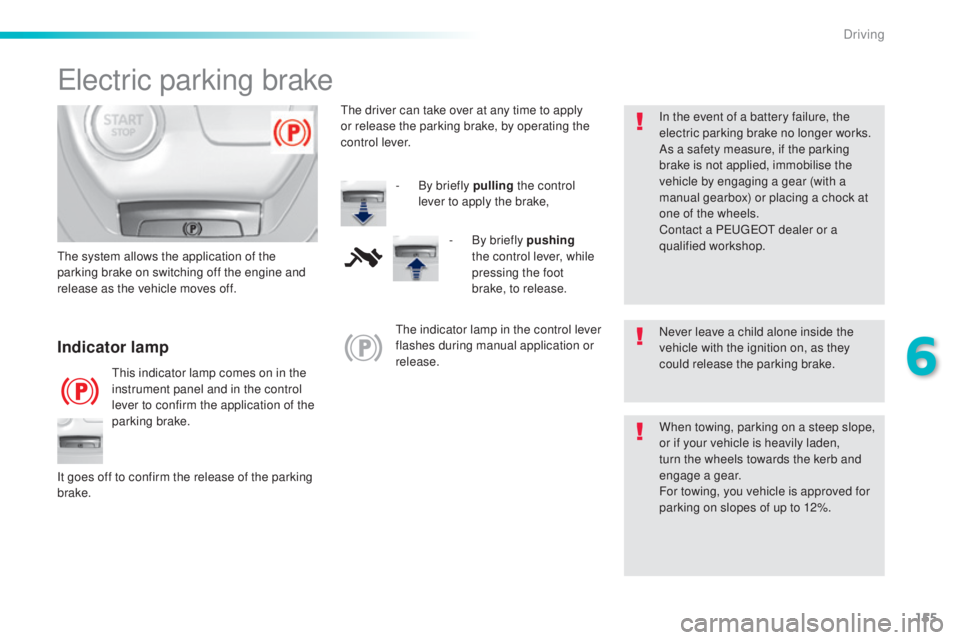
Indicator lamp
this indicator lamp comes on in the
i nstrument panel and in the control
lever to confirm the application of the
parking brake.
the s
ystem allows the application of the
parking brake on switching off the engine and
release as the vehicle moves off.
When towing, parking on a steep slope,
or if your vehicle is heavily laden,
turn the wheels towards the kerb and
engage a gear.
For towing, you vehicle is approved for
parking on slopes of up to 12%.
It goes off to confirm the release of the parking
brake.
the i
ndicator lamp in the control lever
flashes during manual application or
release. In the event of a battery failure, the
electric parking brake no longer works.
As a safety measure, if the parking
brake is not applied, immobilise the
vehicle by engaging a gear (with a
manual gearbox) or placing a chock at
one of the wheels.
Contact a P
eu
ge
Ot d
ealer or a
qualified workshop.
the d
river can take over at any time to apply
or release the parking brake, by operating the
control lever.
-
By b
riefly pulling
the control
lever to apply the brake,
-
By b
riefly pushing
the control lever, while
pressing the foot
brake, to release.
6
Driving
Page 161 of 398
159
308_en_Chap06_conduite_ed02-2015
Emergency braking
In the event of a failure of the main service
brake or in an exceptional situation (e.g. driver
taken ill, under instruction, etc) a continuous
pull on the control lever will brake the vehicle.
Braking takes place while the control lever is
being pulled. It is interrupted if the control lever
is released.
the A
BS and DSC systems provide stability of
the vehicle during emergency braking.
If the emergency braking malfunctions, the
message "Parking brake control faulty" will be
displayed.
the em
ergency braking should only be
used in an exceptional situation.
Repeat this procedure to reactivate automatic
operation.
Reactivation of automatic operation is
confirmed by the indicator lamp in the
instrument panel going off.
Deactivating automatic operation
In some situations, such as very cold weather
or towing (caravan, recovery), it may be
necessary to deactivate automatic operation of
the system.
F
St
art the engine.
F
Ap
ply the parking brake with the control
lever, if it is released.
F
t
ak
e your foot off the brake pedal.
F
Pu
sh and hold the control lever in the
release direction for at least 10 seconds
and no more than 15 seconds.
F
Re
lease the control lever.
F
Pr
ess and hold the brake pedal.
F
Pu
ll the control lever in the apply direction
for 2 seconds.
Deactivation of the automatic functions
is confirmed by illumination of this
indicator lamp in the instrument panel.
F
Re
lease the control lever and the brake
pedal. From this point the parking brake can only
be applied and released manually using the
control lever.
If a failure of the ABS and DSC systems,
signalled by the illumination of one or both
warning lamps in the instrument panel, then
stability of the vehicle is no longer guaranteed.
In this event, stability must be assured by the
driver by repeating alternate “pull-release”
actions on the control lever until the vehicle is
immobilised.
6
Driving
Page 167 of 398
165
308_en_Chap06_conduite_ed02-2015
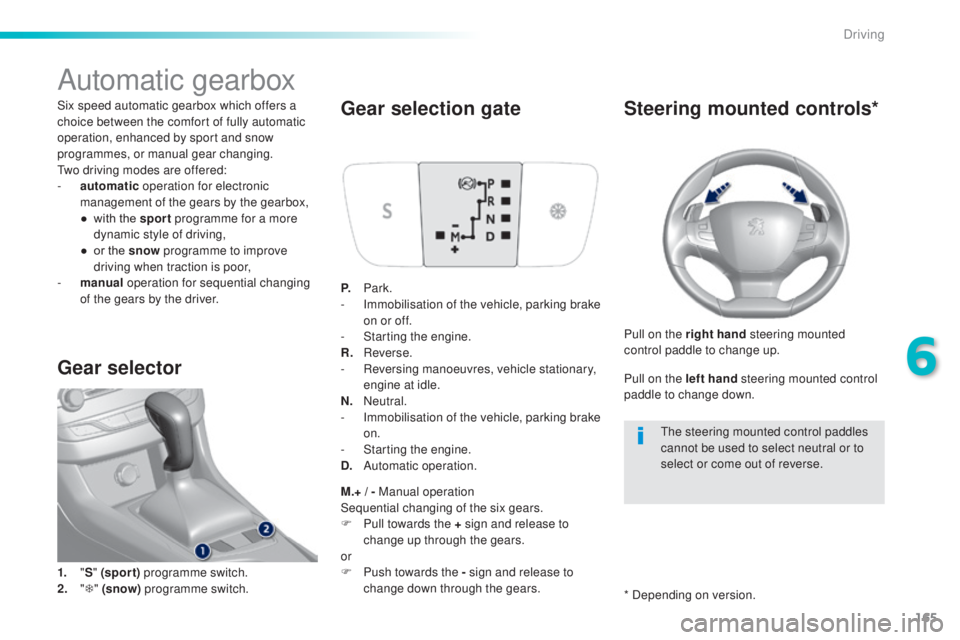
Automatic gearbox
Six speed automatic gearbox which offers a
choice between the comfort of fully automatic
operation, enhanced by sport and snow
programmes, or manual gear changing.
two d
riving modes are offered:
-
au
tomatic operation for electronic
management of the gears by the gearbox,
●
wi
th the sport programme for a more
dynamic style of driving,
●
or t
he snow programme to improve
driving when traction is poor,
-
man
ual operation for sequential changing
of the gears by the driver.
Gear selector
1. " S " (spor t) programme switch.
2. " T " (s
now) programme switch.
Gear selection gate
P. Park.
- Im
mobilisation of the vehicle, parking brake
on or off.
-
St
arting the engine.
R.
Re
verse.
-
Re
versing manoeuvres, vehicle stationary,
engine at idle.
N.
Ne
utral.
-
Im
mobilisation of the vehicle, parking brake
on.
-
St
arting the engine.
D.
Au
tomatic operation.
M.+ / - Manual operation
Sequential changing of the six gears.
F
Pu
ll towards the + sign and release to
change up through the gears.
or
F
Pu
sh towards the - sign and release to
change down through the gears.
Steering mounted controls*
Pull on the right hand steering mounted
control paddle to change up.
Pull on the left hand steering mounted control
paddle to change down.
the s
teering mounted control paddles
cannot be used to select neutral or to
select or come out of reverse.
* Depending on version.
6
Driving
Page 170 of 398
168
308_en_Chap06_conduite_ed02-2015
F Select position M for sequential c hanging
of the six gears.
F
Pu
ll towards the + sign and release to
change up a gear.
F
Pu
sh towards the - sign and release to
change down a gear.
It is only possible to change from one gear to
another if the vehicle speed and engine speed
permit; otherwise, the gearbox will operate
temporarily in automatic mode.
D disappears and the gears
engaged appear in succession in the
instrument panel.
If the engine speed is too low or too high, the
gear selected flashes for a few seconds, then
the actual gear engaged is displayed.
It is possible to change from position D
(automatic) to position M (manual) at any time.
When the vehicle is stationary or moving
very slowly, the gearbox selects gear M1
automatically.
the s
port and snow programmes do not
operate in manual mode.
Manual operation
Invalid value during manual
operation
this symbol is displayed if a gear is
n ot engaged correctly (gear selector
between two positions).
Stopping the vehicle
If the selector lever is not in position P ,
when the driver's door is opened or
approximately 45 seconds after the
ignition is switched off, there is an
audible signal and a message appears.
F
Re
turn the selector lever to
position
P ; t
he audible signal stops
and the message disappears. When the ignition is on, a message
appears in the instrument panel
screen to indicate a gearbox fault.
Operating fault
In this case, the gearbox switches to back-up
mode and is locked in 3rd gear. You may feel
a substantial knock when changing from P
to R and from N to R
.
thi
s will not cause any
damage to the gearbox.
Do not exceed 60 mph (100 km/h), local speed
restrictions permitting.
Have it checked by a P
eu
ge
Ot d
ealer or a
qualified workshop.
Before switching off the engine, you can
engage position P or N to place the gearbox in
neutral.
In both cases, apply the parking brake to
immobilise the vehicle, unless it is programmed
to automatic mode. You risk damaging the gearbox:
-
if y
ou press the accelerator and
brake pedals at the same time,
-
if y
ou force the lever from position
P
to another position when the
battery is flat.
to re
duce fuel consumption when
stationary for long periods with the
engine running (traffic jam...), position
the selector lever at N and apply the
parking brake, unless it is programmed
in automatic mode.
Driving