tow Peugeot 308 2016 Service Manual
[x] Cancel search | Manufacturer: PEUGEOT, Model Year: 2016, Model line: 308, Model: Peugeot 308 2016Pages: 398, PDF Size: 9.38 MB
Page 228 of 398
226
308_en_Chap07_info-pratiques_ed02-2015
Bonnet
Before doing anything under the
bonnet, switch off the Stop & Start
system to avoid any risk of injury
resulting from an automatic change to
S
tA
R
t m o
d e .
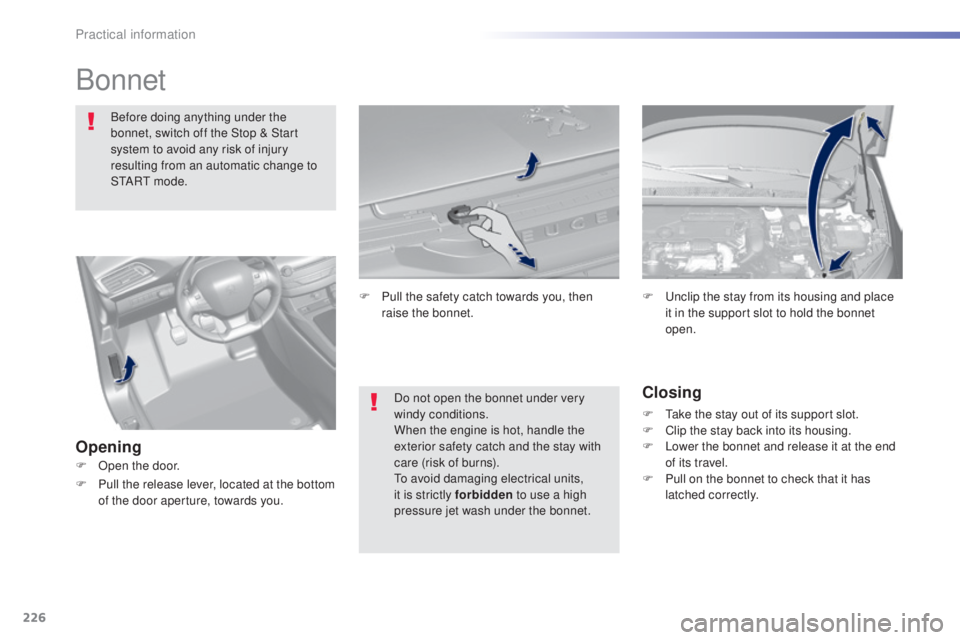
Opening Closing
F take the stay out of its support slot.
F Cl ip the stay back into its housing.
F
Lo
wer the bonnet and release it at the end
of its travel.
F
Pu
ll on the bonnet to check that it has
latched correctly.
F
u
nc
lip the stay from its housing and place
it in the support slot to hold the bonnet
open.
Do not open the bonnet under very
windy conditions.
When the engine is hot, handle the
exterior safety catch and the stay with
care (risk of burns).
to a
void damaging electrical units,
it is strictly forbidden to use a high
pressure jet wash under the bonnet.
F
Pu
ll the safety catch towards you, then
raise the bonnet.
F
Op
en the door.
F
Pu
ll the release lever, located at the bottom
of the door aperture, towards you.
Practical information
Page 236 of 398
234
308_en_Chap07_info-pratiques_ed02-2015
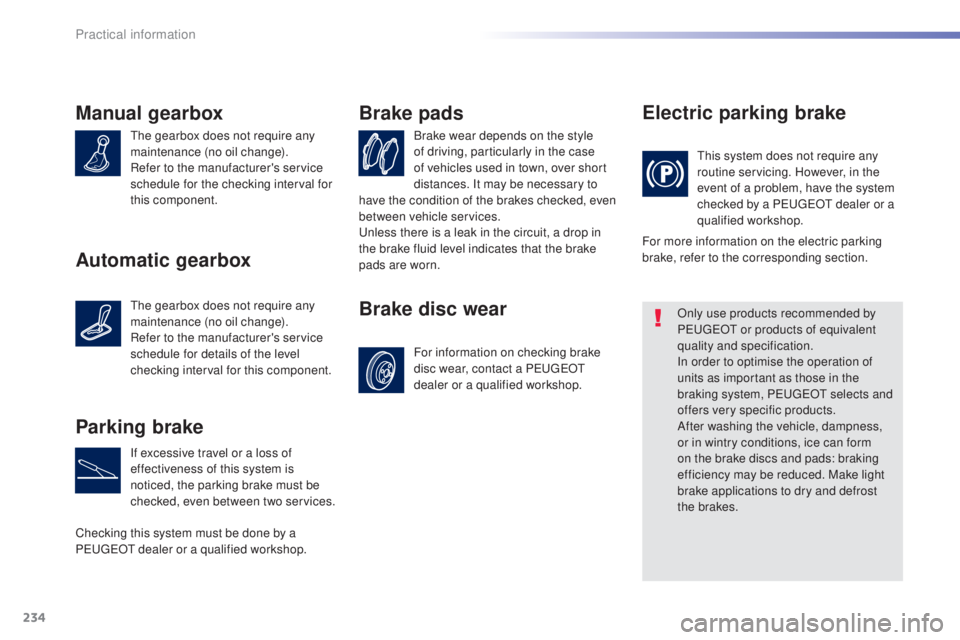
Manual gearbox
the gearbox does not require any
m aintenance (no oil change).
Refer to the manufacturer's service
schedule for the checking interval for
this component. Brake wear depends on the style
of driving, particularly in the case
of vehicles used in town, over short
distances. It may be necessary to
Brake pads
For information on checking brake
disc wear, contact a Peu
geOt
d
ealer or a qualified workshop.
Brake disc wear Electric parking brake
this system does not require any
r outine servicing. However, in the
event of a problem, have the system
checked by a P
eu
ge
Ot d
ealer or a
qualified workshop.
Only use products recommended by
P
eu
ge
Ot o
r products of equivalent
quality and specification.
In order to optimise the operation of
units as important as those in the
braking system, P
eu
ge
Ot s
elects and
offers very specific products.
After washing the vehicle, dampness,
or in wintry conditions, ice can form
on the brake discs and pads: braking
efficiency may be reduced. Make light
brake applications to dry and defrost
the brakes.
Parking brake
If excessive travel or a loss of
effectiveness of this system is
noticed, the parking brake must be
checked, even between two services.
Checking this system must be done by a
P
eu
ge
Ot d
ealer or a qualified workshop. have the condition of the brakes checked, even
between vehicle services.
unl
ess there is a leak in the circuit, a drop in
the brake fluid level indicates that the brake
pads are worn. For more information on the electric parking
brake, refer to the corresponding section.
Automatic gearbox
the gearbox does not require any
m aintenance (no oil change).
Refer to the manufacturer's service
schedule for details of the level
checking interval for this component.
Practical information
Page 245 of 398
243
308_en_Chap08_en-cas-de-panne_ed02-2015
Warning triangle (stowing)
Before leaving your vehicle to set up
and install the triangle, switch on the
hazard warning lamps and put on your
high visibility vest.
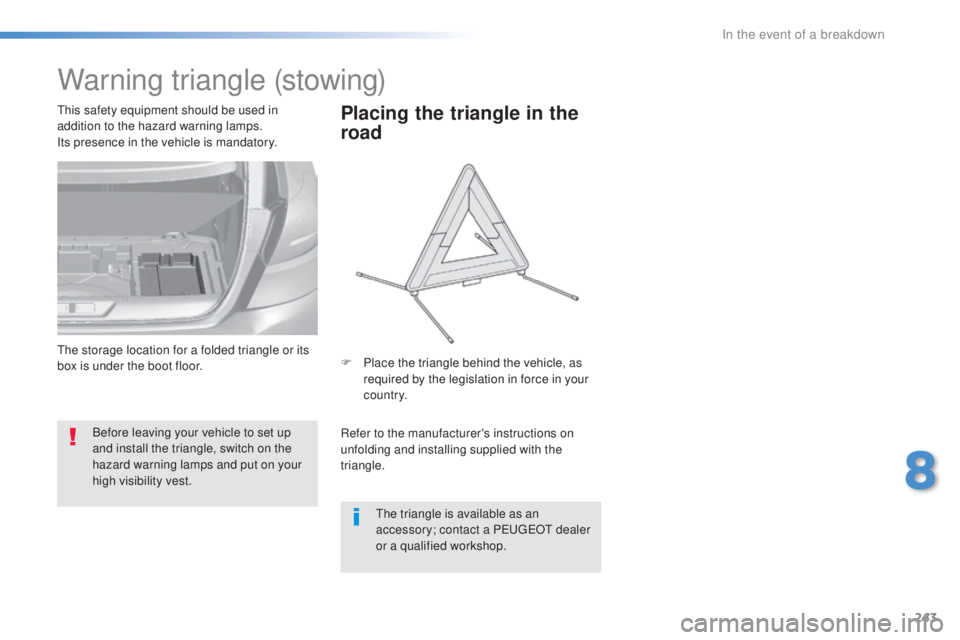
thi
s safety equipment should be used in
addition to the hazard warning lamps.
Its presence in the vehicle is mandatory.
Placing the triangle in the
road
Refer to the manufacturer's instructions on
unfolding and installing supplied with the
triangle. F
Pl
ace the triangle behind the vehicle, as
required by the legislation in force in your
c o unt r y.
the t
riangle is available as an
accessory; contact a P
eu
ge
Ot d
ealer
or a qualified workshop.
the s
torage location for a folded triangle or its
box is under the boot floor.
8
In the event of a breakdown
Page 246 of 398
244
308_en_Chap08_en-cas-de-panne_ed02-2015
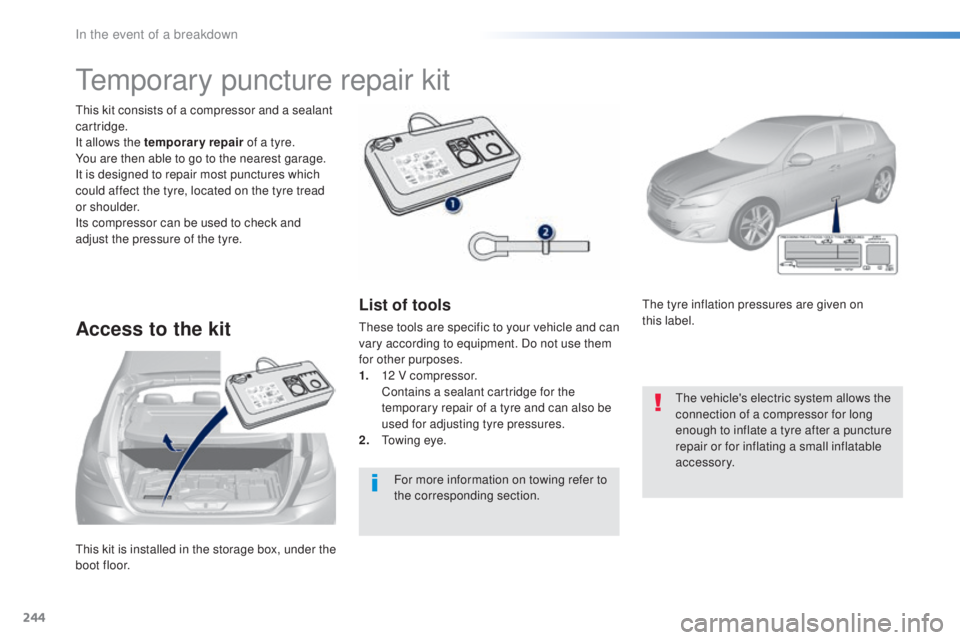
this kit is installed in the storage box, under the
bo ot floor.
thi
s kit consists of a compressor and a sealant
cartridge.
It allows the temporary repair of a tyre.
You are then able to go to the nearest garage.
It is designed to repair most punctures which
could affect the tyre, located on the tyre tread
or shoulder.
Its compressor can be used to check and
adjust the pressure of the tyre.
temporary puncture repair kit
Access to the kit
List of tools
these tools are specific to your vehicle and can
v ary according to equipment. Do not use them
for other purposes.
1.
12 V c
ompressor.
Co
ntains a sealant cartridge for the
temporary repair of a tyre and can also be
used for adjusting tyre pressures.
2.
tow
ing eye.
the t
yre inflation pressures are given on
this lab el.
the v
ehicle's electric system allows the
connection of a compressor for long
enough to inflate a tyre after a puncture
repair or for inflating a small inflatable
accessory.
For more information on towing refer to
the corresponding section.
In the event of a breakdown
Page 250 of 398
248
308_en_Chap08_en-cas-de-panne_ed02-2015
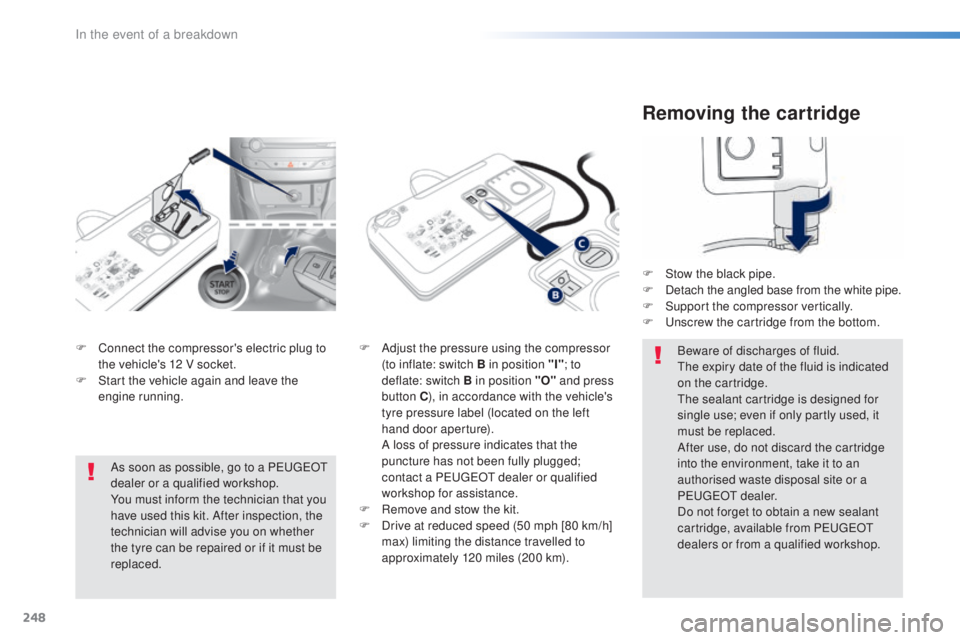
F Connect the compressor's electric plug to
t
he vehicle's 12 V socket.
F
St
art the vehicle again and leave the
engine running. F Ad
just the pressure using the compressor
(to inflate: switch B in position "I" ; to
deflate: switch B
i
n position "O" and press
button C ), in accordance with the vehicle's
tyre pressure label (located on the left
hand door aperture).
A lo
ss of pressure indicates that the
puncture has not been fully plugged;
contact a P
eu
ge
Ot d
ealer or qualified
workshop for assistance.
F
Re
move and stow the kit.
F
Dr
ive at reduced speed (50 mph [80 km/h]
max) limiting the distance travelled to
approximately 120 miles (200 km).
As soon as possible, go to a P
eu
ge
Ot
d
ealer or a qualified workshop.
You must inform the technician that you
have used this kit. After inspection, the
technician will advise you on whether
the tyre can be repaired or if it must be
replaced.
Removing the cartridge
F Stow the black pipe.
F De tach the angled base from the white pipe.
F
Su
pport the compressor vertically.
F
u
ns
crew the cartridge from the bottom.
Beware of discharges of fluid.
the e
xpiry date of the fluid is indicated
on the cartridge.
the s
ealant cartridge is designed for
single use; even if only partly used, it
must be replaced.
After use, do not discard the cartridge
into the environment, take it to an
authorised waste disposal site or a
P
eu
ge
Ot dea
ler.
Do not forget to obtain a new sealant
cartridge, available from P
eu
ge
Ot
d
ealers or from a qualified workshop.
In the event of a breakdown
Page 251 of 398
249
308_en_Chap08_en-cas-de-panne_ed02-2015
Checking tyre pressures /
inflating accessories
You can also use the compressor, without
injecting any product, to:
-
ch
eck or adjust the pressure of your tyres,
-
in
flate other accessories (balls, bicycle
tyres...).
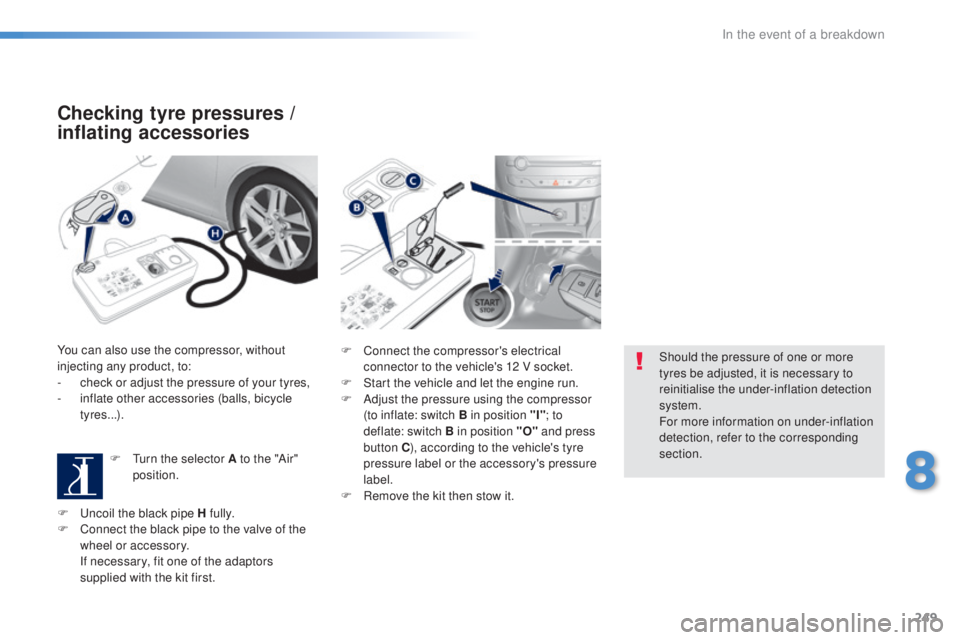
F
t
ur
n the selector A to the "Air"
position. F Con
nect the compressor's electrical
connector to the vehicle's 12 V socket.
F
St
art the vehicle and let the engine run.
F
Ad
just the pressure using the compressor
(to inflate: switch B in position "I" ; to
deflate: switch B in position "O" and press
button C ), according to the vehicle's tyre
pressure label or the accessory's pressure
label.
F
Re
move the kit then stow it.Should the pressure of one or more
tyres be adjusted, it is necessary to
reinitialise the under-inflation detection
system.
For more information on under-inflation
detection, refer to the corresponding
section.
F
u
nc
oil the black pipe H fully.
F
Co
nnect the black pipe to the valve of the
wheel or accessory.
If n
ecessary, fit one of the adaptors
supplied with the kit first.
8
In the event of a breakdown
Page 252 of 398
250
308_en_Chap08_en-cas-de-panne_ed02-2015
Changing a wheel
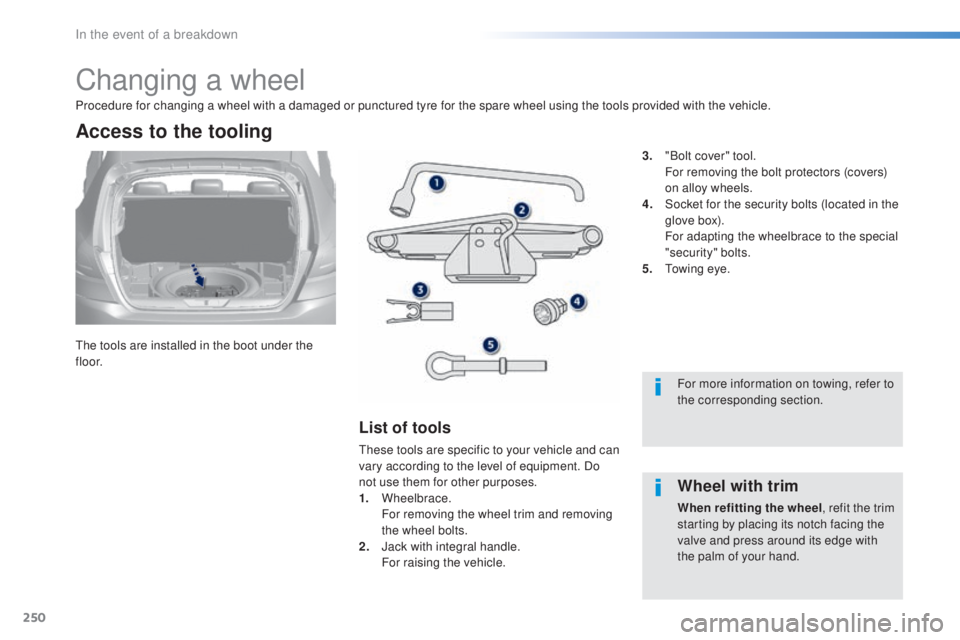
the tools are installed in the boot under the
f l o o r.
Access to the tooling
List of tools
these tools are specific to your vehicle and can
v ary according to the level of equipment. Do
not use them for other purposes.
1.
W
heelbrace.
Fo
r removing the wheel trim and removing
the wheel bolts.
2.
Ja
ck with integral handle.
Fo
r raising the vehicle. 3.
"B
olt cover" tool.
Fo
r removing the bolt protectors (covers)
on alloy wheels.
4.
So
cket for the security bolts (located in the
glove box).
Fo
r adapting the wheelbrace to the special
"security" bolts.
5.
tow
ing eye.
Procedure for changing a wheel with a damaged or punctured tyre for the spare wheel using the tools provided with the vehicle.
For more information on towing, refer to
the corresponding section.
Wheel with trim
When refitting the wheel, refit the trim
starting by placing its notch facing the
valve and press around its edge with
the palm of your hand.
In the event of a breakdown
Page 253 of 398
251
308_en_Chap08_en-cas-de-panne_ed02-2015
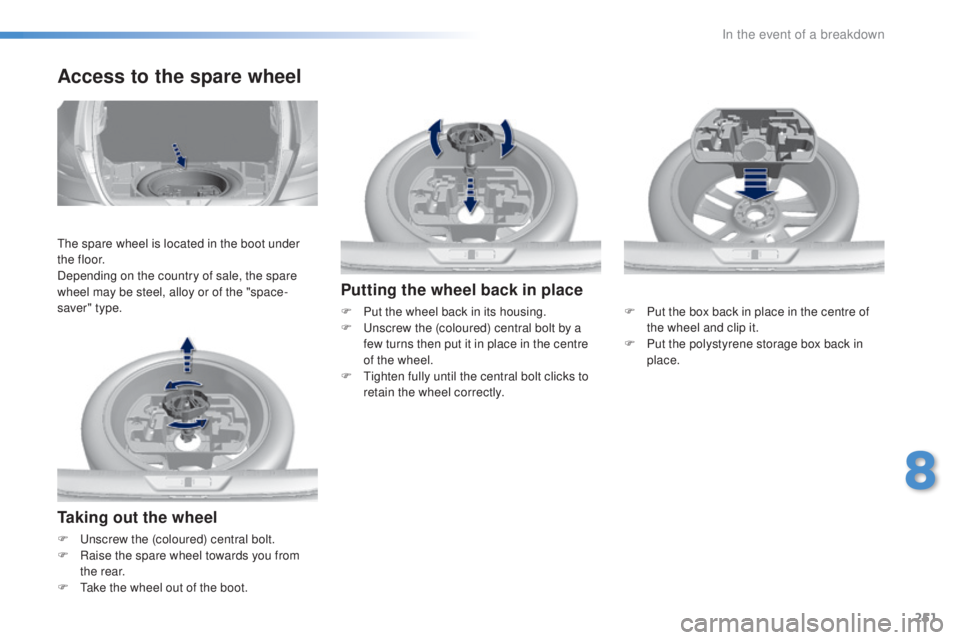
Taking out the wheel
F unscrew the (coloured) central bolt.
F Ra ise the spare wheel towards you from
the rear.
F
t
ak
e the wheel out of the boot.
Access to the spare wheel
the spare wheel is located in the boot under
t h e f l o o r.
Depending on the country of sale, the spare
wheel may be steel, alloy or of the "space-
saver" type.
Putting the wheel back in place
F Put the wheel back in its housing.
F uns crew the (coloured) central bolt by a
few turns then put it in place in the centre
of the wheel.
F
t
ig
hten fully until the central bolt clicks to
retain the wheel correctly. F Pu
t the box back in place in the centre of
the wheel and clip it.
F
Pu
t the polystyrene storage box back in
place.
8
In the event of a breakdown
Page 259 of 398
257
308_en_Chap08_en-cas-de-panne_ed02-2015
In some weather conditions (e.g. low
temperature or humidity), the presence
of misting on the internal sur face of the
glass of the headlamps and rear lamps
is normal; it disappears after the lamps
have been on for a few minutes.the h
eadlamps are fitted with
polycarbonate glass with a protective
coating:
F
do n
ot clean them using a dr y
or abrasive cloth, nor with a
detergent or solvent product,
F
us
e a sponge and soapy water or a
pH neutral product,
F
wh
en using a high pressure washer
on persistent marks, do not keep
the lance directed towards the
lamps or their edges for too long,
so as not to damage their protective
coating and seals.
Changing a bulb should only be done
after the headlamp has been switched
off for several minutes (risk of serious
burns).
F
Do n
ot touch the bulb directly with
your fingers, use a lint-free cloth.
It is imperative to use only anti-
ultraviolet (
uV) t
ype bulbs to avoid
damaging the headlamp.
Always replace a failed bulb with a
new bulb with the same type and
specification.
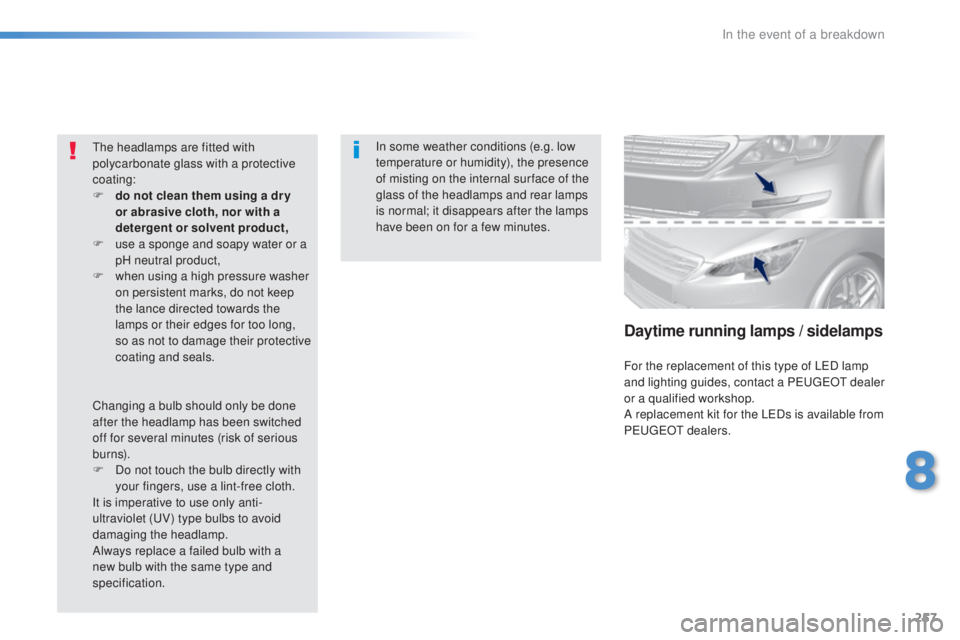
Daytime running lamps / sidelamps
For the replacement of this type of LeD la mp
and lighting guides, contact a Peu geOt d ealer
or a qualified workshop.
A replacement kit for the L
eDs i
s available from
P
eu
ge
Ot dea
lers.
8
In the event of a breakdown
Page 260 of 398
258
308_en_Chap08_en-cas-de-panne_ed02-2015
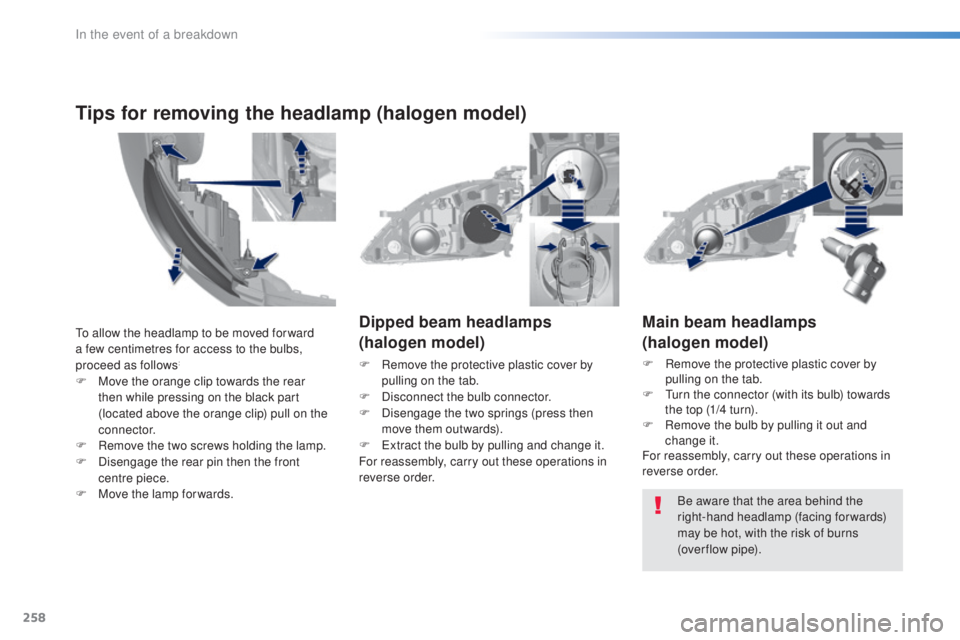
Main beam headlamps
(halogen model)
F Remove the protective plastic cover by
p
ulling on the tab.
F
t
ur
n the connector (with its bulb) towards
the top (1/4 turn).
F
Re
move the bulb by pulling it out and
change it.
For reassembly, carry out these operations in
reverse order.
Dipped beam headlamps
(halogen model)
F Remove the protective plastic cover by
p
ulling on the tab.
F
Di
sconnect the bulb connector.
F
Disenga
ge the two springs (press then
move them outwards).
F
e
xt
ract the bulb by pulling and change it.
For reassembly, carry out these operations in
reverse order.
Be aware that the area behind the
right-hand headlamp (facing forwards)
may be hot, with the risk of burns
(over flow
p
ipe).
to al
low the headlamp to be moved for ward
a few centimetres for access to the bulbs,
proceed as follows:
F Move the orange clip towards the rear
t hen while pressing on the black part
(located above the orange clip) pull on the
connector.
F
Re
move the two screws holding the lamp.
F
Disenga
ge the rear pin then the front
centre piece.
F
Mov
e the lamp for wards.
Tips for removing the headlamp (halogen model)
In the event of a breakdown