ignition Peugeot 308 2016 Workshop Manual
[x] Cancel search | Manufacturer: PEUGEOT, Model Year: 2016, Model line: 308, Model: Peugeot 308 2016Pages: 398, PDF Size: 9.38 MB
Page 154 of 398
152
308_en_Chap06_conduite_ed02-2015
If the vehicle is not immobilised,
the engine will not stop.
Switching off
F Immobilise the vehicle.F
Wi
th the electronic key inside
the vehicle, press the " S TA R T/
STOP " button.
the e
ngine stops and the steering column is
locked.
Ignition on position
(accessories)
If you use the accessory position for too
long, the system automatically goes into
economy mode to avoid the risk of a flat
battery.
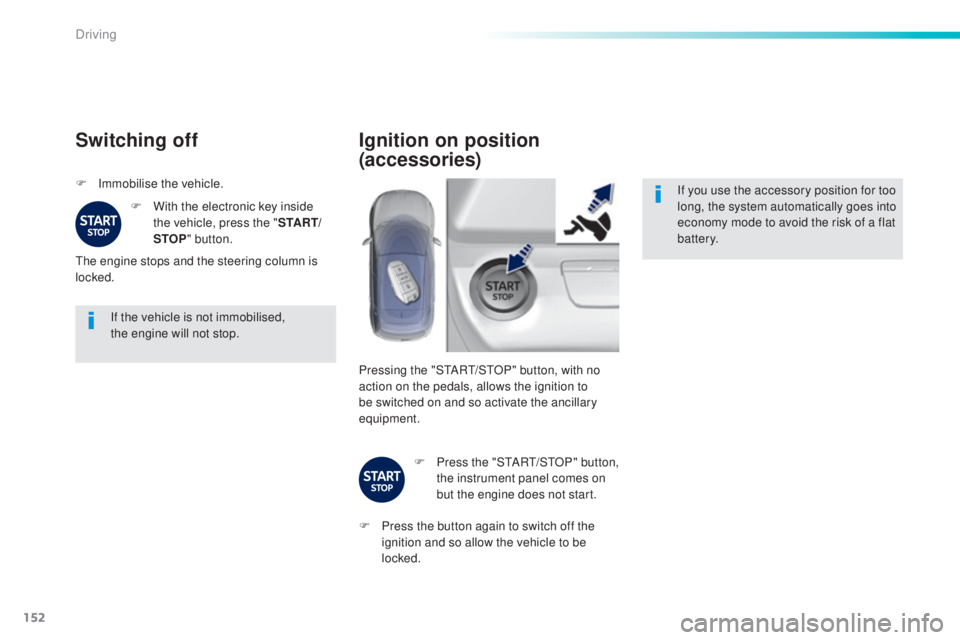
Pressing the "S
tARt/StOP
" button, with no
action on the pedals, allows the ignition to
be switched on and so activate the ancillary
equipment.
F
Pr
ess the "S
tARt/StOP
" button,
the instrument panel comes on
but the engine does not start.
F
Pr
ess the button again to switch off the
ignition and so allow the vehicle to be
locked.
Driving
Page 156 of 398
154
308_en_Chap06_conduite_ed02-2015
Manual parking brake
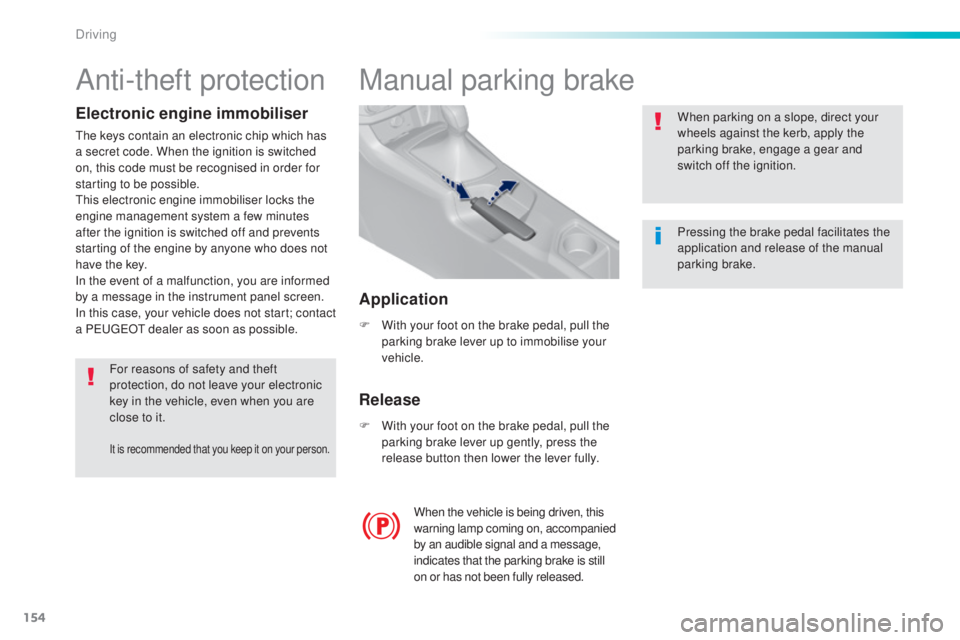
F With your foot on the brake pedal, pull the
parking brake lever up to immobilise your
vehicle.
F
Wi
th your foot on the brake pedal, pull the
parking brake lever up gently, press the
release button then lower the lever fully. When parking on a slope, direct your
wheels against the kerb, apply the
parking brake, engage a gear and
switch off the ignition.
When the vehicle is being driven, this
warning lamp coming on, accompanied
by an audible signal and a message,
indicates that the parking brake is still
on or has not been fully released. Pressing the brake pedal facilitates the
application and release of the manual
parking brake.
Release Application
Anti-theft protection
Electronic engine immobiliser
the keys contain an electronic chip which has
a s ecret code. When the ignition is switched
on, this code must be recognised in order for
starting to be possible.
thi
s electronic engine immobiliser locks the
engine management system a few minutes
after the ignition is switched off and prevents
starting of the engine by anyone who does not
have the key.
In the event of a malfunction, you are informed
by a message in the instrument panel screen.
In this case, your vehicle does not start; contact
a P
eu
ge
Ot d
ealer as soon as possible.
For reasons of safety and theft
protection, do not leave your electronic
key in the vehicle, even when you are
close to it.
It is recommended that you keep it on your person.
Driving
Page 157 of 398
155
308_en_Chap06_conduite_ed02-2015
electric parking brake
Never leave a child alone inside the
vehicle with the ignition on, as they
could release the parking brake.
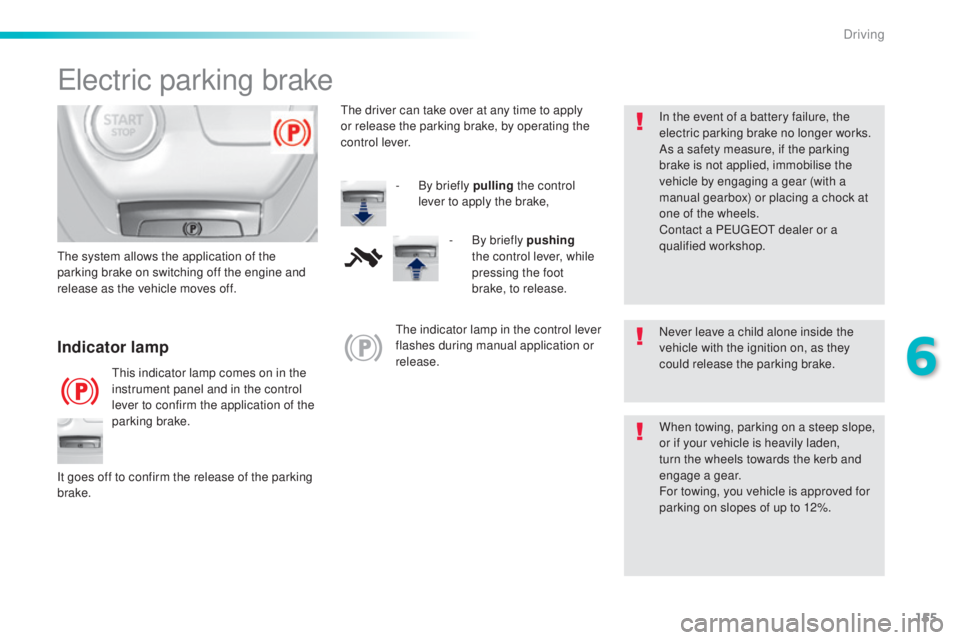
Indicator lamp
this indicator lamp comes on in the
i nstrument panel and in the control
lever to confirm the application of the
parking brake.
the s
ystem allows the application of the
parking brake on switching off the engine and
release as the vehicle moves off.
When towing, parking on a steep slope,
or if your vehicle is heavily laden,
turn the wheels towards the kerb and
engage a gear.
For towing, you vehicle is approved for
parking on slopes of up to 12%.
It goes off to confirm the release of the parking
brake.
the i
ndicator lamp in the control lever
flashes during manual application or
release. In the event of a battery failure, the
electric parking brake no longer works.
As a safety measure, if the parking
brake is not applied, immobilise the
vehicle by engaging a gear (with a
manual gearbox) or placing a chock at
one of the wheels.
Contact a P
eu
ge
Ot d
ealer or a
qualified workshop.
the d
river can take over at any time to apply
or release the parking brake, by operating the
control lever.
-
By b
riefly pulling
the control
lever to apply the brake,
-
By b
riefly pushing
the control lever, while
pressing the foot
brake, to release.
6
Driving
Page 158 of 398
156
308_en_Chap06_conduite_ed02-2015
Automatic release
the complete release of the parking
b rake is confirmed by the brake
indicator lamp and the P indicator
lamp in the control lever going off,
accompanied by the display of the
message "Parking brake released".
When stationary with the engine running, do not
depress the accelerator pedal unnecessarily, you
risk releasing the parking brake.
Automatic application
Application of of the parking brake
is confirmed by illumination of the
brake indicator lamp and the P
indicator lamp in the control lever,
accompanied by the display of the
message "Parking brake applied".
With the engine stalled or in S
tOP
m
ode of Stop & Start, automatic
application does not take place.
With automatic operation, you can
manually apply or release the parking
brake using the control lever.
ens
ure first that the engine is running and the
driver's door is properly closed.
the e
lectric parking brake releases
automatically and progressively when you
press the accelerator : With the vehicle stationary, the parking brake is
automatically applied when the ignition is
switched off
.
With a manual gearbox
F Fully depress the clutch pedal, engage 1st
or reverse gear.
F
Pr
ess the accelerator pedal and release
the clutch pedal.
With an automatic gearbox
F Select position D , M or R.
F Pr ess the accelerator pedal.
Driving
Page 159 of 398
157
308_en_Chap06_conduite_ed02-2015
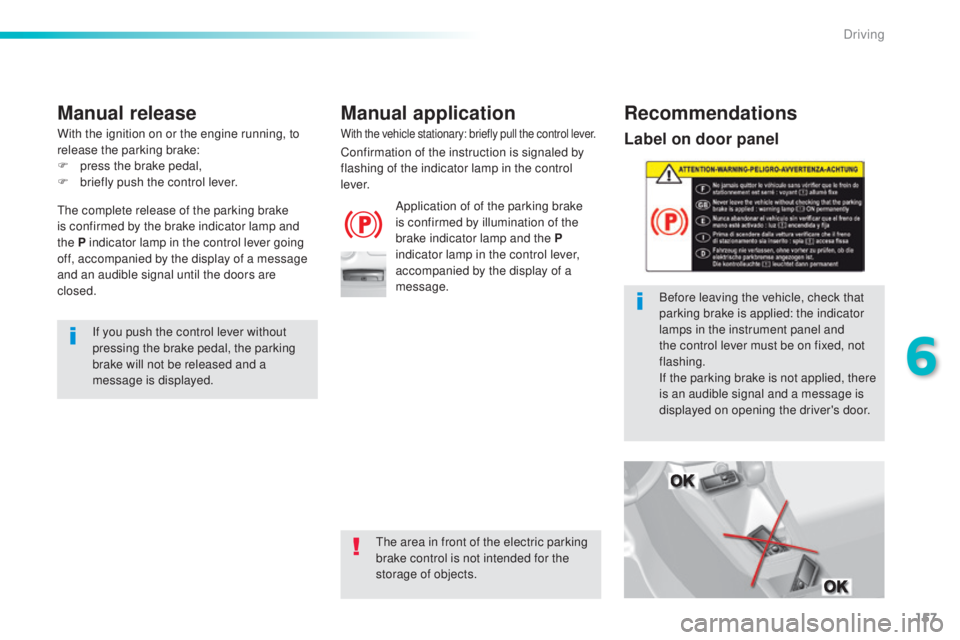
Label on door panel
Before leaving the vehicle, check that
parking brake is applied: the indicator
lamps in the instrument panel and
the control lever must be on fixed, not
flashing.
If the parking brake is not applied, there
is an audible signal and a message is
displayed on opening the driver's door.
Application of of the parking brake
is confirmed by illumination of the
brake indicator lamp and the P
indicator lamp in the control lever,
accompanied by the display of a
message.
Manual release
If you push the control lever without
pressing the brake pedal, the parking
brake will not be released and a
message is displayed.
With the vehicle stationary: briefly pull the control lever.
Confirmation of the instruction is signaled by
flashing of the indicator lamp in the control
l eve r.
With the ignition on or the engine running, to
release the parking brake:
F pr
ess the brake pedal,
F
br
iefly push the control lever.
Manual application Recommendations
the area in front of the electric parking
b rake control is not intended for the
storage of objects.
the c
omplete release of the parking brake
is confirmed by the brake indicator lamp and
the
P
indicator lamp in the control lever going
off, accompanied by the display of a message
and an audible signal until the doors are
closed.
6
Driving
Page 160 of 398
158
308_en_Chap06_conduite_ed02-2015
Immobilising the vehicle
with the engine running
Application of of the parking brake
is confirmed by illumination of the
brake indicator lamp and the P
indicator lamp in the control lever,
accompanied by the display of a
message.
the c
omplete release of the parking
brake is confirmed by the brake
indicator lamp and the P indicator
lamp in the control lever going off,
accompanied by the display of a
message.
to im
mobilise the vehicle with the engine
running, briefly pull the control lever. In very cold conditions (risk of
freezing), recovery, car wash tunnel, it
is recommended that the parking brake
not be applied.
Parking the vehicle with the
parking brake released
F Switch off the ignition.
F
Re
lease the parking brake manually by
pushing the control lever while keeping
your foot on the brake.
to i
mmobilise your vehicle, engage a
gear or fit a chock to one of the wheels.
F
Sw
itch off the engine.
Application of the parking brake is confirmed
by illumination of of the indicator lamps in the
instrument panel and the control lever.
F
Sw
itch the ignition on again, without
starting the engine.
Driving
Page 170 of 398
168
308_en_Chap06_conduite_ed02-2015
F Select position M for sequential c hanging
of the six gears.
F
Pu
ll towards the + sign and release to
change up a gear.
F
Pu
sh towards the - sign and release to
change down a gear.
It is only possible to change from one gear to
another if the vehicle speed and engine speed
permit; otherwise, the gearbox will operate
temporarily in automatic mode.
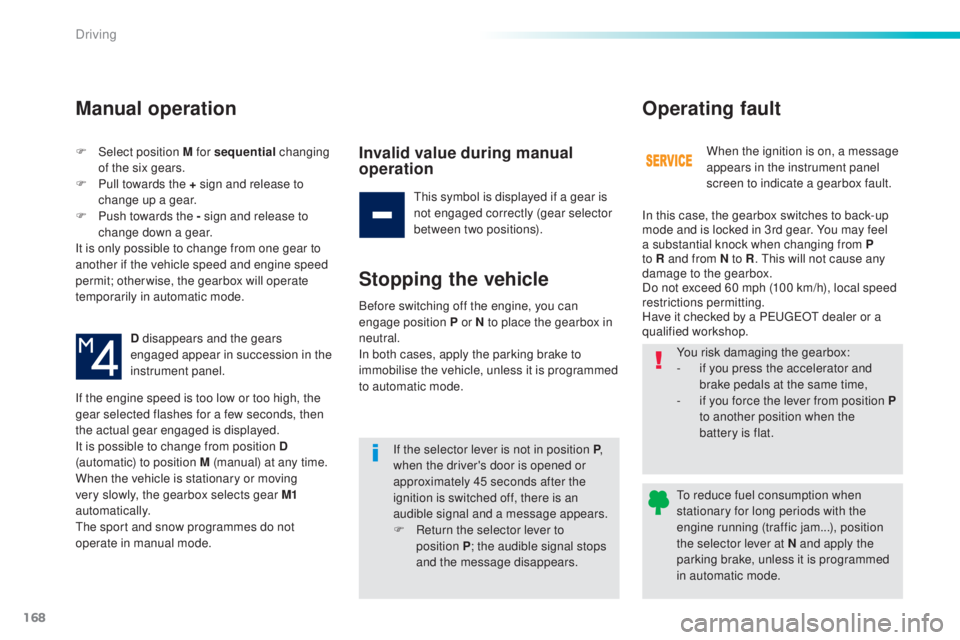
D disappears and the gears
engaged appear in succession in the
instrument panel.
If the engine speed is too low or too high, the
gear selected flashes for a few seconds, then
the actual gear engaged is displayed.
It is possible to change from position D
(automatic) to position M (manual) at any time.
When the vehicle is stationary or moving
very slowly, the gearbox selects gear M1
automatically.
the s
port and snow programmes do not
operate in manual mode.
Manual operation
Invalid value during manual
operation
this symbol is displayed if a gear is
n ot engaged correctly (gear selector
between two positions).
Stopping the vehicle
If the selector lever is not in position P ,
when the driver's door is opened or
approximately 45 seconds after the
ignition is switched off, there is an
audible signal and a message appears.
F
Re
turn the selector lever to
position
P ; t
he audible signal stops
and the message disappears. When the ignition is on, a message
appears in the instrument panel
screen to indicate a gearbox fault.
Operating fault
In this case, the gearbox switches to back-up
mode and is locked in 3rd gear. You may feel
a substantial knock when changing from P
to R and from N to R
.
thi
s will not cause any
damage to the gearbox.
Do not exceed 60 mph (100 km/h), local speed
restrictions permitting.
Have it checked by a P
eu
ge
Ot d
ealer or a
qualified workshop.
Before switching off the engine, you can
engage position P or N to place the gearbox in
neutral.
In both cases, apply the parking brake to
immobilise the vehicle, unless it is programmed
to automatic mode. You risk damaging the gearbox:
-
if y
ou press the accelerator and
brake pedals at the same time,
-
if y
ou force the lever from position
P
to another position when the
battery is flat.
to re
duce fuel consumption when
stationary for long periods with the
engine running (traffic jam...), position
the selector lever at N and apply the
parking brake, unless it is programmed
in automatic mode.
Driving
Page 172 of 398
170
308_en_Chap06_conduite_ed02-2015
Stop & Start
Operation
Going into engine STOP mode
the "ECO" warning lamp comes on
in the instrument panel and the engine
goes into standby automatically:
-
Wi
th a manual gearbox , at speeds below
12 mph (20 km/h) or vehicle stationary
(depending on the engine), when you place
the gear lever in neutral, and you release
the clutch pedal.
Never refuel with the engine in S
tOP
m
ode; you must switch off the ignition
with the button. For your comfort, during parking
manoeuvres, S
tOP m
ode is not
available for a few seconds after
coming out of reverse gear.
S
tOP m
ode does not affect the
functionality of the vehicle, such as for
example, braking, power steering...
A slight delay between the vehicle
stopping and the engine cutting out may
be noticed.
Special cases: STOP mode not
available
StOP mode is not invoked principally when:
- th e vehicle is on a steep slope (up or down),
-
the
driver's door is open,
-
th
e driver's seat belt is not fastened,
-
th
e vehicle has not exceeded 6 mph
(10
k
m/h) since the last engine start by the
driver,
-
th
e electric parking brake is applied or
being applied,
-
th
e engine is needed to maintain a
comfortable temperature in the passenger
compartment,
-
dem
isting is active,
-
som
e special conditions (battery charge,
engine temperature, braking assistance,
ambient temperature...) where the engine is
needed to assure control of a system.
If your vehicle is fitted with Stop & Start,
a time counter calculates the time spent
in S
tOP m
ode during a journey.In this case, the "ECO" warning
lamp flashes for a few seconds then
goes
o
ff.
This operation is perfectly normal.
the S
top & Start
s
ystem puts the engine temporarily into standby - S
tOP m
ode - during stops in the traffic (red lights, traffic jams, or other...).
the e
ngine restarts automatically - S
tARt m
ode - as soon as you want to move off.
the r
estart takes place instantly, quickly and
silently.
Per fect for urban use, the Stop & Start system reduces fuel consumption and exhaust emissions as well as the noise level when stationary.
Stop & Start time
counter
(minutes / seconds or hours / minutes) -
Wi
th an automatic gearbox
, vehicle
stationary, when you press the brake
pedal or place the gear selector lever in
position
N .
I
t resets to zero every time the ignition is
switched on.
Driving
Page 174 of 398
172
308_en_Chap06_conduite_ed02-2015
Operating fault
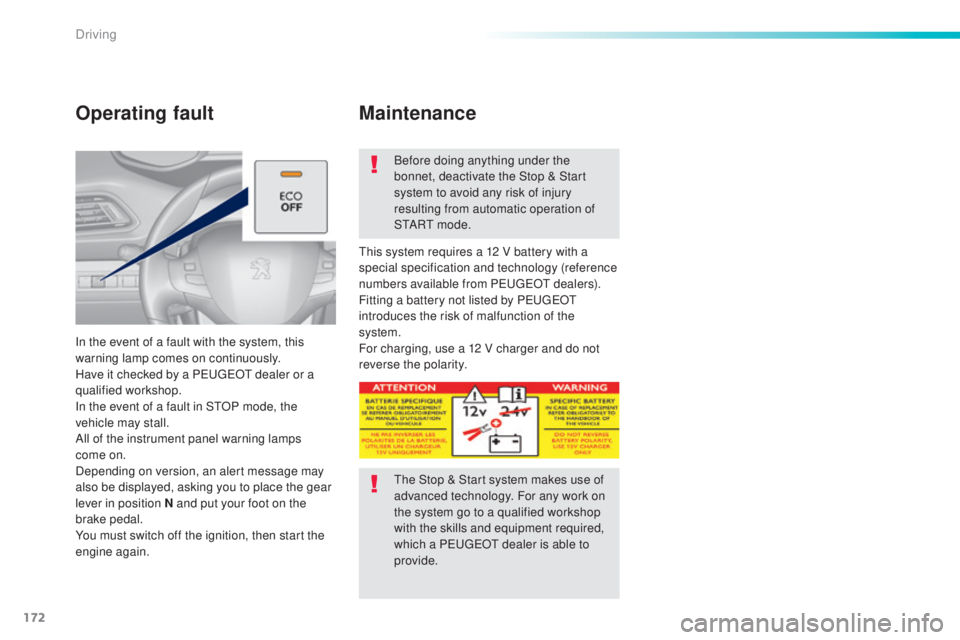
In the event of a fault with the system, this
warning lamp comes on continuously.
Have it checked by a P
eu
ge
Ot d
ealer or a
qualified workshop.
In the event of a fault in S
tOP m
ode, the
vehicle may stall.
All of the instrument panel warning lamps
come on.
Depending on version, an alert message may
also be displayed, asking you to place the gear
lever in position N and put your foot on the
brake pedal.
You must switch off the ignition, then start the
engine again. Before doing anything under the
bonnet, deactivate the Stop & Start
system to avoid any risk of injury
resulting from automatic operation of
S
tA
R
t m o
d e .
thi
s system requires a 12 V battery with a
special specification and technology (reference
numbers available from P
eug
e
Ot de
alers).
Fitting a battery not listed by P
eu
ge
Ot
i
ntroduces the risk of malfunction of the
system.
For charging, use a 12 V charger and do not
reverse the polarity.
Maintenance
the Stop & Start system makes use of
a dvanced technology. For any work on
the system go to a qualified workshop
with the skills and equipment required,
which a P
eu
ge
Ot d
ealer is able to
provide.
Driving
Page 176 of 398
174
308_en_Chap06_conduite_ed02-2015
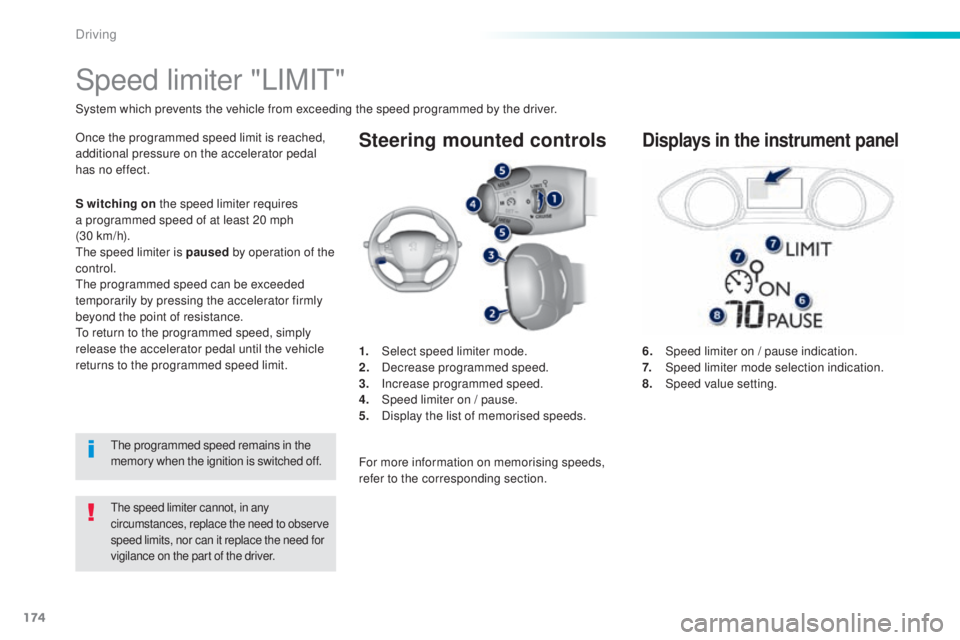
Steering mounted controls
6. Speed limiter on / pause indication.
7. Speed limiter mode selection indication.
8.
Speed
value setting.
Speed limiter "LIMIt"
System which prevents the vehicle from exceeding the speed programmed by the driver.
the speed limiter cannot, in any
c ircumstances, replace the need to observe
speed limits, nor can it replace the need for
vigilance on the part of the driver.
Once the programmed speed limit is reached,
additional pressure on the accelerator pedal
has no effect.
1.
Selec
t speed limiter mode.
2.
Dec
rease programmed speed.
3.
Inc
rease programmed speed.
4.
Sp
eed limiter on / pause.
5.
Di
splay the list of memorised speeds.Displays in the instrument panel
S witching on the speed limiter requires
a programmed speed of at least 20 mph
(30
k
m/h).
the s
peed limiter is paused by operation of the
control.
the
programmed speed can be exceeded
temporarily by pressing the accelerator firmly
beyond the point of resistance.
to re
turn to the programmed speed, simply
release the accelerator pedal until the vehicle
returns to the programmed speed limit.
the p
rogrammed speed remains in the
memory when the ignition is switched off. For more information on memorising speeds,
refer to the corresponding section.
Driving