maintenance Peugeot 308 2016 Owner's Manual
[x] Cancel search | Manufacturer: PEUGEOT, Model Year: 2016, Model line: 308, Model: Peugeot 308 2016Pages: 398, PDF Size: 9.38 MB
Page 2 of 398
On-line handbook
Select one of the following means of access to view your
handbook on-line...
Referring to the handbook on-line also gives you access to the latest information available, easily identified by the bookmark, associated with
this symbol:If the "My
Peuge
Ot" fu
nction is not available on the Peuge
Ot
pu
blic website for your country, you can find your handbook at the
following address:
http://public.servicebox.peugeot.com/ddb/
the language,
the vehicle, its body style,
the print edition of your handbook appropriate for the date of registration of
your vehicle.
Select:
Find your handbook on the Peuge
Ot
we
bsite, under
"My Peuge
Ot". Sc
an this code for direct access to your handbook.
thi
s personal space offers advice and other useful information for
the care and maintenance of your vehicle.
Page 11 of 398
9
308_en_Chap00b_vue-ensemble_ed02-2015
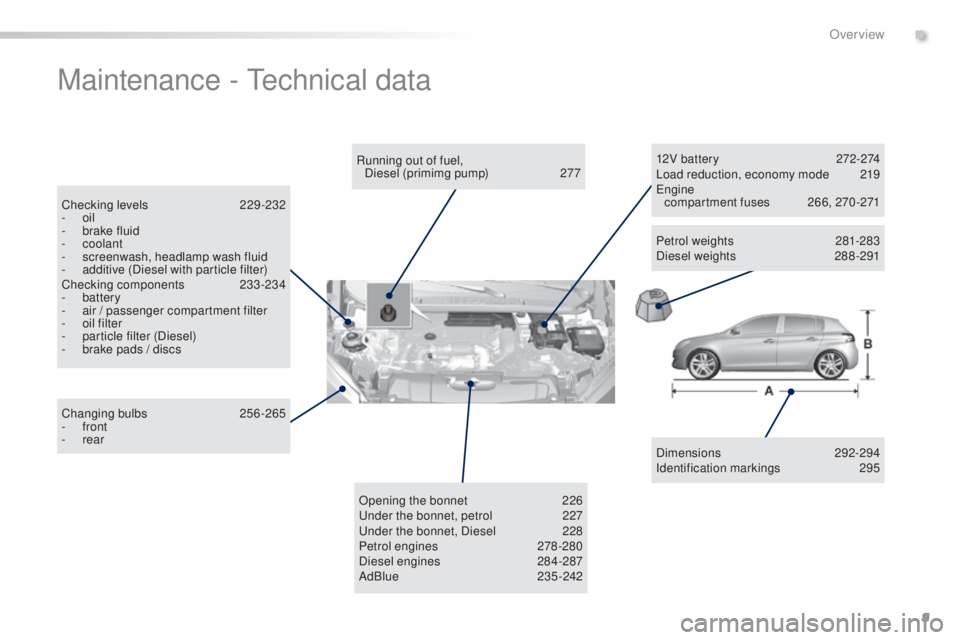
Maintenance - technical data
Dimensions 2 92-294
Identification markings 29 5
Running out of fuel,
Diesel (primimg pump)
27
7
Checking levels
22
9-232
-
o
il
-
br
ake fluid
-
c
oolant
-
sc
reenwash, headlamp wash fluid
-
ad
ditive (Diesel with particle filter)
Checking components
233
-234
-
b
attery
-
ai
r / passenger compartment filter
-
oi
l filter
-
pa
rticle filter (Diesel)
-
br
ake pads / discs
Changing bulbs
25
6-265
-
f
ront
- r
ear 12V battery
27
2-274
Load reduction, economy
mo
de
21
9
engin
e
compartment fuses
26
6, 270 -271
Opening the bonnet
22
6
und
er the bonnet, petrol
22
7
und
er the bonnet, Diesel
22
8
Petrol engines
27
8 -280
Diesel engines
28
4-287
AdBlue
2
35-242 Petrol weights
28
1-283
Diesel weights
28
8 -291
.
Over view
Page 13 of 398
11
308_en_Chap00c_eco-conduite_ed02-2015
Limit the causes of excess consumption
Spread loads throughout the vehicle; place the heaviest items in the
bottom of the boot, as close as possible to the rear seats.
Limit the loads carried in the vehicle and reduce wind resistance (roof
bars, roof rack, bicycle carrier, trailer...).
use a r
oof box in preference.
Remove roof bars and roof racks after use.
At the end of winter, remove snow tyres and refit your summer tyres.
Observe the recommendations on
maintenance
Check the tyre pressures regularly, when cold, referring to the label in
the door aperture, driver's side.
Carry out this check in particular:
-
be
fore a long journey,
-
at e
ach change of season,
-
af
ter a long period out of use.
Don't forget the spare wheel and the tyres on any trailer or caravan.
Have your vehicle serviced regularly (engine oil, oil filter, air filter,
passenger compartment filter...) and observe the schedule of
operations recommended in the manufacturer's service schedule.
With a BlueHDi Diesel engine, if the SCR system is faulty your vehicle
becomes polluting; go to a P
eu
ge
Ot d
ealer or a qualified workshop
without delay to have the emissions of nitrous oxides brought back to
the legal level.
When refuelling, do not continue after the third cut-off of the nozzle to
avoid any over flow.
At the wheel of your new vehicle, it is only after the first 1 800 miles
(3
0
00 kilometres) that you will see the fuel consumption settle down to
a consistent average.
.
eco-driving
Page 93 of 398
91
308_en_Chap03_ergonomie-et-confort_ed02-2015
In order for these systems to be fully effective, follow the operation and maintenance
guidelines below:
F
t
o ob
tain an even air distribution, take care not to obstruct the exterior air intake grilles
located at the base of the windscreen, the nozzles, the vents and the air outlets, as well
as the air extractor located in the boot.
F
Do n
ot cover the sunshine sensor, located on the dashboard; this is used for regulation
of the air conditioning system.
F
Op
erate the air conditioning system for at least 5 to 10 minutes, once or twice a month
to keep it in per fect working order.
F
e
ns
ure that the passenger compartment filter is in good condition and have the filter
elements replaced regularly.
We r
ecommend the use of a combined passenger compartment filter.
tha
nks to its
special active additive, it contributes to the purification of the air breathed by the
occupants and the cleanliness of the passenger compartment (reduction of allergic
symptoms, bad odours and greasy deposits).
F
t
o en
sure correct operation of the air conditioning system, you are also advised to have
it checked regularly as recommended in the warranty and maintenance record.
F
If t
he system does not produce cold air, switch it off and contact a P
eu
ge
Ot d
ealer or
a qualified workshop.
Recommendations for ventilation and air conditioning
If after an extended stop in sunshine,
the interior temperature is very high, first
ventilate the passenger compartment for
a few moments.
Put the air flow control at a setting high
enough to quickly change the air in the
passenger compartment.
the a
ir conditioning system does not
contain chlorine and does not present
any danger to the ozone layer.
the c
ondensation created by the air
conditioning results in a discharge
of water under the vehicle which is
perfectly normal.
When towing the maximum load on a steep gradient in high temperatures, switching off the
air conditioning increases the available engine power and so improves the towing ability.
Stop & Start
the heating and air conditioning
s ystems only work when the engine
is running.
to ma
intain a comfortable
temperature in the passenger
compartment, you can temporarily
deactivate the Stop & Start system (see
the corresponding section).
3
ease of use and comfort
Page 168 of 398
166
308_en_Chap06_conduite_ed02-2015
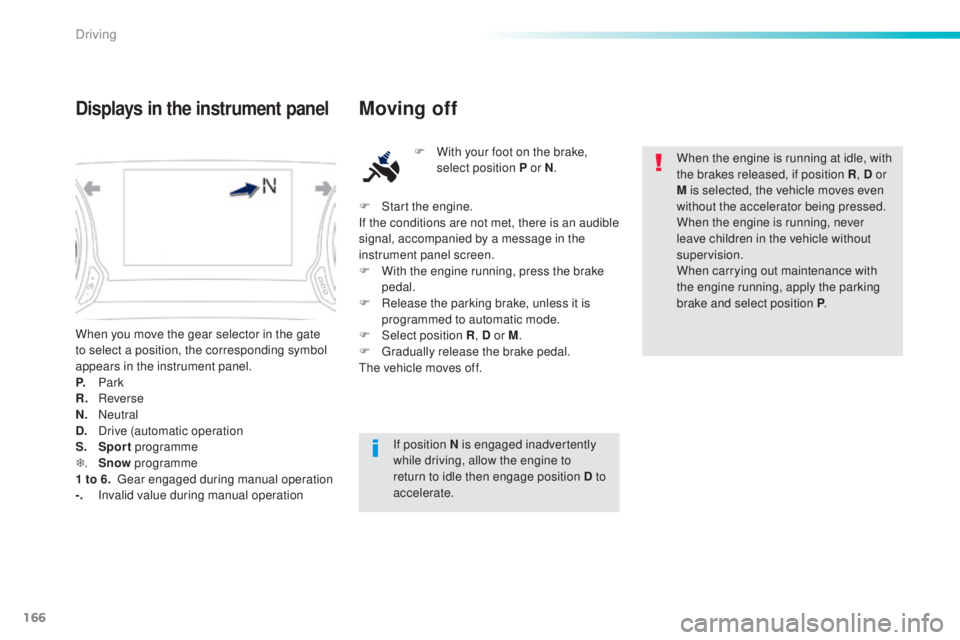
When you move the gear selector in the gate
to select a position, the corresponding symbol
appears in the instrument panel.
P.
Pa
rk
R.
Re
verse
N.
Ne
utral
D.
Dr
ive (automatic operation
S.
Sp
ort programme
T .
Sn
ow programme
1 to 6.
g
ear
engaged during manual operation
-.
In
valid value during manual operation
Displays in the instrument panelMoving off
F With your foot on the brake,
select position P or N .
If position N is engaged inadvertently
while driving, allow the engine to
return to idle then engage position D to
accelerate. When the engine is running at idle, with
the brakes released, if position R
, D or
M is selected, the vehicle moves even
without the accelerator being pressed.
When the engine is running, never
leave children in the vehicle without
supervision.
When carrying out maintenance with
the engine running, apply the parking
brake and select position P .
F
St
art the engine.
If the conditions are not met, there is an audible
signal, accompanied by a message in the
instrument panel screen.
F
Wi
th the engine running, press the brake
pedal.
F
Re
lease the parking brake, unless it is
programmed to automatic mode.
F
Selec
t position R , D or M.
F
g
rad
ually release the brake pedal.
the v
ehicle moves off.
Driving
Page 174 of 398
172
308_en_Chap06_conduite_ed02-2015
Operating fault
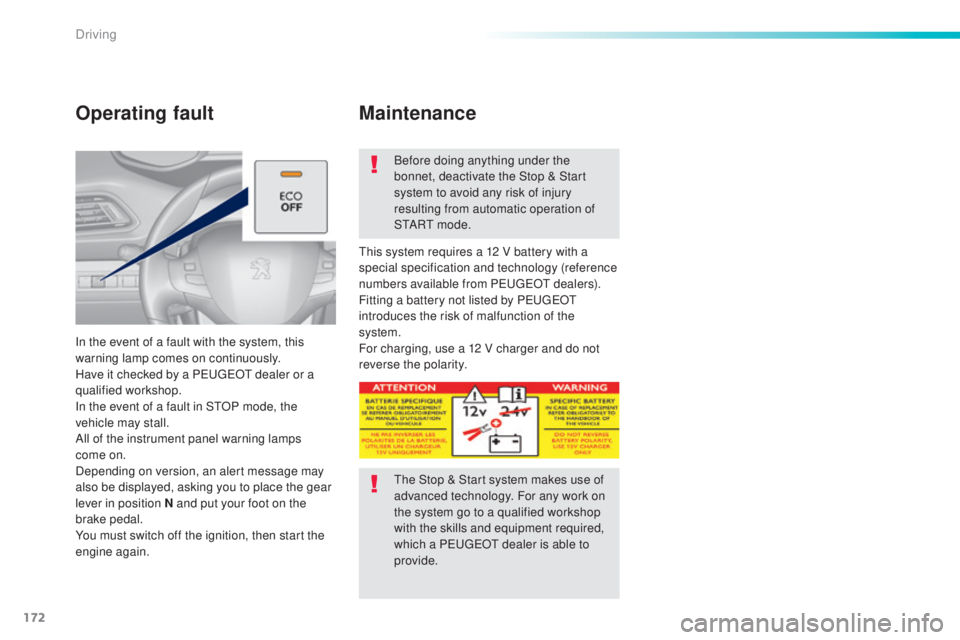
In the event of a fault with the system, this
warning lamp comes on continuously.
Have it checked by a P
eu
ge
Ot d
ealer or a
qualified workshop.
In the event of a fault in S
tOP m
ode, the
vehicle may stall.
All of the instrument panel warning lamps
come on.
Depending on version, an alert message may
also be displayed, asking you to place the gear
lever in position N and put your foot on the
brake pedal.
You must switch off the ignition, then start the
engine again. Before doing anything under the
bonnet, deactivate the Stop & Start
system to avoid any risk of injury
resulting from automatic operation of
S
tA
R
t m o
d e .
thi
s system requires a 12 V battery with a
special specification and technology (reference
numbers available from P
eug
e
Ot de
alers).
Fitting a battery not listed by P
eu
ge
Ot
i
ntroduces the risk of malfunction of the
system.
For charging, use a 12 V charger and do not
reverse the polarity.
Maintenance
the Stop & Start system makes use of
a dvanced technology. For any work on
the system go to a qualified workshop
with the skills and equipment required,
which a P
eu
ge
Ot d
ealer is able to
provide.
Driving
Page 223 of 398
221
308_en_Chap07_info-pratiques_ed02-2015
the fitting of electrical equipment
o r accessories which are not
recommended by P
eu
ge
Ot m
ay result
in a failure of your vehicle's electronic
system and excessive electrical
consumption.
Contact a P
eu
ge
Ot d
ealer
for information on the range of
recommended equipment and
accessories.
Installation of radio
communication
transmitters
Before installing any after-market radio
communication transmitter, you can
contact a P
eu
ge
Ot d
ealer for the
specification of transmitters which can
be fitted (frequency, maximum power,
aerial position, specific installation
requirements), in line with the Vehicle
ele
ctromagnetic Compatibility
Directive
(
2004/104/
eC)
. Depending on the legislation in force in
the country, certain safety equipment
may be compulsory: high visibility
safety vests, warning triangles,
breathalyzers, spare bulbs, spare fuses,
fire extinguisher, first aid kit, mud flaps
at the rear of the vehicle.
By visiting a P
eu
ge
Ot d
ealer, you can also
obtain products for cleaning and maintenance
(exterior and interior) - including ecological
products in the "
teCH
NA
tuRe" ra
nge, topping
up products (screenwash...), touch-up pens
and paint aerosols for the exact colour of your
vehicle, refills (cartridge for the temporary
puncture repair kit...), ...
7
Practical information
Page 235 of 398
233
308_en_Chap07_info-pratiques_ed02-2015
Checks
12 V battery
the battery does not require any maintenance.
H owever, check that the terminals are clean
and correctly tightened, particularly in summer
and winter.Refer to the manufacturer's
service schedule for details of the
replacement intervals for these
components.
Air filter and passenger compartment filter
Replace the oil filter each time the
engine oil is changed.
Refer to the manufacturer's
service schedule for details of
the replacement interval for this
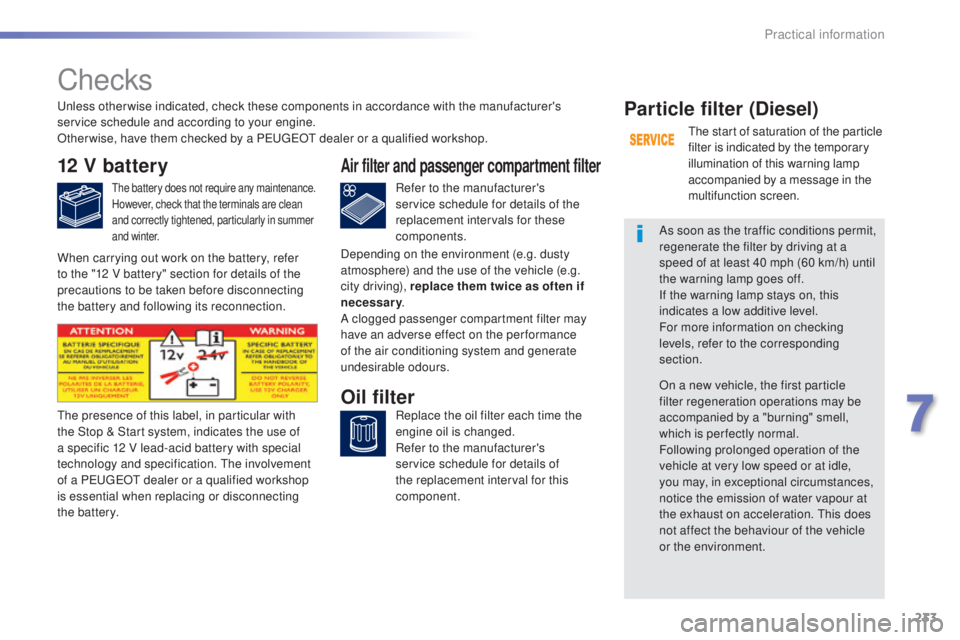
component.Oil filterthe presence of this label, in particular with
t he Stop & Start system, indicates the use of
a specific 12 V lead-acid battery with special
technology and specification.
the
involvement
of a P
eu
ge
Ot d
ealer or a qualified workshop
is essential when replacing or disconnecting
the battery.
Particle filter (Diesel)
the start of saturation of the particle
f ilter is indicated by the temporary
illumination of this warning lamp
accompanied by a message in the
multifunction screen.
As soon as the traffic conditions permit,
regenerate the filter by driving at a
speed of at least 40 mph (60 km/h) until
the warning lamp goes off.
If the warning lamp stays on, this
indicates a low additive level.
For more information on checking
levels, refer to the corresponding
section.
On a new vehicle, the first particle
filter regeneration operations may be
accompanied by a "burning" smell,
which is per fectly normal.
Following prolonged operation of the
vehicle at very low speed or at idle,
you may, in exceptional circumstances,
notice the emission of water vapour at
the exhaust on acceleration.
thi
s does
not affect the behaviour of the vehicle
or the environment.
unl
ess otherwise indicated, check these components in accordance with the manufacturer's
service schedule and according to your engine.
Other wise, have them checked by a Peu
geOt d
ealer or a qualified workshop.
When carrying out work on the battery, refer
to the "12 V battery" section for details of the
precautions to be taken before disconnecting
the battery and following its reconnection. Depending on the environment (e.g. dusty
atmosphere) and the use of the vehicle (e.g.
city driving), replace them twice as often if
necessary
.
A clogged passenger compartment filter may
have an adverse effect on the per formance
of the air conditioning system and generate
undesirable odours.
7
Practical information
Page 388 of 398
386
308_en_Chap11_index-alpha_ed02-2015
Net, high load retaining ...................................89
N umber plate lamps ...................................... 265P
arking sensors, front ...................................19 8
Parking sensors, rear .................................... 198
P
eu
ge
Ot C
onnect Apps
.............................3
45
P
eu
ge
Ot C
onnect Assistance
...................29
6
P
eu
ge
Ot C
onnect Packs
...........................29
6
P
eu
ge
Ot C
onnect SOS
.............................296
Peu
ge
Ot C
onnect Sound (RD5)
................3
63
Plates, identification ...................................... 295
Player, Apple
® ....................................... 31 8, 373
Player, MP3 CD ............................... ......3 17, 3 7 2
Port,
uSB .................................. 80
, 83, 316, 370
Pressures, tyres
........................... 2
44, 249, 295
Pre-tensioning seat belts
.............................. 12
5
Priming the fuel system
................................ 2
77
Protecting children
................. 12
5, 127, 13 0 -14 5
Puncture
................
........................................ 244
Long objects, transporting
..............................
85
Lo
w fuel level
..............................
............
2 2, 213
Luggage retaining strap
............................ 8
6, 87
Lumbar
...............................
.......................
72, 76
Maintenance, routine
...................................... 10
M
ap reading lamps
....................................... 10
4
Markings, identification
................................. 29
5
Massage function
...............................
............. 76
Mat
.......
........................................................... 81
Memorising a speed
..................................... 17
3
Menu, main
..............................
..................... 366
Menus (audio)
...................... 3
06, 308, 310, 320,
322, 326, 346, 348
Menus (
touc
h screen)
................. 29
9, 304, 305
Mirror, rear view
............................................ 10
7
Mirrors, door .................................. 102, 10 6, 195
Misfuel prevention
......................................... 2
14
Mountings, Isofix
...............................
.... 13 9, 14 0
MP3 CD
................
................................. 3 17, 3 7 2Oil change
...............................
...................... 229
Oil consumption
............................................ 2
29
OIl, engine
...............................
...................... 229
Opening the bonnet
...................................... 226
O
pening the boot
................... 48
, 54, 56, 58, 59
Opening the doors
............................. 48
, 54, 56
Pads, brake
................................................... 23
4
Paint colour code
.......................................... 29
5
Panoramic glass sunroof
.............................. 10
3
Parcel shelf, rear
............................................. 86
Pa
rk Assist
...............................
............. 201-208
Parking brake
.................................. 15
, 15 4, 23 4
Parking brake, electric
................... 2
0, 155, 234 Radio
...............
...................................... 312, 3 6 6
Radio, digital (Digital Audio Broadcasting - DAB)
........................... 3
14, 3 6 8
Range, AdBlue
...............................
...............236
RDS
................
....................................... 313, 3 67
Rear screen, demisting
................................. 10
2
Recharging the battery
................................. 2 74
R
ecirculation, air
...............................
............10 0
Reduction of electrical load
.......................... 2
19
Regeneration of the particle filter
........
..................................................... 233
M
O
P
R
N
Alphabetical index