instrument panel PEUGEOT 308 2016 User Guide
[x] Cancel search | Manufacturer: PEUGEOT, Model Year: 2016, Model line: 308, Model: Peugeot 308 2016Pages: 344, PDF Size: 12.23 MB
Page 86 of 344
84
3008_en_Chap04_visibilite_ed01-2015
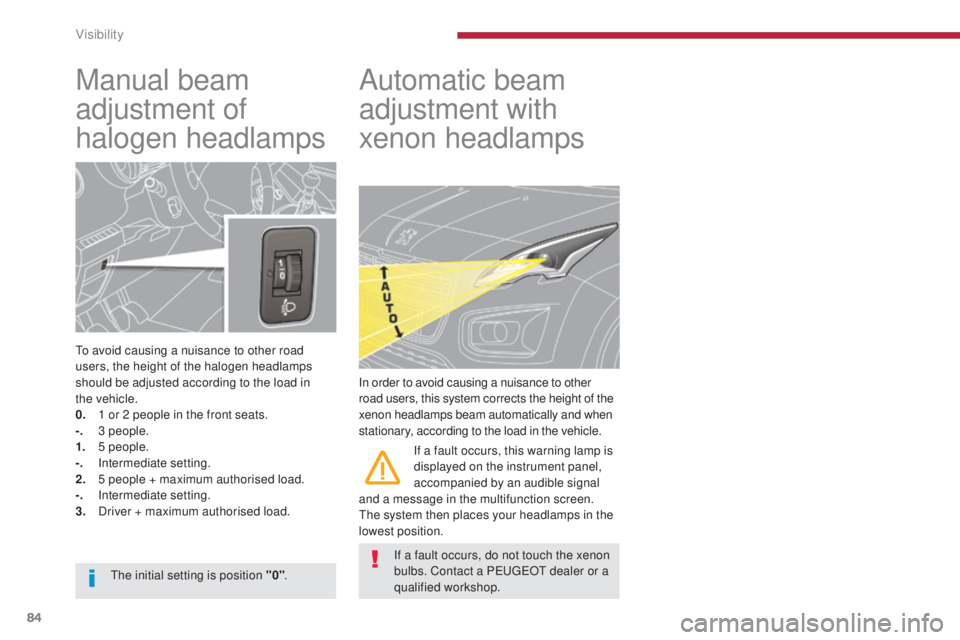
Manual beam
adjustment of
halogen headlamps
To avoid causing a nuisance to other road
users, the height of the halogen headlamps
should be adjusted according to the load in
the
vehicle.
0.
1 o
r 2 people in the front seats.
-.
3
people.
1.
5
people.
-.
I
ntermediate setting.
2.
5 p
eople + maximum authorised load.
-.
I
ntermediate setting.
3.
D
river + maximum authorised load.
Automatic beam
adjustment with
xenon headlamps
In order to avoid causing a nuisance to other
road users, this system corrects the height of the
xenon headlamps beam automatically and when
stationary, according to the load in the vehicle. If a fault occurs, this warning lamp is
displayed on the instrument panel,
accompanied by an audible signal
and a message in the multifunction screen.
The system then places your headlamps in the
lowest position.
The initial setting is position "0" .If a fault occurs, do not touch the xenon
bulbs. Contact a PEUGEOT dealer or a
qualified workshop.
Visibility
Page 87 of 344
85
3008_en_Chap04_visibilite_ed01-2015
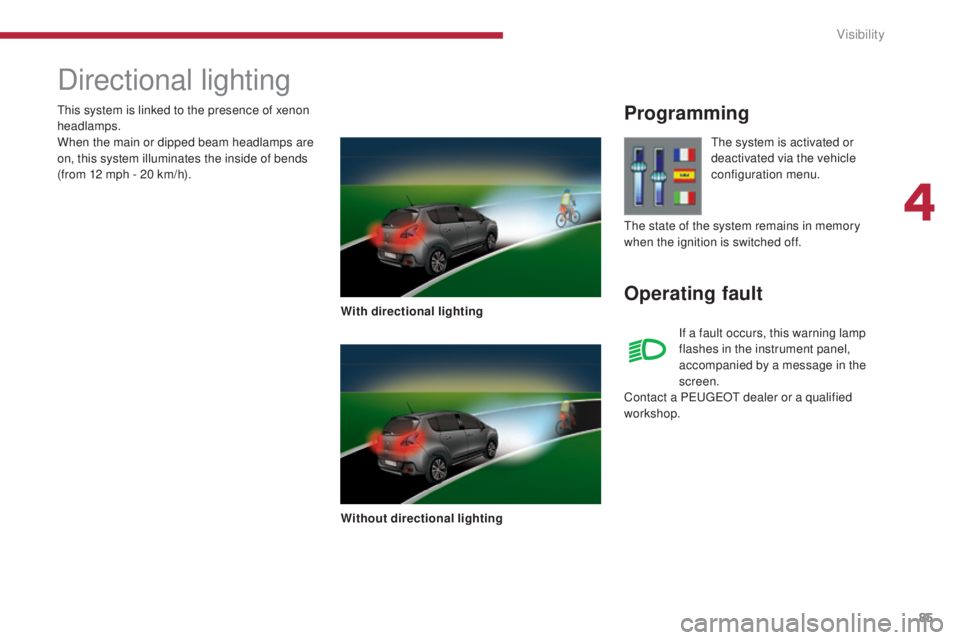
Directional lighting
With directional lighting
Without directional lighting
Programming
Operating fault
The system is activated or
deactivated via the vehicle
configuration menu.
If a fault occurs, this warning lamp
flashes in the instrument panel,
accompanied by a message in the
screen.
Contact a PEUGEOT dealer or a qualified
workshop.
This system is linked to the presence of xenon
headlamps.
When the main or dipped beam headlamps are
on, this system illuminates the inside of bends
(from 12 mph - 20 km/h).
The state of the system remains in memory
when the ignition is switched off.
4
Visibility
Page 90 of 344
88
3008_en_Chap04_visibilite_ed01-2015
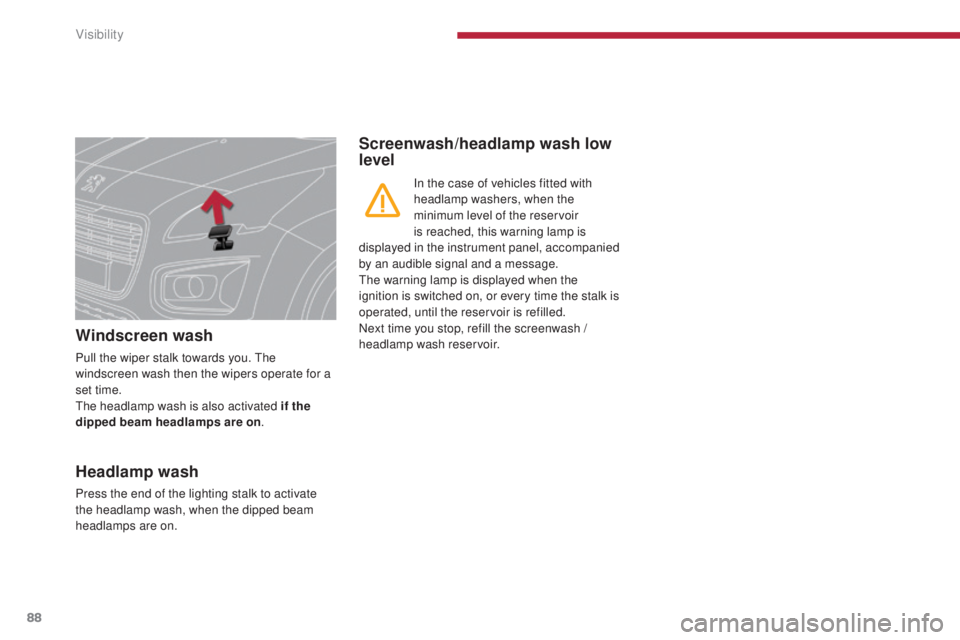
Windscreen wash
Pull the wiper stalk towards you. The
windscreen wash then the wipers operate for a
set time.
The headlamp wash is also activated if the
dipped beam headlamps are on.
Screenwash/headlamp wash low
level
In the case of vehicles fitted with
headlamp washers, when the
minimum level of the reservoir
is reached, this warning lamp is
displayed in the instrument panel, accompanied
by an audible signal and a message.
The warning lamp is displayed when the
ignition is switched on, or every time the stalk is
operated, until the reservoir is refilled.
Next time you stop, refill the screenwash
/
headlamp wash reservoir.
Headlamp wash
Press the end of the lighting stalk to activate
the headlamp wash, when the dipped beam
headlamps are on.
Visibility
Page 127 of 344
125
3008_en_Chap07_securite_ed01-2015
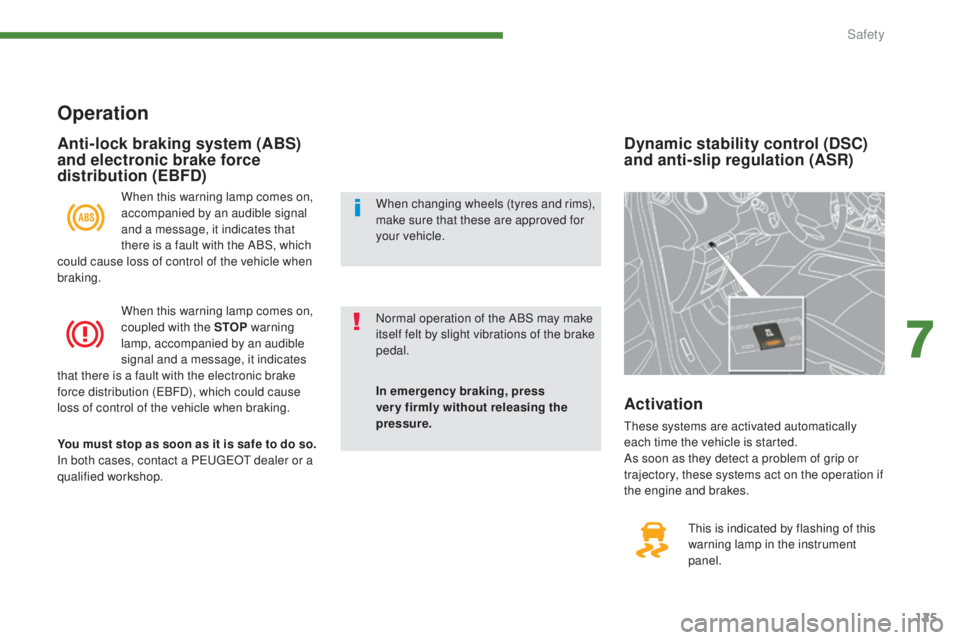
Dynamic stability control (DSC)
and anti-slip regulation (ASR)
This is indicated by flashing of this
warning lamp in the instrument
panel.
Activation
These systems are activated automatically
each time the vehicle is started.
As soon as they detect a problem of grip or
trajectory, these systems act on the operation if
the engine and brakes.
Operation
When this warning lamp comes on,
accompanied by an audible signal
and a message, it indicates that
there is a fault with the ABS, which
could cause loss of control of the vehicle when
braking.
When this warning lamp comes on,
coupled with the STOP warning
lamp, accompanied by an audible
signal and a message, it indicates
that there is a fault with the electronic brake
force distribution (EBFD), which could cause
loss of control of the vehicle when braking.
You must stop as soon as it is safe to do so.
In both cases, contact a PEUGEOT dealer or a
qualified workshop.
Anti-lock braking system (ABS)
and electronic brake force
distribution (EBFD)
In emergency braking, press
very firmly without releasing the
pressure. Normal operation of the ABS may make
itself felt by slight vibrations of the brake
pedal. When changing wheels (tyres and rims),
make sure that these are approved for
your vehicle.
7
Safety
Page 135 of 344
133
3008_en_Chap07_securite_ed01-2015
Operating fault
If this warning lamp comes on,
accompanied by an audible
warning and a message, contact
a PEUGEOT dealer or a qualified
workshop without delay to have the system
checked. The airbags may no longer be
deployed in the event of a serious impact.
Reactivation
When you remove the rear ward facing child
seat, with the ignition off , turn the switch to
the "ON" position to reactivate the airbag and
so assure the safety of your front passenger in
the event of an impact.
When switching the ignition on,
this warning lamp comes on in the
seat belt and passenger's front
airbag warning lamps display for
approximately one minute, to signal
that the passenger's front airbag is
activated.
On switching on the ignition, this
warning lamp comes on in the
instrument panel and/or in the seat
belt and passenger's front airbag
warning lamps display. It stays on
until the airbag is reactivated.
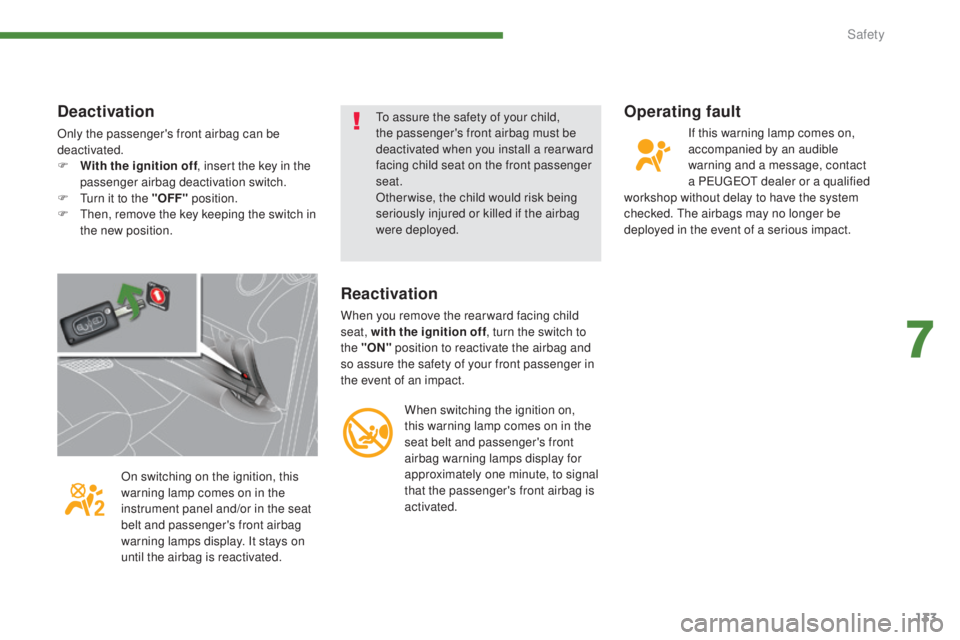
Deactivation
Only the passenger's front airbag can be
deactivated.
F
W
ith the ignition off , insert the key in the
passenger airbag deactivation switch.
F
T
urn it to the "OFF" position.
F
T
hen, remove the key keeping the switch in
the new position. To assure the safety of your child,
the passenger's front airbag must be
deactivated when you install a rear ward
facing child seat on the front passenger
seat.
Otherwise, the child would risk being
seriously injured or killed if the airbag
were deployed.
7
Safety
Page 136 of 344
134
3008_en_Chap07_securite_ed01-2015
Lateral airbags
System which contributes towards improving
the protection of the driver and front passenger
in the event of a serious side impact in order to
limit the risk of injury to the chest.
Each lateral airbag is fitted in the front, in the
outer side of the seat back frame.
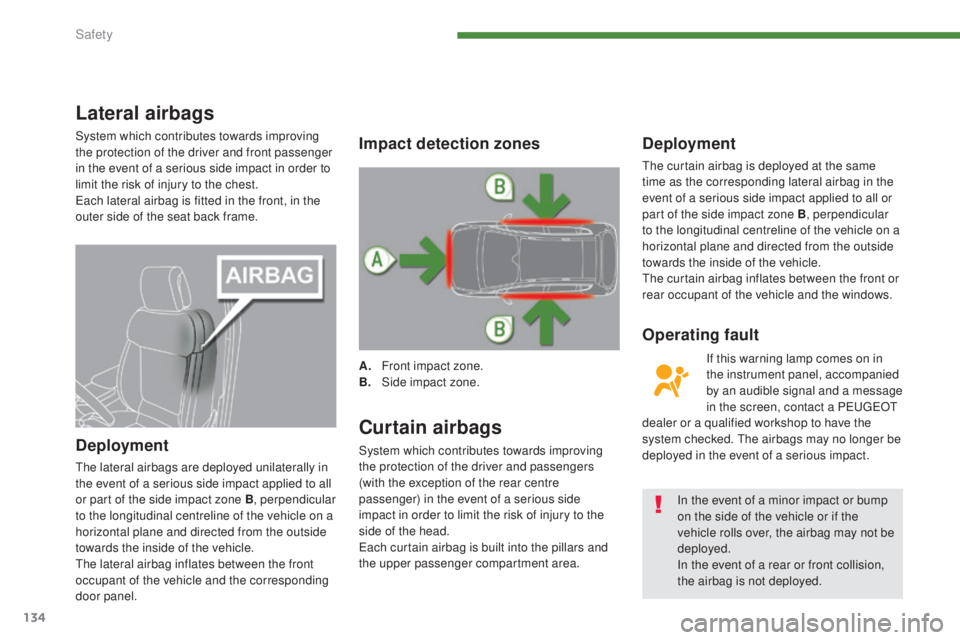
Deployment
The lateral airbags are deployed unilaterally in
the event of a serious side impact applied to all
or part of the side impact zone B, perpendicular
to the longitudinal centreline of the vehicle on a
horizontal plane and directed from the outside
towards the inside of the vehicle.
The lateral airbag inflates between the front
occupant of the vehicle and the corresponding
door panel.
Curtain airbags
System which contributes towards improving
the protection of the driver and passengers
(with the exception of the rear centre
passenger) in the event of a serious side
impact in order to limit the risk of injury to the
side of the head.
Each curtain airbag is built into the pillars and
the upper passenger compartment area.
Deployment
The curtain airbag is deployed at the same
time as the corresponding lateral airbag in the
event of a serious side impact applied to all or
part of the side impact zone B, perpendicular
to the longitudinal centreline of the vehicle on a
horizontal plane and directed from the outside
towards the inside of the vehicle.
The curtain airbag inflates between the front or
rear occupant of the vehicle and the windows.
Impact detection zones
A. Front impact zone.
B. S ide impact zone.
Operating fault
If this warning lamp comes on in
the instrument panel, accompanied
by an audible signal and a message
in the screen, contact a PEUGEOT
dealer or a qualified workshop to have the
system checked. The airbags may no longer be
deployed in the event of a serious impact.
In the event of a minor impact or bump
on the side of the vehicle or if the
vehicle rolls over, the airbag may not be
deployed.
In the event of a rear or front collision,
the airbag is not deployed.
Safety
Page 140 of 344
138
3008_en_Chap08_conduite_ed01-2015
Wait until this warning lamp goes off in the
instrument panel then operate the starter
motor by turning the key to position 3
without pressing the accelerator pedal,
until the engine starts. Once the engine is
running, release the key.
Starting the engine
In certain cases, you may have to apply
more force to the steering (wheels on
full lock, for example).
F
W
ith a petrol engine, operate the starter
motor by turning the key to position 3
without pressing the accelerator pedal,
until the engine starts. Once the engine is
running, release the key.
F
W
ith a Diesel engine, turn the key to
position 2 , ignition on, to operate the
engine pre-heating system. If the engine does not start straight
away, switch off the ignition. Wait a
few moments before operating the
starter motor again. If the engine does
not start after several attempts, do not
keep trying: you risk damaging the
starter motor or the engine. Contact
a PEUGEOT dealer or a qualified
workshop.
In wintry conditions, the warning lamp
can stay on for a longer period. When
the engine is hot, the warning lamp
does not come on.
With the parking brake applied and the gearbox
in neutral or position N or P
:
F
d
epress the clutch pedal fully (manual
gearbox),
or
F
p
ress the brake pedal firmly (electronic or
automatic gearbox),
F
i
nsert the key into the ignition switch; the
system recognises the code,
F
u
nlock the steering column by simultaneously
turning the steering and the key.
In temperate conditions, do not leave
the engine at idle to warm up but move
off straight away and drive at moderate
speed.Never leave the engine running in
an enclosed area without adequate
ventilation: internal combustion
engines emit toxic exhaust gases,
such as carbon monoxide. Danger of
intoxication and death.
In very severe wintry conditions
(temperatures below -23°C), to ensure
the correct operation and durability of
the mechanical components of your
vehicle, engine and gearbox, it is
necessary to leave the engine running
for 4 minutes before moving off.
Driving
Page 142 of 344
140
3008_en_Chap08_conduite_ed01-2015
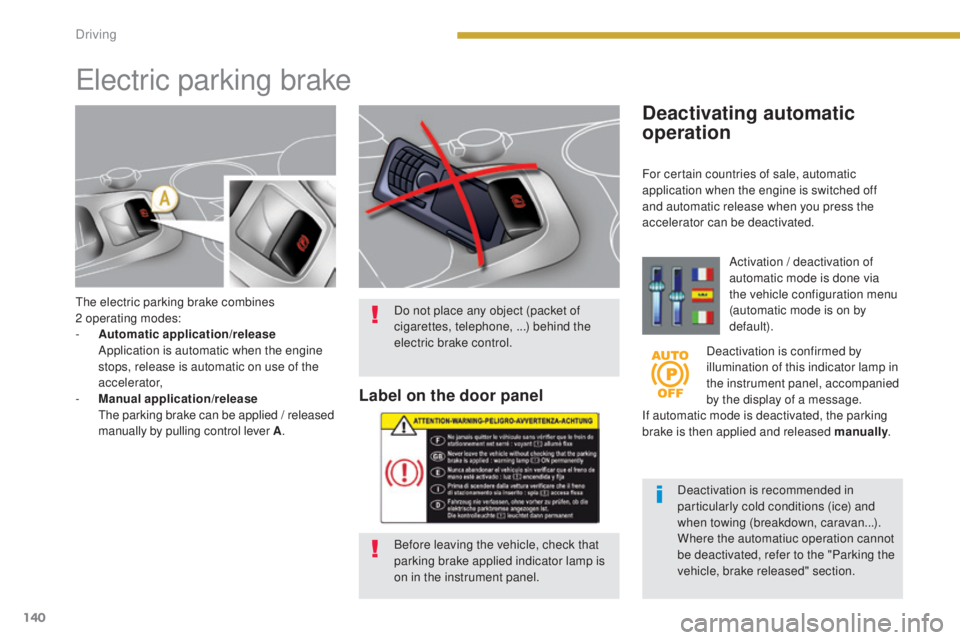
The electric parking brake combines
2 operating modes:
-
A
utomatic application/release
A
pplication is automatic when the engine
stops, release is automatic on use of the
accelerator,
-
M
anual application/release
T
he parking brake can be applied / released
manually by pulling control lever A .
Electric parking brake
Deactivating automatic
operation
Activation / deactivation of
automatic mode is done via
the vehicle configuration menu
(automatic mode is on by
default).
Deactivation is confirmed by
illumination of this indicator lamp in
the instrument panel, accompanied
by the display of a message.
If automatic mode is deactivated, the parking
brake is then applied and released manually .
Deactivation is recommended in
particularly cold conditions (ice) and
when towing (breakdown, caravan...).
Where the automatiuc operation cannot
be deactivated, refer to the "Parking the
vehicle, brake released" section.
Do not place any object (packet of
cigarettes, telephone, ...) behind the
electric brake control.
Label on the door panel
Before leaving the vehicle, check that
parking brake applied indicator lamp is
on in the instrument panel. For certain countries of sale, automatic
application when the engine is switched off
and automatic release when you press the
accelerator can be deactivated.
Driving
Page 143 of 344
141
3008_en_Chap08_conduite_ed01-2015
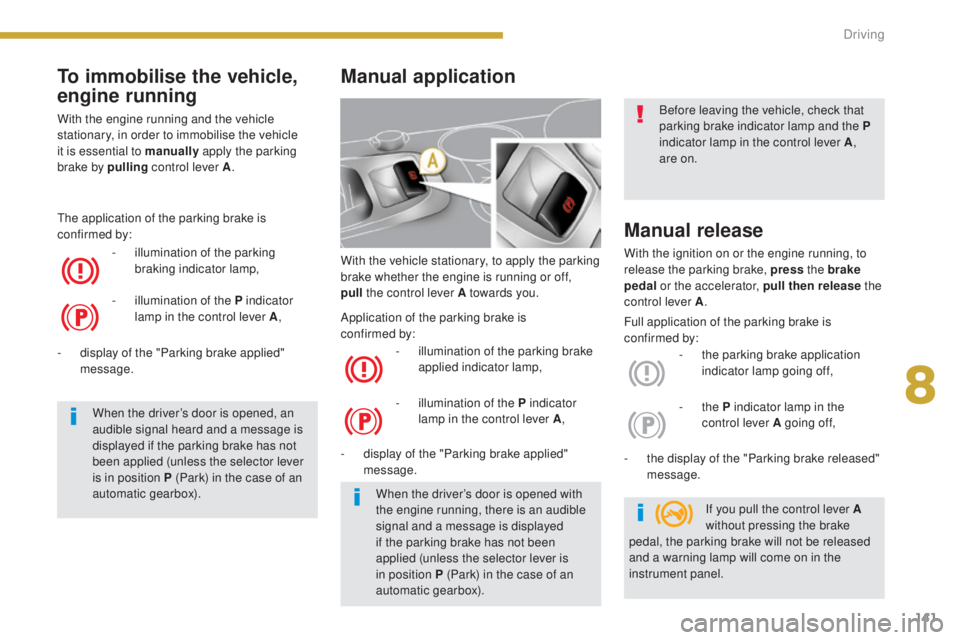
With the vehicle stationary, to apply the parking
brake whether the engine is running or off,
pull
the control lever A towards you.
-
i
llumination of the parking brake
applied indicator lamp,
-
d
isplay of the "Parking brake applied"
message.
Manual release
With the ignition on or the engine running, to
release the parking brake, press the brake
pedal or the accelerator, pull then release the
control lever A .
-
t
he parking brake application
indicator lamp going off,
-
t
he display of the "Parking brake released"
message.
Manual application
- illumination of the P indicator lamp in the control lever A ,-
the P indicator lamp in the
control lever A going of f,
When the driver’s door is opened with
the engine running, there is an audible
signal and a message is displayed
if the parking brake has not been
applied (unless the selector lever is
in position
P (Park) in the case of an
automatic gearbox). If you pull the control lever A
without pressing the brake
pedal, the parking brake will not be released
and a warning lamp will come on in the
instrument panel. Before leaving the vehicle, check that
parking brake indicator lamp and the
P
indicator lamp in the control lever A ,
are on.
Full application of the parking brake is
confirmed by:
Application of the parking brake is
confirmed
by:
To immobilise the vehicle,
engine running
With the engine running and the vehicle
stationary, in order to immobilise the vehicle
it is essential to manually
apply the parking
brake by pulling
control lever A.
-
i
llumination of the parking
braking indicator lamp,
The application of the parking brake is
confirmed by:
-
i
llumination of the P indicator
lamp in the control lever A ,
When the driver’s door is opened, an
audible signal heard and a message is
displayed if the parking brake has not
been applied (unless the selector lever
is in position P (Park) in the case of an
automatic gearbox).
-
d
isplay of the "Parking brake applied"
message.
8
Driving
Page 144 of 344
142
3008_en_Chap08_conduite_ed01-2015
Automatic application,
engine off
With the vehicle stationary, the parking brake
is automatically applied when the engine is
switched off.
Maximum application is essential:
-
i
n the case of a vehicle towing a caravan
or a trailer, if the automatic functions are
activated but you are applying the parking
brake manually,
-
w
hen the gradient you are parked on is
variable in its effect (e.g. on a ferry, in a
lorry, during towing). -
i
llumination of the parking brake
applied indicator lamp,
-
d
isplay of the "Parking brake applied"
message.
The characteristic noise of operation confirms
the application of the electric parking brake. The application of the parking brake is
confirmed by:
-
i
llumination of the P indicator
lamp in the control lever A ,
Before leaving the vehicle, check that
parking brake indicator lamp is on in the
instrument panel.
Never leave a child alone inside the
vehicle with the ignition on, as they
could release the parking brake.
In the case of towing, a loaded vehicle
or parking on a gradient, turn the front
wheels towards the pavement and
engage a gear when you park.
When stationary, with the engine running, do
not press the accelerator pedal unnecessarily,
as you may release the parking brake.
In the case of towing, a loaded vehicle
or parking on a gradient, make a
maximum application of the parking
brake then turn the front wheels
towards the pavement and engage a
gear when you park.
After a maximum application, the
release time will be longer.
Maximum application
If necessary, you can make a maximum
application of the parking brake. It is obtained
by means of a long pull on the control lever
A,
until you see the message "Parking brake
applied" and a beep is heard.
Full release of the parking brake is
confirmed
by:
-
t
he parking brake application
indicator lamp going off,
-
t
he display of the "Parking brake released"
message. -
the P indicator lamp in the
control lever A going of f,
Automatic release
The electric parking brake releases
automatically and progressively when you
press the accelerator :
F
M
anual gearbox : press down fully on the
clutch pedal, engage first gear or reverse,
press on the accelerator pedal and move
of f.
F
E
lectronic gearbox : select position A, M
or R then press the accelerator pedal.
F
A
utomatic gearbox : select position D, M
or R then press the accelerator pedal.
Driving