ad blue PEUGEOT 308 2016 Owner's Manual
[x] Cancel search | Manufacturer: PEUGEOT, Model Year: 2016, Model line: 308, Model: Peugeot 308 2016Pages: 344, PDF Size: 12.23 MB
Page 195 of 344
193
3008_en_Chap09_verifications_ed01-2015
AdBlue® additive and SCR system
for BlueHDi Diesel engines
To assure respect for the environment and
conformity with the new Euro 6 emissions
standard, without adversely affecting the
per formance or fuel consumption of Diesel
engines, PEUGEOT has taken the decision to
equip its vehicles with an effective system that
associates SCR (Selective Catalytic Reduction)
with a particle filter (FAP) for the treatment of
exhaust gases.
Presentation of the SCR system
Using an additive called AdBlue® containing
urea, a catalytic converter turns up to 85%
of nitrous oxides (NOx) into nitrogen and
water, which are harmless to health and the
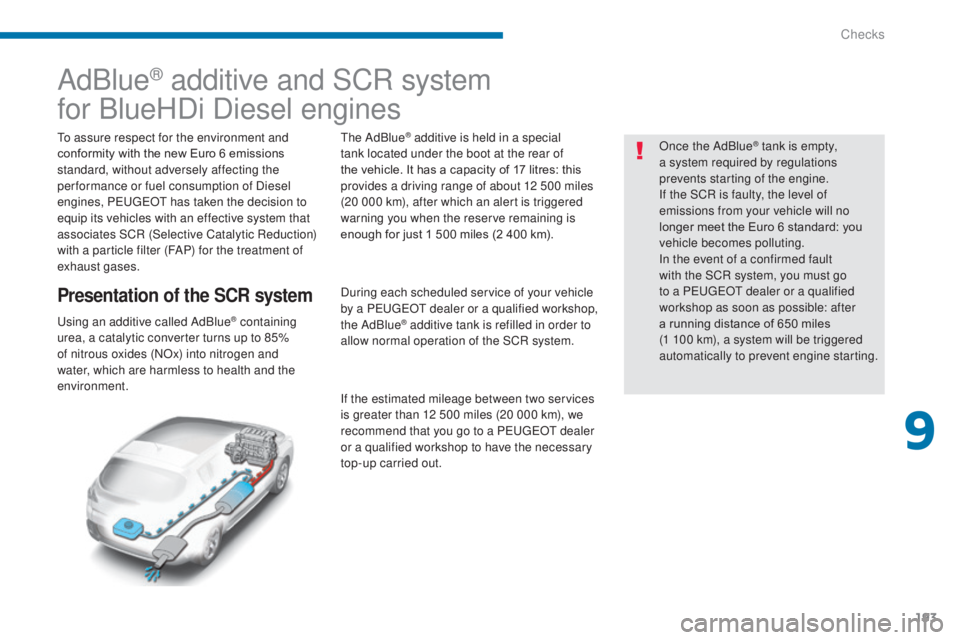
environment. The AdBlue
® additive is held in a special
tank located under the boot at the rear of
the vehicle. It has a capacity of 17 litres: this
provides a driving range of about 12 500 miles
(20 000 km), after which an alert is triggered
warning you when the reserve remaining is
enough for just 1 500 miles (2 400 km).
During each scheduled service of your vehicle
by a PEUGEOT dealer or a qualified workshop,
the AdBlue
® additive tank is refilled in order to
allow normal operation of the SCR system.
If the estimated mileage between two services
is greater than 12 500 miles (20 000 km), we
recommend that you go to a PEUGEOT dealer
or a qualified workshop to have the necessary
top-up carried out. Once the AdBlue
® tank is empty,
a
system required by regulations
prevents starting of the engine.
If the SCR
is faulty, the level of
emissions from your vehicle will no
longer meet the Euro 6 standard: you
vehicle becomes polluting.
In the event of a confirmed fault
with the SCR system, you must go
to a PEUGEOT dealer or a qualified
workshop as soon as possible: after
a running distance of 650 miles
(1
100 km), a system will be triggered
automatically to prevent engine starting.
9
Checks
Page 196 of 344
194
3008_en_Chap09_verifications_ed01-2015
Range indicators
The engine start prevention system
required by regulations is activated
automatically once the AdBlue
® tank is
e m pt y.
Once the AdBlue
® tank is on reserve or after
detection of a fault with the SCR emissions
control system, when the ignition is switched
on, an indicator displays an estimate of the
distance that can be covered, the range, before
engine starting is prevented.
In the event of simultaneous system fault and
low AdBlue
® level, the shortest range figure is
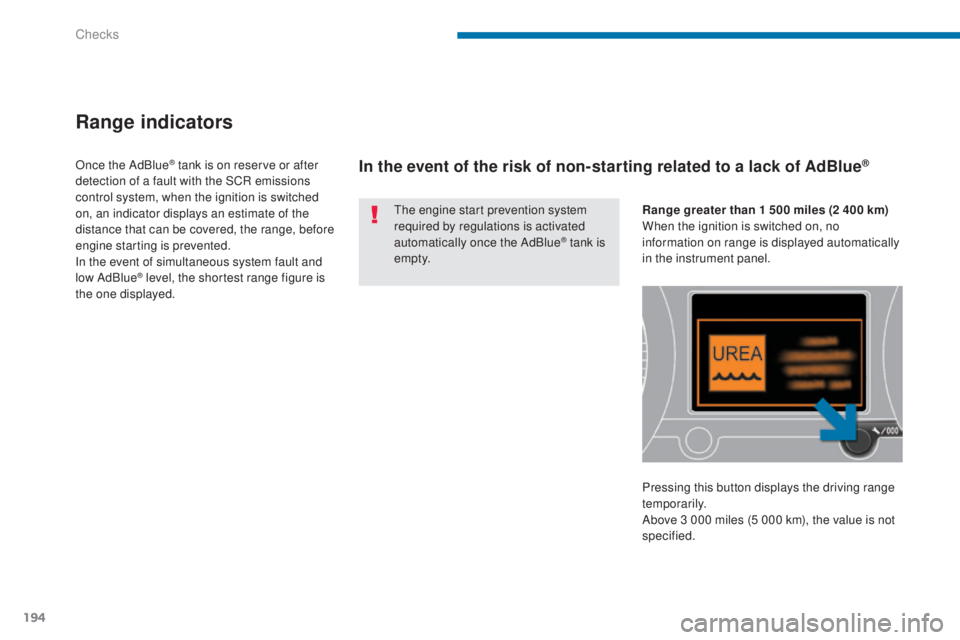
the one displayed. Range greater than 1 500 miles (2 400 km)
When the ignition is switched on, no
information on range is displayed automatically
in the instrument panel.
Pressing this button displays the driving range
temporarily.
Above 3 000 miles (5 000 km), the value is not
specified.
In the event of the risk of non-starting related to a lack of AdBlue®
Checks
Page 197 of 344
195
3008_en_Chap09_verifications_ed01-2015
Remaining range between 350 and 1500 miles (600 and 2 400 km)
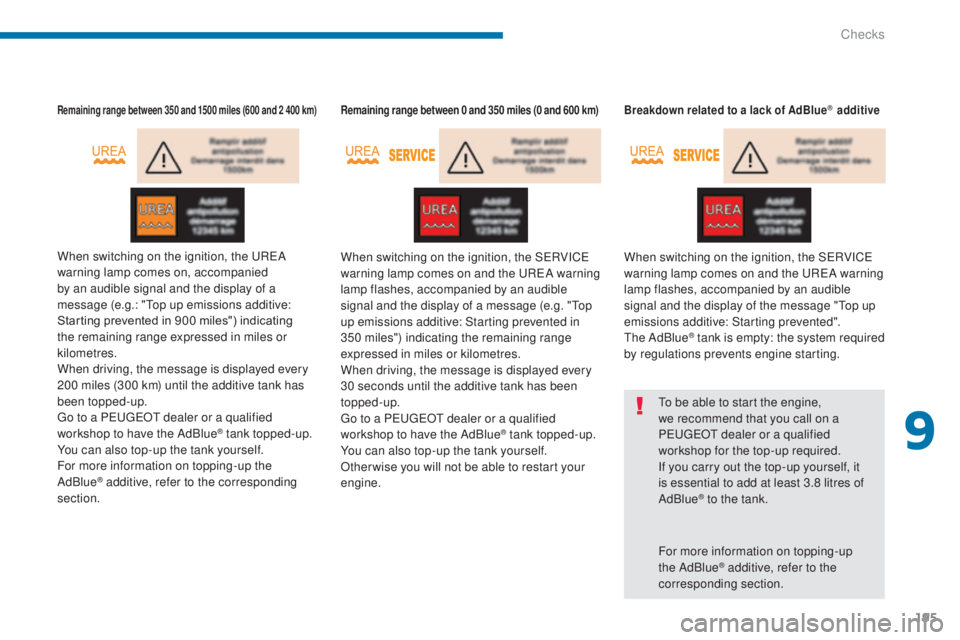
When switching on the ignition, the UREA
warning lamp comes on, accompanied
by an audible signal and the display of a
message (e.g.: "Top up emissions additive:
Starting prevented in 900 miles") indicating
the remaining range expressed in miles or
kilometres.
When driving, the message is displayed every
200 miles (300 km) until the additive tank has
been topped-up.
Go to a PEUGEOT dealer or a qualified
workshop to have the AdBlue
® tank topped-up.
You can also top-up the tank yourself.
For more information on topping-up the
AdBlue
® additive, refer to the corresponding
section.
Remaining range between 0 and 350 miles (0 and 600 km)
When switching on the ignition, the SERVICE
warning lamp comes on and the UREA warning
lamp flashes, accompanied by an audible
signal and the display of a message (e.g. "Top
up emissions additive: Starting prevented in
350 miles") indicating the remaining range
expressed in miles or kilometres.
When driving, the message is displayed every
30 seconds until the additive tank has been
topped-up.
Go to a PEUGEOT dealer or a qualified
workshop to have the AdBlue
® tank topped-up.
You can also top-up the tank yourself.
Other wise you will not be able to restart your
engine.
Breakdown related to a lack of AdBlue® additive
For more information on topping-up
the AdBlue® additive, refer to the
corresponding section. To be able to start the engine,
we recommend that you call on a
PEUGEOT dealer or a qualified
workshop for the top-up required.
If you carry out the top-up yourself, it
is essential to add at least 3.8 litres of
AdBlue
® to the tank.
When switching on the ignition, the SERVICE
warning lamp comes on and the UREA warning
lamp flashes, accompanied by an audible
signal and the display of the message "Top up
emissions additive: Starting prevented".
The AdBlue
® tank is empty: the system required
by regulations prevents engine starting.
9
Checks
Page 199 of 344
197
3008_en_Chap09_verifications_ed01-2015
You have exceeded the authorised
driving limit: the starting prevention
system inhibits engine starting.
Starting prevented
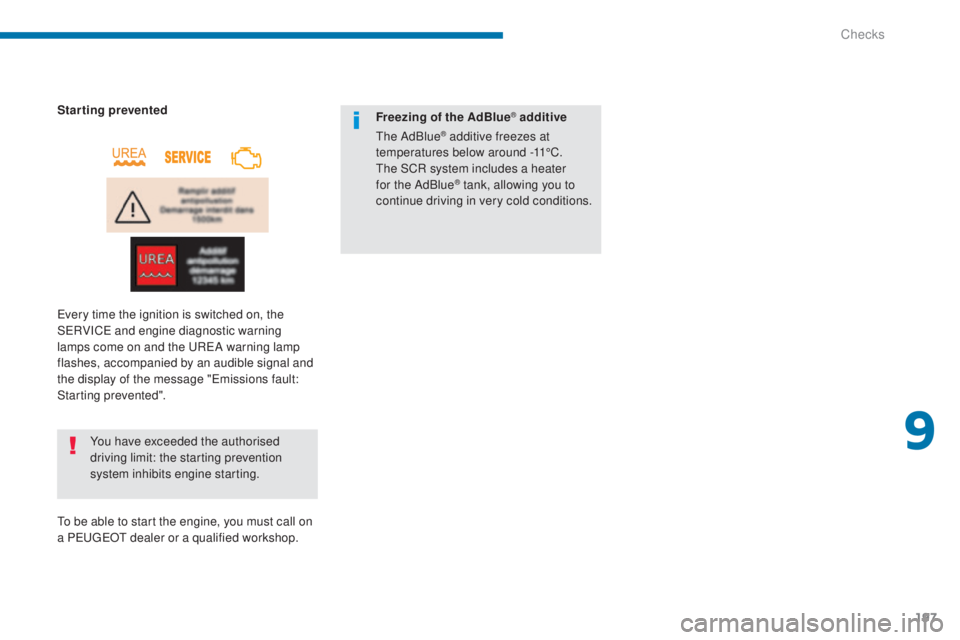
Every time the ignition is switched on, the
SERVICE and engine diagnostic warning
lamps come on and the UREA warning lamp
flashes, accompanied by an audible signal and
the display of the message "Emissions fault:
Starting prevented".
Freezing of the AdBlue
® additive
To be able to start the engine, you must call on
a PEUGEOT dealer or a qualified workshop. The AdBlue® additive freezes at
temperatures below around -11°C.
The SCR system includes a heater
for the AdBlue
® tank, allowing you to
continue driving in very cold conditions.
9
Checks
Page 200 of 344
198
3008_en_Chap09_verifications_ed01-2015
Topping-up the AdBlue® additive
Precautions in use
Keep AdBlue® out of the reach of
children, in its original bottle.
Never transfer AdBlue
® to another
container: it would lose its purity. Use only AdBlue
® additive that meets the
ISO
22241 standard.
The AdBlue® additive is an urea-based
solution. This liquid is non-flammable,
colourless and odourless (kept in a cool area).
In the event of contact with the skin, wash
the affected area with soap and water. In the
event of contact with the eyes, wash (irrigate)
the eyes with large amounts of water or with
an eye wash solution for at least 15 minutes.
If a burning sensation or irritation persists, get
medical attention.
If swallowed, immediately wash out the mouth
with clean water and then drink plenty of water.
In certain conditions (high ambient
temperature, for example), the risk of release
of ammonia cannot be excluded: do not inhale
the product. Ammonia vapour has en irritant
effect on mucous membranes (eyes, nose and
throat). Never dilute the additive with water.
Never pour the additive into the Diesel
fuel tank.
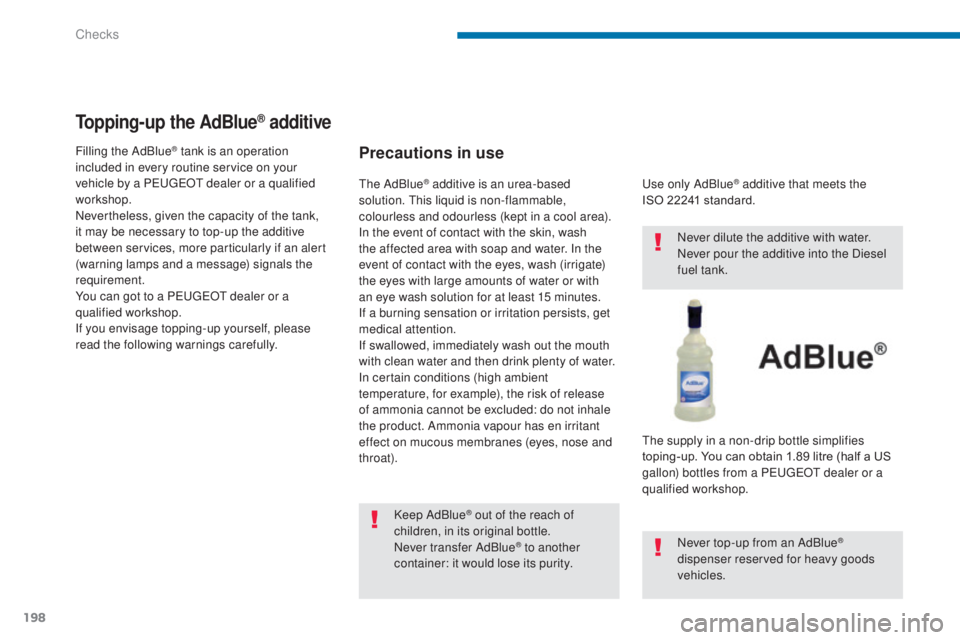
The supply in a non-drip bottle simplifies
toping-up. You can obtain 1.89 litre (half a US
gallon) bottles from a PEUGEOT
dealer or a
qualified workshop.
Never top-up from an AdBlue
®
dispenser reserved for heavy goods
vehicles.
Filling the AdBlue
® tank is an operation
included in every routine service on your
vehicle by a PEUGEOT dealer or a qualified
workshop.
Nevertheless, given the capacity of the tank,
it may be necessary to top-up the additive
between services, more particularly if an alert
(warning lamps and a message) signals the
requirement.
You can got to a PEUGEOT dealer or a
qualified workshop.
If you envisage topping-up yourself, please
read the following warnings carefully.
Checks
Page 201 of 344
199
3008_en_Chap09_verifications_ed01-2015
Never store bottles of AdBlue® in your
vehicle.
Recommendations on storage
AdBlue® freezes at about -11°C and
deteriorates above 25°C. It is recommended
that bottles be stored in a cool area and
protected from direct sunlight.
Under these conditions, the additive can be
kept for at least a year.
If the additive has frozen, it can be used once it
has completely thawed out.
Procedure
Before topping-up, ensure that the vehicle is
parked on a flat and level sur face.
In wintry conditions, ensure that the
temperature of the vehicle is above -11°C.
Otherwise, by freezing, the AdBlue
® cannot
be poured into its tank. Park your vehicle in a
warmer area for a few hours to allow the top-up
to be carried out.
F
S
witch off the ignition and remove the key. F
P
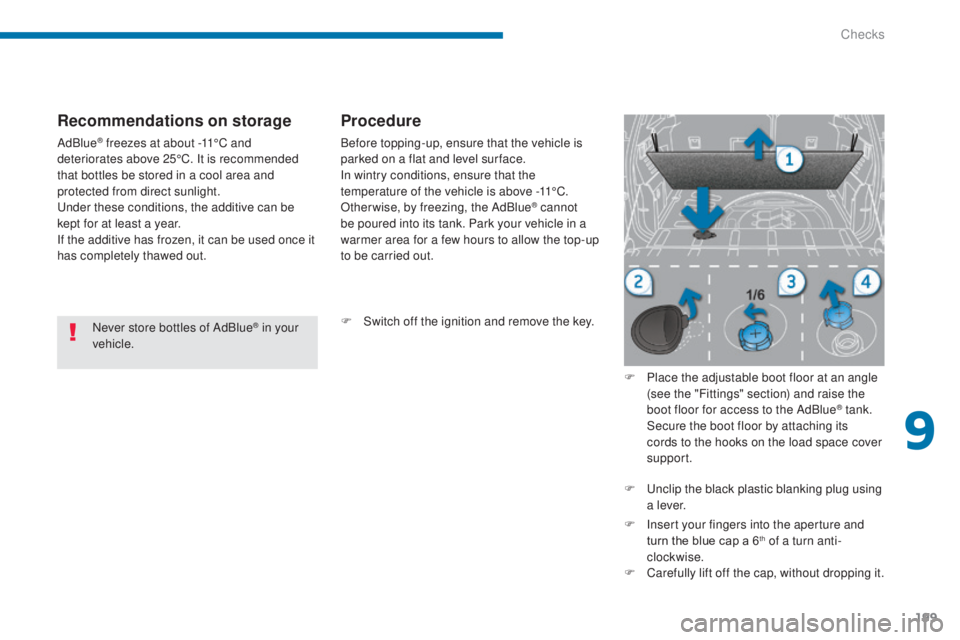
lace the adjustable boot floor at an angle
(see the "Fittings" section) and raise the
boot floor for access to the AdBlue
® tank. S
ecure the boot floor by attaching its
cords to the hooks on the load space cover
support.
F
U
nclip the black plastic blanking plug using
a l eve r.
F
I
nsert your fingers into the aperture and
turn the blue cap a 6
th of a turn anti-
clockwise.
F
C
arefully lift off the cap, without dropping it.
9
Checks
Page 202 of 344
200
3008_en_Chap09_verifications_ed01-2015
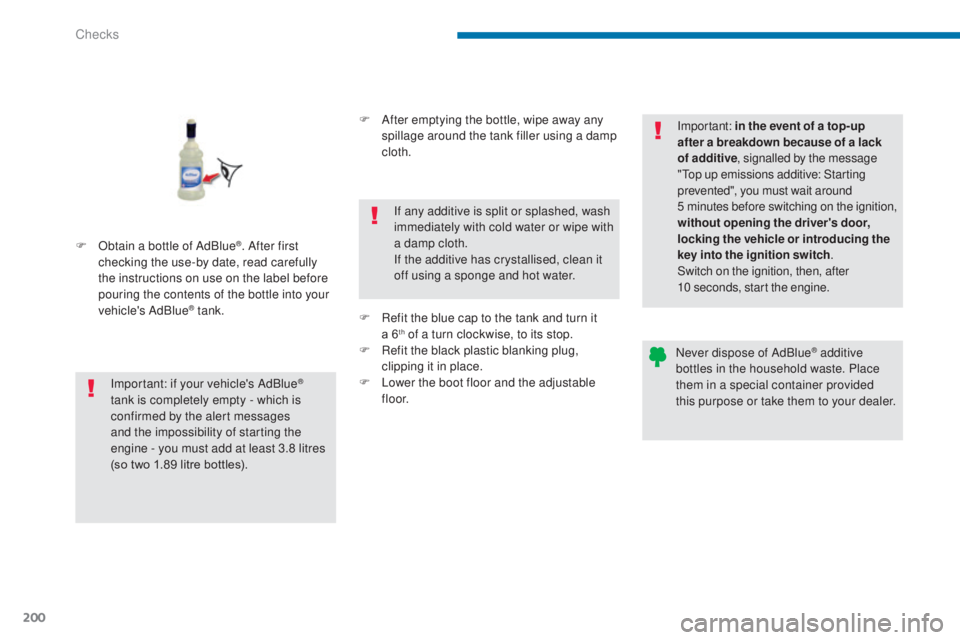
F Obtain a bottle of AdBlue®. After first
checking the use-by date, read carefully
the instructions on use on the label before
pouring the contents of the bottle into your
vehicle's AdBlue
® tank.
Important: if your vehicle's AdBlue
®
tank is completely empty - which is
confirmed by the alert messages
and the impossibility of starting the
engine - you must add at least 3.8 litres
(so
two
1.89 litre bottles). F
A
fter emptying the bottle, wipe away any
spillage around the tank filler using a damp
cloth.
If any additive is split or splashed, wash
immediately with cold water or wipe with
a damp cloth.
If the additive has crystallised, clean it
off using a sponge and hot water.
F
R
efit the blue cap to the tank and turn it
a 6
th of a turn clockwise, to its stop.
F
R
efit the black plastic blanking plug,
clipping it in place.
F
L
ower the boot floor and the adjustable
f l o o r. Important:
in the event of a top-up
after a breakdown because of a lack
of additive , signalled by the message
"Top up emissions additive: Starting
prevented", you must wait around
5 minutes before switching on the ignition,
without opening the driver's door,
locking the vehicle or introducing the
key into the ignition switch .
Switch on the ignition, then, after
10
seconds, start the engine.
Never dispose of AdBlue® additive
bottles in the household waste. Place
them in a special container provided
this purpose or take them to your dealer.
Checks
Page 203 of 344
201
3008_en_Chap10_infos-pratiques_ed01-2015
Tool kit
This is a set of tools provided with the vehicle. The content depends on your vehicle's equipment (temporary puncture repair kit or spare wheel).
Access to the tools
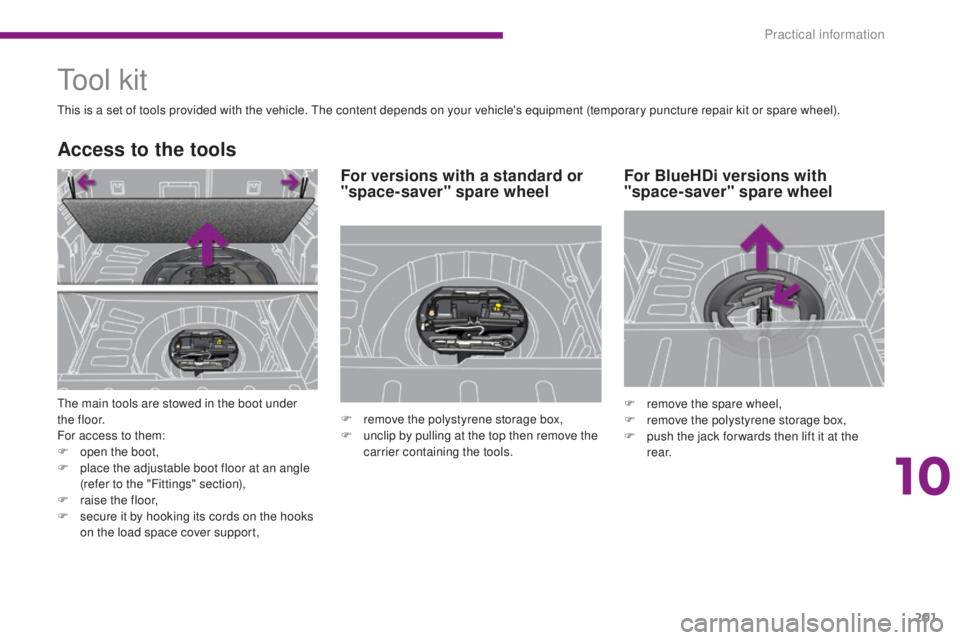
The main tools are stowed in the boot under
t h e f l o o r.
For access to them:
F
o
pen the boot,
F
p
lace the adjustable boot floor at an angle
(refer to the "Fittings" section),
F
r
aise the floor,
F
s
ecure it by hooking its cords on the hooks
on the load space cover support,
For versions with a standard or
"space-saver" spare wheel
F remove the polystyrene storage box,
F u nclip by pulling at the top then remove the
carrier containing the tools.
For BlueHDi versions with
"space-saver" spare wheel
F remove the spare wheel,
F r emove the polystyrene storage box,
F
p
ush the jack for wards then lift it at the
r e a r.
10
Practical information
Page 211 of 344
209
3008_en_Chap10_infos-pratiques_ed01-2015
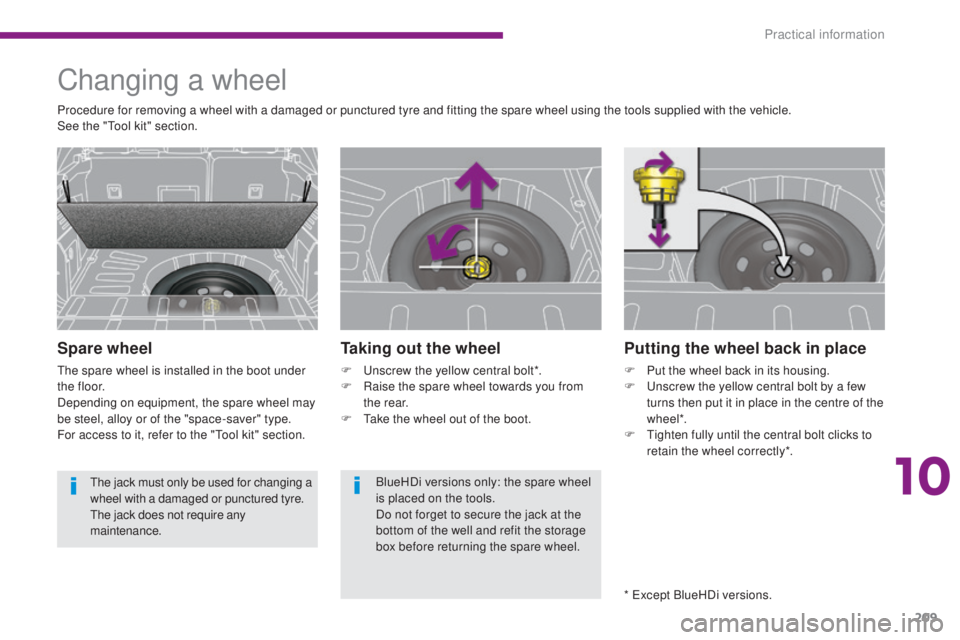
Putting the wheel back in place
F Put the wheel back in its housing.
F U nscrew the yellow central bolt by a few
turns then put it in place in the centre of the
w h e e l*.
F
T
ighten fully until the central bolt clicks to
retain the wheel correctly*.
Changing a wheel
Spare wheel
The spare wheel is installed in the boot under
t h e f l o o r.
Depending on equipment, the spare wheel may
be steel, alloy or of the "space-saver" type.
For access to it, refer to the "Tool kit" section.
Taking out the wheel
F Unscrew the yellow central bolt*.
F R aise the spare wheel towards you from
the rear.
F
T
ake the wheel out of the boot.
Procedure for removing a wheel with a damaged or punctured tyre and fitting the spare wheel using the tools supplied with the vehicle.
See the "Tool kit" section.
* Except BlueHDi versions.
BlueHDi versions only: the spare wheel
is placed on the tools.
Do not forget to secure the jack at the
bottom of the well and refit the storage
box before returning the spare wheel.
The jack must only be used for changing a
wheel with a damaged or punctured tyre.
The jack does not require any
maintenance.
10
Practical information
Page 215 of 344
213
3008_en_Chap10_infos-pratiques_ed01-2015
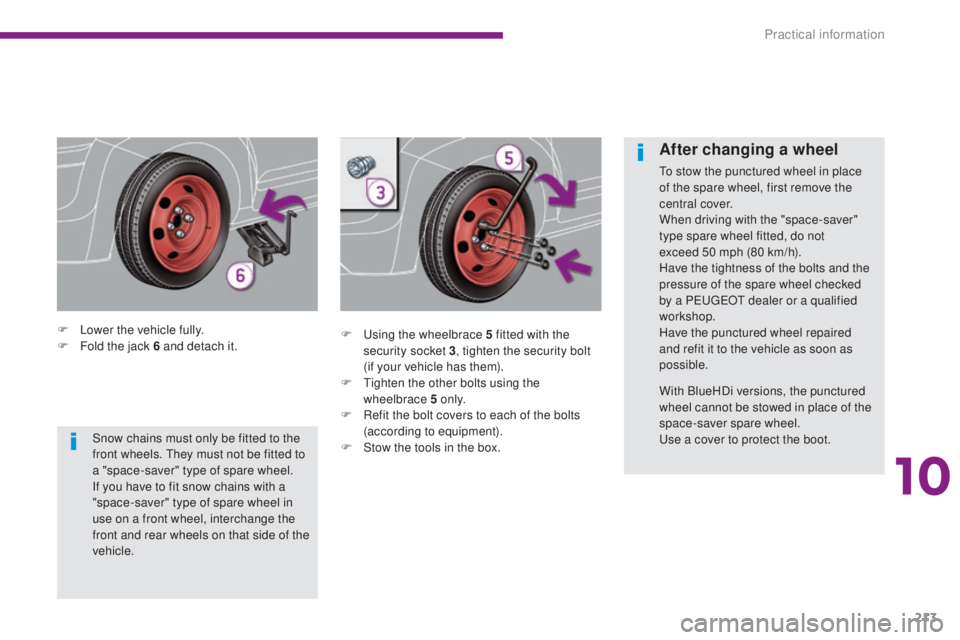
F Lower the vehicle fully.
F F old the jack 6 and detach it. F
U sing the wheelbrace 5 fitted with the
security socket 3 , tighten the security bolt
(if your vehicle has them).
F
T
ighten the other bolts using the
wheelbrace 5 o n l y.
F
R
efit the bolt covers to each of the bolts
(according to equipment).
F
S
tow the tools in the box.
After changing a wheel
To stow the punctured wheel in place
of the spare wheel, first remove the
central cover.
When driving with the "space-saver"
type spare wheel fitted, do not
exceed 50 mph (80 km/h).
Have the tightness of the bolts and the
pressure of the spare wheel checked
by a PEUGEOT dealer or a qualified
workshop.
Have the punctured wheel repaired
and refit it to the vehicle as soon as
possible.
With BlueHDi versions, the punctured
wheel cannot be stowed in place of the
space-saver spare wheel.
Use a cover to protect the boot.
Snow chains must only be fitted to the
front wheels. They must not be fitted to
a "space-saver" type of spare wheel.
If you have to fit snow chains with a
"space-saver" type of spare wheel in
use on a front wheel, interchange the
front and rear wheels on that side of the
vehicle.
10
Practical information