ECU PEUGEOT 308 2016 Service Manual
[x] Cancel search | Manufacturer: PEUGEOT, Model Year: 2016, Model line: 308, Model: Peugeot 308 2016Pages: 344, PDF Size: 12.23 MB
Page 212 of 344
210
3008_en_Chap10_infos-pratiques_ed01-2015
Tyre under-inflation detection
The space-saver type or steel spare
wheel does not have a sensor.
The punctured wheel must be repaired
by a PEUGEOT dealer or a qualified
workshop.
Removing a wheel
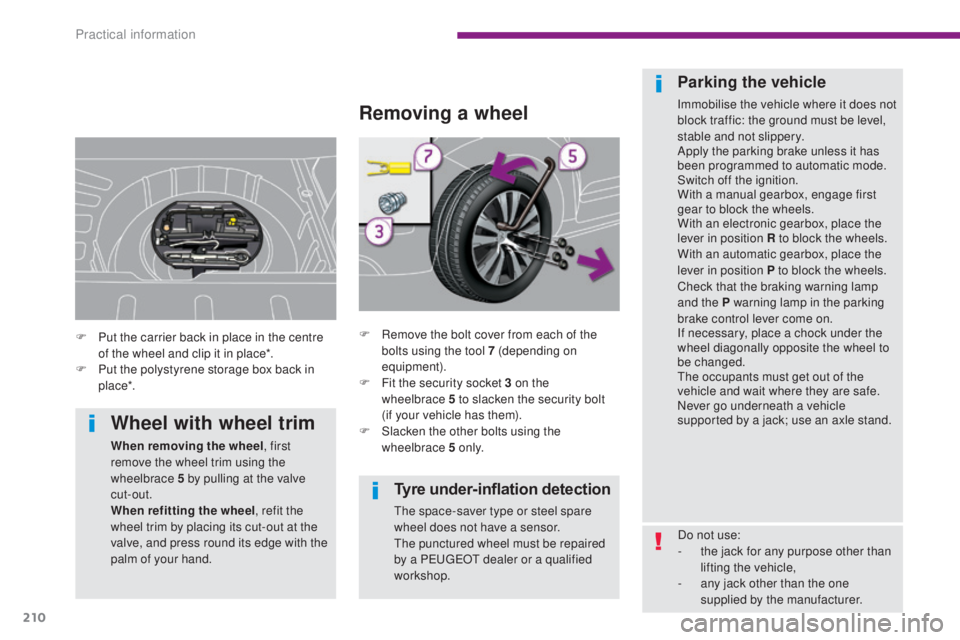
F Remove the bolt cover from each of the bolts using the tool 7 (depending on
equipment).
F
F
it the security socket 3 on the
wheelbrace
5 to slacken the security bolt
(if
your vehicle has them).
F
S
lacken the other bolts using the
wheelbrace 5 o n l y.
Parking the vehicle
Immobilise the vehicle where it does not
block traffic: the ground must be level,
stable and not slippery.
Apply the parking brake unless it has
been programmed to automatic mode.
Switch off the ignition.
With a manual gearbox, engage first
gear to block the wheels.
With an electronic gearbox, place the
lever in position R to block the wheels.
With an automatic gearbox, place the
lever in position P to block the wheels.
Check that the braking warning lamp
and the P warning lamp in the parking
brake control lever come on.
If necessary, place a chock under the
wheel diagonally opposite the wheel to
be changed.
The occupants must get out of the
vehicle and wait where they are safe.
Never go underneath a vehicle
supported by a jack; use an axle stand.
F
P
ut the carrier back in place in the centre
of the wheel and clip it in place*.
F
P
ut the polystyrene storage box back in
p lac e*.
Wheel with wheel trim
When removing the wheel , first
remove the wheel trim using the
wheelbrace 5 by pulling at the valve
cut-out.
When refitting the wheel , refit the
wheel trim by placing its cut-out at the
valve, and press round its edge with the
palm of your hand. Do not use:
-
t
he jack for any purpose other than
lifting the vehicle,
-
a
ny jack other than the one
supplied by the manufacturer.
Practical information
Page 214 of 344
212
3008_en_Chap10_infos-pratiques_ed01-2015
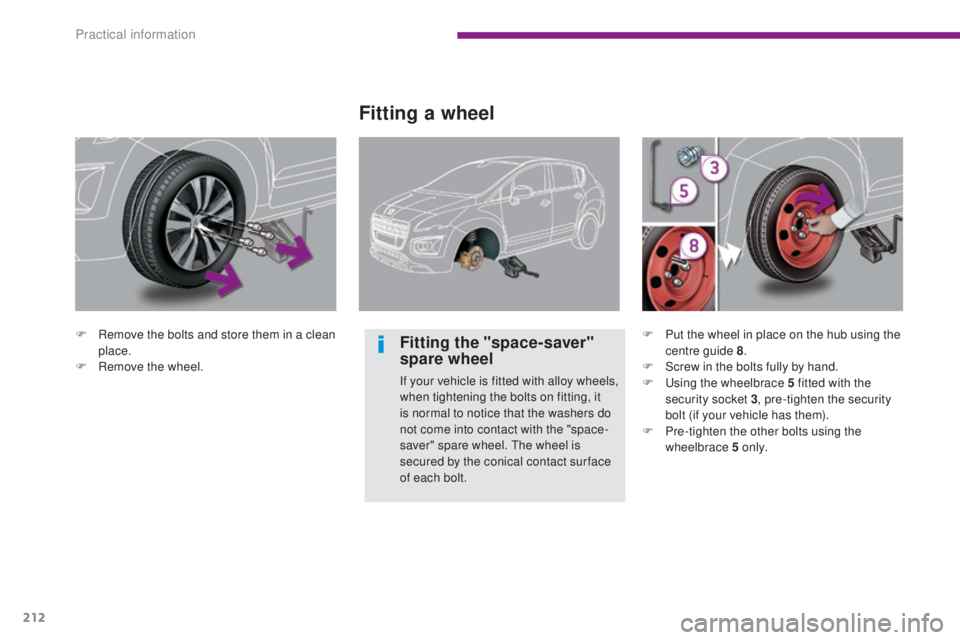
F Remove the bolts and store them in a clean place.
F
R
emove the wheel.
Fitting a wheel
Fitting the "space-saver"
spare wheel
If your vehicle is fitted with alloy wheels,
when tightening the bolts on fitting, it
is normal to notice that the washers do
not come into contact with the "space-
saver" spare wheel. The wheel is
secured by the conical contact sur face
of each bolt. F
P
ut the wheel in place on the hub using the
centre guide 8 .
F S crew in the bolts fully by hand.
F U sing the wheelbrace 5 fitted with the
security socket 3 , pre-tighten the security
bolt (if your vehicle has them).
F
P
re-tighten the other bolts using the
wheelbrace 5 o n l y.
Practical information
Page 215 of 344
213
3008_en_Chap10_infos-pratiques_ed01-2015
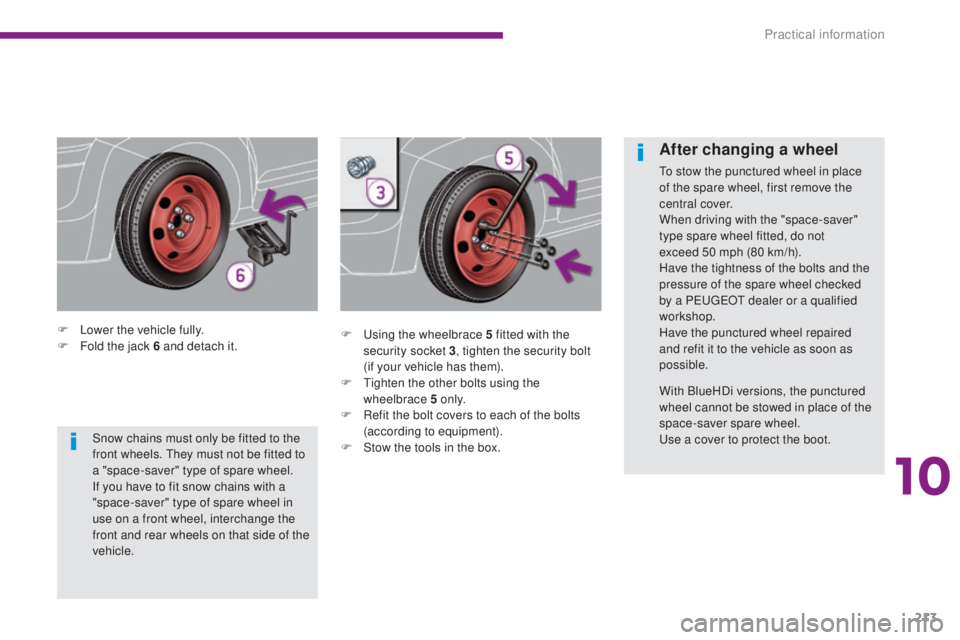
F Lower the vehicle fully.
F F old the jack 6 and detach it. F
U sing the wheelbrace 5 fitted with the
security socket 3 , tighten the security bolt
(if your vehicle has them).
F
T
ighten the other bolts using the
wheelbrace 5 o n l y.
F
R
efit the bolt covers to each of the bolts
(according to equipment).
F
S
tow the tools in the box.
After changing a wheel
To stow the punctured wheel in place
of the spare wheel, first remove the
central cover.
When driving with the "space-saver"
type spare wheel fitted, do not
exceed 50 mph (80 km/h).
Have the tightness of the bolts and the
pressure of the spare wheel checked
by a PEUGEOT dealer or a qualified
workshop.
Have the punctured wheel repaired
and refit it to the vehicle as soon as
possible.
With BlueHDi versions, the punctured
wheel cannot be stowed in place of the
space-saver spare wheel.
Use a cover to protect the boot.
Snow chains must only be fitted to the
front wheels. They must not be fitted to
a "space-saver" type of spare wheel.
If you have to fit snow chains with a
"space-saver" type of spare wheel in
use on a front wheel, interchange the
front and rear wheels on that side of the
vehicle.
10
Practical information
Page 230 of 344
228
3008_en_Chap10_infos-pratiques_ed01-2015
12 V battery
Access to the battery
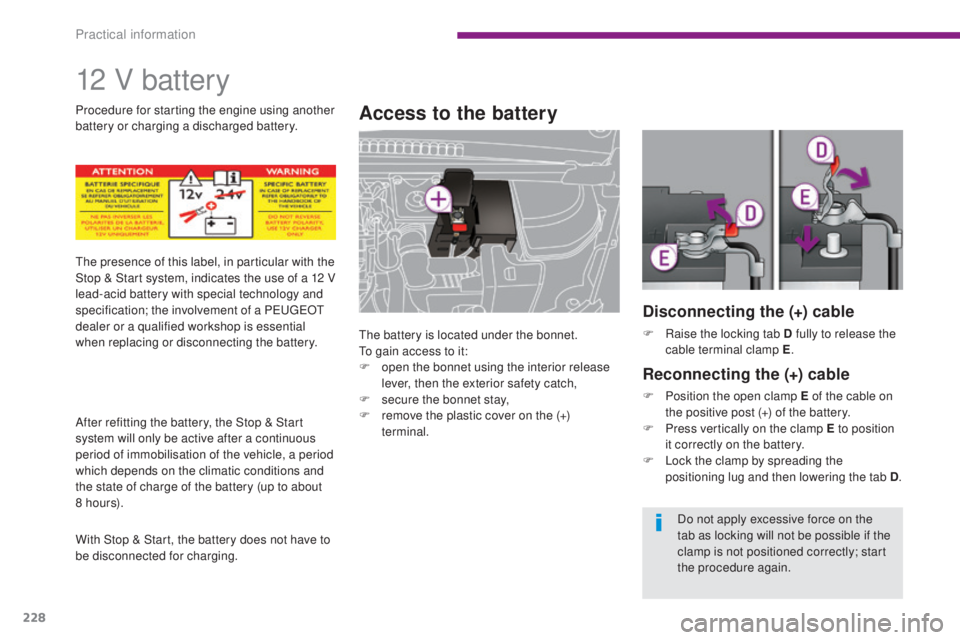
The battery is located under the bonnet.
To gain access to it:
F
o
pen the bonnet using the interior release
lever, then the exterior safety catch,
F
s
ecure the bonnet stay,
F
r
emove the plastic cover on the (+)
terminal.
The presence of this label, in particular with the
Stop & Start system, indicates the use of a 12
V
lead-acid battery with special technology and
specification; the involvement of a PEUGEOT
dealer or a qualified workshop is essential
when replacing or disconnecting the battery.
After refitting the battery, the Stop & Start
system will only be active after a continuous
period of immobilisation of the vehicle, a period
which depends on the climatic conditions and
the state of charge of the battery (up to about
8 h o u r s).
With Stop & Start, the battery does not have to
be disconnected for charging. Procedure for starting the engine using another
battery or charging a discharged battery.
Disconnecting the (+) cable
F Raise the locking tab D fully to release the cable terminal clamp E .
Reconnecting the (+) cable
F Position the open clamp E of the cable on
the positive post (+) of the battery.
F
P
ress vertically on the clamp E to position
it correctly on the battery.
F
L
ock the clamp by spreading the
positioning lug and then lowering the tab D .
Do not apply excessive force on the
tab as locking will not be possible if the
clamp is not positioned correctly; start
the procedure again.
Practical information
Page 234 of 344
232
3008_en_Chap10_infos-pratiques_ed01-2015
Changing a wiper blade
Removing
F Raise the corresponding wiper arm.
F U nclip the wiper blade and remove it.
Fitting
F Put the corresponding new wiper blade in place and clip it.
F
F
old down the wiper arm carefully.
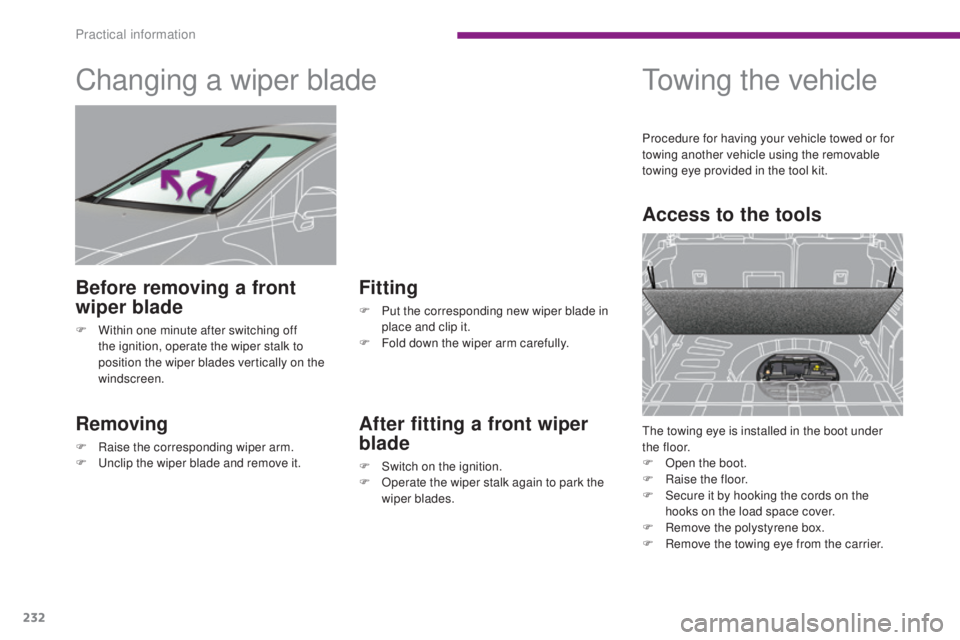
Before removing a front
wiper blade
F Within one minute after switching off the ignition, operate the wiper stalk to
position the wiper blades vertically on the
windscreen.
After fitting a front wiper
blade
F Switch on the ignition.
F O perate the wiper stalk again to park the
wiper blades.
Towing the vehicle
Access to the tools
The towing eye is installed in the boot under
t h e f l o o r.
F
O
pen the boot.
F
Ra
ise the floor.
F
S
ecure it by hooking the cords on the
hooks on the load space cover.
F
R
emove the polystyrene box.
F
R
emove the towing eye from the carrier.
Procedure for having your vehicle towed or for
towing another vehicle using the removable
towing eye provided in the tool kit.
Practical information
Page 242 of 344
240
3008_en_Chap10_infos-pratiques_ed01-2015
Accessories
"Comfort"
Door deflectors, parking sensors, side window
blinds, coat-hanger, insulated module...
"Transport solutions"
Roof bars, towbars, bicycle carrier on towbar,
bicycle carrier on roof bars, ski carrier, rigid
and flexible roof boxes...
Trailer towbar, which must be fitted by a
PEUGEOT dealer.
"Style"
Alloy wheels, door sill trims, chrome-plated
door handle shells, spoiler, gear lever knob...
"Safety and security"
Anti-theft alarm, window etching, wheel
security bolts, child seats and booster
cushions, first aid kit, breathalyzer, warning
triangle, high visibility vest, stolen vehicle
tracking system, dog guard, winter equipment
(snow chains, non-slip covers...)...
"Protection"
Mats*, boot liner, luggage net, style mud
flaps**, seat covers, pet range...
A wide range of accessories and genuine parts is available from the PEUGEOT dealer network.
These accessories and parts are all suitable for your vehicle and benefit from PEUGEOT's recommendation and warranty.
**
T
he configuration of the vehicle requires
that it be fitted with mud flaps at the rear.
*
T
o avoid any risk of jamming of the pedals:
-
e
nsure that the mat is positioned and
secured correctly,
-
n
ever fit one mat on top of another.
Practical information