brake Peugeot 308 2017 Owner's Guide
[x] Cancel search | Manufacturer: PEUGEOT, Model Year: 2017, Model line: 308, Model: Peugeot 308 2017Pages: 392, PDF Size: 10.16 MB
Page 158 of 392
156
308_en_Chap06_conduite_ed01-2016
Automatic release
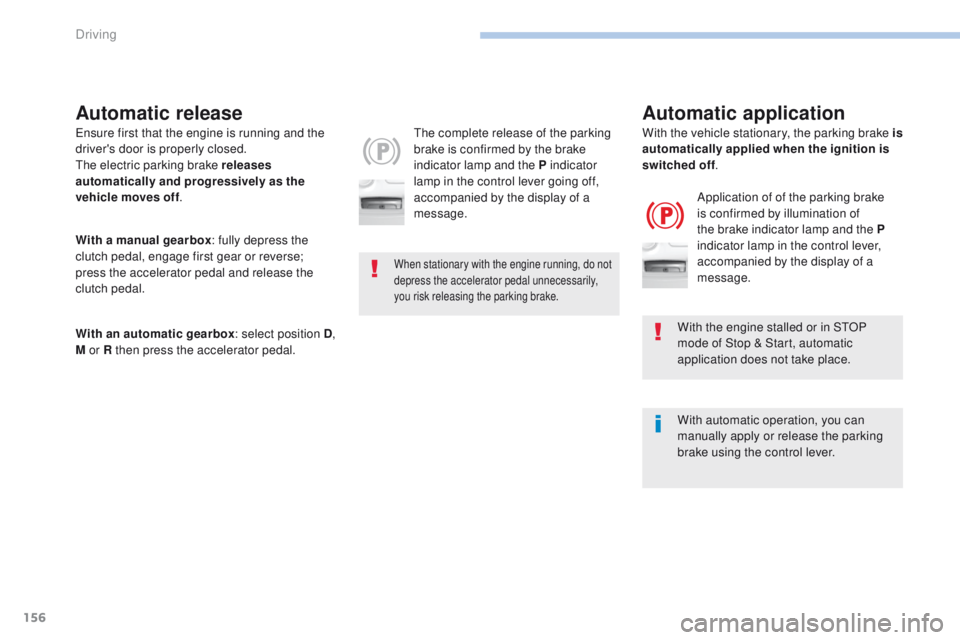
the complete release of the parking
brake is confirmed by the brake
indicator lamp and the P indicator
lamp in the control lever going off,
accompanied by the display of a
message.
When stationary with the engine running, do not
depress the accelerator pedal unnecessarily,
you risk releasing the parking brake.
Automatic application
Application of of the parking brake
is confirmed by illumination of
the brake indicator lamp and the P
indicator lamp in the control lever,
accompanied by the display of a
message.
With the engine stalled or in S
tO
P
mode of Stop & Start, automatic
application does not take place.
With automatic operation, you can
manually apply or release the parking
brake using the control lever.
en
sure first that the engine is running and the
driver's door is properly closed.
th
e electric parking brake releases
automatically and progressively as the
vehicle moves off. With the vehicle stationary, the parking brake is
automatically applied when the ignition is
switched off
.
With a manual gearbox : fully depress the
clutch pedal, engage first gear or reverse;
press the accelerator pedal and release the
clutch pedal.
With an automatic gearbox : select position D,
M or R then press the accelerator pedal.
Driving
Page 159 of 392
157
308_en_Chap06_conduite_ed01-2016
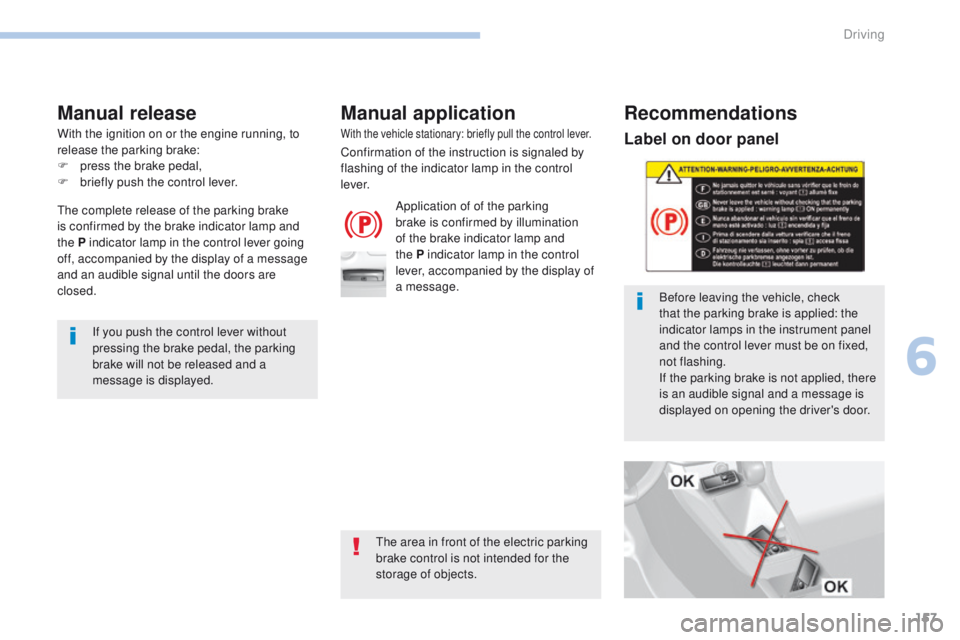
Label on door panel
Before leaving the vehicle, check
that the parking brake is applied: the
indicator lamps in the instrument panel
and the control lever must be on fixed,
not flashing.
If the parking brake is not applied, there
is an audible signal and a message is
displayed on opening the driver's door.
Application of of the parking
brake is confirmed by illumination
of the brake indicator lamp and
the
P
indicator lamp in the control
lever, accompanied by the display of
a message.
Manual release
If you push the control lever without
pressing the brake pedal, the parking
brake will not be released and a
message is displayed.
With the vehicle stationary: briefly pull the control lever.
Confirmation of the instruction is signaled by
flashing of the indicator lamp in the control
l eve r.
With the ignition on or the engine running, to
release the parking brake:
F
p
ress the brake pedal,
F
b
riefly push the control lever.
Manual application Recommendations
the area in front of the electric parking
brake control is not intended for the
storage of objects.
th
e complete release of the parking brake
is confirmed by the brake indicator lamp and
the
P indicator lamp in the control lever going
off, accompanied by the display of a message
and an audible signal until the doors are
closed.
6
Driving
Page 160 of 392
158
308_en_Chap06_conduite_ed01-2016
Immobilising the vehicle
with the engine running
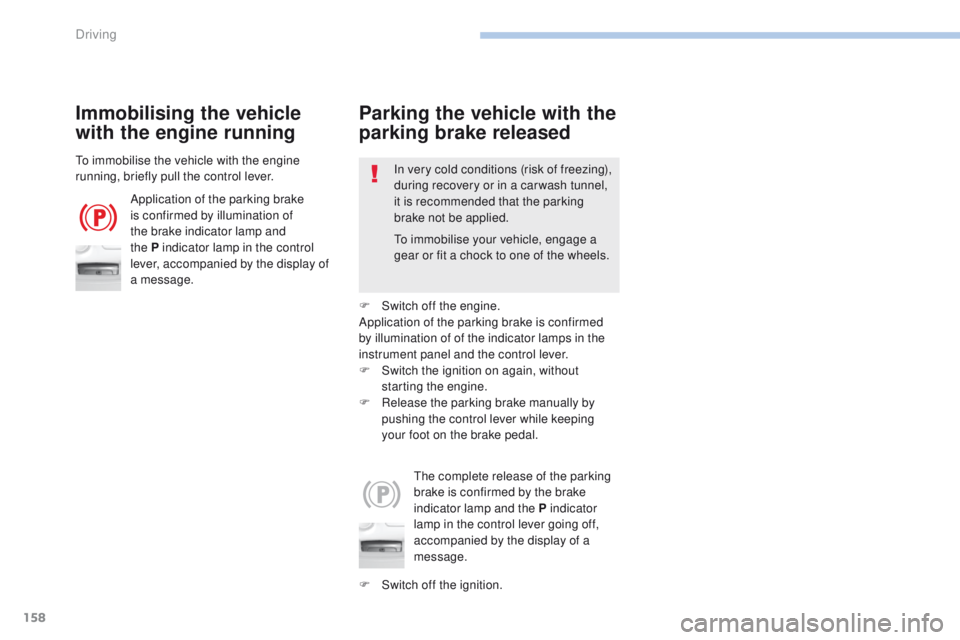
Application of the parking brake
is confirmed by illumination of
the brake indicator lamp and
the P indicator lamp in the control
lever, accompanied by the display of
a message.
th
e complete release of the parking
brake is confirmed by the brake
indicator lamp and the P indicator
lamp in the control lever going off,
accompanied by the display of a
message.
to i
mmobilise the vehicle with the engine
running, briefly pull the control lever. In very cold conditions (risk of freezing),
during recovery or in a car wash tunnel,
it is recommended that the parking
brake not be applied.
Parking the vehicle with the
parking brake released
F Switch off the ignition.
to
immobilise your vehicle, engage a
gear or fit a chock to one of the wheels.
F
S
witch off the engine.
Application of the parking brake is confirmed
by illumination of of the indicator lamps in the
instrument panel and the control lever.
F
S
witch the ignition on again, without
starting the engine.
F
R
elease the parking brake manually by
pushing the control lever while keeping
your foot on the brake pedal.
Driving
Page 161 of 392
159
308_en_Chap06_conduite_ed01-2016
Repeat this procedure to reactivate automatic
operation.
Reactivation of automatic operation is
confirmed by the indicator lamp in the
instrument panel going off.
Deactivating automatic operation
In some situations, such as very cold weather
or towing (caravan, recovery), it may be
necessary to deactivate automatic operation of
the system.
F
S
tart the engine.
F
A
pply the parking brake with the control
lever, if it is released.
F
t
a
ke your foot off the brake pedal.
F
P
ush and hold the control lever in the
release direction for at least 10 seconds
and no more than 15 seconds.
F
R
elease the control lever.
F
P
ress and hold the brake pedal.
F
P
ull the control lever in the apply direction
for 2 seconds.
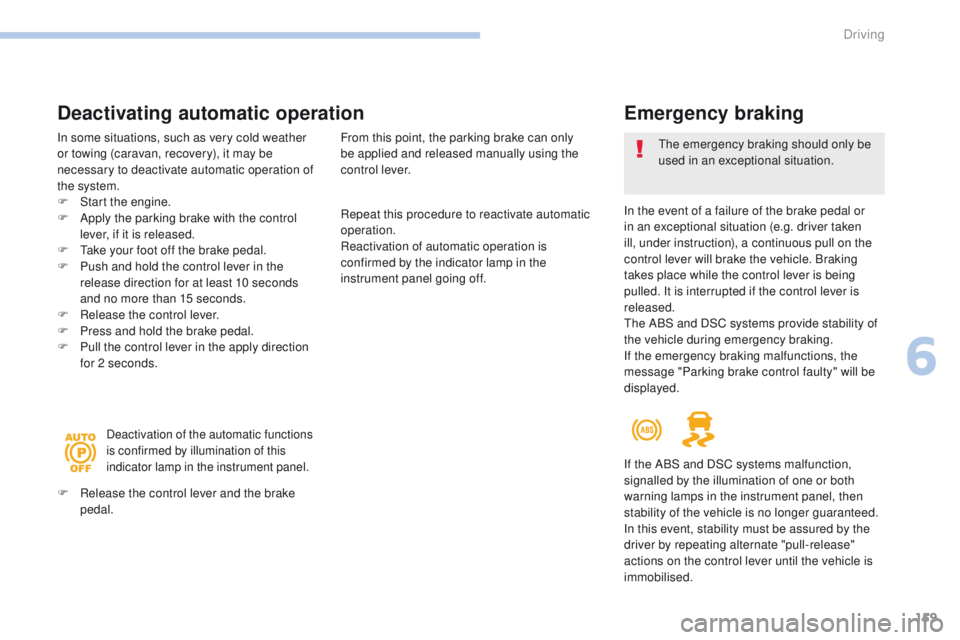
Deactivation of the automatic functions
is confirmed by illumination of this
indicator lamp in the instrument panel.
F Release the control lever and the brake pedal. From this point, the parking brake can only
be applied and released manually using the
control lever.
Emergency braking
the emergency braking should only be
used in an exceptional situation.
In the event of a failure of the brake pedal or
in an exceptional situation (e.g. driver taken
ill, under instruction), a continuous pull on the
control lever will brake the vehicle. Braking
takes place while the control lever is being
pulled. It is interrupted if the control lever is
released.
th
e ABS and DSC systems provide stability of
the vehicle during emergency braking.
If the emergency braking malfunctions, the
message "Parking brake control faulty" will be
displayed.
If the ABS and DSC systems malfunction,
signalled by the illumination of one or both
warning lamps in the instrument panel, then
stability of the vehicle is no longer guaranteed.
In this event, stability must be assured by the
driver by repeating alternate "pull-release"
actions on the control lever until the vehicle is
immobilised.
6
Driving
Page 162 of 392
160
308_en_Chap06_conduite_ed01-2016
Operating faults
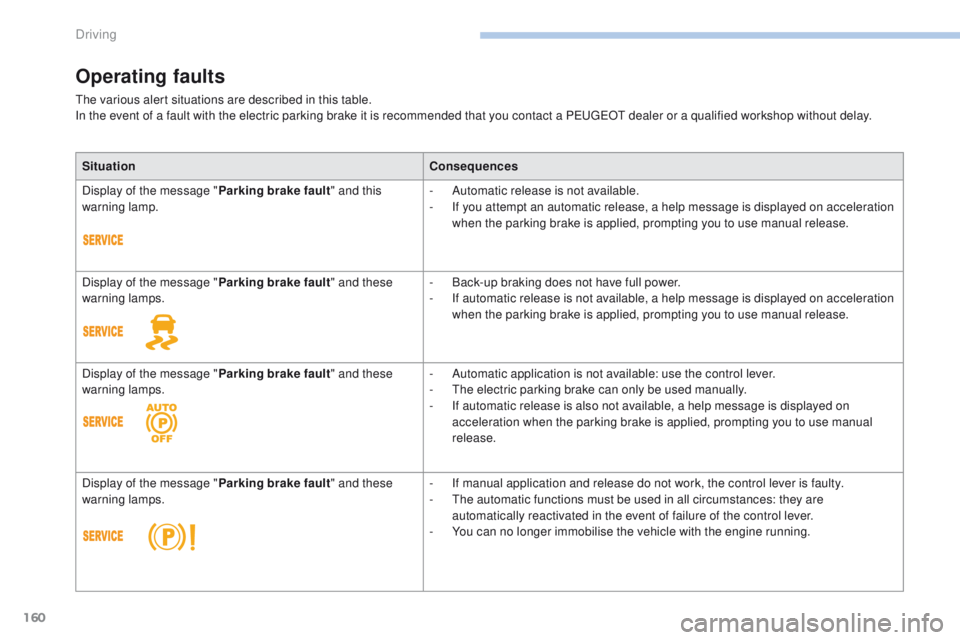
the various alert situations are described in this table.
In the event of a fault with the electric parking brake it is recommended that you contact a PeugeOt dealer or a qualified workshop without delay.
Situation Consequences
Display of the message " Parking brake fault" and this
warning lamp. -
A
utomatic release is not available.
-
I
f you attempt an automatic release, a help message is displayed on acceleration
when the parking brake is applied, prompting you to use manual release.
Display of the message " Parking brake fault" and these
warning lamps. -
B
ack-up braking does not have full power.
-
I
f automatic release is not available, a help message is displayed on acceleration
when the parking brake is applied, prompting you to use manual release.
Display of the message " Parking brake fault" and these
warning lamps. -
A
utomatic application is not available: use the control lever.
-
t
h
e electric parking brake can only be used manually.
-
I
f automatic release is also not available, a help message is displayed on
acceleration when the parking brake is applied, prompting you to use manual
release.
Display of the message " Parking brake fault" and these
warning lamps. -
I
f manual application and release do not work, the control lever is faulty.
-
t
h
e automatic functions must be used in all circumstances: they are
automatically reactivated in the event of failure of the control lever.
-
Y
ou can no longer immobilise the vehicle with the engine running.
Driving
Page 163 of 392
161
308_en_Chap06_conduite_ed01-2016
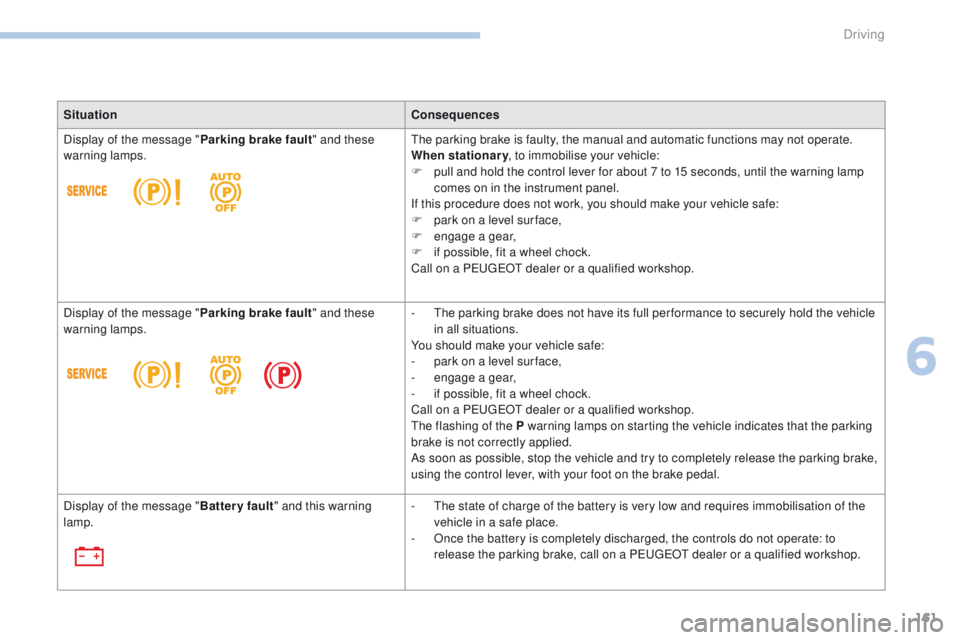
SituationConsequences
Display of the message " Parking brake fault" and these
warning lamps.
th
e parking brake is faulty, the manual and automatic functions may not operate.
When stationary , to immobilise your vehicle:
F
p
ull and hold the control lever for about 7 to 15 seconds, until the warning lamp
comes on in the instrument panel.
If this procedure does not work, you should make your vehicle safe:
F
p
ark on a level sur face,
F
enga
ge a gear,
F
i
f possible, fit a wheel chock.
Call on a P
e
uge
Ot
dealer or a qualified workshop.
Display of the message " Parking brake fault" and these
warning lamps. -
t
h
e parking brake does not have its full per formance to securely hold the vehicle
in all situations.
You should make your vehicle safe:
-
p
ark on a level sur face,
-
enga
ge a gear,
-
i
f possible, fit a wheel chock.
Call on a P
e
uge
Ot
dealer or a qualified workshop.
th
e flashing of the P warning lamps on starting the vehicle indicates that the parking
brake is not correctly applied.
As soon as possible, stop the vehicle and try to completely release the parking brake,
using the control lever, with your foot on the brake pedal.
Display of the message " Battery fault" and this warning
lamp. -
t
h
e state of charge of the battery is very low and requires immobilisation of the
vehicle in a safe place.
-
O
nce the battery is completely discharged, the controls do not operate: to
release the parking brake, call on a P
e
uge
Ot
dealer or a qualified workshop.
6
Driving
Page 164 of 392
162
308_en_Chap06_conduite_ed01-2016
Hill start assist
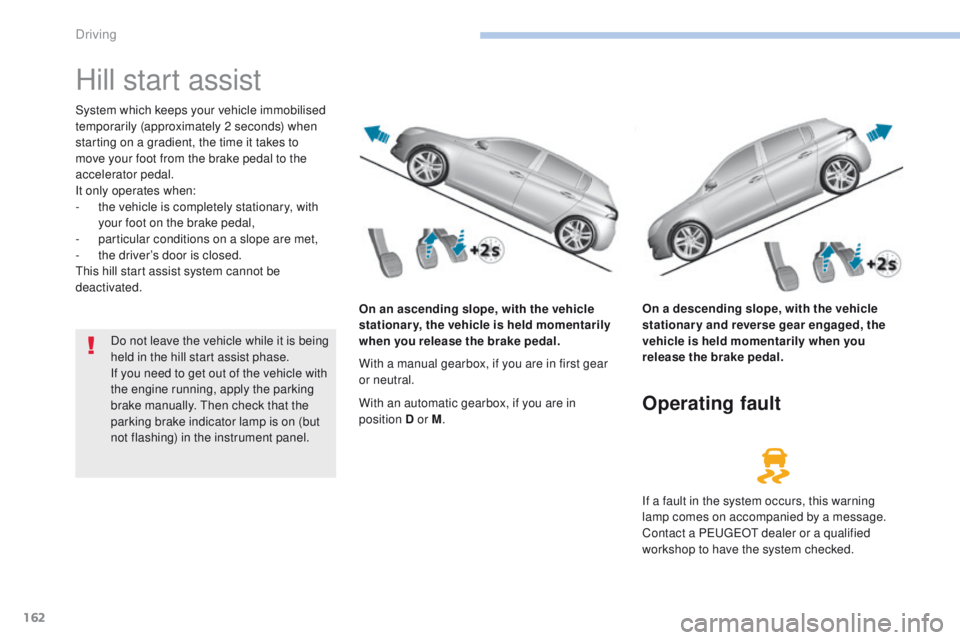
System which keeps your vehicle immobilised
temporarily (approximately 2 seconds) when
starting on a gradient, the time it takes to
move your foot from the brake pedal to the
accelerator pedal.
It only operates when:
-
t
he vehicle is completely stationary, with
your foot on the brake pedal,
-
p
articular conditions on a slope are met,
-
t
he driver’s door is closed.
th
is hill start assist system cannot be
deactivated.
On an ascending slope, with the vehicle
stationary, the vehicle is held momentarily
when you release the brake pedal. On a descending slope, with the vehicle
stationary and reverse gear engaged, the
vehicle is held momentarily when you
release the brake pedal.
Operating fault
Do not leave the vehicle while it is being
held in the hill start assist phase.
If you need to get out of the vehicle with
the engine running, apply the parking
brake manually.
t
h
en check that the
parking brake indicator lamp is on (but
not flashing) in the instrument panel.
If a fault in the system occurs, this warning
lamp comes on accompanied by a message.
Contact a P
e
uge
Ot
dealer or a qualified
workshop to have the system checked.
With a manual gearbox, if you are in first gear
or neutral.
With an automatic gearbox, if you are in
position D or M
.
Driving
Page 167 of 392
165
308_en_Chap06_conduite_ed01-2016
Automatic gearbox
Six speed automatic gearbox which offers a
choice between the comfort of fully automatic
operation, enhanced by sport and snow
programmes, or manual gear changing.
tw
o driving modes are offered:
-
a
utomatic operation for electronic
management of the gears by the gearbox,
●
w
ith the sport programme for a more
dynamic style of driving
●
o
r the snow programme to improve
driving when traction is poor
-
m
anual operation for sequential changing
of the gears by the driver.
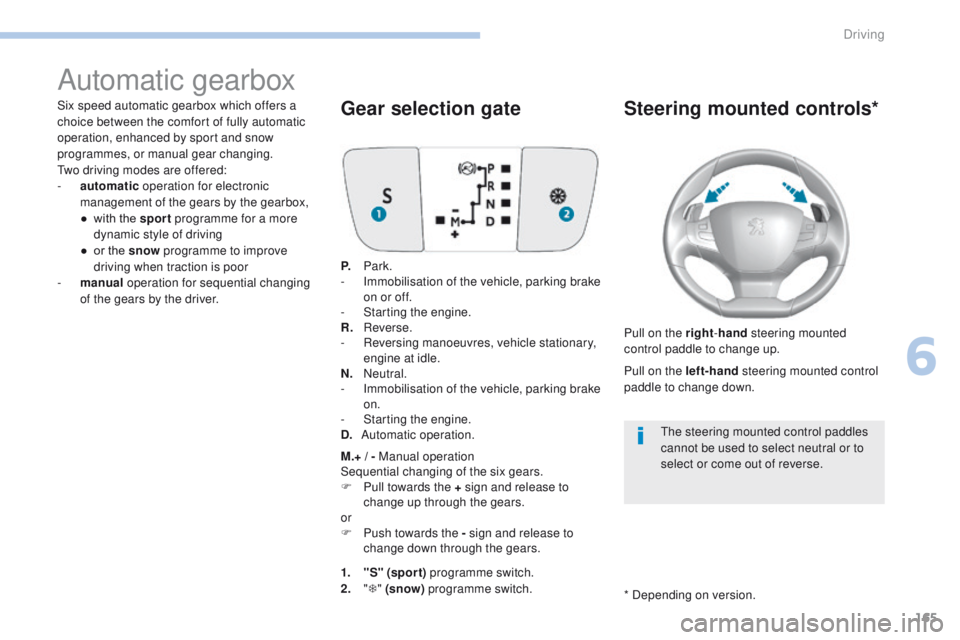
1.
"
S" (spor t) programme switch.
2.
" T "
(snow) programme switch.Gear selection gate
P. Park.
-
I mmobilisation of the vehicle, parking brake
on or off.
-
S
tarting the engine.
R.
R
everse.
-
R
eversing manoeuvres, vehicle stationary,
engine at idle.
N.
N
eutral.
-
I
mmobilisation of the vehicle, parking brake
on.
-
S
tarting the engine.
D.
A
utomatic operation.
M.+ / - Manual operation
Sequential changing of the six gears.
F
P
ull towards the + sign and release to
change up through the gears.
or
F
P
ush towards the - sign and release to
change down through the gears.
Steering mounted controls*
Pull on the right -hand steering mounted
control paddle to change up.
th
e steering mounted control paddles
cannot be used to select neutral or to
select or come out of reverse.
* Depending on version. Pull on the left -hand steering mounted control
paddle to change down.
6
Driving
Page 168 of 392
166
308_en_Chap06_conduite_ed01-2016
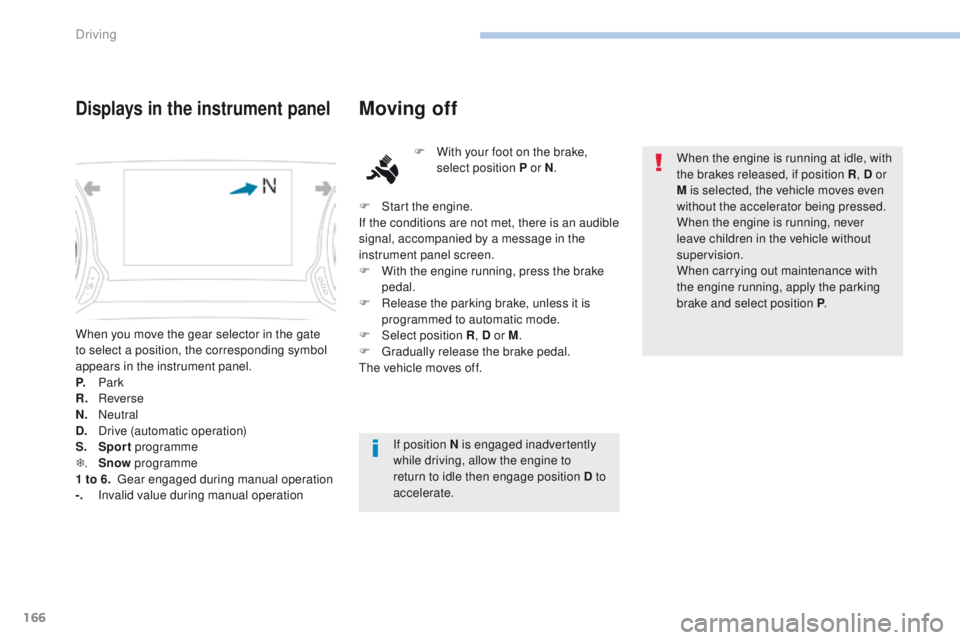
When you move the gear selector in the gate
to select a position, the corresponding symbol
appears in the instrument panel.
P.
Park
R.
R
everse
N.
N
eutral
D.
D
rive (automatic operation)
S.
Sport programme
T .
S
now programme
1 to 6.
g
ea
r engaged during manual operation
-.
I
nvalid value during manual operation
Displays in the instrument panelMoving off
F With your foot on the brake, select position P or N .
If position N is engaged inadvertently
while driving, allow the engine to
return to idle then engage position D to
accelerate. When the engine is running at idle, with
the brakes released, if position R
, D or
M is selected, the vehicle moves even
without the accelerator being pressed.
When the engine is running, never
leave children in the vehicle without
supervision.
When carrying out maintenance with
the engine running, apply the parking
brake and select position P .
F
S
tart the engine.
If the conditions are not met, there is an audible
signal, accompanied by a message in the
instrument panel screen.
F
W
ith the engine running, press the brake
pedal.
F
R
elease the parking brake, unless it is
programmed to automatic mode.
F
Sel
ect position R , D or M.
F
g
r
adually release the brake pedal.
th
e vehicle moves off.
Driving
Page 169 of 392
167
308_en_Chap06_conduite_ed01-2016
Automatic operation
Never select position N while the
vehicle is moving.
Never select positions P or R unless the
vehicle is completely stationary.
Sport and snow programmes
these two special programmes supplement the
automatic operation in very specific conditions
of use.S appears in the instrument panel.
Snow "T"
F Press the " T" switch, after starting the engine.the gearbox adapts to driving on slippery
roads.
th
is programme improves starting and drive
when traction is poor.
T appears in the instrument panel.
Return to automatic operation
F At any time, press the button selected ( S or
" T ") again at any time to quit the programme
engaged and return to auto-adaptive mode.
Creep function (moving
without using the
accelerator)
this function provides great flexibility in
manoeuvring the vehicle at low speed (when
parking, in traffic jams,
…).
With the engine at idle, parking brake released
and position D , M or R selected, the vehicle
moves
as soon as you take your foot off
the brake pedal (even without pressing the
accelerator).
For your safety, this function will be activated
only if you press the brake pedal when
changing from forward drive to reverse.
It is deactivated on opening the driver's door.
Closing the door then pressing the brake or
accelerator pedal reactivates the function.
Never leave children inside the vehicle
without supervision when the engine is
running.
If you vehicle has the Dynamic pack
, refer to
the corresponding section which supplements
sport mode.
F
Sel
ect position D for automatic
changing
of the six gears.th
e gearbox then operates in auto-adaptive
mode, without any intervention on the part
of the driver. It continuously selects the most
suitable gear according to the style of driving,
the profile of the road and the load in the
vehicle.
For maximum acceleration, without touching
the gear selector press the accelerator pedal
down fully (kick-down).
t
h
e gearbox changes
down automatically or maintains the gear
selected until the maximum engine speed is
reached.
On braking, the gearbox changes down
automatically to provide efficient engine
braking.
If you release the accelerator sharply, the
gearbox will not change to a higher gear for
safety reasons.Sport "S"
F Press the "S" switch, after starting the engine.the gearbox automatically favours a dynamic
style of driving.
6
Driving