instrument panel Peugeot 308 2017 Repair Manual
[x] Cancel search | Manufacturer: PEUGEOT, Model Year: 2017, Model line: 308, Model: Peugeot 308 2017Pages: 392, PDF Size: 10.16 MB
Page 210 of 392
208
308_en_Chap06_conduite_ed01-2016
the system is deactivated by pressing the
control.
the
system is deactivated automatically:
-
o
n switching off the ignition,
-
i
f the engine stalls,
-
i
f no manoeuvre is started within 5 minutes
of selection of the type of manoeuvre,
-
a
fter a prolonged stop of the vehicle during
a manoeuvre,
-
i
f the road wheel anti-slip regulation (ASR)
is triggered,
-
i
f the speed of the vehicle exceeds the
stated limit,
-
w
hen the driver interrupts movement of the
steering wheel,
-
a
fter 4 manoeuvre cycles,
-
o
n opening the driver's door,
-
i
f one of the front wheels encounters an
obstacle.
th
e operation indicator lamp goes off in the
instrument panel and a message is displayed
accompanied by an audible signal.
th
e driver should then take back control of the
vehicle's steering.
Deactivation
If the system is deactivated during a
manoeuvre, the drive should reactivate it to
repeat the measurement.
th
e system is switched off automatically:
-
w
hen towing a trailer,
-
i
f the driver's door is opened,
-
i
f the speed of the vehicle is above 42 mph
(70 km/h).
to s
witch the system of for a prolonged period,
contact a P
e
uge
Ot
dealer or a qualified
workshop.
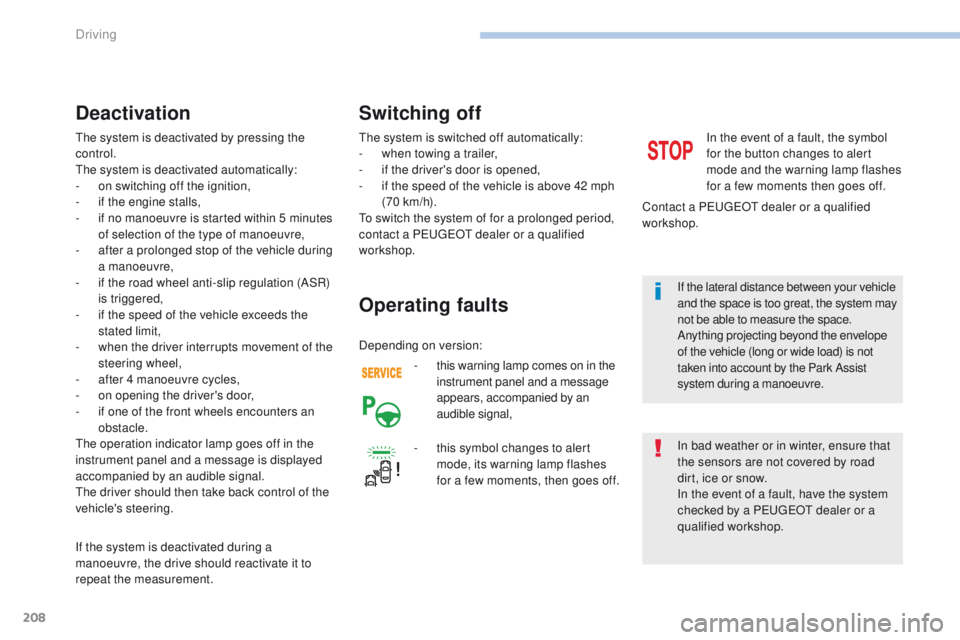
-
t
his warning lamp comes on in the
instrument panel and a message
appears, accompanied by an
audible signal,
Operating faults
In the event of a fault, the symbol
for the button changes to alert
mode and the warning lamp flashes
for a few moments then goes off.
Contact a P
e
uge
Ot
dealer or a qualified
workshop.
Switching off
In bad weather or in winter, ensure that
the sensors are not covered by road
dirt, ice or snow.
In the event of a fault, have the system
checked by a P
e
uge
Ot
dealer or a
qualified workshop.
-
t
his symbol changes to alert
mode, its warning lamp flashes
for a few moments, then goes off. If the lateral distance between your vehicle
and the space is too great, the system may
not be able to measure the space.
Anything projecting beyond the envelope
of the vehicle (long or wide load) is not
taken into account by the Park Assist
system during a manoeuvre.
Depending on version:
Driving
Page 216 of 392
214
308_en_Chap07_info-pratiques_ed01-2016
Low fuel level
When the low fuel level in the tank is
reached, this warning lamp comes on in
the instrument panel, accompanied by
an audible warning and a message.
Fuel supply cut-off
Your vehicle is equipped with a safety device
which cuts off the fuel supply in the event of a
collision. When it first comes on, less than 6 litres of fuel
remain in the tank.
You must refuel as soon as possible to avoid
running out.If you have put in the wrong fuel for
your vehicle, you must have have
the tank drained and refilled with
the correct fuel before you star t the
engine.
Your vehicle is fitted with a catalytic converter,
a device which helps to reduce the level of
harmful emissions in the exhaust gases.
For petrol engines, you must use unleaded
fuel only.
th
e filler neck is narrower, admitting petrol
nozzles only. It is still possible to use a fuel can to fill
the tank but this must be done slowly.
In order to ensure a good flow of fuel,
do not place the nozzle of the fuel can
in direct contact with the flap of the
misfuel prevention device.
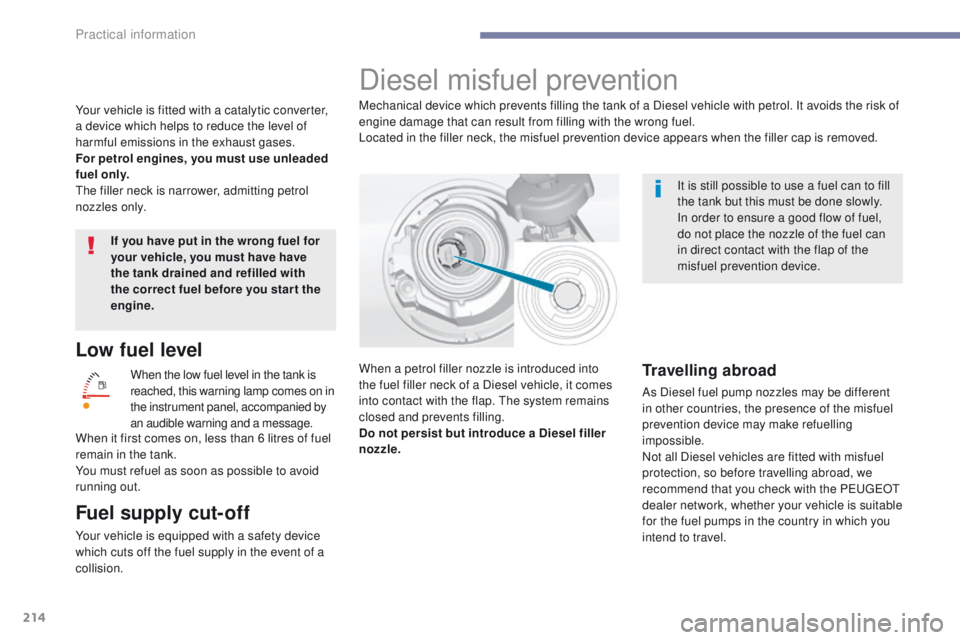
Diesel misfuel prevention
Mechanical device which prevents filling the tank of a Diesel vehicle with petrol. It avoids the risk of
engine damage that can result from filling with the wrong fuel.
Located in the filler neck, the misfuel prevention device appears when the filler cap is removed.
When a petrol filler nozzle is introduced into
the fuel filler neck of a Diesel vehicle, it comes
into contact with the flap.
t
h
e system remains
closed and prevents filling.
Do not persist but introduce a Diesel filler
nozzle.
Travelling abroad
As Diesel fuel pump nozzles may be different
in other countries, the presence of the misfuel
prevention device may make refuelling
impossible.
Not all Diesel vehicles are fitted with misfuel
protection, so before travelling abroad, we
recommend that you check with the P
e
uge
Ot
dealer network, whether your vehicle is suitable
for the fuel pumps in the country in which you
intend to travel.
Practical information
Page 221 of 392
219
308_en_Chap07_info-pratiques_ed01-2016
System which manages the duration of use of certain functions to conserve a sufficient level of
charge in the battery.
After the engine has stopped, you can still use functions such as the audio and telematics
system, windscreen wipers, dipped beam headlamps, courtesy lamps, etc. for a maximum
combined duration of about forty minutes.
energy economy mode
Switching to economy
mode
A message appears in the instrument panel
screen indicating that the vehicle has switched
to economy mode and the active functions are
put on standby.
If a telephone call is being made at this time, it
will be maintained for around 10 minutes with
the Bluetooth hands-free system of your audio
system.
Exiting economy mode
these functions are reactivated automatically
next time the vehicle is driven.
In order to restore the use of these functions
immediately, start the engine and let it run:
-
f
or less than ten minutes, to use the
equipment for approximately five minutes,
-
f
or more than ten minutes, to use the
equipment for up to approximately thirty
minutes.
Let the engine run for the duration specified to
ensure that the battery charge is sufficient.
Do not repeatedly and continuously restart the
engine in order to charge the battery.
A flat battery prevents the engine from starting.
Load reduction mode
System which manages the use of certain
functions according to the level of charge
remaining in the battery.
When the vehicle is being driven, the load
reduction function temporarily deactivates
certain functions, such as the air conditioning,
the heated rear screen...
th
e deactivated functions are reactivated
automatically as soon as conditions permit.
For more information on the 12 V
battery , refer to the corresponding
section.
7
Practical information
Page 230 of 392
228
308_en_Chap07_info-pratiques_ed01-2016
Checking levels
take care when working under the bonnet, as certain areas of the engine may be extremely hot (risk of burns) and the cooling fan could start at
any time (even with the ignition off).
Engine oil level
the check is carried out either when
the ignition is switched on using the
oil level indicator in the instrument
panel for vehicles so equipped, or
using the dipstick.Checking using the dipstick
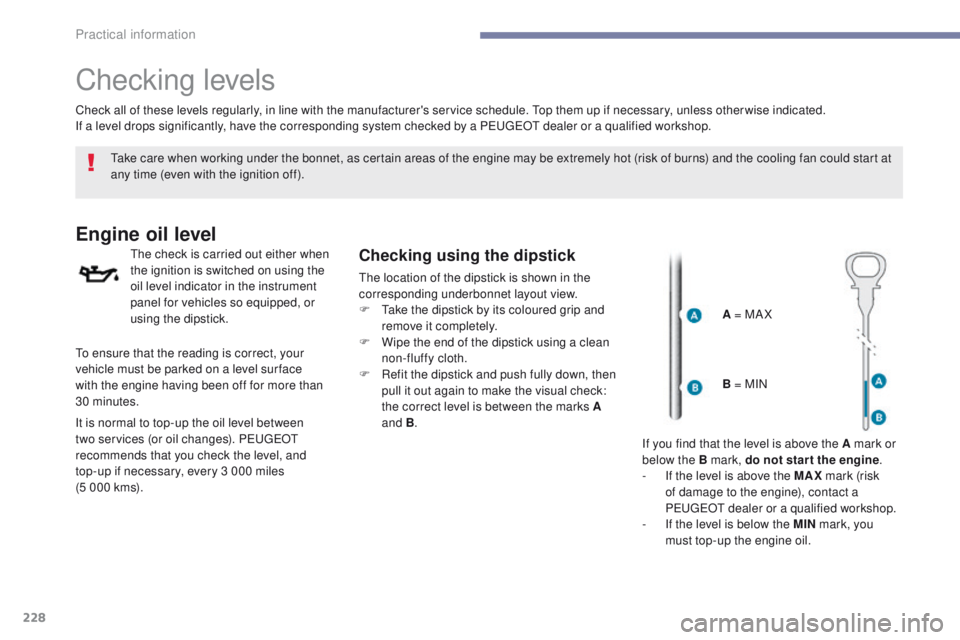
the location of the dipstick is shown in the
corresponding underbonnet layout view.
F t
a
ke the dipstick by its coloured grip and
remove it completely.
F
W
ipe the end of the dipstick using a clean
non-fluffy cloth.
F
R
efit the dipstick and push fully down, then
pull it out again to make the visual check:
the correct level is between the marks A
and B .
Check all of these levels regularly, in line with the manufacturer's service schedule.
t
o
p them up if necessary, unless other wise indicated.
If a level drops significantly, have the corresponding system checked by a P
e
uge
Ot
dealer or a qualified workshop.
A = MA X
to e
nsure that the reading is correct, your
vehicle must be parked on a level sur face
with
the engine having been off for more than
30 minutes.
It is normal to top-up the oil level between
two services (or oil changes). P
e
uge
Ot
recommends that you check the level, and
top-up if necessary, every 3 000 miles
(5 000 kms). B = MIN
If you find that the level is above the A mark or
below the B mark, do not star t the engine .
-
I
f the level is above the MAX mark (risk
of damage to the engine), contact a
P
e
uge
Ot
dealer or a qualified workshop.
-
I
f the level is below the MIN mark, you
must top-up the engine oil.
Practical information
Page 231 of 392
229
308_en_Chap07_info-pratiques_ed01-2016
Oil grade
Before topping-up the oil or changing the oil,
check that the oil is the correct grade for your
engine and conforms to the manufacturer's
recommendations.
Topping-up the engine oil level
the location of the oil filler cap is shown in the
corresponding underbonnet layout view.
F u
n
screw the oil filler cap to reveal the filler
aperture.
F
A
dd oil in small quantities, avoiding any
spills on engine components (risk of fire).
F
W
ait a few minutes before checking the
level again using the dipstick.
F
A
dd more oil if necessary.
F
A
fter checking the level, carefully refit the
oil filler cap and the dipstick in its tube. After topping-up the oil, the check when
switching on the ignition with the oil
level indicator in the instrument panel
is not valid during the 30 minutes after
topping-up.
Engine oil change
Refer to the manufacturer's service schedule
for details of the interval for this operation.
In order to maintain the reliability of the engine
and emission control system, never use
additives in the engine oil.th
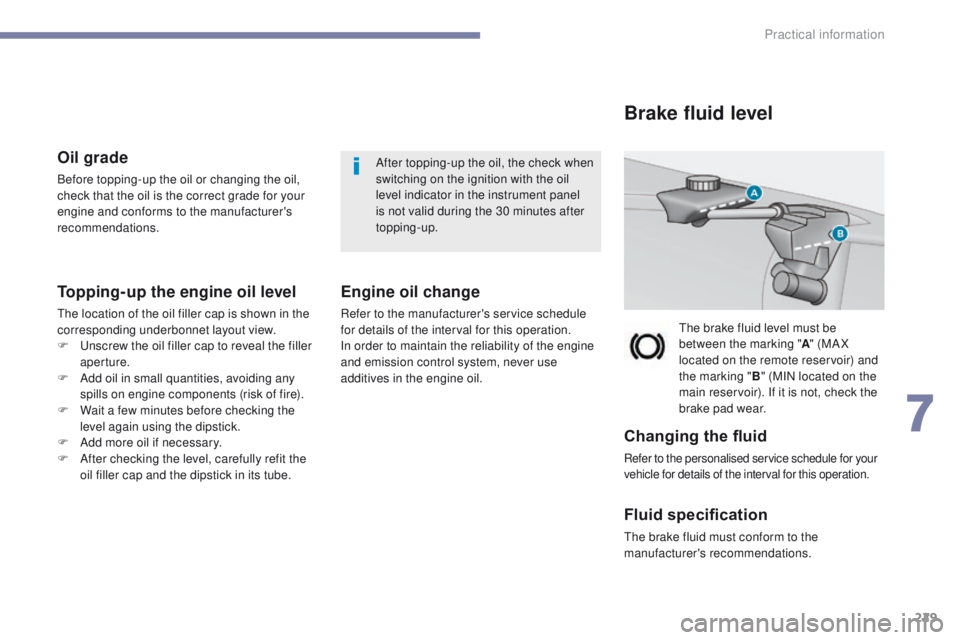
e brake fluid level must be
between the marking " A" (MA X
located on the remote reservoir) and
the marking " B" (MIN located on the
main reservoir). If it is not, check the
brake pad wear.
Brake fluid level
Changing the fluid
Refer to the personalised service schedule for your
vehicle for details of the interval for this operation.
Fluid specification
the brake fluid must conform to the
manufacturer's recommendations.
7
Practical information
Page 232 of 392
230
308_en_Chap07_info-pratiques_ed01-2016
Coolant level
the coolant level should be close
to the "MA X" mark but should never
exceed it.
In addition, as the cooling system is pressurised,
wait at least one hour after switching off the
engine before carrying out any work.
to a
void any risk of scalding, unscrew the cap
by two turns to allow the pressure to drop. When
the pressure has dropped, remove the cap and
top-up the level.
It is normal to top-up the coolant
level between services (or coolant
replacements).
Fluid specification
the coolant must conform to the
manufacturer's recommendations. The cooling fan may star t after switching
off the engine: take care with ar ticles and
clothing that might be caught by the fan
blades. When the engine is warm, the temperature of
the coolant is regulated by the fan.
Fluid specification
For optimum cleaning and to avoid freezing,
this fluid must not be topped-up with or
replaced with plain water.
Screenwash and headlamp
wash fluid
In the case of vehicles fitted with
headlamp washers, the low fluid level
is indicated by an audible signal and
a message in the instrument panel
screen.
to
p-up the reservoir when you next
stop the vehicle.
In wintry conditions, the use of an ethyl alcohol
or methanol base fluid is recommended. Avoid prolonged contact of used oil or
fluids with the skin.
Most of these fluids are harmful to
health or indeed very corrosive.
Do not discard used oil or fluids into
sewers or onto the ground.
ta
ke used oil to a P
e
uge
Ot
dealer or
a qualified workshop (France) or to an
authorised waste disposal site.
Used products
To p p i n g - u p
this additive must be topped-up by a
Pe ugeOt dealer or a qualified workshop
without delay.
Diesel additive level
(Diesel engine with
particle filter)
A low additive level is indicated by
illumination of this warning lamp,
accompanied by an audible warning
and a message in the instrument
panel screen.
Practical information
Page 266 of 392
264
308_en_Chap08_en-cas-de-panne_ed01-2016
Dashboard fuses
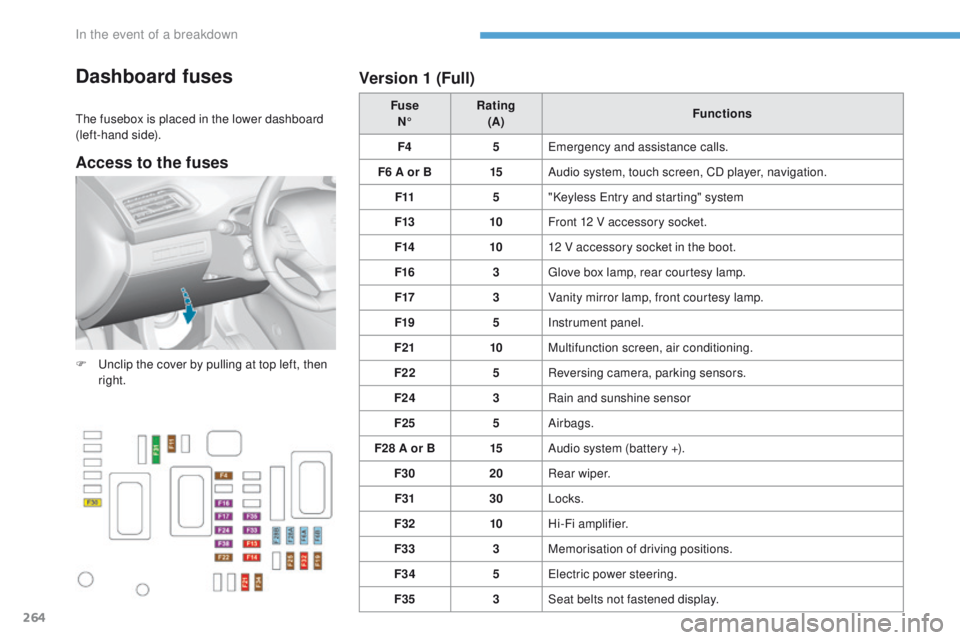
the fusebox is placed in the lower dashboard
(left-hand side). Fuse
N° Rating
(A) Functions
F4 5
em
ergency and assistance calls.
F6 A or B 15Audio system, touch screen, CD player, navigation.
F11 5"Keyless
e
n
try and starting" system
F13 10Front 12 V accessory socket.
F14 1012 V accessory socket in the boot.
F16 3
gl
ove box lamp, rear courtesy lamp.
F17 3Vanity mirror lamp, front courtesy lamp.
F19 5Instrument panel.
F21 10Multifunction screen, air conditioning.
F22 5Reversing camera, parking sensors.
F24 3Rain and sunshine sensor
F25 5Airbags.
F28 A or B 15Audio system (battery +).
F30 20Rear wiper.
F31 30Locks.
F32 10Hi-Fi amplifier.
F33 3Memorisation of driving positions.
F34 5
el
ectric power steering.
F35 3Seat belts not fastened display.
F
u
n
clip the cover by pulling at top left, then
right.
Version 1 (Full)
Access to the fuses
In the event of a breakdown
Page 267 of 392

265
308_en_Chap08_en-cas-de-panne_ed01-2016
Version 2 (Eco)
Fuse
N° Rating
(A) Functions
F9 5
em
ergency and assistance calls.
F13 5Reversing camera and parking sensors
F15 1512 V accessory socket.
F16 15Cigarette lighter.
F17 15Audio system.
F18 20
to
uch screen, CD player, audio and navigation system.
F19 5Rain, sunshine sensor.
F20 5Airbags.
F21 5Instrument panel.
F22/F24 30Interior, exterior, front and rear locks.
F23 5
gl
ove box lamp, vanity mirror, front and rear courtesy lamps.
F25/F27 15Front/rear screenwash pump.
F26 15Horn.
F30 15Rear wiper.
8
In the event of a breakdown
Page 382 of 392

380
308_en_Chap11_index-alpha_ed01-2016
Hazard warning lamps ..........................118, 238
Headlamp adjustment ...................................113
Headlamps, automatic illumination
................................... 1 0 8 , 111, 112
Headlamps, dipped beam
.............107, 252, 254
Headlamps, halogen
.............................252, 254
Headlamps, main beam
........ 1
07, 252, 254, 256
Headlamp wash
............................................ 115
Head restraints, front
...................................... 77
Head restraints, rear
.................................80, 81
Heating
.......................................... 10, 91, 93, 94
Hill start assist
............................................... 16
2
Horn ............................................................... 121
H
eBFD ............................................................. 121ec
o-driving (advice) ........................................ 10
ec
onomy mode
............................................. 219
el
ectronic brake force distribution (
eB
FD)
...12
1
el
ectronic stability control (
e
SC) ............17, 1 2 1
em
ergency braking assistance (
eBA
)
..........12
1
em
ergency call
............................................. 11
9
em
ergency collision braking
...........22, 19 0, 193
em
ergency switching off
............................... 15
2
E
G
F
Deactivation of DSC (eSC) ...........................123
Deadlocking .............................................. 52, 60
Defrosting
........................................ 93, 10 0, 101
Demisting
...............................
.................93, 10 0
Demisting, rear screen
.........................101, 105
Denon (audio system)
.............................89, 293
Dimensions
................................................... 289
Dipstick
................
.................................... 31, 2 28
Direction indicators
.......112, 252, 255, 257, 259
Display of inter-vehicle time
..........................187
Display screen, instrument panel
.................16 4
Display screen, multifunction (with audio system)
....................................... 49
Display screen, multifunction (without audio system)
..................................49
Driver Sport Pack
.......................................... 169
Driving abroad ............................................... 107
Driving economically ....................................... 10
Driving positions (storing)
...............................75
Dynamic pack (sport)
.................................... 169
Dynamic stability c ontrol (DSC)
........................... 17, 21, 121, 123 Filling the AdBlue
® tank
................................ 237
Filling the fuel tank ................................ 21
3, 215
Filter, air
...............
......................................... 231
Filter, oil
......................................................... 231
Filter, particle
........................................ 230, 231
Filter, passenger compartment
..................... 231
Fitting a wheel
...............................
................248
Fitting roof bars
............................................. 223
Fittings, boot
............................................. 87
, 88
Fittings, interior
............................................... 82
Flap, fuel filler
...............................
.................213
Flashing indicators
........................................ 112
Foglamps, rear
.............................. 109, 257, 259
Foglamps
...................................................... 252
Foglamps, front
............................. 109, 252, 256
Folding the rear seats
..................................... 80
Frequency (radio)
................................. 308, 309
Fuel .......................................................... 10, 215
Fuel consumption
............................................ 10
Fu
el tank .......................................................... 22
Fusebox, engine compartment
..................... 266
Fuses
............................................ 262, 264, 266
em
ergency warning lamps
...................
1
18, 238
em
issions control system, SCR .....................
27
en
ergy economy mode
.................................
219
en
gine compartment
...........................
226, 227
en
gine, Diesel
.........
1
5, 215, 227, 274, 281, 285
en
gine, petrol
................................
215, 226, 275
en
gines
.........................................
275, 281, 285
en
vironment
...............................
.........
10, 55, 64
ga
uge, fuel
.................................................... 213
ge
arbox, automatic
....
10, 12, 15, 151, 153, 162,
165, 169 -171, 177, 181, 232, 268
ge
arbox, electronic
........................................
10
ge
arbox, manual
...............
10, 12, 15, 162, 163,
170, 171, 177, 181, 232
gea
r lever
..............................
.........................
10
gea
r lever, automatic gearbox
.....................
16
5
ge
ar lever, manual gearbox
.........................
163
ge
ar shift indicator
.......................................
16 4
glo
ve box, refrigerated
...................................
82
gu
ide-me-home
............................................
112
Alphabetical index
Page 383 of 392
381
308_en_Chap11_index-alpha_ed01-2016
Jack .................................................85, 246, 312
Identification, vehicle
....................................
2
92
Ignition
................
.............................
9 8, 150, 152
Immobiliser, electronic
.....................
53, 65, 154
Indicator, AdBlue
® range ................................. 32
Indicator, coolant temperature ........................ 28
I
ndicator, engine oil level ................................ 31
Indicator lamps, operation
............14, 15, 17, 20
Indicator lamps, status
.............................. 15
, 20
Indicators, direction
...................................... 112
Inflating tyres
.................................................. 10
Inflating tyres and accessories (using the kit)
..............................
................239
Instrument panel
...............................
..............12
Intelligent
t
ra
ction Control
............................ 12
2
Interactive help
........................................ 44, 337
Inter-vehicle time
........................................... 18
7
Isofix mountings
...............................
......140 -14 4 Key
.......................
50, 51, 56, 58, 59, 63, 64, 65
Keyless e
n
try
and Starting ......................
58 - 60, 65, 151, 154
Key with remote control ..............51, 53, 59, 154
Kit, hands-free
..............................346, 347, 370
Kit, temporary puncture repair
................87, 239
I
J
K
Labels, identification ..................................... 2 92
Level, brake fluid ........................................... 2
29
Level, Diesel additive
............................230, 231
Level, engine coolant
..............................28, 230
Level, engine oil
...............................
.......31, 2 28
Level, headlamp wash
..........................11 6 , 2 3 0
Levels and checks
................................ 226-230
Level, screenwash fluid
........................11 6 , 2 3 0
Light-emitting diodes - L
eD
s
........252, 257, 259
Lighting
................
............................14, 104, 107
Lighting dimmer
..............................
................36
Lighting, guide-me home
.................5 3 , 111, 112
Lighting, interior
.................................... 103, 104
Lighting, mood
.............................................. 104
Lighting, welcome
......................................... 112
Loading
................................................... 10, 223
Load reduction mode
.................................... 219
Locating your vehicle
................................ 5
3, 57
L
Locking ............................................................ 65
Long objects, transporting .............................. 86
L
ow fuel level .......................................... 2 2, 213
Luggage cover
..............................
............88, 89
Luggage retaining strap
............................87, 88
Lumbar
...................................................... 73, 78
Maintenance, routine
...................................... 10
Map reading lamps
....................................... 103
Markings, identification
.................................292
Massage function
........................................... 78
Mat
.................................................................. 83
Memorising a speed
..................................... 173
Menu
................................... 302, 304, 306, 316,
318, 322, 330, 342, 344
Menu, main
................................................... 362
Menus (audio)
............................. 302, 304, 306,
316, 318, 342, 344
Menus (
tou
ch screen)
.................2
95, 300, 301
Mirror, rear view
............................................ 10 6
Mirrors, door .................................. 101, 105, 195
Misfuel prevention
...............................
..........214
Mountings, Isofix
................................... 140, 141
MP3 CD
......................................................... 368
M
.
Alphabetical index