engine PEUGEOT 308 2017 Owners Manual
[x] Cancel search | Manufacturer: PEUGEOT, Model Year: 2017, Model line: 308, Model: Peugeot 308 2017Pages: 566, PDF Size: 16.05 MB
Page 285 of 566
283
3008-2_en_Chap07_infos-pratiques_ed01-2016
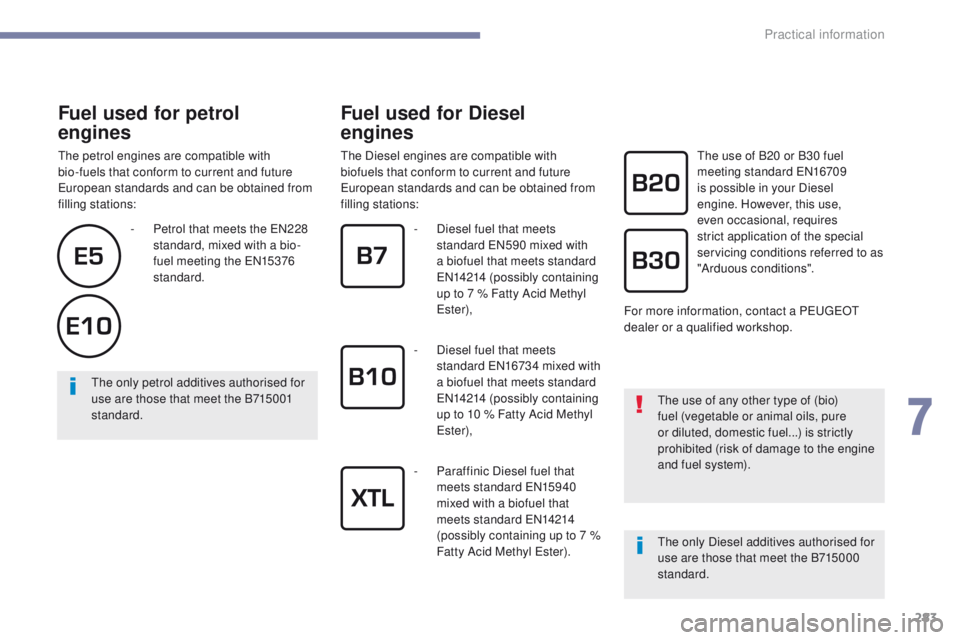
Fuel used for petrol
engines
The petrol engines are compatible with
bio-fuels that conform to current and future
European standards and can be obtained from
filling stations:
Fuel used for Diesel
engines
The Diesel engines are compatible with
biofuels that conform to current and future
European standards and can be obtained from
filling stations:
-
D
iesel fuel that meets
standard EN590 mixed with
a biofuel that meets standard
EN14214 (possibly containing
up to 7 % Fatty Acid Methyl
Ester),
-
Pe
trol that meets the EN228
standard, mixed with a bio-
fuel meeting the EN15376
standard.
The only petrol additives authorised for
use are those that meet the B715001
standard. The use of any other type of (bio)
fuel (vegetable or animal oils, pure
or diluted, domestic fuel...) is strictly
prohibited (risk of damage to the engine
and fuel system).The use of B20 or B30 fuel
meeting standard EN16709
is possible in your Diesel
engine. However, this use,
even occasional, requires
strict application of the special
servicing conditions referred to as
"Arduous conditions".
-
D
iesel fuel that meets
standard EN16734 mixed with
a biofuel that meets standard
EN14214 (possibly containing
up to 10 % Fatty Acid Methyl
Ester),
-
P
araffinic Diesel fuel that
meets standard EN15940
mixed with a biofuel that
meets standard EN14214
(possibly containing up to 7 %
Fatty Acid Methyl Ester). The only Diesel additives authorised for
use are those that meet the B715000
standard.
For more information, contact a PEUGEOT
dealer or a qualified workshop.
7
Practical information
Page 292 of 566
290
3008-2_en_Chap07_infos-pratiques_ed01-2016
Load reduction modeEnergy economy mode
Switching to economy mode
A message appears in the instrument panel
screen indicating that the vehicle has switched
to economy mode and the active functions are
put on standby.
Exiting economy mode
These functions are reactivated automatically
next time the vehicle is driven.
In order to restore the use of these functions
immediately, start the engine and let it run:
-
f
or less than ten minutes, to use the
equipment for approximately five minutes,
-
f
or more than ten minutes, to use the
equipment for up to approximately
thirty
minutes.
Let the engine run for the duration specified to
ensure that the battery charge is sufficient.
Do not repeatedly and continuously restart the
engine in order to charge the battery.
System which manages the use of certain
functions according to the level of charge
remaining in the battery.
When the vehicle is being driven, the load
reduction function temporarily deactivates
certain functions, such as the air conditioning,
the heated rear screen...
The deactivated functions are reactivated
automatically as soon as conditions permit.
System which manages the duration of use of certain functions to conserve a sufficient level of
charge in the battery.
After the engine has stopped, you can still use functions such as the audio and telematics
system,
windscreen wipers, dipped beam headlamps, courtesy lamps, etc. for a maximum
combined duration of about forty minutes.
A flat battery prevents the engine from
starting.
For more information on the 12 V
battery, refer to the corresponding
section.
If a telephone call is being made at this
time, it will be maintained for around
10
minutes with the Bluetooth hands-
free system of your audio system.
Practical information
Page 293 of 566
291
3008-2_en_Chap07_infos-pratiques_ed01-2016
Very cold climate screens*
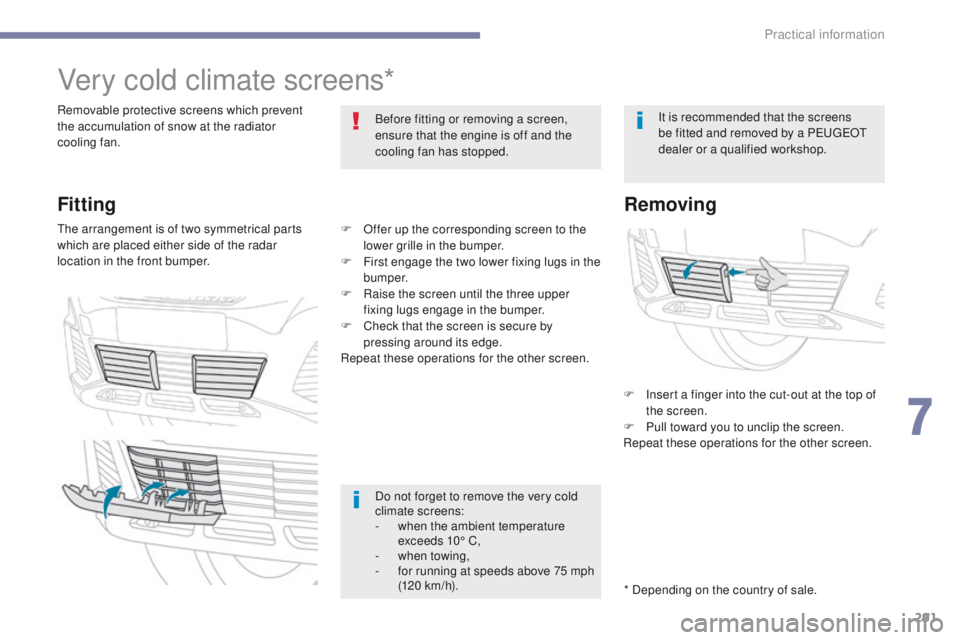
Removable protective screens which prevent
the accumulation of snow at the radiator
cooling fan.Before fitting or removing a screen,
ensure that the engine is off and the
cooling fan has stopped.
* Depending on the country of sale.It is recommended that the screens
be fitted and removed by a PEUGEOT
dealer or a qualified workshop.
Fitting
The arrangement is of two symmetrical parts
which are placed either side of the radar
location in the front bumper.
Removing
F Insert a finger into the cut-out at the top of
the screen.
F
P
ull toward you to unclip the screen.
Repeat these operations for the other screen.
Do not forget to remove the very cold
climate screens:
-
w
hen the ambient temperature
exceeds 10° C,
-
w
hen towing,
-
f
or running at speeds above 75 mph
(120 km/h).
F
O
ffer up the corresponding screen to the
lower grille in the bumper.
F
F
irst engage the two lower fixing lugs in the
b u m p e r.
F
R
aise the screen until the three upper
fixing lugs engage in the bumper.
F
C
heck that the screen is secure by
pressing around its edge.
Repeat these operations for the other screen.
7
Practical information
Page 296 of 566
294
3008-2_en_Chap07_infos-pratiques_ed01-2016
Bonnet
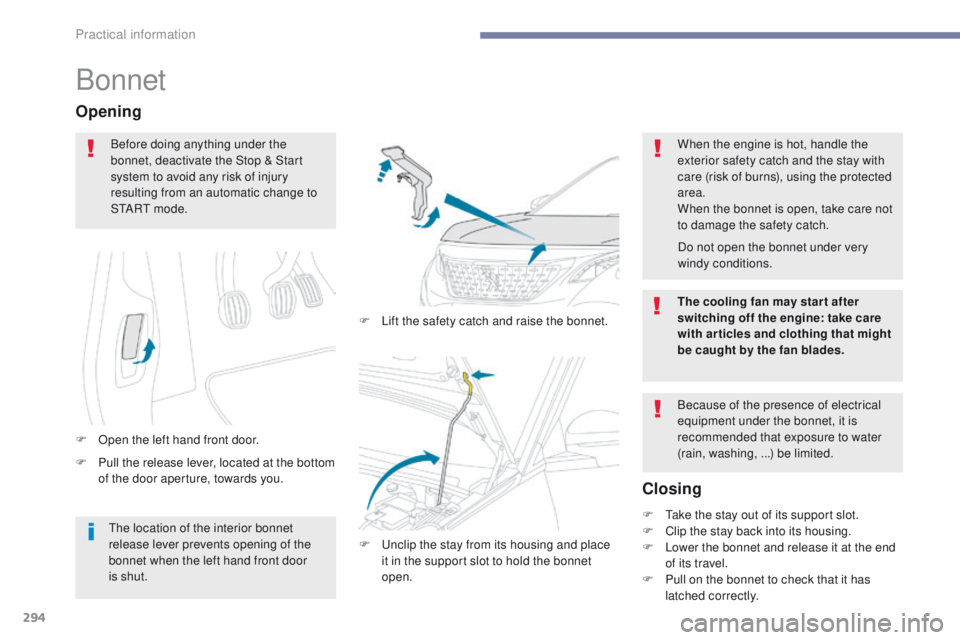
F Pull the release lever, located at the bottom of the door aperture, towards you.
Opening
F Open the left hand front door. F
L
ift the safety catch and raise the bonnet.
Closing
Before doing anything under the
bonnet, deactivate the Stop & Start
system to avoid any risk of injury
resulting from an automatic change to
S TA R T m o d e .
When the engine is hot, handle the
exterior safety catch and the stay with
care (risk of burns), using the protected
area.
When the bonnet is open, take care not
to damage the safety catch.
Because of the presence of electrical
equipment under the bonnet, it is
recommended that exposure to water
(rain, washing, ...) be limited.
F
U
nclip the stay from its housing and place
it in the support slot to hold the bonnet
open. F
T
ake the stay out of its support slot.
F
C
lip the stay back into its housing.
F
L
ower the bonnet and release it at the end
of its travel.
F
P
ull on the bonnet to check that it has
latched correctly.
The location of the interior bonnet
release lever prevents opening of the
bonnet when the left hand front door
is shut. Do not open the bonnet under very
windy conditions.
The cooling fan may star t after
switching off the engine: take care
with articles and clothing that might
be caught by the fan blades.
Practical information
Page 297 of 566
295
3008-2_en_Chap07_infos-pratiques_ed01-2016
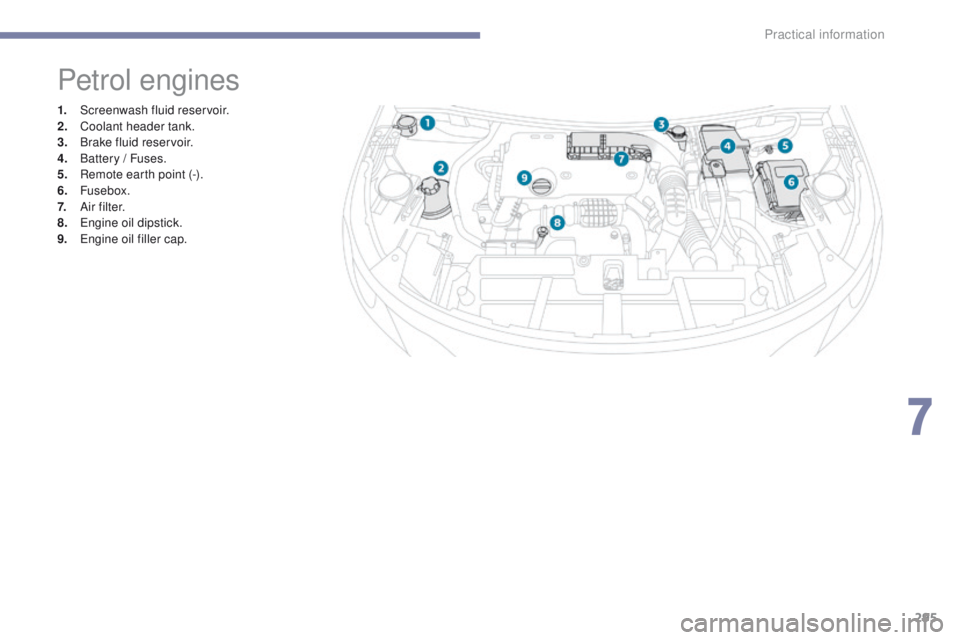
Petrol engines
1. Screenwash fluid reservoir.
2. Coolant header tank.
3.
B
rake fluid reservoir.
4.
B
attery / Fuses.
5.
R
emote earth point (-).
6.
Fusebox.
7.
A
i r f i l t e r.
8.
E
ngine oil dipstick.
9.
E
ngine oil filler cap.
7
Practical information
Page 298 of 566
296
3008-2_en_Chap07_infos-pratiques_ed01-2016
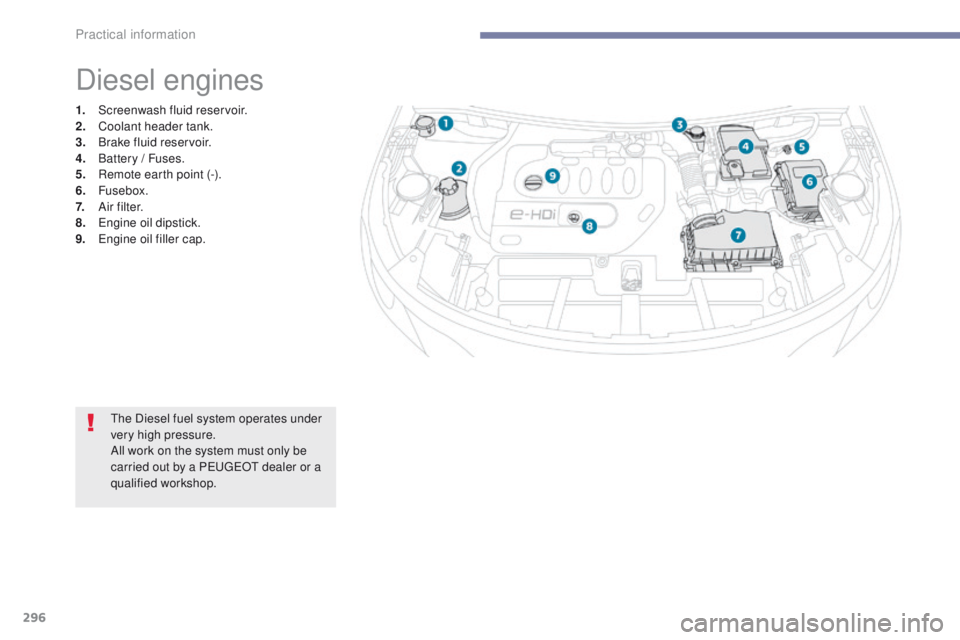
Diesel engines
1. Screenwash fluid reservoir.
2. Coolant header tank.
3.
B
rake fluid reservoir.
4.
B
attery / Fuses.
5.
R
emote earth point (-).
6.
Fusebox.
7.
A
i r f i l t e r.
8.
E
ngine oil dipstick.
9.
E
ngine oil filler cap.
The Diesel fuel system operates under
very high pressure.
All work on the system must only be
carried out by a PEUGEOT dealer or a
qualified workshop.
Practical information
Page 299 of 566
297
3008-2_en_Chap07_infos-pratiques_ed01-2016
Checking levels
The check is carried out either when
the ignition is switched on using the
oil level indicator in the instrument
panel for vehicles so equipped, or
using the dipstick.
Engine oil level
Checking using the dipstick
Check all of these levels regularly, in line with the manufacturer's service schedule. Top them up if necessary, unless other wise indicated.
If a level drops significantly, have the corresponding system checked by a PEUGEOT dealer or a qualified workshop.
It is normal to top-up the oil level between
two services (or oil changes). PEUGEOT
recommends that you check the level, and top-
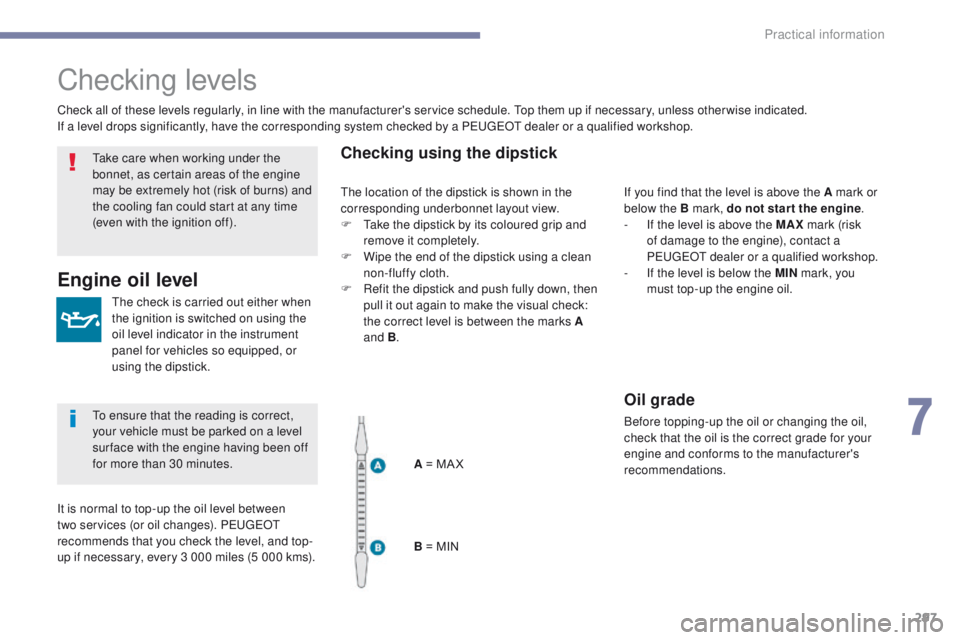
up if necessary, every 3 000 miles (5 000 kms).A = MA X
B = MINIf you find that the level is above the A mark or
below the B mark, do not star t the engine
.
-
I
f the level is above the MAX mark (risk
of damage to the engine), contact a
PEUGEOT dealer or a qualified workshop.
-
I
f the level is below the MIN mark, you
must top-up the engine oil.
Oil grade
Before topping-up the oil or changing the oil,
check that the oil is the correct grade for your
engine and conforms to the manufacturer's
recommendations.
Take care when working under the
bonnet, as certain areas of the engine
may be extremely hot (risk of burns) and
the cooling fan could start at any time
(even with the ignition off).
To ensure that the reading is correct,
your vehicle must be parked on a level
sur face with the engine having been off
for more than 30 minutes.
The location of the dipstick is shown in the
corresponding underbonnet layout view.
F
T
ake the dipstick by its coloured grip and
remove it completely.
F
W
ipe the end of the dipstick using a clean
non-fluffy cloth.
F
R
efit the dipstick and push fully down, then
pull it out again to make the visual check:
the correct level is between the marks A
and B .
7
Practical information
Page 300 of 566
298
3008-2_en_Chap07_infos-pratiques_ed01-2016
Topping-up the engine oil level
The location of the oil filler cap is shown in the
corresponding underbonnet layout view.
F
U
nscrew the oil filler cap to reveal the filler
aperture.
F
A
dd oil in small quantities, avoiding any
spills on engine components (risk of fire).
F
W
ait a few minutes before checking the
level again using the dipstick.
F
A
dd more oil if necessary.
F
A
fter checking the level, carefully refit the
oil filler cap and the dipstick in its tube.
After topping-up the oil, the check when
switching on the ignition with the oil
level indicator in the instrument panel
is not valid during the 30 minutes after
topping-up.
Engine oil change
Refer to the manufacturer's service schedule
for details of the interval for this operation.
In order to maintain the reliability of the engine
and emission control system, never use
additives in the engine oil.
Brake fluid level
Changing the fluid
Refer to the manufacturer's service schedule
for details of the interval for this operation.
Fluid specification
The brake fluid must conform to the
manufacturer's recommendations. The brake fluid level should be close
to the "MA X" mark. If it is not, check
the brake pad wear.
Practical information
Page 301 of 566
299
3008-2_en_Chap07_infos-pratiques_ed01-2016
Screenwash fluid level
Top up the level when necessary.
Fluid specification
For optimum cleaning and to avoid freezing,
this fluid must not be topped up or replaced
with plain water.
In wintry conditions, it is recommended that you
use an ethyl alcohol or methanol based fluid.
Coolant level
Check the coolant level regularly.
It is normal to top-up this fluid
between services.When the engine is hot, the temperature of the
coolant is regulated by the fan.
In addition, as the cooling system is pressurised,
wait at least one hour after switching off the
engine before carrying out any work.
To avoid the risk of scalding in the event of
an urgent need to top-up, with a cloth around
the cap, unscrew it by two turns to allow the
pressure to drop. When the pressure has
dropped, remove the cap and top-up the level.
Once the pressure has dropped, remove the
cap and top-up the level.
The cooling fan may star t after
switching off the engine: take care
with articles and clothing that might
be caught by the fan blades.
The check and top-up must only be done with
the engine cold.
A low coolant level presents a risk of serious
damage to your engine.
The coolant level should be close to the "MA X"
mark but should never exceed it.
If the level is close to or below the "MIN" mark,
it is essential to top-up.
Fluid specification
The coolant must conform to the
manufacturer's recommendations.
7
Practical information
Page 303 of 566
301
3008-2_en_Chap07_infos-pratiques_ed01-2016
Checks
Particle filter (Diesel)
illumination of this warning lamp accompanied
by a message in the multifunction screen.
As soon as the traffic conditions permit,
Versions equipped with Stop & Start are
fitted with a 12 V lead-acid battery of
specific technology and specification.
Its replacement should be carried
out only by a PEUGEOT dealer or a
qualified workshop. regenerate the filter by driving at a speed of at
least 40 mph (60 km/h) until the warning lamp
goes off.
If the warning lamp stays on, this indicates a
low additive level.
For more information on Checking levels
,
refer to the corresponding section.
Unless otherwise indicated, check these components in accordance with the manufacturer's service schedule and according to your engine.
Other wise, have them checked by a PEUGEOT dealer or a qualified workshop.
Air filter and passenger compartment filter
Refer to the manufacturer's
service schedule for details of the
replacement intervals for these
components.
Oil filter
Replace the oil filter each time the
engine oil is changed.
Refer to the manufacturer's
service schedule for details of
the replacement interval for this
component.
12 V battery
The battery does not require any
maintenance.
However, check regularly that the
terminals are correctly tightened
(versions without quick release terminals) and
that the connections are clean.
For more information and the precautions to
take before starting work on the 12 V batter y ,
refer to the corresponding section. Depending on the environment (e.g. dusty
atmosphere) and the use of the vehicle (e.g.
city driving), replace them twice as often if
necessary
.
A clogged passenger compartment filter may
have an adverse effect on the per formance
of the air conditioning system and generate
undesirable odours. The start of saturation of the particle
filter is indicated by the temporary
On a new vehicle, the first particle
filter regeneration operations may be
accompanied by a "burning" smell,
which is per fectly normal.
Following prolonged operation of the
vehicle at very low speed or at idle,
you may, in exceptional circumstances,
notice the emission of water vapour at
the exhaust on acceleration. This does
not affect the behaviour of the vehicle
or the environment.
7
Practical information