ESP PEUGEOT 308 2017 Workshop Manual
[x] Cancel search | Manufacturer: PEUGEOT, Model Year: 2017, Model line: 308, Model: Peugeot 308 2017Pages: 566, PDF Size: 16.05 MB
Page 143 of 566
141
3008-2_en_Chap04_eclairage-et-visibilite_ed01-2016
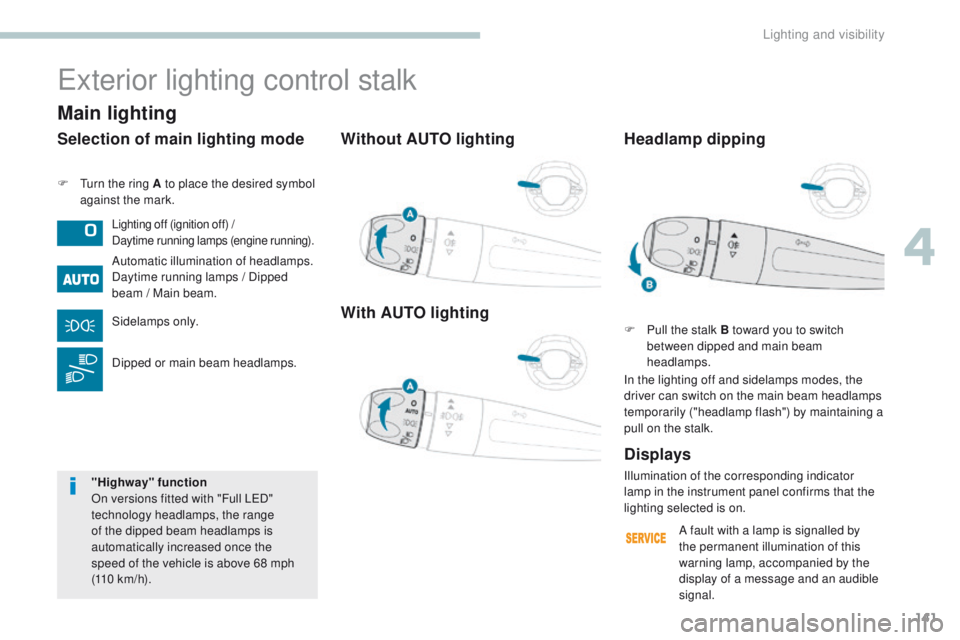
Without AUTO lighting
With AUTO lighting
F Turn the ring A to place the desired symbol against the mark.
Exterior lighting control stalk
Lighting off (ignition off) /
Daytime running lamps (engine running).
Automatic illumination of headlamps.
Daytime running lamps / Dipped
beam / Main beam.
Sidelamps only.
Dipped or main beam headlamps.
Displays
Selection of main lighting mode
Illumination of the corresponding indicator
lamp in the instrument panel confirms that the
lighting selected is on.
Headlamp dipping
F Pull the stalk B toward you to switch
between dipped and main beam
headlamps.
In the lighting off and sidelamps modes, the
driver can switch on the main beam headlamps
temporarily ("headlamp flash") by maintaining a
pull on the stalk.
Main lighting
"Highway" function
On versions fitted with "Full LED"
technology headlamps, the range
of the dipped beam headlamps is
automatically increased once the
speed of the vehicle is above 68 mph
(110
km/h). A fault with a lamp is signalled by
the permanent illumination of this
warning lamp, accompanied by the
display of a message and an audible
signal.
4
Lighting and visibility
Page 146 of 566
144
3008-2_en_Chap04_eclairage-et-visibilite_ed01-2016
Direction indicators
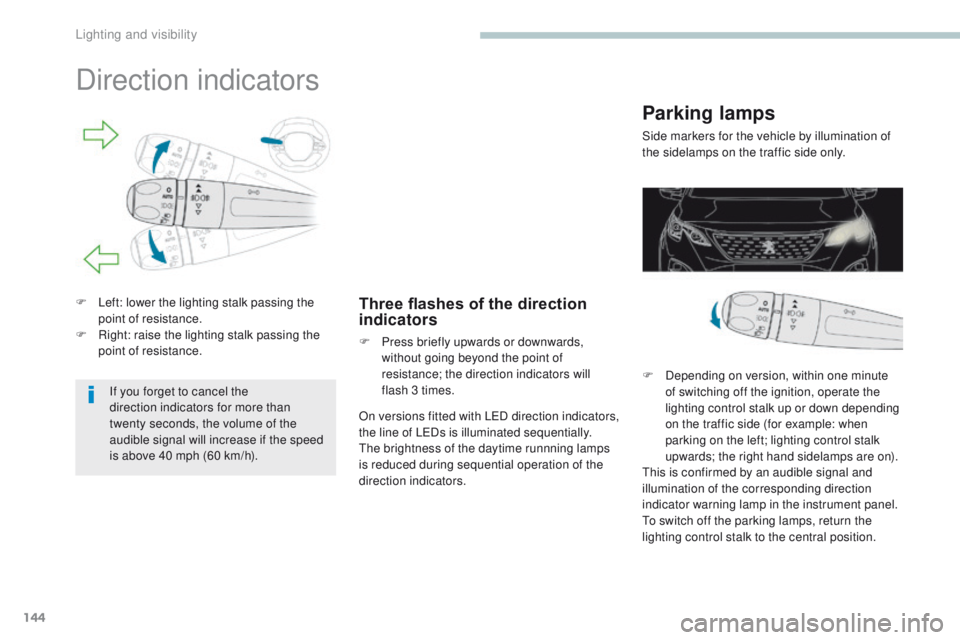
F Left: lower the lighting stalk passing the point of resistance.
F
R
ight: raise the lighting stalk passing the
point of resistance.Three flashes of the direction
indicators
F Press briefly upwards or downwards, without going beyond the point of
resistance; the direction indicators will
flash 3 times.
If you forget to cancel the
direction indicators for more than
twenty
seconds, the volume of the
audible signal will increase if the speed
is above 40 mph (60 km/h). On versions fitted with LED direction indicators,
the line of LEDs is illuminated sequentially.
The brightness of the daytime runnning lamps
is reduced during sequential operation of the
direction indicators.
Parking lamps
Side markers for the vehicle by illumination of
the sidelamps on the traffic side only.
F
D
epending on version, within one minute
of switching off the ignition, operate the
lighting control stalk up or down depending
on the traffic side (for example: when
parking on the left; lighting control stalk
upwards; the right hand sidelamps are on).
This is confirmed by an audible signal and
illumination of the corresponding direction
indicator warning lamp in the instrument panel.
To switch off the parking lamps, return the
lighting control stalk to the central position.
Lighting and visibility
Page 151 of 566
149
3008-2_en_Chap04_eclairage-et-visibilite_ed01-2016
Automatic headlamp dipping
This system is a driving aid.
The driver remains responsible for the
vehicle's lighting, its correct use for the
prevailing conditions of light, visibility,
traffic and observation of driving and
vehicle regulations.
The system will be operational as soon as
you have exceeded 15 mph (25 km/h).
If the speed drops below 9 mph (15
km/h),
the system no longer operates.
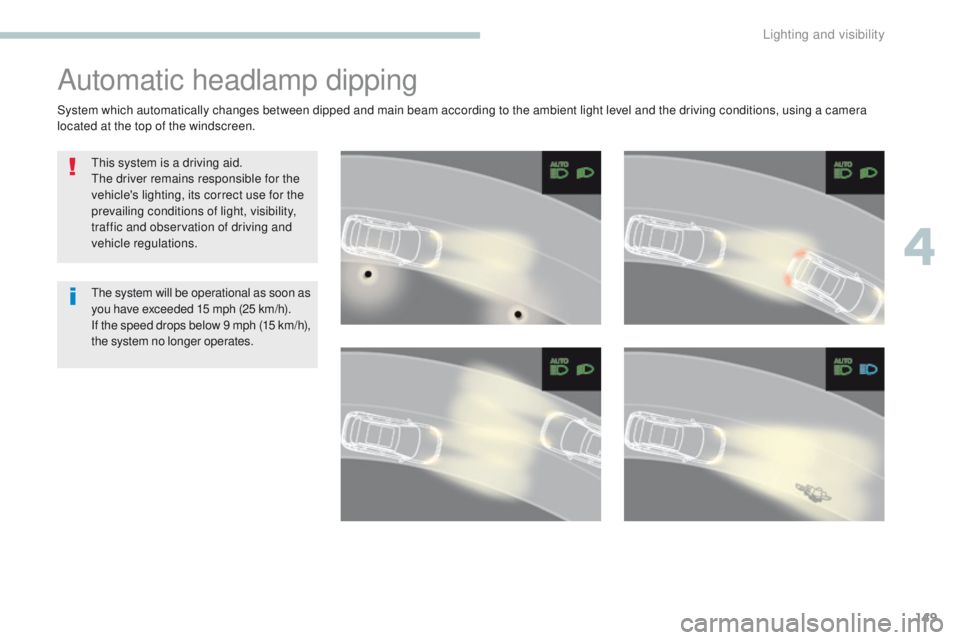
System which automatically changes between dipped and main beam according to the ambient light level and the driving conditions, using a camera
located at the top of the windscreen.
4
Lighting and visibility
Page 153 of 566
151
3008-2_en_Chap04_eclairage-et-visibilite_ed01-2016
Cornering lighting
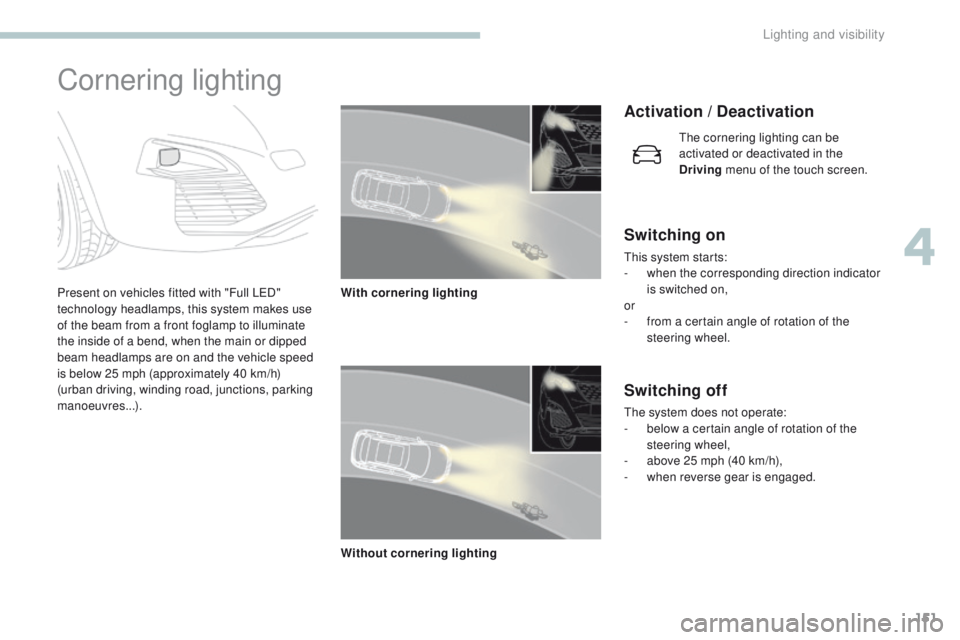
Present on vehicles fitted with "Full LED"
technology headlamps, this system makes use
of the beam from a front foglamp to illuminate
the inside of a bend, when the main or dipped
beam headlamps are on and the vehicle speed
is below 25 mph (approximately 40 km/h)
(urban driving, winding road, junctions, parking
manoeuvres...).With cornering lighting
Activation / Deactivation
Switching on
This system starts:
-
w hen the corresponding direction indicator
is switched on,
or
-
f
rom a certain angle of rotation of the
steering wheel.
Switching off
The system does not operate:
- b elow a certain angle of rotation of the
steering wheel,
-
a
bove 25 mph (40 km/h),
-
w
hen reverse gear is engaged.
Without cornering lighting The cornering lighting can be
activated or deactivated in the
Driving
menu of the touch screen.
4
Lighting and visibility
Page 158 of 566
156
3008-2_en_Chap05_securite_ed01-2016
General safety recommendations
Labels are applied at various
points on your vehicle. They carry
safety warnings as well as vehicle
identification information. Do not
remove them: they form an integral part
of your vehicle.
For any work on your vehicle, use
a qualified workshop that has the
technical information, skills and
equipment required, all of which a
PEUGEOT dealer is able to provide.We draw your attention to
the following points:
- The fitting of electrical equipment or accessories not listed by
PEUGEOT
may cause excessive
current consumption and faults and
failures with the electrical system of
your vehicle. Contact a PEUGEOT
dealer for information on the range
of recommended accessories.
-
A
s a safety measure, access to
the diagnostic socket, used for
the vehicle's electronic systems,
is reserved strictly for PEUGEOT
dealers or qualified workshops,
equipped with the special tools
required (risk of malfunctions of the
vehicle's electronic systems that
could cause breakdowns or serious
accidents). The manufacturer
cannot be held responsible if this
advice is not followed.
-
A
ny modification or adaptation
not intended or authorised by
Automobiles PEUGEOT or
carried out without meeting the
technical requirements defined
by the manufacturer would lead
to the suspension of the legal and
contractual warranties.
Installation of accessory
radio communication
transmitters
Before installing a radio communication
transmitter, you must contact a
PEUGEOT dealer for the specification
of transmitters which can be fitted
(frequency, maximum power,
aerial position, specific installation
requirements), in line with the Vehicle
Electromagnetic Compatibility
Directive
(2004/104/EC).
Depending on the legislation in force in
the country, certain safety equipment
may be compulsory: high visibility
safety vests, warning triangles,
breathalysers, spare bulbs, spare fuses,
fire extinguisher, first aid kit, mud flaps
at the rear of the vehicle...
Safety
Page 165 of 566
163
3008-2_en_Chap05_securite_ed01-2016
Trailer stability assist
Operation
The system is activated automatically when the
ignition is switched on.
The electronic stability programme (ESC) must
not have any faults.
Between 36 and 100 mph (60 and 160 km/h), if
the system detect oscillations (snaking) in the
movement of the trailer, it acts on the brakes to
stabilise the trailer and, if necessary, reduces
engine power to slow down the vehicle.
For information on the weights and towed
loads, refer to the "Technical data" section or
the registration certificate for your vehicle.
For advice on driving safely when To w i n g
a trailer , refer to the corresponding section.
When towing, this system reduces the risk of the vehicle or trailer snaking.
It is available on vehicles with factory-fitted trailer wiring (preparation for towbar option or the towbar with quickly-detachable towball pack).
The correction is signalled by the
flashing of this indicator lamp in the
instrument panel and illumination of
the brake lamps.
Operating fault
Should a fault occur with the system,
this warning lamp comes on in the
instrument panel, accompanied by
the display of a message and an
audible signal.
If you continue to tow a trailer, reduce your
speed and drive carefully!
Contact a PEUGEOT dealer or a qualified
workshop
to have the system checked. The trailer stability assist system offers
increased safety in normal driving,
provided that the recommendations on
towing a trailer are observed. It should
not encourage the driver to take risks,
such as towing a trailer in adverse
operating conditions (overloading,
failure to observe the trailer nose
weight, worn or under-inflated tyres,
faulty braking system, ….)
or drive at
too high a speed.
In certain certain cases, oscillation of
the trailer may not be detected by the
ESC system, particularly with a light
t r a i l e r.
When driving on slippery or poor
sur faces, the system may not be able to
prevent sudden snaking of the trailer.
5
Safety
Page 167 of 566
165
3008-2_en_Chap05_securite_ed01-2016
All terrain (mud, damp grass, ...)
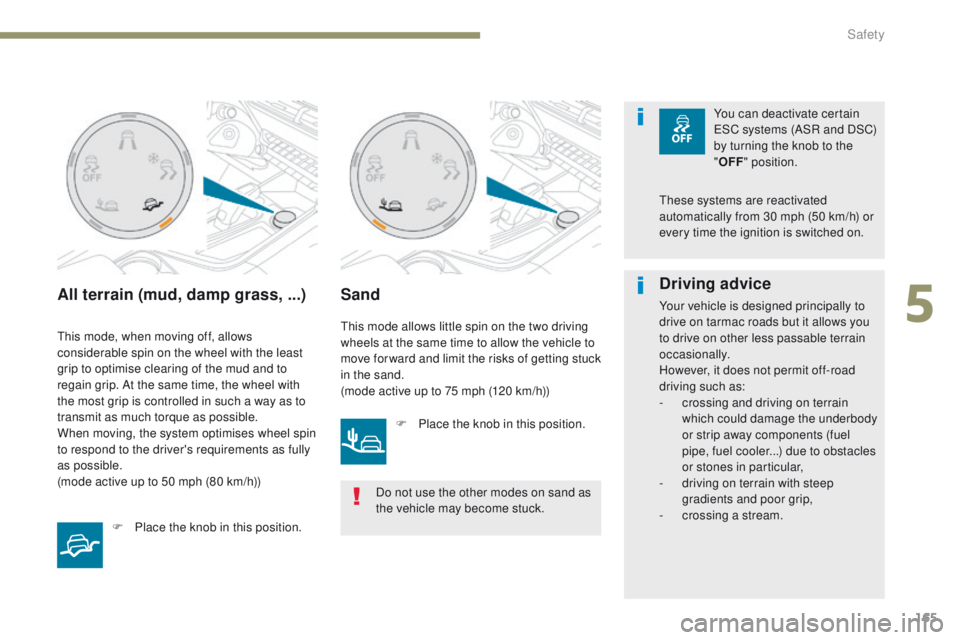
This mode, when moving off, allows
considerable spin on the wheel with the least
grip to optimise clearing of the mud and to
regain grip. At the same time, the wheel with
the most grip is controlled in such a way as to
transmit as much torque as possible.
When moving, the system optimises wheel spin
to respond to the driver's requirements as fully
as possible.
(mode active up to 50 mph (80 km/h))F
P
lace the knob in this position.
Sand
This mode allows little spin on the two driving
wheels at the same time to allow the vehicle to
move for ward and limit the risks of getting stuck
in the sand.
(mode active up to 75 mph (120 km/h))F
P
lace the knob in this position. You can deactivate certain
ESC systems (ASR and DSC)
by turning the knob to the
"
OFF " position.
Driving advice
Your vehicle is designed principally to
drive on tarmac roads but it allows you
to drive on other less passable terrain
occasionally.
However, it does not permit off-road
driving such as:
-
c
rossing and driving on terrain
which could damage the underbody
or strip away components (fuel
pipe, fuel cooler...) due to obstacles
or stones in particular,
-
d
riving on terrain with steep
gradients and poor grip,
-
c
rossing a stream.
Do not use the other modes on sand as
the vehicle may become stuck. These systems are reactivated
automatically from 30 mph (50 km/h) or
every time the ignition is switched on.
5
Safety
Page 171 of 566
169
3008-2_en_Chap05_securite_ed01-2016
Rear seat belts
The rear seats are each fitted with a three-point
inertia reel seat belt.
The outer rear seats are fitted with pyrotechnic
pretensioners and force limiters.
Front seat belts not fastened /
unfastened warning lamp
When the ignition is switched on, this
warning lamp comes on in the seat
belt and passenger's front airbag
warning lamps display, if the driver
and/or the front passenger has not
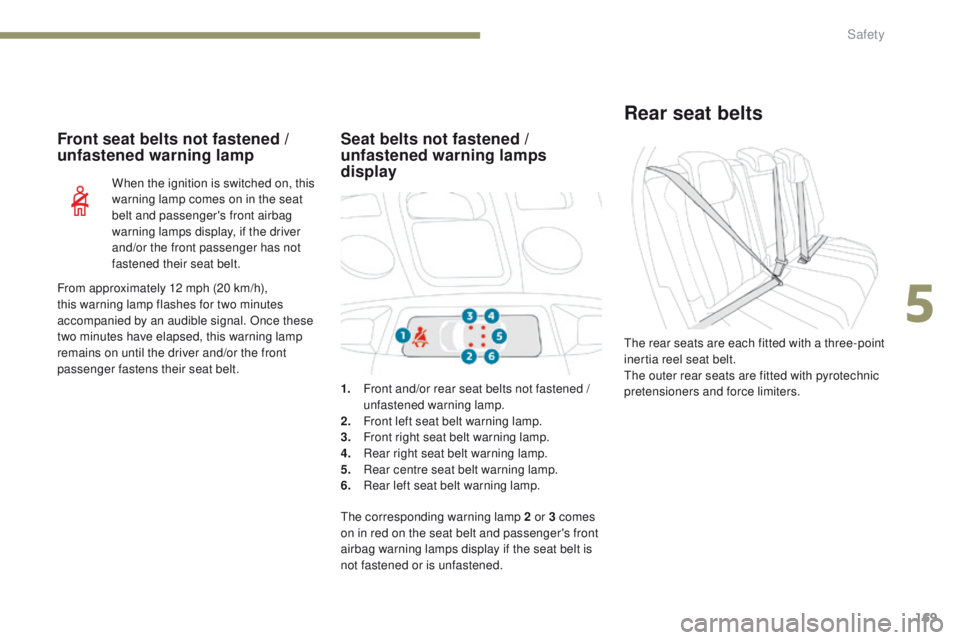
fastened their seat belt.1.
F
ront and/or rear seat belts not fastened /
unfastened warning lamp.
2.
F
ront left seat belt warning lamp.
3.
F
ront right seat belt warning lamp.
4.
R
ear right seat belt warning lamp.
5.
R
ear centre seat belt warning lamp.
6.
R
ear left seat belt warning lamp.
Seat belts not fastened /
unfastened warning lamps
display
The corresponding warning lamp 2 or 3 comes
on in red on the seat belt and passenger's front
airbag warning lamps display if the seat belt is
not fastened or is unfastened.
From approximately 12 mph (20 km/h),
this warning lamp flashes for two minutes
accompanied by an audible signal. Once these
two minutes have elapsed, this warning lamp
remains on until the driver and/or the front
passenger fastens their seat belt.
5
Safety
Page 172 of 566
170
3008-2_en_Chap05_securite_ed01-2016
Fastening
F Pull the strap, then insert the tongue in the buckle.
F
C
heck that the seat belt is fastened
correctly by pulling the strap.
Unfastening
F Press the red button on the buckle.
F G uide the seat belt as it reels in. This warning lamp comes on in
the seat belt and passenger's front
airbag warning lamps display,
when one or more rear passengers
unfasten their seat belt.
Seat belt unfastened warning
lamp
Seat belt unfastened warning
lamps display
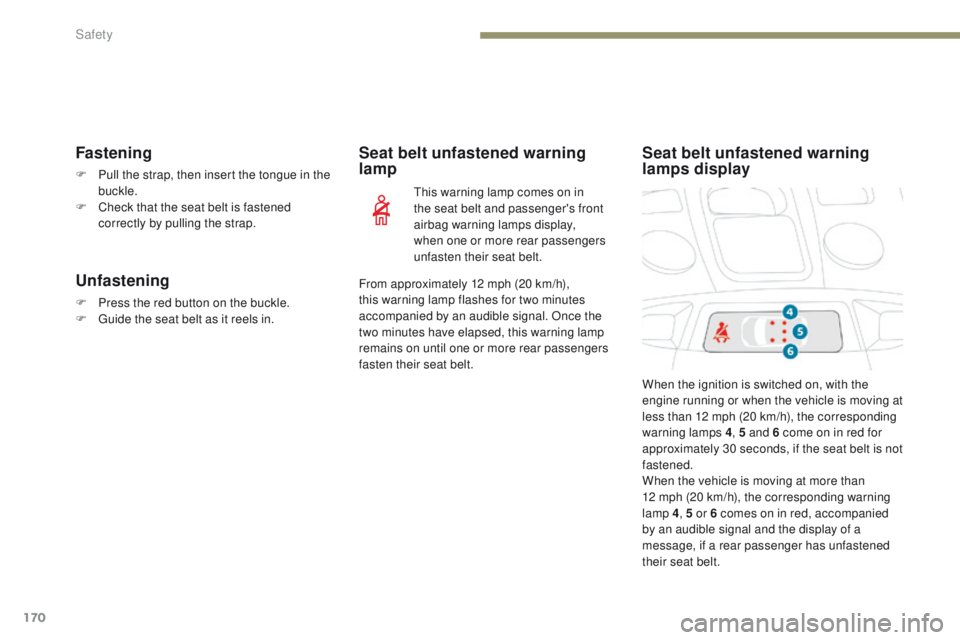
When the ignition is switched on, with the
engine running or when the vehicle is moving at
less than 12 mph (20 km/h), the corresponding
warning lamps 4
, 5 and 6 come on in red for
approximately 30 seconds, if the seat belt is not
fastened.
When the vehicle is moving at more than
12
mph (20 km/h), the corresponding warning
lamp 4 , 5 or 6 comes on in red, accompanied
by an audible signal and the display of a
message, if a rear passenger has unfastened
their seat belt.
From approximately 12 mph (20 km/h),
this warning lamp flashes for two minutes
accompanied by an audible signal. Once the
two minutes have elapsed, this warning lamp
remains on until one or more rear passengers
fasten their seat belt.
Safety
Page 173 of 566
171
3008-2_en_Chap05_securite_ed01-2016
The driver must ensure that passengers use
the seat belts correctly and that they are all
fastened before setting off.
Wherever you are seated in the vehicle,
always fasten your seat belt, even for short
journeys.
Do not interchange the seat belt buckles as
they will not fulfill their role fully.
The seat belts are fitted with an inertia reel
permitting automatic adjustment of the length
of the strap to your size. The seat belt is
stowed automatically when not in use.
Before and after use, ensure that the seat
belt is reeled in correctly.
The lower part of the strap must be
positioned as low as possible on the pelvis.
The upper part must be positioned in the
hollow of the shoulder.
The inertia reels are fitted with an automatic
locking device which comes into operation in
the event of a collision, emergency braking
or if the vehicle rolls over. You can release
the device by pulling the strap firmly and
then releasing it so that it reels in slightly.Recommendations for children
Use a suitable child seat if the passenger is
less than 12 years old or shorter than one
and a half metres.
Never use the same seat belt to secure more
than one person.
Never allow a child to travel on your lap.
For more information on Child seats, refer to
the corresponding section.
In the event of an impact
Depending on the nature and seriousness
of the impact , the pretensioning device may
be deployed before and independently of the
airbags. Deployment of the pretensioners
is accompanied by a slight discharge of
harmless smoke and a noise, due to the
activation of the pyrotechnic cartridge
incorporated in the system.
In all cases, the airbag warning lamp
comes
on.
Following an impact, have the seat belts
system checked, and if necessary replaced,
by a PEUGEOT dealer or a qualified
workshop.
Advice
In order to be effective, a seat belt must:
- b e tightened as close to the body as
possible,
-
b
e pulled in front of you with a smooth
movement, checking that it does not
twist,
-
b
e used to restrain only one person,
-
n
ot bear any trace of cuts or fraying,
-
n
ot be converted or modified to avoid
affecting its performance.
In accordance with current safety
regulations, for all repairs on your vehicle's
seat belts, go to a qualified workshop with
the skills and equipment needed, which a
PEUGEOT dealer is able to provide.
Have your seat belts checked regularly by a
PEUGEOT dealer or a qualified workshop,
particularly if the straps show signs of
damage.
Clean the seat belt straps with soapy
water or a textile cleaning product, sold by
PEUGEOT dealers.
After folding or moving a seat or rear bench
seat, ensure that the seat belt is positioned
and reeled in correctly.
5
Safety