torque PEUGEOT 308 2024 Owners Manual
[x] Cancel search | Manufacturer: PEUGEOT, Model Year: 2024, Model line: 308, Model: PEUGEOT 308 2024Pages: 280, PDF Size: 8.13 MB
Page 8 of 280
6
Overview
Hybrid system
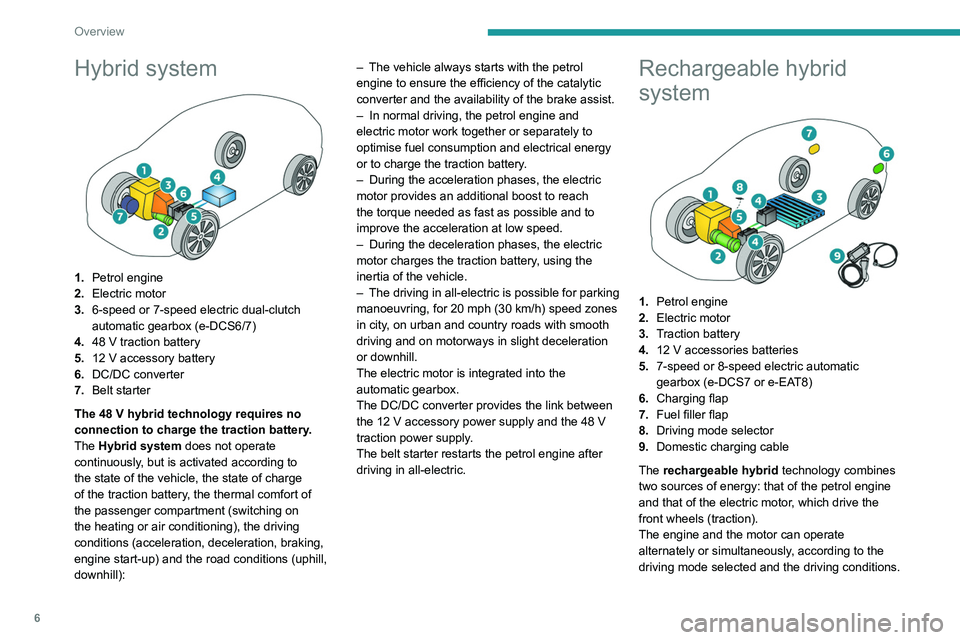
1.Petrol engine
2. Electric motor
3. 6-speed or 7-speed electric dual-clutch
automatic gearbox (e-DCS6/7)
4. 48 V traction battery
5. 12 V accessory battery
6. DC/DC converter
7. Belt starter
The 48
V hybrid technology requires no
connection to charge the traction battery.
The Hybrid system does not operate
continuously, but is activated according to
the state of the vehicle, the state of charge
of the traction battery, the thermal comfort of
the passenger compartment (switching on
the heating or air conditioning), the driving
conditions (acceleration, deceleration, braking,
engine start-up) and the road conditions (uphill,
downhill): –
The vehicle always starts with the petrol
engine to ensure the efficiency of the catalytic
converter and the availability of the brake assist.
–
In normal driving, the petrol engine and
electric motor work together or separately to
optimise fuel consumption and electrical energy
or to charge the traction battery
.
–
During the acceleration phases, the electric
motor provides an additional boost to reach
the torque needed as fast as possible and to
improve the acceleration at low speed.
–
During the deceleration phases, the electric
motor charges the traction battery
, using the
inertia of the vehicle.
– The driving in all-electric is possible for parking
manoeuvring, for 20
mph (30 km/h) speed zones
in city, on urban and country roads with smooth
driving and on motorways in slight deceleration
or downhill.
The electric motor is integrated into the
automatic gearbox.
The DC/DC converter provides the link between
the 12
V accessory power supply and the 48 V
traction power supply.
The belt starter restarts the petrol engine after
driving in all-electric.
Rechargeable hybrid
system
1. Petrol engine
2. Electric motor
3. Traction battery
4. 12 V accessories batteries
5. 7-speed or 8-speed electric automatic
gearbox (e-DCS7 or e-EAT8)
6. Charging flap
7. Fuel filler flap
8. Driving mode selector
9. Domestic charging cable
The rechargeable hybrid technology combines
two sources of energy: that of the petrol engine
and that of the electric motor, which drive the
front wheels (traction).
The engine and the motor can operate
alternately or simultaneously, according to the
driving mode selected and the driving conditions.
Page 102 of 280
100
Driving
Anti-theft protection
Electronic immobiliser
The keys contain a code, which must be
recognised by the vehicle before starting is
possible.
If the system malfunctions, indicated by the
display of a message, the engine will not start.
Contact a PEUGEOT dealer.
Starting/switching off the
engine
The electronic key must be present in the passenger compartment.
The electronic key is also detected in the
boot.
If the electronic key is not detected, a
message is displayed.
Move the electronic key so that the engine
can be started or switched off.
If there is still a problem, refer to the "Key
not detected - Back-up starting or Back-up
switch-off " section.
Starting
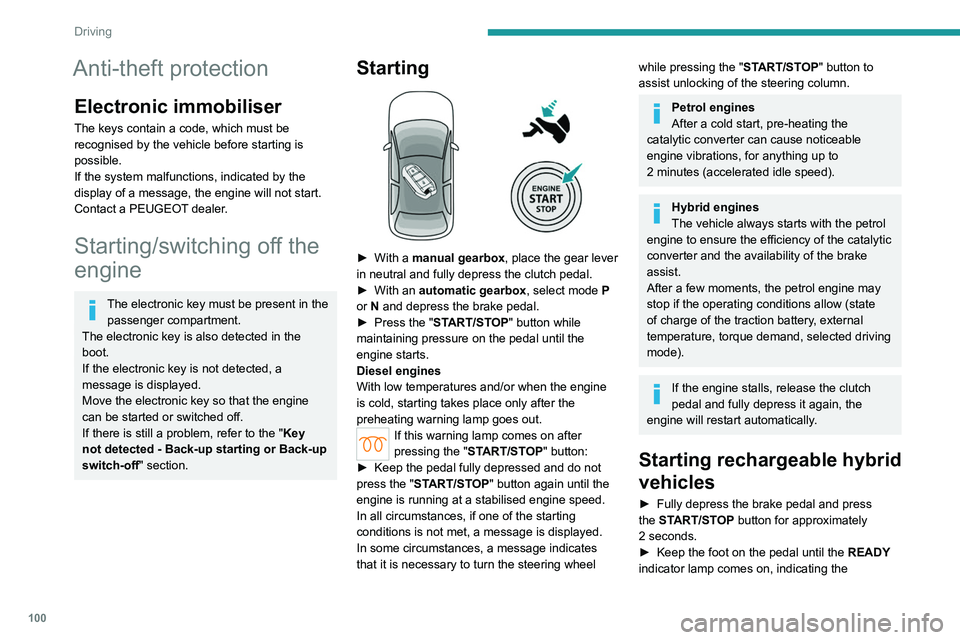
► With a manual gearbox, place the gear lever
in neutral and fully depress the clutch pedal.
►
With an
automatic gearbox, select mode P
or
N and depress the brake pedal.
►
Press the "
START/STOP" button while
maintaining pressure on the pedal until the
engine starts.
Diesel engines
With low temperatures and/or when the engine
is cold, starting takes place only after the
preheating warning lamp goes out.
If this warning lamp comes on after
pressing the " START/STOP" button:
►
Keep the pedal fully depressed and do not
press the "
START/STOP" button again until the
engine is running at a stabilised engine speed.
In all circumstances, if one of the starting
conditions is not met, a message is displayed.
In some circumstances, a message indicates
that it is necessary to turn the steering wheel
while pressing the " START/STOP" button to
assist unlocking of the steering column.
Petrol engines
After a cold start, pre-heating the
catalytic converter can cause noticeable
engine vibrations, for anything up to
2
minutes (accelerated idle speed).
Hybrid engines
The vehicle always starts with the petrol
engine to ensure the efficiency of the catalytic
converter and the availability of the brake
assist.
After a few moments, the petrol engine may
stop if the operating conditions allow (state
of charge of the traction battery, external
temperature, torque demand, selected driving
mode).
If the engine stalls, release the clutch
pedal and fully depress it again, the
engine will restart automatically.
Starting rechargeable hybrid
vehicles
► Fully depress the brake pedal and press
the START/STOP button for approximately
2
seconds.
►
Keep the foot on the pedal until the READY
indicator lamp comes on, indicating the
Page 111 of 280
109
Driving
6► To return to mode N, push without passing
the point of resistance.
Steering-mounted controls
(Depending on equipment)
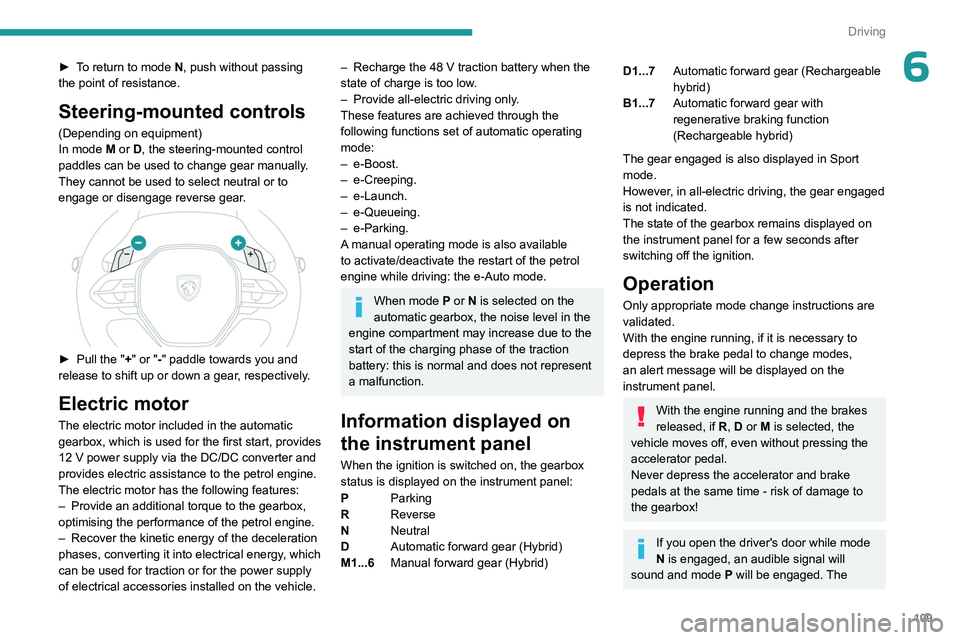
In mode M or D, the steering-mounted control
paddles can be used to change gear manually.
They cannot be used to select neutral or to
engage or disengage reverse gear.
► Pull the " +" or "-" paddle towards you and
release to shift up or down a gear, respectively.
Electric motor
The electric motor included in the automatic
gearbox, which is used for the first start, provides
12
V power supply via the DC/DC converter and
provides electric assistance to the petrol engine.
The electric motor has the following features:
–
Provide an additional torque to the gearbox,
optimising the performance of the petrol engine.
–
Recover the kinetic energy of the deceleration
phases, converting it into electrical energy
, which
can be used for traction or for the power supply
of electrical accessories installed on the vehicle.
– Recharge the 48 V traction battery when the
state of charge is too low.
–
Provide all-electric driving only
.
These features are achieved through the
following functions set of automatic operating
mode:
–
e-Boost.
–
e-Creeping.
–
e-Launch.
–
e-Queueing.
–
e-Parking.
A manual operating mode is also available
to activate/deactivate the restart of the petrol
engine while driving: the e-Auto mode.
When mode P or N is selected on the
automatic gearbox, the noise level in the
engine compartment may increase due to the
start of the charging phase of the traction
battery: this is normal and does not represent
a malfunction.
Information displayed on
the instrument panel
When the ignition is switched on, the gearbox
status is displayed on the instrument panel:
P Parking
R Reverse
N Neutral
D Automatic forward gear (Hybrid)
M1...6 Manual forward gear (Hybrid)
D1...7Automatic forward gear (Rechargeable
hybrid)
B1...7 Automatic forward gear with
regenerative braking function
(Rechargeable hybrid)
The gear engaged is also displayed in Sport
mode.
However, in all-electric driving, the gear engaged
is not indicated.
The state of the gearbox remains displayed on
the instrument panel for a few seconds after
switching off the ignition.
Operation
Only appropriate mode change instructions are
validated.
With the engine running, if it is necessary to
depress the brake pedal to change modes,
an alert message will be displayed on the
instrument panel.
With the engine running and the brakes
released, if R, D or M is selected, the
vehicle moves off, even without pressing the
accelerator pedal.
Never depress the accelerator and brake
pedals at the same time - risk of damage to
the gearbox!
If you open the driver's door while mode
N is engaged, an audible signal will
sound and mode P will be engaged. The
Page 112 of 280
11 0
Driving
audible signal stops when the driver's door is
closed.
At speeds below 3 mph (5 km/h),
opening the driver ’s door will engage
mode P
- risk of sudden braking!
In the event of battery failure, it is
essential to place the chock(s) supplied
with the tool kit against one of the wheels to
immobilise the vehicle.
Special aspects of automatic mode
These functions respond to common driving
situations where the electric motor is available
to provide additional power or zero-emission
driving.
These functions are only available if the traction battery is sufficiently charged.
These five functions cannot be deactivated.
e-Launch
With the petrol engine off, this function allows the
vehicle to run in electric mode without affecting
performance.
By depressing the accelerator pedal, the vehicle
starts to drive as soon as the mode D or R of the
automatic gearbox is selected.
e-Creeping
With the petrol engine off, by releasing the
brake pedal, this function allows the vehicle to
be moved forward or backward in electric mode
without having to depress the accelerator pedal,
as soon as the mode D or R of the automatic
gearbox is selected.
e-Queueing
This function makes it possible to follow a
queue of vehicles with several stops followed
by restarts of the vehicle, using the e-Creeping,
e-Launch and electric driving modes.
e-Parking
This function allows parking manoeuvres to be
carried out at reduced speed with the help of
the electric motor when the mode D or R of the
automatic gearbox is selected.
e-Boost
This function allows simultaneous operation
of the petrol engine and the electric motor,
combined with the automatic gearbox.
By fully depressing the accelerator pedal ("kick-
down" function), when the traction battery is fully
charged, it is possible to exceed the torque of
the petrol engine alone, thanks to the additional
torque provided by the electric motor.
Repeated use of the brake pedal causes
the restart of petrol engine to provide
braking assistance.
Special aspects of manual mode
The gearbox only changes from one gear to
another if the vehicle speed and engine speed
conditions permit.
The petrol engine can also be switched off in
manual mode when stopped in traffic or when
the accelerator pedal is released.
For hybrid vehicles, the all-electric potential of
the driving mode used ( Normal or Eco) is also
retained.
For rechargeable hybrid vehicles, the all-electric
potential of the driving mode used ( Hybrid or
Electric) is also retained.
Using the steering wheel paddles also
causes the restarting of petrol engine.
If high traction is required, the driver can
deactivate the e-Auto mode using the touch
screen application.
Regenerative braking (Brake
function)
The regenerative braking function emulates
engine braking, slowing the vehicle with no need
to depress the brake pedal. When the driver
releases the accelerator pedal, the vehicle slows
down more quickly.
The energy recovered when the accelerator
pedal is released is used to partially recharge the
traction battery.
Page 113 of 280
111
Driving
6This partial recharging has no effect on the charge level indicator.
The resulting deceleration of the vehicle does not cause the brake lamps to come
on.
►
From
mode D, press button B to activate/
deactivate the function.
D on the instrument panel is replaced with B.
The state of the function is not saved when the
ignition is switched off.
In some situations (e.g. battery full,
extreme temperatures), the amount of
regenerative braking may be temporarily
limited, resulting in less deceleration.
The driver must remain alert to traffic
conditions and must always be ready to use
the brake pedal.
Regenerative braking using the brake
pedal
Energy recovery can also be produced
by depressing the brake pedal in order to
partially recharge the traction battery, without
affecting the charge level indicator.
Starting the vehicle
► Fully depress the brake pedal. ►
Start the petrol engine by depressing the
brake pedal until the engine is running at a
stabilised engine speed.
►
With your foot on the brake pedal, push once
or twice backwards to select automatic mode D
,
or forwards to shift into reverse gear R.
►
Release the brake pedal.
►
Accelerate gradually to automatically release
the electric parking brake.
The petrol engine may stop after the first start if
operating conditions allow (e.g.
state of charge
of the traction battery, external temperature,
efficiency of the catalytic converter, torque
demand, selected driving mode, thermal comfort
of the passenger compartment).
Then, the vehicle moves off immediately in all-
electric (e-Launch function).
Switching the vehicle off
Regardless of the current gearbox mode,
mode
P is immediately engaged automatically
when the ignition is switched off.
However, in mode
N, mode P will be engaged
after a delay of 5
seconds (time to enable free-
wheeling mode).
Check that mode
P has been engaged and
that the electric parking brake was applied
automatically; if not, apply it manually.
The corresponding indicator lamps on the gear selector and the electric parking
brake control must be on, as well as the indicator
lamps on the instrument panel.
Gearbox malfunction
This warning lamp comes on, accompanied by an audible signal and
the display of a message.
Go to a PEUGEOT dealer or a qualified
workshop.
Do not drive faster than 62
mph (100 km/h),
keeping to the speed limit.
Switching of the gearbox to back-up mode
Depending on the malfunction, the gearbox only
shifts in odd or even gears, locks in one gear or
loses some gears.
For hybrid vehicles, the paddles on the steering
wheel do not work and mode
M
is no longer
accessible.
You may feel a significant jolt on engaging
reverse gear. This will not damage the gearbox.
Selector malfunction
Minor malfunction
This warning lamp comes on, accompanied by the display of a message
and an audible signal.
Drive carefully.
Go to a PEUGEOT dealer or a qualified
workshop.
In some cases, the selector indicator lamps may
no longer come on, but the gearbox state is still
displayed on the instrument panel.
Page 116 of 280
11 4
Driving
For rechargeable hybrid
versions
Whenever the ignition is switched on, Electric
driving mode is selected by default.
Electric
Allows driving using 100% electrical energy.
The maximum speed is approximately 84 mph
(135
km/h).
When starting the vehicle, if the conditions do
not allow the activation or retention of Electric
mode, the message "Electric mode currently
unavailable" is displayed on the instrument
panel. The vehicle automatically changes to
Hybrid mode.
Conditions of activation
–
Adequate battery charge level. Charging
the vehicle after each drive is therefore
recommended. Electric
mode is available as
long as there is power left in the battery.
–
Outside temperature between approximately
-5°C and 45°C.
Manually exiting the mode
►
Fully depress the accelerator pedal, or
►
Select another mode.
In case of non-use of the vehicle for a
long period (several months), a restart of
the petrol engine may occur even if the
battery is charged.
In the event of multiple starts of the
internal combustion engine without a
sufficient rise in temperature, Electric mode
may be temporarily unavailable (natural
phenomenon of dilution of fuel in oil). The
message "Electric mode unavailable:
automatic operation in progress " then
appears on the instrument panel.
To regain normal electrical operation, drive
approximately 50
miles (80 km) in "motorway"
conditions or approximately 125
miles
(200
km) in urban conditions.
This phenomenon does not cause any
mechanical or electrical damage. It can occur
several times in the life of the vehicle.
Hybrid
To optimise the vehicle's fuel consumption by
managing the alternating or simultaneous
operation of the two types of engine ,
depending on driving conditions and driving
style.
In Hybrid mode, it is possible to drive in 100%
electric mode if the battery charge level is
sufficient and acceleration requirements are
moderate.
Sport
To obtain more dynamic driving in order to
benefit from the maximum performance of the
vehicle.
Electric power is used to supplement the petrol
engine as long as there is energy left in the
battery.
For electric versions
Each time the ignition is switched on, Normal
mode is selected by default.
Normal
This optimises the driving range and dynamic
performance.
To obtain maximum torque and power, depress
the accelerator pedal fully.
Eco
Optimises energy consumption, by reducing
the output of the heating and air conditioning
(without actually deactivating them) and limiting
both motor torque and power.
Sport
Enables more dynamic driving, acting on the
power steering, accelerator and gear changes
with a drive selector and the possibility of
displaying the vehicle’s dynamic settings on the
instrument panel.
Hill start assist
This system keeps the vehicle briefly stationary
(for approximately 2 seconds) when making a hill
start, while you transfer your foot from the brake
pedal to the accelerator pedal.
The system is only active when:
–
The vehicle is completely stationary
, with your
foot on the brake pedal.
–
Certain slope conditions are met.
–
The driver
’s door is closed.
Page 119 of 280
11 7
Driving
6After the engine has restarted, STOP mode is not available until the vehicle
has reached a speed of 5 mph (8
km/h).
During parking manoeuvres, STOP mode
is not available for a few seconds after
coming out of reverse gear or turning the
steering wheel.
Restarting the engine (START mode)
The engine automatically restarts as soon as the
driver indicates the intention of moving off again:
With a manual gearbox: when the clutch pedal
is fully depressed.
With an automatic gearbox:
–
With the selector in mode
D or M: when the
brake pedal is released.
–
With the selector in mode
N and the brake
pedal released: when the mode D or M is
selected.
–
With the selector in mode
P and the brake
pedal depressed: when the mode R, N, D or M
is selected.
–
When the reverse gear is engaged.
Special cases
The engine will restart automatically if the
conditions for operation are met again and in the
following cases:
–
Deselecting the Sport mode (depending on
equipment).
– With a manual gearbox: vehicle speed
exceeds 2.5 mph (4 km/h).
–
With an automatic gearbox, in mode N
, vehicle
speed exceeds 0.6 mph (1
km/h).
In these cases, this indicator lamp flashes
for a few seconds, then goes off.
Malfunctions
In the event of a fault with the system, this
warning lamp flashes for a few moments
on the instrument panel, then remains on,
accompanied by the display of a message.
Have it checked by a PEUGEOT dealer or a
qualified workshop.
The vehicle stalls in STOP mode
All of the instrument panel warning lamps come
on if there is a fault.
►
Switch off the ignition then start the engine
again with the key or the ST
ART/STOP button.
12 V battery
The Stop & Start system requires a
12 V battery of specific technology and
specification.
All work must be carried out only by a
PEUGEOT
dealer or a qualified workshop
e-Auto mode (Hybrid)
The petrol engine stops when low power or torque is required and in stabilised conditions.
The petrol engine is restarted by the belt starter.
The e-Auto mode can switch off the petrol
engine in the following cases:
–
When the operating strategies permit.
–
V
ehicle speed up to 90 mph (145 km/h).
–
When the driver releases the accelerator
pedal in stabilised conditions or in deceleration.
–
During the stop phases.
Restarting is only achieved by the belt starter
until the torque demand is available, if the
traction battery is sufficiently charged. When the
torque demand is insufficient, the petrol engine
restarts.
Using the steering wheel paddles also
causes the restarting of petrol engine.
The e-Auto mode cannot switch off the petrol
engine in the following cases:
–
The state of charge is less than 30% of the
traction battery energy
.
–
There is a need for vacuum brake assist
depending on the altitude.
–
The Sport mode is selected.
–
Maintaining thermal comfort in the passenger
compartment (heating, air conditioning,
demisting/defrosting).
Deactivation/Reactivation
By default, the function is activated when the
ignition is switched on.
It is configured in the ADAS touch screen
application.
or
Direct access to the Shortcuts for driving aids .