air condition Peugeot 308 CC 2011 User Guide
[x] Cancel search | Manufacturer: PEUGEOT, Model Year: 2011, Model line: 308 CC, Model: Peugeot 308 CC 2011Pages: 292, PDF Size: 40.04 MB
Page 89 of 292
5
87
VISIBILITY
Manual guide-me-home lighting
Temporarily keeping the dipped beam
headlamps on after the vehicle's igni-
tion has been switched off makes the
driver's exit easier when the light is
poor.
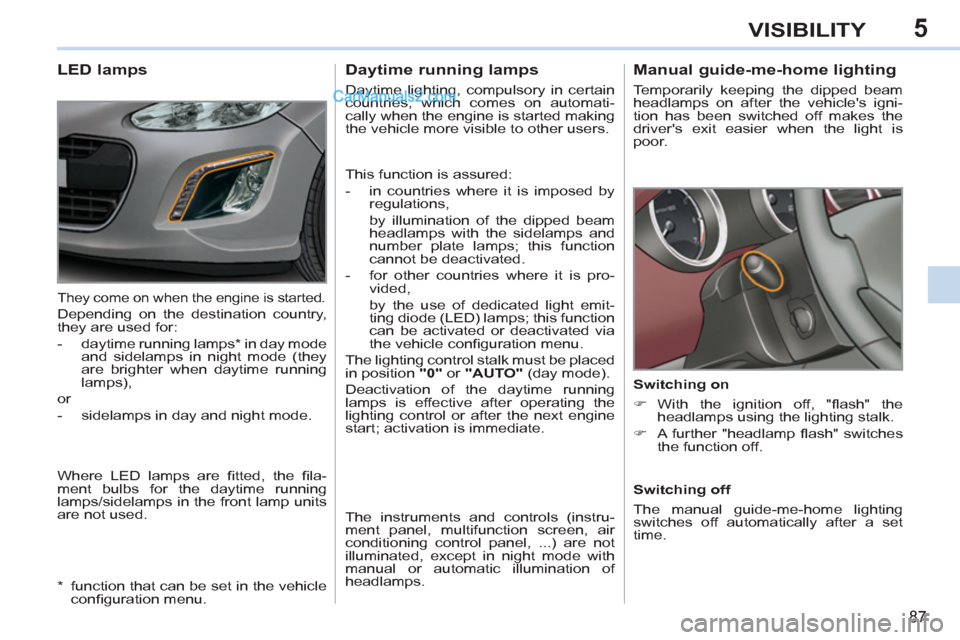
Switching on
)
With the ignition off, "fl ash" the
headlamps using the lighting stalk.
)
A further "headlamp fl ash" switches
the function off.
Switching off
The manual guide-me-home lighting
switches off automatically after a set
time.
Daytime running lamps
Daytime lighting, compulsory in certain
countries, which comes on automati-
cally when the engine is started making
the vehicle more visible to other users.
This function is assured:
- in countries where it is imposed by
regulations,
by illumination of the dipped beam
headlamps with the sidelamps and
number plate lamps; this function
cannot be deactivated.
- for other countries where it is pro-
vided,
by the use of dedicated light emit-
ting diode (LED) lamps; this function
can be activated or deactivated via
the vehicle confi guration menu.
The lighting control stalk must be placed
in position "0"
or "AUTO"
(day mode).
Deactivation of the daytime running
lamps is effective after operating the
lighting control or after the next engine
start; activation is immediate.
The instruments and controls (instru-
ment panel, multifunction screen, air
conditioning control panel, ...) are not
illuminated, except in night mode with
manual or automatic illumination of
headlamps.
LED lamps
Where LED lamps are fi tted, the fi la-
ment bulbs for the daytime running
lamps/sidelamps in the front lamp units
are not used.
They come on when the engine is started.
Depending on the destination country,
they are used for:
- daytime running lamps * in day mode
and sidelamps in night mode (they
are brighter when daytime running
lamps),
or
- sidelamps in day and night mode.
* function that can be set in the vehicle
confi guration menu.
Page 98 of 292
6
96
FITTINGS
LOCKABLE, REFRIGERATED
GLOVE BOX
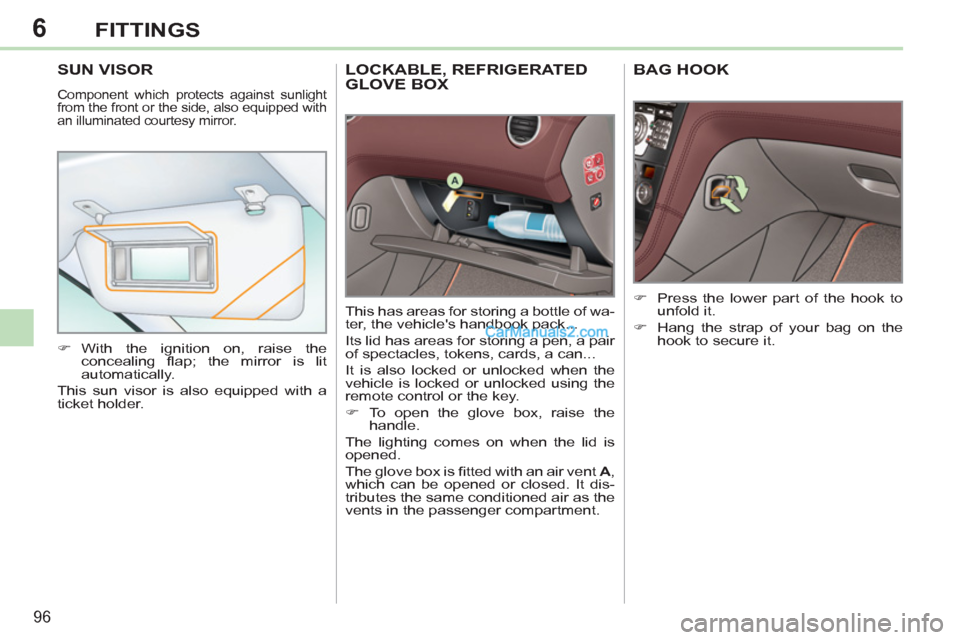
This has areas for storing a bottle of wa-
ter, the vehicle's handbook pack...
Its lid has areas for storing a pen, a pair
of spectacles, tokens, cards, a can...
It is also locked or unlocked when the
vehicle is locked or unlocked using the
remote control or the key.
)
To open the glove box, raise the
handle.
The lighting comes on when the lid is
opened.
The glove box is fi tted with an air vent A
,
which can be opened or closed. It dis-
tributes the same conditioned air as the
vents in the passenger compartment.
SUN VISOR
Component which protects against sunlight
from the front or the side, also equipped with
an illuminated courtesy mirror.
)
With the ignition on, raise the
concealing fl ap; the mirror is lit
automatically.
This sun visor is also equipped with a
ticket holder.
BAG HOOK
)
Press the lower part of the hook to
unfold it.
)
Hang the strap of your bag on the
hook to secure it.
Page 107 of 292
7
!
105
SAFETY
The ESP/ASR systems offer ex-
ceptional safety in normal driving,
but this should not encourage the
driver to take extra risks or drive at
high speed.
The correct functioning of these
systems depends on observation
of the manufacturer's recommen-
dations on:
- wheels (tyres and rims),
- braking components,
- electronic components,
- repair and assembly procedures.
After an impact, have these sys-
tems checked by a PEUGEOT
dealer or a qualifi ed workshop.
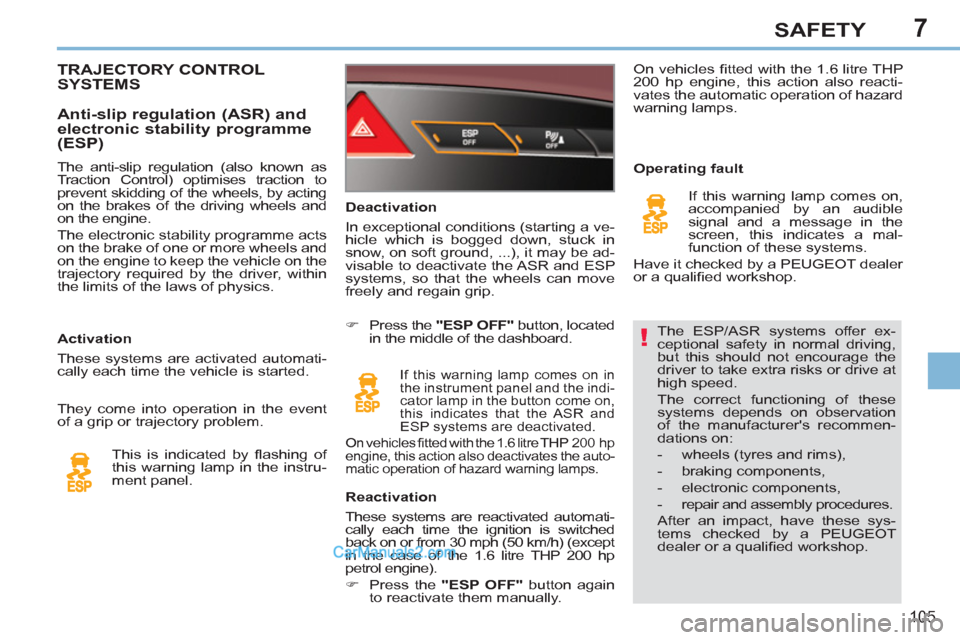
Deactivation
In exceptional conditions (starting a ve-
hicle which is bogged down, stuck in
snow, on soft ground, ...), it may be ad-
visable to deactivate the ASR and ESP
systems, so that the wheels can move
freely and regain grip.
)
Press the "ESP OFF"
button, located
in the middle of the dashboard.
If this warning lamp comes on in
the instrument panel and the indi-
cator lamp in the button come on,
this indicates that the ASR and
ESP systems are deactivated.
On vehicles fi tted with the 1.6 litre THP 200 hp
engine, this action also deactivates the auto-
matic operation of hazard warning lamps.
Reactivation
These systems are reactivated automati-
cally each time the ignition is switched
back on or from 30 mph (50 km/h) (except
in the case of the 1.6 litre THP 200 hp
petrol engine).
)
Press the "ESP OFF"
button again
to reactivate them manually.
Operating fault
If this warning lamp comes on,
accompanied by an audible
signal and a message in the
screen, this indicates a mal-
function of these systems.
Have it checked by a PEUGEOT dealer
or a qualifi ed workshop.
TRAJECTORY CONTROL
SYSTEMS
Activation
These systems are activated automati-
cally each time the vehicle is started.
Anti-slip regulation (ASR) and
electronic stability programme
(ESP)
They come into operation in the event
of a grip or trajectory problem.
This is indicated by fl ashing of
this warning lamp in the instru-
ment panel.
The anti-slip regulation (also known as
Traction Control) optimises traction to
prevent skidding of the wheels, by acting
on the brakes of the driving wheels and
on the engine.
The electronic stability programme acts
on the brake of one or more wheels and
on the engine to keep the vehicle on the
trajectory required by the driver, within
the limits of the laws of physics. On vehicles fi tted with the 1.6 litre THP
200 hp engine, this action also reacti-
vates the automatic operation of hazard
warning lamps.
Page 112 of 292
7
i
!
11 0
SAFETY
AIRBAGS
The airbags have been designed to max-
imise the safety of the occupants in the
event of violent collisions. They supple-
ment the action of the force-limiting seat
belts.
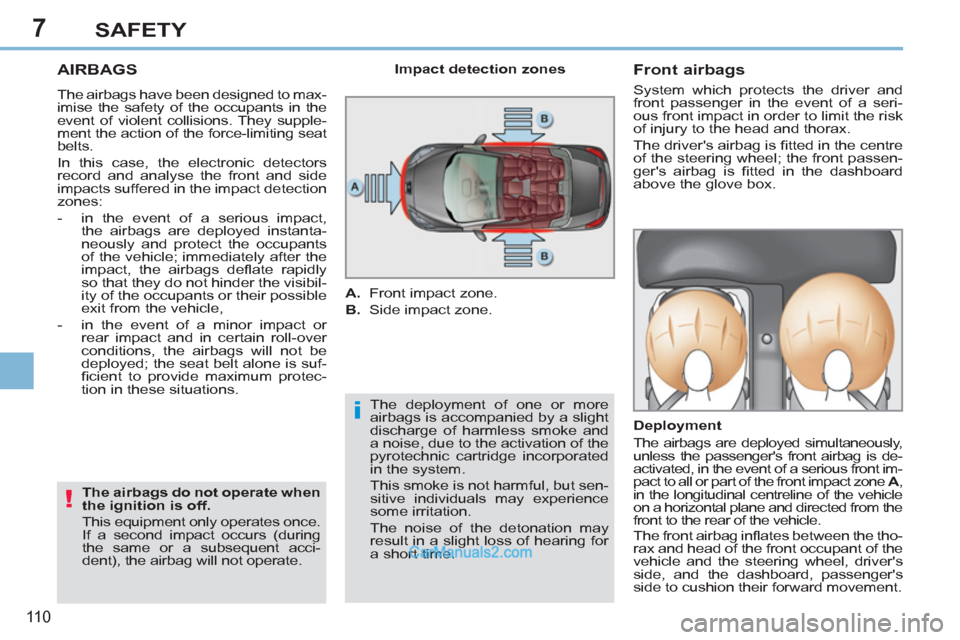
In this case, the electronic detectors
record and analyse the front and side
impacts suffered in the impact detection
zones:
- in the event of a serious impact,
the airbags are deployed instanta-
neously and protect the occupants
of the vehicle; immediately after the
impact, the airbags defl ate rapidly
so that they do not hinder the visibil-
ity of the occupants or their possible
exit from the vehicle,
- in the event of a minor impact or
rear impact and in certain roll-over
conditions, the airbags will not be
deployed; the seat belt alone is suf-
fi cient to provide maximum protec-
tion in these situations.
The deployment of one or more
airbags is accompanied by a slight
discharge of harmless smoke and
a noise, due to the activation of the
pyrotechnic cartridge incorporated
in the system.
This smoke is not harmful, but sen-
sitive individuals may experience
some irritation.
The noise of the detonation may
result in a slight loss of hearing for
a short time.
Front airbags
System which protects the driver and
front passenger in the event of a seri-
ous front impact in order to limit the risk
of injury to the head and thorax.
The driver's airbag is fi tted in the centre
of the steering wheel; the front passen-
ger's airbag is fi tted in the dashboard
above the glove box.
Deployment
The airbags are deployed simultaneously,
unless the passenger's front airbag is de-
activated, in the event of a serious front im-
pact to all or part of the front impact zone A
,
in the longitudinal centreline of the vehicle
on a horizontal plane and directed from the
front to the rear of the vehicle.
The front airbag infl ates between the tho-
rax and head of the front occupant of the
vehicle and the steering wheel, driver's
side, and the dashboard, passenger's
side to cushion their forward movement.
Impact detection zones
A.
Front impact zone.
B.
Side impact zone.
The airbags do not operate when
the ignition is off.
This equipment only operates once.
If a second impact occurs (during
the same or a subsequent acci-
dent), the airbag will not operate.
Page 130 of 292
8
!
i
i
128
DRIVING
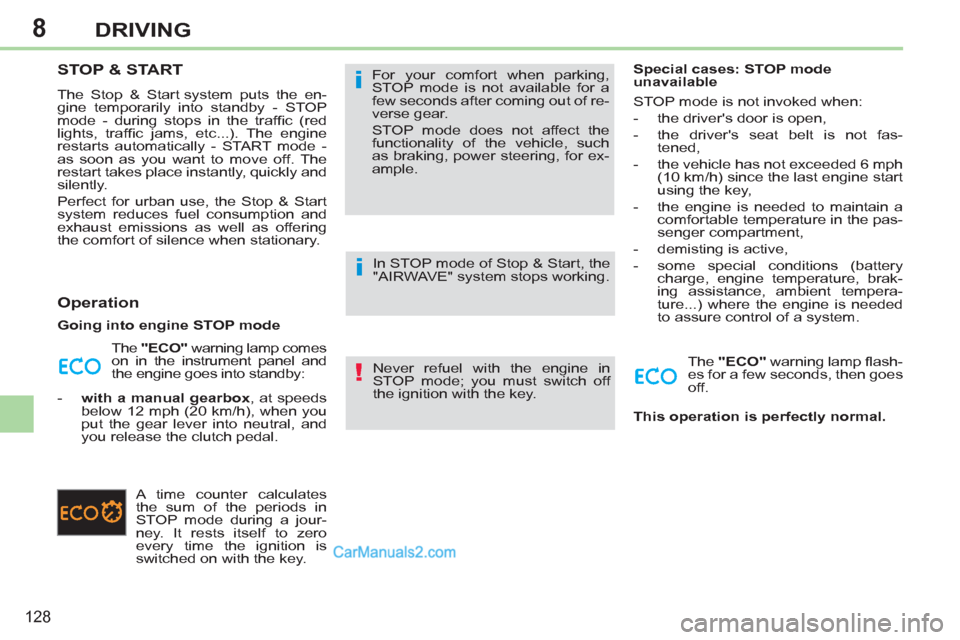
STOP & START
The Stop & Start system puts the en-
gine temporarily into standby - STOP
mode - during stops in the traffi c (red
lights, traffi c jams, etc...). The engine
restarts automatically - START mode -
as soon as you want to move off. The
restart takes place instantly, quickly and
silently.
Perfect for urban use, the Stop & Start
system reduces fuel consumption and
exhaust emissions as well as offering
the comfort of silence when stationary.
Operation
Going into engine STOP mode
The "ECO"
warning lamp comes
on in the instrument panel and
the engine goes into standby:
- with a manual gearbox
, at speeds
below 12 mph (20 km/h), when you
put the gear lever into neutral, and
you release the clutch pedal.
A time counter calculates
the sum of the periods in
STOP mode during a jour-
ney. It rests itself to zero
every time the ignition is
switched on with the key. For your comfort when parking,
STOP mode is not available for a
few seconds after coming out of re-
verse gear.
STOP mode does not affect the
functionality of the vehicle, such
as braking, power steering, for ex-
ample.
Never refuel with the engine in
STOP mode; you must switch off
the ignition with the key.
Special cases: STOP mode
unavailable
STOP mode is not invoked when:
- the driver's door is open,
- the driver's seat belt is not fas-
tened,
- the vehicle has not exceeded 6 mph
(10 km/h) since the last engine start
using the key,
- the engine is needed to maintain a
comfortable temperature in the pas-
senger compartment,
- demisting is active,
- some special conditions (battery
charge, engine temperature, brak-
ing assistance, ambient tempera-
ture...) where the engine is needed
to assure control of a system.
The "ECO"
warning lamp fl ash-
es for a few seconds, then goes
off.
This operation is perfectly normal.
In STOP mode of Stop & Start, the
"AIRWAVE" system stops working.
Page 146 of 292
9
i
144
CHECKS
CHECKS
Unless otherwise indicated, check
these components in accordance with
the Warranty and Maintenance Record
and according to your engine.
Otherwise, have them checked by a
PEUGEOT dealer or a qualifi ed workshop.
Battery
The battery does not require any
maintenance.
However, check that the terminals
are clean and correctly tightened,
particularly in summer and winter.
When carrying out work on the battery, re-
fer to the "Practical information" section for
details of the precautions to be taken before
disconnecting the battery and following its
reconnection.
Air filter and passenger compartment filter
Refer to the Warranty and
Maintenance Record for de-
tails of the replacement inter-
vals for these components.
Depending on the environ-
ment (e.g. dusty atmosphere) and the
use of the vehicle (e.g. city driving), re-
place them twice as often if necessary
(refer to the "Engines" section).
A clogged passenger compartment fi lter
may have an adverse effect on the per-
formance of the air conditioning system
and generate undesirable odours.
Oil filter
Replace the oil fi lter each time
the engine oil is changed.
Refer to the Warranty and
Maintenance Record for de-
tails of the replacement inter-
val for this component.
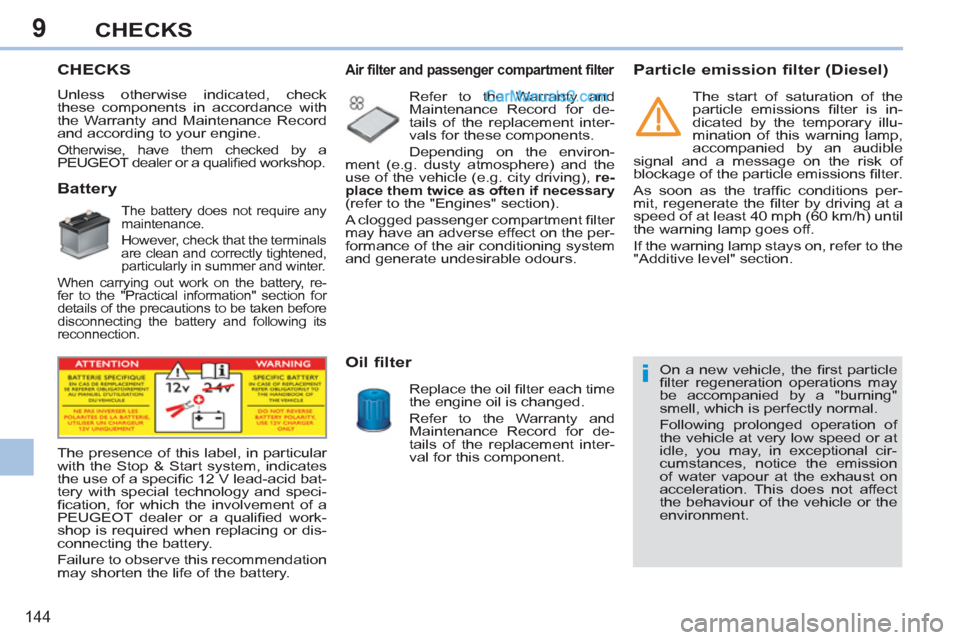
The presence of this label, in particular
with the Stop & Start system, indicates
the use of a specifi c 12 V lead-acid bat-
tery with special technology and speci-
fi cation, for which the involvement of a
PEUGEOT dealer or a qualifi ed work-
shop is required when replacing or dis-
connecting the battery.
Failure to observe this recommendation
may shorten the life of the battery.
Particle emission filter (Diesel)
On a new vehicle, the fi rst particle
fi lter regeneration operations may
be accompanied by a "burning"
smell, which is perfectly normal.
Following prolonged operation of
the vehicle at very low speed or at
idle, you may, in exceptional cir-
cumstances, notice the emission
of water vapour at the exhaust on
acceleration. This does not affect
the behaviour of the vehicle or the
environment.
The start of saturation of the
particle emissions fi lter is in-
dicated by the temporary illu-
mination of this warning lamp,
accompanied by an audible
signal and a message on the risk of
blockage of the particle emissions fi lter.
As soon as the traffi c conditions per-
mit, regenerate the fi lter by driving at a
speed of at least 40 mph (60 km/h) until
the warning lamp goes off.
If the warning lamp stays on, refer to the
"Additive level" section.
Page 163 of 292
10
161
PRACTICAL INFORMATION
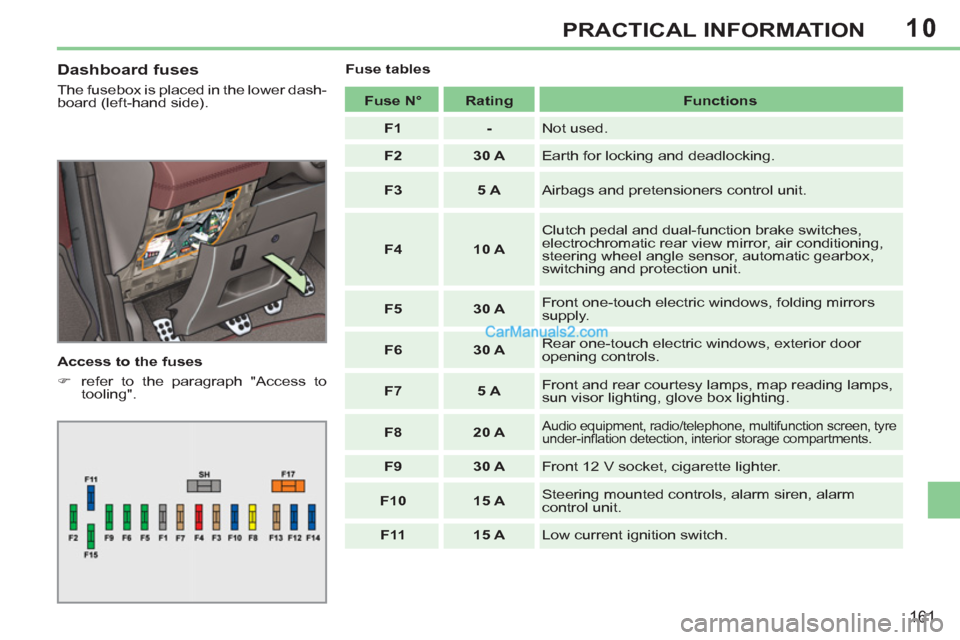
Dashboard fuses
The fusebox is placed in the lower dash-
board (left-hand side).
Access to the fuses
)
refer to the paragraph "Access to
tooling".
Fuse tables
Fuse N°
Rating
Functions
F1
-
Not used.
F2
30 A
Earth for locking and deadlocking.
F3
5 A
Airbags and pretensioners control unit.
F4
10 A
Clutch pedal and dual-function brake switches,
electrochromatic rear view mirror, air conditioning,
steering wheel angle sensor, automatic gearbox,
switching and protection unit.
F5
30 A
Front one-touch electric windows, folding mirrors
supply.
F6
30 A
Rear one-touch electric windows, exterior door
opening controls.
F7
5 A
Front and rear courtesy lamps, map reading lamps,
sun visor lighting, glove box lighting.
F8
20 A
Audio equipment, radio/telephone, multifunction screen, tyre
under-infl ation detection, interior storage compartments.
F9
30 A
Front 12 V socket, cigarette lighter.
F10
15 A
Steering mounted controls, alarm siren, alarm
control unit.
F11
15 A
Low current ignition switch.
Page 164 of 292
10
162
PRACTICAL INFORMATION
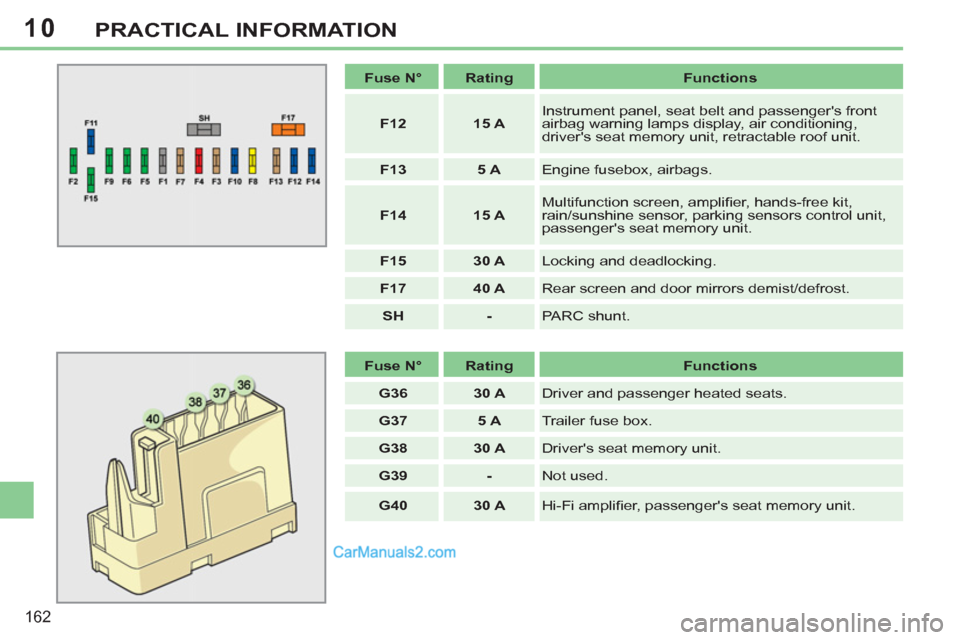
Fuse N°
Rating
Functions
F12
15 A
Instrument panel, seat belt and passenger's front
airbag warning lamps display, air conditioning,
driver's seat memory unit, retractable roof unit.
F13
5 A
Engine fusebox, airbags.
F14
15 A
Multifunction screen, amplifi er, hands-free kit,
rain/sunshine sensor, parking sensors control unit,
passenger's seat memory unit.
F15
30 A
Locking and deadlocking.
F17
40 A
Rear screen and door mirrors demist/defrost.
SH
-
PARC shunt.
Fuse N°
Rating
Functions
G36
30 A
Driver and passenger heated seats.
G37
5 A
Trailer fuse box.
G38
30 A
Driver's seat memory unit.
G39
-
Not used.
G40
30 A
Hi-Fi amplifi er, passenger's seat memory unit.
Page 165 of 292
10
163
PRACTICAL INFORMATION
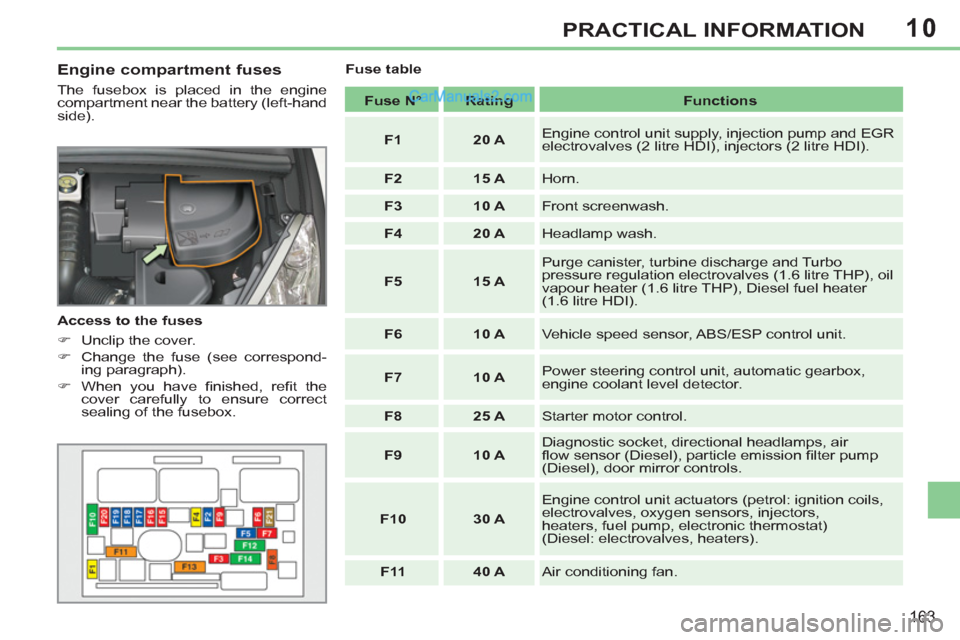
Engine compartment fuses
The fusebox is placed in the engine
compartment near the battery (left-hand
side).
Access to the fuses
)
Unclip the cover.
)
Change the fuse (see correspond-
ing paragraph).
)
When you have fi nished, refi t the
cover carefully to ensure correct
sealing of the fusebox.
Fuse table
Fuse N°
Rating
Functions
F1
20 A
Engine control unit supply, injection pump and EGR
electrovalves (2 litre HDI), injectors (2 litre HDI).
F2
15 A
Horn.
F3
10 A
Front screenwash.
F4
20 A
Headlamp wash.
F5
15 A
Purge canister, turbine discharge and Turbo
pressure regulation electrovalves (1.6 litre THP), oil
vapour heater (1.6 litre THP), Diesel fuel heater
(1.6 litre HDI).
F6
10 A
Vehicle speed sensor, ABS/ESP control unit.
F7
10 A
Power steering control unit, automatic gearbox,
engine coolant level detector.
F8
25 A
Starter motor control.
F9
10 A
Diagnostic socket, directional headlamps, air
fl ow sensor (Diesel), particle emission fi lter pump
(Diesel), door mirror controls.
F10
30 A
Engine control unit actuators (petrol: ignition coils,
electrovalves, oxygen sensors, injectors,
heaters, fuel pump, electronic thermostat)
(Diesel: electrovalves, heaters).
F11
40 A
Air conditioning fan.
Page 170 of 292
10
!
!
i
168
PRACTICAL INFORMATION
Before disconnecting the
battery
Wait 2 minutes after switching off
the ignition before disconnecting
the battery.
Close the roof, the windows and
the doors before disconnecting the
battery.
Following reconnection of the
battery
Following reconnection of the bat-
tery, switch on the ignition and wait
1 minute before starting to permit
initialisation of the electronic sys-
tems. However, if slight diffi culties
are encountered following this op-
eration, contact a PEUGEOT dealer
or a qualifi ed workshop.
Referring to the corresponding sec-
tion, you must yourself reinitialise:
- the remote control key,
- the electric windows and the
automatic partial opening of the
door windows,
- the GPS satellite navigation
system.
Let the engine run for the duration
specifi ed to ensure that the battery
charge is suffi cient.
Do not repeatedly and continu-
ously restart the engine in order to
charge the battery.
A fl at battery prevents the engine
from starting (refer to the "Battery"
paragraph). If the telephone is being used at
this time:
- it will be maintained for 5 min-
utes with the hands-free kit of
your Peugeot Connect Sound,
Peugeot Connect Nav,
- it will still be possible to fi n-
ish the call with the Peugeot
Connect Media.
ENERGY ECONOMY MODE
System which manages the duration of
use of certain functions to conserve a
suffi cient level of charge in the battery.
After the engine has stopped, you can
still use functions such as the audio and
telematics system, windscreen wip-
ers, dipped beam headlamps, courtesy
lamps, etc. for a maximum combined
duration of thirty minutes.
This period may be greatly reduced if
the battery is not fully charged.
Exiting economy mode
These functions are reactivated auto-
matically next time the vehicle is driven.
To restore the use of these functions im-
mediately, start the engine and let it run
for at least 5 minutes.
Switching to economy mode
Once this time has elapsed, a message
appears in the screen indicating that
the vehicle has switched to economy
mode and the active functions are put
on standby.
LOAD REDUCTION MODE
System which manages the use of
certain functions in relation to the level
of charge remaining in the battery.
When the vehicle is being driven, the
load reduction function temporarily de-
activates certain functions, such as
the air conditioning, the "AIRWAVE"
systems, the heated rear screen...
Certain deactivated functions are reac-
tivated automatically as soon as condi-
tions permit.