steering Peugeot 308 CC 2011 User Guide
[x] Cancel search | Manufacturer: PEUGEOT, Model Year: 2011, Model line: 308 CC, Model: Peugeot 308 CC 2011Pages: 292, PDF Size: 40.04 MB
Page 115 of 292
7
!
11 3
SAFETY
For the airbags to be fully
effective, observe the following
safety rules:
Sit in a normal upright position.
Wear a correctly adjusted seat belt.
Do not leave anything between the
occupants and the airbags (a child,
pet, object...). This could hamper the
operation of the airbags or injure the
occupants.
After an accident or if the vehicle has
been stolen or broken into, have the
airbag systems checked.
All work on the airbag system must be
carried out by a PEUGEOT dealer or
a qualifi ed workshop.
Even if all of the precautions mentioned
are observed, a risk of injury or of minor
burns to the head, chest or arms when
an airbag is deployed cannot be ruled
out. The bag infl ates almost instantly
(within a few milliseconds) then defl ates
within the same time discharging the
hot gas via openings provided for this
purpose.
Front airbags
Do not drive holding the steering wheel by its spokes or resting your hands on
the centre part of the wheel.
Passengers must not place their feet on the dashboard.
If possible, do not smoke as deployment of the airbags can cause burns or the
risk of injury from a cigarette or pipe.
Never remove or pierce the steering wheel or hit it violently.
Lateral airbags
Fit only approved covers on the seats, compatible with deployment of the lateral
airbags. For information on the range of seat covers suitable for your vehicle,
contact a PEUGEOT dealer (see "Practical information § Accessories").
Do not fi x or attach anything to the seat backs. This could cause injury to the
chest or arms if the lateral airbag is deployed.
Do not fi x or attach anything to the front head restraints (articles of clothing...).
This could cause injury to the head if the lateral airbag is deployed.
Do not sit with the upper part of the body any nearer to the door than necessary.
Page 130 of 292
8
!
i
i
128
DRIVING
STOP & START
The Stop & Start system puts the en-
gine temporarily into standby - STOP
mode - during stops in the traffi c (red
lights, traffi c jams, etc...). The engine
restarts automatically - START mode -
as soon as you want to move off. The
restart takes place instantly, quickly and
silently.
Perfect for urban use, the Stop & Start
system reduces fuel consumption and
exhaust emissions as well as offering
the comfort of silence when stationary.
Operation
Going into engine STOP mode
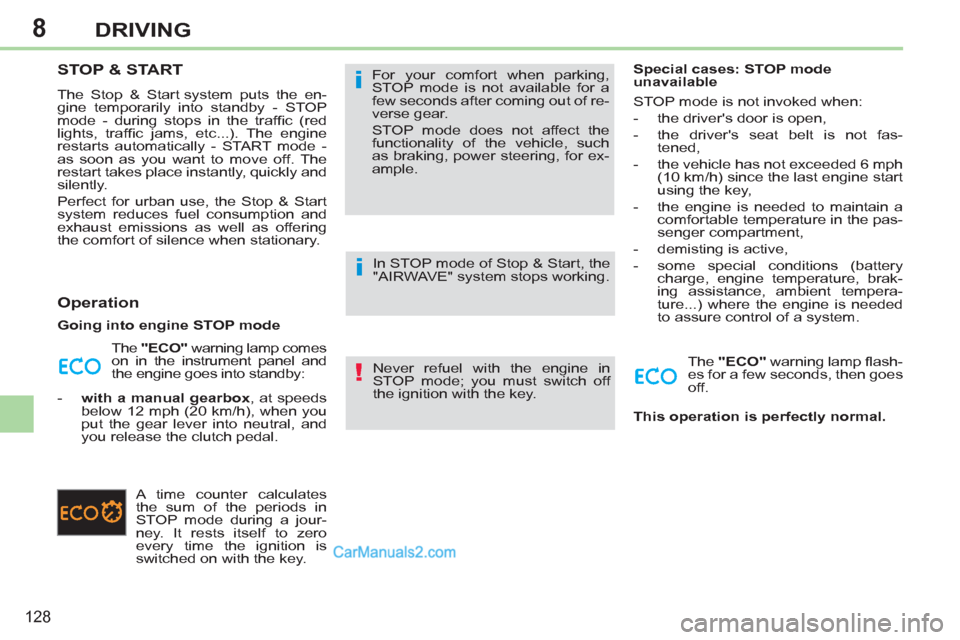
The "ECO"
warning lamp comes
on in the instrument panel and
the engine goes into standby:
- with a manual gearbox
, at speeds
below 12 mph (20 km/h), when you
put the gear lever into neutral, and
you release the clutch pedal.
A time counter calculates
the sum of the periods in
STOP mode during a jour-
ney. It rests itself to zero
every time the ignition is
switched on with the key. For your comfort when parking,
STOP mode is not available for a
few seconds after coming out of re-
verse gear.
STOP mode does not affect the
functionality of the vehicle, such
as braking, power steering, for ex-
ample.
Never refuel with the engine in
STOP mode; you must switch off
the ignition with the key.
Special cases: STOP mode
unavailable
STOP mode is not invoked when:
- the driver's door is open,
- the driver's seat belt is not fas-
tened,
- the vehicle has not exceeded 6 mph
(10 km/h) since the last engine start
using the key,
- the engine is needed to maintain a
comfortable temperature in the pas-
senger compartment,
- demisting is active,
- some special conditions (battery
charge, engine temperature, brak-
ing assistance, ambient tempera-
ture...) where the engine is needed
to assure control of a system.
The "ECO"
warning lamp fl ash-
es for a few seconds, then goes
off.
This operation is perfectly normal.
In STOP mode of Stop & Start, the
"AIRWAVE" system stops working.
Page 133 of 292
8
i
131
DRIVING
SPEED LIMITER
System which prevents the vehicle from
exceeding the speed programmed by
the driver.
When the programmed speed limit is
reached, pressing the accelerator pedal
no longer has any effect.
The speed limiter is switched on
man-
ually: it requires a programmed speed
of at least 20 mph (30 km/h).
The speed limiter is switched off
by
manual operation of the control.
The programmed speed can be ex-
ceeded temporarily by pressing the ac-
celerator fi rmly.
To return to the programmed speed,
simply slow down to a speed below the
programmed speed.
The programmed speed remains in the
memory when the ignition is switched off.
The speed limiter cannot, in any cir-
cumstances, replace the need to re-
spect speed limits, nor can it replace
the need for vigilance and responsi-
bility on the part of the driver.
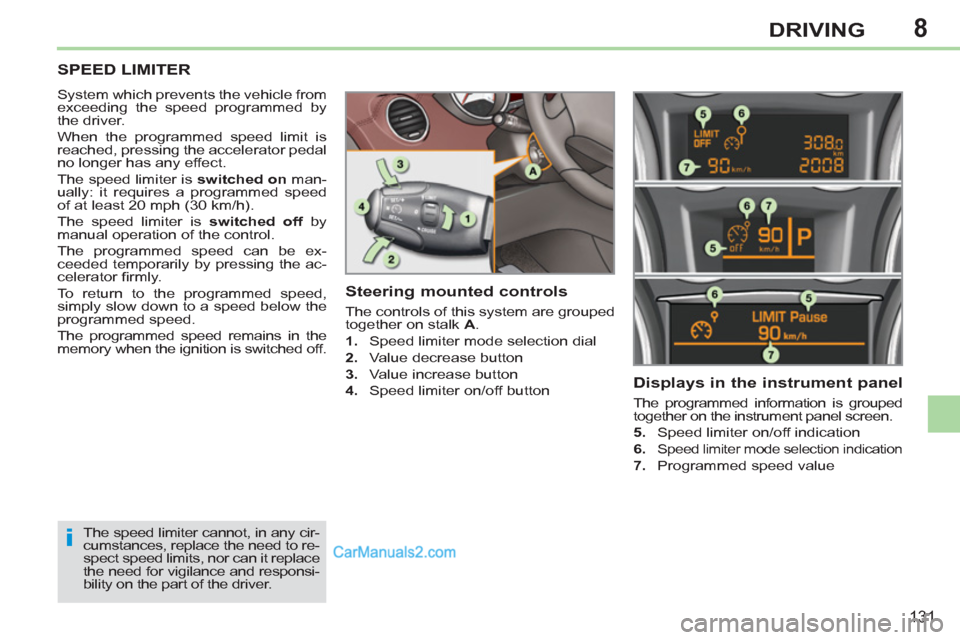
Steering mounted controls
The controls of this system are grouped
together on stalk A
.
1.
Speed limiter mode selection dial
2.
Value decrease button
3.
Value increase button
4.
Speed limiter on/off button
Displays in the instrument panel
The programmed information is grouped
together on the instrument panel screen.
5.
Speed limiter on/off indication
6.
Speed limiter mode selection indication
7.
Programmed speed value
Page 135 of 292
8
i
133
DRIVING
CRUISE CONTROL
System which automatically maintains
the speed of the vehicle at the value
programmed by the driver, without any
action on the accelerator pedal.
The cruise control is switched on
manually: it requires a minimum vehicle
speed of 25 mph (40 km/h) and the en-
gaging:
- of fourth gear on the manual gear-
box,
-
of second gear on the automatic gear-box, in sequential driving mode,
- of position D
on the automatic
gearbox.
The cruise control is switched off
manu-
ally or by pressing the brake or clutch
pedal or on triggering of the ESP sys-
tem for safety reasons.
It is possible to exceed the programmed
speed temporarily by pressing the ac-
celerator pedal.
To return to the programmed speed,
simply release the accelerator pedal.
Switching off the ignition cancels any
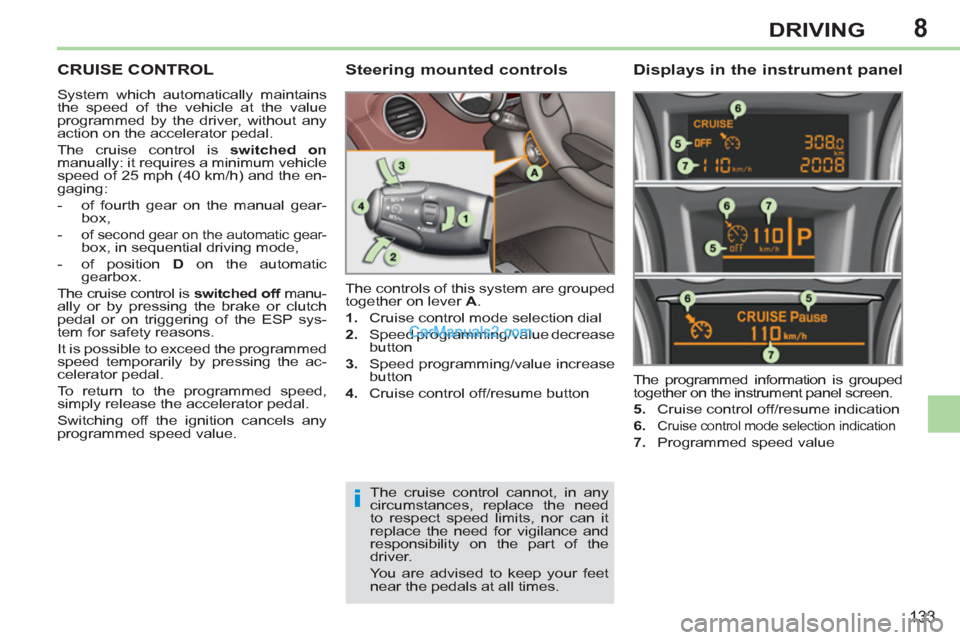
programmed speed value. The controls of this system are grouped
together on lever A
.
1.
Cruise control mode selection dial
2.
Speed programming/value decrease
button
3.
Speed programming/value increase
button
4.
Cruise control off/resume button The programmed information is grouped
together on the instrument panel screen.
5.
Cruise control off/resume indication
6.
Cruise control mode selection indication
7.
Programmed speed value
Steering mounted controls
Displays in the instrument panel
The cruise control cannot, in any
circumstances, replace the need
to respect speed limits, nor can it
replace the need for vigilance and
responsibility on the part of the
driver.
You are advised to keep your feet
near the pedals at all times.
Page 142 of 292
9
140
CHECKS
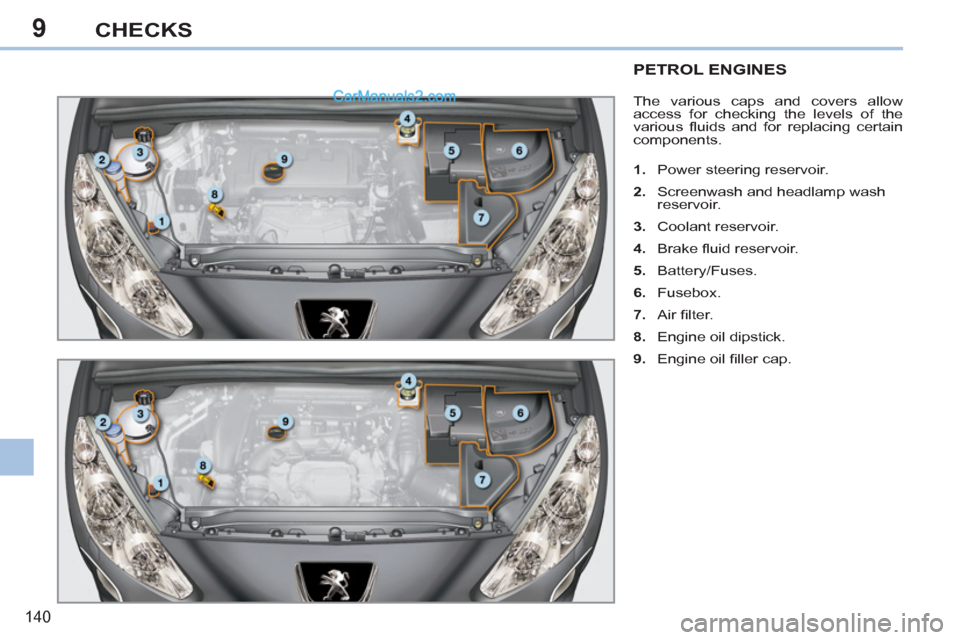
PETROL ENGINES
The various caps and covers allow
access for checking the levels of the
various fl uids and for replacing certain
components.
1.
Power steering reservoir.
2.
Screenwash and headlamp wash
reservoir.
3.
Coolant reservoir.
4.
Brake fl uid reservoir.
5.
Battery/Fuses.
6.
Fusebox.
7.
Air fi lter.
8.
Engine oil dipstick.
9.
Engine oil fi ller cap.
Page 143 of 292
9
141
CHECKS
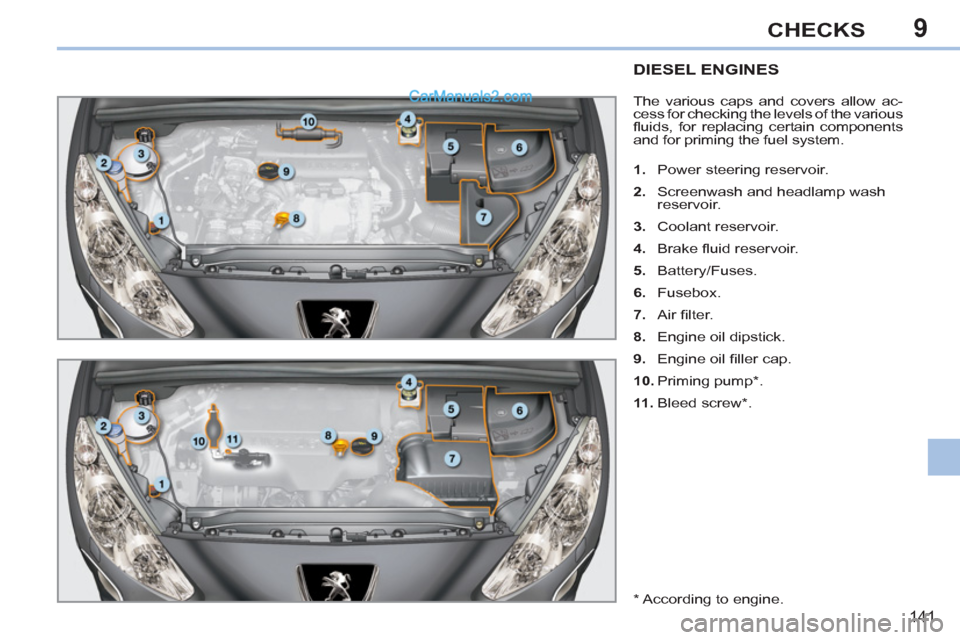
DIESEL ENGINES
The various caps and covers allow ac-
cess for checking the levels of the various
fl uids, for replacing certain components
and for priming the fuel system.
1.
Power steering reservoir.
2.
Screenwash and headlamp wash
reservoir.
3.
Coolant reservoir.
4.
Brake fl uid reservoir.
5.
Battery/Fuses.
6.
Fusebox.
7.
Air fi lter.
8.
Engine oil dipstick.
9.
Engine oil fi ller cap.
10.
Priming pump * .
11 .
Bleed screw * .
* According to engine.
Page 144 of 292
9
!
i
142
CHECKS
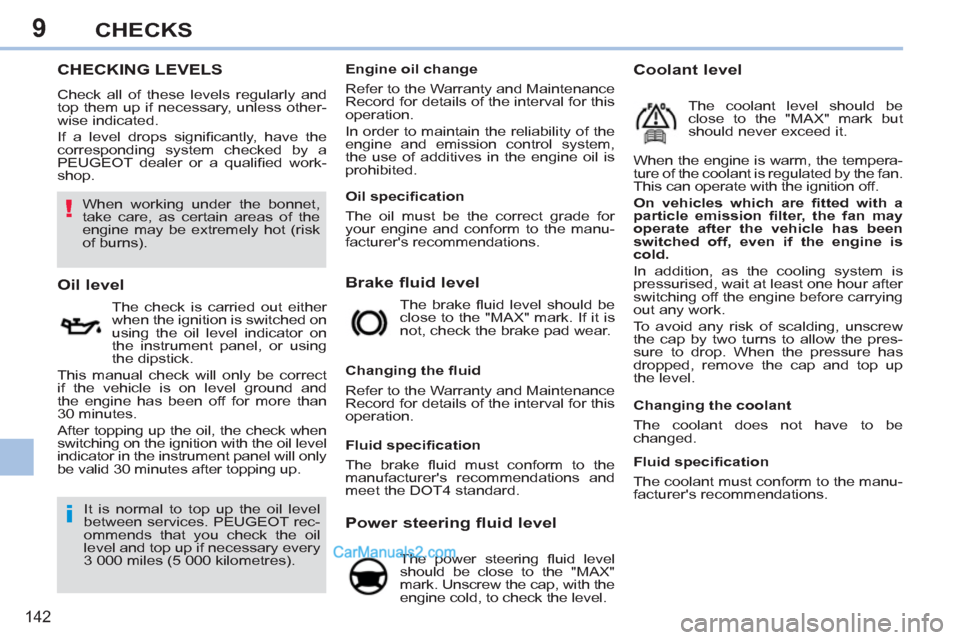
CHECKING LEVELS
Check all of these levels regularly and
top them up if necessary, unless other-
wise indicated.
If a level drops signifi cantly, have the
corresponding system checked by a
PEUGEOT dealer or a qualifi ed work-
shop.
Brake fluid level
Oil level
The check is carried out either
when the ignition is switched on
using the oil level indicator on
the instrument panel, or using
the dipstick.
This manual check will only be correct
if the vehicle is on level ground and
the engine has been off for more than
30 minutes.
After topping up the oil, the check when
switching on the ignition with the oil level
indicator in the instrument panel will only
be valid 30 minutes after topping up. The brake fl uid level should be
close to the "MAX" mark. If it is
not, check the brake pad wear.
Power steering fluid level
The power steering fl uid level
should be close to the "MAX"
mark. Unscrew the cap, with the
engine cold, to check the level.
It is normal to top up the oil level
between services. PEUGEOT rec-
ommends that you check the oil
level and top up if necessary every
3 000 miles (5 000 kilometres).
Changing the fl uid
Refer to the Warranty and Maintenance
Record for details of the interval for this
operation. When the engine is warm, the tempera-
ture of the coolant is regulated by the fan.
This can operate with the ignition off.
On vehicles which are fi tted with a
particle emission fi lter, the fan may
operate after the vehicle has been
switched off, even if the engine is
cold.
In addition, as the cooling system is
pressurised, wait at least one hour after
switching off the engine before carrying
out any work.
To avoid any risk of scalding, unscrew
the cap by two turns to allow the pres-
sure to drop. When the pressure has
dropped, remove the cap and top up
the level.
Coolant level
The coolant level should be
close to the "MAX" mark but
should never exceed it.
Changing the coolant
The coolant does not have to be
changed.
When working under the bonnet,
take care, as certain areas of the
engine may be extremely hot (risk
of burns).
Fluid specifi cation
The coolant must conform to the manu-
facturer's recommendations.
Fluid specifi cation
The brake fl uid must conform to the
manufacturer's recommendations and
meet the DOT4 standard.
Oil specifi cation
The oil must be the correct grade for
your engine and conform to the manu-
facturer's recommendations.
Engine oil change
Refer to the Warranty and Maintenance
Record for details of the interval for this
operation.
In order to maintain the reliability of the
engine and emission control system,
the use of additives in the engine oil is
prohibited.
Page 148 of 292
10
i
146
PRACTICAL INFORMATION
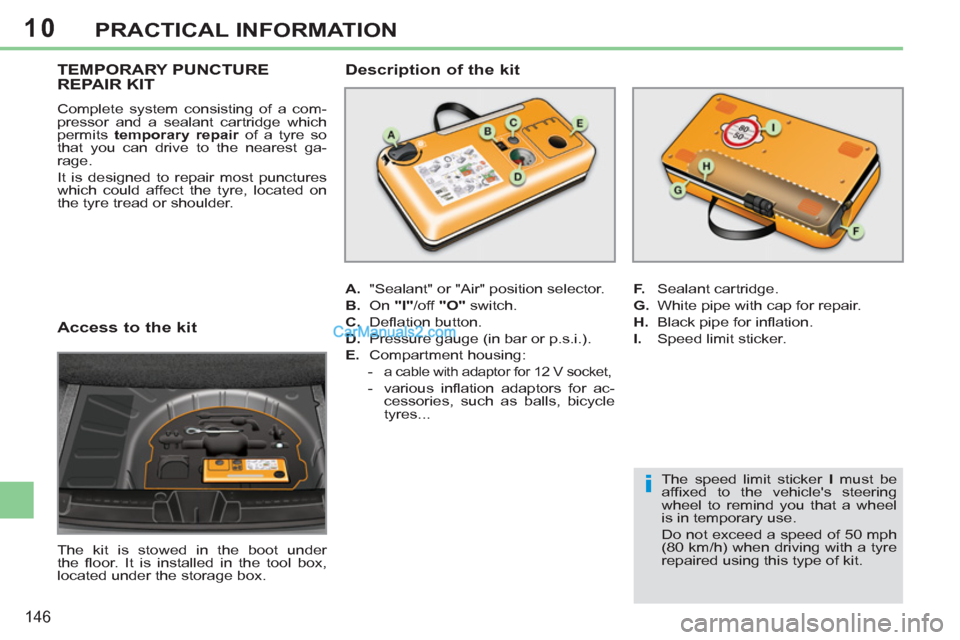
Access to the kit
The kit is stowed in the boot under
the fl oor. It is installed in the tool box,
located under the storage box.
TEMPORARY PUNCTURE
REPAIR KIT
Complete system consisting of a com-
pressor and a sealant cartridge which
permits temporary repair
of a tyre so
that you can drive to the nearest ga-
rage.
It is designed to repair most punctures
which could affect the tyre, located on
the tyre tread or shoulder.
A.
"Sealant" or "Air" position selector.
B.
On "I"
/off "O"
switch.
C.
Defl ation button.
D.
Pressure gauge (in bar or p.s.i.).
E.
Compartment housing:
-
a cable with adaptor for 12 V socket,
- various infl ation adaptors for ac-
cessories, such as balls, bicycle
tyres...
Description of the kit
F.
Sealant cartridge.
G.
White pipe with cap for repair.
H.
Black pipe for infl ation.
I.
Speed limit sticker.
The speed limit sticker I
must be
affi xed to the vehicle's steering
wheel to remind you that a wheel
is in temporary use.
Do not exceed a speed of 50 mph
(80 km/h) when driving with a tyre
repaired using this type of kit.
Page 163 of 292
10
161
PRACTICAL INFORMATION
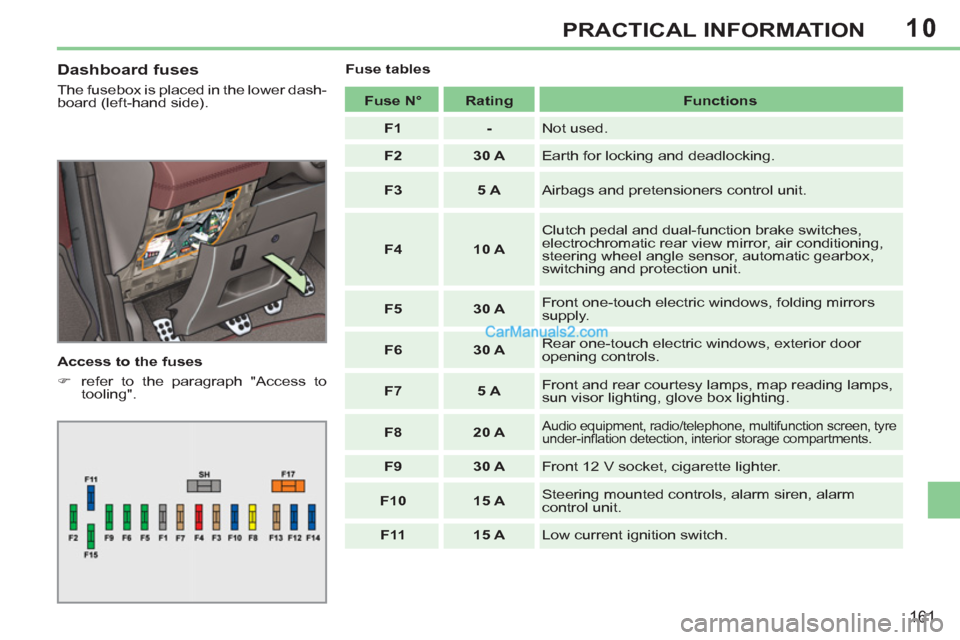
Dashboard fuses
The fusebox is placed in the lower dash-
board (left-hand side).
Access to the fuses
)
refer to the paragraph "Access to
tooling".
Fuse tables
Fuse N°
Rating
Functions
F1
-
Not used.
F2
30 A
Earth for locking and deadlocking.
F3
5 A
Airbags and pretensioners control unit.
F4
10 A
Clutch pedal and dual-function brake switches,
electrochromatic rear view mirror, air conditioning,
steering wheel angle sensor, automatic gearbox,
switching and protection unit.
F5
30 A
Front one-touch electric windows, folding mirrors
supply.
F6
30 A
Rear one-touch electric windows, exterior door
opening controls.
F7
5 A
Front and rear courtesy lamps, map reading lamps,
sun visor lighting, glove box lighting.
F8
20 A
Audio equipment, radio/telephone, multifunction screen, tyre
under-infl ation detection, interior storage compartments.
F9
30 A
Front 12 V socket, cigarette lighter.
F10
15 A
Steering mounted controls, alarm siren, alarm
control unit.
F11
15 A
Low current ignition switch.
Page 165 of 292
10
163
PRACTICAL INFORMATION
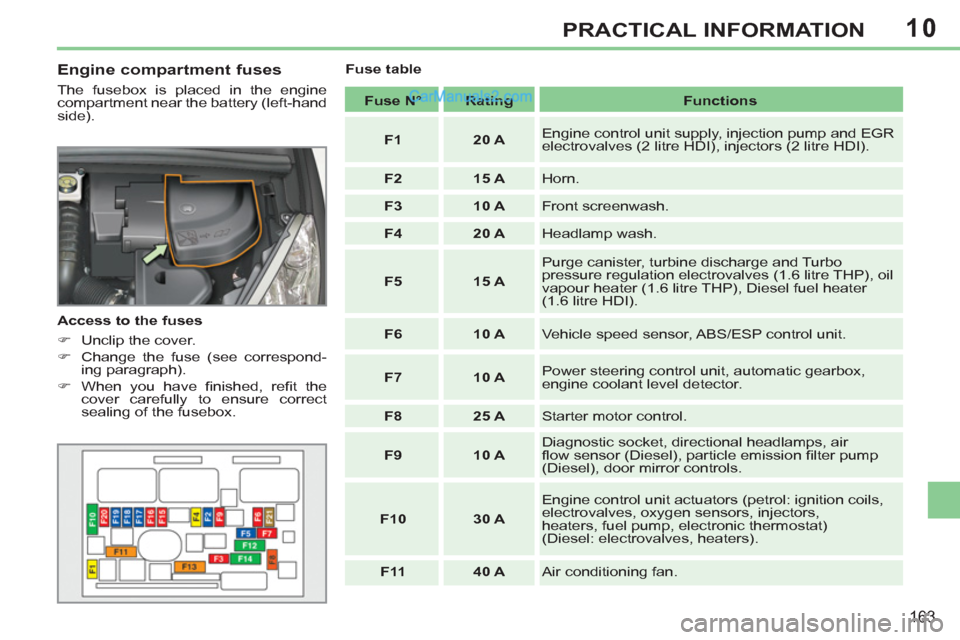
Engine compartment fuses
The fusebox is placed in the engine
compartment near the battery (left-hand
side).
Access to the fuses
)
Unclip the cover.
)
Change the fuse (see correspond-
ing paragraph).
)
When you have fi nished, refi t the
cover carefully to ensure correct
sealing of the fusebox.
Fuse table
Fuse N°
Rating
Functions
F1
20 A
Engine control unit supply, injection pump and EGR
electrovalves (2 litre HDI), injectors (2 litre HDI).
F2
15 A
Horn.
F3
10 A
Front screenwash.
F4
20 A
Headlamp wash.
F5
15 A
Purge canister, turbine discharge and Turbo
pressure regulation electrovalves (1.6 litre THP), oil
vapour heater (1.6 litre THP), Diesel fuel heater
(1.6 litre HDI).
F6
10 A
Vehicle speed sensor, ABS/ESP control unit.
F7
10 A
Power steering control unit, automatic gearbox,
engine coolant level detector.
F8
25 A
Starter motor control.
F9
10 A
Diagnostic socket, directional headlamps, air
fl ow sensor (Diesel), particle emission fi lter pump
(Diesel), door mirror controls.
F10
30 A
Engine control unit actuators (petrol: ignition coils,
electrovalves, oxygen sensors, injectors,
heaters, fuel pump, electronic thermostat)
(Diesel: electrovalves, heaters).
F11
40 A
Air conditioning fan.