tow PEUGEOT 308 CC 2013 User Guide
[x] Cancel search | Manufacturer: PEUGEOT, Model Year: 2013, Model line: 308 CC, Model: PEUGEOT 308 CC 2013Pages: 268, PDF Size: 15.28 MB
Page 76 of 268
4
i
!
74
ACCESS
The key cannot be removed from
the lock until the cap is put back on
the tank.
Opening the cap may trigger an
inrush of air. This vacuum, which
is completely normal, is caused by
the sealing of the fuel system.
FUEL TANK
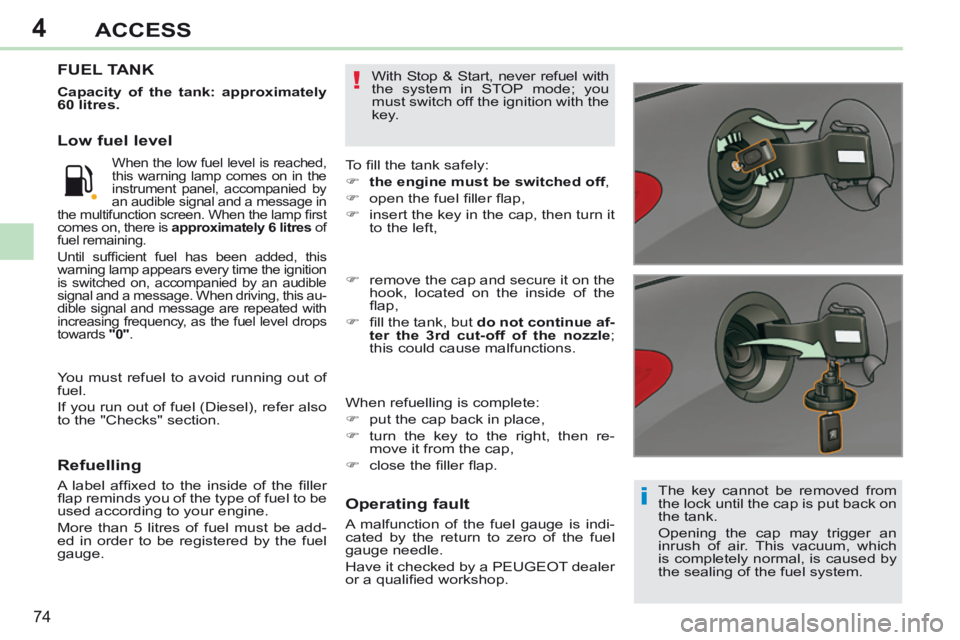
To fi ll the tank safely:
the engine must be switched off,
open the fuel fi ller fl ap,
insert the key in the cap, then turn it to the left,
When refuelling is complete:
put the cap back in place,
turn the key to the right, then re- move it from the cap,
close the fi ller fl ap. remove the cap and secure it on the hook, located on the inside of the
fl ap,
fi ll the tank, but do not continue af-
ter the 3rd cut-off of the nozzle ;
this could cause malfunctions.
Capacity of the tank: approximately
60 litres.
Refuelling
A label affi xed to the inside of the fi ller
fl ap reminds you of the type of fuel to be
used according to your engine.
More than 5 litres of fuel must be add-
ed in order to be registered by the fuel
gauge.
When the low fuel level is reached,
this warning lamp comes on in the
instrument panel, accompanied by
an audible signal and a message in
the multifunction screen. When the lamp fi rst
comes on, there is approximately 6 litres of
fuel remaining.
Until suffi cient fuel has been added, this
warning lamp appears every time the ignition
is switched on, accompanied by an audible
signal and a message. When driving, this au-
dible signal and message are repeated with
increasing frequency, as the fuel level drops
towards "0" .
Operating fault
A malfunction of the fuel gauge is indi-
cated by the return to zero of the fuel
gauge needle.
Have it checked by a PEUGEOT dealer
or a qualifi ed workshop. With Stop & Start, never refuel with
the system in STOP mode; you
must switch off the ignition with the
key.
Low fuel level
You must refuel to avoid running out of
fuel.
If you run out of fuel (Diesel), refer also
to the "Checks" section.
Page 78 of 268
5
76
VISIBILITY
EXTERIOR LIGHTING CONTROLS
Control stalk for the selection and con-
trol of the various front and rear lamps
providing the vehicle's lighting.
Main lighting
The various front and rear lamps of the
vehicle are designed to adapt the driv-
er's visibility progressively in relation to
the climatic conditions:
- sidelamps, to be seen,
- dipped beam headlamps to see without dazzling other drivers,
-
main beam headlamps to see clearly
when the road is clear.
Additional lighting
Other lamps are fi tted to fulfi l the re-
quirements of particular driving condi-
tions:
- a rear foglamp to be seen from a distance,
- front foglamps for even better for- ward vision,
- directional headlamps for improved visibility when cornering,
- daytime running lamps to be seen during the day.
Settings
Various automatic lighting control modes
are also available depending on options:
- daytime running lamps,
- automatic illumination of headlamps,
- directional lighting,
- guide-me-home lighting.
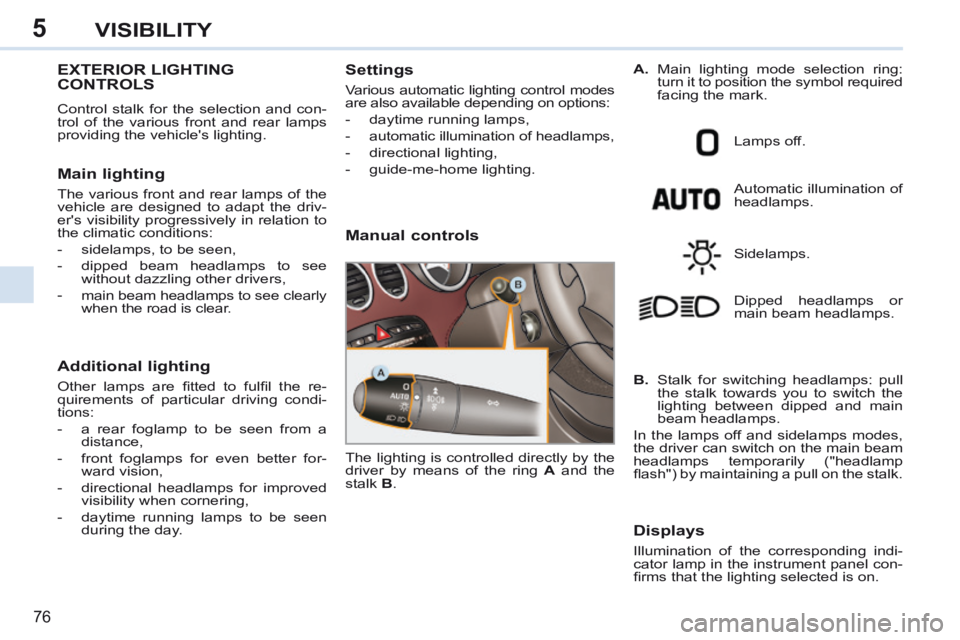
Manual controls
Automatic illumination of
headlamps.
The lighting is controlled directly by the
driver by means of the ring A and the
stalk B . Lamps off.
Sidelamps.
B. Stalk for switching headlamps: pull the stalk towards you to switch the
lighting between dipped and main
beam headlamps.
In the lamps off and sidelamps modes,
the driver can switch on the main beam
headlamps temporarily ("headlamp
fl ash") by maintaining a pull on the stalk. Dipped headlamps or
main beam headlamps.
Displays
Illumination of the corresponding indi-
cator lamp in the instrument panel con-
fi rms that the lighting selected is on. A.
Main lighting mode selection ring:
turn it to position the symbol required
facing the mark.
Page 93 of 268
6
91
FITTINGS
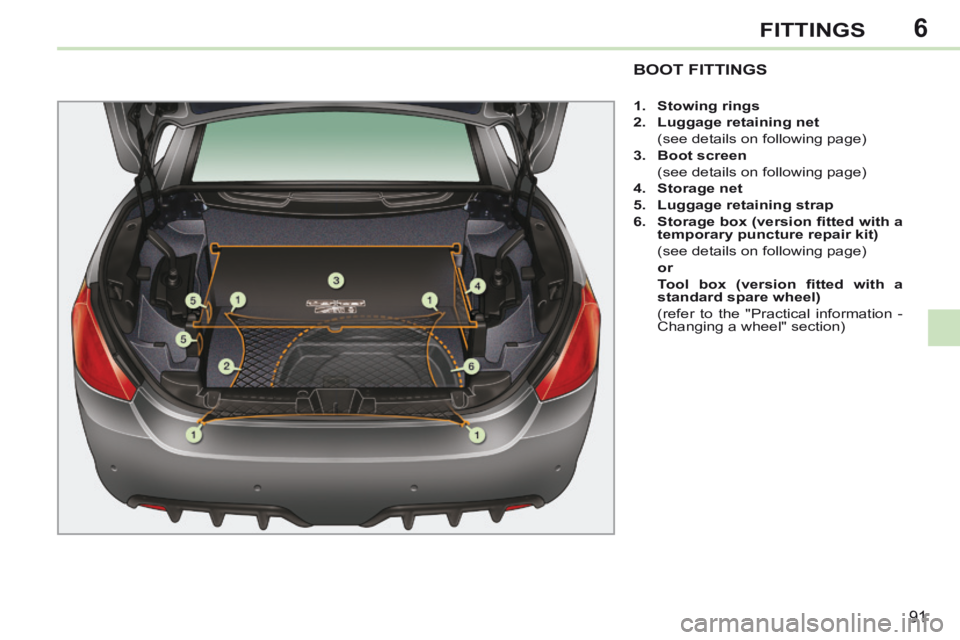
BOOT FITTINGS
1. Stowing rings
2. Luggage retaining net
(see details on following page)
3. Boot screen
(see details on following page)
4. Storage net
5. Luggage retaining strap
6. Storage box (version fi tted with a temporary puncture repair kit)
(see details on following page)
or
Tool box (version fi tted with a
standard spare wheel)
(refer to the "Practical information - Changing a wheel" section)
Page 94 of 268
6
i
92
FITTINGS
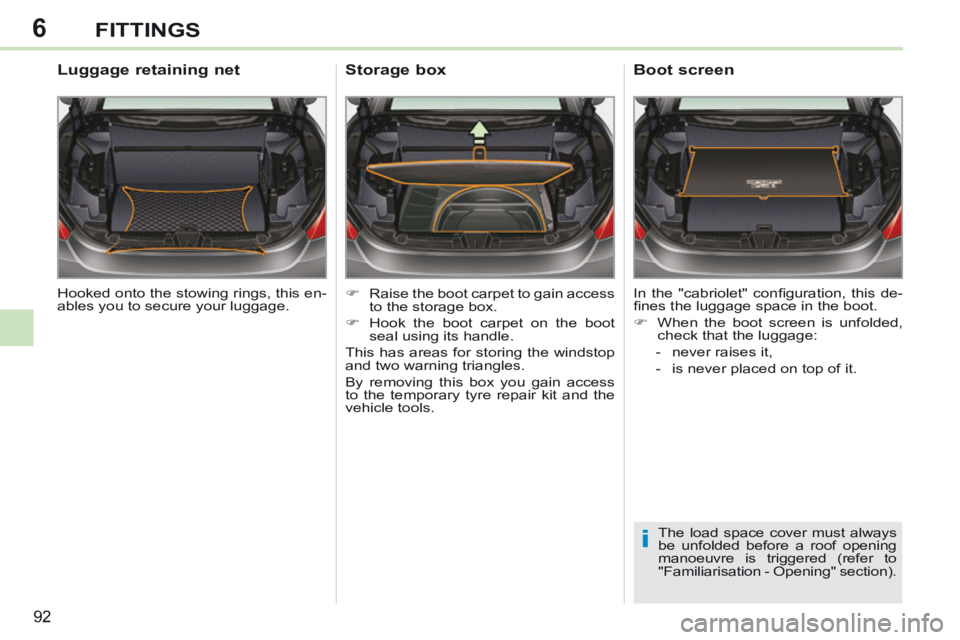
Hooked onto the stowing rings, this en-
ables you to secure your luggage.
Luggage retaining net
Raise the boot carpet to gain access to the storage box.
Hook the boot carpet on the boot seal using its handle.
This has areas for storing the windstop
and two warning triangles.
By removing this box you gain access
to the temporary tyre repair kit and the
vehicle tools.
Storage box Boot screen
In the "cabriolet" confi guration, this de-
fi nes the luggage space in the boot.
When the boot screen is unfolded,
check that the luggage:
- never raises it,
- is never placed on top of it.
The load space cover must always
be unfolded before a roof opening
manoeuvre is triggered (refer to
"Familiarisation - Opening" section).
Page 95 of 268
7
i
i
93
SAFETY
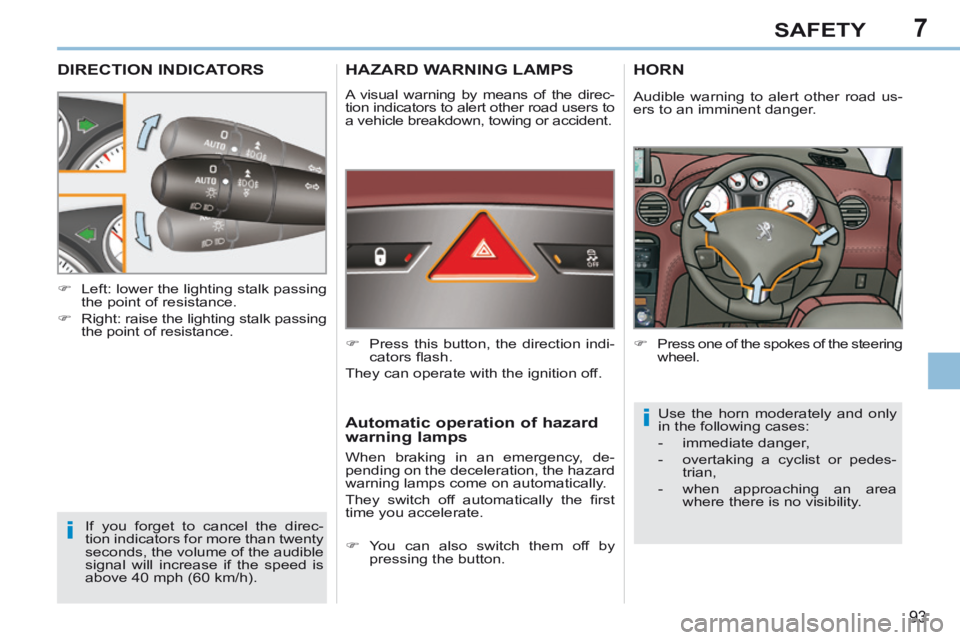
DIRECTION INDICATORS
If you forget to cancel the direc-
tion indicators for more than twenty
seconds, the volume of the audible
signal will increase if the speed is
above 40 mph (60 km/h).
Left: lower the lighting stalk passing
the point of resistance.
Right: raise the lighting stalk passing the point of resistance.
HAZARD WARNING LAMPS
A visual warning by means of the direc-
tion indicators to alert other road users to
a vehicle breakdown, towing or accident.
Press this button, the direction indi-cators fl ash.
They can operate with the ignition off.
Automatic operation of hazard
warning lamps
When braking in an emergency, de-
pending on the deceleration, the hazard
warning lamps come on automatically.
They switch off automatically the fi rst
time you accelerate.
You can also switch them off by pressing the button.
HORN
Press one of the spokes of the steering wheel.
Use the horn moderately and only
in the following cases:
- immediate danger,
- overtaking a cyclist or pedes- trian,
- when approaching an area where there is no visibility.
Audible warning to alert other road us-
ers to an imminent danger.
Page 101 of 268
7
i
99
SAFETY
The driver must ensure that passen-
gers use the seat belts correctly and
that they are all restrained securely
before setting off.
Wherever you are seated in the ve-
hicle, always fasten your seat belt,
even for short journeys.
Do not interchange the seat belt buck-
les as they will not fulfi l their role fully.
The seat belts are fi tted with an inertia
reel permitting automatic adjustment
of the length of the strap to your size.
The seat belt is stowed automatically
when not in use.
Before and after use, ensure that the
seat belt is reeled in correctly.
The lower part of the strap must be
positioned as low as possible on the
pelvis.
The upper part must be positioned in
the hollow of the shoulder.
The inertia reels are fi tted with an au-
tomatic locking device which comes
into operation in the event of a collision,
emergency braking or if the vehicle rolls
over. You can release the device by
pulling fi rmly on the strap and releasing
it so that it reels in slightly. In order to be effective, a seat belt
must:
- be tightened as close to the body
as possible,
- be pulled in front of you with a smooth movement, checking that
it does not twist,
- be used to restrain only one person,
- not bear any trace of cuts or fraying,
- not be converted or modifi ed to avoid affecting its performance.
In accordance with current safety
regulations, for all repairs on your
vehicle, go to a qualifi ed workshop
with the skills and equipment needed,
which a PEUGEOT dealer is able to
provide.
Have your seat belts checked regu-
larly by a PEUGEOT dealer or a
qualifi ed workshop, particularly if the
straps show signs of damage.
Clean the seat belt straps with soapy
water or a textile cleaning product,
sold by PEUGEOT dealers.
After folding or moving a seat or rear
bench seat, ensure that the seat belt
is positioned and reeled in correctly. Recommendations for children
Use a suitable child seat if the pas-
senger is less than 12 years old or
shorter than one and a half metres.
Never use the same seat belt to se-
cure more than one person.
Never allow a child to travel on your
lap.
In the event of an impact
Depending on the nature and serious-
ness of the impact , the pretensioning
device may be deployed before and in-
dependently of the airbags. Deployment
of the pretensioners is accompanied by
a slight discharge of harmless smoke
and a noise, due to the activation of the
pyrotechnic cartridge incorporated in the
system.
In all cases, the airbag warning lamp
comes on.
Following an impact, have the seat
belts system checked, and if neces-
sary replaced, by a PEUGEOT dealer
or a qualifi ed workshop.
Page 102 of 268

7
i
!
100
SAFETY
AIRBAGS
The airbags have been designed to
maximise the safety of the occupants in
the event of violent collisions. They sup-
plement the action of the force-limiting
seat belts.
In this case, the electronic detectors
record and analyse the front and side
impacts suffered in the impact detection
zones:
- in the event of a serious impact, the airbags are deployed instanta-
neously and contribute towards pro-
tecting the occupants of the vehicle;
immediately after the impact, the
airbags defl ate rapidly so that they
do not hinder the visibility of the oc-
cupants or their possible exit from
the vehicle,
- in the event of a minor impact or rear impact and in certain roll-over
conditions, the airbags will not be
deployed; the seat belt alone con-
tributes towards providing your pro-
tection in these situations. The deployment of one or more
airbags is accompanied by a slight
discharge of smoke and a noise,
due to the activation of the pyro-
technic cartridge incorporated in
the system.
This smoke is not harmful, but sen-
sitive individuals may experience
some irritation.
The noise of the detonation may
result in a slight loss of hearing for
a short time.
Front airbags
Deployment
The airbags are deployed, except the pas-
senger's front airbag it it has been deacti-
vated, in the event of a serious front impact
to all or part of the front impact zone A , in
the longitudinal centreline of the vehicle on
a horizontal plane and directed from the
front to the rear of the vehicle.
The front airbag infl ates between the tho-
rax and head of the front occupant of the
vehicle and the steering wheel, driver's
side, and the dashboard, passenger's side
to cushion their forward movement.
Impact detection zones
A. Front impact zone.
B. Side impact zone.
The airbags do not operate when
the ignition is off.
This equipment only operates once.
If a second impact occurs (during
the same or a subsequent acci-
dent), the airbag will not operate. System which protects the driver and
front passenger in the event of a seri-
ous front impact in order to limit the risk
of injury to the head and thorax.
The driver's airbag is fi tted in the centre
of the steering wheel; the front passen-
ger's airbag is fi tted in the dashboard
above the glove box.
Page 104 of 268
7
i
102
SAFETY
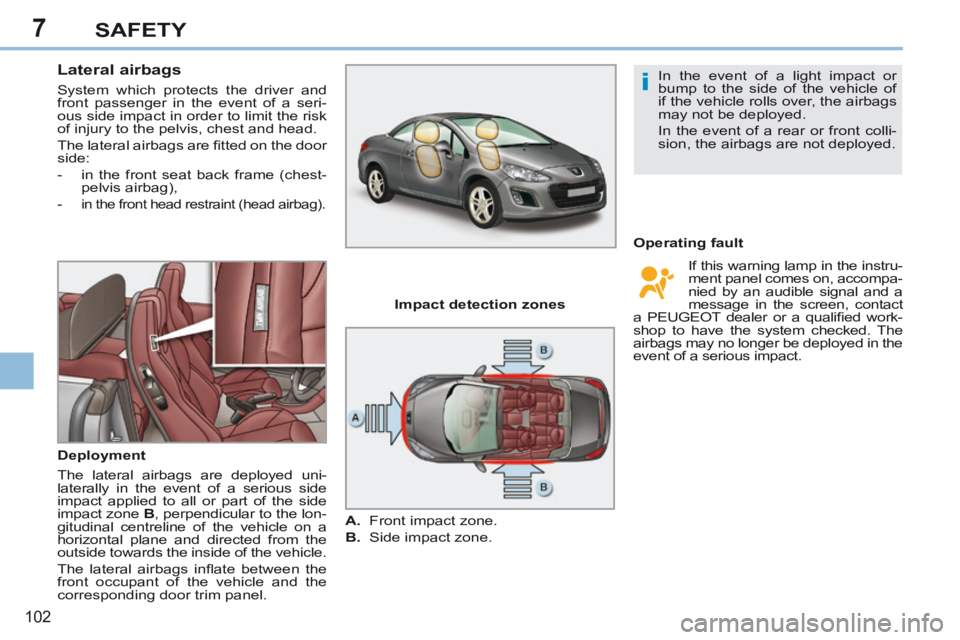
Lateral airbags
System which protects the driver and
front passenger in the event of a seri-
ous side impact in order to limit the risk
of injury to the pelvis, chest and head.
The lateral airbags are fi tted on the door
side:
- in the front seat back frame (chest-pelvis airbag),
-
in the front head restraint (head airbag).
Deployment
The lateral airbags are deployed uni-
laterally in the event of a serious side
impact applied to all or part of the side
impact zone B , perpendicular to the lon-
gitudinal centreline of the vehicle on a
horizontal plane and directed from the
outside towards the inside of the vehicle.
The lateral airbags infl ate between the
front occupant of the vehicle and the
corresponding door trim panel. Operating fault
Impact detection zones
A. Front impact zone.
B. Side impact zone. If this warning lamp in the instru-
ment panel comes on, accompa-
nied by an audible signal and a
message in the screen, contact
a PEUGEOT dealer or a qualifi ed work-
shop to have the system checked. The
airbags may no longer be deployed in the
event of a serious impact. In the event of a light impact or
bump to the side of the vehicle of
if the vehicle rolls over, the airbags
may not be deployed.
In the event of a rear or front colli-
sion, the airbags are not deployed.
Page 120 of 268
8
PRND
!i
11 8
DRIVING
Return to automatic operation
At any time, press the button select-ed again to quit the programme en-
gaged and return to auto-adaptive
mode.
Manual operation
Select position M for sequential
changing of the six gears.
Push the lever towards the + sign to
change up a gear.
Pull the lever towards the - sign to
change down a gear.
It is only possible to change from one
gear to another if the vehicle speed and
engine speed permit; otherwise, the
gearbox will operate temporarily in au-
tomatic mode.
M and the gears engaged
manually appear in succes-
sion in the instrument panel.
If the engine speed is too low or too
high, the gear selected fl ashes for a few
seconds, then the actual gear engaged
is displayed.
It is possible to change from position D
(automatic) to position M (manual) at
any time.
When the vehicle is stationary or mov-
ing very slowly, the gearbox selects
gear M1 automatically.
The sport and snow programmes do not
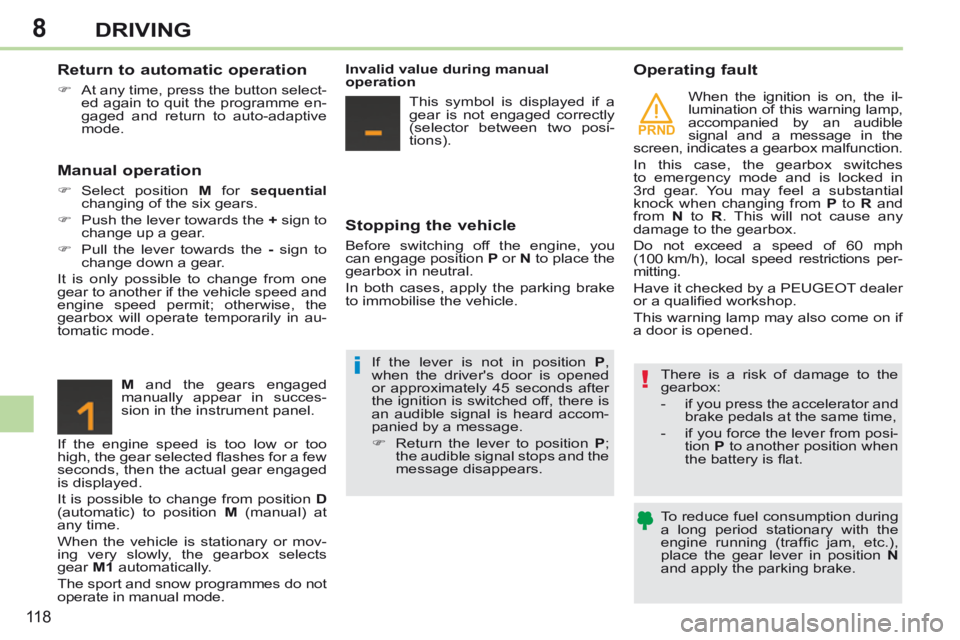
operate in manual mode. Invalid value during manual
operation
This symbol is displayed if a
gear is not engaged correctly
(selector between two posi-
tions).
Stopping the vehicle
Before switching off the engine, you
can engage position P or N to place the
gearbox in neutral.
In both cases, apply the parking brake
to immobilise the vehicle.
Operating fault
There is a risk of damage to the
gearbox:
- if you press the accelerator and brake pedals at the same time,
- if you force the lever from posi- tion P to another position when
the battery is fl at.
To reduce fuel consumption during
a long period stationary with the
engine running (traffi c jam, etc.),
place the gear lever in position N
and apply the parking brake.
If the lever is not in position
P ,
when the driver's door is opened
or approximately 45 seconds after
the ignition is switched off, there is
an audible signal is heard accom-
panied by a message.
Return the lever to position P ;
the audible signal stops and the
message disappears. When the ignition is on, the il-
lumination of this warning lamp,
accompanied by an audible
signal and a message in the
screen, indicates a gearbox malfunction.
In this case, the gearbox switches
to emergency mode and is locked in
3rd gear. You may feel a substantial
knock when changing from P to R and
from N to R . This will not cause any
damage to the gearbox.
Do not exceed a speed of 60 mph
(100 km/h), local speed restrictions per-
mitting.
Have it checked by a PEUGEOT dealer
or a qualifi ed workshop.
This warning lamp may also come on if
a door is opened.
Page 131 of 268
8
ii
129
DRIVING
Front parking sensors
In addition to the rear parking sensors,
the front parking sensors are triggered
when an obstacle is detected in front
and the speed of the vehicle is still be-
low 6 mph (10 km/h).
The front parking sensors are interrupted
if the vehicle stops for more than three
seconds in forward gear, if no further ob-
stacles are detected or when the speed
of the vehicle exceeds 6 mph (10 km/h).
The sound emitted by the speaker (front
or rear) indicates whether the obstacle
is in front or behind.
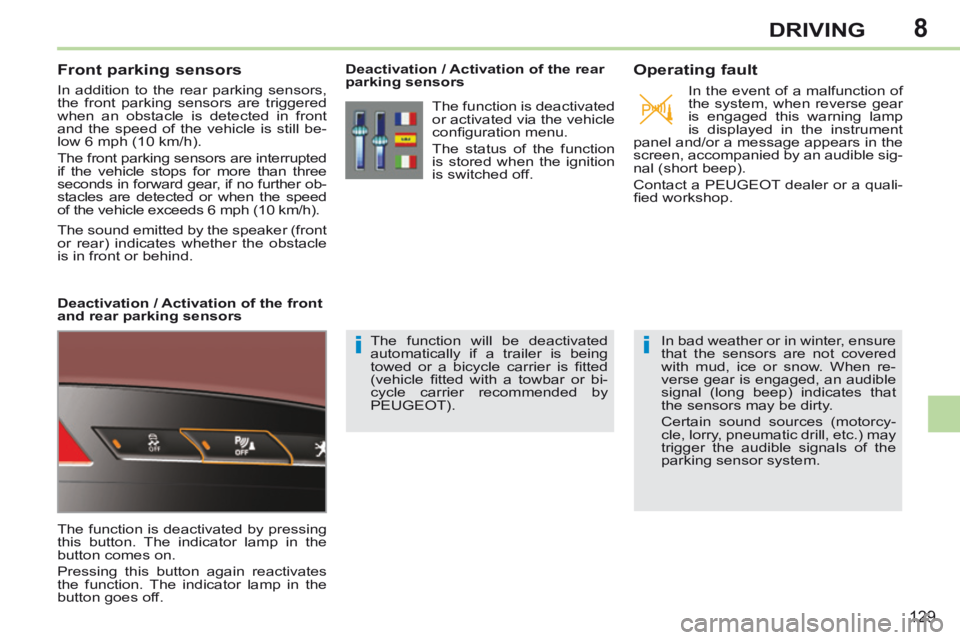
The function is deactivated by pressing
this button. The indicator lamp in the
button comes on.
Pressing this button again reactivates
the function. The indicator lamp in the
button goes off. Deactivation / Activation of the rear
parking sensors
The function will be deactivated
automatically if a trailer is being
towed or a bicycle carrier is fi tted
(vehicle fi tted with a towbar or bi-
cycle carrier recommended by
PEUGEOT).
Operating fault
In the event of a malfunction of
the system, when reverse gear
is engaged this warning lamp
is displayed in the instrument
panel and/or a message appears in the
screen, accompanied by an audible sig-
nal (short beep).
Contact a PEUGEOT dealer or a quali-
fi ed workshop.
In bad weather or in winter, ensure
that the sensors are not covered
with mud, ice or snow. When re-
verse gear is engaged, an audible
signal (long beep) indicates that
the sensors may be dirty.
Certain sound sources (motorcy-
cle, lorry, pneumatic drill, etc.) may
trigger the audible signals of the
parking sensor system.
The function is deactivated
or activated via the vehicle
confi guration menu.
The status of the function
is stored when the ignition
is switched off.
Deactivation / Activation of the front
and rear parking sensors