tow PEUGEOT 308 CC 2013 Owner's Manual
[x] Cancel search | Manufacturer: PEUGEOT, Model Year: 2013, Model line: 308 CC, Model: PEUGEOT 308 CC 2013Pages: 268, PDF Size: 15.28 MB
Page 141 of 268
9
!
139
CHECKS
Only use products recommended
by PEUGEOT or products of equiv-
alent quality and specifi cation.
In order to optimise the operation
of units as important as those in the
braking system, PEUGEOT selects
and offers very specifi c products.
After washing the vehicle, damp-
ness, or in wintry conditions, ice
can form on the brake discs and
pads: braking effi ciency may be
reduced. Make light brake applica-
tions to dry and defrost the brakes. Brake disc wear Brake pads Parking brake
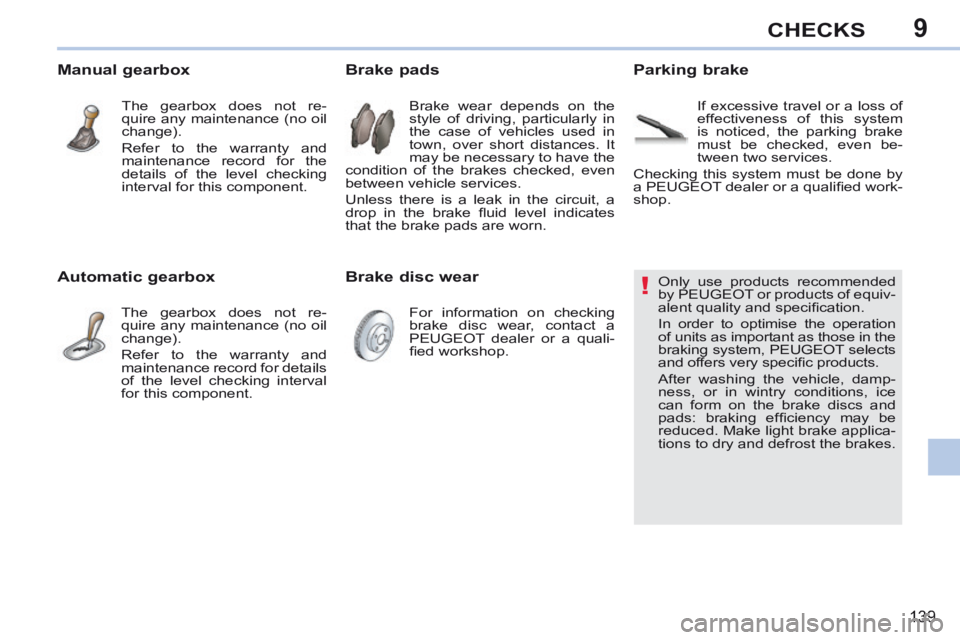
Brake wear depends on the
style of driving, particularly in
the case of vehicles used in
town, over short distances. It
may be necessary to have the
condition of the brakes checked, even
between vehicle services.
Unless there is a leak in the circuit, a
drop in the brake fl uid level indicates
that the brake pads are worn.
For information on checking
brake disc wear, contact a
PEUGEOT dealer or a quali-
fi ed workshop. If excessive travel or a loss of
effectiveness of this system
is noticed, the parking brake
must be checked, even be-
tween two services.
Checking this system must be done by
a PEUGEOT dealer or a qualifi ed work-
shop.
Manual gearbox
The gearbox does not re-
quire any maintenance (no oil
change).
Refer to the warranty and
maintenance record for the
details of the level checking
interval for this component.
Automatic gearbox
The gearbox does not re-
quire any maintenance (no oil
change).
Refer to the warranty and
maintenance record for details
of the level checking interval
for this component.
Page 142 of 268
10
i
140
PRACTICAL INFORMATION
Access to the kit
The kit is stowed in the boot under
the fl oor. It is installed in the tool box,
located under the storage box.
TEMPORARY PUNCTURE REPAIR KIT
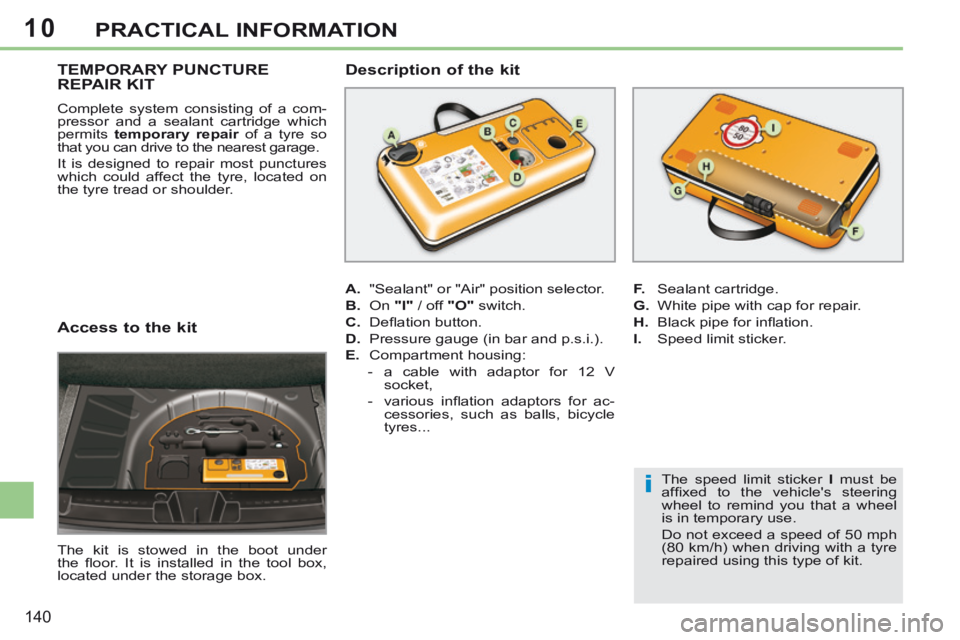
A. "Sealant" or "Air" position selector.
B. On "I" / off "O" switch.
C. Defl ation button.
D. Pressure gauge (in bar and p.s.i.).
E. Compartment housing: - a cable with adaptor for 12 V socket,
- various infl ation adaptors for ac- cessories, such as balls, bicycle
tyres...
Description of the kit
F. Sealant cartridge.
G. White pipe with cap for repair.
H. Black pipe for infl ation.
I. Speed limit sticker.
The speed limit sticker I must be
affi xed to the vehicle's steering
wheel to remind you that a wheel
is in temporary use.
Do not exceed a speed of 50 mph
(80 km/h) when driving with a tyre
repaired using this type of kit.
Complete system consisting of a com-
pressor and a sealant cartridge which
permits
temporary repair of a tyre so
that you can drive to the nearest garage.
It is designed to repair most punctures
which could affect the tyre, located on
the tyre tread or shoulder.
Page 145 of 268
10
!
143
PRACTICAL INFORMATION
2. Infl ation
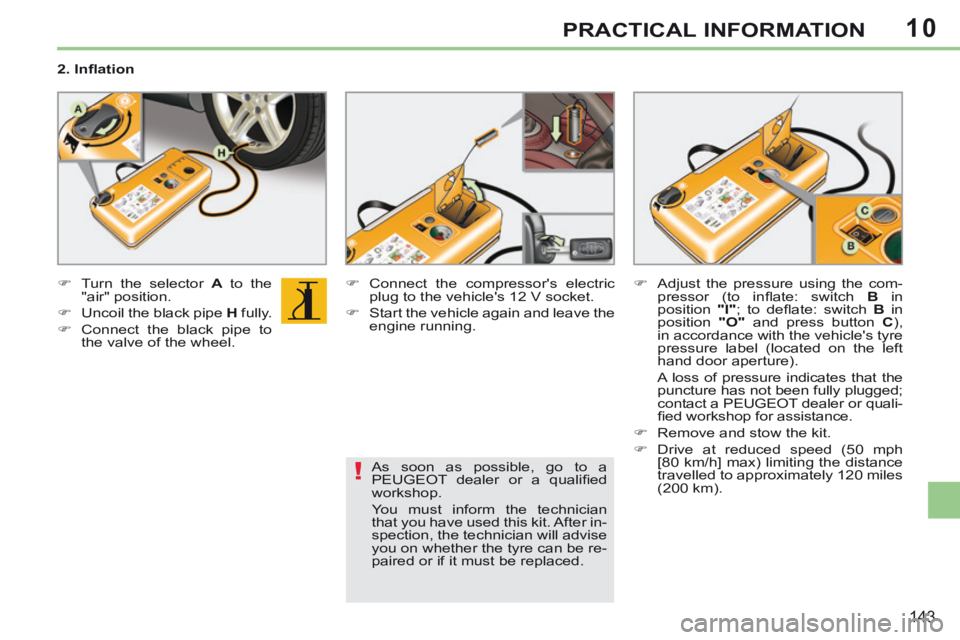
Turn the selector A to the
"air" position.
Uncoil the black pipe H fully.
Connect the black pipe to the valve of the wheel. Connect the compressor's electric
plug to the vehicle's 12 V socket.
Start the vehicle again and leave the engine running. Adjust the pressure using the com-
pressor (to infl ate: switch B in
p osition "I" ; to defl ate: switch B in
position "O" and press button C ),
in accordance with the vehicle's tyre
pressure label (located on the left
hand door aperture).
A loss of pressure indicates that the puncture has not been fully plugged;
contact a PEUGEOT dealer or quali-
fi ed workshop for assistance.
Remove and stow the kit.
Drive at reduced speed (50 mph [80 km/h] max) limiting the distance
travelled to approximately 120 miles
(200 km).
As soon as possible, go to a
PEUGEOT dealer or a qualifi ed
workshop.
You must inform the technician
that you have used this kit. After in-
spection, the technician will advise
you on whether the tyre can be re-
paired or if it must be replaced.
Page 146 of 268
10
!
!
144
PRACTICAL INFORMATION
Removing the cartridge
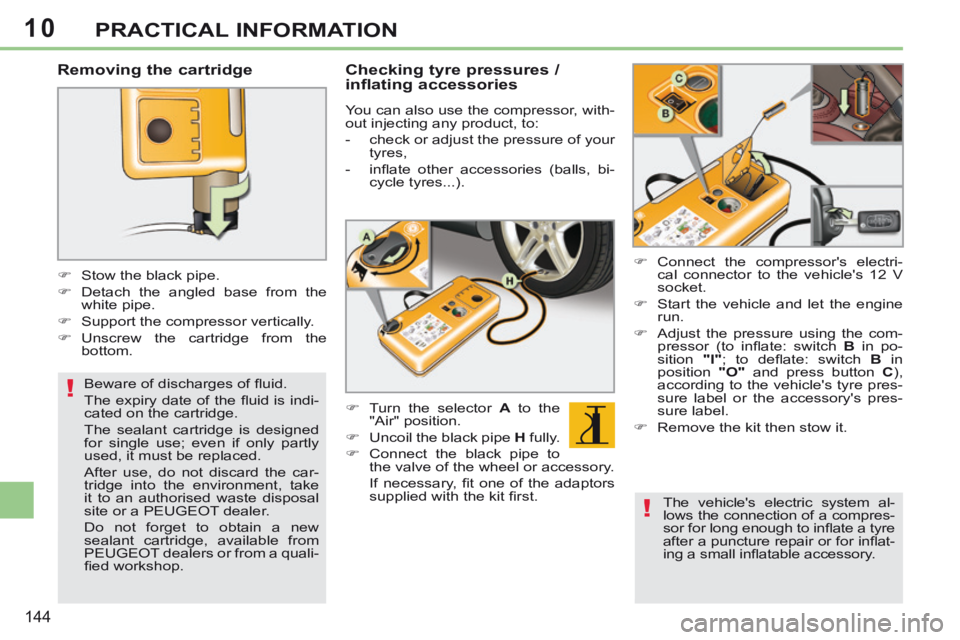
Stow the black pipe.
Detach the angled base from the white pipe.
Support the compressor vertically.
Unscrew the cartridge from the bottom.
Beware of discharges of fl uid.
The expiry date of the fl uid is indi-
cated on the cartridge.
The sealant cartridge is designed
for single use; even if only partly
used, it must be replaced.
After use, do not discard the car-
tridge into the environment, take
it to an authorised waste disposal
site or a PEUGEOT dealer.
Do not forget to obtain a new
sealant cartridge, available from
PEUGEOT dealers or from a quali-
fi ed workshop.
Checking tyre pressures /
inflating accessories
You can also use the compressor, with-
out injecting any product, to:
- check or adjust the pressure of your tyres,
- infl ate other accessories (balls, bi- cycle tyres...).
Turn the selector A to the
"Air" position.
Uncoil the black pipe H fully.
Connect the black pipe to the valve of the wheel or accessory.
If necessary, fi t one of the adaptors supplied with the kit fi rst. Connect the compressor's electri-
cal connector to the vehicle's 12 V
socket.
Start the vehicle and let the engine run.
Adjust the pressure using the com- pressor (to infl ate: switch B in po-
sition "I" ; to defl ate: switch B in
position "O" and press button C ),
according to the vehicle's tyre pres-
sure label or the accessory's pres-
sure label.
Remove the kit then stow it.
The vehicle's electric system al-
lows the connection of a compres-
sor for long enough to infl ate a tyre
after a puncture repair or for infl at-
ing a small infl atable accessory.
Page 148 of 268
10
i
i
146
PRACTICAL INFORMATION
Fitting the steel spare wheel
If your vehicle is fi tted with alloy
wheels, it is normal to notice, when
tightening the bolts on fi tting, that
the washers do not come into con-
tact with the steel spare wheel. The
wheel is secured by the conical
contact of each bolt.
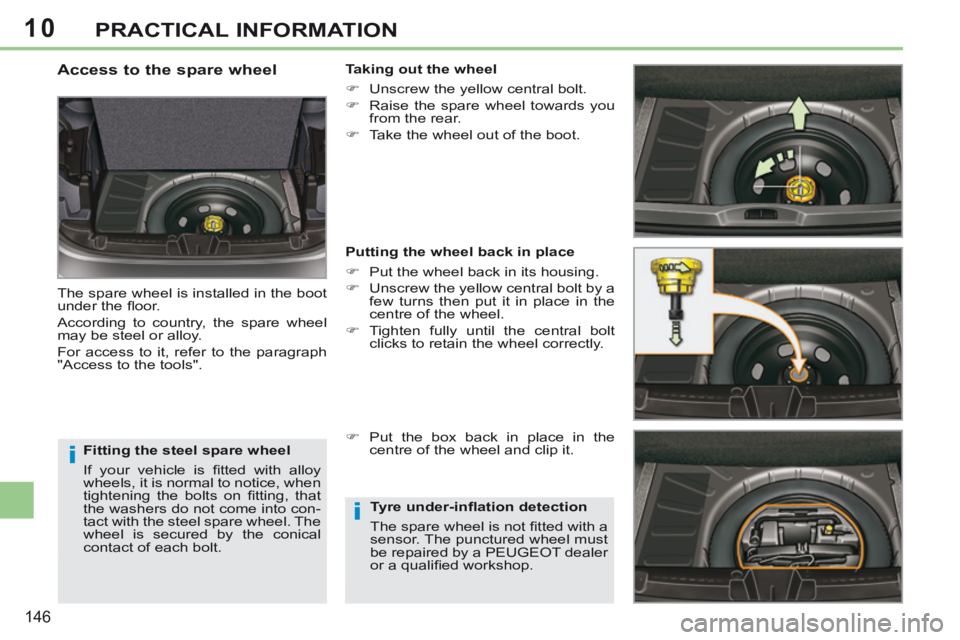
Access to the spare wheel
The spare wheel is installed in the boot
under the fl oor.
According to country, the spare wheel
may be steel or alloy.
For access to it, refer to the paragraph
"Access to the tools". Taking out the wheel
Unscrew the yellow central bolt.
Raise the spare wheel towards you
from the rear.
Take the wheel out of the boot.
Putting the wheel back in place
Put the wheel back in its housing.
Unscrew the yellow central bolt by a few turns then put it in place in the
centre of the wheel.
Tighten fully until the central bolt clicks to retain the wheel correctly.
Put the box back in place in the c entre of the wheel and clip it.
Tyre under-infl ation detection
The spare wheel is not fi tted with a
sensor. The punctured wheel must
be repaired by a PEUGEOT dealer
or a qualifi ed workshop.
Page 154 of 268
10
152
PRACTICAL INFORMATION
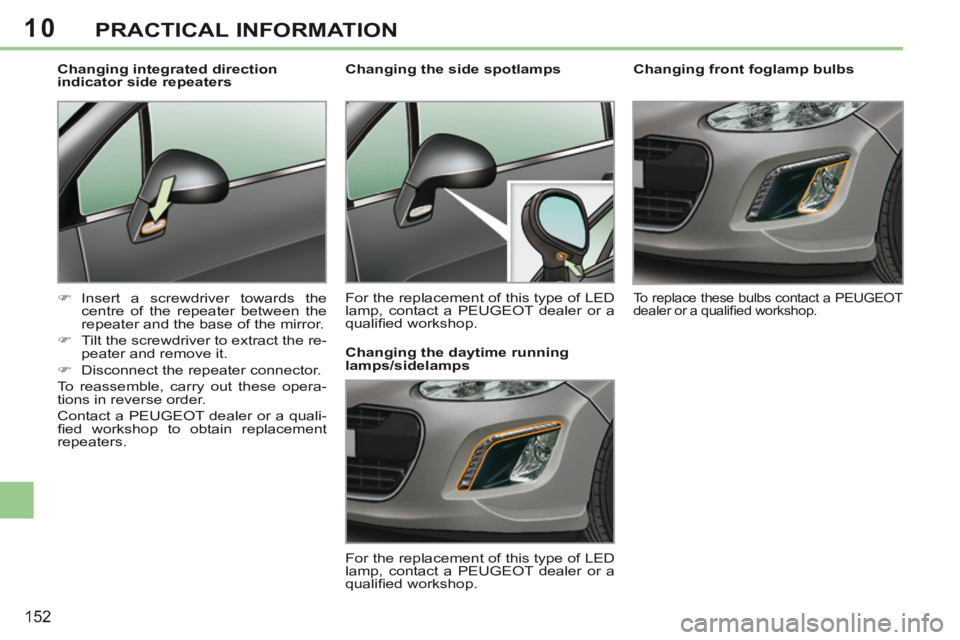
Changing front foglamp bulbs
To replace these bulbs contact a PEUGEOT
dealer or a qualifi ed workshop.
Changing the side spotlamps
For the replacement of this type of LED
lamp, contact a PEUGEOT dealer or a
qualifi ed workshop.
Changing integrated direction
indicator side repeaters
Insert a screwdriver towards the
centre of the repeater between the
repeater and the base of the mirror.
Tilt the screwdriver to extract the re- peater and remove it.
Disconnect the repeater connector.
To reassemble, carry out these opera-
tions in reverse order.
Contact a PEUGEOT dealer or a quali-
fi ed workshop to obtain replacement
repeaters. Changing the daytime running
lamps/sidelamps
For the replacement of this type of LED
lamp, contact a PEUGEOT dealer or a
qualifi ed workshop.
Page 156 of 268
10
!
154
PRACTICAL INFORMATION
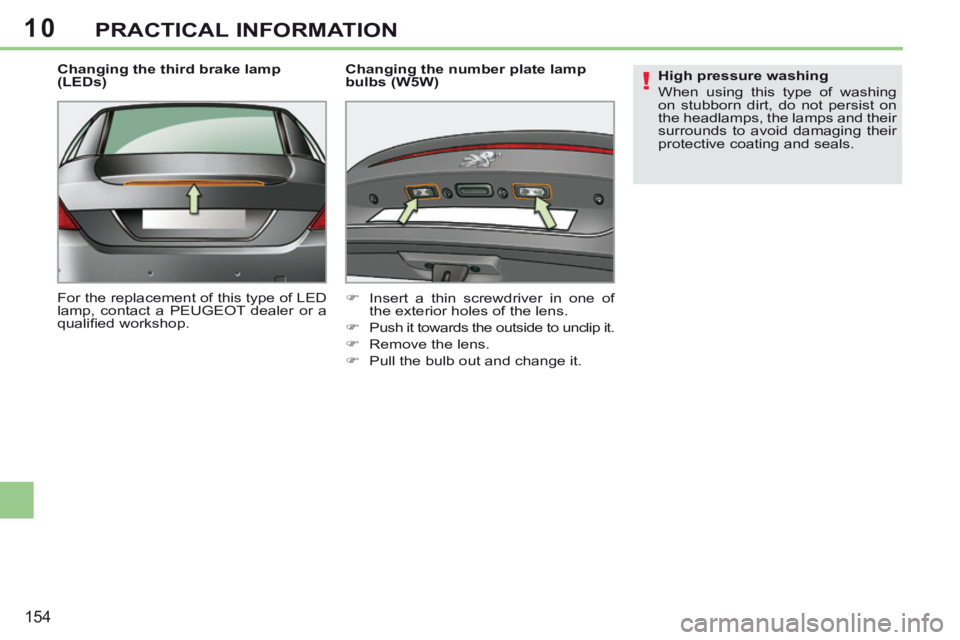
Changing the third brake lamp
(LEDs)
For the replacement of this type of LED
lamp, contact a PEUGEOT dealer or a
qualifi ed workshop. Changing the number plate lamp
bulbs (W5W)
Insert a thin screwdriver in one of
the exterior holes of the lens.
Push it towards the outside to unclip it.
Remove the lens.
Pull the bulb out and change it. High pressure washing
When using this type of washing
on stubborn dirt, do not persist on
the headlamps, the lamps and their
surrounds to avoid damaging their
protective coating and seals.
Page 167 of 268
10
i
165
PRACTICAL INFORMATION
CHANGING A WIPER BLADE
Removing
Raise the corresponding wiper arm.
Unclip the wiper blade and remove it.
Fitting
Put the corresponding new wiper blade in place and clip it.
Fold down the wiper arm carefully.
Before removing a front wiper
blade
Within one minute after switching off the ignition, operate the wiper stalk
to position the wiper blades verti-
cally on the windscreen.
After fitting a front wiper blade
Switch on the ignition.
Operate the wiper stalk again to park the wiper blades.
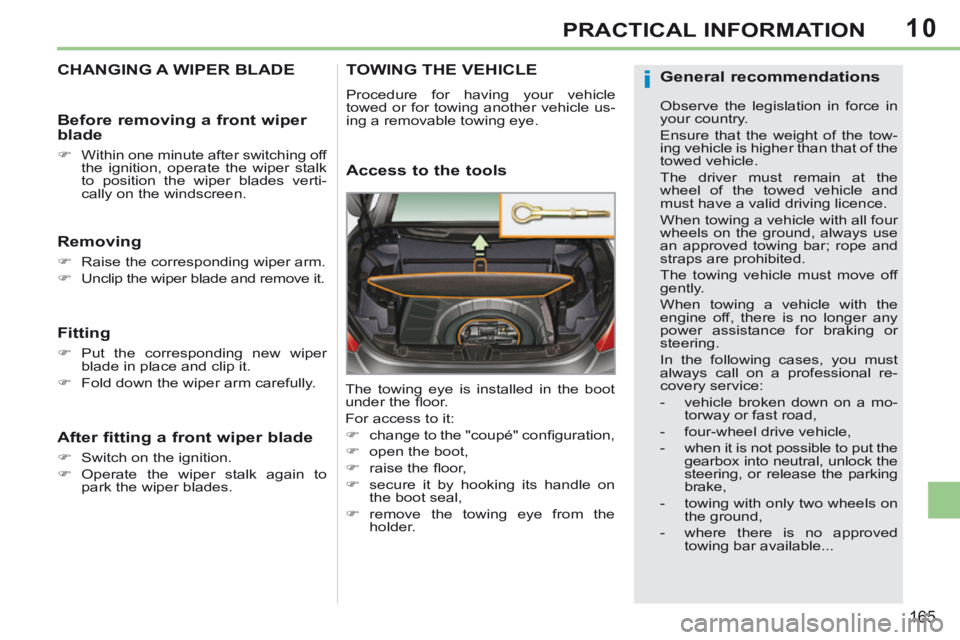
TOWING THE VEHICLE
Procedure for having your vehicle
towed or for towing another vehicle us-
ing a removable towing eye.
Access to the tools
The towing eye is installed in the boot
under the fl oor.
For access to it:
change to the "coupé" confi guration,
open the boot,
raise the fl oor,
secure it by hooking its handle on the boot seal,
remove the towing eye from the holder.
General recommendations
Observe the legislation in force in
your country.
Ensure that the weight of the tow-
ing vehicle is higher than that of the
towed vehicle.
The driver must remain at the
wheel of the towed vehicle and
must have a valid driving licence.
When towing a vehicle with all four
wheels on the ground, always use
an approved towing bar; rope and
straps are prohibited.
The towing vehicle must move off
gently.
When towing a vehicle with the
engine off, there is no longer any
power assistance for braking or
steering.
In the following cases, you must
a lways call on a professional re-
covery service:
- vehicle broken down on a mo-torway or fast road,
- four-wheel drive vehicle,
- when it is not possible to put the gearbox into neutral, unlock the
steering, or release the parking
brake,
- towing with only two wheels on the ground,
- where there is no approved towing bar available...
Page 168 of 268
10
i
166
PRACTICAL INFORMATION
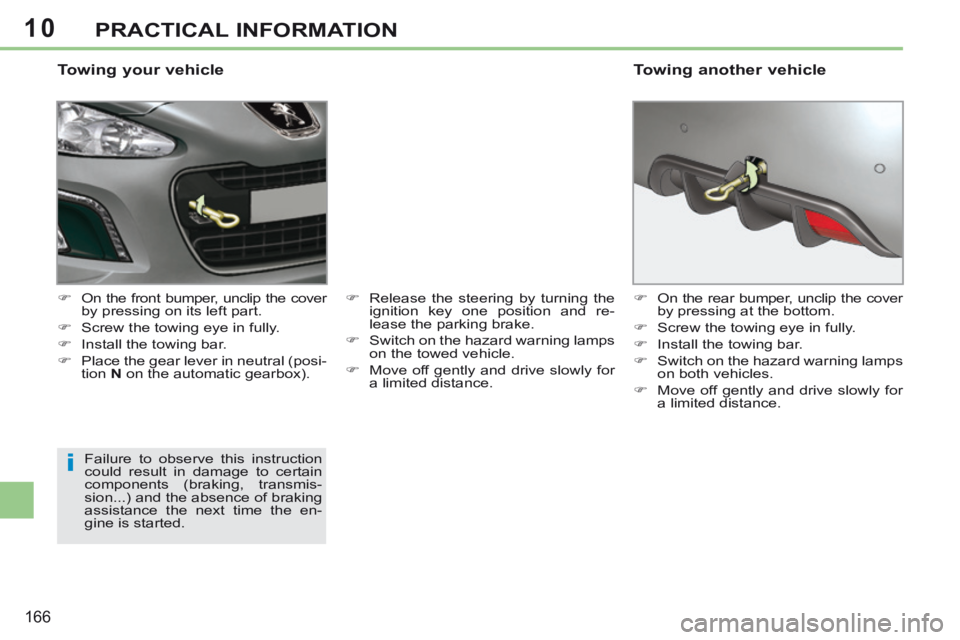
Towing your vehicle
On the front bumper, unclip the cover by pressing on its left part.
Screw the towing eye in fully.
Install the towing bar.
Place the gear lever in neutral (posi- tion N on the automatic gearbox). Release the steering by turning the
ignition key one position and re-
lease the parking brake.
Switch on the hazard warning lamps on the towed vehicle.
Move off gently and drive slowly for a limited distance.
Failure to observe this instruction
could result in damage to certain
components (braking, transmis-
sion...) and the absence of braking
assistance the next time the en-
gine is started. On the rear bumper, unclip the cover
by pressing at the bottom.
Screw the towing eye in fully.
Install the towing bar.
Switch on the hazard warning lamps on both vehicles.
Move off gently and drive slowly for a limited distance.
Towing another vehicle
Page 169 of 268
10
i
i
167
PRACTICAL INFORMATION
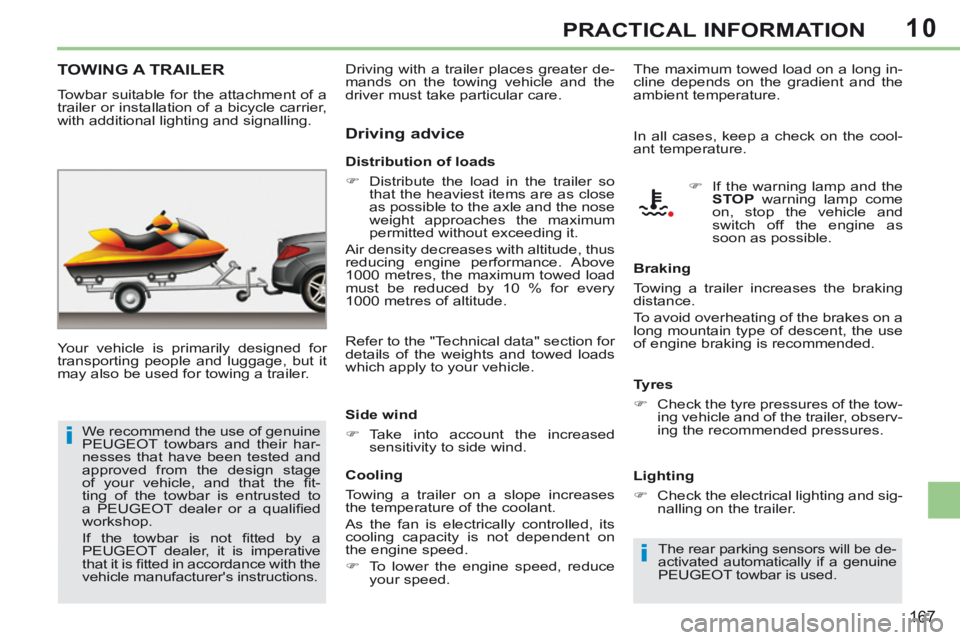
TOWING A TRAILER
Your vehicle is primarily designed for
transporting people and luggage, but it
may also be used for towing a trailer. Distribution of loads
Distribute the load in the trailer so
that the heaviest items are as close
as possible to the axle and the nose
weight approaches the maximum
permitted without exceeding it.
Air density decreases with altitude, thus
reducing engine performance. Above
1000 metres, the maximum towed load
must be reduced by 10 % for every
1000 metres of altitude.
Refer to the "Technical data" section for
details of the weights and towed loads
which apply to your vehicle.
Side wind
Take into account the increased sensitivity to side wind.
Towbar suitable for the attachment of a
trailer or installation of a bicycle carrier,
with additional lighting and signalling.
Driving advice
We recommend the use of genuine
PEUGEOT towbars and their har-
nesses that have been tested and
approved from the design stage
of your vehicle, and that the fi t-
ting of the towbar is entrusted to
a PEUGEOT dealer or a qualifi ed
workshop.
If the towbar is not fi tted by a
PEUGEOT dealer, it is imperative
that it is fi tted in accordance with the
vehicle manufacturer's instructions. Driving with a trailer places greater de-
mands on the towing vehicle and the
driver must take particular care.
In all cases, keep a check on the cool-
ant temperature.
Braking
Towing a trailer increases the braking
distance.
To avoid overheating of the brakes on a
long mountain type of descent, the use
of engine braking is recommended.
Tyres
Check the tyre pressures of the tow-ing vehicle and of the trailer, observ-
ing the recommended pressures.
Lighting
Check the electrical lighting and sig- nalling on the trailer.
The rear parking sensors will be de-
activated automatically if a genuine
PEUGEOT towbar is used.
If the warning lamp and the STOP warning lamp come
on, stop the vehicle and
switch off the engine as
soon as possible.
The maximum towed load on a long in-
cline depends on the gradient and the
ambient temperature.
Cooling
Towing a trailer on a slope increases
the temperature of the coolant.
As the fan is electrically controlled, its
cooling capacity is not dependent on
the engine speed.
To lower the engine speed, reduce your speed.