ignition Peugeot 308 CC 2014 Workshop Manual
[x] Cancel search | Manufacturer: PEUGEOT, Model Year: 2014, Model line: 308 CC, Model: Peugeot 308 CC 2014Pages: 268, PDF Size: 15.33 MB
Page 137 of 268
9
!
i
135
CHECKS
CHECKING LEVELS
Engine oil level
The check is carried out either
when the ignition is switched
on using the oil level indicator
in the instrument panel for ve-
hicles with and electric oil level gauge,
or using the dipstick. It is normal to top up the oil level
between two services (or oil chang-
es). PEUGEOT recommends that
you check the level, and top up
if necessary, every 3 000 miles
(5 000 kms).
Take care when working under the
bonnet, as certain areas of the en-
gine may be extremely hot (risk of
burns) and the cooling fan could
start at any time (even with the ig-
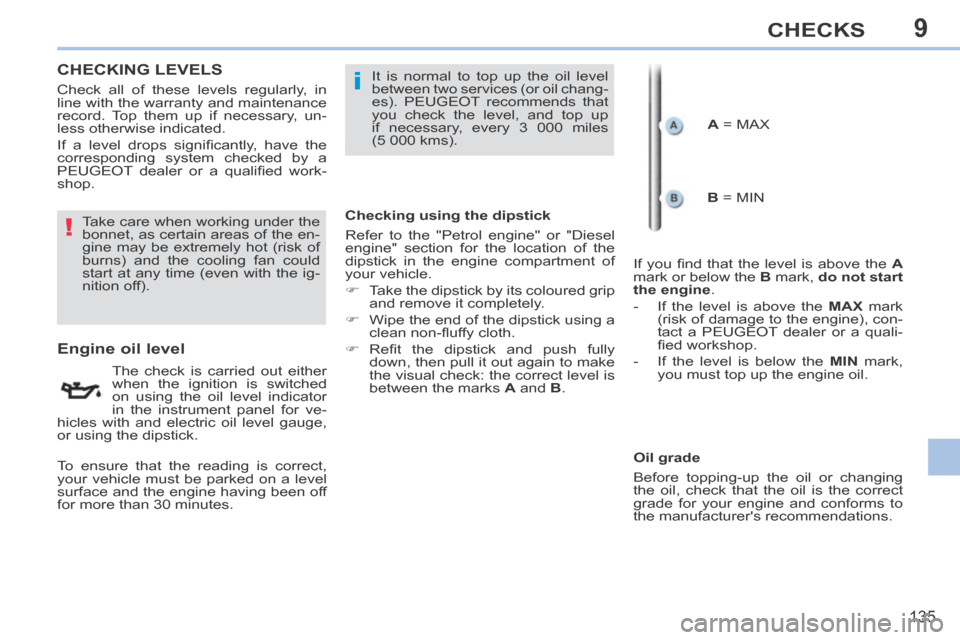
nition off). A = MAX
To ensure that the reading is correct,
your vehicle must be parked on a level
surface and the engine having been off
for more than 30 minutes. Check all of these levels regularly, in
line with the warranty and maintenance
record. Top them up if necessary, un-
less otherwise indicated.
If a level drops signifi cantly, have the
corresponding system checked by a
PEUGEOT dealer or a qualifi ed work-
shop. Checking using the dipstick
Refer to the "Petrol engine" or "Diesel
engine" section for the location of the
dipstick in the engine compartment of
your vehicle.
Take the dipstick by its coloured grip and remove it completely.
Wipe the end of the dipstick using a clean non-fl uffy cloth.
Refi t the dipstick and push fully down, then pull it out again to make
the visual check: the correct level is
between the marks A and B . B = MIN
If you fi nd that the level is above the A
mark or below the B mark, do not start
the engine .
- If the level is above the MAX mark
(risk of damage to the engine), con-
tact a PEUGEOT dealer or a quali-
fi ed workshop.
- If the level is below the MIN mark,
you must top up the engine oil.
Oil grade
Before topping-up the oil or changing
the oil, check that the oil is the correct
grade for your engine and conforms to
the manufacturer's recommendations.
Page 138 of 268
9
i
136
CHECKS
Brake fluid level
The brake fl uid level should be
close to the "MAX" mark. If it is
not, check the brake pad wear.
Power steering fluid level
The power steering fl uid level
should be close to the "MAX"
mark. With the engine cold,
unscrew the cap to check the
level.
Changing the fl uid
Refer to the warranty and maintenance
record for details of the interval for this
operation.
When the engine is warm, the tempera-
ture of the coolant is regulated by the
fan.
Coolant level
The coolant level should be
close to the "MAX" mark but
should never exceed it.
The cooling fan may start after
switching off the engine: take care
with articles and clothing that might
become caught by the fan blades.
Fluid specifi cation
The coolant must conform to the manu-
facturer's recommendations.
Fluid specifi cation
The brake fl uid must conform to the
manufacturer's recommendations.
In addition, as the cooling system is
pressurised, wait at least one hour after
switching off the engine before carrying
out any work.
To avoid any risk of scalding, unscrew
the cap by two turns to allow the pres-
sure to drop. When the pressure has
dropped, remove the cap and top up
the level.
Topping up the engine oil level
Refer to the "Petrol engine" or "Diesel
engine" section for the location of the oil
fi ller cap in the engine compartment of
your vehicle.
Unscrew the oil fi ller cap to reveal
the fi ller aperture.
Add oil in small quantities, avoiding any spills on engine components
(risk of fi re).
Wait a few minutes before checking the level again using the dipstick.
Add more oil if necessary.
After checking the level, carefully re- fi t the oil fi ller cap and the dipstick in
its tube.
After topping up the oil, the check
when switching on the ignition with
the oil level indicator in the instru-
ment panel is not valid during the
30 minutes after topping up.
Engine oil change
Refer to the warranty and maintenance
record for details of the interval for this
operation.
In order to maintain the reliability of the
engine and emission control system,
the use of additives in the engine oil is
prohibited.
Page 143 of 268
10
i!
141
PRACTICAL INFORMATION
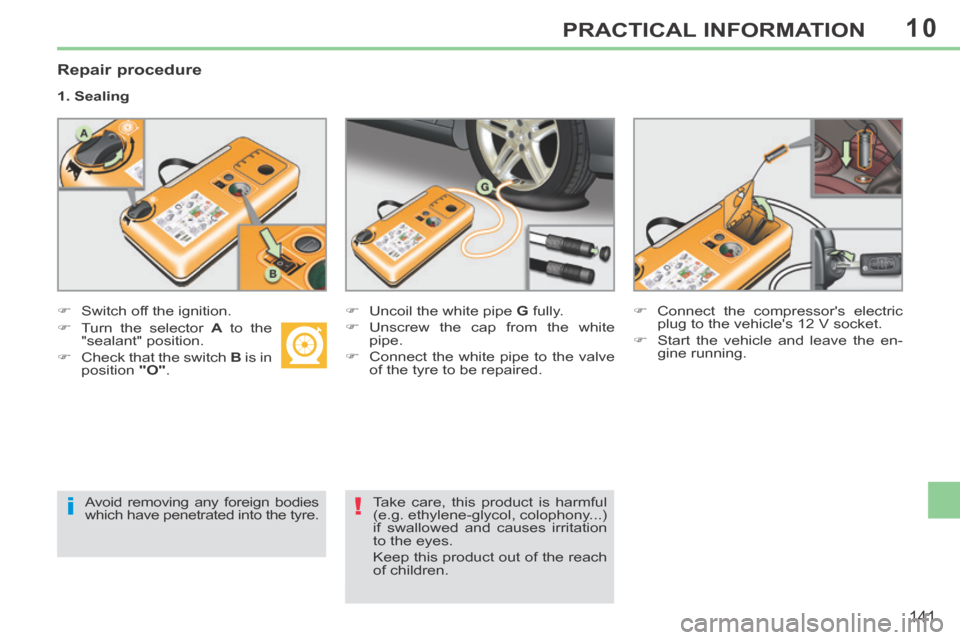
Repair procedure
1. Sealing
Switch off the ignition. Uncoil the white pipe G fully.
Unscrew the cap from the white pipe.
Connect the white pipe to the valve of the tyre to be repaired. Connect the compressor's electric
plug to the vehicle's 12 V socket.
Start the vehicle and leave the en- gine running.
Avoid removing any foreign bodies
which have penetrated into the tyre. Take care, this product is harmful
(e.g. ethylene-glycol, colophony...)
if swallowed and causes irritation
to the eyes.
Keep this product out of the reach
of children.
Turn the selector
A to the
"sealant" position.
Check that the switch B is in
position "O" .
Page 149 of 268
10
i
147
PRACTICAL INFORMATION
Parking the vehicle
Immobilise the vehicle where it
does not block traffi c: the ground
must be level, stable and non-
slippery ground.
Apply the parking brake, switch off
the ignition and engage fi rst gear *
to lock the wheels.
If necessary, place a chock under
the wheel diagonally opposite the
wheel to be changed.
It is imperative that you ensure that
the occupants get out of the ve-
hicle and wait where they are safe.
Never go underneath a vehicle
raised using a jack; use an axle
stand.
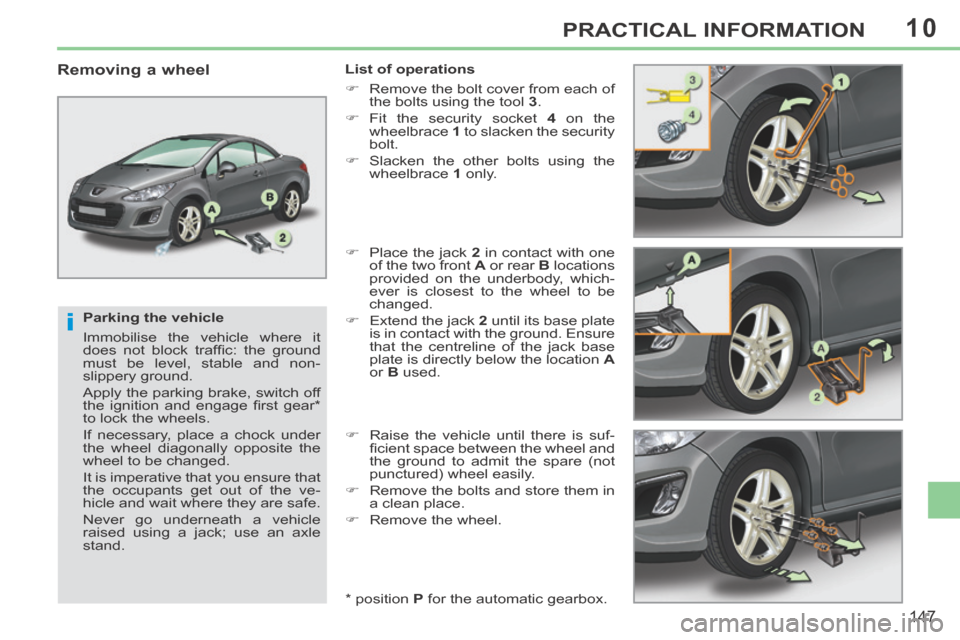
Removing a wheel List of operations
Remove the bolt cover from each of the bolts using the tool 3 .
Fit the security socket 4 on the
wheelbrace 1 to slacken the security
bolt.
Slacken the other bolts using the wheelbrace 1 only.
Place the jack 2 in contact with one
of the two front A or rear B locations
provided on the underbody, which-
ever is closest to the wheel to be
changed.
Extend the jack 2 until its base plate
is in contact with the ground. Ensure
that the centreline of the jack base
plate is directly below the location A
or B used.
Raise the vehicle until there is suf- fi cient space between the wheel and
the ground to admit the spare (not
punctured) wheel easily.
Remove the bolts and store them in a clean place.
Remove the wheel.
* position P for the automatic gearbox.
Page 155 of 268
10
!
153
PRACTICAL INFORMATION
Rear lamps
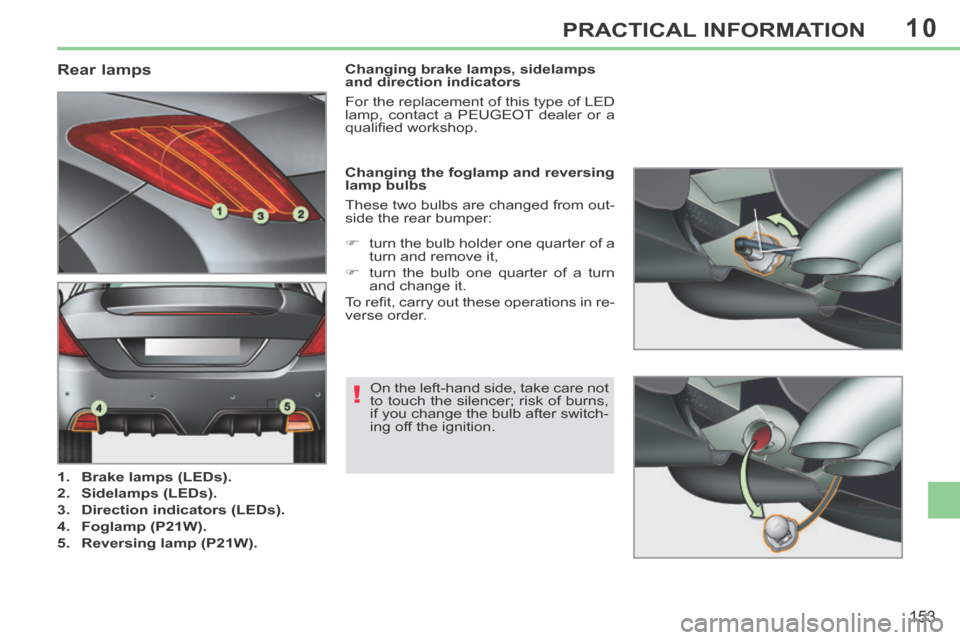
1. Brake lamps (LEDs).
2. Sidelamps (LEDs).
3. Direction indicators (LEDs).
4. Foglamp (P21W).
5. Reversing lamp (P21W). Changing the foglamp and reversing
lamp bulbs
These two bulbs are changed from out-
side the rear bumper:
On the left-hand side, take care not
to touch the silencer; risk of burns,
if you change the bulb after switch-
ing off the ignition.
turn the bulb holder one quarter of a
turn and remove it,
turn the bulb one quarter of a turn and change it.
To refi t, carry out these operations in re-
verse order. Changing brake lamps, sidelamps
and direction indicators
For the replacement of this type of LED
lamp, contact a PEUGEOT dealer or a
qualifi ed workshop.
Page 157 of 268
10
!
i
155
PRACTICAL INFORMATION
PEUGEOT will not accept responsi-
bility for the cost incurred in repairing
your vehicle or for rectifying malfunc-
tions resulting from the installation
of accessories not supplied and not
recommended by PEUGEOT and
not installed in accordance with its
instructions, in particular when the
combined consumption of all of the
additional equipment connected ex-
ceeds 10 milliamperes. Installing electrical accessories
Your vehicle's electrical system is
designed to operate with standard
or optional equipment.
Before installing other electrical
equipment or accessories on your
vehicle, contact a PEUGEOT dealer
or a qualifi ed workshop.
CHANGING A FUSE
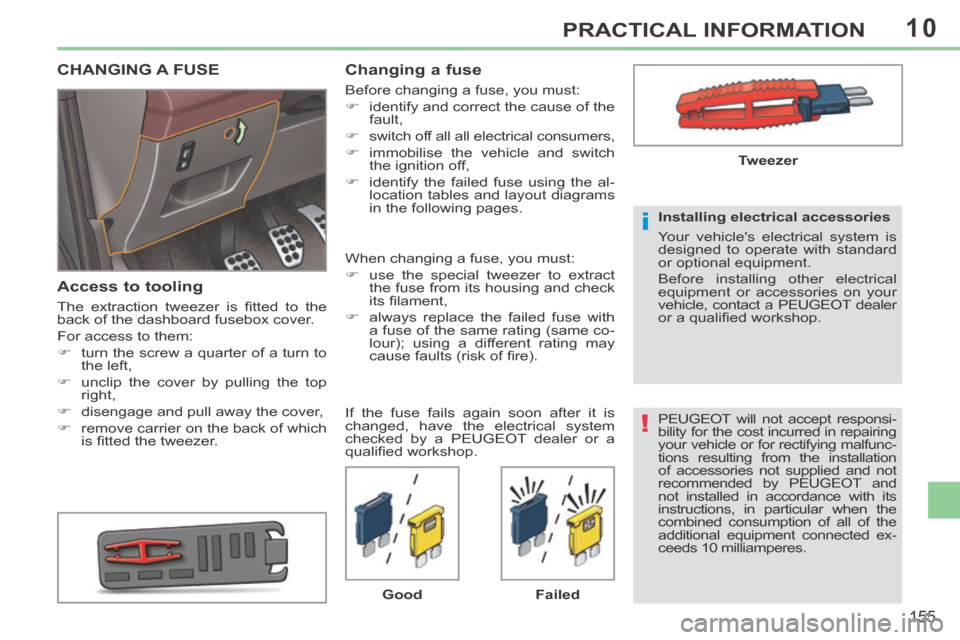
Access to tooling
The extraction tweezer is fi tted to the
back of the dashboard fusebox cover.
For access to them:
turn the screw a quarter of a turn to the left,
unclip the cover by pulling the top right,
disengage and pull away the cover,
remove carrier on the back of which is fi tted the tweezer.
Changing a fuse
Before changing a fuse, you must:
identify and correct the cause of the fault,
switch off all all electrical consumers,
immobilise the vehicle and switch the ignition off,
identify the failed fuse using the al- location tables and layout diagrams
in the following pages.
Good Failed Tweezer
When changing a fuse, you must:
use the special tweezer to extract the fuse from its housing and check
its fi lament,
always replace the failed fuse with a fuse of the same rating (same co-
lour); using a different rating may
cause faults (risk of fi re).
If the fuse fails again soon after it is
changed, have the electrical system
checked by a PEUGEOT dealer or a
qualifi ed workshop.
Page 158 of 268
10
156
PRACTICAL INFORMATION
Dashboard fuses
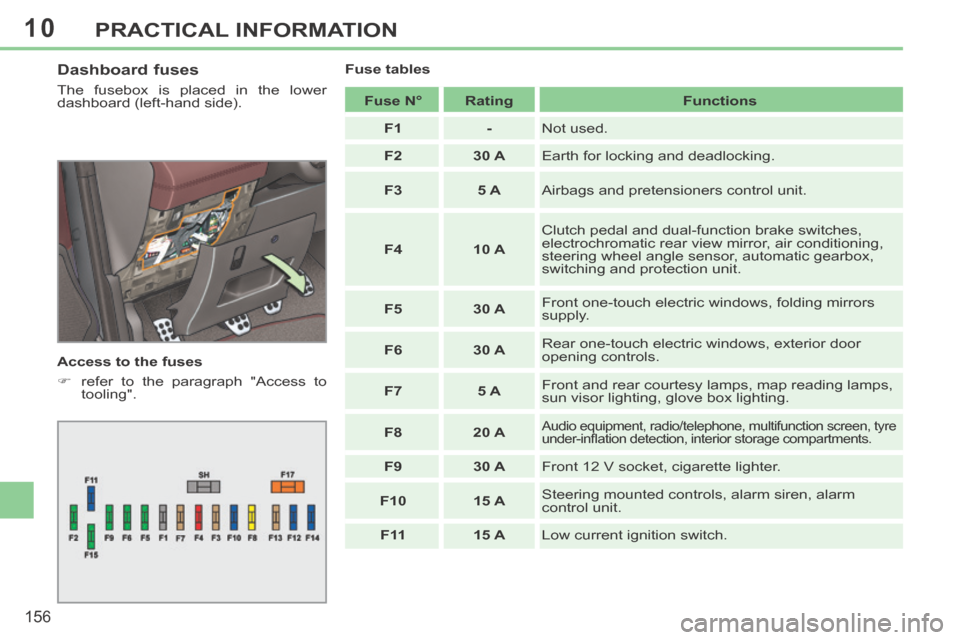
The fusebox is placed in the lower
dashboard (left-hand side).
Access to the fuses
refer to the paragraph "Access to tooling". Fuse tables
Fuse N° Rating Functions
F1 - Not used.
F2 30 A Earth for locking and deadlocking.
F3 5 A Airbags and pretensioners control unit.
F4 10 A Clutch pedal and dual-function brake switches,
electrochromatic rear view mirror, air conditioning,
steering wheel angle sensor, automatic gearbox,
switching and protection unit.
F5 30 A Front one-touch electric windows, folding mirrors
supply.
F6 30 A Rear one-touch electric windows, exterior door
opening controls.
F7 5 A Front and rear courtesy lamps, map reading lamps,
sun visor lighting, glove box lighting.
F8 20 A
Audio equipment, radio/telephone, multifunction screen, tyre
under-infl ation detection, interior storage compartments.
F9 30 A Front 12 V socket, cigarette lighter.
F10 15 A Steering mounted controls, alarm siren, alarm
control unit.
F 11 15 A Low current ignition switch.
Page 160 of 268
10
158
PRACTICAL INFORMATION
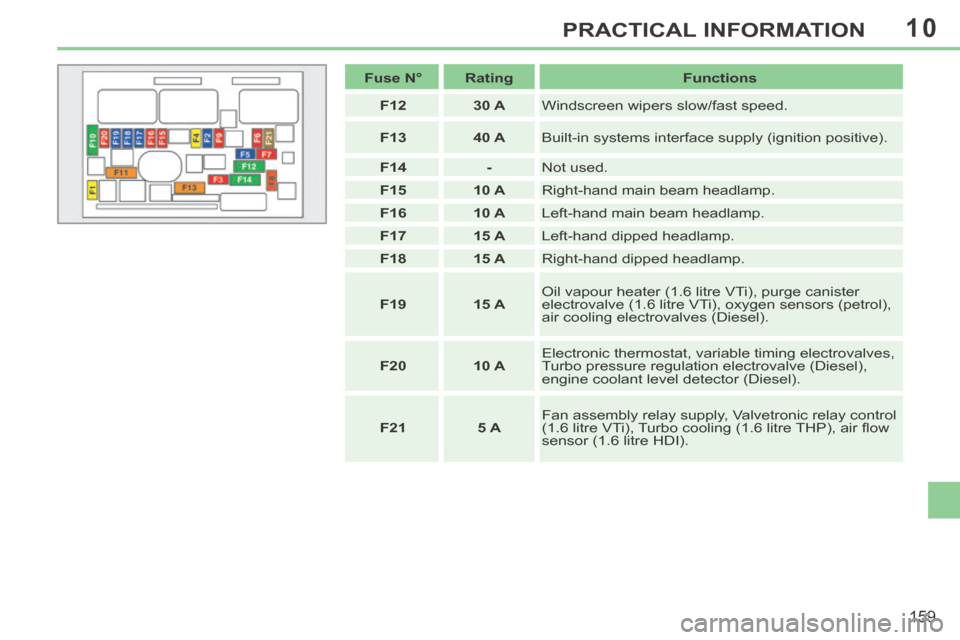
Engine compartment fuses
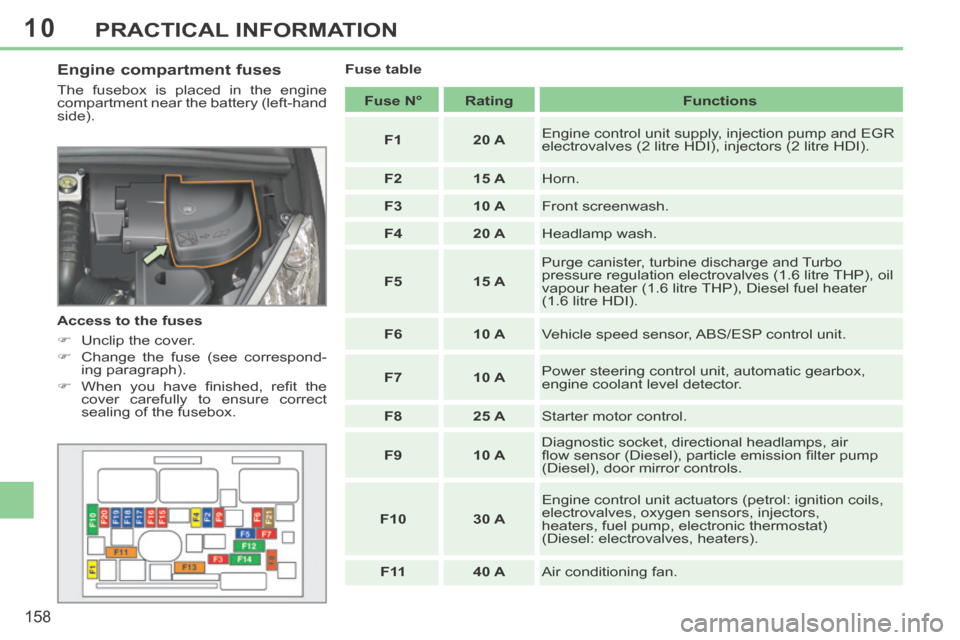
The fusebox is placed in the engine
compartment near the battery (left-hand
side).
Access to the fuses
Unclip the cover.
Change the fuse (see correspond-ing paragraph).
When you have fi nished, refi t the cover carefully to ensure correct
sealing of the fusebox. Fuse table
Fuse N° Rating Functions
F1 20 A Engine control unit supply, injection pump and EGR
electrovalves (2 litre HDI), injectors (2 litre HDI).
F2 15 A Horn.
F3 10 A Front screenwash.
F4 20 A Headlamp wash.
F5 15 A Purge canister, turbine discharge and Turbo
pressure regulation electrovalves (1.6 litre THP), oil
vapour heater (1.6 litre THP), Diesel fuel heater
(1.6 litre HDI).
F6 10 A Vehicle speed sensor, ABS/ESP control unit.
F7 10 A Power steering control unit, automatic gearbox,
engine coolant level detector.
F8 25 A Starter motor control.
F9 10 A Diagnostic socket, directional headlamps, air
fl ow sensor (Diesel), particle emission fi lter pump
(Diesel), door mirror controls.
F10 30 A Engine control unit actuators (petrol: ignition coils,
electrovalves, oxygen sensors, injectors,
heaters, fuel pump, electronic thermostat)
(Diesel: electrovalves, heaters).
F 11 40 A Air conditioning fan.
Page 161 of 268
10
159
PRACTICAL INFORMATION
Fuse N° Rating Functions
F12 30 A Windscreen wipers slow/fast speed.
F13 40 A Built-in systems interface supply (ignition positive).
F14 - Not used.
F15 10 A Right-hand main beam headlamp.
F16 10 A Left-hand main beam headlamp.
F17 15 A Left-hand dipped headlamp.
F18 15 A Right-hand dipped headlamp.
F19 15 A Oil vapour heater (1.6 litre VTi), purge canister
electrovalve (1.6 litre VTi), oxygen sensors (petrol),
air cooling electrovalves (Diesel).
F20 10 A Electronic thermostat, variable timing electrovalves,
Turbo pressure regulation electrovalve (Diesel),
engine coolant level detector (Diesel).
F21 5 A Fan assembly relay supply, Valvetronic relay control
(1.6 litre VTi), Turbo cooling (1.6 litre THP), air fl ow
sensor (1.6 litre HDI).
Page 163 of 268
10
!
i
i
!
161
PRACTICAL INFORMATION
12 V BATTERY
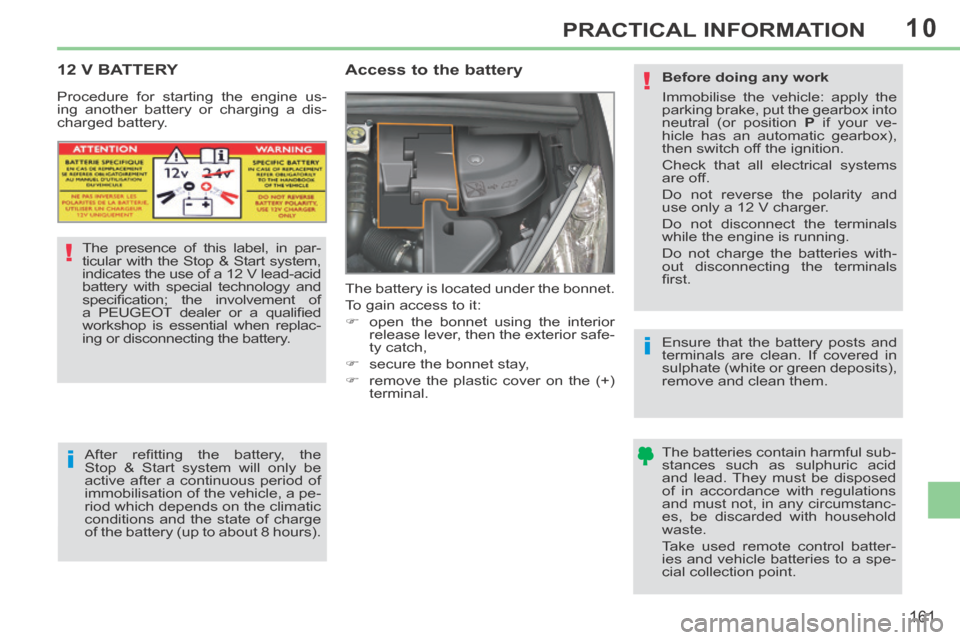
Access to the battery
The battery is located under the bonnet.
To gain access to it:
open the bonnet using the interior release lever, then the exterior safe-
ty catch,
secure the bonnet stay,
remove the plastic cover on the (+) terminal.
The presence of this label, in par-
ticular with the Stop & Start system,
indicates the use of a 12 V lead-acid
battery with special technology and
specifi cation; the involvement of
a PEUGEOT dealer or a qualifi ed
workshop is essential when replac-
ing or disconnecting the battery.
After refi tting the battery, the
Stop & Start system will only be
active after a continuous period of
immobilisation of the vehicle, a pe-
riod which depends on the climatic
conditions and the state of charge
of the battery (up to about 8 hours).
Procedure for starting the engine us-
ing another battery or charging a dis-
charged battery.
Before doing any work
Immobilise the vehicle: apply the
parking brake, put the gearbox into
neutral (or position
P if your ve-
hicle has an automatic gearbox),
then switch off the ignition.
Check that all electrical systems
are off.
Do not reverse the polarity and
use only a 12 V charger.
Do not disconnect the terminals
while the engine is running.
Do not charge the batteries with-
out disconnecting the terminals
fi rst.
Ensure that the battery posts and
terminals are clean. If covered in
sulphate (white or green deposits),
remove and clean them.
The batteries contain harmful sub-
stances such as sulphuric acid
and lead. They must be disposed
of in accordance with regulations
and must not, in any circumstanc-
es, be discarded with household
waste.
Take used remote control batter-
ies and vehicle batteries to a spe-
cial collection point.