wheel PEUGEOT 4007 2009.5. Owner's Manual
[x] Cancel search | Manufacturer: PEUGEOT, Model Year: 2009.5., Model line: 4007, Model: PEUGEOT 4007 2009.5.Pages: 230, PDF Size: 16.57 MB
Page 127 of 230
7
DRIVING
"Normal" automatic mode
Select position D .
"D" appears on the instrument panel
display.
The gearbox then operates in automatic
mode, without any action on the part of
the driver.
To optimise driving comfort and obtain
the most suitable gear, avoid sharp vari-
ations in the pressure on the accelerator
pedal.
"Temporary" manual mode
In the automatic mode, you can resume
control temporarily at any time using
the steering wheel controls.
The use of these controls permits man-
ual selection of the gears in situations
which require a faster changedown than
that offered in automatic mode (arrival
at a roundabout, exit from a car park
with a steep gradient, overtaking...).
The gearbox engages the gear re-
quested if the engine speed permits it.
The gear engaged appears.
To return to the automatic mode, press
the back of the "+/OFF" control for at
least 2 seconds. "Sport" automatic mode
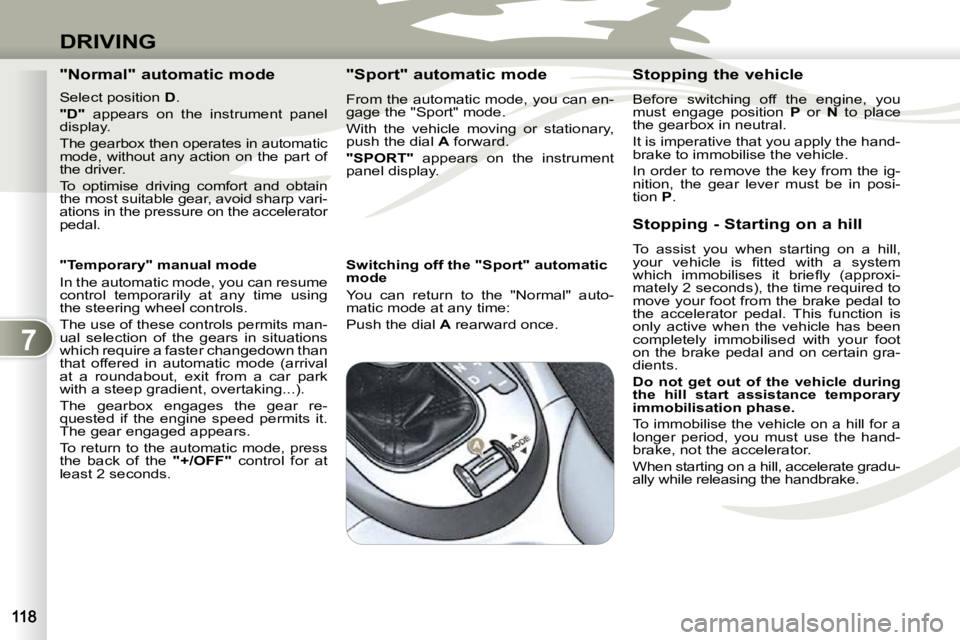
From the automatic mode, you can en-
gage the "Sport" mode.
With the vehicle moving or stationary,
push the dial
A forward.
"SPORT" appears on the instrument
panel display.
Switching off the "Sport" automatic
mode
You can return to the "Normal" auto-
matic mode at any time:
Push the dial A rearward once. Stopping the vehicle
Before switching off the engine, you
must engage position
P or N to place
the gearbox in neutral.
It is imperative that you apply the hand-
brake to immobilise the vehicle.
In order to remove the key from the ig-
nition, the gear lever must be in posi-
tion P .
Stopping - Starting on a hill
To assist you when starting on a hill,
your vehicle is fi tted with a system
which immobilises it briefl y (approxi-
mately 2 seconds), the time required to
move your foot from the brake pedal to
the accelerator pedal. This function is
only active when the vehicle has been
completely immobilised with your foot
on the brake pedal and on certain gra-
dients.
Do not get out of the vehicle during
the hill start assistance temporary
immobilisation phase.
To immobilise the vehicle on a hill for a
longer period, you must use the hand-
brake, not the accelerator.
When starting on a hill, accelerate gradu-
ally while releasing the handbrake.
Page 129 of 230
7
DRIVING
FOUR WHEEL DRIVE SYSTEM
WITH ELECTRONIC CONTROL
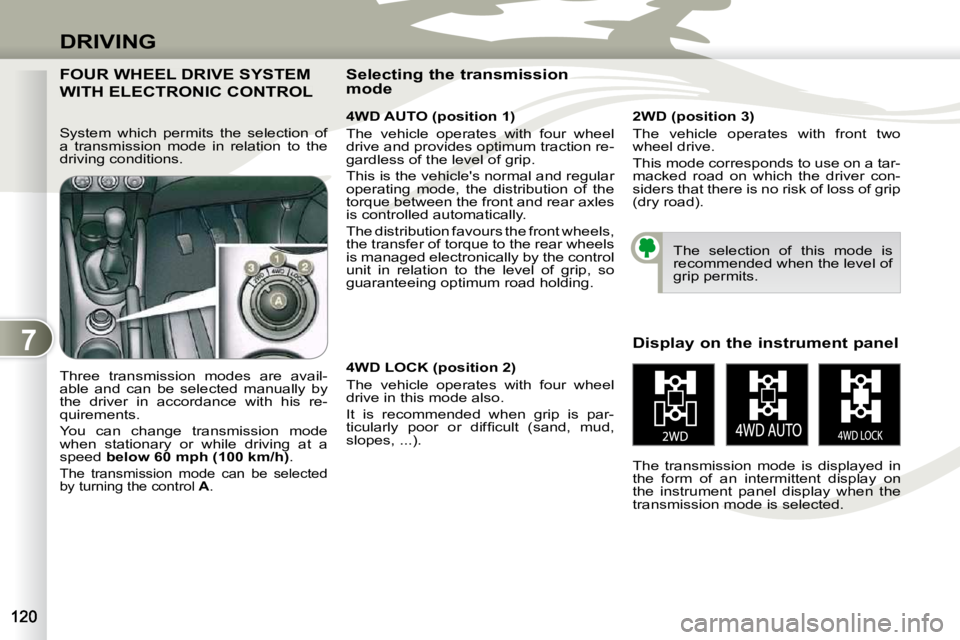
4WD AUTO (position 1)
The vehicle operates with four wheel
drive and provides optimum traction re-
gardless of the level of grip.
This is the vehicle's normal and regular
operating mode, the distribution of the
torque between the front and rear axles
is controlled automatically.
The distribution favours the front wheels,
the transfer of torque to the rear wheels
is managed electronically by the control
unit in relation to the level of grip, so
guaranteeing optimum road holding.
Three transmission modes are avail-
able and can be selected manually by
the driver in accordance with his re-
quirements.
You can change transmission mode
when stationary or while driving at a
speed below 60 mph (100 km/h) .
The transmission mode can be selected
by turning the control A .
Display on the instrument panel
The transmission mode is displayed in
the form of an intermittent display on
the instrument panel display when the
transmission mode is selected.
Selecting the transmission
mode
The selection of this mode is
recommended when the level of
grip permits.
2WD (position 3)
The vehicle operates with front two
wheel drive.
This mode corresponds to use on a tar-
macked road on which the driver con-
siders that there is no risk of loss of grip
(dry road).
4WD LOCK (position 2)
The vehicle operates with four wheel
drive in this mode also.
It is recommended when grip is par-
ticularly poor or diffi cult (sand, mud,
slopes, ...).
System which permits the selection of
a transmission mode in relation to the
driving conditions.
Page 130 of 230
7
DRIVING
Operating faults
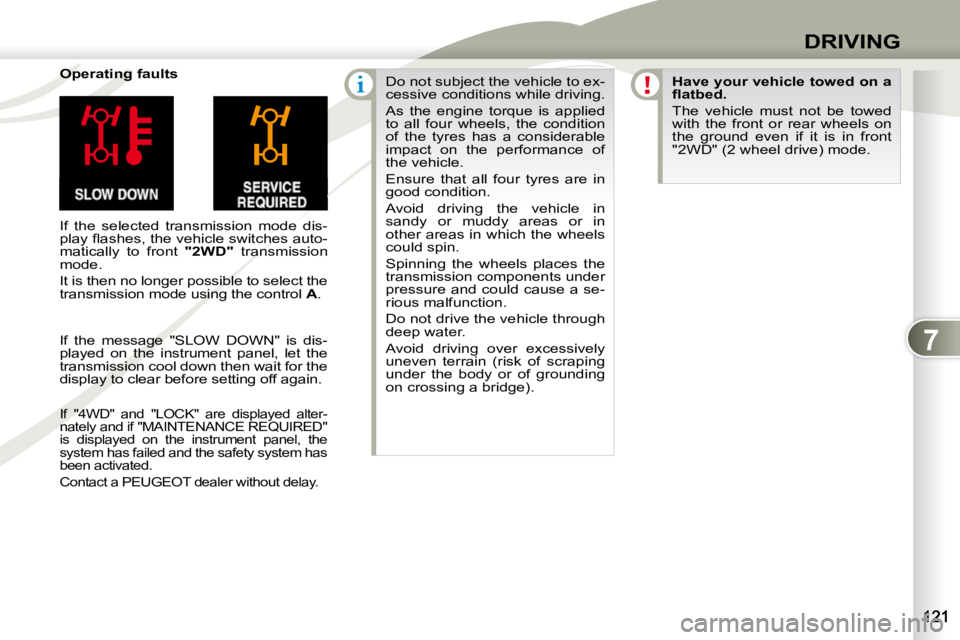
If the selected transmission mode dis-
play fl ashes, the vehicle switches auto-
matically to front "2WD" transmission
mode.
It is then no longer possible to select the
transmission mode using the control A . Do not subject the vehicle to ex-
cessive conditions while driving.
As the engine torque is applied
to all four wheels, the condition
of the tyres has a considerable
impact on the performance of
the vehicle.
Ensure that all four tyres are in
good condition.
Avoid driving the vehicle in
sandy or muddy areas or in
other areas in which the wheels
could spin.
Spinning the wheels places the
transmission components under
pressure and could cause a se-
rious malfunction.
Do not drive the vehicle through
deep water.
Avoid driving over excessively
uneven terrain (risk of scraping
under the body or of grounding
on crossing a bridge).
Have your vehicle towed on a
fl atbed.
The vehicle must not be towed
with the front or rear wheels on
the ground even if it is in front
"2WD" (2 wheel drive) mode.
If the message "SLOW DOWN" is dis-
played on the instrument panel, let the
transmission cool down then wait for the
display to clear before setting off again.
If "4WD" and "LOCK" are displayed alter-
nately and if "MAINTENANCE REQUIRED"
is displayed on the instrument panel, the
system has failed and the safety system has
been activated.
Contact a PEUGEOT dealer without delay.
Page 131 of 230
7
DRIVING
Programming
Press button 1 .
Set the programmed speed by ac-
celerating to the required speed,
then press button 2 "COAST SET" .
CRUISE CONTROL
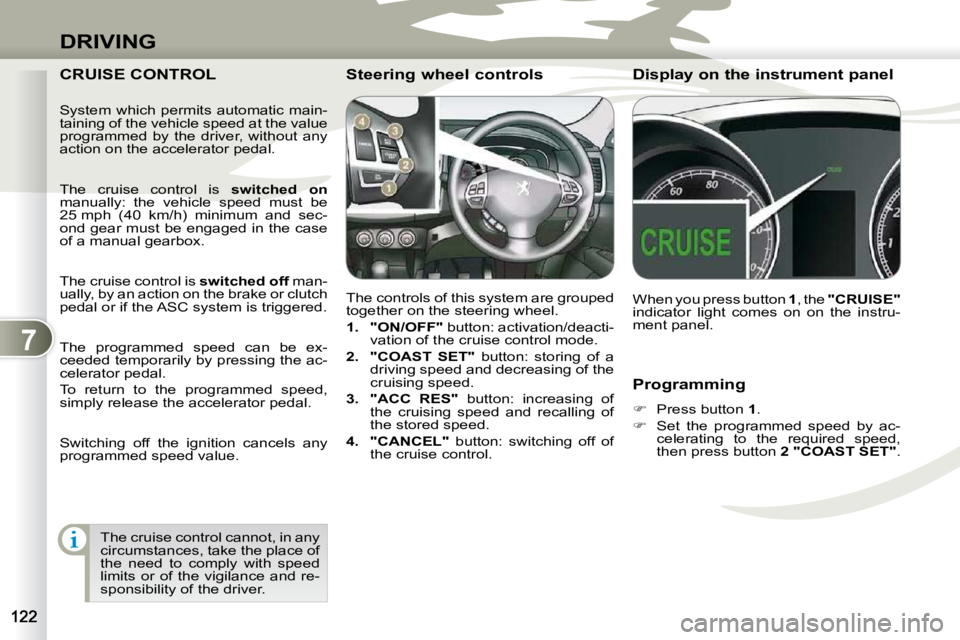
The controls of this system are grouped
together on the steering wheel.
1. "ON/OFF" button: activation/deacti-
vation of the cruise control mode.
2. "COAST SET" button: storing of a
driving speed and decreasing of the
cruising speed.
3. "ACC RES" button: increasing of
the cruising speed and recalling of
the stored speed.
4. "CANCEL" button: switching off of
the cruise control. When you press button
1 , the "CRUISE"
indicator light comes on on the instru-
ment panel.
Steering wheel controls Display on the instrument
panel
The cruise control cannot, in any
circumstances, take the place of
the need to comply with speed
limits or of the vigilance and re-
sponsibility of the driver.
System which permits automatic main-
taining of the vehicle speed at the value
programmed by the driver, without any
action on the accelerator pedal.
The cruise control is
switched on
manually: the vehicle speed must be
25 mph (40 km/h) minimum and sec-
ond gear must be engaged in the case
of a manual gearbox.
The cruise control is switched off man-
ually, by an action on the brake or clutch
pedal or if the ASC system is triggered.
The programmed speed can be ex-
ceeded temporarily by pressing the ac-
celerator pedal.
To return to the programmed speed,
simply release the accelerator pedal.
Switching off the ignition cancels any
programmed speed value.
Page 143 of 230
9
PRACTICAL INFORMATION
CHANGING A WHEEL CHANGING
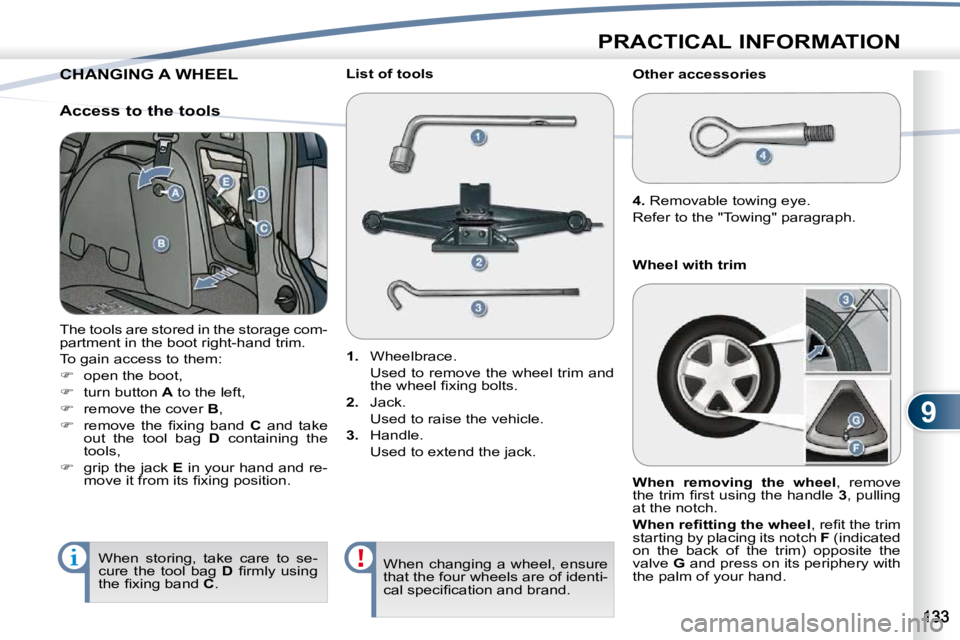
The tools are stored in the storage com-
partment in the boot right-hand trim.
To gain access to them:
open the boot,
turn button A to the left,
remove the cover B ,
remove the fi xing band C and take
out the tool bag D containing the
tools,
grip the jack E in your hand and re-
move it from its fi xing position.
1. Wheelbrace.
Used to remove the wheel trim and the wheel fi xing bolts.
2. Jack.
Used to raise the vehicle.
3. Handle.
Used to extend the jack.
List of tools
Other accessories
4. Removable towing eye.
Refer to the "Towing" paragraph.
Access to the tools
When changing a wheel, ensure
that the four wheels are of identi-
cal specifi cation and brand.
When storing, take care to se-
cure the tool bag
D fi rmly using
the fi xing band C .
When removing the wheel , remove
the trim fi rst using the handle 3 , pulling
at the notch.
When refi tting the wheel , refi t the trim
starting by placing its notch F (indicated
on the back of the trim) opposite the
valve G and press on its periphery with
the palm of your hand.
Wheel with trim
Page 144 of 230
9
PRACTICAL INFORMATION
Fixing the "space-saving"
spare wheel
If your vehicle is fi tted with alloy
wheels, it is normal to notice that
the washers do not come into
contact with the "space-saving"
spare wheel when tightening the
bolts on fi tting. The wheel is re-
tained by the conical contact of
each bolt.
Access to the spare wheel in
the 7 seat configuration
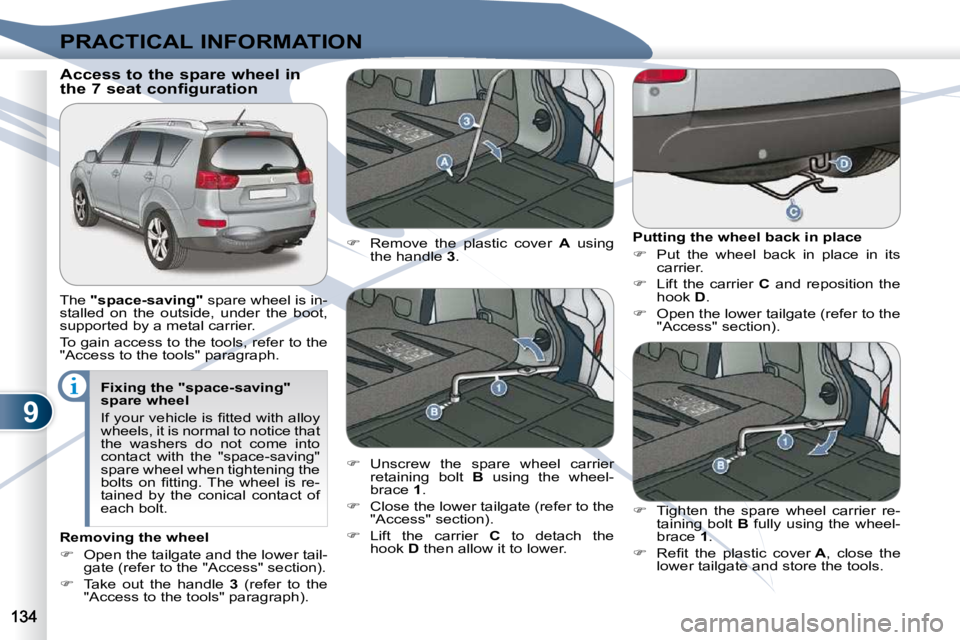
The "space-saving" spare wheel is in-
stalled on the outside, under the boot,
supported by a metal carrier.
To gain access to the tools, refer to the
"Access to the tools" paragraph. Putting the wheel back in place
Put the wheel back in place in its
carrier.
Lift the carrier C and reposition the
hook D .
Open the lower tailgate (refer to the
"Access" section).
Remove the plastic cover A using
the handle 3 .
Unscrew the spare wheel carrier
retaining bolt B using the wheel-
brace 1 .
Close the lower tailgate (refer to the
"Access" section).
Lift the carrier C to detach the
hook D then allow it to lower.
Tighten the spare wheel carrier re-
taining bolt B fully using the wheel-
brace 1 .
Refi t the plastic cover A , close the
lower tailgate and store the tools.
Removing the wheel
Open the tailgate and the lower tail-
gate (refer to the "Access" section).
Take out the handle 3 (refer to the
"Access to the tools" paragraph).
Page 145 of 230
9
PRACTICAL INFORMATION
Access to the spare wheel in
the 5 seat configuration
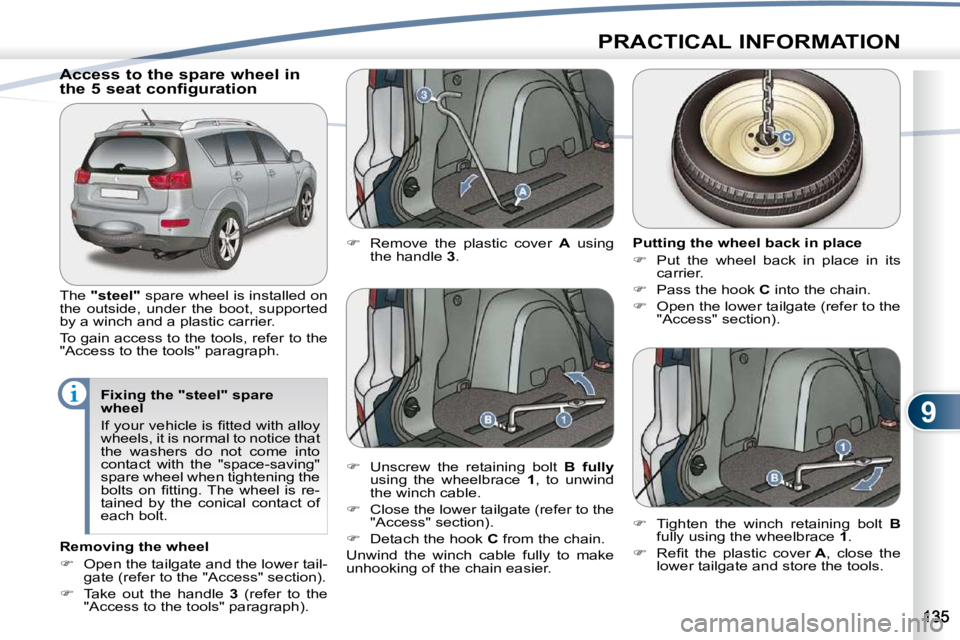
The "steel" spare wheel is installed on
the outside, under the boot, supported
by a winch and a plastic carrier.
To gain access to the tools, refer to the
"Access to the tools" paragraph.
Fixing the "steel" spare
wheel
If your vehicle is fi tted with alloy
wheels, it is normal to notice that
the washers do not come into
contact with the "space-saving"
spare wheel when tightening the
bolts on fi tting. The wheel is re-
tained by the conical contact of
each bolt.
Removing the wheel
Open the tailgate and the lower tail-
gate (refer to the "Access" section).
Take out the handle 3 (refer to the
"Access to the tools" paragraph).
Remove the plastic cover A using
the handle 3 . Putting the wheel back in place
Put the wheel back in place in its
carrier.
Pass the hook C into the chain.
Open the lower tailgate (refer to the
"Access" section).
Unscrew the retaining bolt B fully
using the wheelbrace 1 , to unwind
the winch cable.
Close the lower tailgate (refer to the
"Access" section).
Detach the hook C from the chain.
Unwind the winch cable fully to make
unhooking of the chain easier.
Tighten the winch retaining bolt B
fully using the wheelbrace 1 .
Refi t the plastic cover A , close the
lower tailgate and store the tools.
Page 146 of 230
9
PRACTICAL INFORMATION
Parking the vehicle
Immobilise the vehicle where it
does not block traffi c: if possible,
park the vehicle on level, stable
and non-slippery ground.
Apply the handbrake, switch
off the ignition and engage fi rst
gear to lock the wheels.
If necessary, place a chock under
the wheel diagonally opposite the
wheel to be changed.
Never go underneath a vehicle
raised using a jack; use a stand.
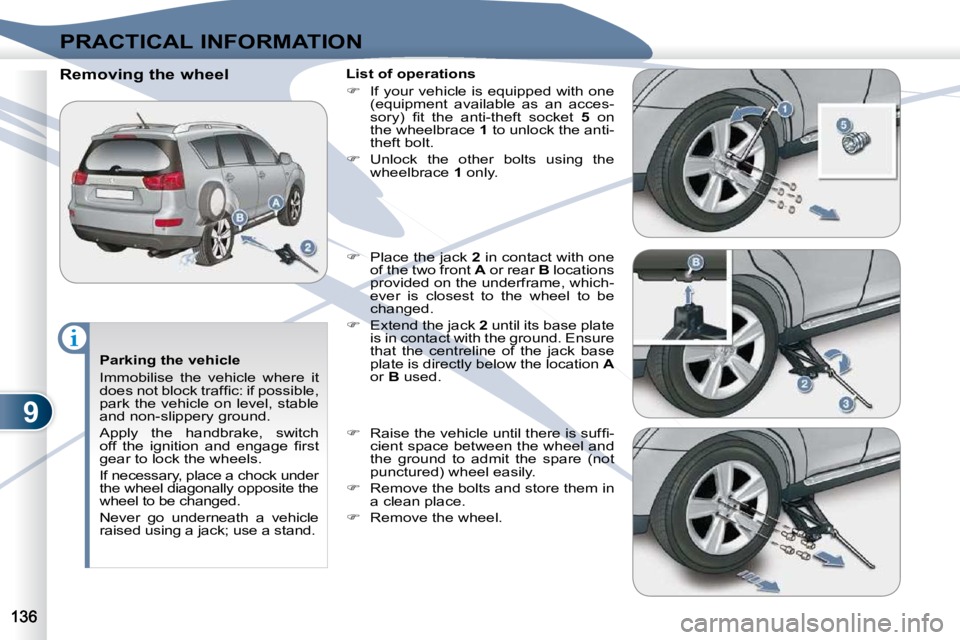
Removing the wheel
List of operations
If your vehicle is equipped with one
(equipment available as an acces-
sory) fi t the anti-theft socket 5 on
the wheelbrace 1 to unlock the anti-
theft bolt.
Unlock the other bolts using the
wheelbrace 1 only.
Place the jack 2 in contact with one
of the two front A or rear B locations
provided on the underframe, which-
ever is closest to the wheel to be
changed.
Extend the jack 2 until its base plate
is in contact with the ground. Ensure
that the centreline of the jack base
plate is directly below the location A
or B used.
Raise the vehicle until there is suffi -
cient space between the wheel and
the ground to admit the spare (not
punctured) wheel easily.
Remove the bolts and store them in
a clean place.
Remove the wheel.
Page 147 of 230
9
PRACTICAL INFORMATION
After changing a wheel
When using the "space-saving"
spare wheel, do not exceed a
speed of 50 mph (80 km/h).
Have the tightening of the bolts
and the pressure of the spare
wheel checked by a PEUGEOT
dealer without delay.
Have the punctured wheel re-
paired and replace it on the vehi-
cle as soon as possible.
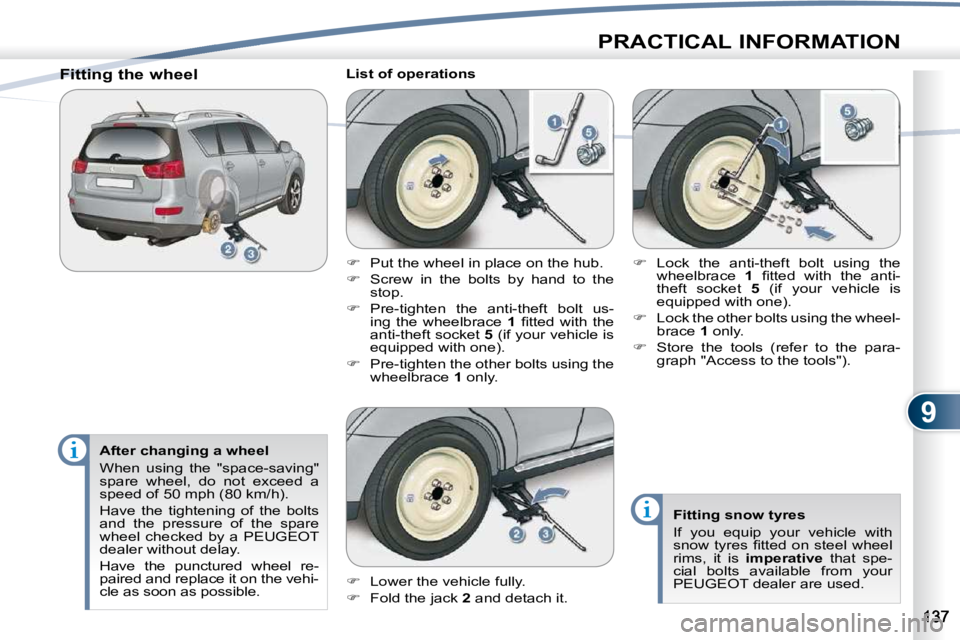
Fitting the wheel
List of operations
Lower the vehicle fully.
Fold the jack 2 and detach it.
Lock the anti-theft bolt using the
wheelbrace 1 fi tted with the anti-
theft socket 5 (if your vehicle is
equipped with one).
Lock the other bolts using the wheel-
brace 1 only.
Store the tools (refer to the para-
graph "Access to the tools").
Fitting snow tyres
If you equip your vehicle with
snow tyres fi tted on steel wheel
rims, it is imperative that spe-
cial bolts available from your
PEUGEOT dealer are used.
Put the wheel in place on the hub.
Screw in the bolts by hand to the
stop.
Pre-tighten the anti-theft bolt us-
ing the wheelbrace 1 fi tted with the
anti-theft socket 5 (if your vehicle is
equipped with one).
Pre-tighten the other bolts using the
wheelbrace 1 only.
Page 156 of 230
9
PRACTICAL INFORMATION
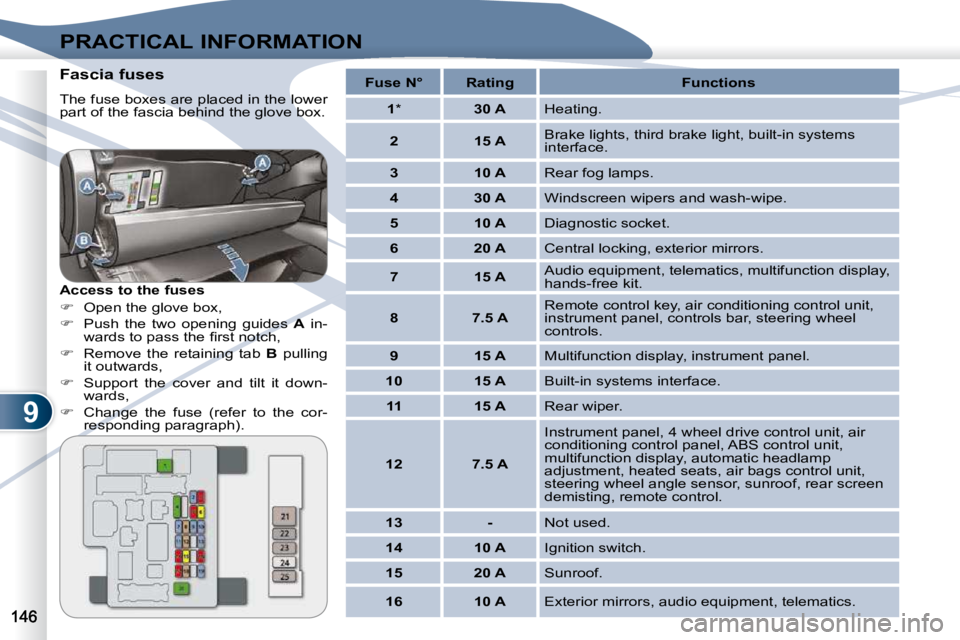
Fascia fuses
The fuse boxes are placed in the lower
part of the fascia behind the glove box.
Access to the fuses
Open the glove box,
Push the two opening guides A in-
wards to pass the fi rst notch,
Remove the retaining tab B pulling
it outwards,
Support the cover and tilt it down-
wards,
Change the fuse (refer to the cor-
responding paragraph).
Fuse N° Rating Functions
1 * 30 A Heating.
2 15 A Brake lights, third brake light, built-in systems
interface.
3 10 A Rear fog lamps.
4 30 A Windscreen wipers and wash-wipe.
5 10 A Diagnostic socket.
6 20 A Central locking, exterior mirrors.
7 15 A Audio equipment, telematics, multifunction display,
hands-free kit.
8 7.5 A Remote control key, air conditioning control unit,
instrument panel, controls bar, steering wheel
controls.
9 15 A Multifunction display, instrument panel.
10 15 A Built-in systems interface.
11 15 A Rear wiper.
12 7.5 A Instrument panel, 4 wheel drive control unit, air
conditioning control panel, ABS control unit,
multifunction display, automatic headlamp
adjustment, heated seats, air bags control unit,
steering wheel angle sensor, sunroof, rear screen
demisting, remote control.
13 - Not used.
14 10 A Ignition switch.
15 20 A Sunroof.
16 10 A Exterior mirrors, audio equipment, telematics.