air condition PEUGEOT 4008 2017 User Guide
[x] Cancel search | Manufacturer: PEUGEOT, Model Year: 2017, Model line: 4008, Model: PEUGEOT 4008 2017Pages: 368, PDF Size: 12.22 MB
Page 88 of 368
86
4008_en_Chap03_Ergonomie-et-confort_ed01-2016
5. Air conditioning On / Off
F Press button 5 to activate the air
conditioning.
th
e indicator lamp comes on.Personalisation of the Air
Conditioning On / Off function
this function is controlled automatically.
However, you can deactivate its automatic
control if you wish to activate or deactivate the
air conditioning at any time.
Changing the status
Press the Air Conditioning On / Off button for at
least 10 seconds.
When the status changes from active to
inactive, three bleeps are heard and the
indicator lamp flashes three times.
When the status changes from inactive to
active, two bleeps are heard and the indicator
lamp flashes three times.
Automatic control active
If the air distribution adjustment dial and the
air flow adjustment dial are placed in the
"A
u
t
O
" position, or if the temperature control
dial is set to the minimum temperature, the air
conditioning system is controlled automatically.
Automatic control inactive
the air conditioning system is no longer
controlled automatically.
ease of use and comfort
Page 89 of 368
87
4008_en_Chap03_Ergonomie-et-confort_ed01-2016
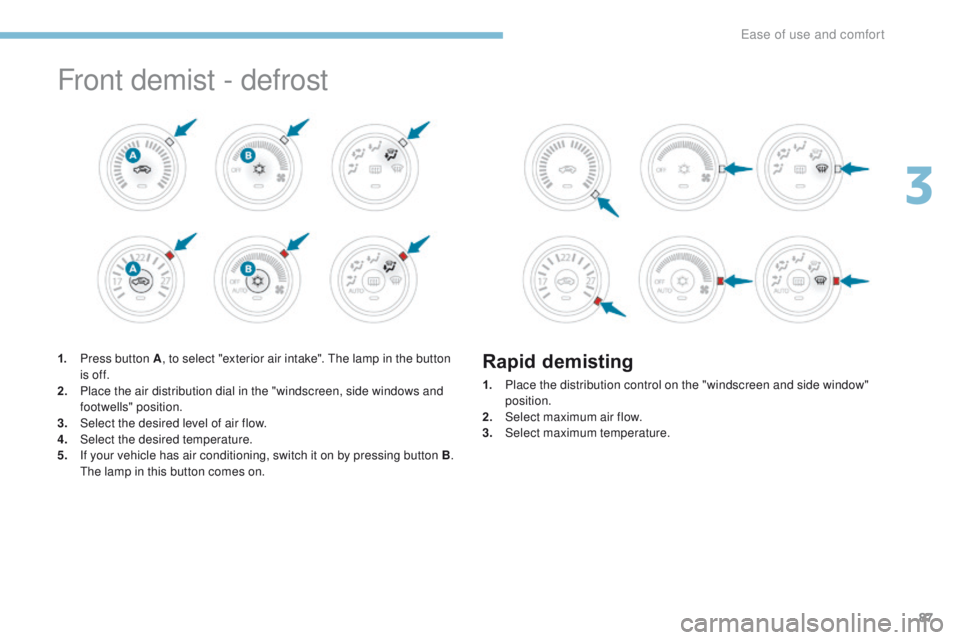
Front demist - defrost
1. Press button A, to select "exterior air intake". th e lamp in the button
is of f.
2.
P
lace the air distribution dial in the "windscreen, side windows and
footwells" position.
3.
S
elect the desired level of air flow.
4.
S
elect the desired temperature.
5.
I
f your vehicle has air conditioning, switch it on by pressing button B.
th
e lamp in this button comes on.Rapid demisting
1. Place the distribution control on the "windscreen and side window" position.
2.
Sel
ect maximum air flow.
3.
Sel
ect maximum temperature.
3
ease of use and comfort
Page 90 of 368
88
4008_en_Chap03_Ergonomie-et-confort_ed01-2016
Rear screen demist - defrost
Switching on
the rear screen demisting/defrosting can only
operate when the engine is running.
Switching off
the demisting/defrosting switches off
automatically to prevent an excessive
consumption of current.
F
I
t is possible to stop the demisting/
defrosting operation before it is switched
off automatically by pressing the button
again.
t
h
e indicator lamp associated with
the button goes off.
F
S
witch off the demisting/defrosting of the
rear screen and door mirrors as soon as
appropriate, as lower current consumption
results in reduced fuel consumption.
th
e control button is located on the air conditioning system control panel.
F
P
ress this button to demist /defrost
the rear screen and (depending
on version) the door mirrors.
t
h
e
indicator lamp associated with the
button comes on.
ease of use and comfort
Page 92 of 368
90
4008_en_Chap03_Ergonomie-et-confort_ed01-2016
Mat
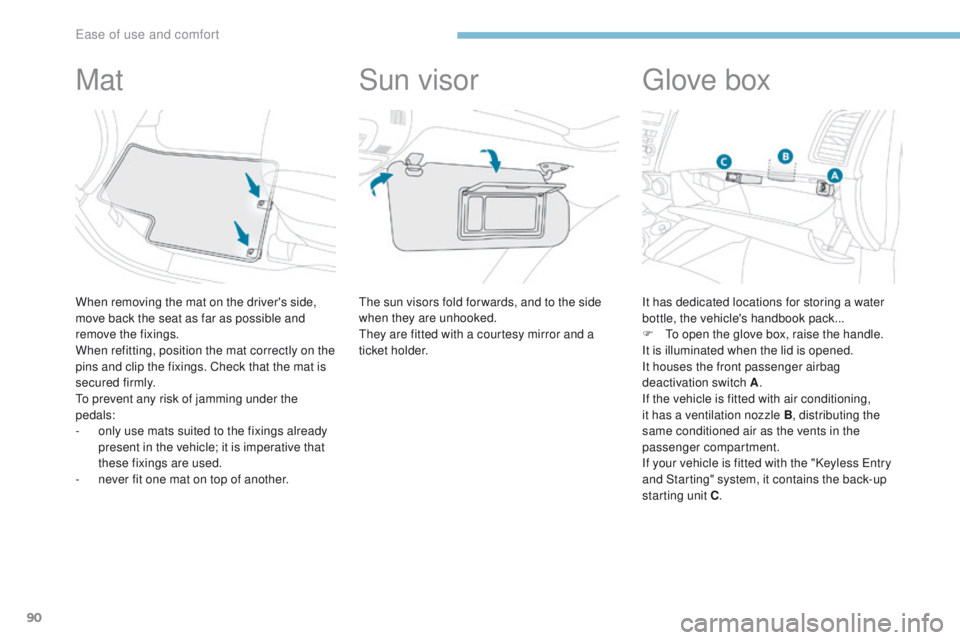
When removing the mat on the driver's side,
move back the seat as far as possible and
remove the fixings.
When refitting, position the mat correctly on the
pins and clip the fixings. Check that the mat is
secured firmly.
to p
revent any risk of jamming under the
pedals:
-
o
nly use mats suited to the fixings already
present in the vehicle; it is imperative that
these fixings are used.
-
n
ever fit one mat on top of another.
Sun visorgl ove box
It has dedicated locations for storing a water
bottle, the vehicle's handbook pack...
F
t
o o
pen the glove box, raise the handle.
It is illuminated when the lid is opened.
It houses the front passenger airbag
deactivation switch A .
If the vehicle is fitted with air conditioning,
it has a ventilation nozzle B , distributing the
same conditioned air as the vents in the
passenger compartment.
If your vehicle is fitted with the "Keyless
e
n
try
and Starting" system, it contains the back-up
starting unit C .th
e sun visors fold for wards, and to the side
when they are unhooked.
th
ey are fitted with a courtesy mirror and a
ticket holder.
ease of use and comfort
Page 117 of 368
115
4008_en_Chap04_conduite_ed01-2016
Under-inflation alert
the alert is given by the fixed
illumination of this warning lamp and
the display of a message.
F
R
educe speed immediately, avoid sudden
steering movements or harsh brake
applications.
F
S
top as soon as it is safe to do so.
th
e loss of pressure detected does not
always lead to visible deformation of the
tyre. Do not rely on just a visual check.
th
e alert is maintained until the
reference pressure is reinitialised after
the inflation, repair or replacement of
the tyres concerned. In the event of
the repair or replacement of tyres, the
sensor identifiers must be registered in
the system by a P
e
uge
Ot
dealer or a
qualified workshop.
th
e spare wheel does not have
a sensor, so there is no need to
reinitialise the system for driving with
the spare wheel fitted.
F
I f you have a compressor (the one in the
temporary puncture repair kit, for example),
check the four tyre pressures when cold.
I
f it is not possible to check the tyre
pressures immediately, drive carefully at
reduced speed.
or
F
I
n the event of a puncture, use the
temporary puncture repair kit or the spare
wheel (depending on equipment).
Reinitialising the reference
pressure
Before reinitialising the system, ensure
that the pressures in the four tyres are
suitable for the conditions of use of the
vehicle and are as specified on the tyre
pressure label.
th
e under-inflation detection system
cannot warn of an incorrect pressure at
the time of reinitialisation.
th
e system must be reinitialised after any
adjustment of tyre pressures and after
changing one or more wheels.
4
Driving
Page 129 of 368
127
4008_en_Chap05_Eclairage-et-visibilite_ed01-2016
Lighting controls
Stalk for selecting and switching the vehicle's
front and rear exterior lamps.Main lighting
the various front and rear lamps of the vehicle
are designed to adapt the lighting progressively
in relation to the climatic conditions and so
ensure the best visibility for the driver:
-
s
idelamps, to be seen,
-
d
ipped beam headlamps to see without
dazzling other drivers,
-
m
ain beam headlamps to see clearly when
the road is clear.
Additional lighting
Other lamps are provided to fulfil the
requirements of particular driving conditions:
-
a r
ear foglamp to be seen from a distance,
-
f
ront foglamps for even better visibility,
-
d
aytime running lamps to be seen during
t h e d ay.
In some weather conditions (e.g. low
temperature or humidity), the presence
of misting on the internal sur face of the
glass of the headlamps and rear lamps
is normal; it disappears after the lamps
have been on for a few minutes. Other lighting functions are also available:
-
a
utomatic illumination of
headlamps,
-
gu
ide-me-home lighting,
-
w
elcome lighting.
Travelling abroad
If using your vehicle in a country that
drives on the other side of the road, the
headlamps must be adjusted to avoid
dazzling on-coming drivers.
Contact a P
e
uge
Ot
dealer or a
qualified workshop.
5
Lighting and visibility
Page 134 of 368
132
4008_en_Chap05_Eclairage-et-visibilite_ed01-2016
exterior welcome lightingRemote switching on of the lighting makes your approach to the vehicle easier in poor light.
It comes on when the vehicle is unlocked remotely.
Switching on
F Place the lighting control in position "OFF" or "Au tO ".
F
P
ress the open padlock on the
remote control or the electronic
key.
t
h
e sidelamps come on for about
30 seconds. For vehicles fitted
with automatic illumination of
headlamps, the welcome lighting
only comes on under conditions
of low ambient light.
Switching off
the welcome lighting goes off immediately if:
- y ou press the open padlock on the remote
control,
-
y
ou place the lighting control in another
position,
-
y
ou switch on the ignition (or select "ON"
mode for vehicles fitted with the "Keyless
en
try and Starting" system).
Lighting and visibility
Page 136 of 368
134
4008_en_Chap05_Eclairage-et-visibilite_ed01-2016
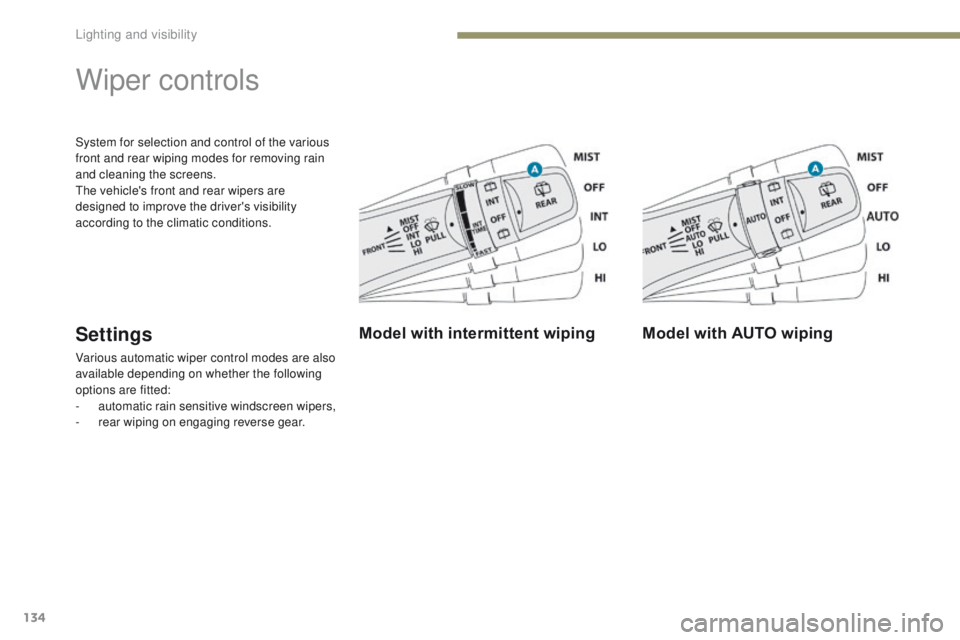
System for selection and control of the various
front and rear wiping modes for removing rain
and cleaning the screens.
th
e vehicle's front and rear wipers are
designed to improve the driver's visibility
according to the climatic conditions.
Wiper controls
Settings
Various automatic wiper control modes are also
available depending on whether the following
options are fitted:
-
a
utomatic rain sensitive windscreen wipers,
-
r
ear wiping on engaging reverse gear.
Model with intermittent wiping Model with AUTO wiping
Lighting and visibility
Page 153 of 368
151
4008_en_Chap06_securite_ed01-2016
Airbags
General information
System designed to contribute towards
improving the safety of the occupants (with
the exception of the rear centre passenger)
in the event of violent collisions. t
h
e airbags
supplement the action of the seat belts fitted
with force limiters (all except the centre rear
passenger belt).
If a collision occurs, the electronic detectors
record and analyse the front and side impacts
sustained in the impact detection zones:
-
i
n the case of a serious impact, the airbags
are deployed instantly and contribute
towards better protection of the occupants
of the vehicle (with the exception of the
rear centre passenger); immediately after
the impact, the airbags deflate rapidly so
that they do not hinder visibility or the exit
of the occupants,
-
i
n the case of a minor or rear impact or in
certain roll-over conditions, the airbags
may not be deployed; the seat belt
alone contributes towards ensuring your
protection in these situations.
The airbags do not operate when the
ignition is switched off.
th
is equipment will only deploy once.
If a second impact occurs (during the
same or a subsequent accident), the
airbag will not be deployed again. Deployment of one or more of the
airbags is accompanied by a slight
emission of smoke and a noise, due
to the activation of the pyrotechnic
cartridge incorporated in the system.
th
is smoke is not harmful, but sensitive
individuals may experience slight
irritation.
th
e noise of detonation associated with
the deployment of one or more airbags
may result in a slight loss of hearing for
a short time.
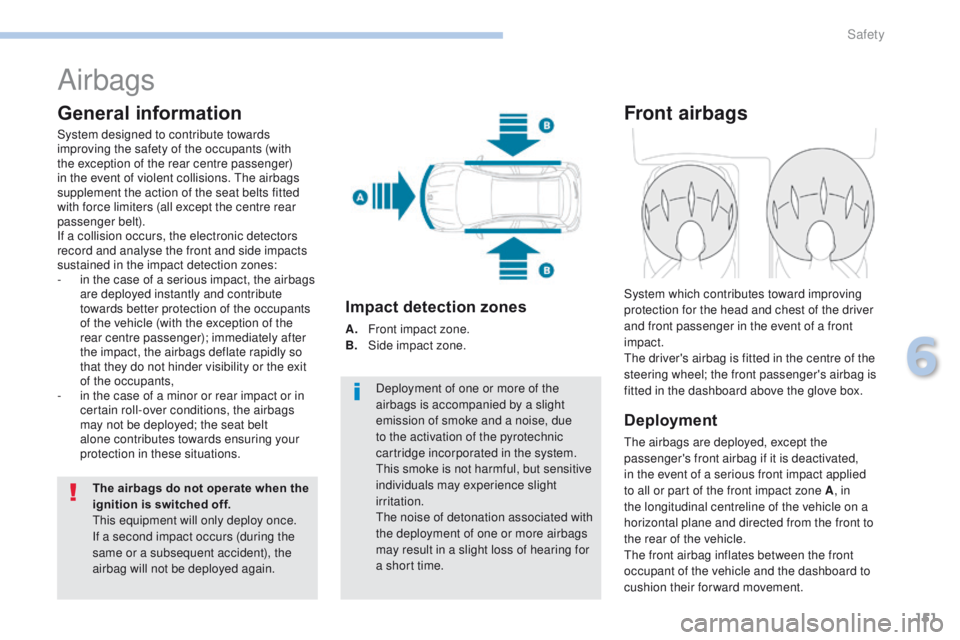
Impact detection zones
A. Front impact zone.
B. S ide impact zone.
Front airbags
Deployment
the airbags are deployed, except the
passenger's front airbag if it is deactivated,
in the event of a serious front impact applied
to all or part of the front impact zone A , in
the longitudinal centreline of the vehicle on a
horizontal plane and directed from the front to
the rear of the vehicle.
th
e front airbag inflates between the front
occupant of the vehicle and the dashboard to
cushion their forward movement. System which contributes toward improving
protection for the head and chest of the driver
and front passenger in the event of a front
impact.
th
e driver's airbag is fitted in the centre of the
steering wheel; the front passenger's airbag is
fitted in the dashboard above the glove box.
6
Safety
Page 188 of 368
186
4008_en_Chap07_info-pratiques_ed01-2016
Checking components
12 V battery
Electrolyte level
For access to the 12 V Battery, refer
to the corresponding section. Refer to the warranty and
maintenance record for details of
the replacement intervals for these
components.
Air filter and passenger compartment filter
Replace the oil filter each time the
engine oil is changed.
Refer to the warranty and
maintenance record for details of
the replacement interval for this
component.
Oil filter
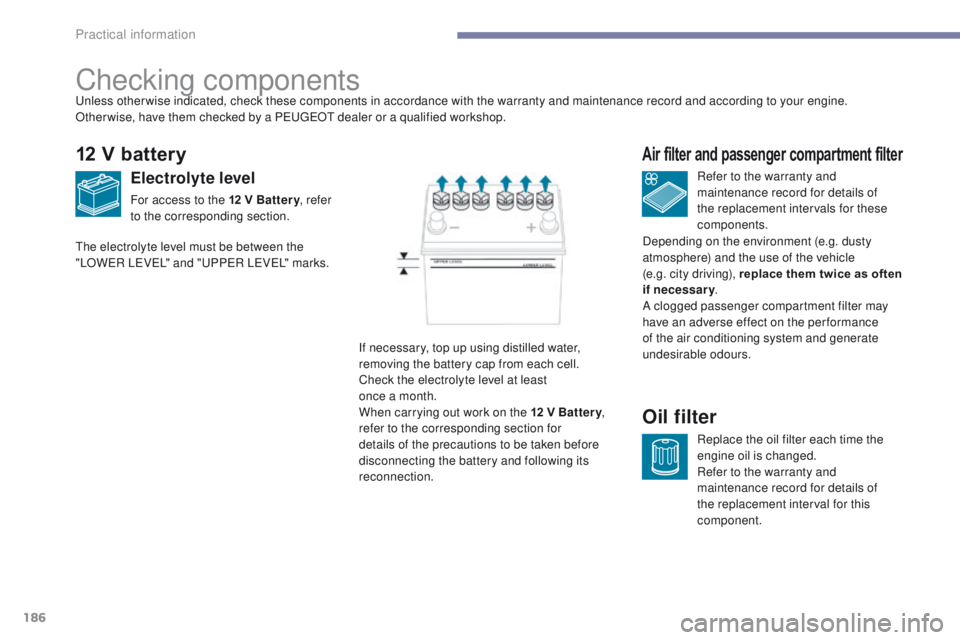
If necessary, top up using distilled water,
removing the battery cap from each cell.
Check the electrolyte level at least
once a month.
When carrying out work on the 12 V Battery
,
refer to the corresponding section for
details of the precautions to be taken before
disconnecting the battery and following its
reconnection.
un
less other wise indicated, check these components in accordance with the warranty and maintenance record and according to your engine.
Other wise, have them checked by a P
e
uge
Ot
dealer or a qualified workshop.
th
e electrolyte level must be between the
"LOW
eR LeVeL
" and "
uP
P
eR LeVeL
" marks.
Depending on the environment (e.g. dusty
atmosphere) and the use of the vehicle
(e.g. city driving), replace them twice as often
if necessary
.
A clogged passenger compartment filter may
have an adverse effect on the per formance
of the air conditioning system and generate
undesirable odours.
Practical information