gearbox PEUGEOT 4008 2017 Owner's Manual
[x] Cancel search | Manufacturer: PEUGEOT, Model Year: 2017, Model line: 4008, Model: PEUGEOT 4008 2017Pages: 368, PDF Size: 12.22 MB
Page 122 of 368
120
4008_en_Chap04_conduite_ed01-2016
Cruise control
System which automatically maintains the vehicle speed at the value programmed by the driver, without any action on the accelerator pedal.
th
e cruise control is switched on manually:
the vehicle speed must be at least 25 mph
(40 km/h) and second gear or higher must be
engaged in the case of a manual gearbox.
th
e cruise control is switched off manually, by
an action on the brake or clutch pedal or if the
ASC system is triggered.
th
e programmed speed can be exceeded
temporarily by pressing the accelerator pedal.
th
e cruise control cannot, in any
circumstances, take the place of the
need to comply with speed limits or of
the vigilance of the driver.
th
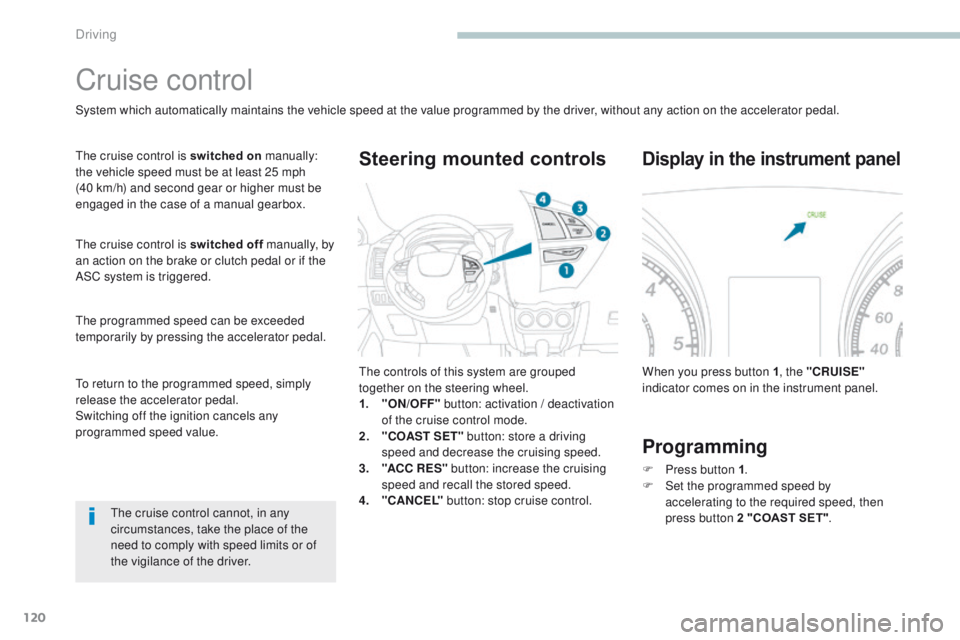
e controls of this system are grouped
together on the steering wheel.
1.
"
ON/OFF" button: activation / deactivation
of the cruise control mode.
2.
"
COAST SET" button: store a driving
speed and decrease the cruising speed.
3.
"A
CC R ES" button: increase the cruising
speed and recall the stored speed.
4.
"C
ANCEL" button: stop cruise control.
Steering mounted controls
When you press button 1 , the "CRUISE"
indicator comes on in the instrument panel.
Display in the instrument panel
Programming
F Press button 1 .
F S et the programmed speed by
accelerating
to the required speed, then
press button 2 "COAST SET" .
to r
eturn to the programmed speed, simply
release the accelerator pedal.
Switching off the ignition cancels any
programmed speed value.
Driving
Page 127 of 368
125
4008_en_Chap04_conduite_ed01-2016
Visual assistance
Front parking sensors
Deactivation / Activation of the
front and rear parking sensors
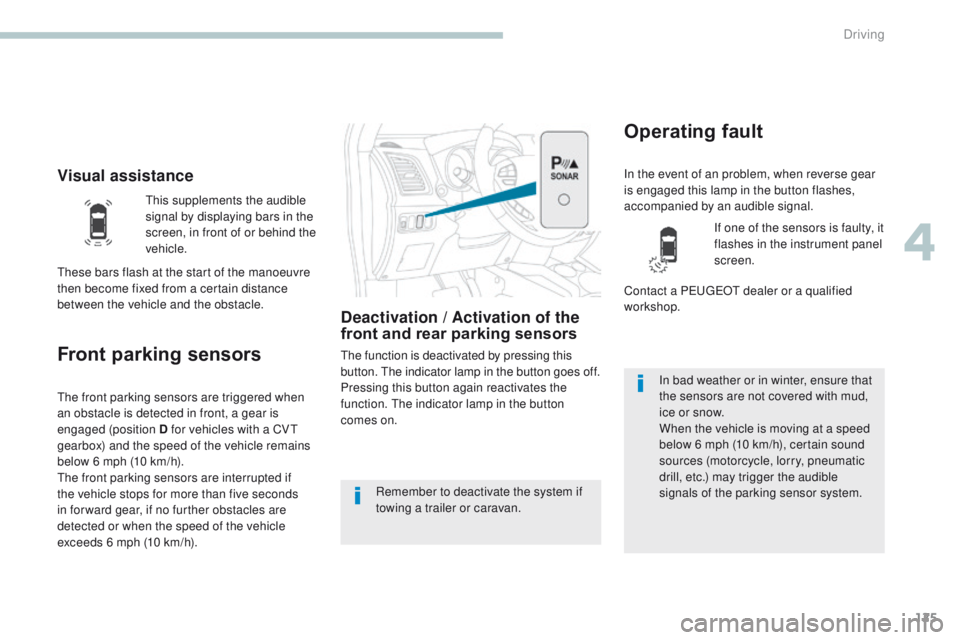
the function is deactivated by pressing this
button. th e indicator lamp in the button goes off.
Pressing this button again reactivates the
function.
t
h
e indicator lamp in the button
comes on.
Operating fault
the front parking sensors are triggered when
an obstacle is detected in front, a gear is
engaged (position D for vehicles with a CV
t
gearbox) and the speed of the vehicle remains
below 6 mph (10 km/h).
th
e front parking sensors are interrupted if
the vehicle stops for more than five seconds
in for ward gear, if no further obstacles are
detected or when the speed of the vehicle
exceeds 6 mph (10 km/h). Remember to deactivate the system if
towing a trailer or caravan.In bad weather or in winter, ensure that
the sensors are not covered with mud,
ice or snow.
When the vehicle is moving at a speed
below 6 mph (10 km/h), certain sound
sources (motorcycle, lorry, pneumatic
drill, etc.) may trigger the audible
signals of the parking sensor system.
In the event of an problem, when reverse gear
is engaged this lamp in the button flashes,
accompanied by an audible signal.
th
is supplements the audible
signal by displaying bars in the
screen, in front of or behind the
vehicle. If one of the sensors is faulty, it
flashes in the instrument panel
screen.
Contact a P
e
uge
Ot
dealer or a qualified
workshop.
th
ese bars flash at the start of the manoeuvre
then become fixed from a certain distance
between the vehicle and the obstacle.
4
Driving
Page 189 of 368
187
4008_en_Chap07_info-pratiques_ed01-2016
Manual gearbox
Refer to the warranty and
maintenance record for servicing of
the gearbox.
"CVT" gearbox
For servicing of the "CVt" gearbox,
refer to the manufacturer's service
schedule for details of the interval for
checking this component.
Particle filter (Diesel)
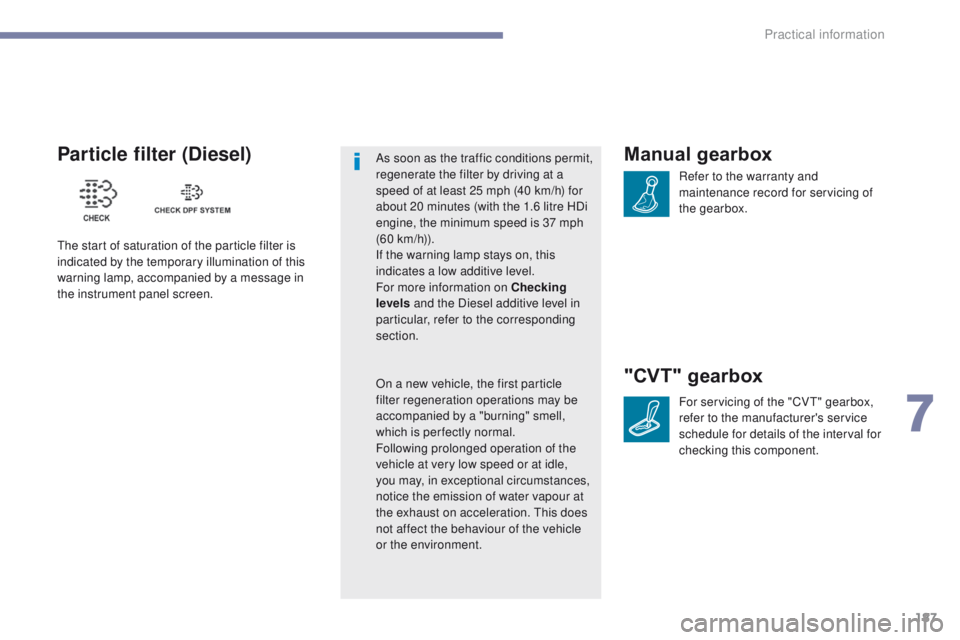
the start of saturation of the particle filter is
indicated by the temporary illumination of this
warning lamp, accompanied by a message in
the instrument panel screen. As soon as the traffic conditions permit,
regenerate the filter by driving at a
speed of at least 25 mph (40 km/h) for
about 20 minutes (with the 1.6 litre HDi
engine, the minimum speed is 37 mph
(60 km/h)).
If the warning lamp stays on, this
indicates a low additive level.
For more information on Checking
levels
and the Diesel additive level in
particular, refer to the corresponding
section.
On a new vehicle, the first particle
filter regeneration operations may be
accompanied by a "burning" smell,
which is per fectly normal.
Following prolonged operation of the
vehicle at very low speed or at idle,
you may, in exceptional circumstances,
notice the emission of water vapour at
the exhaust on acceleration.
t
h
is does
not affect the behaviour of the vehicle
or the environment.
7
Practical information
Page 192 of 368
190
4008_en_Chap08_en-cas-de panne_ed01-2016
After repairing the tyre, the speed
restriction sticker should be affixed
to the centre of the vehicle's steering
wheel to remind you that this wheel
must only be used temporarily.
Do not exceed a speed of 50 mph
(80
km/h) when driving with a tyre
repaired using this type of kit.
Repair procedure
F Stop the vehicle in as safe a location as possible and on a level and stable sur face.
e
n
sure that the tyre valve is not at the
bottom of the wheel, in contact with the
ground.
F
A
pply the parking brake.
F
P
lace the gear lever in position R for
vehicles with a manual gearbox, or in
position P for vehicles with a CV
t
gearbox.
F
S
witch off the ignition.
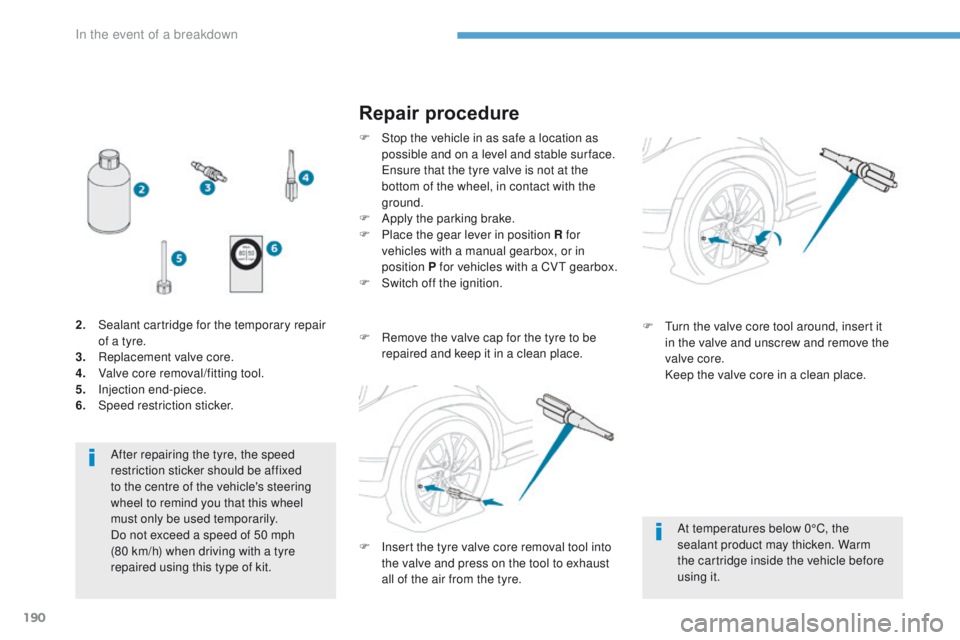
2.
S
ealant cartridge for the temporary repair
of a tyre.
3.
R
eplacement valve core.
4.
V
alve core removal/fitting tool.
5.
I
njection end-piece.
6.
Spe
ed restriction sticker. F
R
emove the valve cap for the tyre to be
repaired and keep it in a clean place.
At temperatures below 0°C, the
sealant product may thicken. Warm
the cartridge inside the vehicle before
using it.
F
t
u
rn the valve core tool around, insert it
in the valve and unscrew and remove the
valve core.
K
eep the valve core in a clean place.
F
I
nsert the tyre valve core removal tool into
the valve and press on the tool to exhaust
all of the air from the tyre.
In the event of a breakdown
Page 213 of 368
211
4008_en_Chap08_en-cas-de panne_ed01-2016
12 V battery
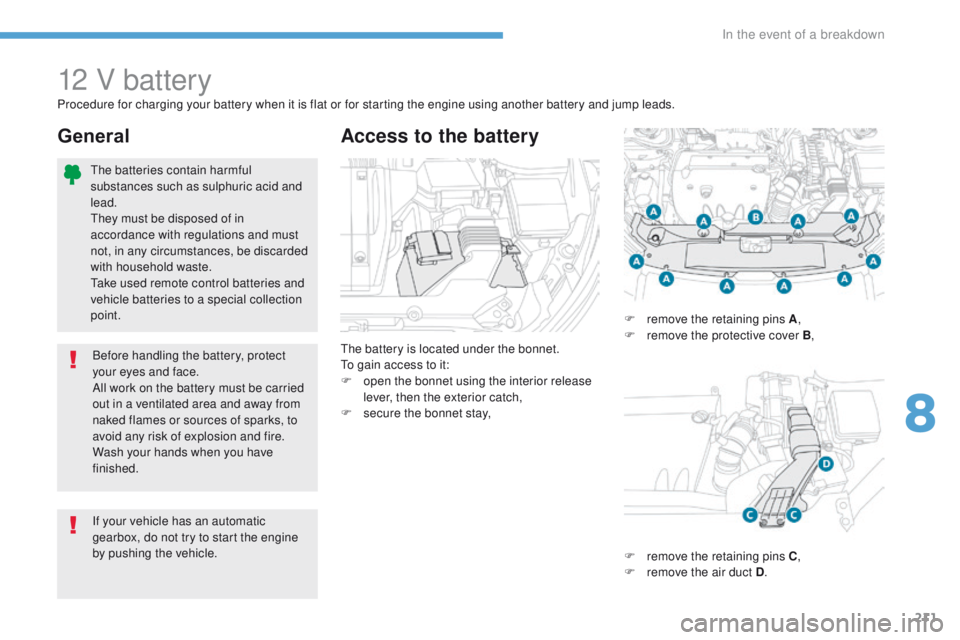
the battery is located under the bonnet.to g
ain access to it:
F
o
pen the bonnet using the interior release
lever, then the exterior catch,
F
s
ecure the bonnet stay,
Access to the battery
Procedure for charging your battery when it is flat or for starting the engine using another battery and jump leads.
F
r
emove the retaining pins A,
F
r
emove the protective cover B,
F
r
emove the retaining pins C,
F
r
emove the air duct D.
General
If your vehicle has an automatic
gearbox, do not try to start the engine
by pushing the vehicle.
th
e batteries contain harmful
substances such as sulphuric acid and
lead.
th
ey must be disposed of in
accordance with regulations and must
not, in any circumstances, be discarded
with household waste.
ta
ke used remote control batteries and
vehicle batteries to a special collection
point.
Before handling the battery, protect
your eyes and face.
All work on the battery must be carried
out in a ventilated area and away from
naked flames or sources of sparks, to
avoid any risk of explosion and fire.
Wash your hands when you have
finished.
8
In the event of a breakdown
Page 216 of 368
214
4008_en_Chap08_en-cas-de panne_ed01-2016
Do not invert the polarities and use only a 12 V charger.
Do not disconnect the terminals while the engine is running.
Do not charge the batteries without disconnecting the terminals first.
Do not push the vehicle to start the engine if it is fitted with a CV
t
gearbox.
Disconnecting the battery
to maintain a sufficient level of charge
to start the engine, it is advisable to
disconnect the battery if the vehicle is not
going to be used for a very long period.
Before disconnecting the battery:
F
C
lose all the doors and windows, the
tailgate and the roof.
F
S
witch off all power-consuming
equipment (audio system, wipers,
lamps, etc.).
F
S
witch off the ignition and wait
4
minutes.
Once you have gained access to the
battery, start by disconnecting the (-)
terminal.
Following reconnection of the
battery
Following reconnection of the battery,
switch on the ignition and wait 1 minute
before starting to permit initialisation of the
electronic systems.
However, if problems remain following this
operation, contact a P
e
uge
Ot
dealer or a
qualified workshop.
Referring to the corresponding section, you
must reinitialise certain equipment yourself,
such as:
-
t
h
e remote control key or the electronic
key (depending on version).
-
t
h
e electric blind(s).
-
t
h
e electric windows.
-
t
h
e date and time.
-
t
h
e stored radio stations. Some functions are not available if the
battery is not sufficiently charged.
Never try to charge a frozen battery.
If the battery has been frozen, have it
checked by a Pe
ugeOt dealer or a
qualified workshop, who will check that
the internal components have not been
damaged and the casing is not cracked,
which could cause a leak of toxic and
corrosive acid.
th
e Stop & Start system may not be
operational during the trip following the
first engine start.
In this case, the system will only be
available again after a continuous
period of immobilisation of the vehicle,
a period which depends on the exterior
temperature and the state of charge of
the battery (up to about 8 hours).
In the event of a breakdown
Page 217 of 368
215
4008_en_Chap08_en-cas-de panne_ed01-2016
towing the vehicle
Towing your vehicle
2 wheel drive (2WD) versions: towing
with the wheels on the ground
General recommendations
towing with the wheels on the ground
is only possible on 2 wheel drive (2WD)
versions.
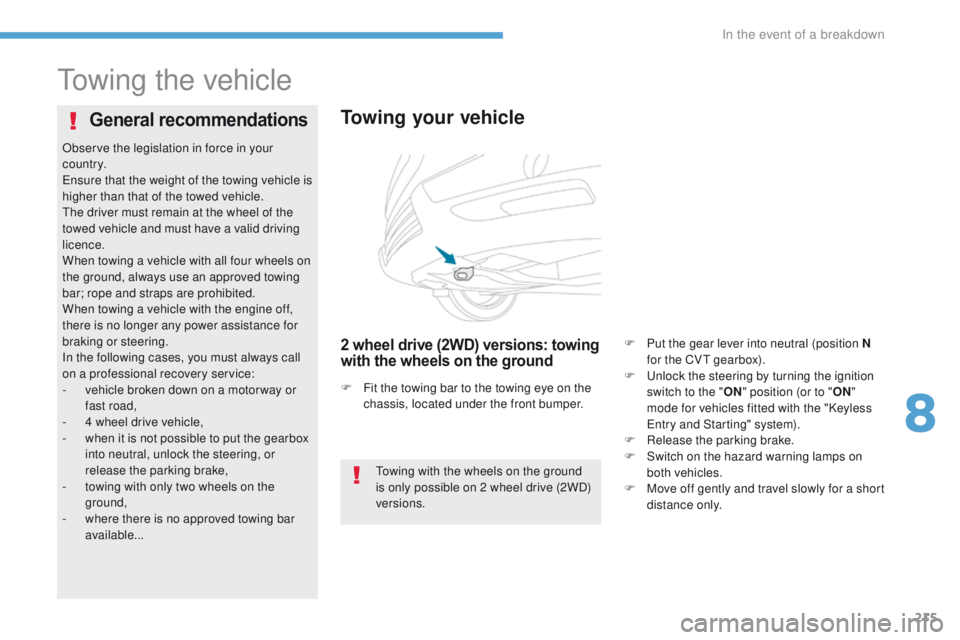
F
F
it the towing bar to the towing eye on the
chassis, located under the front bumper.
Observe the legislation in force in your
c o unt r y.
en
sure that the weight of the towing vehicle is
higher than that of the towed vehicle.
th
e driver must remain at the wheel of the
towed vehicle and must have a valid driving
licence.
When towing a vehicle with all four wheels on
the ground, always use an approved towing
bar; rope and straps are prohibited.
When towing a vehicle with the engine off,
there is no longer any power assistance for
braking or steering.
In the following cases, you must always call
on a professional recovery service:
-
v
ehicle broken down on a motor way or
fast road,
-
4 w
heel drive vehicle,
-
w
hen it is not possible to put the gearbox
into neutral, unlock the steering, or
release the parking brake,
-
t
owing with only two wheels on the
ground,
-
w
here there is no approved towing bar
available... F
P
ut the gear lever into neutral (position N
for the CV
t
gearbox).
F u
n
lock the steering by turning the ignition
switch to the " ON" position (or to " ON"
mode for vehicles fitted with the "Keyless
en
try and Starting" system).
F
R
elease the parking brake.
F S witch on the hazard warning lamps on
both vehicles.
F
M
ove off gently and travel slowly for a short
distance only.
8
In the event of a breakdown
Page 221 of 368
219
4008_en_Chap09_caracteristiques-techniques_ed01-2016
* the maximum power corresponds to the value type-approved on a test bed, under conditions defined in eu ropean legislation
(Directive 1999/99/eC ).
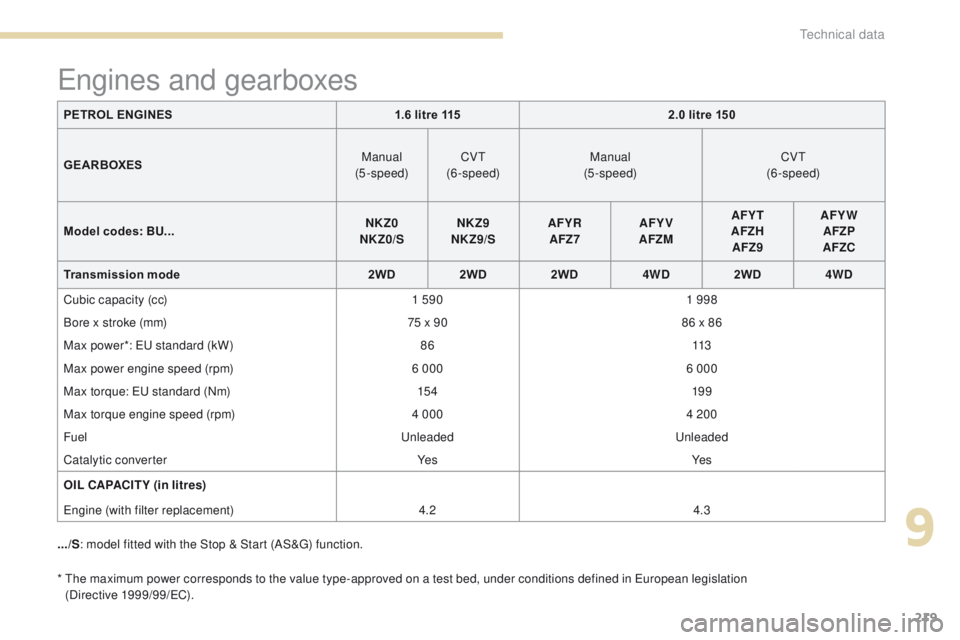
engines and gearboxes
.../S: model fitted with the Stop & Start (AS&g) f unction.
PETROL ENGINES
1.6 litre 1152.0 litre 150
GEARBOXES Manual
(5-speed) CV
t(
6-speed)
Manual
(5-speed) CV
t(
6-speed)
Model codes : BU... NKZ0
NKZ0/S NKZ9
NKZ9/S AFYR
AFZ7 AFYV
AFZM AFYT
AFZH AFZ9 AFYW
AFZP
AFZC
Transmission mode 2WD2WD2WD 4WD2WD 4WD
Cubic capacity (cc) 1 5901 998
Bore x stroke (mm) 75 x 9086 x 86
Max power*: eu standard (kW)
86 113
Max power engine speed (rpm) 6 0006 000
Max torque: eu standard (Nm)
15 4 19 9
Max torque engine speed (rpm) 4 0004 200
Fuel
u
nleaded
u
nleaded
Catalytic converter Ye sYe s
OIL CAPACITY (in litres)
eng
ine (with filter replacement)
4.24.3
9
technical data
Page 223 of 368
221
4008_en_Chap09_caracteristiques-techniques_ed01-2016
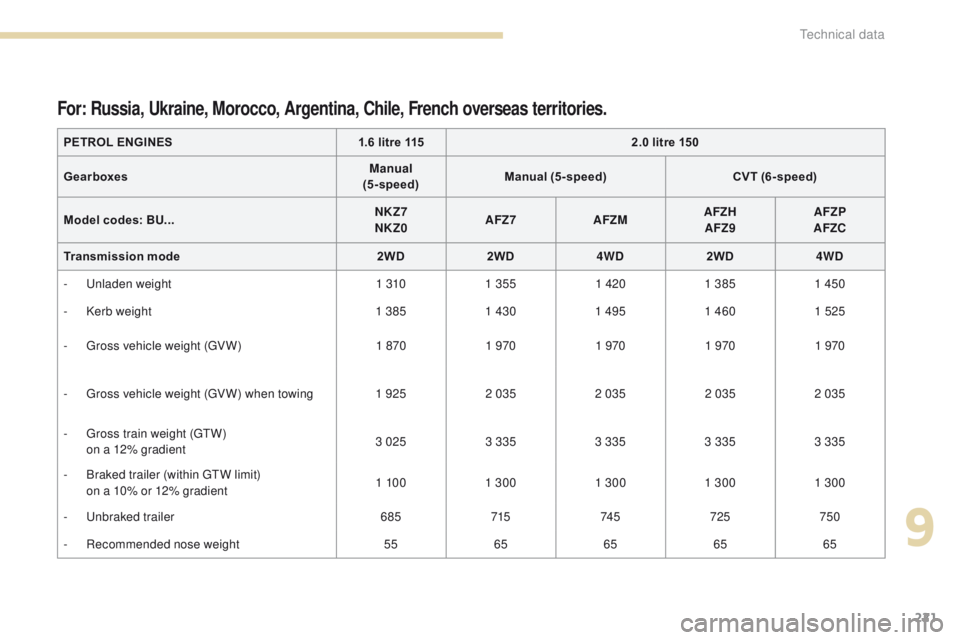
For: Russia, Ukraine, Morocco, Argentina, Chile, French overseas territories.
PETROL ENGINES1.6 litre 1152.0 litre 150
Gearboxes Manual
(5 - speed) Manual (5-speed)
CVT (6-speed)
Model codes: BU... NKZ7
NKZ0 AFZ7
AFZM AFZH
AFZ9 AFZP
AFZC
Transmission mode 2WD2WD 4WD2WD 4WD
-
u
n
laden weight 1 3101 355 1 4201 385 1 450
-
K
erb weight 1 3851 430 1 4951 460 1 525
-
g
r
oss vehicle weight (
gV
W)1 8701 9701 9701 9701 970
-
g
r
oss vehicle weight (
gV
W) when towing1 9252 035 2 0352 0352 035
-
g
r
oss train weight (
g
t
W
)
o
n a 12% gradient 3 025
3 335 3 3353 3353 335
-
B
raked trailer (within gt
W l
imit)
o
n a 10% or 12% gradient 1 10 0
1 300 1 3001 3001 300
-
u
nb
raked trailer 68571574 5725 750
-
R
ecommended nose weight 5565656565
9
Technical data
Page 224 of 368
222
4008_en_Chap09_caracteristiques-techniques_ed01-2016
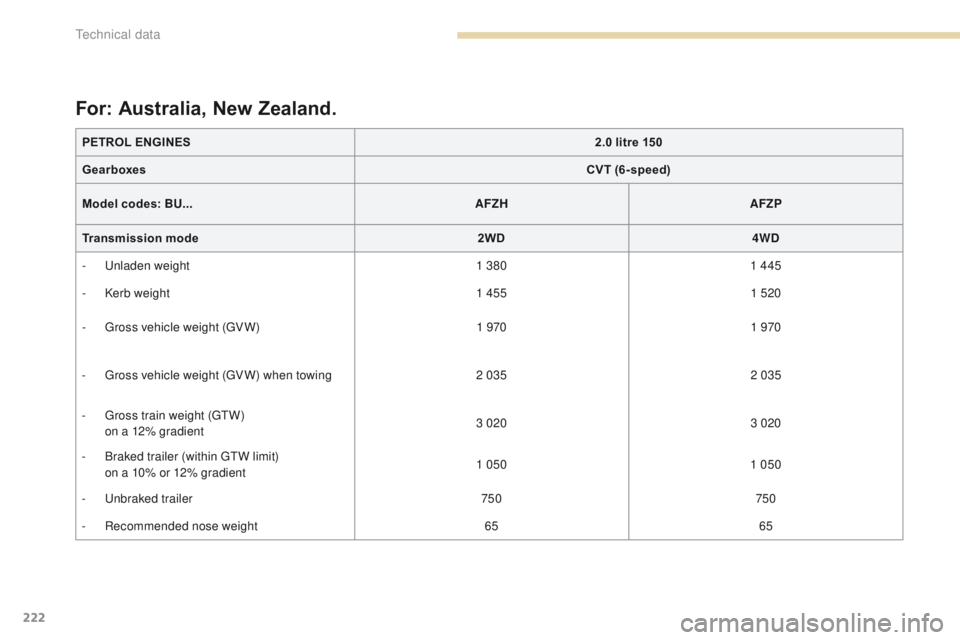
For: Australia, New Zealand.
PETROL ENGINES2.0 litre 150
Gearboxes CVT (6-speed)
Model codes: BU... AFZHAFZP
Transmission mode 2WD4WD
-
u
n
laden weight 1 3801 445
-
K
erb weight 1 4551 520
-
g
r
oss vehicle weight (
gV
W) 1 970 1 970
-
g
r
oss vehicle weight (
gV
W) when towing 2 035 2 035
-
g
r
oss train weight (
g
t
W
)
o
n a 12% gradient 3 020
3 020
-
B
raked trailer (within gt
W l
imit)
o
n a 10% or 12% gradient 1 050
1 050
-
u
nb
raked trailer 750750
-
R
ecommended nose weight 6565
technical data