instrument panel PEUGEOT 4008 2017 Owner's Guide
[x] Cancel search | Manufacturer: PEUGEOT, Model Year: 2017, Model line: 4008, Model: PEUGEOT 4008 2017Pages: 368, PDF Size: 12.22 MB
Page 127 of 368
125
4008_en_Chap04_conduite_ed01-2016
Visual assistance
Front parking sensors
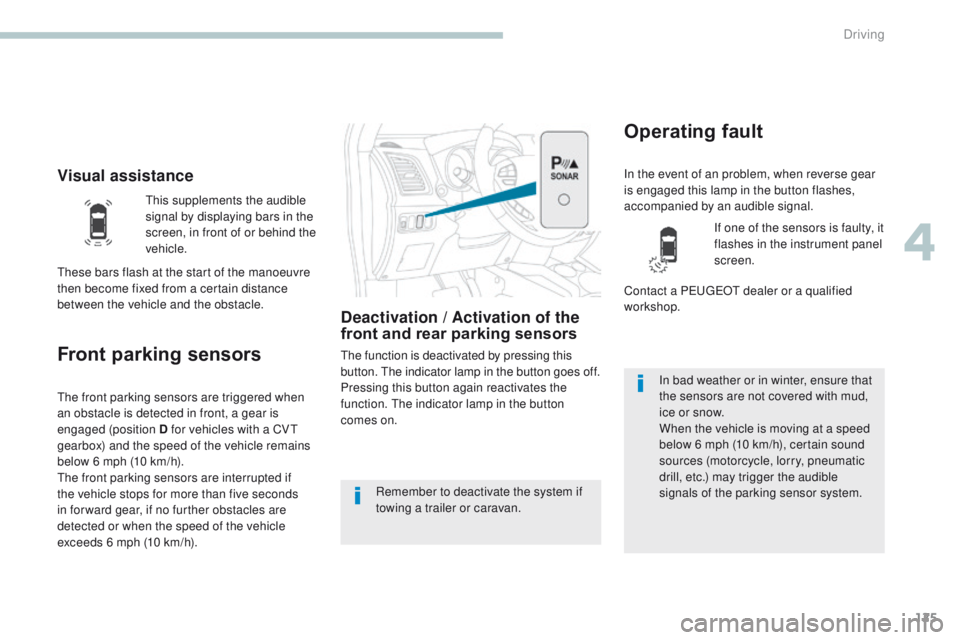
Deactivation / Activation of the
front and rear parking sensors
the function is deactivated by pressing this
button. th e indicator lamp in the button goes off.
Pressing this button again reactivates the
function.
t
h
e indicator lamp in the button
comes on.
Operating fault
the front parking sensors are triggered when
an obstacle is detected in front, a gear is
engaged (position D for vehicles with a CV
t
gearbox) and the speed of the vehicle remains
below 6 mph (10 km/h).
th
e front parking sensors are interrupted if
the vehicle stops for more than five seconds
in for ward gear, if no further obstacles are
detected or when the speed of the vehicle
exceeds 6 mph (10 km/h). Remember to deactivate the system if
towing a trailer or caravan.In bad weather or in winter, ensure that
the sensors are not covered with mud,
ice or snow.
When the vehicle is moving at a speed
below 6 mph (10 km/h), certain sound
sources (motorcycle, lorry, pneumatic
drill, etc.) may trigger the audible
signals of the parking sensor system.
In the event of an problem, when reverse gear
is engaged this lamp in the button flashes,
accompanied by an audible signal.
th
is supplements the audible
signal by displaying bars in the
screen, in front of or behind the
vehicle. If one of the sensors is faulty, it
flashes in the instrument panel
screen.
Contact a P
e
uge
Ot
dealer or a qualified
workshop.
th
ese bars flash at the start of the manoeuvre
then become fixed from a certain distance
between the vehicle and the obstacle.
4
Driving
Page 130 of 368
128
4008_en_Chap05_Eclairage-et-visibilite_ed01-2016
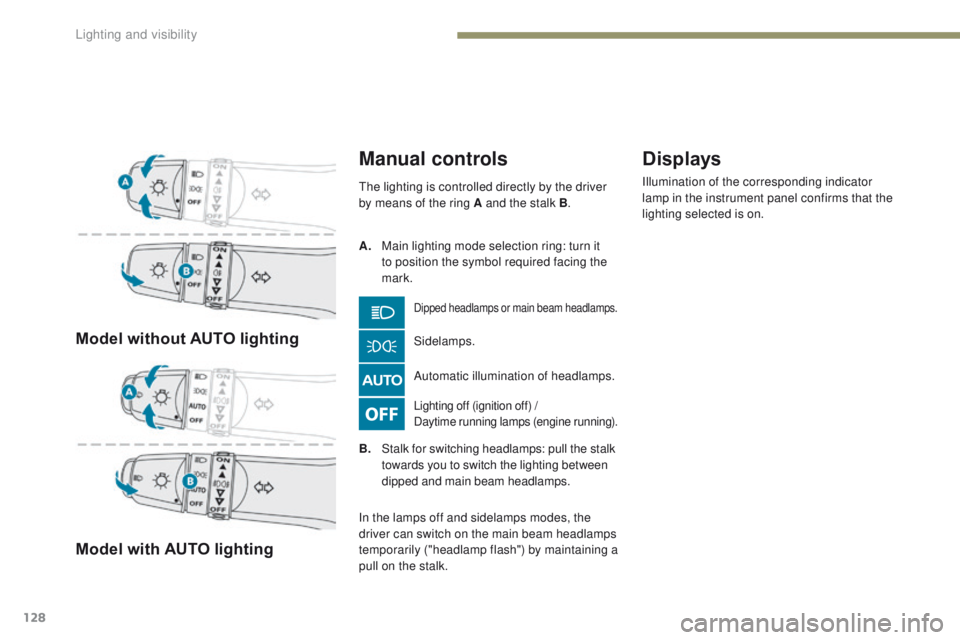
Model without AUTO lighting
Model with AUTO lighting
Manual controls
Lighting off (ignition off) /
Daytime running lamps (engine running).
Automatic illumination of headlamps. Sidelamps.
Dipped headlamps or main beam headlamps.
Displays
Illumination of the corresponding indicator
lamp in the instrument panel confirms that the
lighting selected is on.
A.
M
ain lighting mode selection ring: turn it
to position the symbol required facing the
mark.th
e lighting is controlled directly by the driver
by means of the ring A and the stalk B .
B.
S
talk for switching headlamps: pull the stalk
towards you to switch the lighting between
dipped and main beam headlamps.
In the lamps off and sidelamps modes, the
driver can switch on the main beam headlamps
temporarily ("headlamp flash") by maintaining a
pull on the stalk.
Lighting and visibility
Page 145 of 368
143
4008_en_Chap06_securite_ed01-2016
group of supplementary systems which help
you to obtain optimum braking in complete
safety in emergency situations:
-
a
nti-lock braking system (ABS),
-
e
lectronic brake force distribution (
eB
FD).
Braking assistance systems
Anti-lock braking system
and electronic brake force
distribution
Linked systems which improve the stability and
manoeuvrability of your vehicle when braking,
in particular on poor or slippery sur faces.
Activation
the anti-lock braking system is active if the
vehicle speed is higher than 6 mph (10 km/h).
It is deactivated when the vehicle speed falls
below 3
mph (5 km/h).
th
e anti-lock braking system comes into
operation automatically when there is a risk of
wheel lock.
Normal operation of the ABS may make itself
felt by slight vibration of the brake pedal.
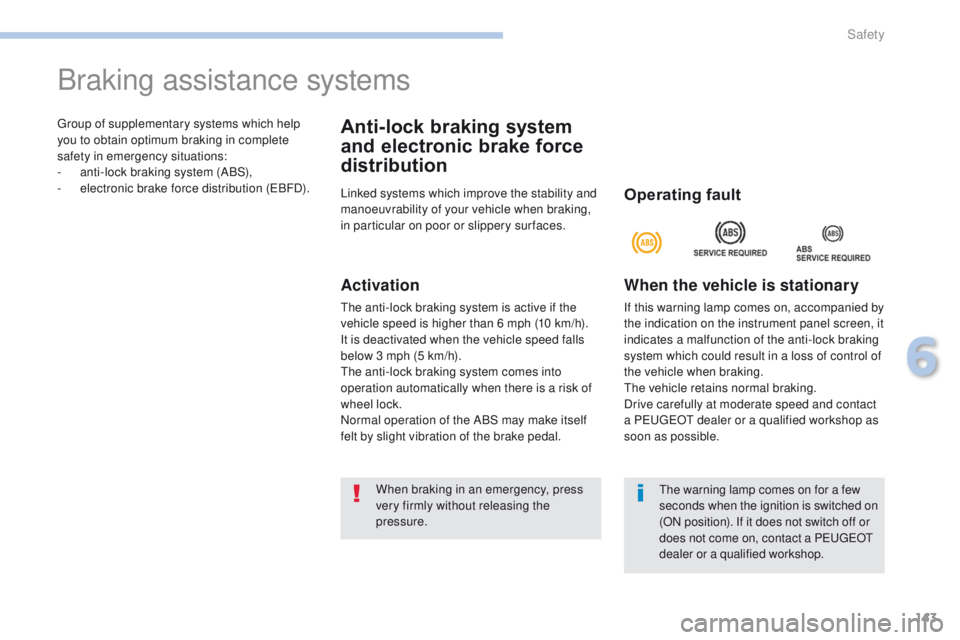
Operating fault
When the vehicle is stationary
If this warning lamp comes on, accompanied by
the indication on the instrument panel screen, it
indicates a malfunction of the anti-lock braking
system which could result in a loss of control of
the vehicle when braking.
th
e vehicle retains normal braking.
Drive carefully at moderate speed and contact
a P
e
uge
Ot
dealer or a qualified workshop as
soon as possible.
When braking in an emergency, press
very firmly without releasing the
pressure.
th
e warning lamp comes on for a few
seconds when the ignition is switched on
(ON position). If it does not switch off or
does not come on, contact a P
e
uge
Ot
d
ealer or a qualified workshop.
6
Safety
Page 146 of 368
144
4008_en_Chap06_securite_ed01-2016
When the vehicle is moving
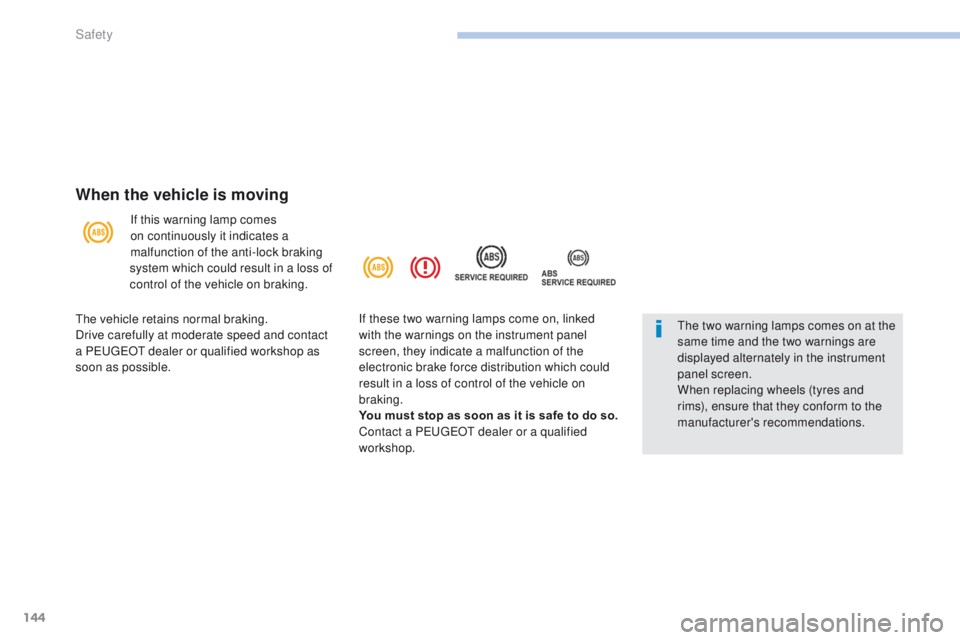
If this warning lamp comes
on continuously it indicates a
malfunction of the anti-lock braking
system which could result in a loss of
control of the vehicle on braking.
th
e two warning lamps comes on at the
same time and the two warnings are
displayed alternately in the instrument
panel screen.
When replacing wheels (tyres and
rims), ensure that they conform to the
manufacturer's recommendations.
th
e vehicle retains normal braking.
Drive carefully at moderate speed and contact
a P
e
uge
Ot
dealer or qualified workshop as
soon as possible. If these two warning lamps come on, linked
with the warnings on the instrument panel
screen, they indicate a malfunction of the
electronic brake force distribution which could
result in a loss of control of the vehicle on
braking.
You must stop as soon as it is safe to do so.
Contact a P
e
uge
Ot
dealer or a qualified
workshop.
Safety
Page 147 of 368
145
4008_en_Chap06_securite_ed01-2016
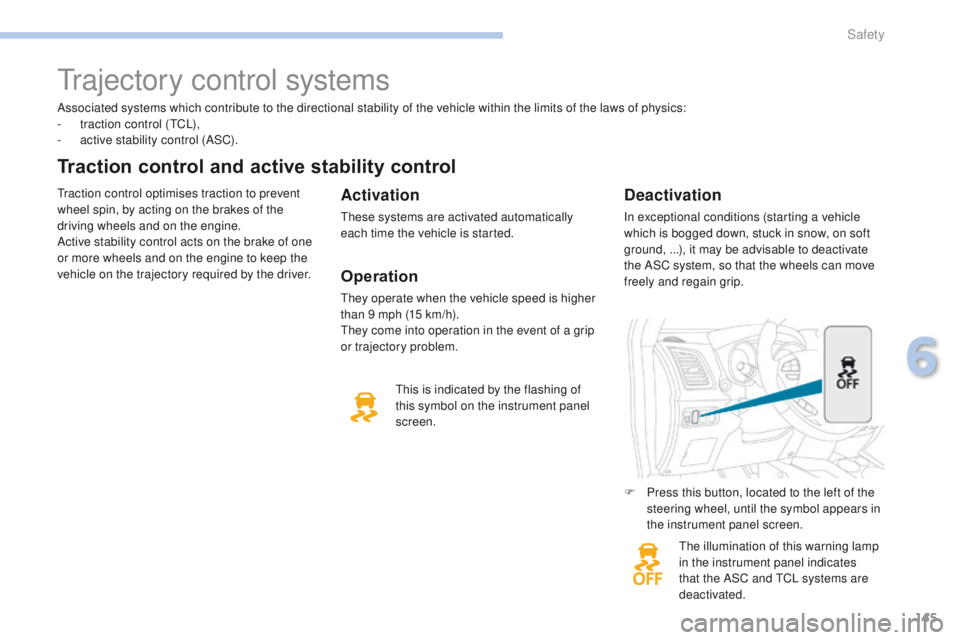
Associated systems which contribute to the directional stability of the vehicle within the limits of the laws of physics:
- t raction control (tC L),
-
a
ctive stability control (ASC).
Traction control and active stability control
traction control optimises traction to prevent
wheel spin, by acting on the brakes of the
driving wheels and on the engine.
Active stability control acts on the brake of one
or more wheels and on the engine to keep the
vehicle on the trajectory required by the driver.Activation
these systems are activated automatically
each time the vehicle is started.
th
e illumination of this warning lamp
in the instrument panel indicates
that the ASC and
t
C
L systems are
deactivated.
Deactivation
In exceptional conditions (starting a vehicle
which is bogged down, stuck in snow, on soft
ground, ...), it may be advisable to deactivate
the ASC system, so that the wheels can move
freely and regain grip.
th
is is indicated by the flashing of
this symbol on the instrument panel
screen.
trajectory control systems
F Press this button, located to the left of the steering wheel, until the symbol appears in
the instrument panel screen.
Operation
they operate when the vehicle speed is higher
than 9 mph (15 km/h).
th
ey come into operation in the event of a grip
or trajectory problem.
6
Safety
Page 148 of 368
146
4008_en_Chap06_securite_ed01-2016
ReactivationOperating fault
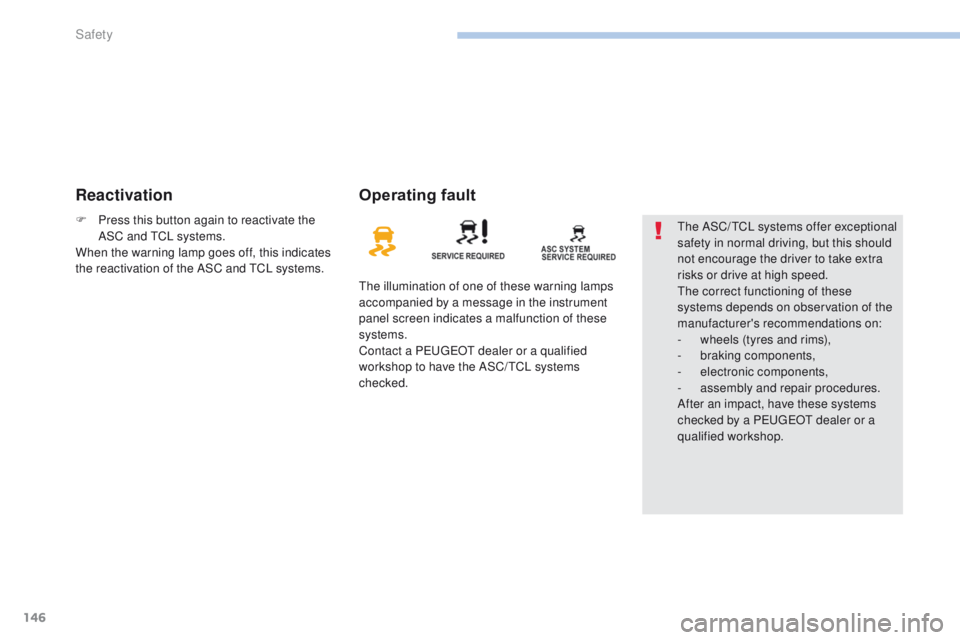
the illumination of one of these warning lamps
accompanied by a message in the instrument
panel screen indicates a malfunction of these
systems.
Contact a P
e
uge
Ot
dealer or a qualified
workshop to have the ASC/
tC
L systems
checked.
th
e ASC/
tC
L systems offer exceptional
safety in normal driving, but this should
not encourage the driver to take extra
risks or drive at high speed.th e correct functioning of these
systems depends on observation of the
manufacturer's recommendations on:
-
w
heels (tyres and rims),
-
b
raking components,
-
el
ectronic components,
-
a
ssembly and repair procedures.
After an impact, have these systems
checked by a P
e
uge
Ot
dealer or a
qualified workshop.
F
P
ress this button again to reactivate the
ASC and
t
C
L systems.
When the warning lamp goes off, this indicates
the reactivation of the ASC and
t
C
L systems.
Safety
Page 150 of 368
148
4008_en_Chap06_securite_ed01-2016
If the driver does not fasten their seat belt
within one minute after switching on the
ignition, the warning lamp flashes accompanied
by an intermittent audible signal and a display
on the instrument panel screen.
th
e warning lamp, the audible signal
and
the display stop after approximately
90
seconds and return until the driver fastens
their seat belt.
If the seat belt is unfastened while the vehicle
is moving , you are alerted by the same
warnings.
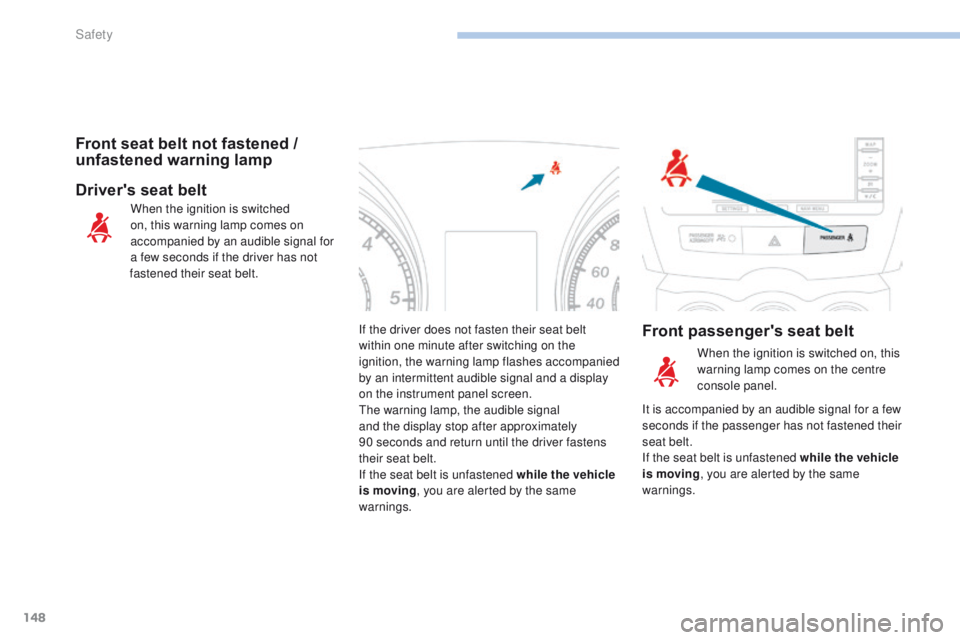
When the ignition is switched
on, this warning lamp comes on
accompanied by an audible signal for
a few seconds if the driver has not
fastened their seat belt.
Front seat belt not fastened /
u nfastened warning lamp
Front passenger's seat belt
Driver's seat belt
When the ignition is switched on, this
warning lamp comes on the centre
console panel.
It is accompanied by an audible signal for a few
seconds if the passenger has not fastened their
seat belt.
If the seat belt is unfastened while the vehicle
is moving , you are alerted by the same
warnings.
Safety
Page 154 of 368
152
4008_en_Chap06_securite_ed01-2016
Deactivation
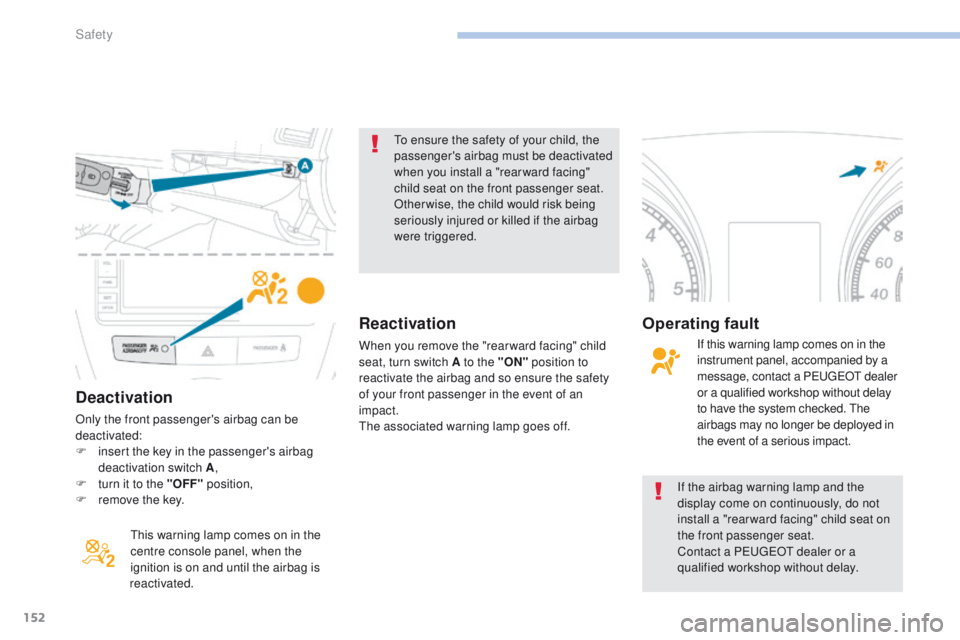
Only the front passenger's airbag can be
deactivated:
F
i
nsert the key in the passenger's airbag
deactivation switch A ,
F
t
urn it to the "OFF" position,
F
r
emove the key.
th
is warning lamp comes on in the
centre console panel, when the
ignition is on and until the airbag is
reactivated.
to e
nsure the safety of your child, the
passenger's airbag must be deactivated
when you install a "rear ward facing"
child seat on the front passenger seat.
Otherwise, the child would risk being
seriously injured or killed if the airbag
were triggered.
If the airbag warning lamp and the
display come on continuously, do not
install a "rear ward facing" child seat on
the front passenger seat.
Contact a P
e
uge
Ot
dealer or a
qualified workshop without delay.
Reactivation
When you remove the "rear ward facing" child
seat, turn switch A to the "ON" position to
reactivate the airbag and so ensure the safety
of your front passenger in the event of an
impact.
th
e associated warning lamp goes off.
Operating fault
If this warning lamp comes on in the
instrument panel, accompanied by a
message, contact a P
e
uge
Ot
dealer
or a qualified workshop without delay
to have the system checked.
t
h
e
airbags may no longer be deployed in
the event of a serious impact.
Safety
Page 156 of 368
154
4008_en_Chap06_securite_ed01-2016
In the event of a minor impact or bump
on the side of the vehicle or if the
vehicle rolls over, the airbag may not be
deployed.
In the event of a rear or front collision,
the airbag is not deployed.
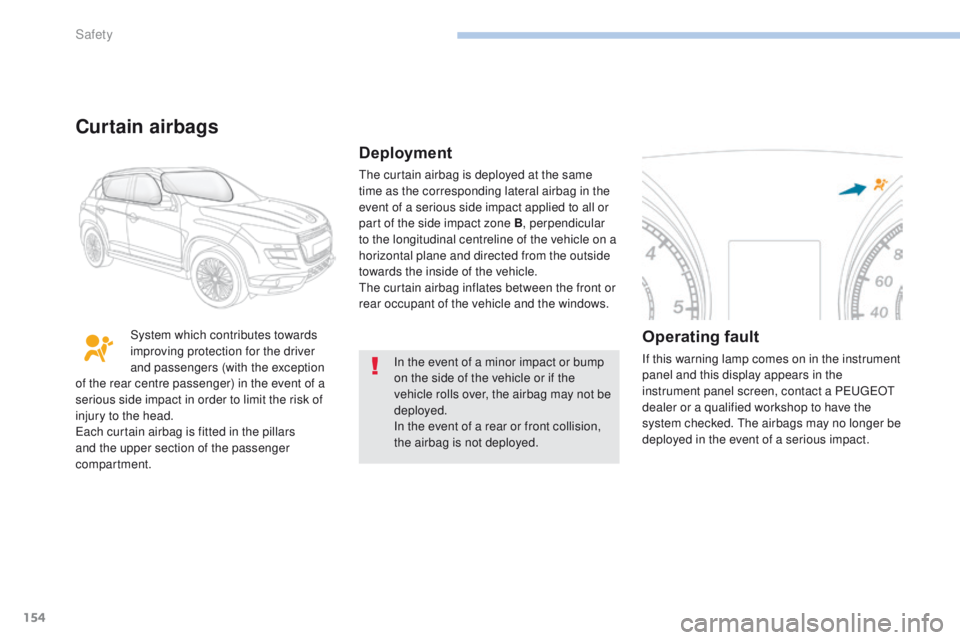
System which contributes towards
improving protection for the driver
and passengers (with the exception
of the rear centre passenger) in the event of a
serious side impact in order to limit the risk of
injury to the head.
ea
ch curtain airbag is fitted in the pillars
and the upper section of the passenger
compartment.
Curtain airbags
Deployment
the curtain airbag is deployed at the same
time as the corresponding lateral airbag in the
event of a serious side impact applied to all or
part of the side impact zone B, perpendicular
to the longitudinal centreline of the vehicle on a
horizontal plane and directed from the outside
towards the inside of the vehicle.
th
e curtain airbag inflates between the front or
rear occupant of the vehicle and the windows.
Operating fault
If this warning lamp comes on in the instrument
panel and this display appears in the
instrument panel screen, contact a P
e
uge
Ot
dealer or a qualified workshop to have the
system checked.
t
h
e airbags may no longer be
deployed in the event of a serious impact.
Safety
Page 160 of 368
158
4008_en_Chap06_securite_ed01-2016
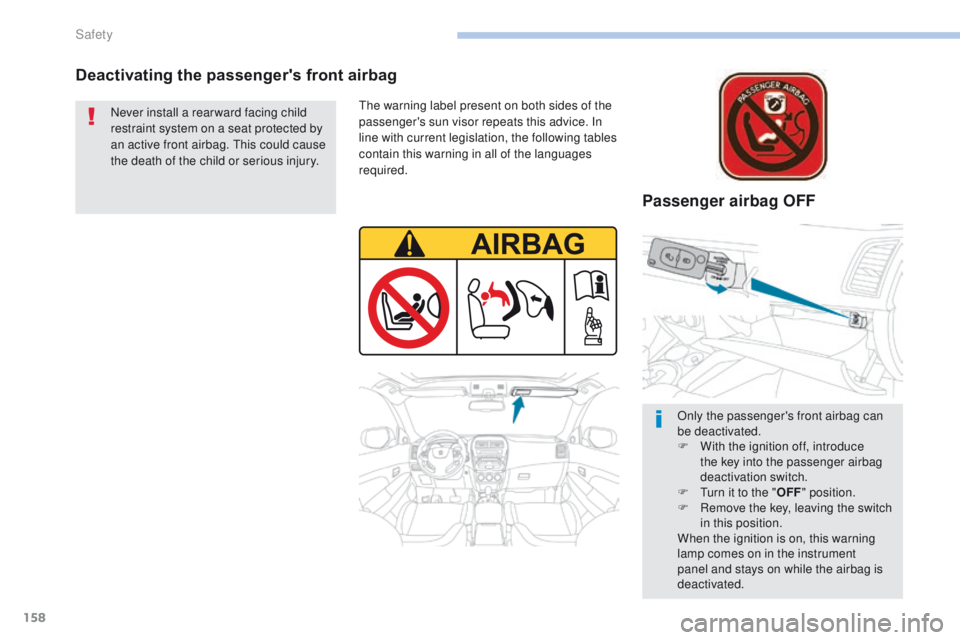
Deactivating the passenger's front airbagPassenger airbag OFF
the warning label present on both sides of the
passenger's sun visor repeats this advice. In
line with current legislation, the following tables
contain this warning in all of the languages
required.
Never install a rear ward facing child
restraint system on a seat protected by
an active front airbag.
t
h
is could cause
the death of the child or serious injury.
Only the passenger's front airbag can
be deactivated.
F
W
ith the ignition off, introduce
the key into the passenger airbag
deactivation switch.
F
t
u
rn it to the "OFF" position.
F
R
emove the key, leaving the switch
in this position.
When the ignition is on, this warning
lamp comes on in the instrument
panel and stays on while the airbag is
deactivated.
Safety