engine oil PEUGEOT 5008 2016 User Guide
[x] Cancel search | Manufacturer: PEUGEOT, Model Year: 2016, Model line: 5008, Model: PEUGEOT 5008 2016Pages: 364, PDF Size: 12.98 MB
Page 202 of 364

200
5008_en_Chap09_verifications_ed01-2015
Power steering fluid level
The power steering fluid level should
be close to the "MA X" mark. With
the engine cold, unscrew the cap to
check the level.
Fluid specification
The brake fluid must conform to the
manufacturer's recommendations.
Changing the fluid
Refer to the manufacturer's service schedule
for details of the interval for this operation.
Brake fluid level
The brake fluid level should be close
to the "MA X" mark. If it is not, check
the brake pad wear.
After topping-up the oil, the check when
switching on the ignition with the oil
level indicator in the instrument panel
is not valid during the 30 minutes after
topping up.Oil grade
Before topping-up the oil or changing the oil,
check that the oil is the correct grade for your
engine and conforms to the manufacturer's
recommendations.
Topping-up the engine oil level
F Locate the oil filler cap in the engine
compartment of your vehicle.
For more information on the petrol or Diesel
engine, refer to the corresponding section.
F
U
nscrew the oil filler cap to reveal the filler
aperture.
F
A
dd oil in small quantities, avoiding any
spills on engine components (risk of fire).
F
W
ait a few minutes before checking the
level again using the dipstick.
F
A
dd more oil if necessary.
F
A
fter checking the level, carefully refit the
oil filler cap and the dipstick in its tube.
Engine oil change
Refer to the manufacturer's service schedule
for details of the interval for this operation.
In order to maintain the reliability of the engine
and emission control system, never use
additives in the engine oil.
Checks
Page 203 of 364
201
5008_en_Chap09_verifications_ed01-2015
Diesel additive level (Diesel
engine with particle filter)
Used products
To p p i n g u p
This additive must be topped up by a
PEUGEOT dealer or a qualified workshop
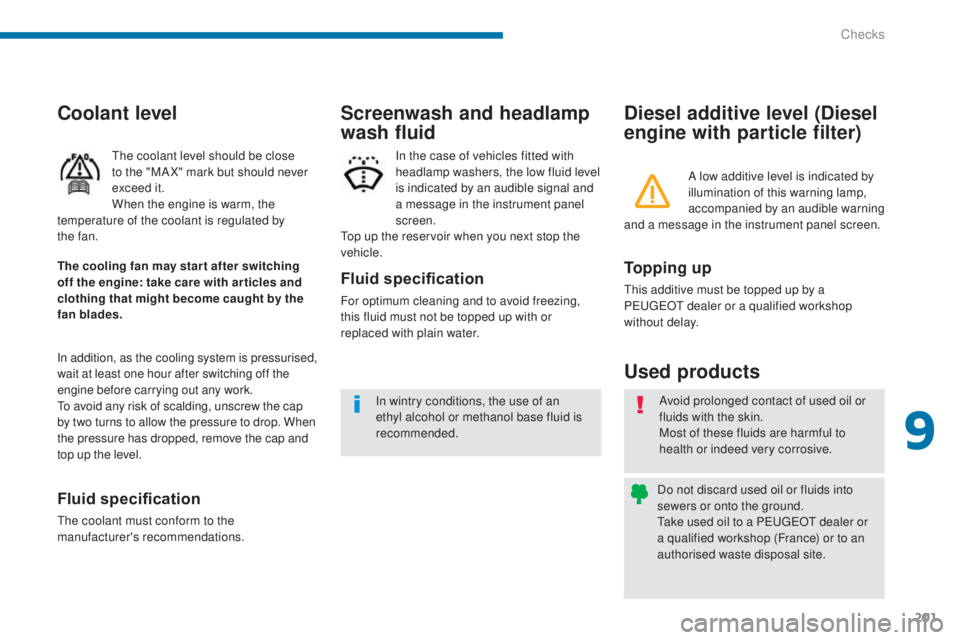
without delay.A low additive level is indicated by
illumination of this warning lamp,
accompanied by an audible warning
and a message in the instrument panel screen.Fluid specification
For optimum cleaning and to avoid freezing,
this fluid must not be topped up with or
replaced with plain water. In the case of vehicles fitted with
headlamp washers, the low fluid level
is indicated by an audible signal and
a message in the instrument panel
screen.
Top up the reservoir when you next stop the
vehicle.
Screenwash and headlamp
wash fluid
Avoid prolonged contact of used oil or
fluids with the skin.
Most of these fluids are harmful to
health or indeed very corrosive.
Do not discard used oil or fluids into
sewers or onto the ground.
Take used oil to a PEUGEOT dealer or
a qualified workshop (France) or to an
authorised waste disposal site.
The cooling fan may star t after switching
off the engine: take care with ar ticles and
clothing that might become caught by the
fan blades.
Fluid specification
The coolant must conform to the
manufacturer's recommendations.
Coolant level
The coolant level should be close
to the "MA X" mark but should never
exceed it.
When the engine is warm, the
temperature of the coolant is regulated by
the fan.
In addition, as the cooling system is pressurised,
wait at least one hour after switching off the
engine before carrying out any work.
To avoid any risk of scalding, unscrew the cap
by two turns to allow the pressure to drop. When
the pressure has dropped, remove the cap and
top up the level. In wintry conditions, the use of an
ethyl alcohol or methanol base fluid is
recommended.
9
Checks
Page 204 of 364
202
5008_en_Chap09_verifications_ed01-2015
Particle filter (Diesel)
Checks
Unless otherwise indicated, check these
components in accordance with the
manufacturer's service schedule and according
to your engine.
Other wise, have them checked by a PEUGEOT
dealer or a qualified workshop.
12 V batteryThe battery does not require any maintenance.
However, check that the terminals are clean
and correctly tightened, particularly in summer
and winter.
When carrying out work on the battery, refer
to the "12 V battery" section for details of the precautions to
be taken before disconnecting the battery and following its
reconnection.
Air filter and passenger compartment filter
Refer to the manufacturer's service
schedule for details of the replacement
intervals for these components.
Depending on the environment
(e.g. dusty atmosphere) and the use of the vehicle
(e.g. city driving), replace them twice as often if
necessary .
A clogged passenger compartment filter may have
an adverse effect on the per formance of the air
conditioning system and generate undesirable
odours.
Oil filter
Replace the oil filter each time the
engine oil is changed.
Refer to the manufacturer's
service schedule for details of
the replacement interval for this
component. On a new vehicle, the first particle
filter regeneration operations may be
accompanied by a "burning" smell,
which is per fectly normal.
Following prolonged operation of the
vehicle at very low speed or at idle,
you may, in exceptional circumstances,
notice the emission of water vapour at
the exhaust on acceleration. This does
not affect the behaviour of the vehicle
or the environment.
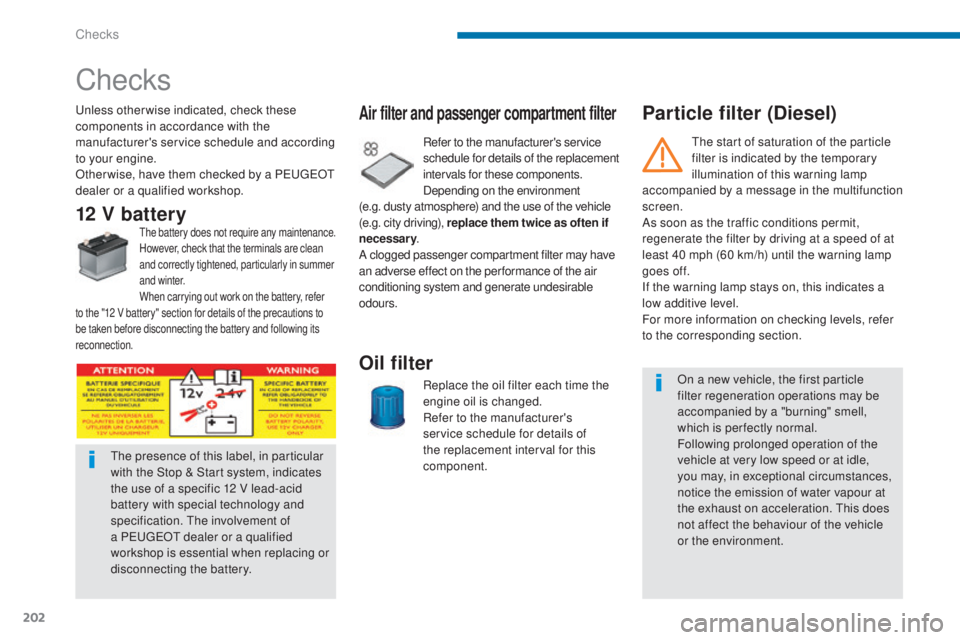
The presence of this label, in particular
with the Stop & Start system, indicates
the use of a specific 12 V lead-acid
battery with special technology and
specification. The involvement of
a PEUGEOT dealer or a qualified
workshop is essential when replacing or
disconnecting the battery. The start of saturation of the particle
filter is indicated by the temporary
illumination of this warning lamp
accompanied by a message in the multifunction
screen.
As soon as the traffic conditions permit,
regenerate the filter by driving at a speed of at
least 40 mph (60 km/h) until the warning lamp
goes off.
If the warning lamp stays on, this indicates a
low additive level.
For more information on checking levels, refer
to the corresponding section.
Checks
Page 218 of 364
216
5008_en_Chap10_infos-pratiques_ed01-2015
Repair procedure
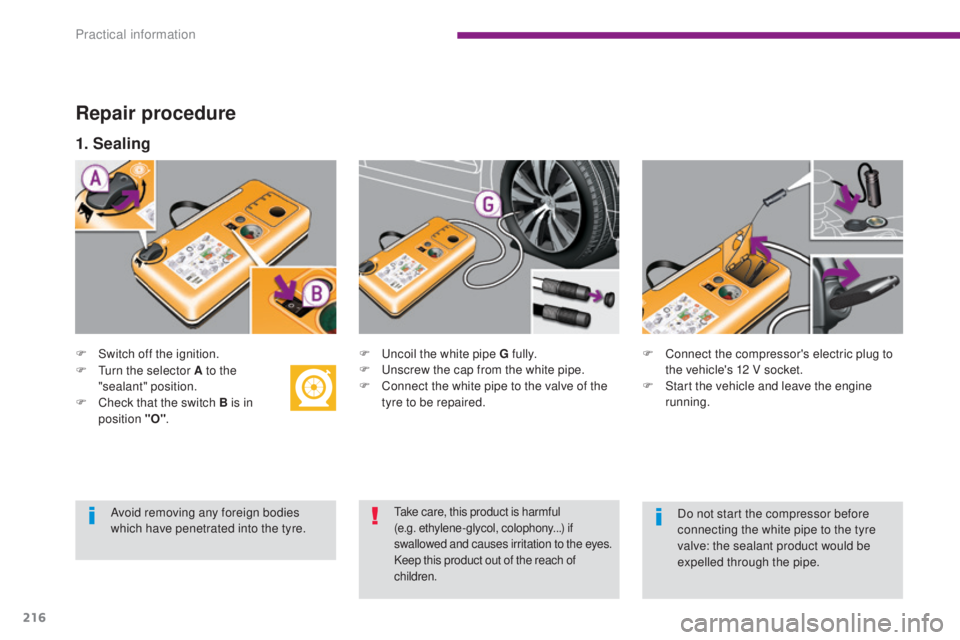
F Switch off the ignition.F U ncoil the white pipe G fully.
F U nscrew the cap from the white pipe.
F
C
onnect the white pipe to the valve of the
tyre to be repaired. F
C onnect the compressor's electric plug to
the vehicle's 12 V socket.
F
S
tart the vehicle and leave the engine
running.
1. Sealing
F Turn the selector A to the "sealant" position.
F
C
heck that the switch B is in
position "O" .
Take care, this product is harmful
(e.g.
ethylene-glycol, colophony...) if
swallowed and causes irritation to the eyes.
Keep this product out of the reach of
children.Avoid removing any foreign bodies
which have penetrated into the tyre. Do not start the compressor before
connecting the white pipe to the tyre
valve: the sealant product would be
expelled through the pipe.
Practical information
Page 220 of 364
218
5008_en_Chap10_infos-pratiques_ed01-2015
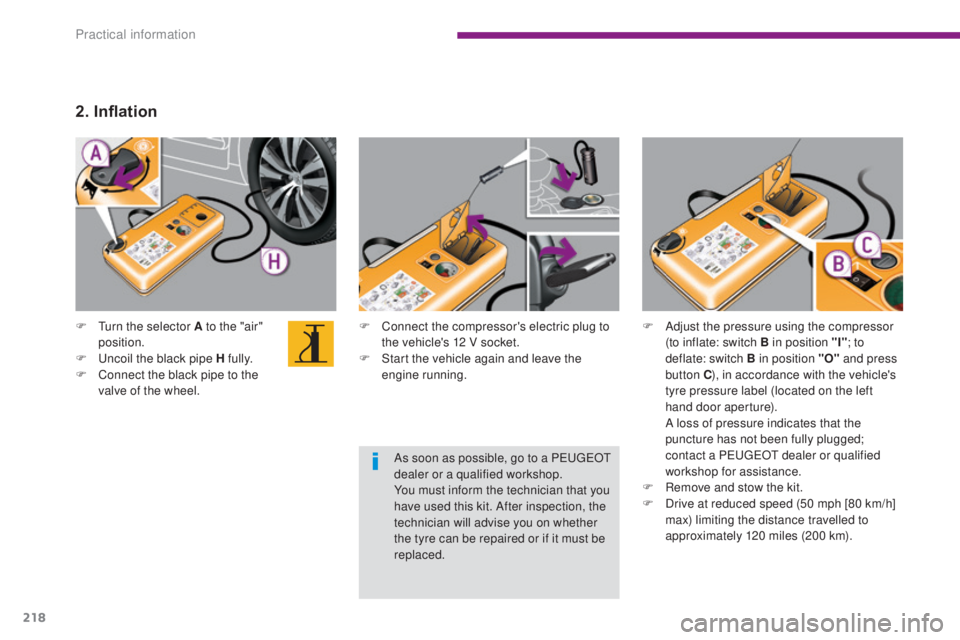
F Connect the compressor's electric plug to the vehicle's 12 V socket.
F
S
tart the vehicle again and leave the
engine running.
F
T
urn the selector A to the "air"
position.
F
U
ncoil the black pipe H fully.
F
C
onnect the black pipe to the
valve of the wheel.
2. Inflation
F Adjust the pressure using the compressor (to inflate: switch B in position "I" ; to
deflate: switch B
in position "O" and press
button C ), in accordance with the vehicle's
tyre pressure label (located on the left
hand door aperture).
A l
oss of pressure indicates that the
puncture has not been fully plugged;
contact a PEUGEOT dealer or qualified
workshop for assistance.
F
R
emove and stow the kit.
F
D
rive at reduced speed (50 mph [80 km/h]
max) limiting the distance travelled to
approximately 120 miles (200 km).
As soon as possible, go to a PEUGEOT
dealer or a qualified workshop.
You must inform the technician that you
have used this kit. After inspection, the
technician will advise you on whether
the tyre can be repaired or if it must be
replaced.
Practical information
Page 221 of 364
219
5008_en_Chap10_infos-pratiques_ed01-2015
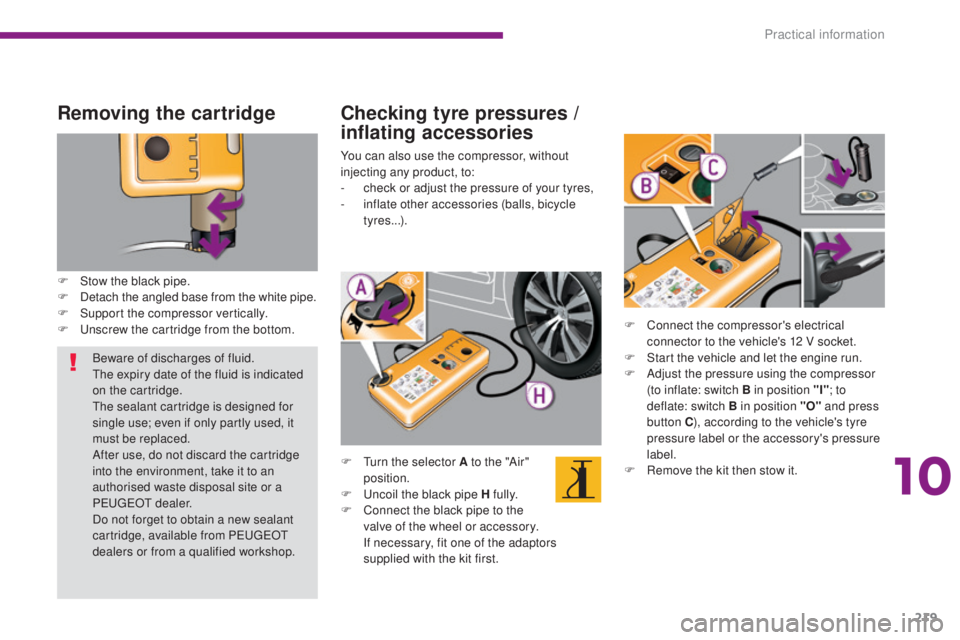
Removing the cartridge
F Stow the black pipe.
F D etach the angled base from the white pipe.
F
S
upport the compressor vertically.
F
U
nscrew the cartridge from the bottom.
Checking tyre pressures /
inflating accessories
You can also use the compressor, without
injecting any product, to:
-
c
heck or adjust the pressure of your tyres,
-
i
nflate other accessories (balls, bicycle
tyres...).
F
T
urn the selector A to the "Air"
position.
F
U
ncoil the black pipe H fully.
F
C
onnect the black pipe to the
valve of the wheel or accessory.
I
f necessary, fit one of the adaptors
supplied with the kit first. F
C
onnect the compressor's electrical
connector to the vehicle's 12 V socket.
F
S
tart the vehicle and let the engine run.
F
A
djust the pressure using the compressor
(to inflate: switch B in position "I" ; to
deflate: switch B in position "O" and press
button C ), according to the vehicle's tyre
pressure label or the accessory's pressure
label.
F
R
emove the kit then stow it.
Beware of discharges of fluid.
The expiry date of the fluid is indicated
on the cartridge.
The sealant cartridge is designed for
single use; even if only partly used, it
must be replaced.
After use, do not discard the cartridge
into the environment, take it to an
authorised waste disposal site or a
PEUGEOT dealer.
Do not forget to obtain a new sealant
cartridge, available from PEUGEOT
dealers or from a qualified workshop.
10
Practical information
Page 243 of 364
241
5008_en_Chap10_infos-pratiques_ed01-2015
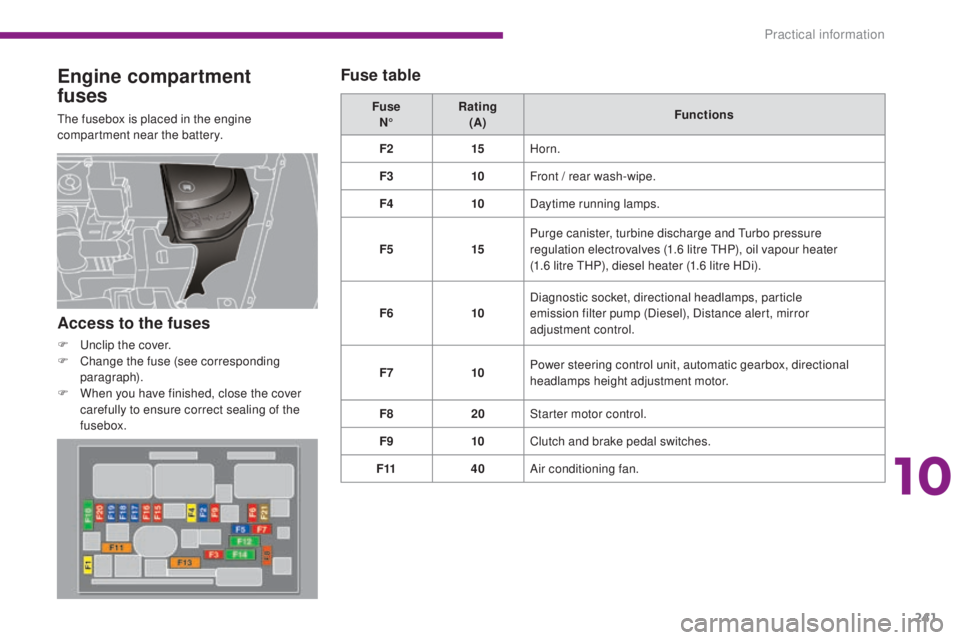
Engine compartment
fuses
The fusebox is placed in the engine
compartment near the battery.Fuse
N° Rating
(A) Functions
F2 15Horn.
F3 10Front / rear wash-wipe.
F4 10Daytime running lamps.
F5 15Purge canister, turbine discharge and Turbo pressure
regulation electrovalves (1.6 litre THP), oil vapour heater
(1.6 litre THP), diesel heater (1.6 litre HDi).
F6 10Diagnostic socket, directional headlamps, particle
emission filter pump (Diesel), Distance alert, mirror
adjustment control.
F7 10Power steering control unit, automatic gearbox, directional
headlamps height adjustment motor.
F8 20Starter motor control.
F9 10Clutch and brake pedal switches.
F11 40Air conditioning fan.
Access to the fuses
F Unclip the cover.
F
C hange the fuse (see corresponding
paragraph).
F
W
hen you have finished, close the cover
carefully to ensure correct sealing of the
fusebox.
Fuse table
10
Practical information
Page 260 of 364
258
5008_en_Chap11_caracteristiques_ed01-2015
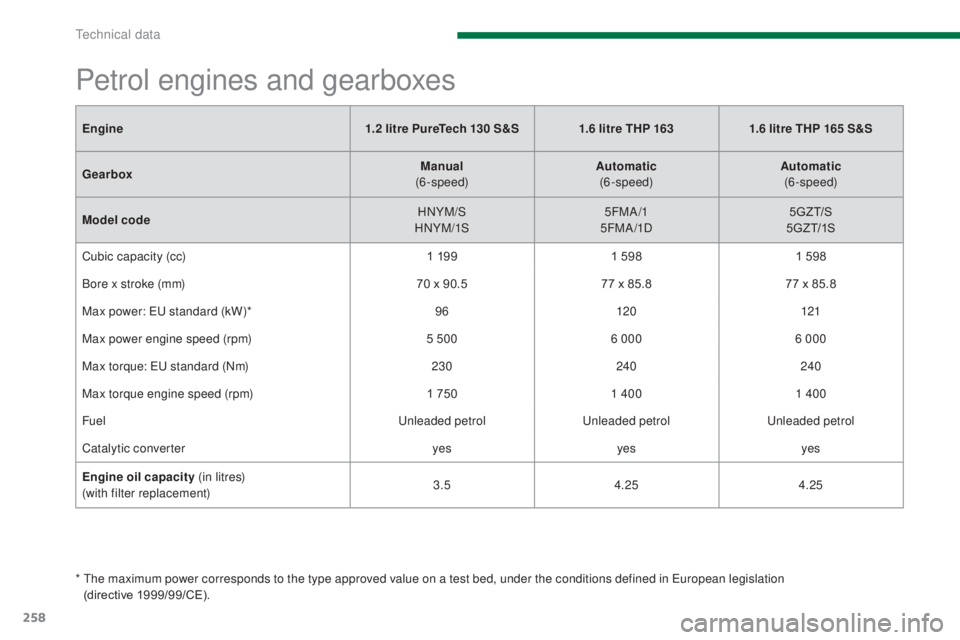
Engine1.2 litre PureTech 130 S&S 1.6 litre THP 163 1.6 litre THP 165 S&S
Gearbox Manual
(6-speed) Automatic
(6-speed) Automatic
(6-speed)
Model code HNYM/S
HNYM/1S 5FMA /1
5FM A /1D 5G Z T/S
5G Z T/1S
Cubic capacity (cc) 1 1991 598 1 598
Bore x stroke (mm) 70 x 90.577 x 85.8 77 x 85.8
Max power: EU standard (kW)* 96120 121
Max power engine speed (rpm) 5 5006 000 6 000
Max torque: EU standard (Nm) 230240240
Max torque engine speed (rpm) 1 7501 400 1 400
Fuel Unleaded petrolUnleaded petrolUnleaded petrol
Catalytic converter yesyesyes
Engine oil capacity (in litres)
(with filter replacement) 3.5
4.25 4.25
Petrol engines and gearboxes
* The maximum power corresponds to the type approved value on a test bed, under the conditions defined in European legislation
(directive 1999/99/CE).
Technical data
Page 263 of 364
261
5008_en_Chap11_caracteristiques_ed01-2015
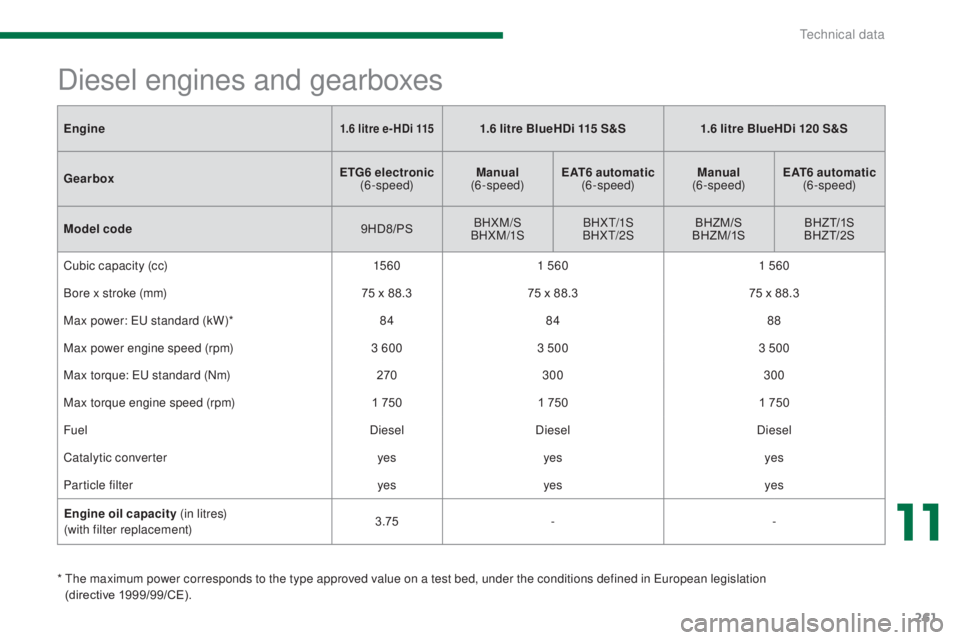
Engine1.6 litre e- HDi 1151.6 litre BlueHDi 115 S & S 1.6 litre BlueHDi 120 S&S
Gearbox ETG6 electronic
(6-speed) Manual
(6-speed) EAT6 automatic
(6-speed) Manual
(6-speed) EAT6 automatic
(6-speed)
Model code 9HD8/PSBHXM/S
BHXM/1S BH X T/1S
BH X T/2S BHZM/S
BHZM /1S BHZ T/1S
BHZ T/2S
Cubic capacity (cc) 15 6 01 560 1 560
Bore x stroke (mm) 75 x 88.375 x 88.3 75 x 88.3
Max power: EU standard (kW)* 8484 88
Max power engine speed (rpm) 3 6003 500 3 500
Max torque: EU standard (Nm) 270300 300
Max torque engine speed (rpm) 1 7501 750 1 750
Fuel DieselDiesel Diesel
Catalytic converter yesyes yes
Particle filter yesyes yes
Engine oil capacity (in litres)
(with filter replacement) 3.75
- -
Diesel engines and gearboxes
* The maximum power corresponds to the type approved value on a test bed, under the conditions defined in European legislation
(directive 1999/99/CE).
11
Technical data
Page 264 of 364
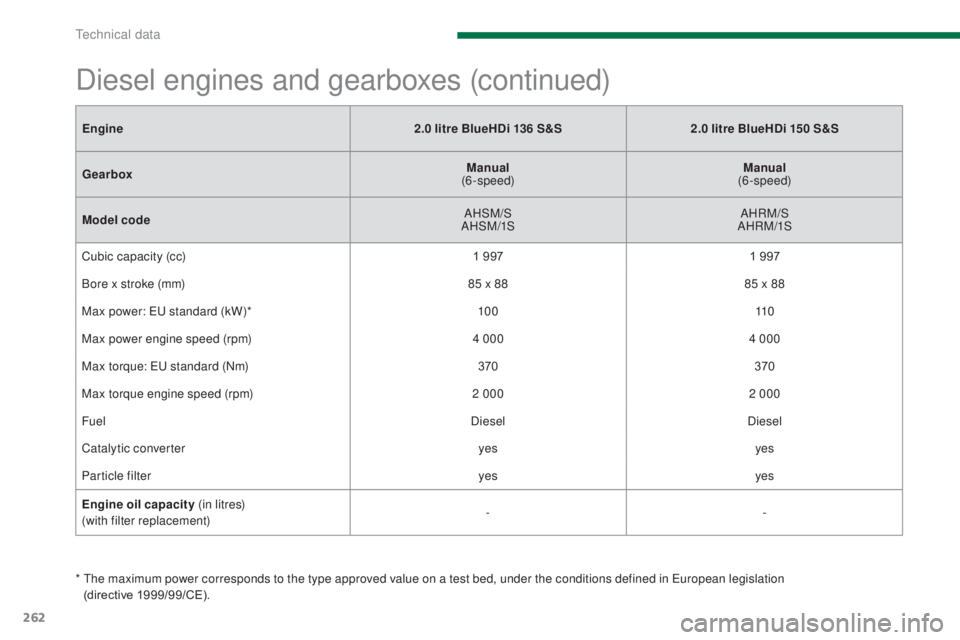
262
5008_en_Chap11_caracteristiques_ed01-2015
Engine2.0 litre BlueHDi 136 S&S2.0 litre BlueHDi 150 S&S
Gearbox Manual
(6-speed) Manual
(6-speed)
Model code AHSM/S
AHSM/1S AHRM/S
AHRM/1S
Cubic capacity (cc) 1 9971 997
Bore x stroke (mm) 85 x 8885 x 88
Max power: EU standard (kW)* 10 011 0
Max power engine speed (rpm) 4 0004 000
Max torque: EU standard (Nm) 370370
Max torque engine speed (rpm) 2 0002 000
Fuel DieselDiesel
Catalytic converter yesyes
Particle filter yesyes
Engine oil capacity (in litres)
(with filter replacement) -
-
Diesel engines and gearboxes (continued)
* The maximum power corresponds to the type approved value on a test bed, under the conditions defined in European legislation
(directive 1999/99/CE).
Technical data