deactivate airbag PEUGEOT 5008 2017 Owners Manual
[x] Cancel search | Manufacturer: PEUGEOT, Model Year: 2017, Model line: 5008, Model: PEUGEOT 5008 2017Pages: 404, PDF Size: 15.31 MB
Page 16 of 404
14
Warning / indicator lampStateCause Action / Observations
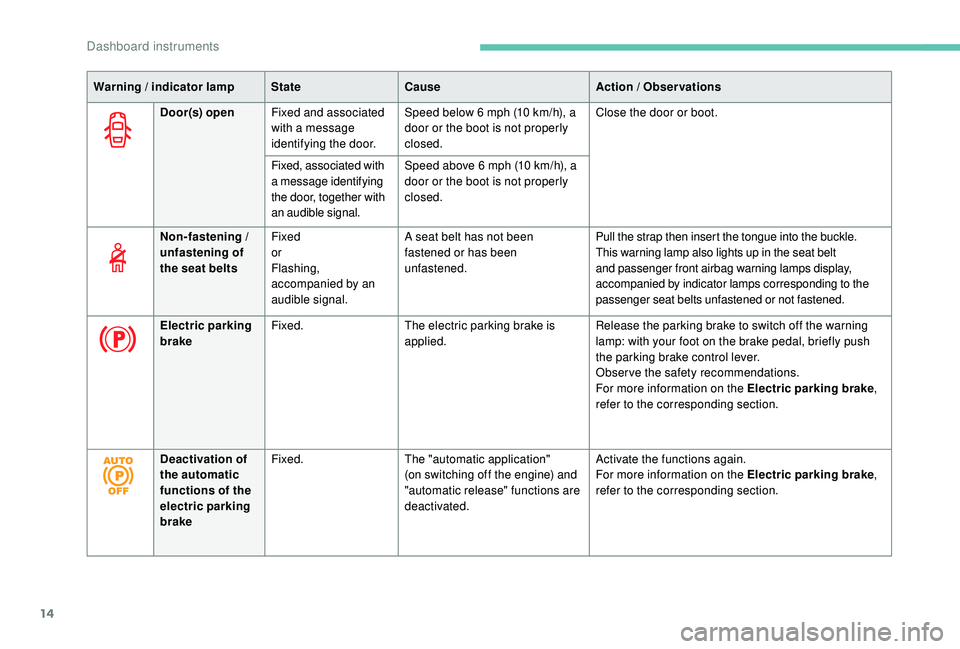
Door(s) open Fixed and associated
with a message
identifying the door. Speed below 6
mph (10 km/h), a
door or the boot is not properly
closed. Close the door or boot.
Fixed, associated with
a message identifying
the door, together with
an audible signal. Speed above 6
mph (10 km/h), a
door or the boot is not properly
closed.
Non-fastening /
unfastening of
the seat belts Fixed
or
Flashing,
accompanied by an
audible signal. A seat belt has not been
fastened or has been
unfastened.
Pull the strap then insert the tongue into the buckle.
This warning lamp also lights up in the seat belt
and passenger front airbag warning lamps display,
accompanied by indicator lamps corresponding to the
passenger seat belts unfastened or not fastened.
Electric parking
brake Fixed.
The electric parking brake is
applied. Release the parking brake to switch off the warning
lamp: with your foot on the brake pedal, briefly push
the parking brake control lever.
Observe the safety recommendations.
For more information on the Electric parking brake
,
refer to the corresponding section.
Deactivation of
the automatic
functions of the
electric parking
brake Fixed.
The "automatic application"
(on switching off the engine) and
"automatic release" functions are
deactivated. Activate the functions again.
For more information on the Electric parking brake
,
refer to the corresponding section.
Dashboard instruments
Page 20 of 404
18
Warning / indicator lampStateCause Action / Observations
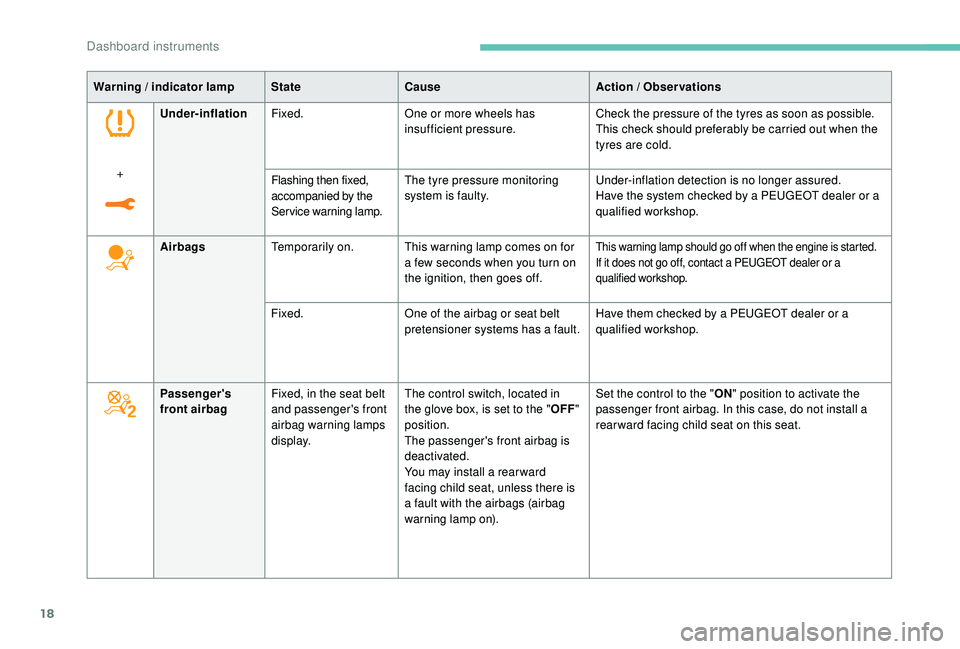
Airbags Temporarily on. This warning lamp comes on for
a few seconds when you turn on
the ignition, then goes off.
This warning lamp should go off when the engine is started.
If it does not go off, contact a PEUGEOT dealer or a
qualified workshop.
Fixed.One of the airbag or seat belt
pretensioner systems has a fault. Have them checked by a PEUGEOT dealer or a
qualified workshop.
Under-inflation
Fixed. One or more wheels has
insufficient pressure. Check the pressure of the tyres as soon as possible.
This check should preferably be carried out when the
tyres are cold.
+ Flashing then fixed,
accompanied by the
Service warning lamp.The tyre pressure monitoring
system is faulty.
Under-inflation detection is no longer assured.
Have the system checked by a PEUGEOT dealer or a
qualified workshop.
Passenger's
front airbag Fixed, in the seat belt
and passenger's front
airbag warning lamps
display. The control switch, located in
the glove box, is set to the "
OFF"
position.
The passenger's front airbag is
deactivated.
You may install a rear ward
facing child seat, unless there is
a fault with the airbags (airbag
warning lamp on). Set the control to the "
ON" position to activate the
passenger front airbag. In this case, do not install a
rear ward facing child seat on this seat.
Dashboard instruments
Page 21 of 404
19
Warning / indicator lampStateCause Action / Observations
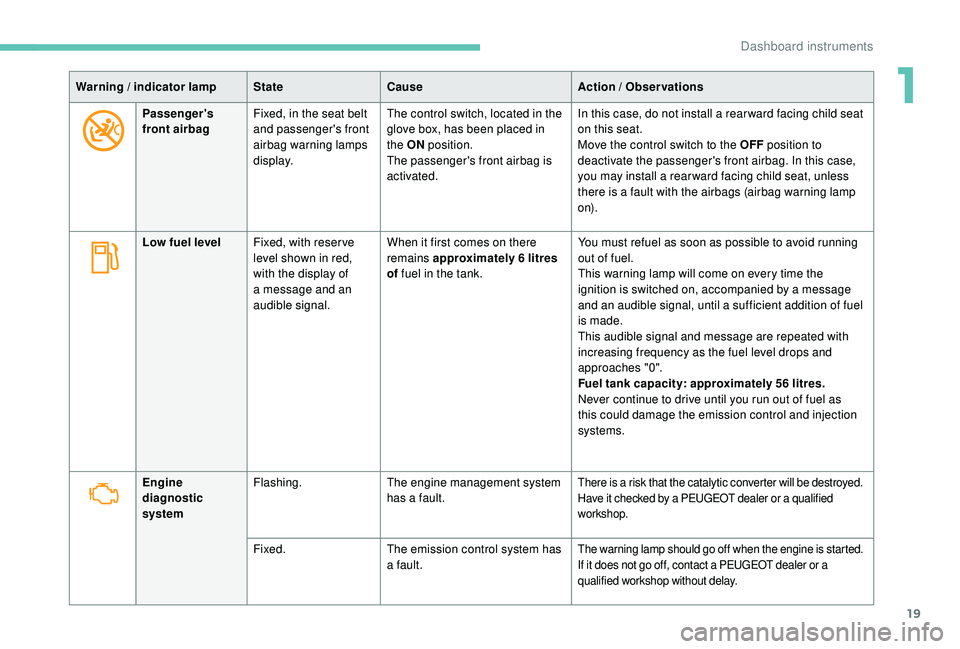
Passenger's
front airbag Fixed, in the seat belt
and passenger's front
airbag warning lamps
display. The control switch, located in the
glove box, has been placed in
the ON
position.
The passenger's front airbag is
activated. In this case, do not install a rear ward facing child seat
on this seat.
Move the control switch to the OFF
position to
deactivate the passenger's front airbag. In this case,
you may install a rear ward facing child seat, unless
there is a fault with the airbags (airbag warning lamp
o n).
Low fuel level Fixed, with reser ve
level shown in red,
with the display of
a message and an
audible signal. When it first comes on there
remains approximately 6
litres
of fuel in the tank. You must refuel as soon as possible to avoid running
out of fuel.
This warning lamp will come on every time the
ignition is switched on, accompanied by a message
and an audible signal, until a sufficient addition of fuel
is made.
This audible signal and message are repeated with
increasing frequency as the fuel level drops and
approaches "0".
Fuel tank capacity: approximately 56
litres.
Never continue to drive until you run out of fuel as
this could damage the emission control and injection
systems.
Engine
diagnostic
system Flashing.
The engine management system
has a fault.
There is a risk that the catalytic converter will be destroyed.
Have it checked by a PEUGEOT dealer or a qualified
workshop.
Fixed.The emission control system has
a fault.The warning lamp should go off when the engine is started.
If it does not go off, contact a PEUGEOT dealer or a
qualified workshop without delay.
1
Dashboard instruments
Page 155 of 404
153
Airbags
General information
System designed to contribute towards
improving the safety of the occupants (with
the exception of the centre rear passenger)
in the event of violent collisions. The airbags
supplement the action of the seat belts fitted
with force limiters (with the exception of the
centre rear passenger belt).
If a collision occurs, the electronic detectors
record and analyse the front and side impacts
sustained in the impact detection zones:
-
i
n the case of a serious impact, the airbags
are deployed instantly and contribute
towards better protection of the occupants
of the vehicle (with the exception of the
centre rear passenger); immediately after
the impact, the airbags deflate rapidly so
that they do not hinder visibility or the exit of
the occupants,
-
i
n the case of a minor or rear impact or
in certain rollover conditions, the airbags
may not be deployed; the seat belt
alone contributes towards ensuring your
protection in these situations.
The airbags do not operate when the
ignition is switched off.
This equipment will only deploy once. If a
second impact occurs (during the same or
a subsequent accident), the airbag will not
be deployed again.
Impact detection zones
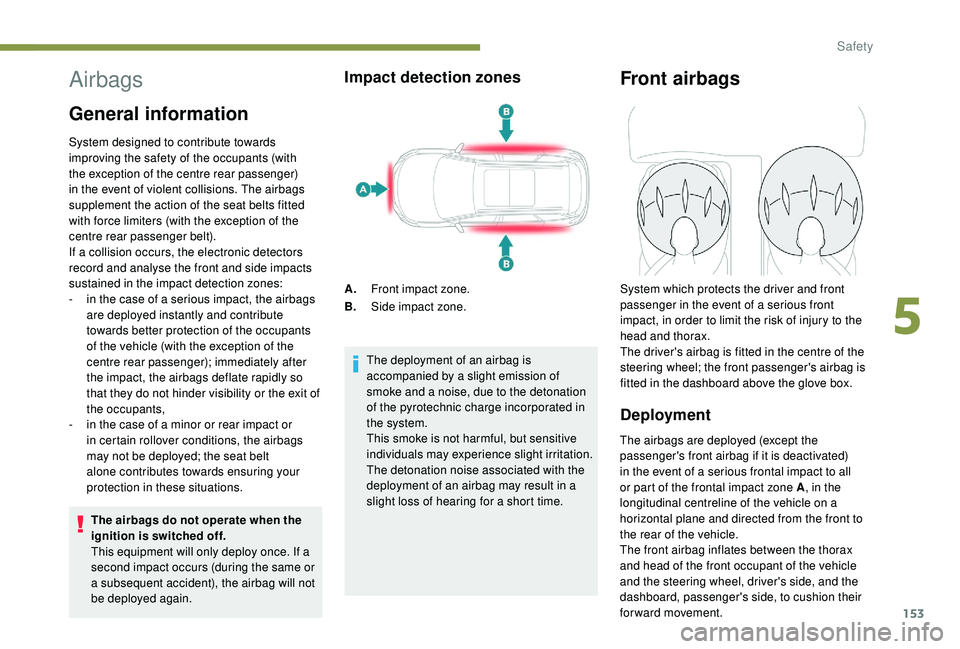
A. Front impact zone.
B. Side impact zone.
The deployment of an airbag is
accompanied by a slight emission of
smoke and a noise, due to the detonation
of the pyrotechnic charge incorporated in
the system.
This smoke is not harmful, but sensitive
individuals may experience slight irritation.
The detonation noise associated with the
deployment of an airbag may result in a
slight loss of hearing for a short time.
Front airbags
Deployment
The airbags are deployed (except the
passenger's front airbag if it is deactivated)
in the event of a serious frontal impact to all
or part of the frontal impact zone A , in the
longitudinal centreline of the vehicle on a
horizontal plane and directed from the front to
the rear of the vehicle.
The front airbag inflates between the thorax
and head of the front occupant of the vehicle
and the steering wheel, driver's side, and the
dashboard, passenger's side, to cushion their
for ward movement. System which protects the driver and front
passenger in the event of a serious front
impact, in order to limit the risk of injury to the
head and thorax.
The driver's airbag is fitted in the centre of the
steering wheel; the front passenger's airbag is
fitted in the dashboard above the glove box.
5
Safety
Page 156 of 404
154
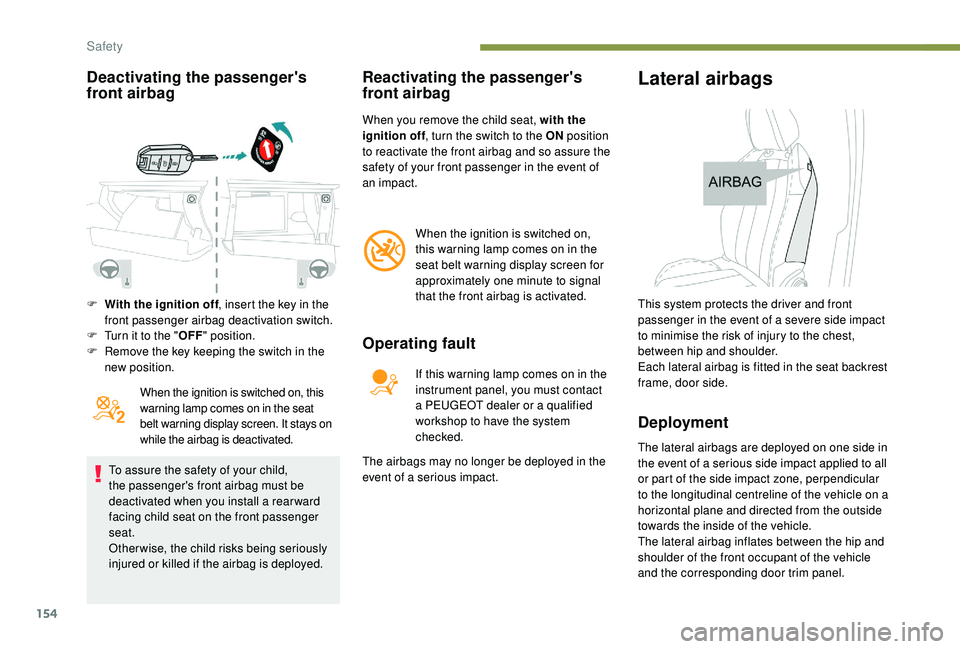
Deactivating the passenger's
front airbag
When the ignition is switched on, this
warning lamp comes on in the seat
belt warning display screen. It stays on
while the airbag is deactivated.
To assure the safety of your child,
the passenger's front airbag must be
deactivated when you install a rear ward
facing child seat on the front passenger
seat.
Otherwise, the child risks being seriously
injured or killed if the airbag is deployed.
Reactivating the passenger's
front airbag
When you remove the child seat, with the
ignition off , turn the switch to the ON position
to reactivate the front airbag and so assure the
safety of your front passenger in the event of
an impact.
When the ignition is switched on,
this warning lamp comes on in the
seat belt warning display screen for
approximately one minute to signal
that the front airbag is activated.
Operating fault
If this warning lamp comes on in the
instrument panel, you must contact
a PEUGEOT dealer or a qualified
workshop to have the system
checked.
The airbags may no longer be deployed in the
event of a serious impact.
Lateral airbags
Deployment
The lateral airbags are deployed on one side in
the event of a serious side impact applied to all
or part of the side impact zone, perpendicular
to the longitudinal centreline of the vehicle on a
horizontal plane and directed from the outside
towards the inside of the vehicle.
The lateral airbag inflates between the hip and
shoulder of the front occupant of the vehicle
and the corresponding door trim panel.
F
W
ith the ignition off
, insert the key in the
front passenger airbag deactivation switch.
F
T
urn it to the "
OFF" position.
F
R
emove the key keeping the switch in the
new position. This system protects the driver and front
passenger in the event of a severe side impact
to minimise the risk of injury to the chest,
between hip and shoulder.
Each lateral airbag is fitted in the seat backrest
frame, door side.
Safety
Page 159 of 404
157
General points relating to
child seats
* The legislation on carrying children is specific to each country. Consult the
legislation in force in your country.
Although one of the main criteria of PEUGEOT
when designing your vehicle, the safety of your
children also depends on you.
For maximum safety, please obser ve the
following recommendations:
-
I
n accordance with European regulations,
all children under the age of 12 or less
than one and a half metres tall must
travel in an approved child seat suited to
their weight and installed on a vehicle seat
fitted with a seat belt or ISOFIX mountings*.
-
S
tatistically, the safest seats in your
vehicle for carr ying children are the rear
seats.
-
A c
hild weighing less than 9 kg must
travel in the rear ward facing position
both in the front and in the rear. PEUGEOT recommends
that children
should travel on the rear seats of your
vehicle:
- "
rearward facing " up to the age of 3,
- "
forward facing " over the age of 3.
Child seat at the front
Refer to the current legislation in your country
before installing your child on this seat.
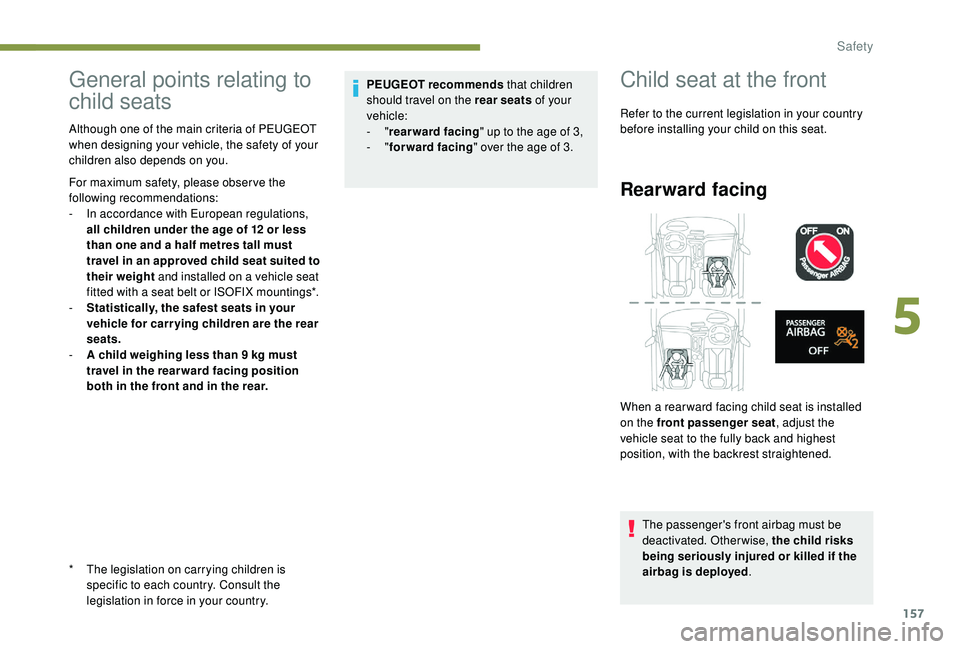
Rearward facing
When a rear ward facing child seat is installed
on the front passenger seat , adjust the
vehicle seat to the fully back and highest
position, with the backrest straightened.
The passenger's front airbag must be
deactivated. Otherwise, the child risks
being seriously injured or killed if the
airbag is deployed .
5
Safety
Page 166 of 404
164
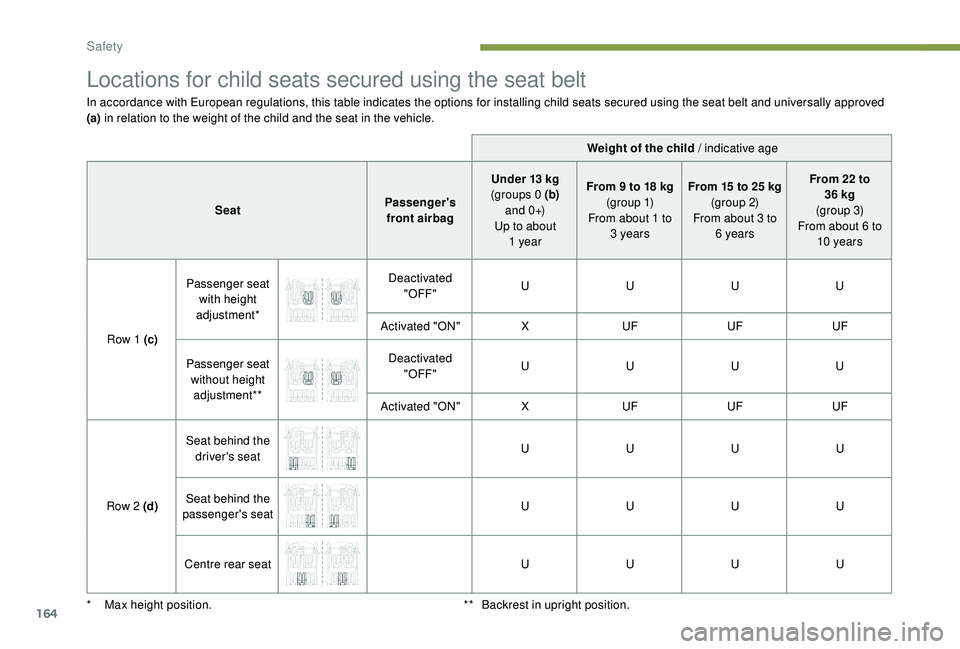
Locations for child seats secured using the seat belt
In accordance with European regulations, this table indicates the options for installing child seats secured using the seat belt and universally approved
(a) in relation to the weight of the child and the seat in the vehicle.
Weight of the child / indicative age
Seat Passenger's
front airbag Under 13
kg
(groups 0
(b)
a n d 0 +)
Up to about 1
yearFrom 9
to 18 kg
(g r o u p 1)
From about 1
to
3
yearsFrom 15
to 25 kg
(group 2)
From about 3
to
6
yearsFrom 22
to
36
kg
(group 3)
From about 6
to
10
years
Row 1
(c)Passenger seat
with height
adjustment* Deactivated
"OFF" U
UUU
Activated "ON" XUF UFUF
Passenger seat without height adjustment** Deactivated
"OFF" U
UUU
Activated "ON" XUF UFUF
Row 2
(d)Seat behind the
driver's seat U
UUU
Seat behind the
passenger's seat U
UUU
Centre rear seat UUUU
*
M
ax height position. **
B
ackrest in upright position.
Safety
Page 170 of 404
168
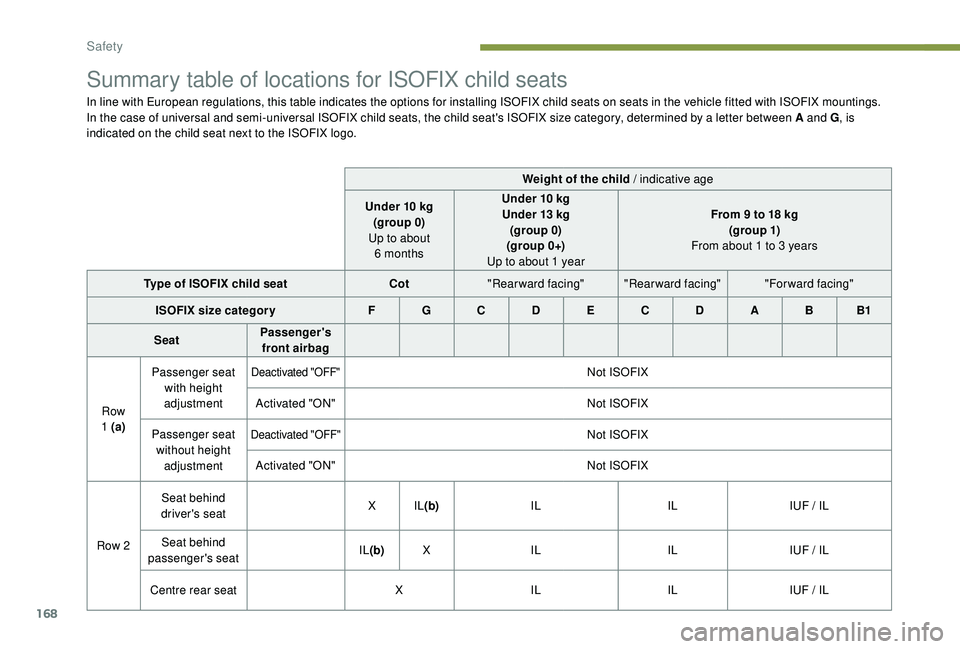
Summary table of locations for ISOFIX child seats
In line with European regulations, this table indicates the options for installing ISOFIX child seats on seats in the vehicle fitted with ISOFIX mountings.
In the case of universal and semi-universal ISOFIX child seats, the child seat's ISOFIX size category, determined by a letter between A and G, is
indicated on the child seat next to the ISOFIX logo.
Weight of the child / indicative age
Under 10
kg
(group 0)
Up to about 6
monthsUnder 10
kg
Under 13
kg
(group 0)
(group 0+)
Up to about 1
yearFrom 9
to 18 kg
(g ro up 1)
From about 1
to 3 years
Type of ISOFIX child seat Cot"Rearward facing" "Rearward facing" "Forward facing"
ISOFIX size categor y F G C D E C D A B B1
Seat Passenger's
front airbag
Row
1
(a) Passenger seat
with height
adjustment
Deactivated "OFF"Not ISOFIX
Activated "ON" Not ISOFIX
Passenger seat without height adjustment
Deactivated "OFF"Not ISOFIX
Activated "ON" Not ISOFIX
Row 2 Seat behind
driver's seat X
IL(b) IL ILIUF / IL
Seat behind
passenger's seat IL
(b) X IL ILIUF / IL
Centre rear seat XIL ILIUF / IL
Safety
Page 172 of 404
170
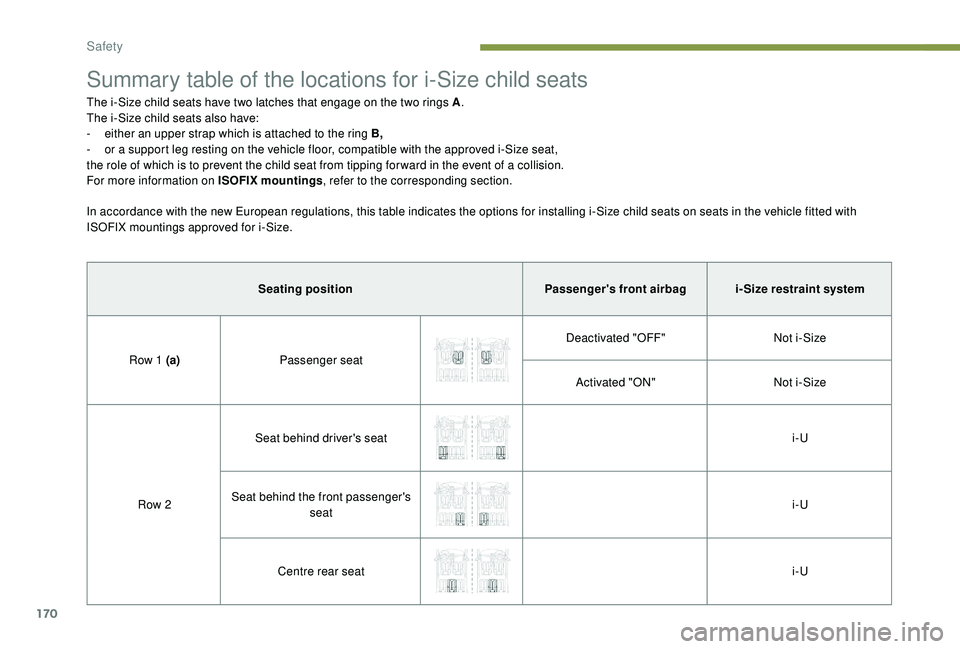
Summary table of the locations for i-Size child seats
The i-Size child seats have two latches that engage on the two rings A.
The i-Size child seats also have:
-
e
ither an upper strap which is attached to the ring B,
-
o
r a support leg resting on the vehicle floor, compatible with the approved i-Size seat,
the role of which is to prevent the child seat from tipping for ward in the event of a collision.
For more information on ISOFIX mountings , refer to the corresponding section.
In accordance with the new European regulations, this table indicates the options for installing i-Size child seats on seats in the vehicle fitted with
ISOFIX mountings approved for i-Size.
Seating position Passenger's front airbagi- Size restraint system
Row 1
(a) Passenger seat Deactivated "OFF"
Not i-Size
Activated "ON" Not i-Size
Row 2 Seat behind driver's seat
i-U
Seat behind the front passenger's seat i-U
Centre rear seat i-U
Safety
Page 174 of 404
172
The incorrect installation of a child seat in a
vehicle compromises the child's protection in
the event of an accident.
Check that there is no seat belt or seat belt
buckle under the child seat as this could
make it unstable.
Remember to fasten the seat belts or the
child seat harnesses keeping the slack
relative to the child's body to a minimum,
even for short journeys.
When installing a child seat using the seat
belt, ensure that the seat belt is tightened
correctly on the child seat and that it secures
the child seat firmly on the seat of your
vehicle. If your passenger seat is adjustable,
move it for wards if necessary.
At rear seating positions, always leave
sufficient space between the front seat and:
-
a "
rear ward facing" child seat,
-
t
he feet of a child seated in a "for ward
facing" child seat.
For this, move the seat for ward and, if
necessary, straighten its backrest too.
For optimal installation of the "forward facing"
child seat, verify that its backrest is as close
as possible to the backrest of the vehicle
seat, if possible in contact with it.
Advice
The head restraint must be removed before
installing a child seat with a backrest on a
passenger seat.
Ensure that the head restraint is stored or
attached securely to prevent it from being
thrown around the vehicle in the event of
sharp braking. Refit the head restraint once
the child seat has been removed. PEUGEOT recommends using a booster seat
with a backrest, equipped with a belt guide at
shoulder level.
As a safety precaution, do not leave:
-
a c
hild or children alone and unattended in
a vehicle,
-
a c
hild or an animal in a vehicle under the
sun, with the windows closed,
-
t
he keys within the reach of children inside
the vehicle.
To prevent accidental opening of the doors
and rear windows, use the child lock.
Take care not to open the rear windows by
more than one third.
To protect young children from the rays of the
sun, fit side blinds on the rear windows.
Children in front
The legislation on carrying children on the
front passenger seat is specific to each
country. Refer to the legislation in force in
your country.
Deactivate the passenger's front airbag when
a rear ward facing child seat is installed on the
front passenger seat.
Otherwise, the child risks being seriously
injured or killed if the airbag is deployed.
Installing a booster seat
The chest part of the seat belt must be
positioned on the child's shoulder without
touching the neck.
Ensure that the lap part of the seat belt
passes correctly over the child's thighs.
Safety