towing PEUGEOT 5008 2018 Owner's Manual
[x] Cancel search | Manufacturer: PEUGEOT, Model Year: 2018, Model line: 5008, Model: PEUGEOT 5008 2018Pages: 364, PDF Size: 13.03 MB
Page 227 of 364
225
Following use
When travelling without a trailer or load
on a
towbar-mounted carrier, the towball
must be removed and the protective plug
inserted in the carrier. This measure
applies particularly where the towball
might obscure visibility of the number
plate or its lighting.
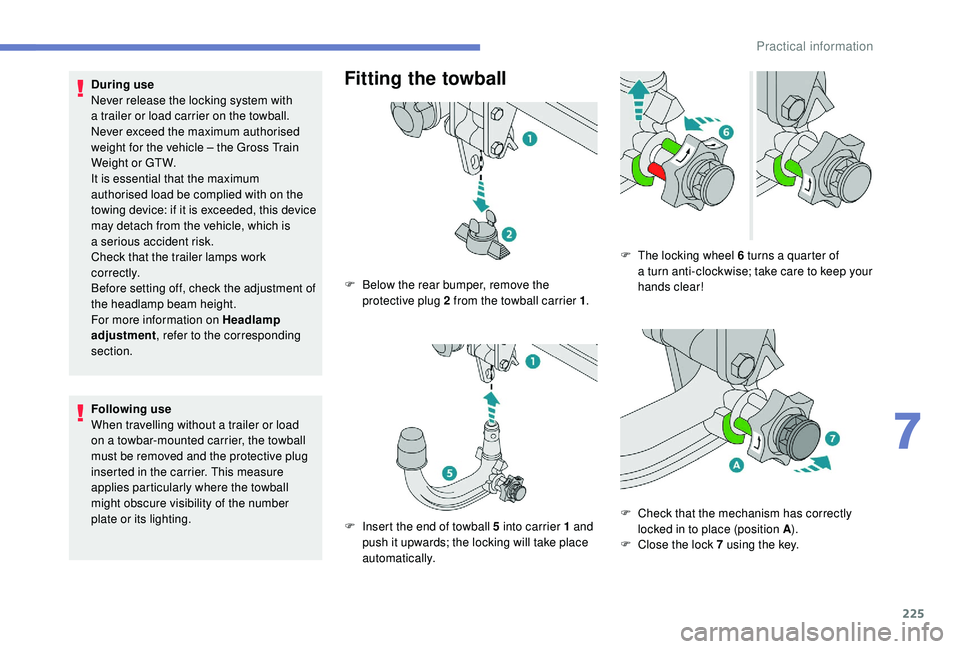
Fitting the towballDuring use
Never release the locking system with
a
trailer or load carrier on the towball.
Never exceed the maximum authorised
weight for the vehicle – the Gross Train
Weight or GTW.
It is essential that the maximum
authorised load be complied with on the
towing device: if it is exceeded, this device
may detach from the vehicle, which is
a
serious accident risk.
Check that the trailer lamps work
c o r r e c t l y.
Before setting off, check the adjustment of
the headlamp beam height.
For more information on Headlamp
adjustment , refer to the corresponding
section. F
B
elow the rear bumper, remove the
protective plug 2
from the towball carrier 1.
F
I
nsert the end of towball 5 into carrier 1 and
push it upwards; the locking will take place
automatically. F
T
he locking wheel 6 turns a quarter of
a
turn anti-clockwise; take care to keep your
hands clear!
F
C
heck that the mechanism has correctly
locked in to place (position A ).
F
C
lose the lock 7 using the key.
7
Practical information
Page 230 of 364
228
A flat battery prevents the engine from
starting.
For more information on the 12 V batter y,
refer to the corresponding section.
-
f
or more than ten minutes, to use the
equipment for up to approximately thirty
minutes.
Let the engine run for the duration specified to
ensure that the battery charge is sufficient.
Do not repeatedly and continuously restart the
engine in order to charge the battery.
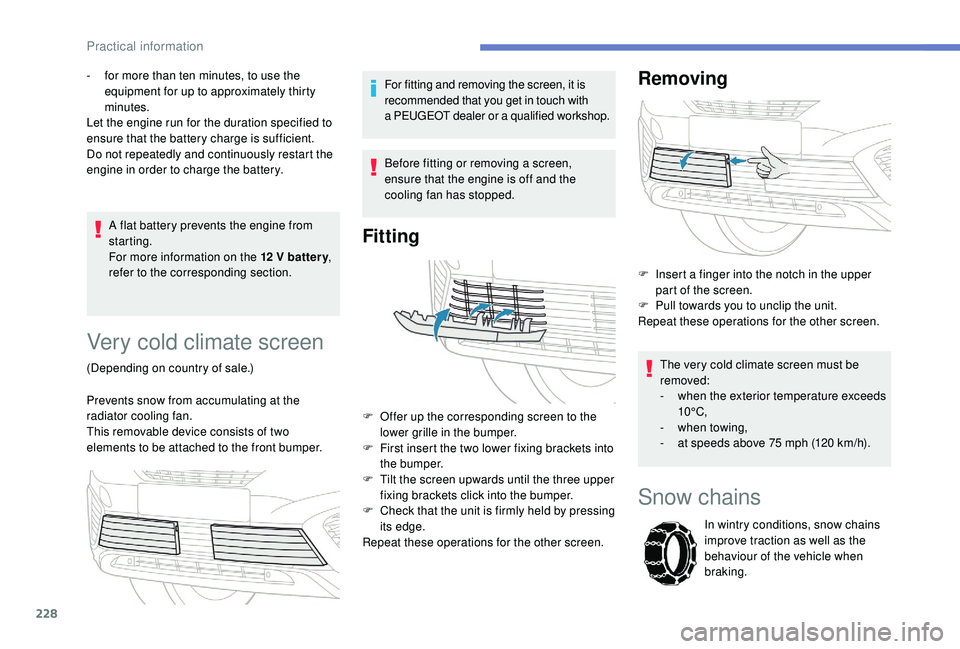
Very cold climate screen
(Depending on country of sale.)
Prevents snow from accumulating at the
radiator cooling fan.
This removable device consists of two
elements to be attached to the front bumper. For fitting and removing the screen, it is
recommended that you get in touch with
a
PEUGEOT dealer or a qualified workshop.
Before fitting or removing a screen,
ensure that the engine is off and the
cooling fan has stopped.
Fitting
F Offer up the corresponding screen to the lower grille in the bumper.
F
F
irst insert the two lower fixing brackets into
the bumper.
F
T
ilt the screen upwards until the three upper
fixing brackets click into the bumper.
F
C
heck that the unit is firmly held by pressing
its edge.
Repeat these operations for the other screen.
Removing
F Insert a finger into the notch in the upper
part of the screen.
F
P
ull towards you to unclip the unit.
Repeat these operations for the other screen.
The very cold climate screen must be
removed:
-
w
hen the exterior temperature exceeds
10°C,
-
w
hen towing,
-
a
t speeds above 75 mph (120 km/h).
Snow chains
In wintry conditions, snow chains
improve traction as well as the
behaviour of the vehicle when
braking.
Practical information
Page 243 of 364
241
With 2.0 HDi engines
F Fill the fuel tank with at least five litres of Diesel.
F
O
pen the bonnet.
F
I
f necessary, unclip the cover to access the
priming pump.
F
L
oosen the degassing screw.
F
U
se the priming pump until fuel appears in
the transparent tube.
F
R
etighten the degassing screw.
F
O
perate the starter until the engine starts (if
the engine does not start at the first attempt,
wait around 15
seconds before trying
again).
F
I
f the engine does not start after a few
attempts, operate the priming pump again
then start the engine.
F
P
ut it back in place, clip in the cover and
ensure it is clipped in.
F
C
lose the bonnet.
Tool kit
This is a set of tools provided with the vehicle.
I ts content depends on your vehicle's
equipment:
-
t
emporary puncture repair kit,
-
spar
e wheel.
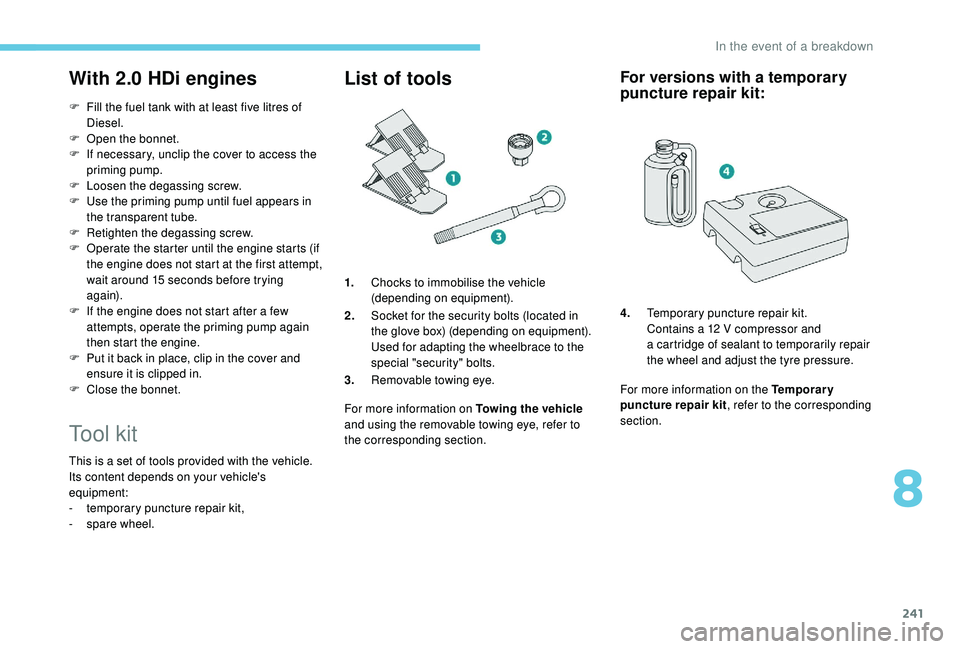
List of tools
1.Chocks to immobilise the vehicle
(depending on equipment).
2. Socket for the security bolts (located in
the glove box) (depending on equipment).
Used for adapting the wheelbrace to the
special "security" bolts.
3. Removable towing eye.
For more information on Towing the vehicle
and using the removable towing eye, refer to
the corresponding section.
For versions with a temporary
p uncture repair kit:
4. Temporary puncture repair kit.
Contains a
12 V compressor and
a
cartridge of sealant to temporarily repair
the wheel and adjust the tyre pressure.
For more information on the Temporary
puncture repair kit , refer to the corresponding
section.
8
In the event of a breakdown
Page 244 of 364
242
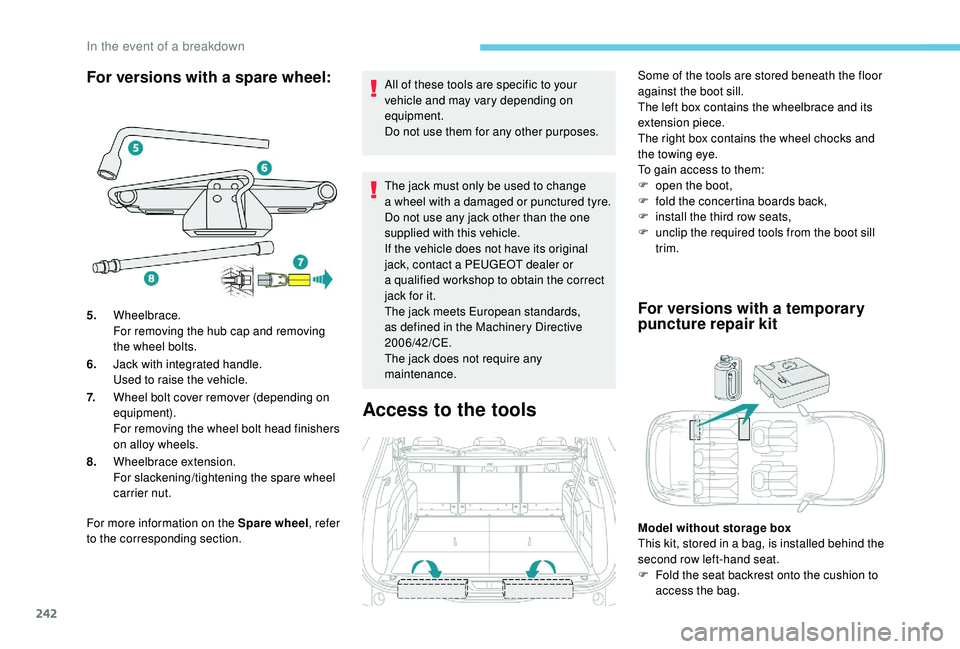
For versions with a spare wheel:
For more information on the Spare wheel, refer
to the corresponding section. All of these tools are specific to your
vehicle and may vary depending on
equipment.
Do not use them for any other purposes.
The jack must only be used to change
a
wheel with a damaged or punctured tyre.
Do not use any jack other than the one
supplied with this vehicle.
If the vehicle does not have its original
jack, contact a PEUGEOT dealer or
a qualified workshop to obtain the correct
jack for it.
The jack meets European standards,
as defined in the Machinery Directive
2006/42/CE.
The jack does not require any
maintenance.
Access to the tools
Some of the tools are stored beneath the floor
against the boot sill.
The left box contains the wheelbrace and its
extension piece.
The right box contains the wheel chocks and
the towing eye.
To gain access to them:
F
o
pen the boot,
F
fo
ld the concertina boards back,
F
i
nstall the third row seats,
F
u
nclip the required tools from the boot sill
trim.
5. Wheelbrace.
For removing the hub cap and removing
the wheel bolts.
6. Jack with integrated handle.
Used to raise the vehicle.
7. Wheel bolt cover remover (depending on
equipment).
For removing the wheel bolt head finishers
on alloy wheels.
8. Wheelbrace extension.
For slackening/tightening the spare wheel
carrier nut.
For versions with a temporary
p uncture repair kit
Model without storage box
This kit, stored in a
bag, is installed behind the
second row left-hand seat.
F
F
old the seat backrest onto the cushion to
access the bag.
In the event of a breakdown
Page 267 of 364
265
For right-hand drive vehicles, when the
total distance recorder has reached
62 miles (100 km), it is necessary to wait
approx. 15
minutes before starting the
engine.
However, if minor problems persist following
this operation, contact a
PEUGEOT dealer or
a
qualified workshop.
Referring to the corresponding section, you
must yourself reinitialise or reset certain
systems, such as:
-
t
he key with remote control or electronic key
(depending on version),
-
t
he sunroof and its electric blind,
-
t
he electric windows,
-
t
he date and time,
-
t
he preset radio stations. The Stop & Start system may not be
operational during the trip following the
first engine start.
In this case, the system will only be
available again after a
continuous
period of immobilisation of the vehicle,
a period which depends on the exterior
temperature and the state of charge of the
battery (up to about 8 hours).
Do not force the lever as locking will not
be possible if the clamp is not positioned
correctly; start the procedure again.
Following reconnection of the
battery
After reconnecting the battery, turn on the
ignition and wait 1
minute before starting
the engine, in order to enable the electronic
systems to initialise.
Towing the vehicle
Procedure for having your vehicle towed or
for towing another vehicle using a removable
towing eye.
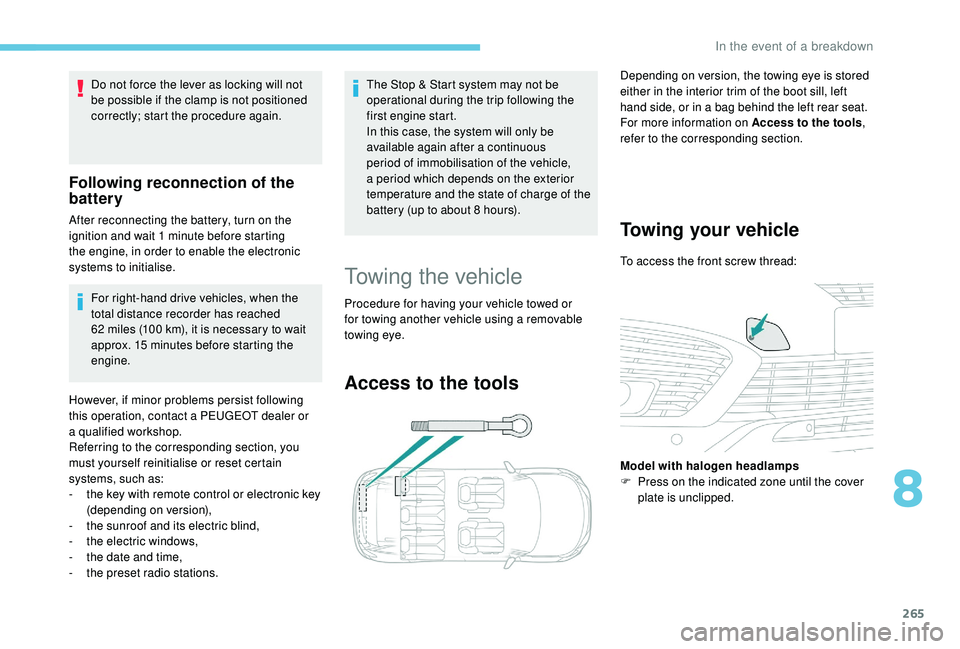
Access to the tools
Depending on version, the towing eye is stored
either in the interior trim of the boot sill, left
hand side, or in a
bag behind the left rear seat.
For more information on Access to the tools ,
refer to the corresponding section.
Towing your vehicle
To access the front screw thread:
Model with halogen headlamps
F
P
ress on the indicated zone until the cover
plate is unclipped.
8
In the event of a breakdown
Page 268 of 364
266
F Screw in the towing eye until it tightens fully.
F I nstall the towbar.
F
P
lace the gearbox in neutral.
Failure to follow this instruction could
result in damage to some components
(brakes, transmission, etc.) and the
absence of braking assistance when the
engine is restarted.
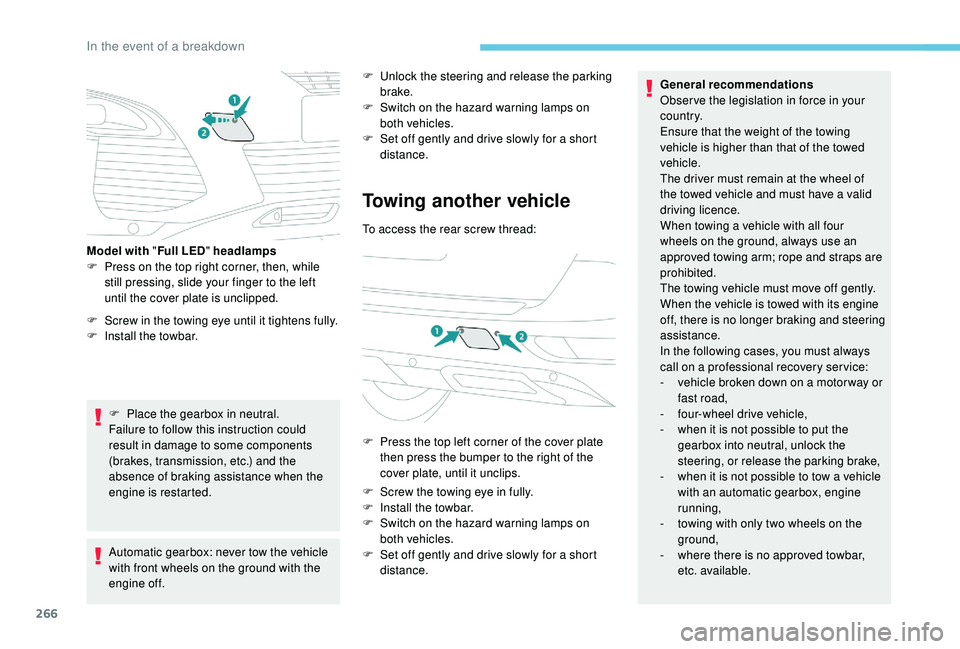
Model with "
Full LED" headlamps
F
P
ress on the top right corner, then, while
still pressing, slide your finger to the left
until the cover plate is unclipped.
Automatic gearbox: never tow the vehicle
with front wheels on the ground with the
engine off. F
U
nlock the steering and release the parking
brake.
F
S
witch on the hazard warning lamps on
both vehicles.
F
S
et off gently and drive slowly for a short
distance.
Towing another vehicle
To access the rear screw thread:
F
P
ress the top left corner of the cover plate
then press the bumper to the right of the
cover plate, until it unclips.
F
S
crew the towing eye in fully.
F
I
nstall the towbar.
F
S
witch on the hazard warning lamps on
both vehicles.
F
S
et off gently and drive slowly for a short
distance. General recommendations
Obser ve the legislation in force in your
c o u nt r y.
Ensure that the weight of the towing
vehicle is higher than that of the towed
vehicle.
The driver must remain at the wheel of
the towed vehicle and must have a
valid
driving licence.
When towing a vehicle with all four
wheels on the ground, always use an
approved towing arm; rope and straps are
prohibited.
The towing vehicle must move off gently.
When the vehicle is towed with its engine
off, there is no longer braking and steering
assistance.
In the following cases, you must always
call on a
professional recovery ser vice:
-
v
ehicle broken down on a motor way or
fast road,
-
f
our-wheel drive vehicle,
-
w
hen it is not possible to put the
gearbox into neutral, unlock the
steering, or release the parking brake,
-
w
hen it is not possible to tow a vehicle
with an automatic gearbox, engine
running,
-
t
owing with only two wheels on the
ground,
-
w
here there is no approved towbar,
etc. available.
In the event of a breakdown
Page 269 of 364
267
Engine technical data and
towed loads
Engines
The engine characteristics are given in the
vehicle's registration document, as well as in
sales brochures.The maximum power corresponds to the
value type-approved on a
test bed, under
conditions defined in European legislation
(Directive 1999/99/EC).
For more information, contact a
PEUGEOT
dealer or a
qualified workshop.
Weights and towed loads
The weights and towed loads relating to your
vehicle are given in the registration document,
as well as in sales brochures.
These values are also given on the
manufacturer's plate or label.
For more information, contact a PEUGEOT
dealer or a
qualified workshop. The GTW values and the towable loads
listed are valid for a
maximum altitude of
1,000 metres. The towable load must be
reduced by steps of 10% for each additional
1,000
metres.
The maximum authorised nose weight
corresponds to the weight permitted on the
towbar.
GT W: Gross train weight.
When exterior temperatures are high,
the vehicle per formance may be limited
in order to protect the engine. When the
exterior temperature is higher than 37°C,
limit the towed weight.
Towing using a lightly loaded vehicle can
adversely affect roadholding.
Braking distances are increased when
towing a trailer.
When using a
vehicle to tow, never
exceed a
speed of approximately 60 mph
(100
km/h) (obser ve the local legislation in
f o r c e). If the exterior temperature is high, it is
recommended that the engine be allowed
to idle for 1
to 2 minutes after the vehicle
comes to a stop, to facilitate its cooling.
9
Technical data
Page 359 of 364
279
V
W
U
Ventilation ........................................... 84- 88, 92
Very cold climate screen (snow shield) ........228
Visibility
...............
............................................ 93
Vision, 180° for ward
..................................... 210
Visiopark
....................................................... 2
07
Visiopark 1 - Visiopark 2
...............................210
Voice commands
......................................... 5 -10
Warning and indicator lamps
.......................... 11
W
arning lamp, braking system
..................14 -15
Warning lamp, Diesel engine pre-heater
.......23
Warning lamp, driver's seat belt not fastened
...............................
..........132
Warning lamps
.................................... 11, 14, 35
Warning lamp, seat belts
..............................132
Warning lamp, Service ....................................16
Weights
...............
...........................267-269, 271
Welcome lighting ..................................... 4 8 , 11 6
Wheel, spare
.................. 2
36, 241-243, 246 -249
Window controls
............................................. 63
Windscreen, heated
.................................. 93-94
Wiper blades (changing)
.......................120, 257
Wiper, rear .............................................. 11 9 -12 0
Wipers
............................................. 24, 119, 121
Wipers, automatic rain sensitive
...........11 9 , 12 1
Under-inflation (detection)
............................
174
Unlocking
..................................................
46, 49
Unlocking from the inside ...............................
55
Unlocking the boot
...............................
.....
48-49
Unlocking the doors
........................................ 60
U
nlocking the tailgate
...............................
4
8-49
Updating the date
...................................... 3
1, 18
Updating the time
...............................
.......
31, 17
USB
...................................................
23 -24, 9, 7
Table position
.............................................
70 -71
Tables, aircraft
..............................................
107
Tables of fuses
..............................................
261
Tailgate
................
............................................
59
Ta n k , f u e l
...............................................
220-221
Technical data
............................... 26
8-269, 271
Telephone
...... 10
1-102, 25 -29, 13 -16, 10 -11, 13
Telephone, Bluetooth with voice recognition
................................... 14
T
emperature, coolant
......................................
32
Third brake lamp
...........................................
256
Three flashes (direction indicators) .............. 11
3
Ticket holder
...................................................
99
Time (setting)
................................ 38 - 40, 31, 17
TMC (Traffic info)
............................................ 13
T
o o l s
....................................... 241-243, 246 -248
Total distance recorder
............................. 35-36
Touch screen ......................................... 101, 1, 1
Touch screen ~ Touch screen tablet
................................................. 40, 42, 44
Towball, quickly detachable
.................. 224-227
To w b a r
...............................
..... 127, 15 5 -15 6, 2 23
Towed loads
................................... 267-269, 271
Towing another vehicle
......................... 265-266
Traction control (ASR)
........................... 125 -12 9
Traffic information (TA)
..................................... 5
Traffic information (TMC)
................................ 13
Tr a i l e r
...............
...................... 127, 15 5 -15 6, 2 23
Trailer stability assist (TSA)
.......................... 12
7
Trajectory control systems
............................ 12
5
Triangle, warning ........................................... 240
Trip computer
............................................. 37- 3 8
Trip distance recorder
............................... 35
-36
Ty r e s
.............................................................. 236
Tyre under-inflation detection
......... 18, 174, 246
T
.
Alphabetical index