engine Peugeot 508 2012 Repair Manual
[x] Cancel search | Manufacturer: PEUGEOT, Model Year: 2012, Model line: 508, Model: Peugeot 508 2012Pages: 340, PDF Size: 11.11 MB
Page 137 of 340
5
135
i
ii
Visibility
Lighting left on audible signal
An audible signal when a front door is opened warns the driver that the vehicle's exterior lighting is on, with theignition off and in manual lighting mode.
In this case, switching off the lighting stops the audible signal.
With the ignition off, if the dipped headlamps remain on, the vehicle goes into "ECO" mode to avoid discharging the battery.
In some weather conditions (e.g. lowtemperature or humidity), the presenceof misting on the internal sur face of the glass of the headlamps and rear lamps is normal; it disappears after the lampshave been on for a few minutes.
Daytime lighting, compulsory in cer tain
countries, which comes on automatically when
the engine is star ted making the vehicle more
visible to other road users.
Daytime running lamps
This function is assured:
- in countries where it is imposed by
regulations, by illumination of the dippedbeam headlamps with the sidelamps and number plate lamps.
- for other countries where it is provided,
by the use of dedicated lamps.
This function can be activatedor deactivated via the vehicleconfiguration menu.
The lighting goes off when you switchoff the ignition, but you can always switch it on again using the lighting control stalk.
Page 149 of 340
5
147
i!
Visibility
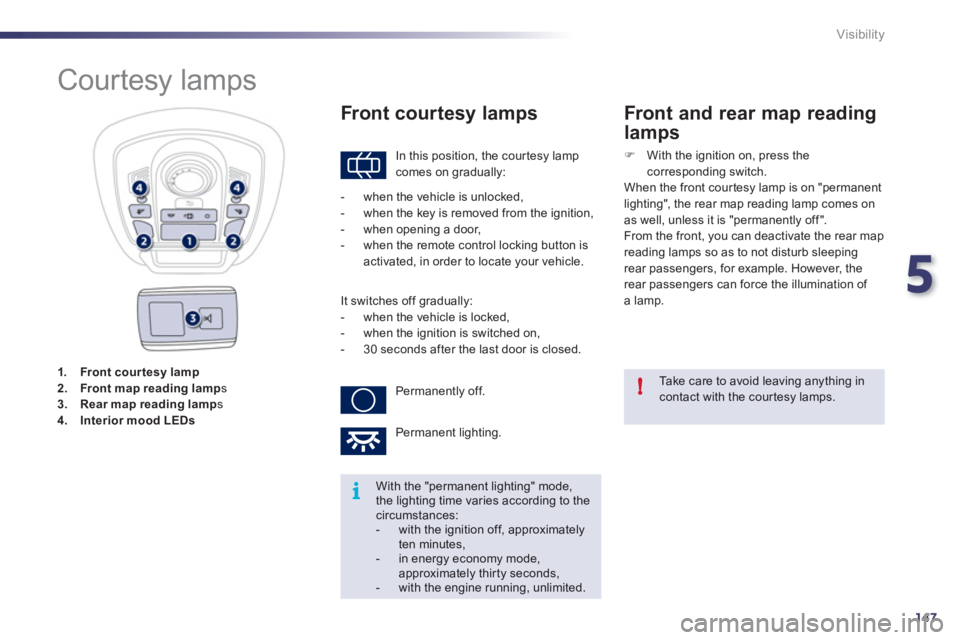
1.Front cour tesy lamp2.Front map reading lamps 3.Rear map reading lamp s4.Interior mood LEDs
Courtesy lamps
In this position, the cour tesy lamp comes on gradually:
Front courtesy lamps
Take care to avoid leaving anything in contact with the cour tesy lamps.
With the "permanent lighting" mode, the lighting time varies according to thecircumstances: - with the ignition off, approximatelyten minutes,- in energy economy mode, approximately thirty seconds,- with the engine running, unlimited.
- when the vehicle is unlocked,
- when the ke
y is removed from the ignition,
- when opening a door,
- when the remote control locking button is
activated, in order to locate your vehicle.
It switches off
gradually:
- when the vehicle is locked,
- when the ignition is switched on,
- 30 seconds after the last door is closed.
Permanentl
y off.
Permanent lighting.
Front and rear map reading
lamps
)
With the ignition on, press the
corresponding switch.
When the front courtesy lamp is on "permanent
lighting", the rear map reading lamp comes on
as well, unless it is "permanentl
y off".
From the front, you can deactivate the rear map
reading lamps so as to not disturb sleeping
rear passengers, for example. However, the
rear passengers can force the illumination of
a lamp.
Page 166 of 340
164
Safety
Electronic Stability Programme (ESC: Electronic Stability Control) incorporating the
following systems:
- the anti-lock braking system (ABS) and
the electronic brake force distribution (EBFD),
- the emergency braking assistance,
- the anti-slip re
gulation (ASR) or traction control,
- the dynamic stability control (DSC).
Electronic stability programme (ESC)
Definitions
Anti-lock braking system (ABS)
and electronic brake force
distribution
(EBFD)
This system improves the stability and
manoeuvrability of your vehicle when braking
and offers improved control in corners,
in par ticular on poor or slippery road surfaces.
The ABS prevents wheel lock in the event of emergency braking.
The electronic brake force distribution system
manages the braking pressure wheel by wheel.
Emergency braking assistance
In an emergency, this system enables you to reach the optimum braking pressure more quickly and therefore reduce the stoppingdistance.
It is triggered in relation to the speed at which
the brake pedal is pressed. This is
felt by areduction in the resistance of the pedal and an
increase in the effectiveness of the braking.
Anti-skid regulation (ASR)
The ASR system (also known as Traction Control) optimises traction in order to avoid
wheel slip by acting on the brakes of the drivingwheels and on the engine. It also improves
the directional stability of the vehicle onacceleration.
Dynamic stability control (DSC)
If there is a difference between the pathfollowed by the vehicle and that required bythe driver, the DSC monitors each wheel and
automatically acts on the brake of one or more
wheels and on the engine to return the vehicle
to the re
quired path, within the limits of the laws
of physics.
Page 168 of 340
166
!
Safety
Dynamic stability control (DSC)
Activation
This system is activated automatically each
time the vehicle is started.
It comes into operation in the event of a grip or
trajectory problem.
This is indicated b
y flashing of this
warning lamp in the instrument panel.
Deactivation
In exceptional conditions (starting a vehicle
which is bogged down, stuck in snow, on softground...), it may be advisable to deactivate
the DSC system, so that the wheels can move
freely and regain grip.
The DSC system offers exceptional safety in normal driving, but this should not encourage the driver to take extra risks or drive at high speed.
The correct operation of the system depends on obser vation of the manufacturer's recommendationsregarding the wheels (tyres and rims),the braking components, the electronic components and the PEUGEOTassembly and operation procedures.
After an impact, have the systemchecked by a PEUGEOT dealer or a qualified workshop.
Operating fault
If this warning lamp comes on,
accompanied by an audible signal
and a messa
ge in the instrument
panel screen, this indicates a fault
with the system.
Contact a PEUGEOT dealer or a qualified
workshop to have the system checked.
Reactivation
The system is reactivated automatically eachtime the ignition is switched back on or from
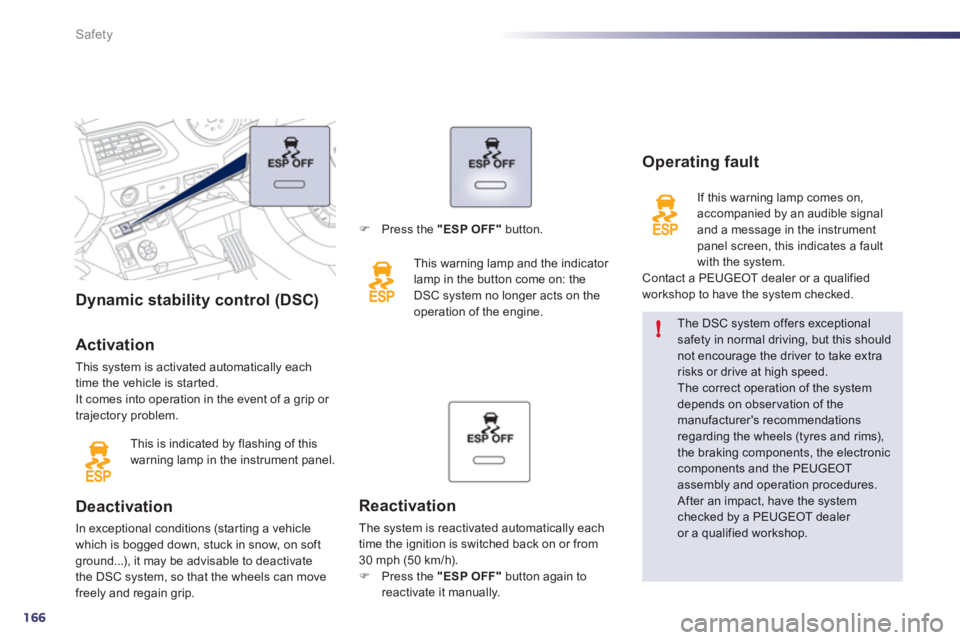
30 mph (50 km/h).) Press the "ESP OFF"
button again to
reactivate it manually.
) Press the "ESP OFF"
button.
This warnin
g lamp and the indicator
lamp in the button come on: the
D
SC system no longer acts on the
operation of the engine.
Page 178 of 340
176
!i!
Practical information
Repair procedure
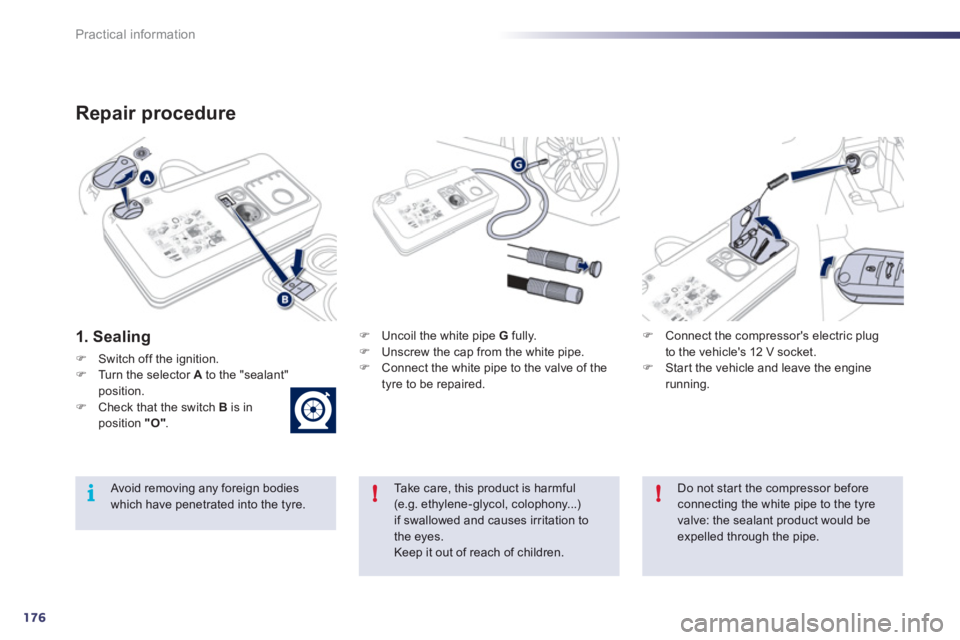
1. Sealing
)Switch off the ignition.)Turn the selector Ato the "sealant"position.)Check that the switch B is in position "O".
)
Uncoil the white pipe G
fully.)
Unscrew the cap from the white pipe.)
Connect the white pipe to the valve of the
tyre to be repaired.
)Connect the compressor's electric plug
to the vehicle's 12 V socket. )Star t the vehicle and leave the engine running.
Take care, this product is harmful(e.g. ethylene-glycol, colophony...) if swallowed and causes irritation to the eyes. Keep it out of reach of children.
Avoid removing any foreign bodieswhich have penetrated into the tyre.
Do not star t the compressor before connecting the white pipe to the tyre valve: the sealant product would be expelled through the pipe.
Page 180 of 340
178
!
Practical information
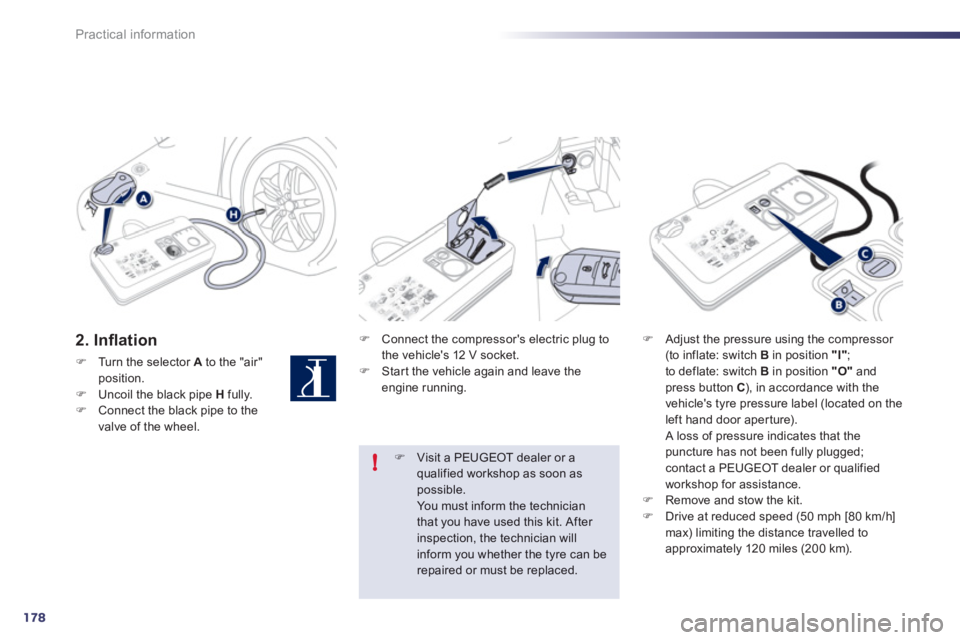
2. Infl ation
)Turn the selector Ato the "air" position.)Uncoil the black pipe Hfully. )Connect the black pipe to the
valve of the wheel.
) Connect the compressor's electric plug to
the vehicle's 12 V socket.) Star t the vehicle again and leave the engine running.
)Adjust the pressure using the compressor (to inflate: switch B
in position "I"
;
to deflate: switch B in position "O"and press button C ), in accordance with the
vehicle's tyre pressure label (located on the
left hand door aper ture).
A loss of pressure indicates that thepuncture has not been fully plugged; contact a PEUGEOT dealer or qualified
workshop for assistance.)Remove and stow the kit.)Drive at reduced speed (50 mph [80 km/h] max) limiting the distance travelled to
approximately 120 miles (200 km).
)Visit a PEUGEOT dealer or aqualified workshop as soon aspossible. You must inform the technician that you have used this kit. After
inspection, the technician willinform you whether the tyre can berepaired or must be replaced.
Page 181 of 340
8
179
!
Practical information
Removing the cartridge
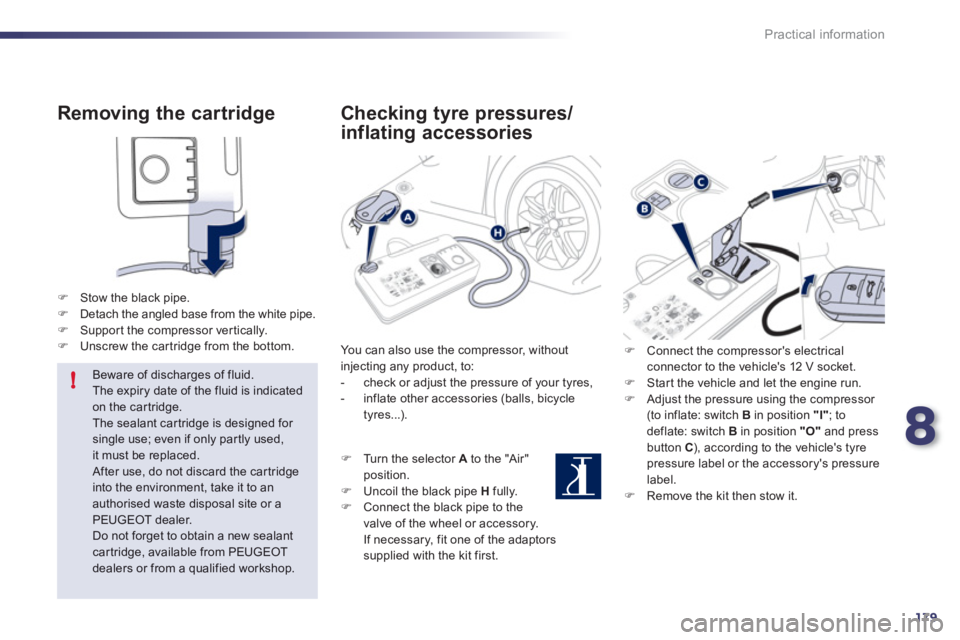
)Stow the black pipe. )Detach the angled base from the white pipe.)Suppor t the compressor ver tically.)Unscrew the car tridge from the bottom.
Beware of discharges of fluid.
The expiry date of the fluid is indicated on the car tridge.The sealant car tridge is designed for
single use; even if only partly used,it must be replaced. After use, do not discard the car tridgeinto the environment, take it to an authorised waste disposal site or a PEUGEOT dealer.
Do not forget to obtain a new sealantcartridge, available from PEUGEOT dealers or from a qualified workshop.
Checking tyre pressures/
inflating accessories
You can also use the compressor, withoutinjecting any product, to:
- check or adjust the pressure of your tyres,
- inflate other accessories (balls, bicycle
tyres...).
)
Turn the selector Ato the "Air"
position.
) Uncoil the black pipe H
fully.)
Connect the black pipe to the
valve of the wheel or accessory.
If necessary, fit one of the adaptorssupplied with the kit first.
) Connect the compressor's electrical connector to the vehicle's 12 V socket. )
Star t the vehicle and let the engine run. )
Adjust the pressure using the compressor (to inflate: switch B
in position "I"
; to deflate: switch B
in position "O"and press button C), according to the vehicle's tyrepressure label or the accessory's pressure
label. ) Remove the kit then stow it.
Page 201 of 340
8
199
Practical information
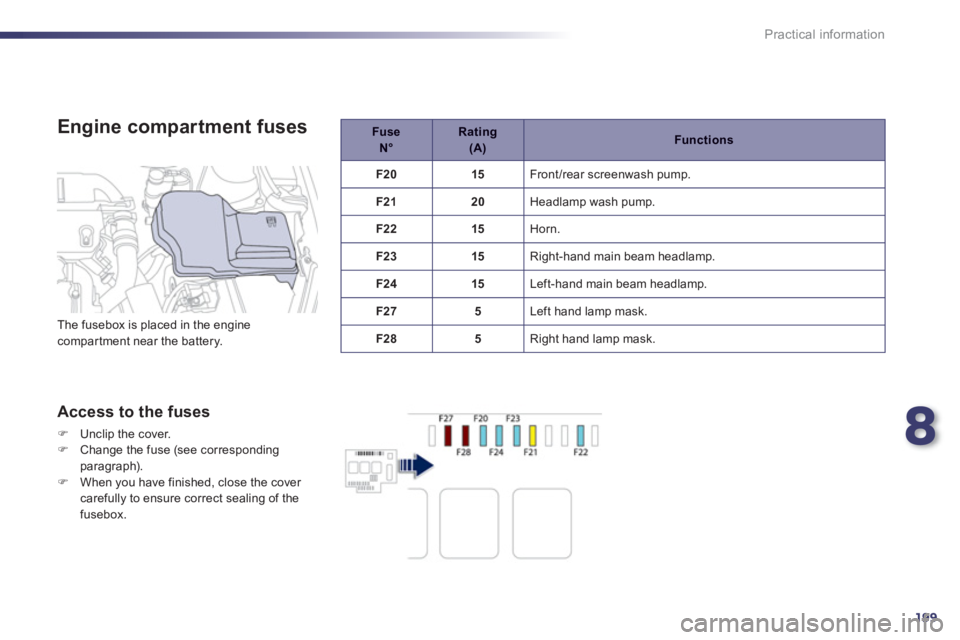
Engine compartment fuses
Access to the fuses
)Unclip the cover. )Change the fuse (see corresponding paragraph).)When you have finished, close the cover carefully to ensure correct sealing of the
fusebox.
Fuse N°
Rating (A)Functions
F20 15
Front /rear screenwash pump.
F2
120 Headlamp wash pump.
F2215 Horn.
F2
315 Right-hand main beam headlamp.
F2
415 Left-hand main beam headlamp.
F27 5
Le
ft hand lamp mask.
F2
85 Right hand lamp mask. The fusebox is placed in the engine compartment near the battery.
Page 203 of 340
8
201
i
Practical information
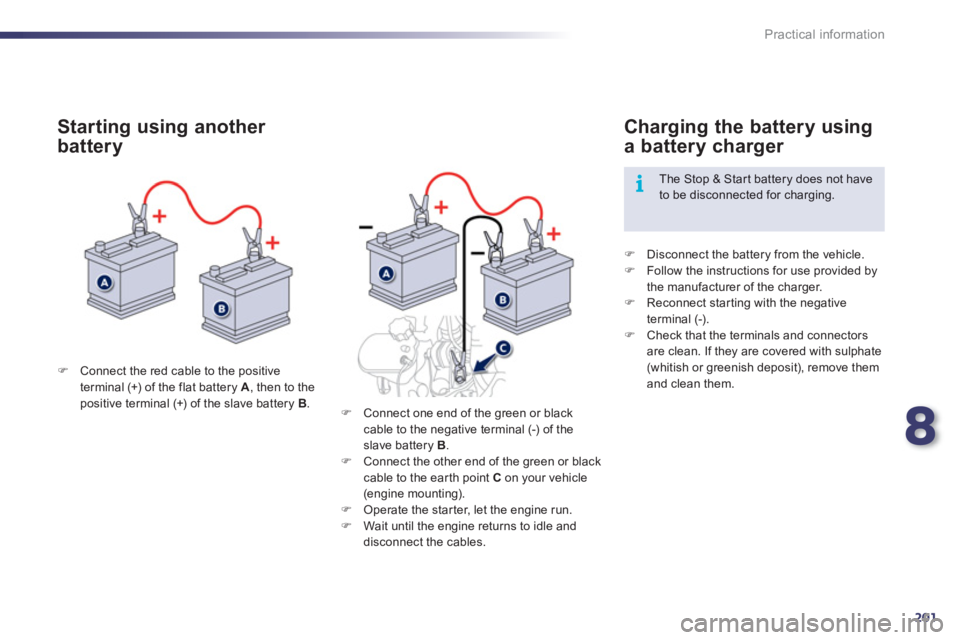
)Connect the red cable to the positive
terminal (+) of the flat battery A , then to the positive terminal (+) of the slave battery B
.
Starting using another
battery
)
Disconnect the battery from the vehicle.)
Follow the instructions for use provided by
the manufacturer of the charger. ) Reconnect starting with the negative
terminal (-). ) Check that the terminals and connectorsare clean. If they are covered with sulphate (whitish or greenish deposit), remove themand clean them.
Charging the battery using
a battery charger
The Stop & Star t battery does not have to be disconnected for charging.
)
Connect one end of the green or black cable to the negative terminal (-) of the
slave battery B.)
Connect the other end of the green or blackcable to the ear th point C
on your vehicle (engine mounting).)
Operate the star ter, let the engine run.)
Wait until the engine returns to idle and disconnect the cables.
Page 204 of 340
202
!
i
Practical information
The batteries contain harmful substances such as sulphuric acid and lead. They must be disposed of inaccordance with regulations and must not, in any circumstances, be discarded with household waste. Ta k e used remote control batteries andvehicle batteries to a special collectionpoint.
Do not reverse the polarity and use only a 12 V charger.
Do not disconnect the terminals whilethe engine is running.
Do not charge the batteries without disconnecting the terminals first. Do not push the vehicle to star t the engine if it is fitted with the 6 -speed electronic gearbox system or an automatic gearbox.
It is advisable to disconnect the battery if the vehicle is to be left unused for more than one month.
Before disconnecting the battery
Wait 2 minutes after switching off the ignitionbefore disconnecting the battery.
Close the windows and the doors beforedisconnecting the battery.
Following reconnection of thebattery
Following reconnection of the battery, switch on
the ignition and wait 1 minute before star ting to
permit initialisation of the electronic systems.However, if problems remain following this
operation, contact a PEUGEOT dealer or a
qualified workshop.
Referring to the corresponding section, you must yourself reinitialise:
- the remote control key,
- the panoramic sunroof blind,
- the GPS satellite navigation system.
Load reduction mode
System which manages the use of cer tain
functions according to the level of charge
remaining in the battery.
When the vehicle is bein
g driven, the load
reduction function temporarily deactivates certain functions, such as the air conditioning,
the heated rear screen...
The deactivated functions are reactivated
automatically as soon as conditions permit.