fuel cap Peugeot 508 2014 Owner's Manual - RHD (UK, Australia)
[x] Cancel search | Manufacturer: PEUGEOT, Model Year: 2014, Model line: 508, Model: Peugeot 508 2014Pages: 352, PDF Size: 13.51 MB
Page 8 of 352
6
Familiarisation
Open
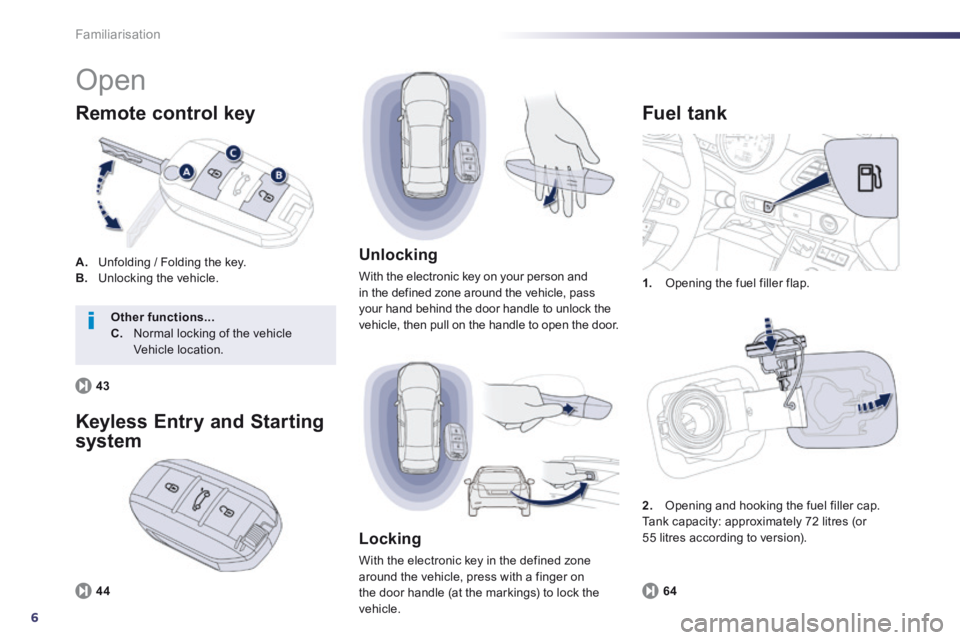
A. Unfolding / Folding the key. B. Unlocking the vehicle.
Remote control key
1. Opening the fuel filler flap.
Fuel tank
64
Unlocking
With the electronic key on your person and in the defined zone around the vehicle, pass your hand behind the door handle to unlock the vehicle, then pull on the handle to open the door.
Locking
With the electronic key in the defined zone around the vehicle, press with a finger on the door handle (at the markings) to lock the vehicle.
Keyless Entry and Starting
system
2. Opening and hooking the fuel filler cap. Tank capacity: approximately 72 litres (or 55 litres according to version).
Other functions...C. Normal locking of the vehicle Vehicle location.
44
43
Page 66 of 352
64
Access
Fuel tank Capacity of the tank: approximately 72 litres (or 55 litres according to version).
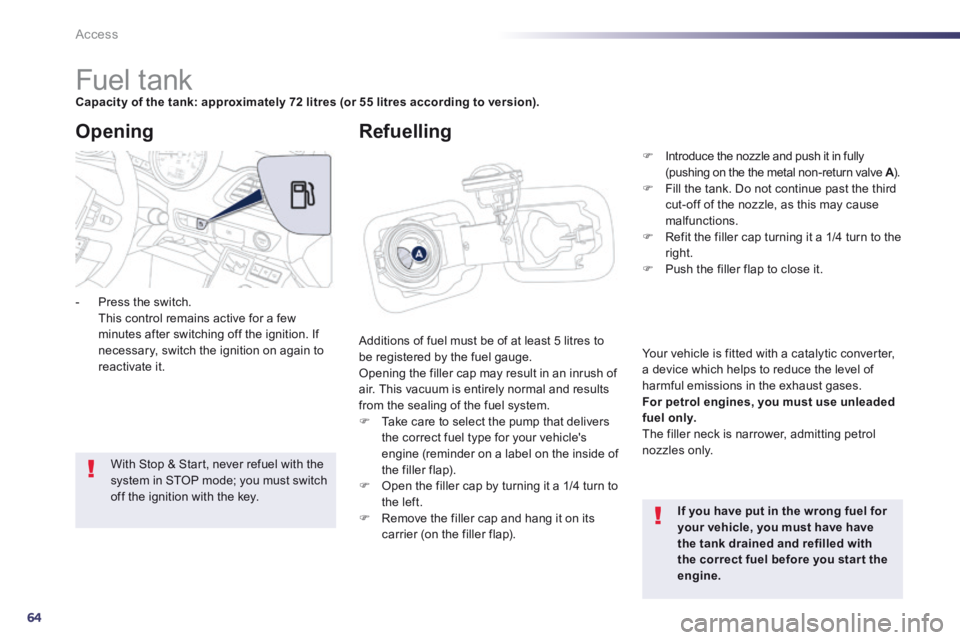
Additions of fuel must be of at least 5 litres to be registered by the fuel gauge. Opening the filler cap may result in an inrush of air. This vacuum is entirely normal and results from the sealing of the fuel system. Take care to select the pump that delivers
the correct fuel type for your vehicle's engine (reminder on a label on the inside of the filler flap). Open the filler cap by turning it a 1/4 turn to the left. Remove the filler cap and hang it on its carrier (on the filler flap).
Opening
If you have put in the wrong fuel for your vehicle, you must have have the tank drained and refilled with the correct fuel before you star t the engine.
With Stop & Start, never refuel with the system in STOP mode; you must switch off the ignition with the key.
- Press the switch. This control remains active for a few minutes after switching off the ignition. If necessary, switch the ignition on again to reactivate it.
Refuelling
Introduce the nozzle and push it in fully (pushing on the the metal non-return valve A ). A ). A Fill the tank. Do not continue past the third cut-off of the nozzle, as this may cause malfunctions.
Refit the filler cap turning it a 1/4 turn to the right. Push the filler flap to close it.
Your vehicle is fitted with a catalytic converter, a device which helps to reduce the level of harmful emissions in the exhaust gases. For petrol engines, you must use unleaded fuel only. The filler neck is narrower, admitting petrol nozzles only.
Page 67 of 352
2
65
Access
Low fuel level
When the low fuel level in the tank is reached, this warning lamp comes on in the instrument panel, accompanied by an audible warning and a message in the instrument panel screen. When it first comes on, around 7 litres of fuel remain in the tank. You must refuel as soon as possible to avoid running out.
Fuel supply cut-off
Your vehicle is equipped with a safety device which cuts off the fuel supply in the event of a collision.
It is still possible to use a fuel can to fill the tank but this must be done slowly. In order to ensure a good flow of fuel, do not place the nozzle of the fuel can in direct contact with the flap of the misfuel prevention device.
Diesel misfuel prevention
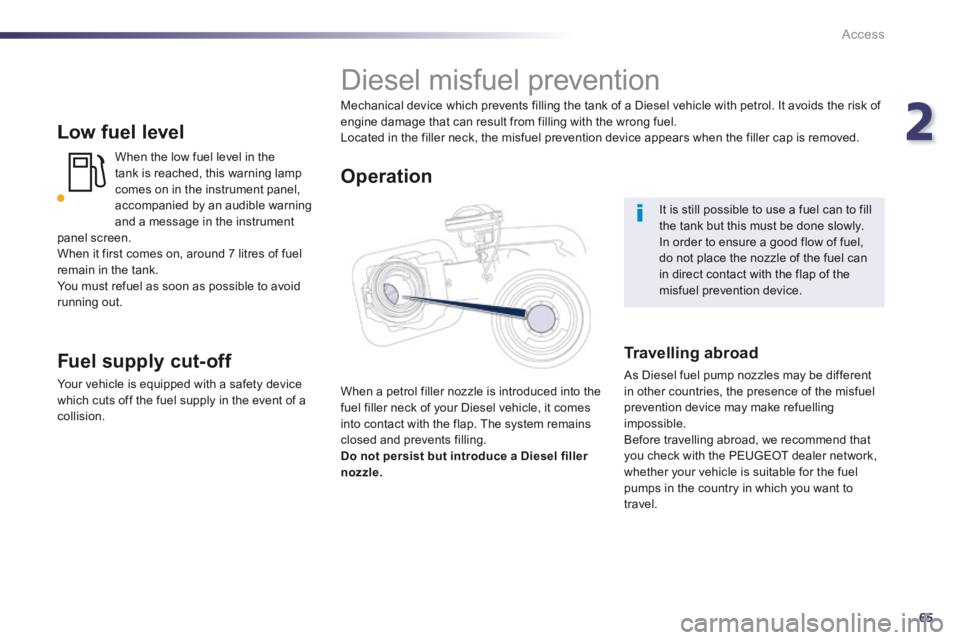
Mechanical device which prevents filling the tank of a Diesel vehicle with petrol. It avoids the risk of engine damage that can result from filling with the wrong fuel. Located in the filler neck, the misfuel prevention device appears when the filler cap is removed.
When a petrol filler nozzle is introduced into the fuel filler neck of your Diesel vehicle, it comes into contact with the flap. The system remains
closed and prevents filling. Do not persist but introduce a Diesel filler nozzle.
Operation
Travelling abroad
As Diesel fuel pump nozzles may be different in other countries, the presence of the misfuel prevention device may make refuelling impossible. Before travelling abroad, we recommend that you check with the PEUGEOT dealer network, whether your vehicle is suitable for the fuel pumps in the country in which you want to travel.
Page 89 of 352
3
87
Comfort
In order for these systems to be fully effective, follow the operation and maintenance guidelines below: If the interior temperature remains very high after the vehicle has been parked in the sun for a considerable time, first ventilate the passenger compartment for a few minutes. Place the air flow control at a sufficient level to provide an adequate renewal of air in the passenger compartment. To obtain an even air distribution, take care not to obstruct the exterior air intake grilles located at the base of the windscreen, the nozzles, the vents and the air outlets, as well as the air extractor located in the boot. Use in preference the intake of exterior air as prolonged use of the air recirculation may cause misting of the windows and side windows. Do not cover the sunshine sensor, located on the dashboard; this is used for regulation of the automatic air conditioning system. Operate the air conditioning system for 5 to 10 minutes, once or twice a month to keep it in good working order. Ensure that the passenger compartment filter is in good condition and have the filter elements replaced regularly (refer to the "Checks" section). We recommend the use of a combined passenger compartment filter. Thanks to its second special active filter, it contributes to the purification of the air breathed by the occupants and the cleanliness of the passenger compartment (reduction of allergic symptoms, bad odours and greasy deposits). The air conditioning uses power from the engine while operating. This results in an increase in the vehicle's fuel consumption. When towing at or near maximum capacity or on steep slopes in high ambient temperatures, switching off the air conditioning saves engine power and so improves towing capacity. Condensation created by the air conditioning results in a discharge of water under the vehicle when stationary, which is per fectly normal. To ensure correct operation of the air conditioning system, you are also advised to have it checked regularly. If the system does not produce cold air, do not use it and contact a PEUGEOT dealer or a qualified workshop.
Recommendations for ventilation and air conditioning
The air conditioning system does not contain chlorine and does not present any danger to the ozone layer.
Page 224 of 352
222
Checks
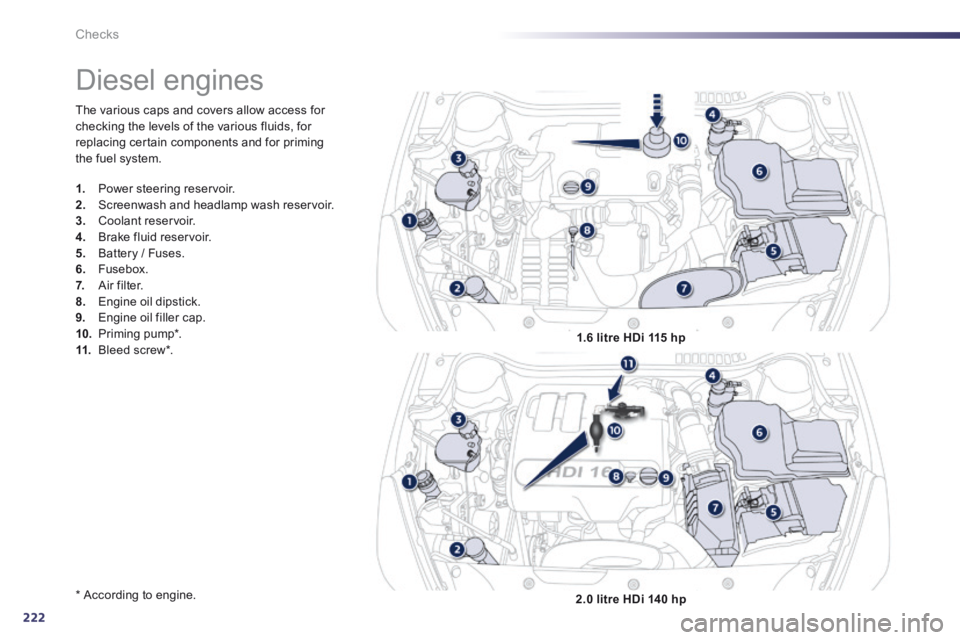
The various caps and covers allow access for checking the levels of the various fluids, for replacing certain components and for priming the fuel system.
* According to engine.
Diesel engines
1. Power steering reservoir. 2. Screenwash and headlamp wash reservoir. 3. Coolant reservoir.
4. Brake fluid reservoir. 5. Battery / Fuses. 6. Fusebox. 7. Air filter. 8. Engine oil dipstick. 9. Engine oil filler cap. 10. Priming pump * . 11. Bleed screw * . 1.6 litre HDi 115 hp
2.0 litre HDi 140 hp
Page 225 of 352
9
223
Checks
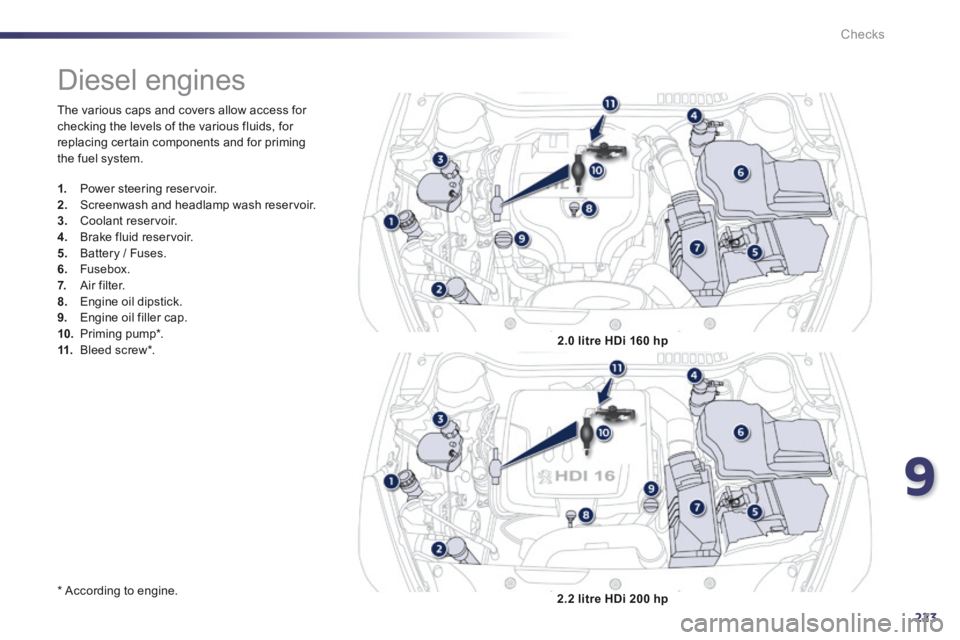
The various caps and covers allow access for checking the levels of the various fluids, for replacing certain components and for priming the fuel system.
* According to engine.
Diesel engines
1. Power steering reservoir. 2. Screenwash and headlamp wash reservoir. 3. Coolant reservoir.
4. Brake fluid reservoir. 5. Battery / Fuses. 6. Fusebox. 7. Air filter. 8. Engine oil dipstick. 9. Engine oil filler cap. 10. Priming pump * . 11. Bleed screw * . 2.0 litre HDi 160 hp
2.2 litre HDi 200 hp
Page 226 of 352
224
Checks
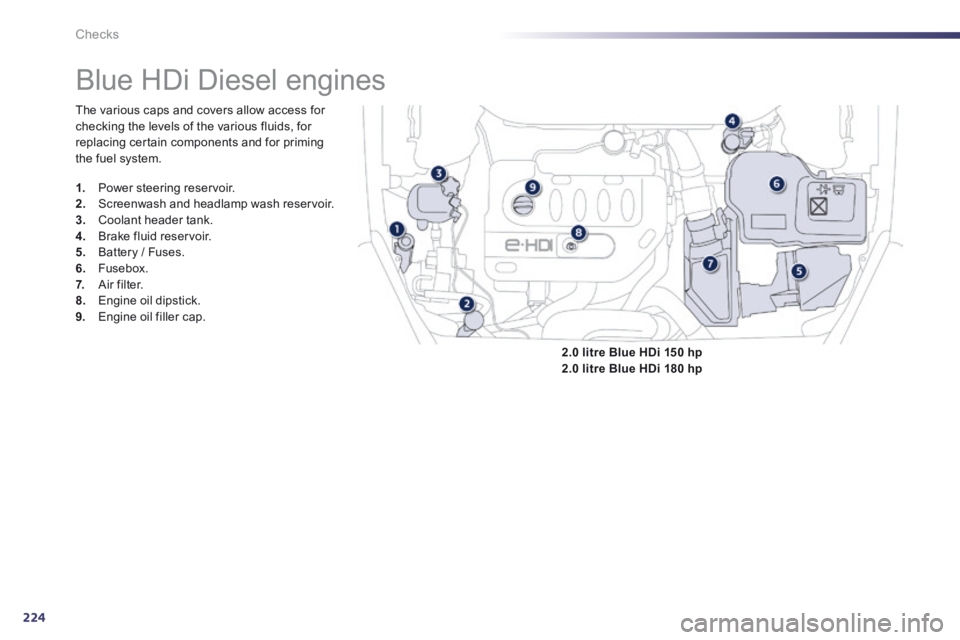
Blue HDi Diesel engines
The various caps and covers allow access for checking the levels of the various fluids, for replacing certain components and for priming the fuel system.
1. Power steering reservoir. 2. Screenwash and headlamp wash reservoir. 3. Coolant header tank. 4. Brake fluid reservoir. 5. Battery / Fuses. 6. Fusebox. 7. Air filter. 8. Engine oil dipstick. 9. Engine oil filler cap.
2.0 litre Blue HDi 150 hp2.0 litre Blue HDi 180 hp
Page 232 of 352
230
Checks
AdBlue ® additive
for Blue HDi Diesel engines
To ensure respect for the environment, without altering per formance or penalising the fuel consumption of its Diesel engine, PEUGEOT has taken the decision to equip its vehicles with an effective system for the treatment of exhaust gases, by associating the particle emissions filter (PEF) and the treatment of nitrous oxides (NOx) through the use of the AdBlue ® additive. ® additive. ®
In this way PEUGEOT meets the EURO 6 regulations which impose a sharp reduction of these gases on Diesel engines.
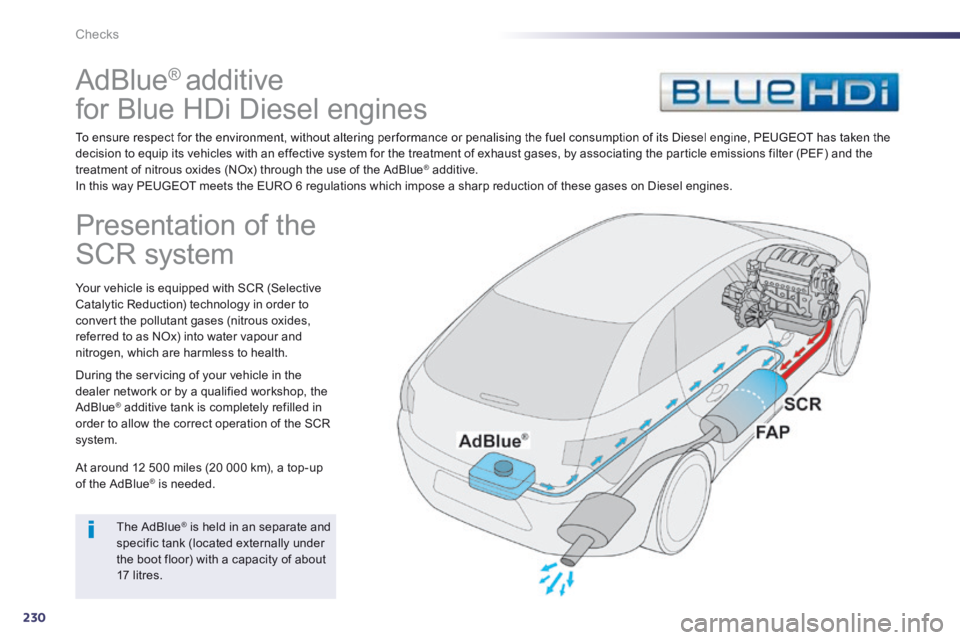
Presentation of the
SCR system
Your vehicle is equipped with SCR (Selective Catalytic Reduction) technology in order to convert the pollutant gases (nitrous oxides, referred to as NOx) into water vapour and nitrogen, which are harmless to health.
During the servicing of your vehicle in the dealer network or by a qualified workshop, the AdBlue ® additive tank is completely refilled in ® additive tank is completely refilled in ®
order to allow the correct operation of the SCR system.
At around 12 500 miles (20 000 km), a top-up of the AdBlue ® is needed. ® is needed. ®
The AdBlue ® is held in an separate and ® is held in an separate and ®
specific tank (located externally under the boot floor) with a capacity of about 17 litres.
Page 237 of 352
10
235
Technical data
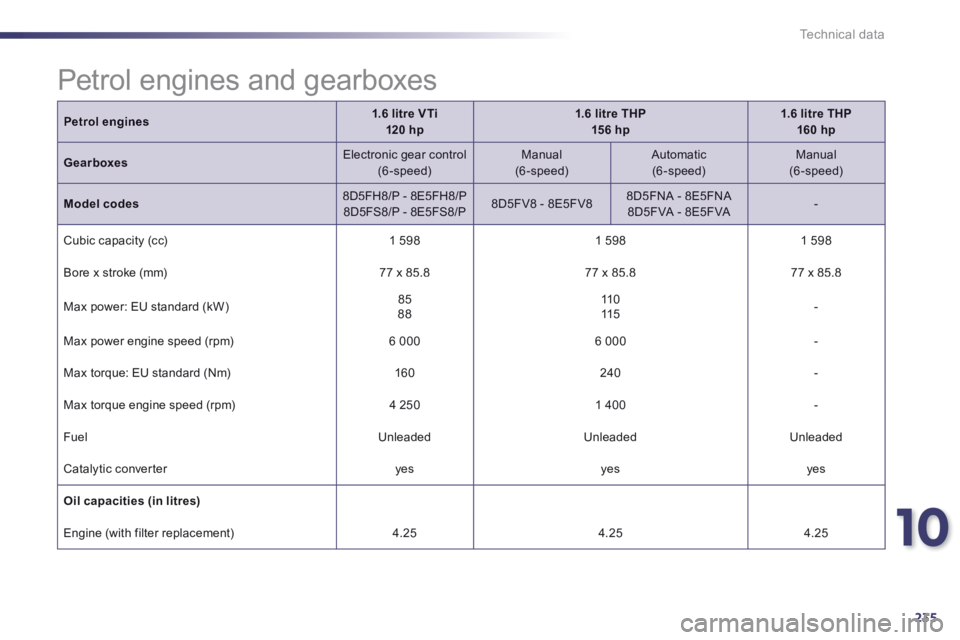
Petrol engines1.6 litre VTi 120 hp1.6 litre THP 15 6 hp1.6 litre THP 160 hp
Gearboxes Electronic gear control (6-speed) Manual (6-speed) Automatic (6-speed) Manual (6-speed)
Model codes 8D5FH8/P - 8E5FH8/P 8D5FS8/P - 8E5FS8/P 8D5FV8 - 8E5FV8 8D5FNA - 8E5FNA 8D5FVA - 8E5FVA -
Cubic capacity (cc) 1 598 1 598 1 598
Bore x stroke (mm) 77 x 85.8 77 x 85.8 77 x 85.8
Max power: EU standard (kW) 85 88 11 0 115 -
Max power engine speed (rpm) 6 000 6 000 -
Max torque: EU standard (Nm) 160 240 -
Max torque engine speed (rpm) 4 250 1 400 -
Fuel Unleaded Unleaded Unleaded
Catalytic converter yes yes yes
Oil capacities (in litres)
Engine (with filter replacement) 4.25 4.25 4.25
Petrol engines and gearboxes
Page 240 of 352
238
Technical data
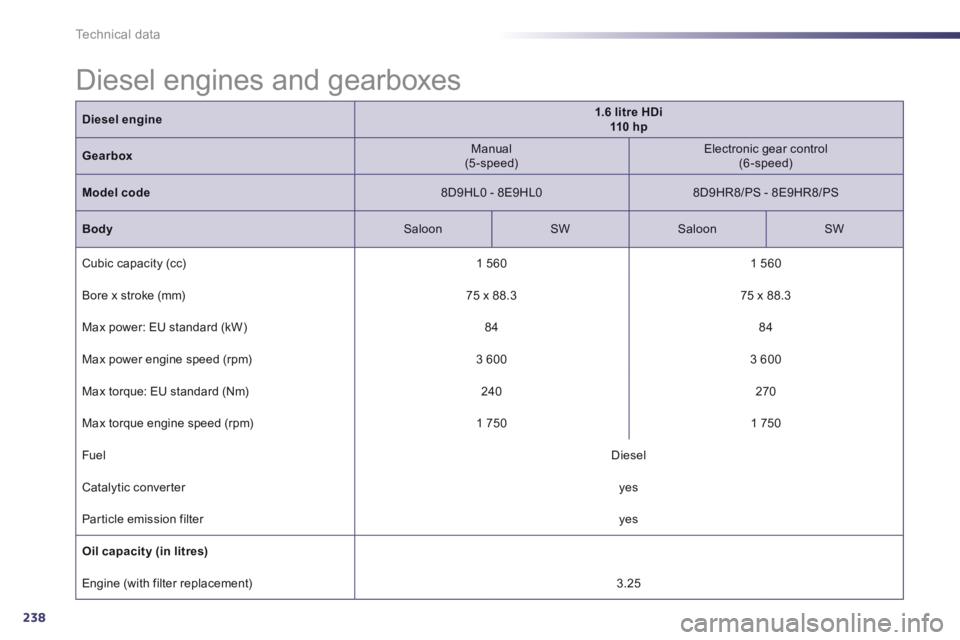
Diesel engine1.6 litre HDi 110 h p
Gearbox Manual (5-speed) Electronic gear control (6-speed)
Model code 8D9HL0 - 8E9HL0 8D9HR8/PS - 8E9HR8/PS
Body Saloon SW Saloon SW
Cubic capacity (cc) 1 560 1 560
Bore x stroke (mm) 75 x 88.3 75 x 88.3
Max power: EU standard (kW) 84 84
Max power engine speed (rpm) 3 600 3 600
Max torque: EU standard (Nm) 240 270
Max torque engine speed (rpm) 1 750 1 750
Fuel Diesel
Catalytic converter yes
Particle emission filter yes
Oil capacity (in litres)
Engine (with filter replacement) 3.25
Diesel engines and gearboxes