roof Peugeot 508 2014 Owner's Manual - RHD (UK, Australia)
[x] Cancel search | Manufacturer: PEUGEOT, Model Year: 2014, Model line: 508, Model: Peugeot 508 2014Pages: 352, PDF Size: 13.51 MB
Page 4 of 352
.
Contents
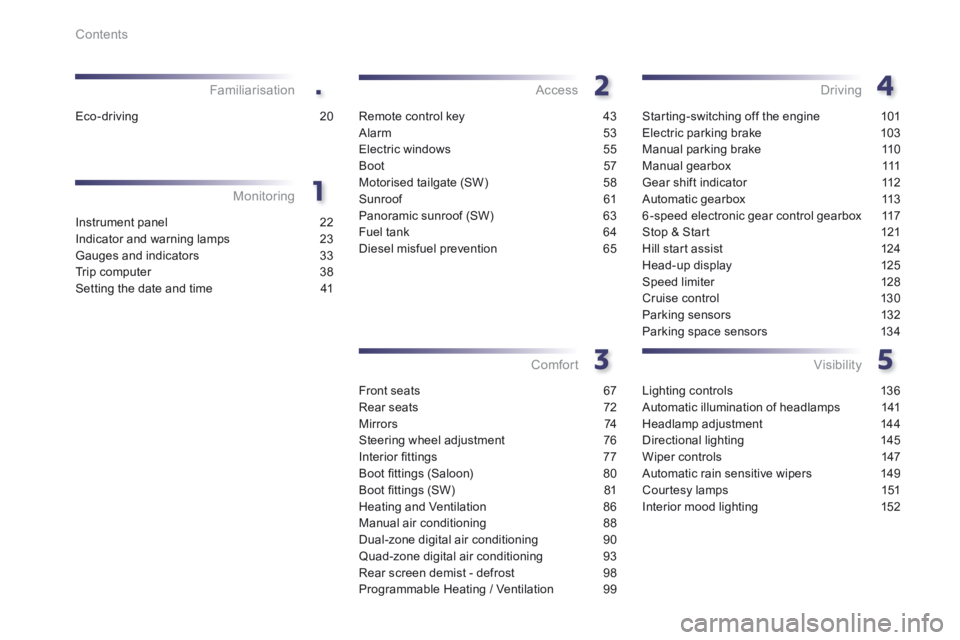
Instrument panel 22
Indicator and warning lamps 23
Gauges and indicators 33
Trip computer 38
Setting the date and time 41
Monitoring
Familiarisation
Remote control key
43
Alarm 53
Electric windows 55
Boot 57
Motorised tailgate (SW) 58
Sunroof 61
Panoramic sunroof (SW) 63
Fuel tank 64
Diesel misfuel prevention 65
Access
Front seats 67
Rear seats 72
M i r r o r s 74
Steering wheel adjustment 76
Interior fi ttings 77
Boot fi ttings (Saloon) 80
Boot fi ttings (SW) 81
Heating and Ventilation 86
Manual air conditioning 88
Dual-zone digital air conditioning 90
Quad-zone digital air conditioning 93
Rear screen demist - defrost 98
Programmable Heating / Ventilation 99
Comfort
Starting-switching off the engine 101
Electric parking brake 103
Manual parking brake 110
Manual gearbox 111
Gear shift indicator 112
Automatic gearbox 113
6-speed electronic gear control gearbox 117
Stop & Start 121
Hill start assist 124
Head-up display 125
Speed limiter 128
Cruise control 130
Parking sensors 132
Parking space sensors 134
Driving
Lighting controls 136
Automatic illumination of headlamps 141
Headlamp adjustment 144
Directional lighting 145
Wiper controls 147
Automatic rain sensitive wipers 149
Courtesy lamps 151
Interior mood lighting 152
Visibility
Eco-driving 20
Page 5 of 352
.
.
Contents
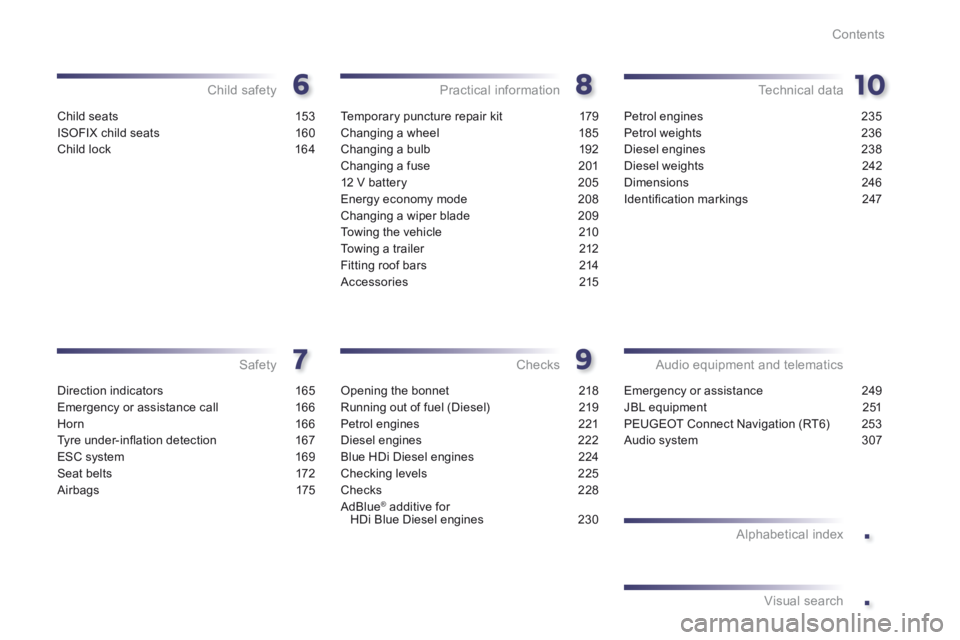
Child seats 153
ISOFIX child seats 160
Child lock 164
Child safety
Direction indicators 165
Emergency or assistance call 166
Horn 166
Tyre under-infl ation detection 167
ESC system 169
Seat belts 172
Airbags 175
Safety
Temporary puncture repair kit 179
Changing a wheel 185
Changing a bulb 192
Changing a fuse 201
12 V battery 205
Energy economy mode 208
Changing a wiper blade 209
Towing the vehicle 210
Towing a trailer 212
Fitting roof bars 214
Accessories 215
Practical information
Opening the bonnet 218
Running out of fuel (Diesel) 219
Petrol engines 221
Diesel engines 222
Blue HDi Diesel engines 224
Checking levels 225
Checks 228
AdBlue® additive for ® additive for ®
HDi Blue Diesel engines 230
Checks
Petrol engines 235
Petrol weights 236
Diesel engines 238
Diesel weights 242
Dimensions 246
Identifi cation markings 247
Technical data
Emergency or assistance 249
JBL equipment 251
PEUGEOT Connect Navigation (RT6) 253
Audio system 307
Audio equipment and telematics
Alphabetical indexVisual search
Page 22 of 352
20
Optimise the use of your
gearbox
With a manual gearbox, move off gently, change up without waiting and drive by changing up quite soon. If your vehicle has
the system, the gear shift indicator invites you to change up; it is displayed in the instrument panel, follow its instructions.
With an automatic or electronic gearbox, stay in Drive "D" or Auto "A" , according to the type of gearbox, without pressing the accelerator pedal heavily or suddenly.
Drive smoothly
Maintain a safe distance between vehicles, use engine braking rather than the brake pedal, and press the accelerator progressively. These practices contribute towards a reduction in
fuel consumption and CO2 emissions and also helps reduce the background traffic noise.
If your vehicle has cruise control, make use of the system at speeds above 25 mph (40 km/h) when the traffic is flowing well.
Control the use of your electrical equipment
Before moving off, if the passenger compartment is too warm, ventilate it by opening the windows and air vents before using the air conditioning. Above 30 mph (50 km/h), close the windows and leave the air vents open.
Remember to make use of equipment that can help keep the temperature in the passenger compartment down (sunroof and window blinds...). Switch off the air conditioning, unless it has automatic digital regulation, as soon as the desired temperature is attained. Switch off the demisting and defrosting controls, if not automatic. Switch off the heated seat as soon as possible.
Switch off the headlamps and front foglamps when the level of light does not require their use.
Avoid running the engine before moving off, particularly in winter; your vehicle will warm up much faster while driving.
As a passenger, if you avoid connecting your multimedia devices (film, music, video game...), you will contribute towards limiting the consumption of electrical energy, and so of fuel. Disconnect your portable devices before leaving the vehicle.
Eco-driving Eco-driving is a range of everyday practices that allow the motorist to optimise their fuel consumption and CO2 emissions.
Page 23 of 352
.
21
Limit the causes of excess
consumption
Spread loads throughout the vehicle; place the heaviest items in the bottom of the boot, as close as possible to the rear seats. Limit the loads carried in the vehicle and reduce wind resistance (roof bars, roof rack, bicycle carrier, trailer...). Use a roof box in preference. Remove roof bars and roof racks after use.
At the end of winter, remove snow tyres and refit your summer tyres.
Observe the recommendations
on maintenance
Check the tyre pressures regularly, when cold, referring to the label in the door aperture, driver's side.
Carry out this check in particular: - before a long journey, - at each change of season, - after a long period out of use. Don't forget the spare wheel and the tyres on any trailer or caravan.
Have your vehicle serviced regularly (engine oil, oil filter, air filter...) and observe the schedule of operations recommended by the manufacturer.
When refuelling, do not continue after the third cut-off of the nozzle to avoid any over flow.
At the wheel of your new vehicle, it is only after the first 1 800 miles (3 000 kilometres) that you will see the fuel consumption settle down to a consistent average.
Page 49 of 352
2
47
Access
Locking the vehicle
Normal locking
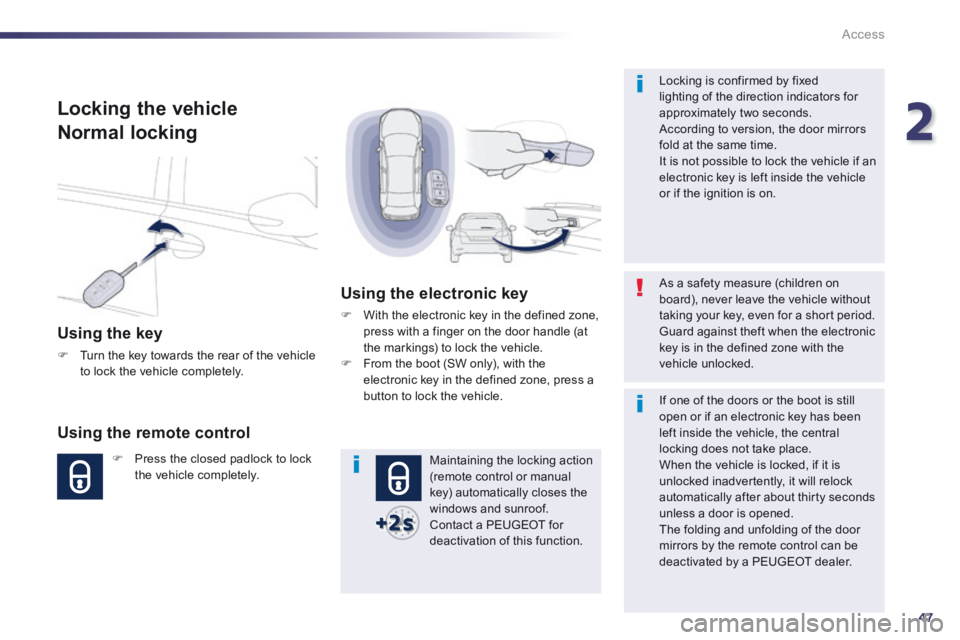
Using the key
Turn the key towards the rear of the vehicle to lock the vehicle completely.
Using the remote control
Press the closed padlock to lock the vehicle completely.
Using the electronic key
With the electronic key in the defined zone, press with a finger on the door handle (at the markings) to lock the vehicle. From the boot (SW only), with the electronic key in the defined zone, press a button to lock the vehicle.
Maintaining the locking action (remote control or manual key) automatically closes the windows and sunroof. Contact a PEUGEOT for deactivation of this function.
As a safety measure (children on board), never leave the vehicle without taking your key, even for a short period. Guard against theft when the electronic key is in the defined zone with the vehicle unlocked.
Locking is confirmed by fixed lighting of the direction indicators for approximately two seconds. According to version, the door mirrors fold at the same time. It is not possible to lock the vehicle if an electronic key is left inside the vehicle or if the ignition is on.
If one of the doors or the boot is still open or if an electronic key has been
left inside the vehicle, the central locking does not take place. When the vehicle is locked, if it is unlocked inadvertently, it will relock automatically after about thirty seconds unless a door is opened. The folding and unfolding of the door mirrors by the remote control can be deactivated by a PEUGEOT dealer.
Page 63 of 352
2
61
Access
Sunroof
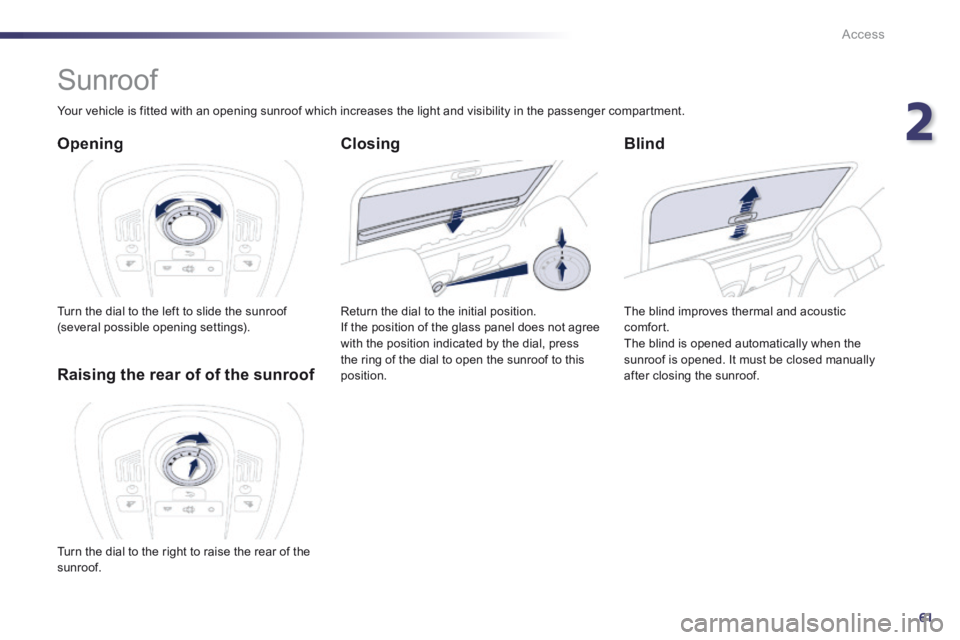
Opening
Turn the dial to the left to slide the sunroof (several possible opening settings).
Blind
The blind improves thermal and acoustic comfort. The blind is opened automatically when the sunroof is opened. It must be closed manually after closing the sunroof. Raising the rear of of the sunroof
Your vehicle is fitted with an opening sunroof which increases the light and visibility in the passenger compartment.
Return the dial to the initial position. If the position of the glass panel does not agree with the position indicated by the dial, press the ring of the dial to open the sunroof to this position.
Closing
Turn the dial to the right to raise the rear of the sunroof.
Page 64 of 352
62
Access
Safety anti-pinch
Am anti-pinch system stops the closing of the roof, whether sliding or from the raised at the rear position. If the sunroof encounters an obstacle it partially opens again. If the sunroof fails to close at a second attempt, it may be necessary to force the closing of the sunroof using the reinitialisation procedure.
Reinitialising the system
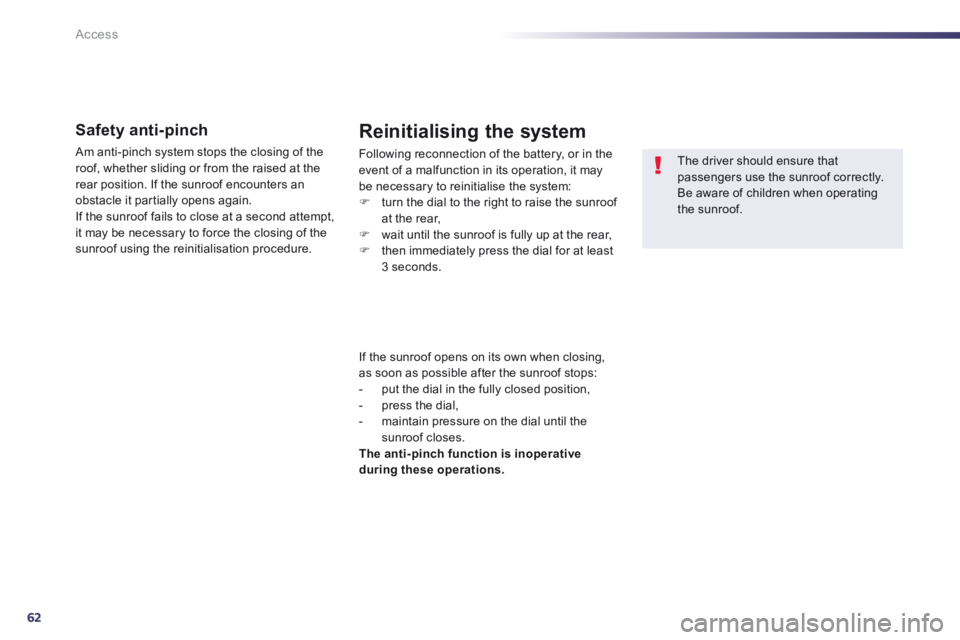
Following reconnection of the battery, or in the event of a malfunction in its operation, it may be necessary to reinitialise the system: turn the dial to the right to raise the sunroof at the rear, wait until the sunroof is fully up at the rear, then immediately press the dial for at least 3 seconds.
If the sunroof opens on its own when closing, as soon as possible after the sunroof stops: - put the dial in the fully closed position, - press the dial, - maintain pressure on the dial until the sunroof closes. The anti-pinch function is inoperative during these operations.
The driver should ensure that passengers use the sunroof correctly. Be aware of children when operating the sunroof.
Page 65 of 352
2
63
Access
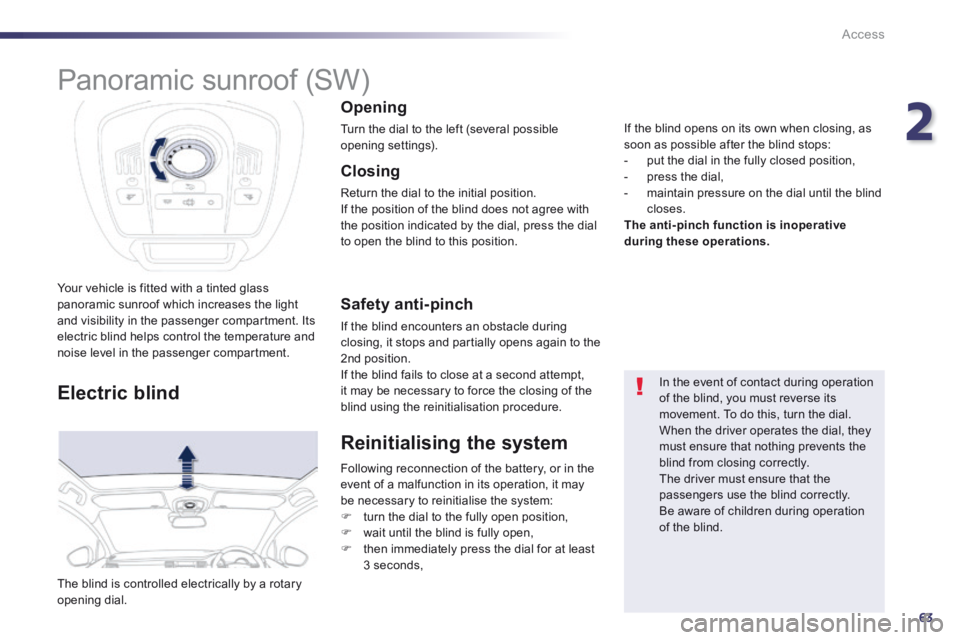
Your vehicle is fitted with a tinted glass panoramic sunroof which increases the light and visibility in the passenger compartment. Its electric blind helps control the temperature and noise level in the passenger compartment.
The blind is controlled electrically by a rotary opening dial.
Opening
Turn the dial to the left (several possible opening settings).
Safety anti-pinch
If the blind encounters an obstacle during closing, it stops and partially opens again to the 2nd position. If the blind fails to close at a second attempt, it may be necessary to force the closing of the blind using the reinitialisation procedure.
Closing
Return the dial to the initial position. If the position of the blind does not agree with the position indicated by the dial, press the dial to open the blind to this position.
Electric blind In the event of contact during operation of the blind, you must reverse its movement. To do this, turn the dial.
When the driver operates the dial, they must ensure that nothing prevents the blind from closing correctly. The driver must ensure that the passengers use the blind correctly. Be aware of children during operation of the blind.
Reinitialising the system
Following reconnection of the battery, or in the event of a malfunction in its operation, it may be necessary to reinitialise the system: turn the dial to the fully open position, wait until the blind is fully open, then immediately press the dial for at least 3 seconds,
If the blind opens on its own when closing, as soon as possible after the blind stops: - put the dial in the fully closed position, - press the dial, - maintain pressure on the dial until the blind closes.
The anti-pinch function is inoperative during these operations.
Panoramic sunroof (SW)
Page 86 of 352
84
Comfort
High load retaining net
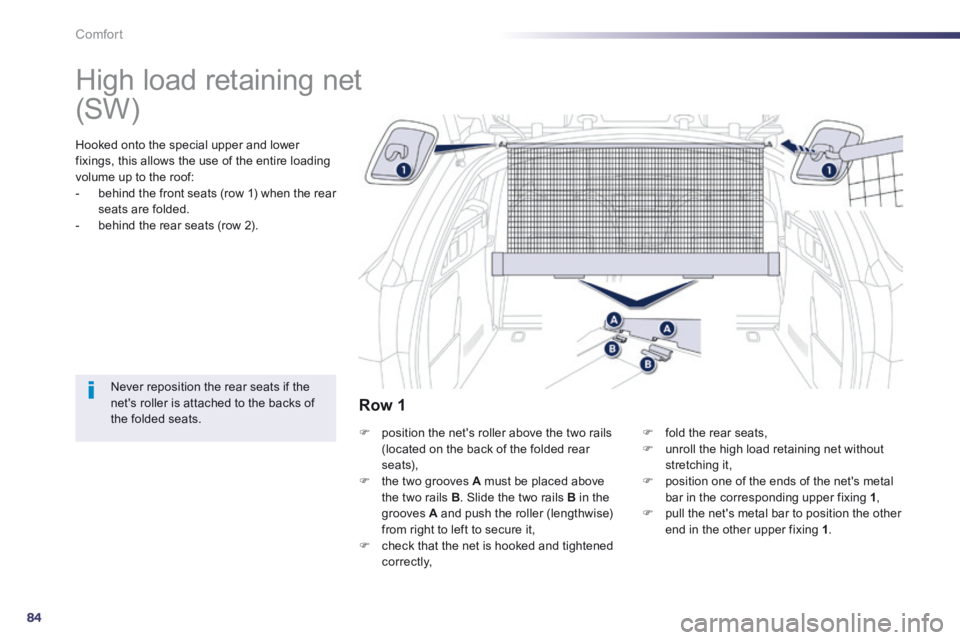
Hooked onto the special upper and lower fixings, this allows the use of the entire loading volume up to the roof: - behind the front seats (row 1) when the rear seats are folded. - behind the rear seats (row 2).
Never reposition the rear seats if the net's roller is attached to the backs of the folded seats. position the net's roller above the two rails (located on the back of the folded rear seats), the two grooves A must be placed above the two rails B . Slide the two rails B in the grooves A and push the roller (lengthwise) from right to left to secure it,
check that the net is hooked and tightened c o r r e c t l y,
fold the rear seats, unroll the high load retaining net without stretching it, position one of the ends of the net's metal bar in the corresponding upper fixing 1 , pull the net's metal bar to position the other end in the other upper fixing 1 .
Row 1
(SW)
Page 180 of 352
178
Safety
Sit in a normal upright position. Wear a correctly adjusted seat belt. Do not leave anything between the occupants and the airbags (a child, pet, object...). This could hamper the operation of
the airbags or injure the occupants. After an accident or if the vehicle has been stolen or broken into, have the airbag systems checked. All work on the airbag system must be carried out by a PEUGEOT dealer or a qualified workshop. Even if all of the precautions mentioned are observed, a risk of injury or of minor burns to the head, chest or arms when an airbag is deployed cannot be ruled out. The bag inflates almost instantly (within a few milliseconds) then deflates within the same time discharging the hot gas via openings provided for this purpose.
Lateral airbags
Use only approved covers on the seats, compatible with the deployment the lateral airbags. For information on the range of seat covers suitable for your vehicle, you can contact a PEUGEOT dealer. Refer to the "Accessories" section. Do not fix or attach anything to the seat backs (clothing...). This could cause injury to the chest or arms if the lateral airbag is deployed. Do not sit with the upper part of the body any nearer to the door than necessary.
Front airbags
Do not drive holding the steering wheel by its spokes or resting your hands on the centre part of the wheel. Passengers must not place their feet on the dashboard. If possible, do not smoke as deployment of the airbags can cause burns or the risk of injury from a cigarette or pipe. Never remove or pierce the steering wheel or hit it violently.
For the airbags to be fully effective, observe the following safety rules:
Curtain airbags
Do not fix or attach anything to the roof. This could cause injury to the head if the curtain airbag is deployed. If fitted on your vehicle, do not remove the grab handles installed on the roof, they play a part in securing the curtain airbags.