steering Peugeot 508 2016 User Guide
[x] Cancel search | Manufacturer: PEUGEOT, Model Year: 2016, Model line: 508, Model: Peugeot 508 2016Pages: 371, PDF Size: 12.12 MB
Page 125 of 371
123
508_en_Chap04_eclairage-et-visibilite_ed01-2016
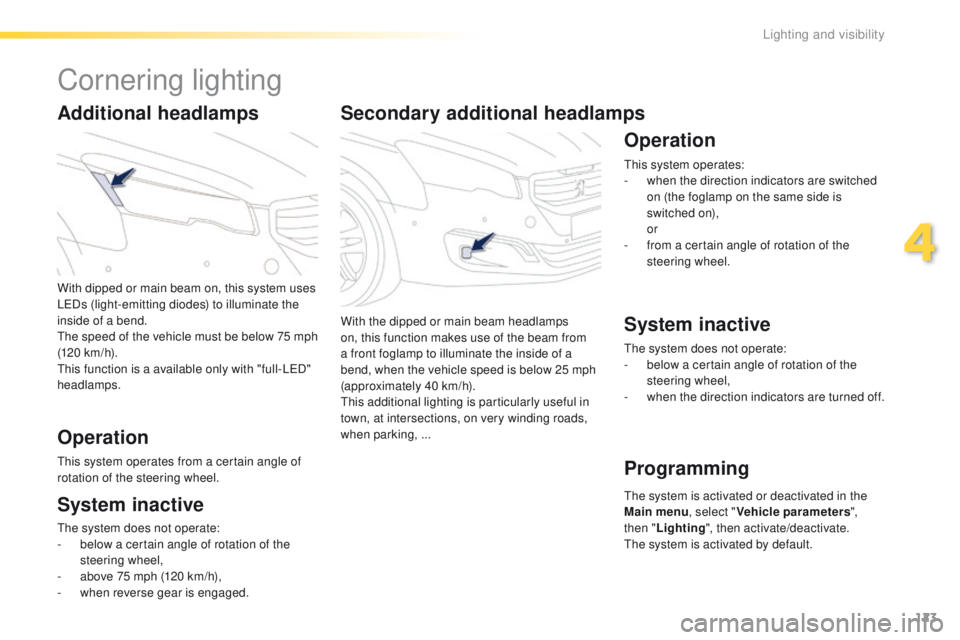
Secondary additional headlamps
With the dipped or main beam headlamps
on, this function makes use of the beam from
a front foglamp to illuminate the inside of a
bend, when the vehicle speed is below 25 mph
(approximately 40 km/h).
th
is additional lighting is particularly useful in
town, at intersections, on very winding roads,
when parking,
...
Operation
this system operates:
- w hen the direction indicators are switched
on (the foglamp on the same side is
switched on),
or
-
f
rom a certain angle of rotation of the
steering wheel.
System inactive
Programming
the system does not operate:
- b elow a certain angle of rotation of the
steering wheel,
-
w
hen the direction indicators are turned off.
th
e system is activated or deactivated in the
Main menu , select "Vehicle parameters ",
then " Lighting ", then activate/deactivate.
th
e system is activated by default.
With dipped or main beam on, this system uses
L
eD
s (light-emitting diodes) to illuminate the
inside of a bend.th
e speed of the vehicle must be below 75
m
ph
(120 km/h).
th
is function is a available only with "full-L
eD
"
headlamps.
Additional headlamps
Operation
this system operates from a certain angle of
rotation of the steering wheel.
System inactive
the system does not operate:
- b elow a certain angle of rotation of the
steering wheel,
-
a
bove 75 mph (120 km/h),
-
w
hen reverse gear is engaged.
Cornering lighting
4
Lighting and visibility
Page 134 of 371
132
508_en_Chap05_securite_ed01-2016
Hazard warning lamps
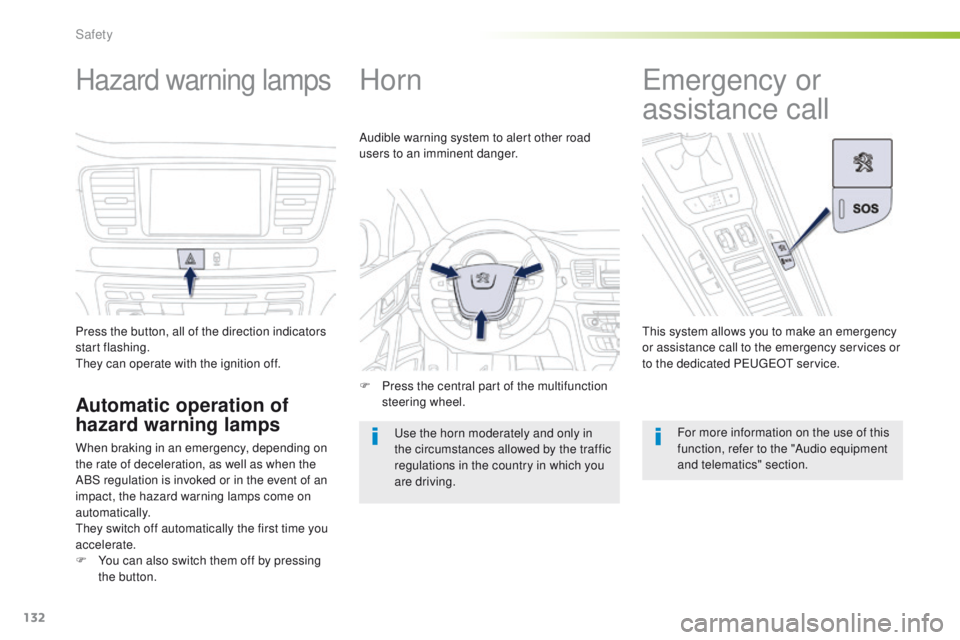
Press the button, all of the direction indicators
start flashing.
th
ey can operate with the ignition off.
Automatic operation of
hazard warning lamps
When braking in an emergency, depending on
the rate of deceleration, as well as when the
ABS regulation is invoked or in the event of an
impact, the hazard warning lamps come on
automatically.
th
ey switch off automatically the first time you
accelerate.
F
Y
ou can also switch them off by pressing
the button.
Horn
F Press the central part of the multifunction steering wheel.
Audible warning system to alert other road
users to an imminent danger.
us
e the horn moderately and only in
the circumstances allowed by the traffic
regulations in the country in which you
are driving.
emergency or
assistance call
this system allows you to make an emergency
or assistance call to the emergency services or
to the dedicated P
e
uge
Ot
service.
For more information on the use of this
function, refer to the "Audio equipment
and telematics" section.
Safety
Page 141 of 371
139
508_en_Chap05_securite_ed01-2016
Airbags
General information
System designed to contribute towards
improving the safety of the occupants (with
the exception of the rear centre passenger)
in the event of violent collisions. t
h
e airbags
supplement the action of the seat belts fitted
with force limiters (all except the centre rear
passenger belt).
If a collision occurs, the electronic detectors
record and analyse the front and side impacts
sustained in the impact detection zones:
-
i
n the case of a serious impact, the airbags
are deployed instantly and contribute
towards better protection of the occupants
of the vehicle (with the exception of the
rear centre passenger); immediately after
the impact, the airbags deflate rapidly so
that they do not hinder visibility or the exit
of the occupants,
-
i
n the case of a minor or rear impact or in
certain roll-over conditions, the airbags
may not be deployed; the seat belt
alone contributes towards ensuring your
protection in these situations.
The airbags do not operate when the
ignition is switched off. Deployment of one or more of the
airbags is accompanied by a slight
emission of smoke and a noise, due
to the activation of the pyrotechnic
cartridge incorporated in the system.
th
is smoke is not harmful, but sensitive
individuals may experience slight
irritation.
th
e noise of detonation associated with
the deployment of one or more airbags
may result in a slight loss of hearing for
a short time.
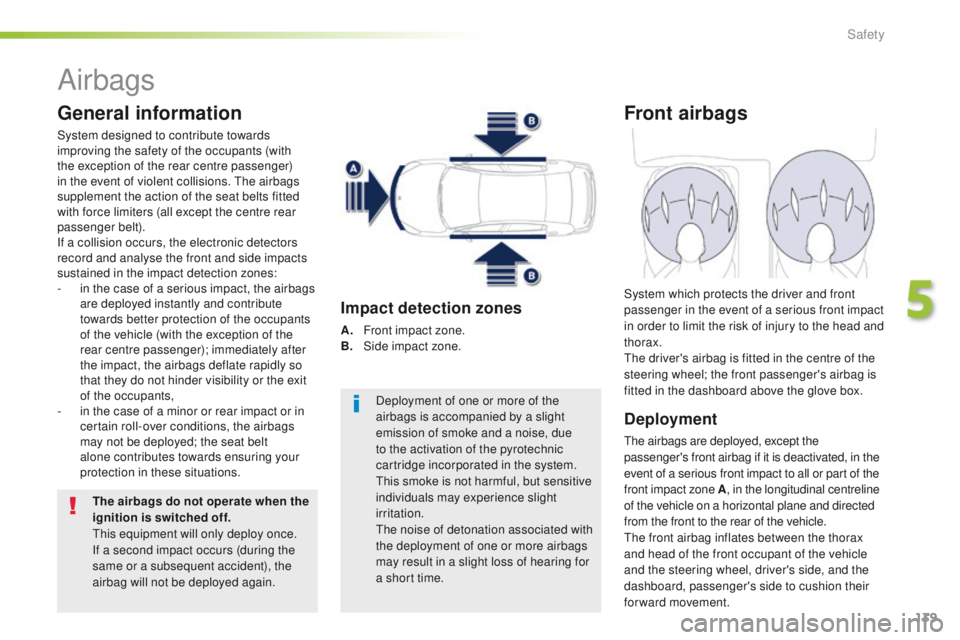
Impact detection zones
A. Front impact zone.
B. S ide impact zone.
Front airbags
Deployment
the airbags are deployed, except the
passenger's front airbag if it is deactivated, in the
event of a serious front impact to all or part of the
front impact zone A , in the longitudinal centreline
of the vehicle on a horizontal plane and directed
from the front to the rear of the vehicle.
th
e front airbag inflates between the thorax
and head of the front occupant of the vehicle
and the steering wheel, driver's side, and the
dashboard, passenger's side to cushion their
for ward movement. System which protects the driver and front
passenger in the event of a serious front impact
in order to limit the risk of injury to the head and
thorax.
th
e driver's airbag is fitted in the centre of the
steering wheel; the front passenger's airbag is
fitted in the dashboard above the glove box.
th
is equipment will only deploy once.
If a second impact occurs (during the
same or a subsequent accident), the
airbag will not be deployed again.
5
Safety
Page 144 of 371
142
508_en_Chap05_securite_ed01-2016
Sit in a normal upright position.
Wear a correctly adjusted seat belt.
Do not leave anything between the
occupants and the airbags (a child, pet,
object...), nor fix or attach anything close to
the inflation trajectory of the airbags; this
could cause injuries during their deployment.
Never modify the original definition of your
vehicle, particularly in the area directly
around the airbags.
After an accident or if the vehicle has been
stolen or broken into, have the airbag
systems checked.
All work on the airbag system must be
carried out by a P
e
uge
Ot
dealer or a
qualified workshop.
ev
en if all of the precautions mentioned
are observed, a risk of injury or of minor
burns to the head, chest or arms when an
airbag is deployed cannot be ruled out.
t
h
e
bag inflates almost instantly (within a few
milliseconds) then deflates within the same
time discharging the hot gas via openings
provided for this purpose.Lateral airbags
use only approved covers on the seats,
compatible with the deployment the lateral
airbags. For information on the range of seat
covers suitable for your vehicle, you can
contact a P
e
uge
Ot
dealer.
For more information on accessories, refer
to the corresponding section.
Do not fix or attach anything to the seat
backs (clothing...).
t
h
is could cause injury
to the chest or arms if the lateral airbag is
deployed.
Do not sit with the upper part of the body any
nearer to the door than necessary.
Front airbags
Do not drive holding the steering wheel by its
spokes or resting your hands on the centre
part of the wheel.
Passengers must not place their feet on the
dashboard.
Do not smoke as deployment of the airbags
can cause burns or the risk of injury from a
cigarette or pipe.
Never remove or pierce the steering wheel or
hit it violently.
Do not fit or attach anything to the steering
wheel or dashboard, this could cause
injuries with deployment of the airbags.
Advice
Curtain airbags
Do not fix or attach anything to the roof. th is
could cause injury to the head if the curtain
airbag is deployed.
If fitted on your vehicle, do not remove the
grab handles installed on the roof, they play
a part in securing the curtain airbags.
For the airbags to be fully effective, observe the safety recommendations below:
Safety
Page 164 of 371
162
508_en_Chap06_conduite_ed01-2016
In certain circumstances, you may have
to apply some force to turn the wheels
(if the wheels are against a kerb, for
example).
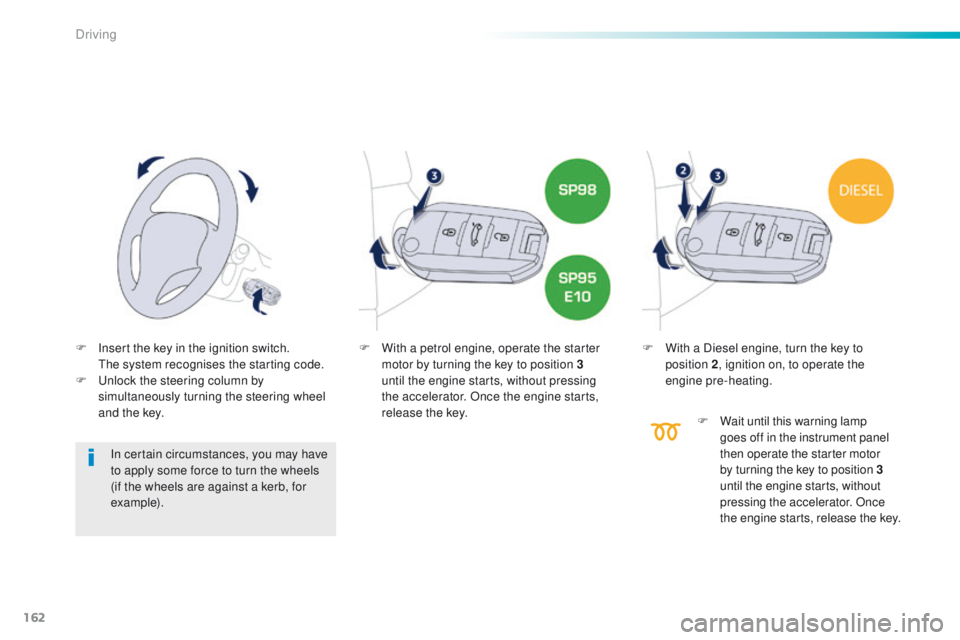
F
I
nsert the key in the ignition switch.
t
h
e system recognises the starting code.
F
u
n
lock the steering column by
simultaneously turning the steering wheel
and the key. F
W
ith a petrol engine, operate the starter
motor by turning the key to position 3
until the engine starts, without pressing
the accelerator. Once the engine starts,
release the key. F
W
ith a Diesel engine, turn the key to
position 2 , ignition on, to operate the
engine pre-heating.
F
W
ait until this warning lamp
goes off in the instrument panel
then operate the starter motor
by turning the key to position 3
until the engine starts, without
pressing the accelerator. Once
the engine starts, release the key.
Driving
Page 166 of 371
164
508_en_Chap06_conduite_ed01-2016
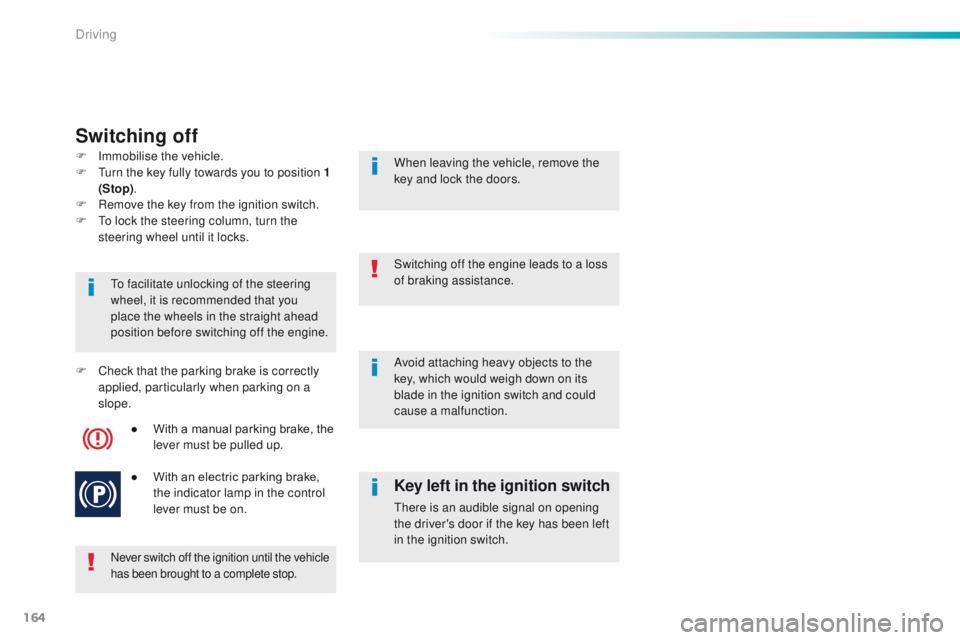
Switching off
Never switch off the ignition until the vehicle
has been brought to a complete stop.
to facilitate unlocking of the steering
wheel, it is recommended that you
place the wheels in the straight ahead
position before switching off the engine.When leaving the vehicle, remove the
key and lock the doors.
F
C
heck that the parking brake is correctly
applied, particularly when parking on a
slope.
●
W
ith a manual parking brake, the
lever must be pulled up.
●
W
ith an electric parking brake,
the indicator lamp in the control
lever must be on. Switching off the engine leads to a loss
of braking assistance.
Key left in the ignition switch
there is an audible signal on opening
the driver's door if the key has been left
in the ignition switch. Avoid attaching heavy objects to the
key, which would weigh down on its
blade in the ignition switch and could
cause a malfunction.
F
Imm
obilise the vehicle.
F
t
u
rn the key fully towards you to position 1
(Stop) .
F
R
emove the key from the ignition switch.
F
t
o l
ock the steering column, turn the
steering wheel until it locks.
Driving
Page 167 of 371
165
508_en_Chap06_conduite_ed01-2016
For Diesel vehicles, in very cold
weather the engine will not start
until the pre-heater warning
lamp has gone off.
If this warning lap comes on
after pressing the "S TA R T/
STOP " button, you should
maintain pressure on the brake
or clutch pedal until the warning
lamp goes off and not press the
" START/STOP " button, until the
engine starts. If the vehicle is not immobilised, the
engine will not stop.
Switching off
F Immobilise the vehicle.
F
W
ith the electronic key inside
the vehicle, press the " S TA R T/
STOP " button.
th
e engine stops and the steering column is
locked.
Ignition on (accessory) position
With the electronic key inside the vehicle,
press the "StA Rt/ StO P" button, with no
action on the pedals, to switch the ignition
on or off and so allow the use of the ancillary
equipment.
If one of the starting conditions is not
met, a reminder message appears in
the instrument panel screen. In some
circumstances, it is necessary to turn
the steering wheel slightly while pressing
the "S
tA
R
t/
S
tO
P" button to assist
unlocking of the steering; a message
warns you when this is needed.
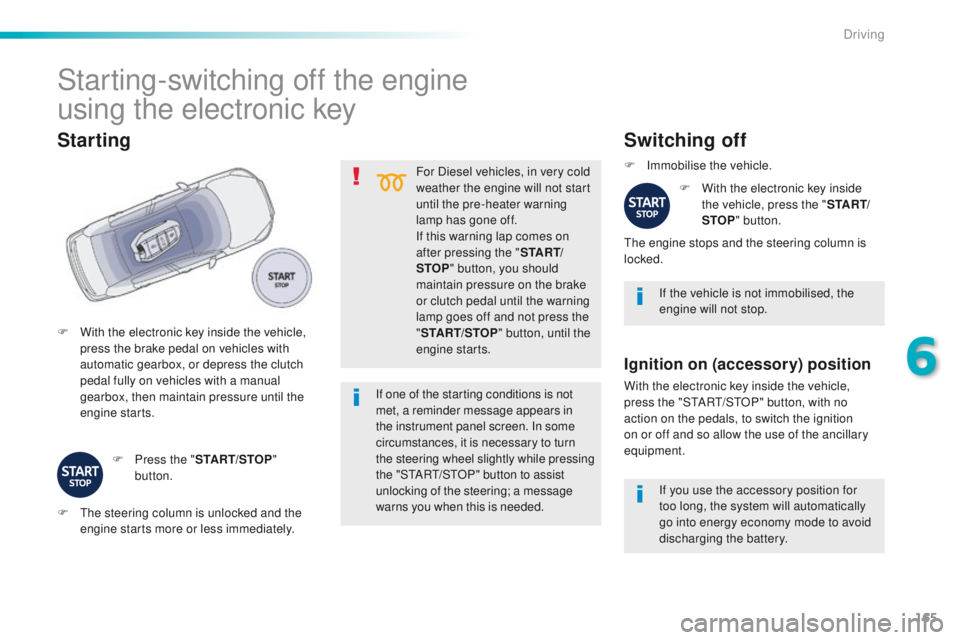
F
W
ith the electronic key inside the vehicle,
press the brake pedal on vehicles with
automatic gearbox, or depress the clutch
pedal fully on vehicles with a manual
gearbox, then maintain pressure until the
engine starts.
Starting
F Press the " START/STOP"
button.
Starting-switching off the engine
using the electronic key
F the steering column is unlocked and the engine starts more or less immediately. If you use the accessory position for
too long, the system will automatically
go into energy economy mode to avoid
discharging the battery.
6
Driving
Page 168 of 371
166
508_en_Chap06_conduite_ed01-2016
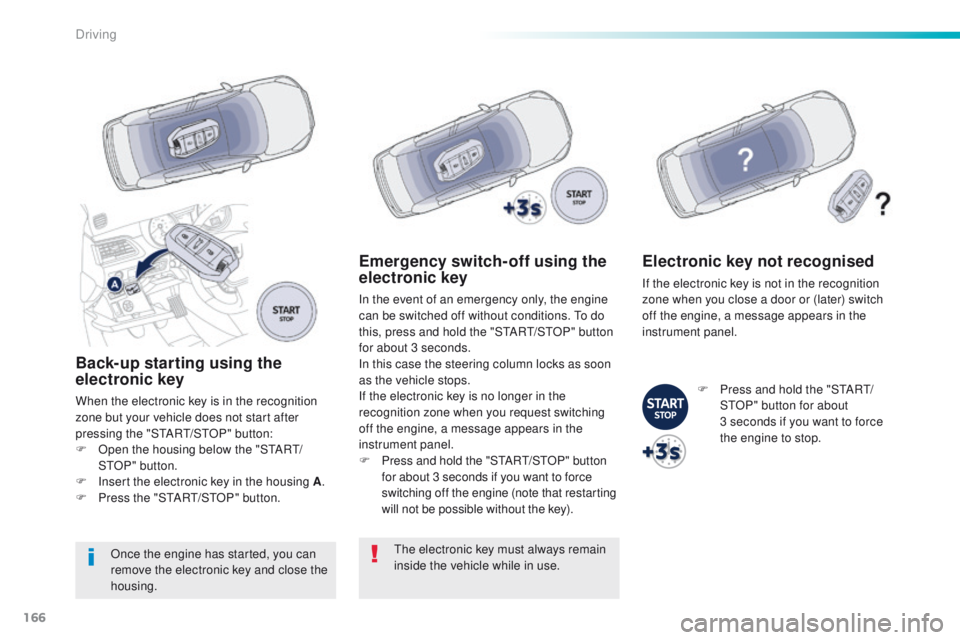
Back-up starting using the
electronic key
When the electronic key is in the recognition
zone but your vehicle does not start after
pressing the "S
tA
R
t/
S
tO
P" button:
F
O
pen the housing below the "S
tA
R
t/
St
OP " button.
F
I
nsert the electronic key in the housing A .
F
P
ress the "S
tA
R
t/
S
tO
P" button.
Once the engine has started, you can
remove the electronic key and close the
housing.
Emergency switch-off using the
electronic key
In the event of an emergency only, the engine
can be switched off without conditions. to d o
this, press and hold the "S
tA
R
t/
S
tO
P" button
for about 3 seconds.
In this case the steering column locks as soon
as the vehicle stops.
If the electronic key is no longer in the
recognition zone when you request switching
off the engine, a message appears in the
instrument panel.
F
P
ress and hold the "S
tA
R
t/
S
tO
P" button
for about 3 seconds if you want to force
switching off the engine (note that restarting
will not be possible without the key).
th
e electronic key must always remain
inside the vehicle while in use.
Electronic key not recognised
If the electronic key is not in the recognition
zone when you close a door or (later) switch
off the engine, a message appears in the
instrument panel.
F
P
ress and hold the "S
tA
R
t/
StO
P" button for about
3
seconds if you want to force
the engine to stop.
Driving
Page 178 of 371
176
508_en_Chap06_conduite_ed01-2016
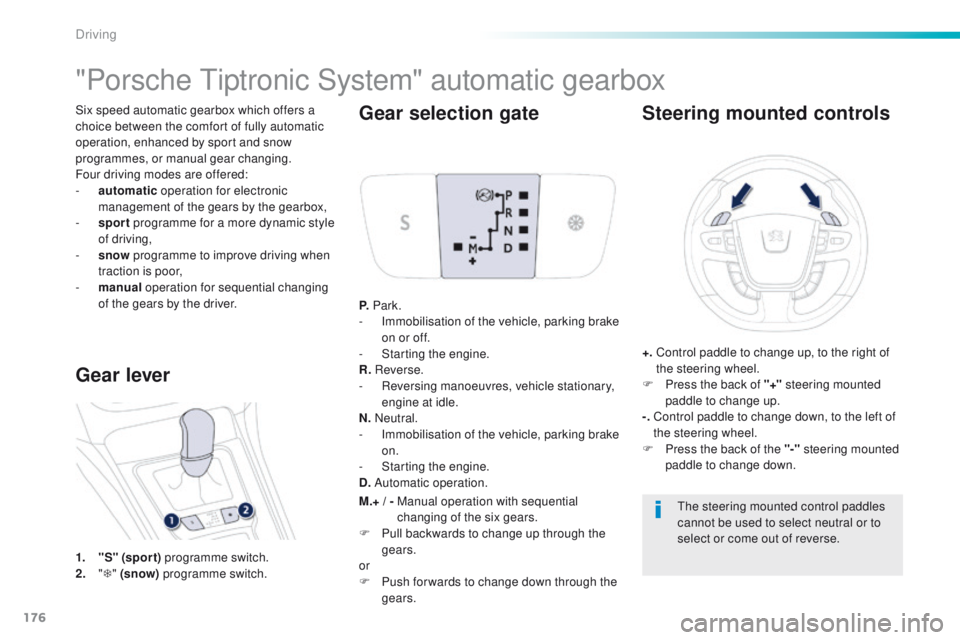
Six speed automatic gearbox which offers a
choice between the comfort of fully automatic
operation, enhanced by sport and snow
programmes, or manual gear changing.
Four driving modes are offered:
-
a
utomatic operation for electronic
management of the gears by the gearbox,
-
sp
ort programme for a more dynamic style
of driving,
-
s
now programme to improve driving when
traction is poor,
-
m
anual operation for sequential changing
of the gears by the driver.
"Porsche ti ptronic System" automatic gearbox
1. "S" (spor t) programme switch.
2. " T "
(snow) programme switch.
Gear lever Gear selection gate
P.
Park.
- I mmobilisation of the vehicle, parking brake
on or off.
-
S
tarting the engine.
R. Reverse.
-
R
eversing manoeuvres, vehicle stationary,
engine at idle.
N. Neutral.
-
I
mmobilisation of the vehicle, parking brake
on.
-
S
tarting the engine.
D. Automatic operation.
Steering mounted controls
+. Control paddle to change up, to the right of
the steering wheel.
F
P
ress the back of "+" steering mounted
paddle to change up.
-.
C
ontrol paddle to change down, to the left of
the steering wheel.
F
P
ress the back of the "-" steering mounted
paddle to change down.
th
e steering mounted control paddles
cannot be used to select neutral or to
select or come out of reverse.
M.+
/ -
M
anual operation with sequential
changing of the six gears.
F
P
ull backwards to change up through the
gears.
or
F
P
ush for wards to change down through the
gears.
Driving
Page 182 of 371
180
508_en_Chap06_conduite_ed01-2016
Stop & Start
Operation
Going into engine STOP mode
the "ECO" indicator lamp comes
on in the instrument panel and the
engine goes into standby:
-
w
ith a manual gearbox, at speeds below
12 mph (20 km/h), or vehicle stationary
with the e-
tH
P 165 version, when you put
the gear lever into neutral and release the
clutch pedal,
-
w
ith an automatic gearbox, vehicle
stationary, when you press the brake pedal
or you put the gear selector in position N .
If your vehicle is fitted with the system, a time
counter calculates the sum of the periods in
S
tO
P mode during a journey. It rests itself to
zero every time the ignition is switched on with
t h e key. Never refuel with the engine in
S
tO
P mode; you must switch off the
ignition with the key. For your comfort, during parking
maoeuvres, S
tO
P mode is not
available for a few seconds after
coming out of reverse gear.
S
tO
P mode does not affect the
functionality of the vehicle, such as for
example, braking, power steering...
th
e Stop & Start
system puts the engine
temporarily into standby - S
tO
P mode -
during stops in the traffic (red lights, traffic
jams, or other...).
t
h
e engine restarts
automatically
-
StA
Rt
mode - as soon as
you want to move off.
th
e restart takes place
instantly, quickly and silently.
Per fect for urban use, the Stop & Start system
reduces fuel consumption and exhaust
emissions as well as the noise level when
stationary.
Driving