warning light Peugeot 508 2016 User Guide
[x] Cancel search | Manufacturer: PEUGEOT, Model Year: 2016, Model line: 508, Model: Peugeot 508 2016Pages: 371, PDF Size: 12.12 MB
Page 128 of 371
126
508_en_Chap04_eclairage-et-visibilite_ed01-2016
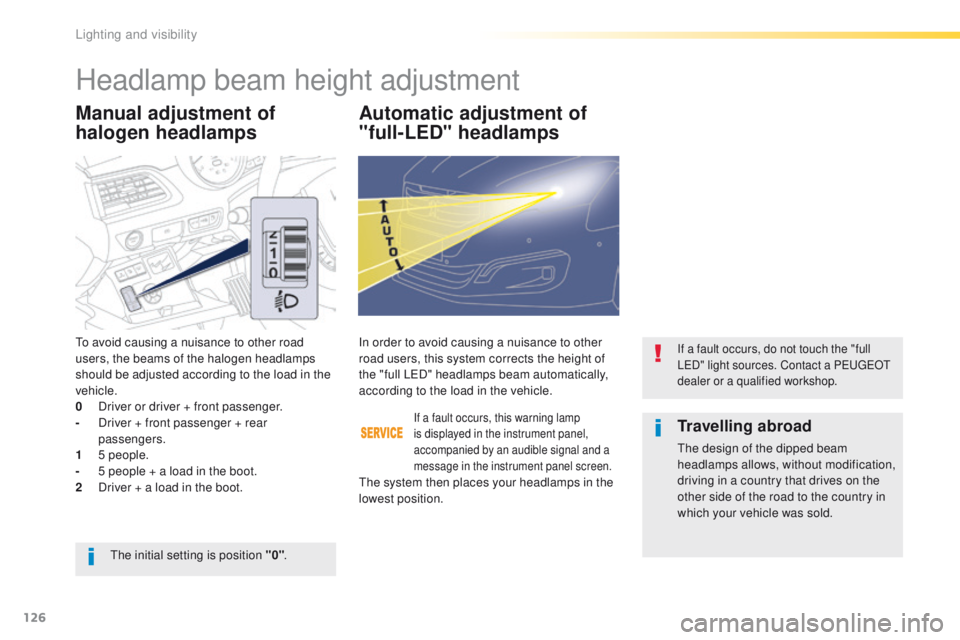
Manual adjustment of
halogen headlampsAutomatic adjustment of
"full-LED" headlamps
to avoid causing a nuisance to other road
users, the beams of the halogen headlamps
should be adjusted according to the load in the
vehicle.
0
D
river or driver + front passenger.
-
D
river + front passenger + rear
passengers.
1
5
people.
-
5 p
eople + a load in the boot.
2
D
river + a load in the boot.
If a fault occurs, this warning lamp
is displayed in the instrument panel,
accompanied by an audible signal and a
message in the instrument panel screen.
In order to avoid causing a nuisance to other
road users, this system corrects the height of
the "full L e
D
" headlamps beam automatically,
according to the load in the vehicle.If a fault occurs, do not touch the "full
LeD " light sources. Contact a Pe ugeOt
dealer or a qualified workshop.
the initial setting is position "0" .
Travelling abroad
the design of the dipped beam
headlamps allows, without modification,
driving in a country that drives on the
other side of the road to the country in
which your vehicle was sold.
th
e system then places your headlamps in the
lowest position.
Headlamp beam height adjustment
Lighting and visibility
Page 131 of 371
129
508_en_Chap04_eclairage-et-visibilite_ed01-2016
Screenwash/headlamp wash
level low
In the case of vehicles fitted with
headlamp washers, when the fluid
reservoir low level is reached this warning
lamp comes on in the instrument panel,
accompanied by an audible signal and a
message in the instrument panel screen.
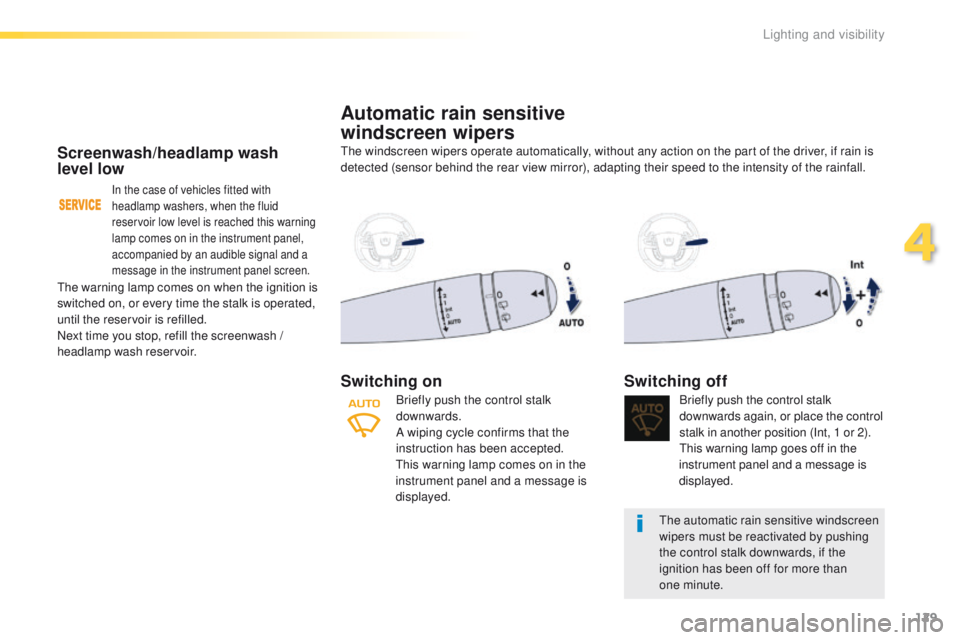
Automatic rain sensitive
windscreen wipers
Switching on
Briefly push the control stalk
downwards.
A wiping cycle confirms that the
instruction has been accepted.
th
is warning lamp comes on in the
instrument panel and a message is
displayed. Briefly push the control stalk
downwards again, or place the control
stalk in another position (Int, 1 or 2).
th
is warning lamp goes off in the
instrument panel and a message is
displayed.
Switching off
the automatic rain sensitive windscreen
wipers must be reactivated by pushing
the control stalk downwards, if the
ignition has been off for more than
one
minute.
th
e windscreen wipers operate automatically, without any action on the part of the driver, if rain is
detected (sensor behind the rear view mirror), adapting their speed to the intensity of the rainfall.
the warning lamp comes on when the ignition is
switched on, or every time the stalk is operated,
until the reservoir is refilled.
Next time you stop, refill the screenwash /
headlamp wash reservoir.
4
Lighting and visibility
Page 136 of 371
134
508_en_Chap05_securite_ed01-2016
Snow driving assistance
(Intelligent Traction Control)
Your vehicle has a system to help driving on
snow: Intelligent Traction Control.
th
is automatic system continuously checks
for situations of difficult sur face adhesion that
could make it difficult to move off or make
progress on deep fresh snow or compacted
snow.
In these situations, Intelligent Traction
Control limits the amount of wheel slip to
provide the best traction and trajectory control.
In extremely severe conditions (deep snow,
mud…), it can be useful to temporarily
deactivate the wheel anti-slip regulation
system to allow a degree of wheel spin and so
recover grip.
It is recommended that the system be
reactivated as soon as possible.
Snow tyres are strongly recommended on
sur faces offering low levels of adhesion.
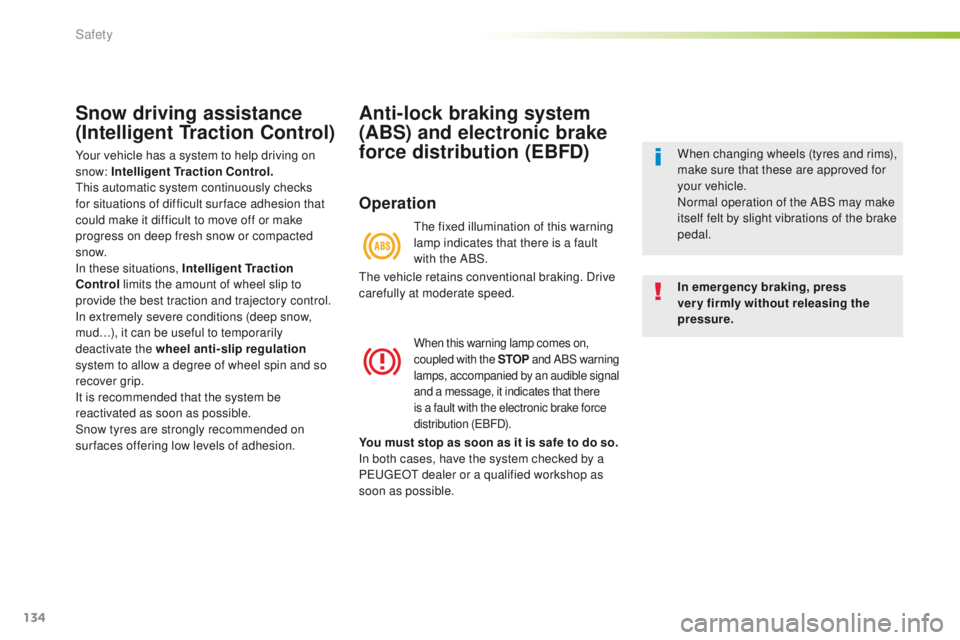
Anti-lock braking system
(ABS) and electronic brake
force distribution (EBFD)
Operation
In emergency braking, press
very firmly without releasing the
pressure. When changing wheels (tyres and rims),
make sure that these are approved for
your vehicle.
Normal operation of the ABS may make
itself felt by slight vibrations of the brake
pedal.
th
e fixed illumination of this warning
lamp indicates that there is a fault
with the ABS.
When this warning lamp comes on,
coupled with the STOP and ABS warning
lamps, accompanied by an audible signal
and a message, it indicates that there
is a fault with the electronic brake force
distribution (
eB
FD).
the vehicle retains conventional braking. Drive
carefully at moderate speed.
You must stop as soon as it is safe to do so.
In both cases, have the system checked by a
P
e
uge
Ot
dealer or a qualified workshop as
soon as possible.
Safety
Page 140 of 371
138
508_en_Chap05_securite_ed01-2016
the driver must ensure that passengers use
the seat belts correctly and that they are all
fastened before setting off.
Wherever you are seated in the vehicle,
always fasten your seat belt, even for short
journeys.
Do not interchange the seat belt buckles as
they will not fulfil their role fully.
th
e seat belts are fitted with an inertia reel
permitting automatic adjustment of the
length of the strap to your size.
t
h
e seat belt
is stowed automatically when not in use.
Before and after use, ensure that the seat
belt is reeled in correctly.
th
e lower part of the strap must be
positioned as low as possible on the pelvis.
th
e upper part must be positioned in the
hollow of the shoulder.
th
e inertia reels are fitted with an automatic
locking device which comes into operation in
the event of a collision, emergency braking
or if the vehicle rolls over. You can release
the device by pulling the strap firmly and
then releasing it so that it reels in slightly.Recommendations for children
use a suitable child seat if the passenger is
less than 12 years old or shorter than one
and a half metres.
Never use the same seat belt to secure more
than one person.
Never allow a child to travel on your lap.
For more information on child seats, refer to
the corresponding section.
In order to be effective, a seat belt must:
-
b
e tightened as close to the body as
possible,
-
b
e pulled in front of you with a smooth
movement, checking that it does not
twist,
-
b
e used to restrain only one person,
-
n
ot bear any trace of cuts or fraying,
-
n
ot be converted or modified to avoid
affecting its performance.
In accordance with current safety
regulations, for all repairs on your vehicle's
seat belts, go to a qualified workshop with
the skills and equipment needed, which a
P
e
uge
Ot d
ealer is able to provide.
Have your seat belts checked regularly by a
P
e
uge
Ot
dealer or a qualified workshop,
particularly if the straps show signs of
damage.
Clean the seat belt straps with soapy
water or a textile cleaning product, sold by
P
e
uge
Ot d
ealers.
After folding or moving a seat or rear bench
seat, ensure that the seat belt is positioned
and reeled in correctly.
In the event of an impact
Depending on the nature and
seriousness of the impact , the
pretensioning device may be deployed
before and independently of the airbags.
Deployment of the pretensioners is
accompanied by a slight discharge of
harmless smoke and a noise, due to the
activation of the pyrotechnic cartridge
incorporated in the system.
In all cases, the airbag warning lamp comes
on.
Following an impact, have the seat belts
system checked, and if necessary replaced,
by a P
e
uge
Ot
dealer or a qualified
workshop.
Advice
Safety
Page 162 of 371
160
508_en_Chap06_conduite_ed01-2016
When towing
Distribution of loads
F Distribute the load in the trailer so that the heaviest items are as close as possible to
the axle and the nose weight approaches
the maximum permitted without
exceeding
it.
Air density decreases with altitude, thus
reducing engine performance. Above
1
000 metres, the maximum towed load must
be reduced by 10
% for every 1 000 metres of
altitude.
Side wind
F take into account the increased sensitivity to side wind.
Cooling
towing a trailer on a slope increases the
temperature of the coolant.
As the fan is electrically controlled, its cooling
capacity is not dependent on the engine speed.
F
t
o l
ower the engine speed, reduce your
speed.
th
e maximum towed load on a long incline
depends on the gradient and the ambient
temperature.
In all cases, keep a check on the coolant
temperature.
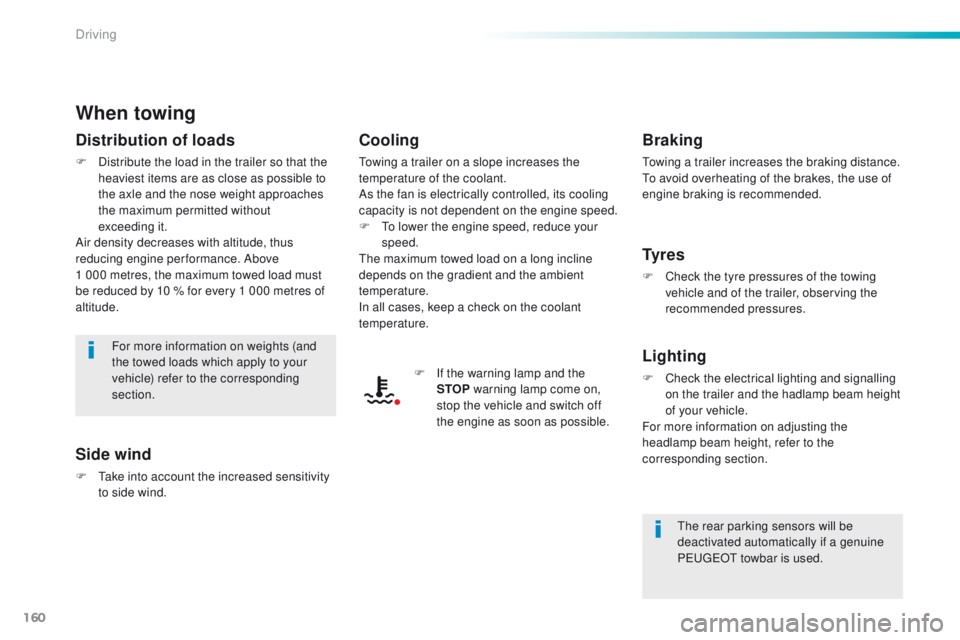
F
I
f the warning lamp and the
STOP warning lamp come on,
stop the vehicle and switch off
the engine as soon as possible.
Braking
towing a trailer increases the braking distance.to a void overheating of the brakes, the use of
engine braking is recommended.
Ty r e s
F Check the tyre pressures of the towing vehicle and of the trailer, observing the
recommended pressures.
Lighting
F Check the electrical lighting and signalling on the trailer and the hadlamp beam height
of your vehicle.
For more information on adjusting the
headlamp beam height, refer to the
corresponding section.
th
e rear parking sensors will be
deactivated automatically if a genuine
P
e
uge
Ot
towbar is used.
For more information on weights (and
the towed loads which apply to your
vehicle) refer to the corresponding
section.
Driving
Page 167 of 371
165
508_en_Chap06_conduite_ed01-2016
For Diesel vehicles, in very cold
weather the engine will not start
until the pre-heater warning
lamp has gone off.
If this warning lap comes on
after pressing the "S TA R T/
STOP " button, you should
maintain pressure on the brake
or clutch pedal until the warning
lamp goes off and not press the
" START/STOP " button, until the
engine starts. If the vehicle is not immobilised, the
engine will not stop.
Switching off
F Immobilise the vehicle.
F
W
ith the electronic key inside
the vehicle, press the " S TA R T/
STOP " button.
th
e engine stops and the steering column is
locked.
Ignition on (accessory) position
With the electronic key inside the vehicle,
press the "StA Rt/ StO P" button, with no
action on the pedals, to switch the ignition
on or off and so allow the use of the ancillary
equipment.
If one of the starting conditions is not
met, a reminder message appears in
the instrument panel screen. In some
circumstances, it is necessary to turn
the steering wheel slightly while pressing
the "S
tA
R
t/
S
tO
P" button to assist
unlocking of the steering; a message
warns you when this is needed.
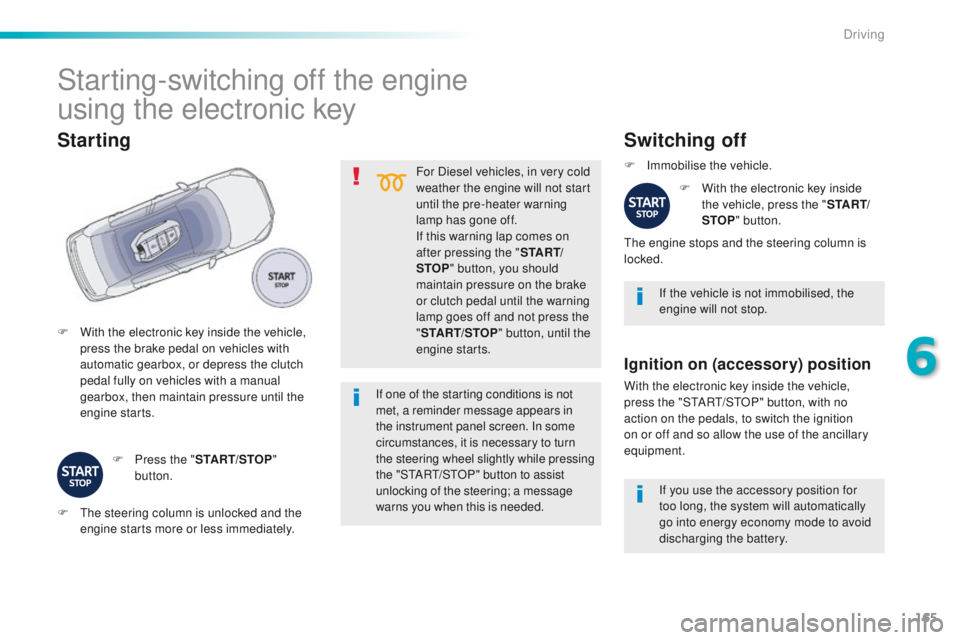
F
W
ith the electronic key inside the vehicle,
press the brake pedal on vehicles with
automatic gearbox, or depress the clutch
pedal fully on vehicles with a manual
gearbox, then maintain pressure until the
engine starts.
Starting
F Press the " START/STOP"
button.
Starting-switching off the engine
using the electronic key
F the steering column is unlocked and the engine starts more or less immediately. If you use the accessory position for
too long, the system will automatically
go into energy economy mode to avoid
discharging the battery.
6
Driving
Page 173 of 371
171
508_en_Chap06_conduite_ed01-2016
Emergency braking
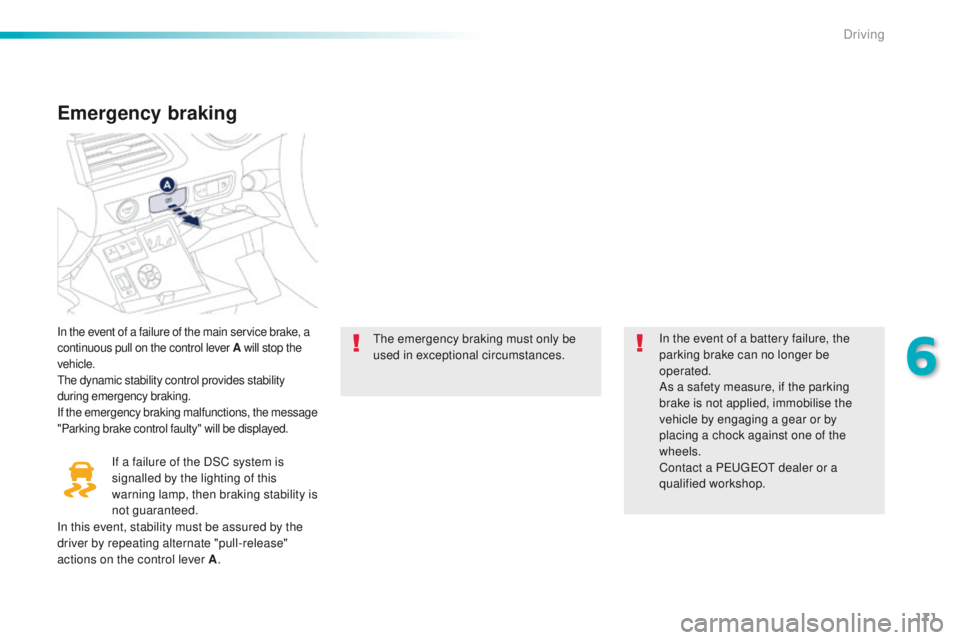
In the event of a failure of the main service brake, a
continuous pull on the control lever A will stop the
vehicle.
th
e dynamic stability control provides stability
during emergency braking.
If the emergency braking malfunctions, the message
"Parking brake control faulty" will be displayed.
If a failure of the DSC system is
signalled by the lighting of this
warning lamp, then braking stability is
not guaranteed.
th
e emergency braking must only be
used in exceptional circumstances. In the event of a battery failure, the
parking brake can no longer be
operated.
As a safety measure, if the parking
brake is not applied, immobilise the
vehicle by engaging a gear or by
placing a chock against one of the
wheels.
Contact a Pe
ugeOt dealer or a
qualified workshop.
In this event, stability must be assured by the
driver by repeating alternate "pull-release"
actions on the control lever A .
6
Driving
Page 199 of 371
197
508_en_Chap06_conduite_ed01-2016
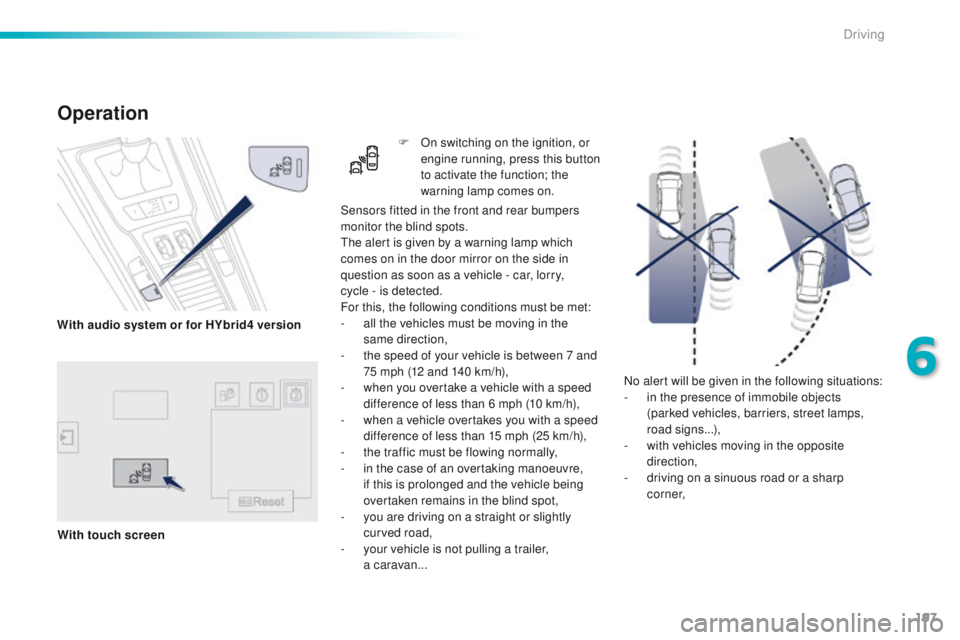
No alert will be given in the following situations:
- i n the presence of immobile objects
(parked vehicles, barriers, street lamps,
road signs...),
-
w
ith vehicles moving in the opposite
direction,
-
d
riving on a sinuous road or a sharp
c o r n e r,
Sensors fitted in the front and rear bumpers
monitor the blind spots.
th
e alert is given by a warning lamp which
comes on in the door mirror on the side in
question as soon as a vehicle - car, lorry,
cycle
- is detected.
For this, the following conditions must be met:
-
a
ll the vehicles must be moving in the
same direction,
-
t
he speed of your vehicle is between 7 and
75 mph (12 and 140 km/h),
-
w
hen you overtake a vehicle with a speed
difference of less than 6 mph (10 km/h),
-
w
hen a vehicle overtakes you with a speed
difference of less than 15 mph (25 km/h),
-
t
he traffic must be flowing normally,
-
i
n the case of an overtaking manoeuvre,
if this is prolonged and the vehicle being
overtaken remains in the blind spot,
-
y
ou are driving on a straight or slightly
curved road,
-
y
our vehicle is not pulling a trailer,
a
caravan...
Operation
F On switching on the ignition, or engine running, press this button
to activate the function; the
warning lamp comes on.
With audio system or for HYbrid4 version
With touch screen
6
Driving
Page 267 of 371
265
508_en_Chap09_caracteristiques-techniques_ed01-2016
* the kerb weight is equal to the unladen weight + driver (75 kg).
** th e weight of the braked trailer can be increased, within the gtW l imit, if the gV W of the towing vehicle is reduced by an equal amount; warning,
towing using a lightly loaded towing vehicle may have an adverse effect on its road holding.
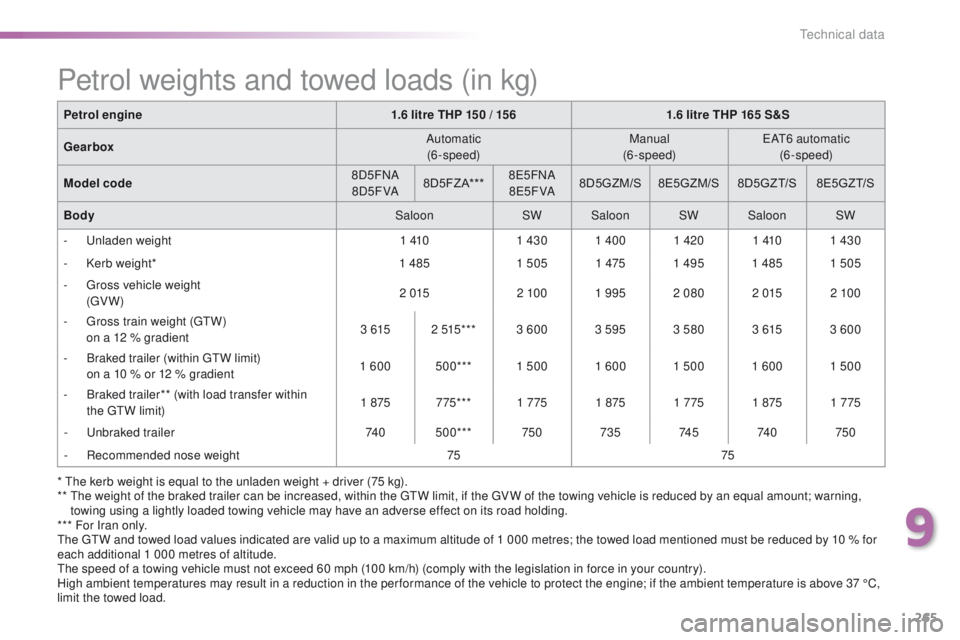
Petrol weights and towed loads (in kg)
Petrol engine 1.6 litre THP 150 / 1561.6 litre THP 165 S&S
Gearbox Automatic
(6-speed) Manual
(6-speed)
eAt6
automatic
(6-speed)
Model code 8D5FNA
8 D5 F VA 8D5FZA*** 8
e5
FNA
8
e5
F VA8D5GZM/S 8E5GZM/S
8 D5G Z T/S8E5GZT/S
Body SaloonSWSaloon SWSaloon SW
-
u
n
laden weight 1 4101 430 1 400 1 4201 4101 430
-
K
erb weight* 1 4851 5051 4751 495 1 485 1 505
-
g
r
oss vehicle weight
(
g
V
W) 2 015
2 10 01 995 2 080 2 0152 10 0
-
g
r
oss train weight (
g
t
W
)
o
n a 12 % gradient 3 615
2 515*** 3 600 3 595 3 580 3 6153 600
-
B
raked trailer (within gt
W l
imit)
o
n a 10 % or 12 % gradient 1 600
500*** 1 500 1 600 1 500 1 600 1 500
-
B
raked trailer** (with load transfer within
the
gt
W l
imit) 1 875
775*** 1 7751 8751 775 1 8751 775
-
u
nb
raked trailer 74 0500*** 750735 74 5 74 0 750
-
R
ecommended nose weight 7575
*** For Iran only.
th
e gt
W a
nd towed load values indicated are valid up to a maximum altitude of 1 000 metres; the towed load mentioned must be reduced by 10 % for
each additional 1 000 metres of altitude.
th
e speed of a towing vehicle must not exceed 60 mph (100 km/h) (comply with the legislation in force in your country).
High ambient temperatures may result in a reduction in the per formance of the vehicle to protect the engine; if the ambient temperature is above 37 °C,
limit the towed load.
9
technical data
Page 270 of 371
268
508_en_Chap09_caracteristiques-techniques_ed01-2016
* the kerb weight is equal to the unladen weight + driver (75 kg).
** th e weight of the braked trailer can be increased, within the gtW l imit, if the gV W of the towing vehicle is reduced by an equal amount; warning,
towing using a lightly loaded towing vehicle may have an adverse effect on its road holding.
th
e gt
W a
nd towed load values indicated are valid up to a maximum altitude of 1 000 metres; the towed load mentioned must be reduced by 10 % for
each additional 1 000 metres of altitude.
th
e speed of a towing vehicle must not exceed 60 mph (100 km/h) (comply with the legislation in force in your country).
High ambient temperatures may result in a reduction in the per formance of the vehicle to protect the engine; if the ambient temperature is above 37 °C,
limit the towed load.
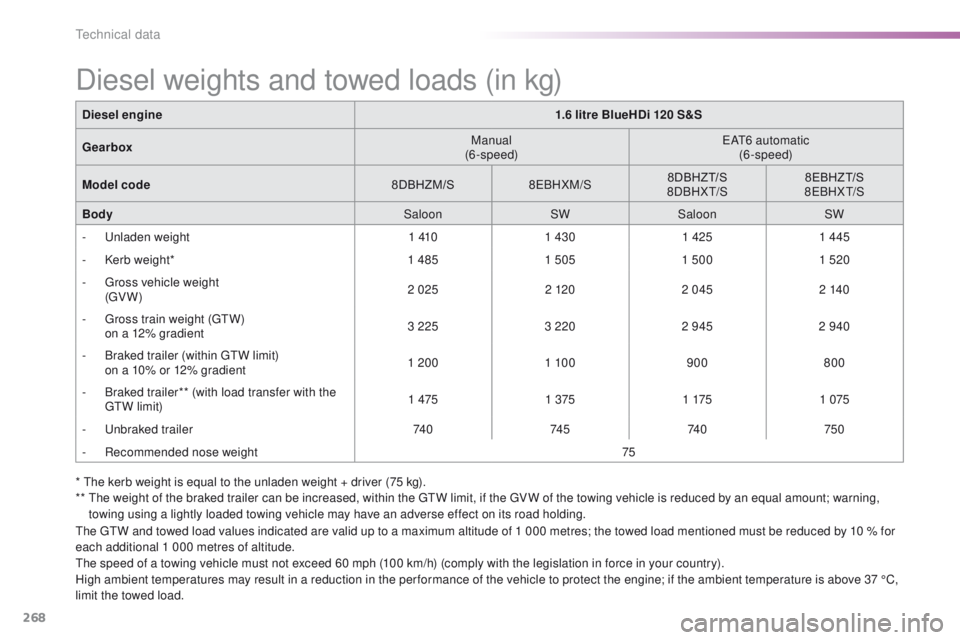
Diesel weights and towed loads (in kg)
Diesel engine 1.6 litre BlueHDi 120 S&S
Gearbox Manual
(6-speed)
eAt6
automatic
(6-speed)
Model code 8DBHZM/S8
eB
HXM/S8 D BHZ T/S
8 D BH X
t
/S8 EBHZ T/S
8
eB
H X
t
/S
Body SaloonSWSaloon SW
-
u
n
laden weight 1 4101 430 1 4251 445
-
K
erb weight* 1 4851 5051 500 1 520
-
g
r
oss vehicle weight
(
g
V
W) 2 025
2 1202 045 2 140
-
g
r
oss train weight (
g
t
W
)
o
n a 12% gradient 3 225
3 2202 945 2 940
-
B
raked trailer (within gt
W l
imit)
o
n a 10% or 12% gradient 1 200
1 10 0 900800
-
B
raked trailer** (with load transfer with the
g
t
W
limit) 1 475
1 375 1 1751 075
-
u
nb
raked trailer 74 074 5 74 0750
-
R
ecommended nose weight 75
technical data