wheel Peugeot 508 2016 User Guide
[x] Cancel search | Manufacturer: PEUGEOT, Model Year: 2016, Model line: 508, Model: Peugeot 508 2016Pages: 371, PDF Size: 12.12 MB
Page 80 of 371
78
508_en_Chap03_ergonomie-et-confort_ed01-2016
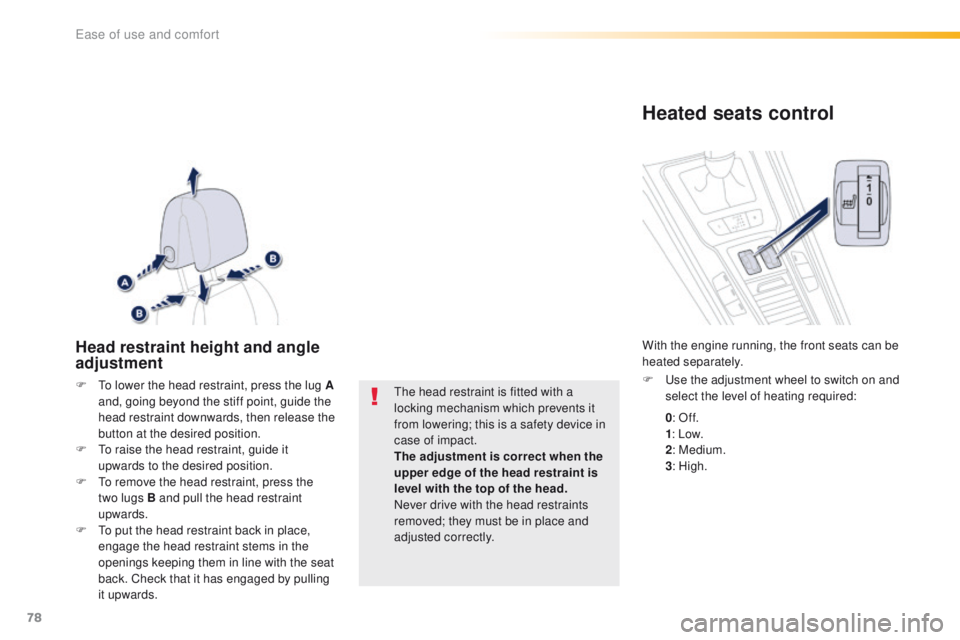
Head restraint height and angle
adjustment
F to lower the head restraint, press the lug A and, going beyond the stiff point, guide the
head restraint downwards, then release the
button at the desired position.
F
t
o r
aise the head restraint, guide it
upwards to the desired position.
F
t
o r
emove the head restraint, press the
two
lugs B and pull the head restraint
upwards.
F
t
o p
ut the head restraint back in place,
engage the head restraint stems in the
openings keeping them in line with the seat
back. Check that it has engaged by pulling
it upwards.th e head restraint is fitted with a
locking mechanism which prevents it
from lowering; this is a safety device in
case of impact.
The adjustment is correct when the
upper edge of the head restraint is
level with the top of the head.
Never drive with the head restraints
removed; they must be in place and
adjusted correctly.
Heated seats control
F use the adjustment wheel to switch on and select the level of heating required:
With the engine running, the front seats can be
heated separately.
0: Of f.
1 : Low.
2 : Medium.
3 : High.
ease of use and comfort
Page 81 of 371
79
508_en_Chap03_ergonomie-et-confort_ed01-2016
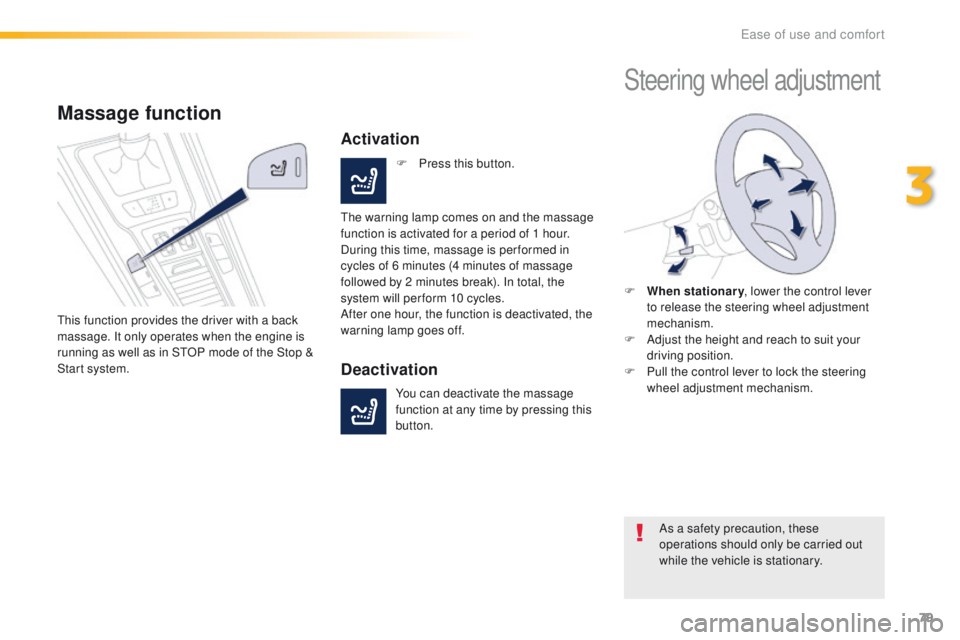
Massage function
this function provides the driver with a back
massage. It only operates when the engine is
running as well as in S
tO
P mode of the Stop &
Start system.
Activation
F Press this button.
th
e warning lamp comes on and the massage
function is activated for a period of 1 hour.
During this time, massage is per formed in
cycles of 6 minutes (4 minutes of massage
followed by 2 minutes break). In total, the
system will per form 10 cycles.
After one hour, the function is deactivated, the
warning lamp goes off.
Deactivation
You can deactivate the massage
function at any time by pressing this
button.
Steering wheel adjustment
F When stationary , lower the control lever
to release the steering wheel adjustment
mechanism.
F
A
djust the height and reach to suit your
driving position.
F
P
ull the control lever to lock the steering
wheel adjustment mechanism.
As a safety precaution, these
operations should only be carried out
while the vehicle is stationary.
3
ease of use and comfort
Page 99 of 371
97
508_en_Chap03_ergonomie-et-confort_ed01-2016
Programmable heating
mode
this is an additional and separate system
which heats the engine hot water circuit
to improve defrosting and to preheat the
passenger compartment.
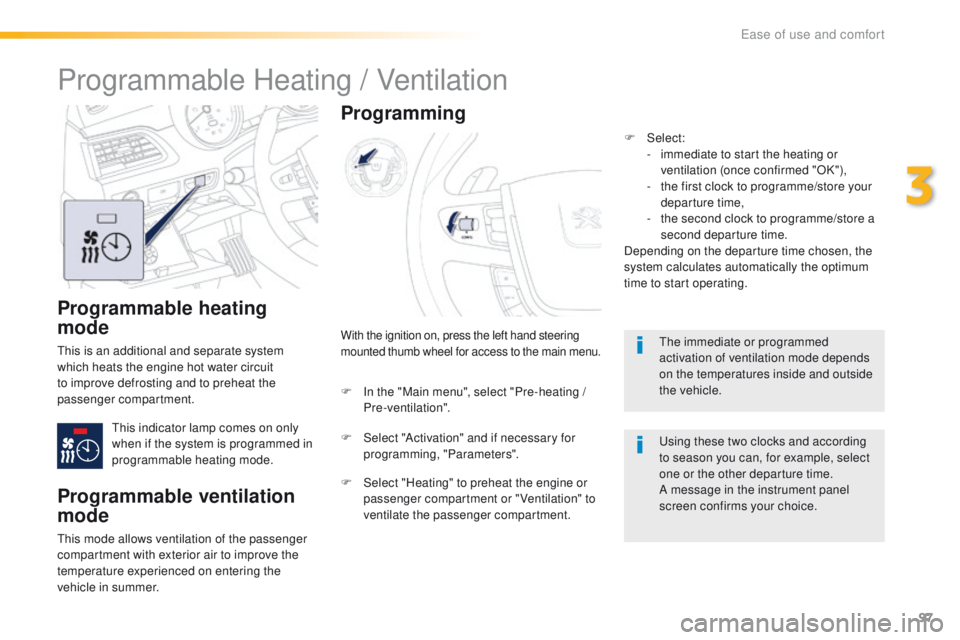
th
is indicator lamp comes on only
when if the system is programmed in
programmable heating mode.With the ignition on, press the left hand steering
mounted thumb wheel for access to the main menu.
Programming
F In the "Main menu", select "Pre-heating /
Pre-ventilation".
F
S
elect "Activation" and if necessary for
programming, "Parameters".
F
S
elect "Heating" to preheat the engine or
passenger compartment or "Ventilation" to
ventilate the passenger compartment.
Programmable Heating / Ventilation
Programmable ventilation
mode
this mode allows ventilation of the passenger
compartment with exterior air to improve the
temperature experienced on entering the
vehicle in summer. F
Select:
-
i
mmediate to start the heating or
ventilation (once confirmed "OK"),
-
t
he first clock to programme/store your
departure time,
-
t
he second clock to programme/store a
second departure time.
Depending on the departure time chosen, the
system calculates automatically the optimum
time to start operating.
th
e immediate or programmed
activation of ventilation mode depends
on the temperatures inside and outside
the vehicle.
us
ing these two clocks and according
to season you can, for example, select
one or the other departure time.
A message in the instrument panel
screen confirms your choice.
3
ease of use and comfort
Page 101 of 371
99
508_en_Chap03_ergonomie-et-confort_ed01-2016
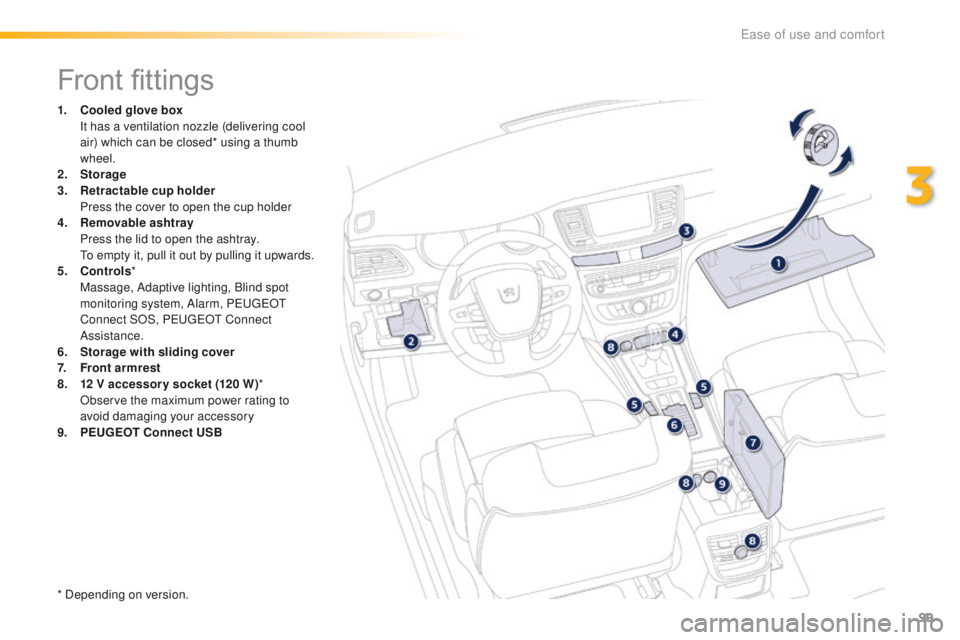
Front fittings
1. Cooled glove box I
t has a ventilation nozzle (delivering cool
air) which can be closed* using a thumb
wheel.
2.
Sto
rage
3.
R
etractable cup holder
P
ress the cover to open the cup holder
4.
Re
movable ashtray
P
ress the lid to open the ashtray.
t
o e
mpty it, pull it out by pulling it upwards.
5.
C
ontrols *
M
assage, Adaptive lighting, Blind spot
monitoring system, Alarm, P
e
uge
Ot
Connect SOS, P
e
uge
Ot
Connect
Assistance.
6.
S
torage with sliding cover
7.
F
ront armrest
8.
1 2
V accessory socket (120 W )*
O
bserve the maximum power rating to
avoid damaging your accessory
9.
P
EUGEOT Connect USB
* Depending on version.
3
ease of use and comfort
Page 114 of 371
112
508_en_Chap03_ergonomie-et-confort_ed01-2016
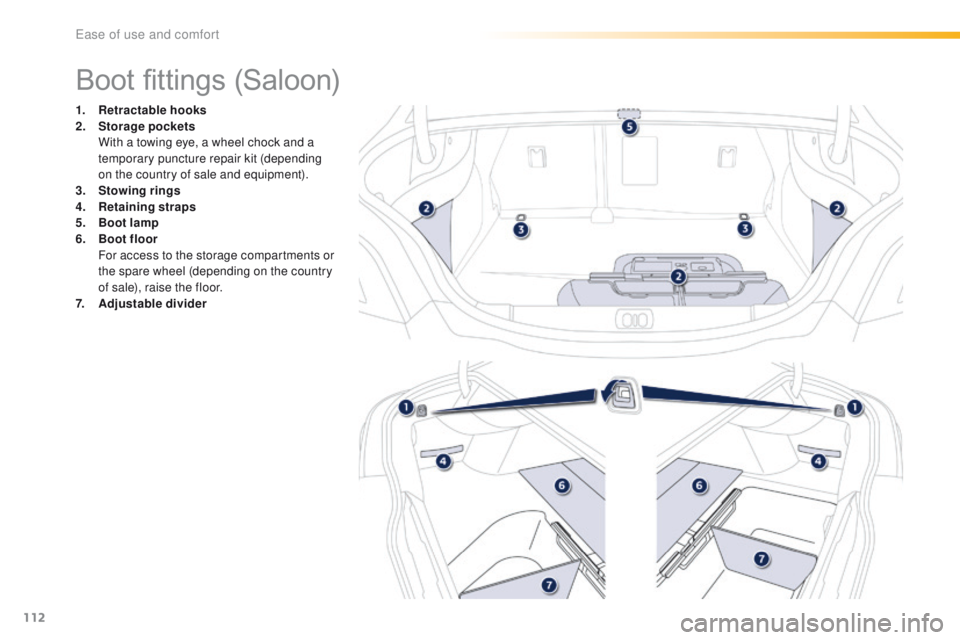
Boot fittings (Saloon)
1. Retractable hooks
2. Storage pockets
W
ith a towing eye, a wheel chock and a
temporary puncture repair kit (depending
on the country of sale and equipment).
3.
S
towing rings
4.
R
etaining straps
5.
B
oot lamp
6.
B
oot floor
F
or access to the storage compartments or
the spare wheel (depending on the country
of sale), raise the floor.
7.
A
djustable divider
ease of use and comfort
Page 115 of 371
113
508_en_Chap03_ergonomie-et-confort_ed01-2016
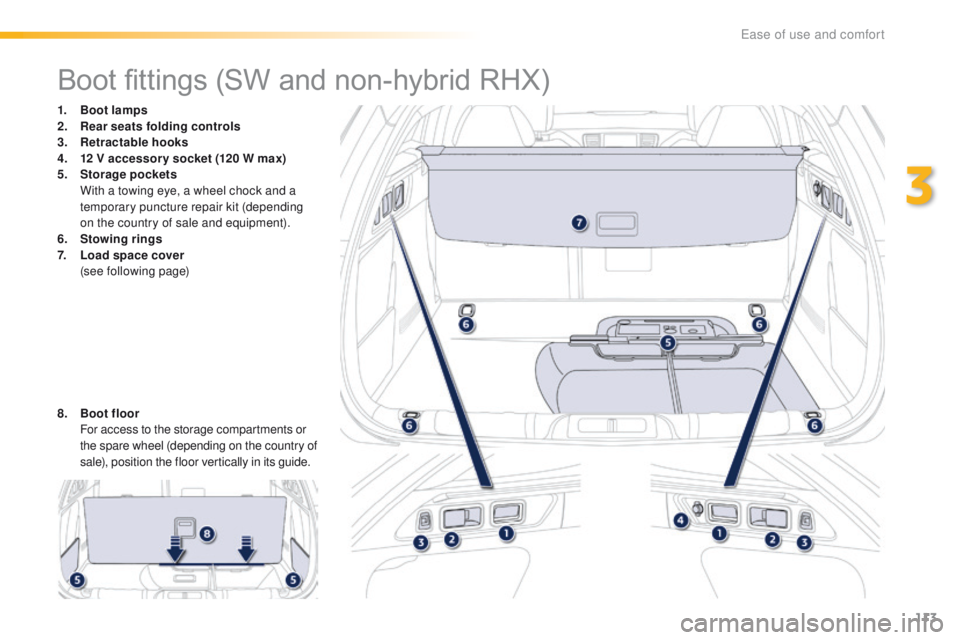
Boot fittings (SW and non-hybrid RHX)
1. Boot lamps
2. Rear seats folding controls
3.
R
etractable hooks
4.
1
2 V accessor y socket (120 W max)
5.
Sto
rage pockets
W
ith a towing eye, a wheel chock and a
temporary puncture repair kit (depending
on the country of sale and equipment).
6.
S
towing rings
7.
L
oad space cover
(
see following page)
8.
B
oot floor
F
or access to the storage compartments or
the spare wheel (depending on the country of
sale), position the floor vertically in its guide.
3
ease of use and comfort
Page 125 of 371
123
508_en_Chap04_eclairage-et-visibilite_ed01-2016
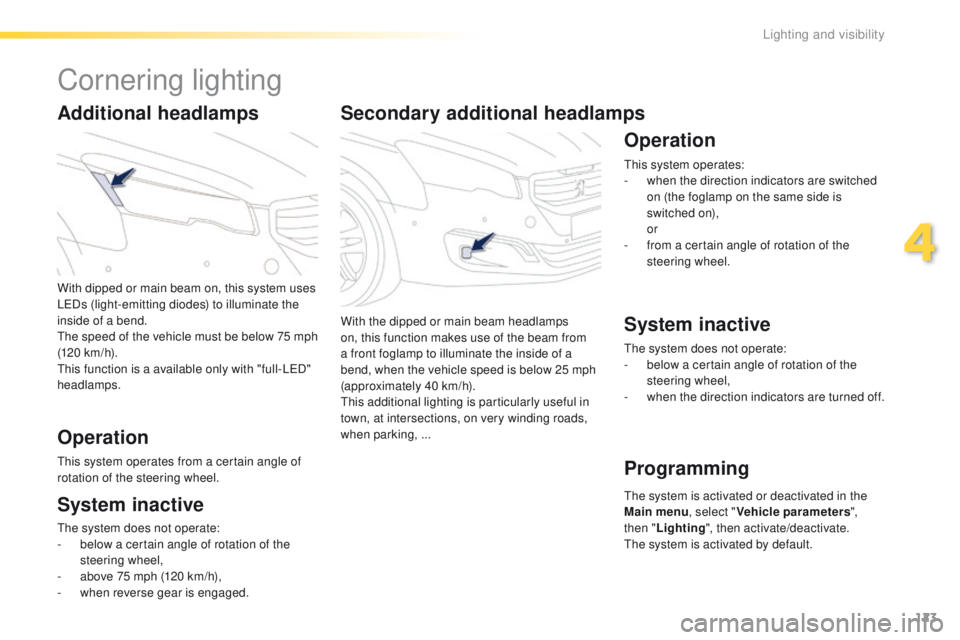
Secondary additional headlamps
With the dipped or main beam headlamps
on, this function makes use of the beam from
a front foglamp to illuminate the inside of a
bend, when the vehicle speed is below 25 mph
(approximately 40 km/h).
th
is additional lighting is particularly useful in
town, at intersections, on very winding roads,
when parking,
...
Operation
this system operates:
- w hen the direction indicators are switched
on (the foglamp on the same side is
switched on),
or
-
f
rom a certain angle of rotation of the
steering wheel.
System inactive
Programming
the system does not operate:
- b elow a certain angle of rotation of the
steering wheel,
-
w
hen the direction indicators are turned off.
th
e system is activated or deactivated in the
Main menu , select "Vehicle parameters ",
then " Lighting ", then activate/deactivate.
th
e system is activated by default.
With dipped or main beam on, this system uses
L
eD
s (light-emitting diodes) to illuminate the
inside of a bend.th
e speed of the vehicle must be below 75
m
ph
(120 km/h).
th
is function is a available only with "full-L
eD
"
headlamps.
Additional headlamps
Operation
this system operates from a certain angle of
rotation of the steering wheel.
System inactive
the system does not operate:
- b elow a certain angle of rotation of the
steering wheel,
-
a
bove 75 mph (120 km/h),
-
w
hen reverse gear is engaged.
Cornering lighting
4
Lighting and visibility
Page 134 of 371
132
508_en_Chap05_securite_ed01-2016
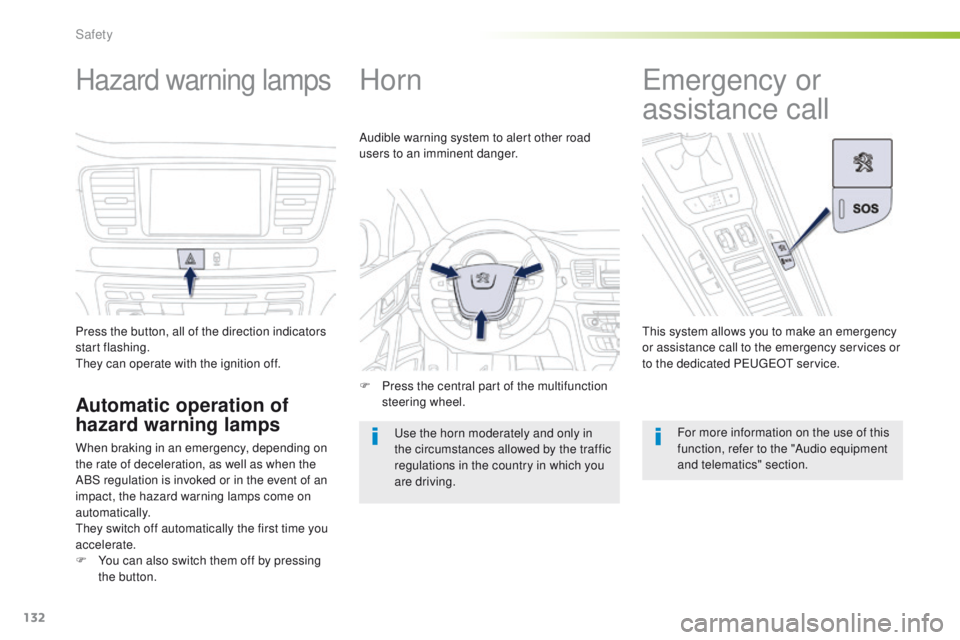
Hazard warning lamps
Press the button, all of the direction indicators
start flashing.
th
ey can operate with the ignition off.
Automatic operation of
hazard warning lamps
When braking in an emergency, depending on
the rate of deceleration, as well as when the
ABS regulation is invoked or in the event of an
impact, the hazard warning lamps come on
automatically.
th
ey switch off automatically the first time you
accelerate.
F
Y
ou can also switch them off by pressing
the button.
Horn
F Press the central part of the multifunction steering wheel.
Audible warning system to alert other road
users to an imminent danger.
us
e the horn moderately and only in
the circumstances allowed by the traffic
regulations in the country in which you
are driving.
emergency or
assistance call
this system allows you to make an emergency
or assistance call to the emergency services or
to the dedicated P
e
uge
Ot
service.
For more information on the use of this
function, refer to the "Audio equipment
and telematics" section.
Safety
Page 135 of 371
133
508_en_Chap05_securite_ed01-2016
electronic stability control (eSC) incorporating
the following systems:
-
a
nti-lock braking system (ABS) and
electronic brake force distribution (
eB
FD),
-
em
ergency braking assistance (
eBA
),
-
w
heel anti-slip regulation (ASR) or traction
control,
-
d
ynamic stability control (DSC).
electronic stability control (eS C)
Definitions
Anti-lock braking system (ABS)
and electronic brake force
distribution (EBFD)
this system improves the stability and
manoeuvrability of your vehicle when braking
and contributes towards improved control on
corners, in particular on poor or slippery road
surfaces.
th
e ABS prevents wheel lock in the event of
emergency braking.
th
e e
B
FD manages the braking pressure
wheel by wheel.
Emergency braking assistance
(EBA)
In an emergency, this system enables you to
reach the optimum braking pressure more
quickly and therefore reduce the stopping
distance.
It is triggered according to the speed at which
the brake pedal is pressed.
t
h
is is felt by a
reduction in the resistance of the pedal and an
increase in the effectiveness of the braking.
Anti-slip regulation (ASR)
the ASR system (also known as tr action
Control) optimises traction in order to limit
wheel slip by acting on the brakes of the driving
wheels and on the engine. It also improves
the directional stability of the vehicle on
acceleration.
Dynamic stability control (DSC)
If there is a difference between the path
followed by the vehicle and that required by
the driver, the DSC monitors each wheel and
automatically acts on the brake of one or more
wheels and on the engine to return the vehicle
to the required path, within the limits of the laws
of physics.
5
Safety
Page 136 of 371
134
508_en_Chap05_securite_ed01-2016
Snow driving assistance
(Intelligent Traction Control)
Your vehicle has a system to help driving on
snow: Intelligent Traction Control.
th
is automatic system continuously checks
for situations of difficult sur face adhesion that
could make it difficult to move off or make
progress on deep fresh snow or compacted
snow.
In these situations, Intelligent Traction
Control limits the amount of wheel slip to
provide the best traction and trajectory control.
In extremely severe conditions (deep snow,
mud…), it can be useful to temporarily
deactivate the wheel anti-slip regulation
system to allow a degree of wheel spin and so
recover grip.
It is recommended that the system be
reactivated as soon as possible.
Snow tyres are strongly recommended on
sur faces offering low levels of adhesion.
Anti-lock braking system
(ABS) and electronic brake
force distribution (EBFD)
Operation
In emergency braking, press
very firmly without releasing the
pressure. When changing wheels (tyres and rims),
make sure that these are approved for
your vehicle.
Normal operation of the ABS may make
itself felt by slight vibrations of the brake
pedal.
th
e fixed illumination of this warning
lamp indicates that there is a fault
with the ABS.
When this warning lamp comes on,
coupled with the STOP and ABS warning
lamps, accompanied by an audible signal
and a message, it indicates that there
is a fault with the electronic brake force
distribution (
eB
FD).
the vehicle retains conventional braking. Drive
carefully at moderate speed.
You must stop as soon as it is safe to do so.
In both cases, have the system checked by a
P
e
uge
Ot
dealer or a qualified workshop as
soon as possible.
Safety