stop start Peugeot 508 2016 Owner's Guide
[x] Cancel search | Manufacturer: PEUGEOT, Model Year: 2016, Model line: 508, Model: Peugeot 508 2016Pages: 371, PDF Size: 12.12 MB
Page 169 of 371
167
508_en_Chap06_conduite_ed01-2016
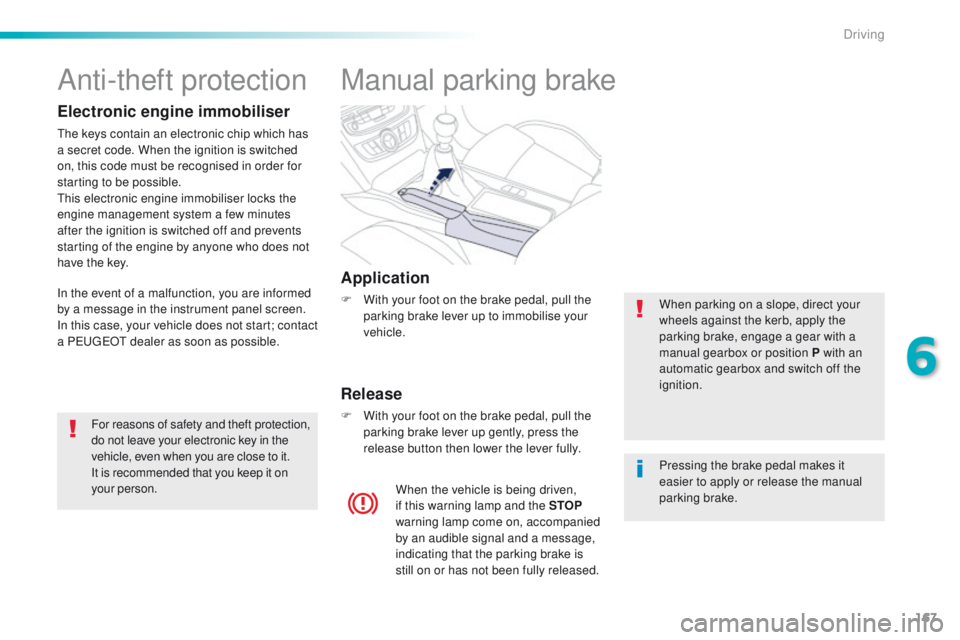
Manual parking brake
Application
F With your foot on the brake pedal, pull the parking brake lever up to immobilise your
vehicle.
Release
F With your foot on the brake pedal, pull the parking brake lever up gently, press the
release button then lower the lever fully. When parking on a slope, direct your
wheels against the kerb, apply the
parking brake, engage a gear with a
manual gearbox or position P with an
automatic gearbox and switch off the
ignition.
When the vehicle is being driven,
if this warning lamp and the STOP
warning lamp come on, accompanied
by an audible signal and a message,
indicating that the parking brake is
still on or has not been fully released. Pressing the brake pedal makes it
easier to apply or release the manual
parking brake.
Anti-theft protection
Electronic engine immobiliser
the keys contain an electronic chip which has
a secret code. When the ignition is switched
on, this code must be recognised in order for
starting to be possible.
th
is electronic engine immobiliser locks the
engine management system a few minutes
after the ignition is switched off and prevents
starting of the engine by anyone who does not
have the key.
In the event of a malfunction, you are informed
by a message in the instrument panel screen.
In this case, your vehicle does not start; contact
a P
e
uge
Ot
dealer as soon as possible.
For reasons of safety and theft protection,
do not leave your electronic key in the
vehicle, even when you are close to it.
It is recommended that you keep it on
your person.
6
Driving
Page 175 of 371
173
508_en_Chap06_conduite_ed01-2016
SituationsConsequences
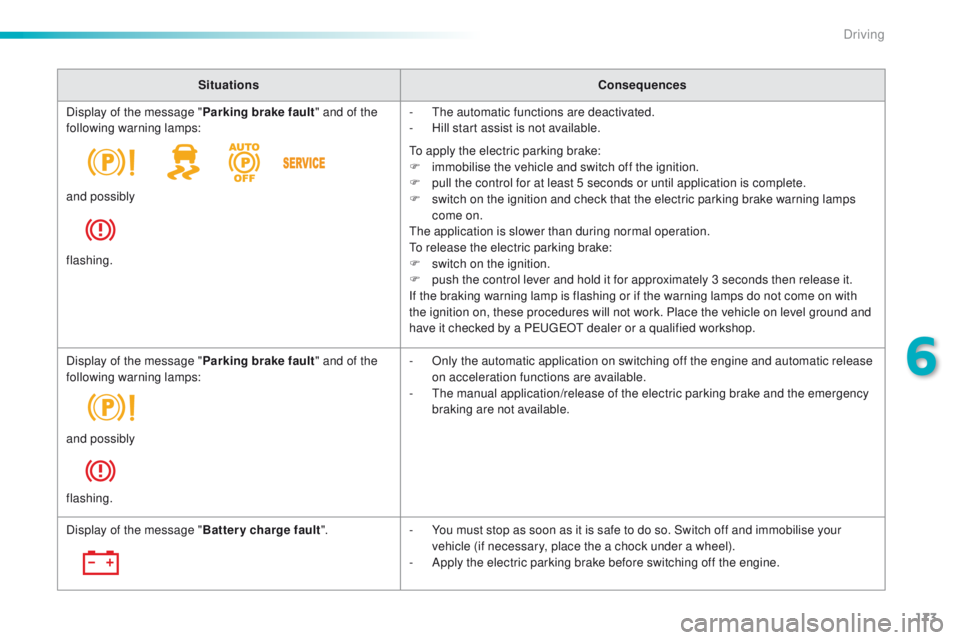
Display of the message " Parking brake fault" and of the
following warning lamps: -
t
h
e automatic functions are deactivated.
-
H
ill start assist is not available.
to a
pply the electric parking brake:
F
i
mmobilise the vehicle and switch off the ignition.
F
p
ull the control for at least 5 seconds or until application is complete.
F
s
witch on the ignition and check that the electric parking brake warning lamps
come on.
th
e application is slower than during normal operation.
to r
elease the electric parking brake:
F
s
witch on the ignition.
F
p
ush the control lever and hold it for approximately 3 seconds then release it.
If the braking warning lamp is flashing or if the warning lamps do not come on with
the ignition on, these procedures will not work. Place the vehicle on level ground and
have it checked by a P
e
uge
Ot
dealer or a qualified workshop.
and possibly
flashing.
Display of the message "
Parking brake fault" and of the
following warning lamps: -
O
nly the automatic application on switching off the engine and automatic release
on acceleration functions are available.
-
t
h
e manual application/release of the electric parking brake and the emergency
braking are not available.
and possibly
flashing.
Display of the message " Battery charge fault".-
Y
ou must stop as soon as it is safe to do so. Switch off and immobilise your
vehicle (if necessary, place the a chock under a wheel).
-
A
pply the electric parking brake before switching off the engine.
6
Driving
Page 177 of 371
175
508_en_Chap06_conduite_ed01-2016
gear shift indicator*
Operation
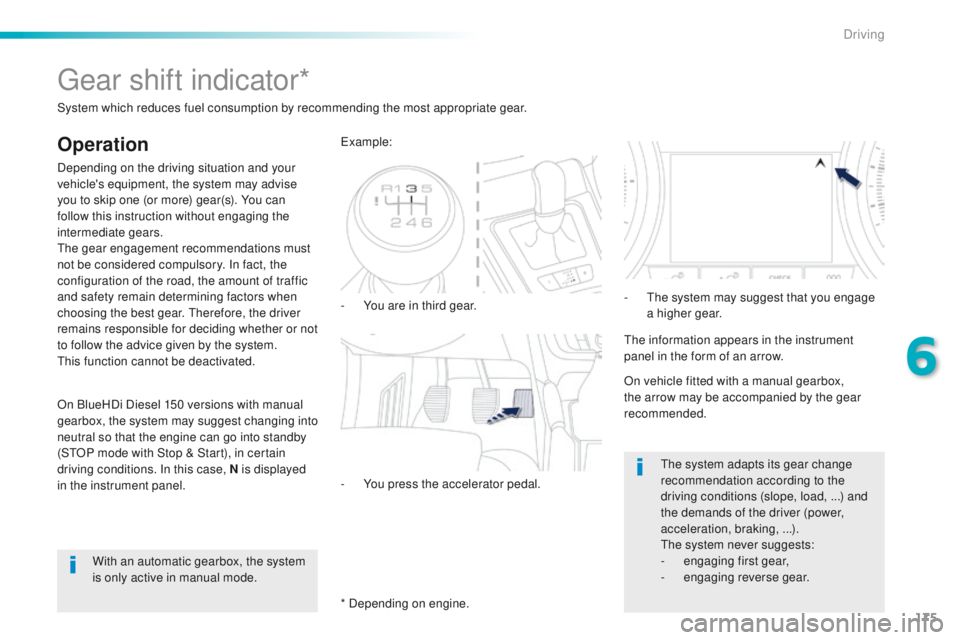
Depending on the driving situation and your
vehicle's equipment, the system may advise
you to skip one (or more) gear(s). You can
follow this instruction without engaging the
intermediate gears.
the
gear engagement recommendations must
not be considered compulsory. In fact, the
configuration of the road, the amount of traffic
and safety remain determining factors when
choosing the best gear.
t
her
efore, the driver
remains responsible for deciding whether or not
to follow the advice given by the system.
th
is function cannot be deactivated. -
Y
ou are in third gear.
ex
ample:
-
Y
ou press the accelerator pedal.
System which reduces fuel consumption by recommending the most appropriate gear.
With an automatic gearbox, the system
is only active in manual mode. * Depending on engine.
th
e information appears in the instrument
panel in the form of an arrow.
th
e system adapts its gear change
recommendation according to the
driving conditions (slope, load, ...) and
the demands of the driver (power,
acceleration, braking, ...).
th
e system never suggests:
-
e
ngaging first gear,
-
enga
ging reverse gear.
On vehicle fitted with a manual gearbox,
the arrow may be accompanied by the gear
recommended.
On BlueHDi Diesel 150 versions with manual
gearbox, the system may suggest changing into
neutral so that the engine can go into standby
(S
tO
P mode with Stop & Start), in certain
driving conditions. In this case, N is displayed
in the instrument panel. -
t
h
e system may suggest that you engage
a higher gear.
6
Driving
Page 182 of 371
180
508_en_Chap06_conduite_ed01-2016
Stop & Start
Operation
Going into engine STOP mode
the "ECO" indicator lamp comes
on in the instrument panel and the
engine goes into standby:
-
w
ith a manual gearbox, at speeds below
12 mph (20 km/h), or vehicle stationary
with the e-
tH
P 165 version, when you put
the gear lever into neutral and release the
clutch pedal,
-
w
ith an automatic gearbox, vehicle
stationary, when you press the brake pedal
or you put the gear selector in position N .
If your vehicle is fitted with the system, a time
counter calculates the sum of the periods in
S
tO
P mode during a journey. It rests itself to
zero every time the ignition is switched on with
t h e key. Never refuel with the engine in
S
tO
P mode; you must switch off the
ignition with the key. For your comfort, during parking
maoeuvres, S
tO
P mode is not
available for a few seconds after
coming out of reverse gear.
S
tO
P mode does not affect the
functionality of the vehicle, such as for
example, braking, power steering...
th
e Stop & Start
system puts the engine
temporarily into standby - S
tO
P mode -
during stops in the traffic (red lights, traffic
jams, or other...).
t
h
e engine restarts
automatically
-
StA
Rt
mode - as soon as
you want to move off.
th
e restart takes place
instantly, quickly and silently.
Per fect for urban use, the Stop & Start system
reduces fuel consumption and exhaust
emissions as well as the noise level when
stationary.
Driving
Page 183 of 371
181
508_en_Chap06_conduite_ed01-2016
Going into engine START mode
the "ECO" indicator lamp goes off
and the engine starts automatically:
-
w
ith a manual gearbox , when you fully
depress the clutch pedal,
-
w
ith an automatic gearbox:
●
g
ear selector in position D or M , when
you release the brake pedal,
●
o
r gear selector in position N and brake
pedal released, when you put the gear
selector in position D or M ,
●
o
r when you engage reverse gear. StA
Rt mode is invoked automatically when:
- t he driver's door is open,
-
t
he driver's seat belt is not fastened,
-
t
he speed of the vehicle exceeds 18 mph
(25 km/h) with a manual gearbox (2 mph
(3 km/h) with the
t
H
P 165 version), or
2
mph (3 km/h) with an automatic gearbox,
-
t
he electric parking brake is being applied,
-
s
ome special conditions (battery charge,
engine temperature, braking assistance,
ambient temperature...) where the engine is
needed for control of a system.
Special cases: START invoked
automatically
In this case the "ECO" indicator lamp
flashes for a few seconds, then goes
of f.
This operation is perfectly normal.
Special cases: STOP mode not
available
StOP mode is not invoked when:
- t he driver's door is open,
-
t
he driver's seat belt is not fastened,
-
t
he vehicle has not exceeded 6 mph
(10
km/h) since the last engine start using
t h e key,
-
t
he vehicle is stopped on a steep slope
(up
or down),
-
t
he electric parking brake is applied or
being applied,
-
t
he engine is needed to maintain a
comfortable temperature in the passenger
compartment,
-
d
emisting is selected,
-
s
ome special conditions (battery charge,
engine temperature, braking assistance,
ambient temperature...) where the engine is
needed to assure control of a system.
In this case, the "ECO" indicator
lamp flashes for a few seconds then
goes off.
This operation is perfectly normal.
6
Driving
Page 202 of 371
200
508_en_Chap07_info-pratiques_ed01-2016
Fuel
Additions of fuel must be of at least 5 litres to
be registered by the fuel gauge.
Opening the filler cap may result in an inrush of
air. t
h
is vacuum is entirely normal and results
from the sealing of the fuel system.
F
t
a
ke care to select the pump that delivers
the correct fuel type for your vehicle's
engine (reminder on a label on the inside of
the filler flap).
F
O
pen the filler cap by turning it a 1/4 turn to
the left.
F
R
emove the filler cap and hang it on its
carrier (on the filler flap).
Fuel tank
Capacity of the tank: approximately 72 litres (or 55 litres according to version).
If you have put in the wrong fuel for
your vehicle, you must have have
the tank drained and refilled with
the correct fuel before starting the
engine.
With Stop & Start, never refuel with
the system in S
tO
P mode; you must
switch off the ignition with the key, or
the S
tA
R
t/
S
tO
P button if your vehicle
has Keyless
e
n
try and Starting.
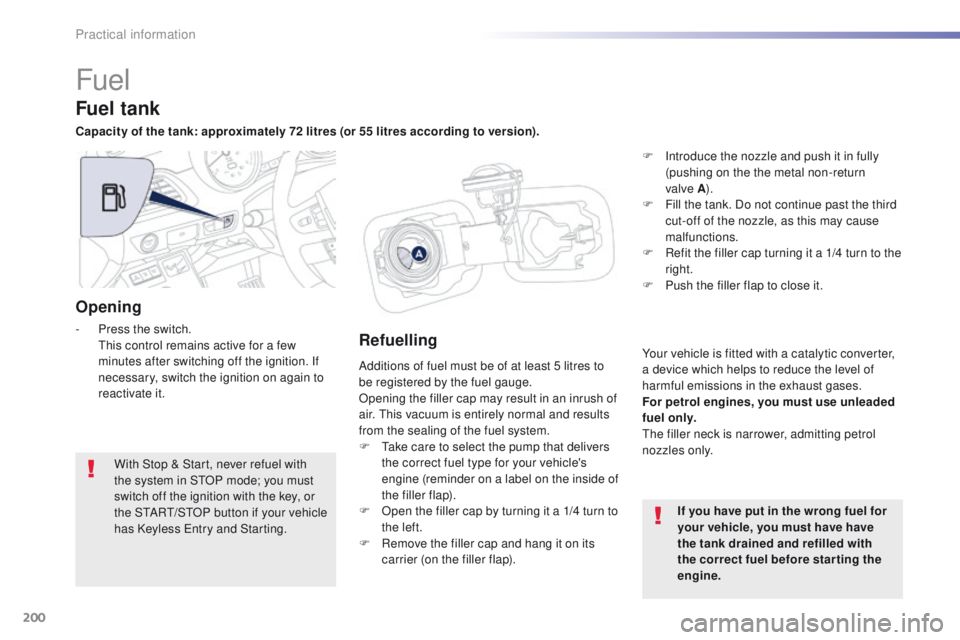
Opening
- Press the switch. th is control remains active for a few
minutes after switching off the ignition. If
necessary, switch the ignition on again to
reactivate it.Refuelling
F Introduce the nozzle and push it in fully (pushing on the the metal non-return
valve
A).
F
F
ill the tank. Do not continue past the third
cut-off of the nozzle, as this may cause
malfunctions.
F
R
efit the filler cap turning it a 1/4 turn to the
right.
F
P
ush the filler flap to close it.
Your vehicle is fitted with a catalytic converter,
a device which helps to reduce the level of
harmful emissions in the exhaust gases.
For petrol engines, you must use unleaded
fuel only.
th
e filler neck is narrower, admitting petrol
nozzles only.
Practical information
Page 216 of 371
214
508_en_Chap07_info-pratiques_ed01-2016
Opening the bonnet
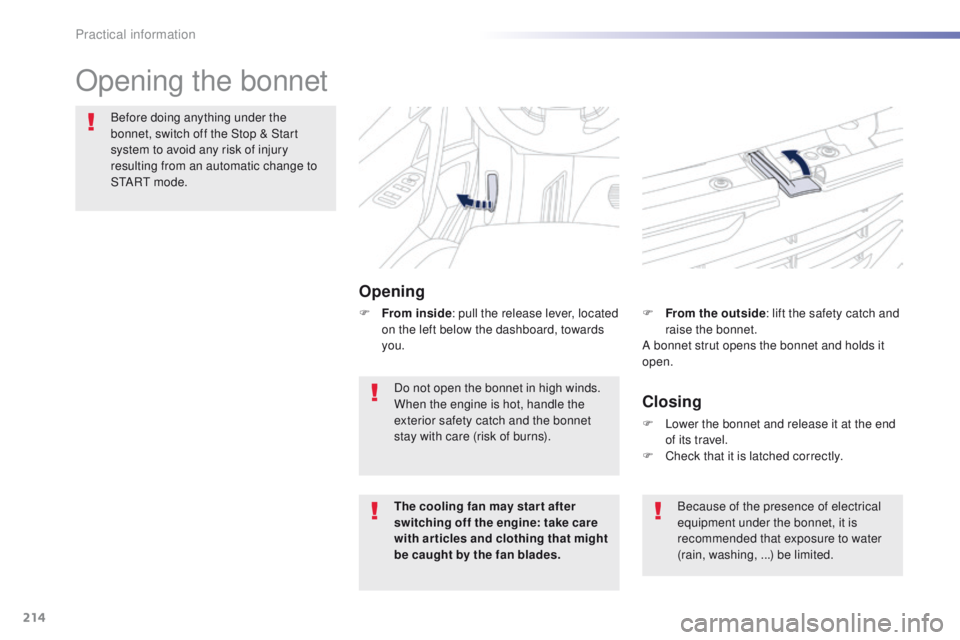
Opening
Before doing anything under the
bonnet, switch off the Stop & Start
system to avoid any risk of injury
resulting from an automatic change to
S
t
A R
t m
o d e .
Closing
F Lower the bonnet and release it at the end of its travel.
F
C
heck that it is latched correctly.
F
F
rom the outside
: lift the safety catch and
raise the bonnet.
A bonnet strut opens the bonnet and holds it
open.
The cooling fan may star t after
switching off the engine: take care
with articles and clothing that might
be caught by the fan blades. Because of the presence of electrical
equipment under the bonnet, it is
recommended that exposure to water
(rain, washing,
...) be limited.
F
Fr
om inside
: pull the release lever, located
on the left below the dashboard, towards
you.
Do not open the bonnet in high winds.
When the engine is hot, handle the
exterior safety catch and the bonnet
stay with care (risk of burns).
Practical information
Page 223 of 371
221
508_en_Chap07_info-pratiques_ed01-2016
Checks
12 V battery
the battery does not require any
maintenance.
However, check regularly that the
terminals are correctly tightened (versions
without quick release terminals) and that
the connections are clean.Refer to the manufacturer's
service schedule for details of the
replacement intervals for these
components.
Air filter and passenger compartment filter
Replace the oil filter each time the
engine oil is changed.
Refer to the manufacturer's
service schedule for details of
the replacement interval for this
component.
Oil filter
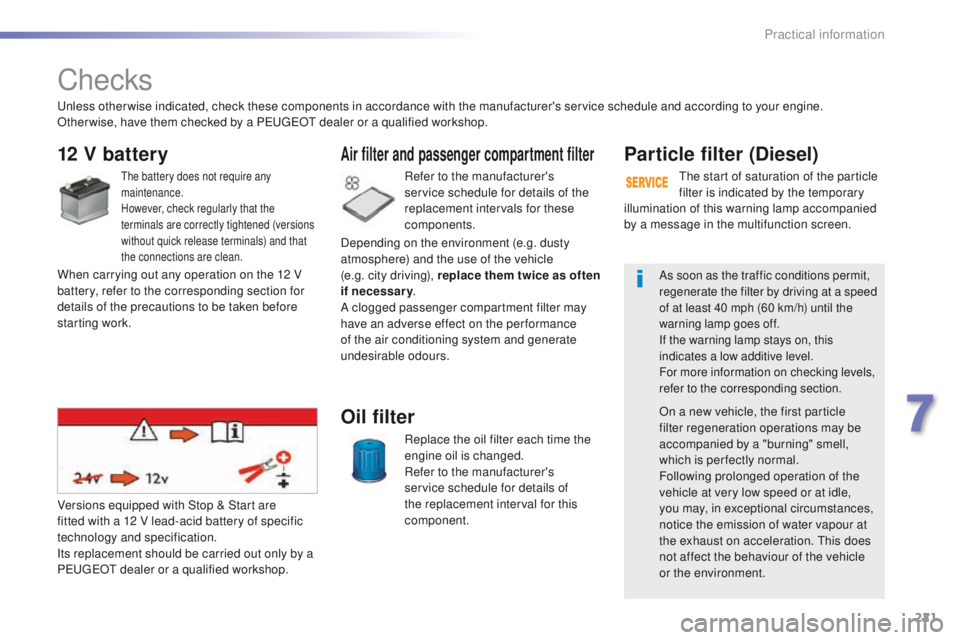
Versions equipped with Stop & Start are
fitted with a 12 V lead-acid battery of specific
technology and specification.
Its replacement should be carried out only by a
P
e
uge
Ot
dealer or a qualified workshop.
Particle filter (Diesel)
the start of saturation of the particle
filter is indicated by the temporary
As soon as the traffic conditions permit,
regenerate the filter by driving at a speed
of at least 40 mph (60 km/h) until the
warning lamp goes off.
If the warning lamp stays on, this
indicates a low additive level.
For more information on checking levels,
refer to the corresponding section.
On a new vehicle, the first particle
filter regeneration operations may be
accompanied by a "burning" smell,
which is per fectly normal.
Following prolonged operation of the
vehicle at very low speed or at idle,
you may, in exceptional circumstances,
notice the emission of water vapour at
the exhaust on acceleration.
t
h
is does
not affect the behaviour of the vehicle
or the environment.
un
less otherwise indicated, check these components in accordance with the manufacturer's service schedule and according to your engine.
Other wise, have them checked by a P
e
uge
Ot
dealer or a qualified workshop.
When carrying out any operation on the 12 V
battery, refer to the corresponding section for
details of the precautions to be taken before
starting work. Depending on the environment (e.g. dusty
atmosphere) and the use of the vehicle
(e.g.
city driving), replace them twice as often
if necessary .
A clogged passenger compartment filter may
have an adverse effect on the per formance
of the air conditioning system and generate
undesirable odours. illumination of this warning lamp accompanied
by a message in the multifunction screen.
7
Practical information
Page 228 of 371
226
508_en_Chap07_info-pratiques_ed01-2016
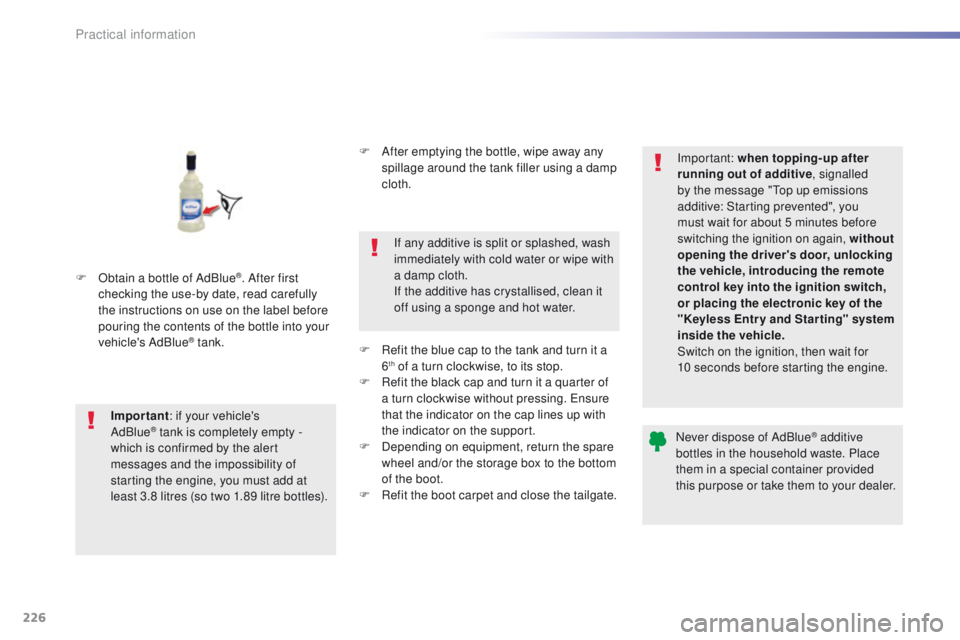
F Obtain a bottle of AdBlue®. After first
checking the use-by date, read carefully
the instructions on use on the label before
pouring the contents of the bottle into your
vehicle's AdBlue
® tank.
Important : if your vehicle's
AdBlue
® tank is completely empty -
w
hich is confirmed by the alert
messages and the impossibility of
starting the engine, you must add at
least 3.8 litres (so two 1.89 litre bottles). F
A
fter emptying the bottle, wipe away any
spillage around the tank filler using a damp
cloth.
If any additive is split or splashed, wash
immediately with cold water or wipe with
a damp cloth.
If the additive has crystallised, clean it
off using a sponge and hot water.
F
R
efit the blue cap to the tank and turn it a
6
th of a turn clockwise, to its stop.
F
R
efit the black cap and turn it a quarter of
a turn clockwise without pressing.
e
n
sure
that the indicator on the cap lines up with
the indicator on the support.
F
D
epending on equipment, return the spare
wheel and/or the storage box to the bottom
of the boot.
F
R
efit the boot carpet and close the tailgate. Important: when topping-up after
running out of additive
, signalled
by the message "
to
p up emissions
additive: Starting prevented", you
must wait for about 5 minutes before
switching the ignition on again, without
opening the driver's door, unlocking
the vehicle, introducing the remote
control key into the ignition switch,
or placing the electronic key of the
"Keyless Entr y and Star ting" system
inside the vehicle.
Switch on the ignition, then wait for
10 seconds before starting the engine.
Never dispose of AdBlue
® additive
bottles in the household waste. Place
them in a special container provided
this purpose or take them to your dealer.
Practical information
Page 255 of 371
253
508_en_Chap08_en-cas-de-pannes_ed01-2016
12 V battery
Versions equipped with Stop & Start are
fitted with a 12 V lead-acid battery of
specific technology and specification.
Its replacement should be carried
out only by a P
e
uge
Ot
dealer or a
qualified workshop.
th
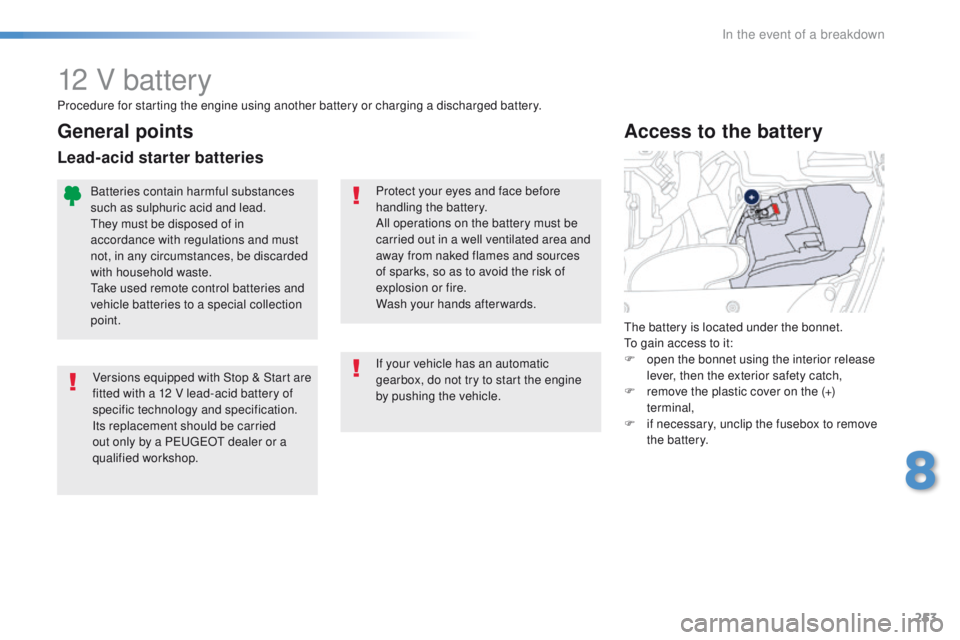
e battery is located under the bonnet.
to g
ain access to it:
F
o
pen the bonnet using the interior release
lever, then the exterior safety catch,
F r emove the plastic cover on the (+)
terminal,
F
i
f necessary, unclip the fusebox to remove
the battery.
Access to the battery
Procedure for starting the engine using another battery or charging a discharged battery.
Protect your eyes and face before
handling the battery.
All operations on the battery must be
carried out in a well ventilated area and
away from naked flames and sources
of sparks, so as to avoid the risk of
explosion or fire.
Wash your hands afterwards.
Batteries contain harmful substances
such as sulphuric acid and lead.
th
ey must be disposed of in
accordance with regulations and must
not, in any circumstances, be discarded
with household waste.
ta
ke used remote control batteries and
vehicle batteries to a special collection
point.
General points
Lead-acid starter batteries
If your vehicle has an automatic
gearbox, do not try to start the engine
by pushing the vehicle.
8
In the event of a breakdown