warning Peugeot 508 2019 Owner's Guide
[x] Cancel search | Manufacturer: PEUGEOT, Model Year: 2019, Model line: 508, Model: Peugeot 508 2019Pages: 320, PDF Size: 10.09 MB
Page 27 of 320
25
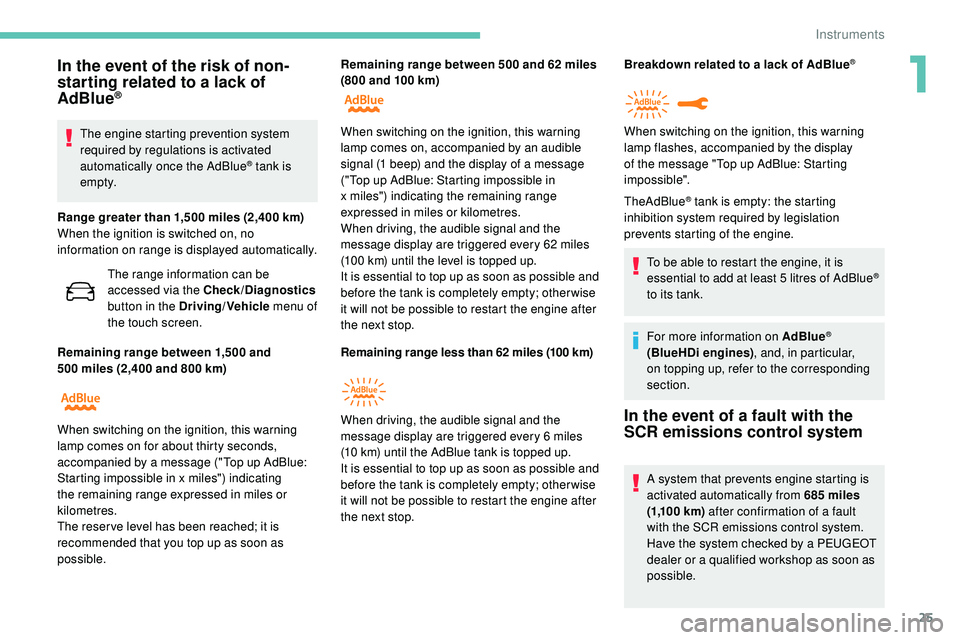
In the event of the risk of non-
starting related to a lack of
AdBlue
®
The engine starting prevention system
required by regulations is activated
automatically once the AdBlue
® tank is
e m pt y.
Range greater than 1,500 miles (2,400 km)
When the ignition is switched on, no
information on range is displayed automatically. The range information can be
accessed via the Check/Diagnostics
button in the Driving/Vehicle menu of
the touch screen.
Remaining range between 1,500 and
500
miles (2,400 and 800
km) Remaining range between 500 and 62 miles
(800 and 100
km)
Remaining range less than 62 miles (100 km)
When driving, the audible signal and the
message display are triggered every 6 miles
(10 km) until the AdBlue tank is topped up.
It is essential to top up as soon as possible and
before the tank is completely empty; other wise
it will not be possible to restart the engine after
the next stop. Breakdown related to a lack of AdBlue
®
TheAdBlue® tank is empty: the starting
inhibition system required by legislation
prevents starting of the engine.
To be able to restart the engine, it is
essential to add at least 5 litres of AdBlue
®
to its tank.
For more information on AdBlue
®
(BlueHDi engines) , and, in particular,
on topping up, refer to the corresponding
section.
When switching on the ignition, this warning
lamp comes on for about thirty seconds,
accompanied by a message ("Top up AdBlue:
Starting impossible in x miles") indicating
the remaining range expressed in miles or
kilometres.
The reser ve level has been reached; it is
recommended that you top up as soon as
possible. When switching on the ignition, this
warning
lamp comes on, accompanied by an audible
signal (1 beep) and the display of a message
("Top up AdBlue: Starting impossible in
x miles") indicating the remaining range
expressed in miles or kilometres.
When driving, the audible signal and the
message display are triggered every 62 miles
(100 km) until the level is topped up.
It is essential to top up as soon as possible and
before the tank is completely empty; other wise
it will not be possible to restart the engine after
the next stop. When switching on the ignition, this warning
lamp flashes, accompanied by the display
of the message "Top up AdBlue: Starting
impossible".
In the event of a fault with the
SCR emissions control system
A system that prevents engine starting is
activated automatically from 685 miles
(1,10 0 k m)
after confirmation of a fault
with the SCR emissions control system.
Have the system checked by a PEUGEOT
dealer or a qualified workshop as soon as
possible.
1
Instruments
Page 28 of 320
26
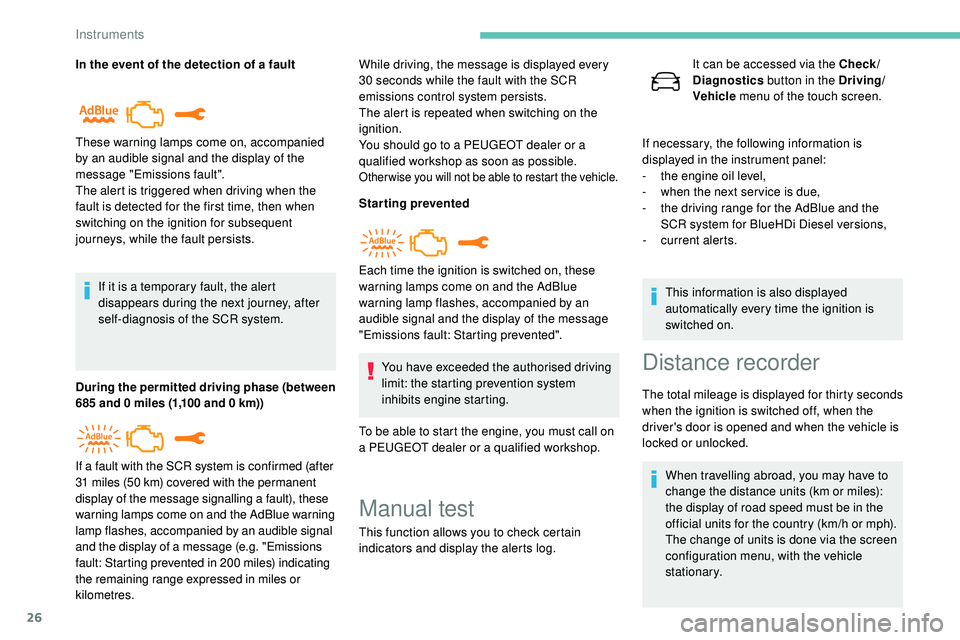
In the event of the detection of a faultIf it is a temporary fault, the alert
disappears during the next journey, after
self-diagnosis of the SCR system.
During the permitted driving phase (between
685 and 0 miles (1,100 and 0 km)) While driving, the message is displayed every
30 seconds while the fault with the SCR
emissions control system persists.
The alert is repeated when switching on the
ignition.
You should go to a PEUGEOT dealer or a
qualified workshop as soon as possible.
Other wise you will not be able to restart the vehicle.
Starting prevented
You have exceeded the authorised driving
limit: the starting prevention system
inhibits engine starting.
To be able to start the engine, you must call on
a PEUGEOT dealer or a qualified workshop.
These warning lamps come on, accompanied
by an audible signal and the display of the
message "Emissions fault".
The alert is triggered when driving when the
fault is detected for the first time, then when
switching on the ignition for subsequent
journeys, while the fault persists.
If a fault with the SCR system is confirmed (after
31 miles (50 km) covered with the permanent
display of the message signalling a fault), these
warning lamps come on and the AdBlue warning
lamp flashes, accompanied by
an audible signal
and the display of a message (e.g. "Emissions
fault: Starting prevented in 200 miles) indicating
the remaining range expressed in miles or
kilometres. Each time the ignition is switched on, these
warning lamps come on and the AdBlue
warning lamp flashes, accompanied by an
audible signal and the display of the message
"Emissions fault: Starting prevented".
Manual test
This function allows you to check certain
indicators and display the alerts log. It can be accessed via the Check/
Diagnostics
button in the Driving/
Vehicle menu of the touch screen.
If necessary, the following information is
displayed in the instrument panel:
-
t
he engine oil level,
-
w
hen the next ser vice is due,
-
t
he driving range for the AdBlue and the
SCR system for BlueHDi Diesel versions,
-
c
urrent alerts.
Distance recorder
The total mileage is displayed for thirty seconds
when the ignition is switched off, when the
driver's door is opened and when the vehicle is
locked or unlocked.
When travelling abroad, you may have to
change the distance units (km or miles):
the display of road speed must be in the
official units for the country (km/h or mph).
The change of units is done via the screen
configuration menu, with the vehicle
stationary. This information is also displayed
automatically every time the ignition is
switched on.
Instruments
Page 32 of 320
30
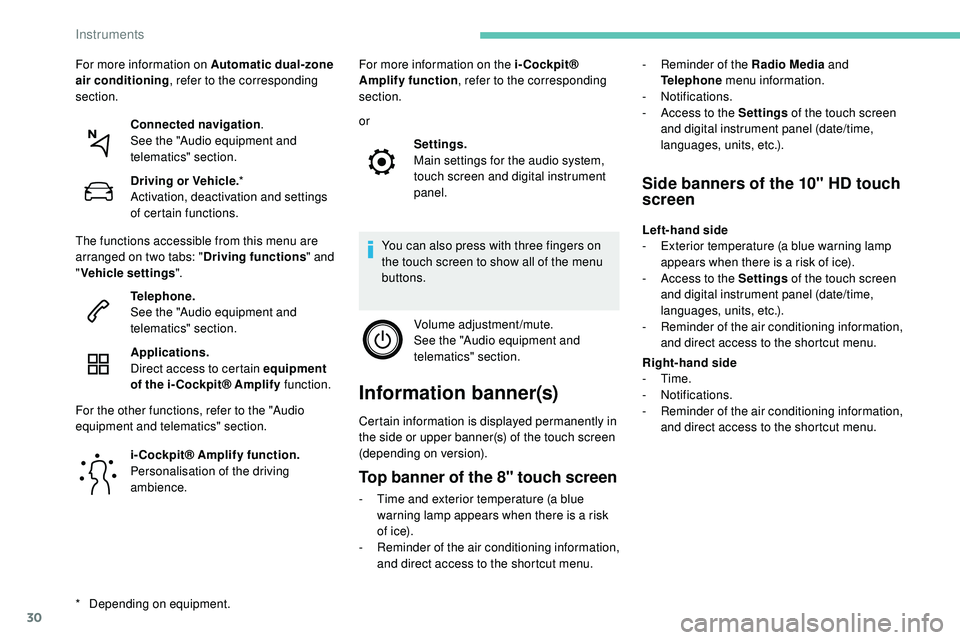
i-Cockpit® Amplify function.
Personalisation of the driving
ambience.or
You can also press with three fingers on
the touch screen to show all of the menu
buttons. Volume adjustment/mute.
See the "Audio equipment and
telematics" section.
Information banner(s)
Certain information is displayed permanently in
the side or upper banner(s) of the touch screen
(depending on version).
Connected navigation
.
See the "Audio equipment and
telematics" section.
Driving or Vehicle. *
Activation, deactivation and settings
of certain functions.
Telephone.
See the "Audio equipment and
telematics" section.
Applications.
Direct access to certain equipment
of the i- Cockpit® Amplify function.
For more information on Automatic dual-zone
air conditioning
, refer to the corresponding
section.
The functions accessible from this menu are
arranged on two tabs: " Driving functions" and
" Vehicle settings ".
For the other functions, refer to the "Audio
equipment and telematics" section. Settings.
Main settings for the audio system,
touch screen and digital instrument
panel.
For more information on the i-Cockpit®
Amplify function
, refer to the corresponding
section.
Top banner of the 8" touch screen
- Time and exterior temperature (a blue warning lamp appears when there is a risk
of i c e).
-
R
eminder of the air conditioning information,
and direct access to the shortcut menu.
Side banners of the 10" HD touch
screen
Left-hand side
- E xterior temperature (a blue warning lamp
appears when there is a risk of ice).
-
A
ccess to the Settings of the touch screen
and digital instrument panel (date/time,
languages, units, etc.).
-
R
eminder of the air conditioning information,
and direct access to the shortcut menu.
Right-hand side
-
Time.
-
Notifications.
-
R
eminder of the air conditioning information,
and direct access to the shortcut menu.
-
R
eminder of the Radio Media
and
Telephone menu information.
-
Notifications.
-
A
ccess to the Settings
of the touch screen
and digital instrument panel (date/time,
languages, units, etc.).
*
D
epending on equipment.
Instruments
Page 45 of 320
43
F With a manual gearbox, place the gear
lever in neutral then fully depress the clutch
pedal.
F
W
ith an automatic gearbox , from mode P,
fully depress the brake pedal.
F
S
witch on the ignition by pressing the
" START/STOP " button.
The electronic key is now fully operational
again.
If the fault persists after reinitialisation, contact
a PEUGEOT dealer or a qualified workshop
without delay.
Central locking
This function allows the doors and boot to be
locked or unlocked simultaneously from inside
the vehicle.
Manual mode
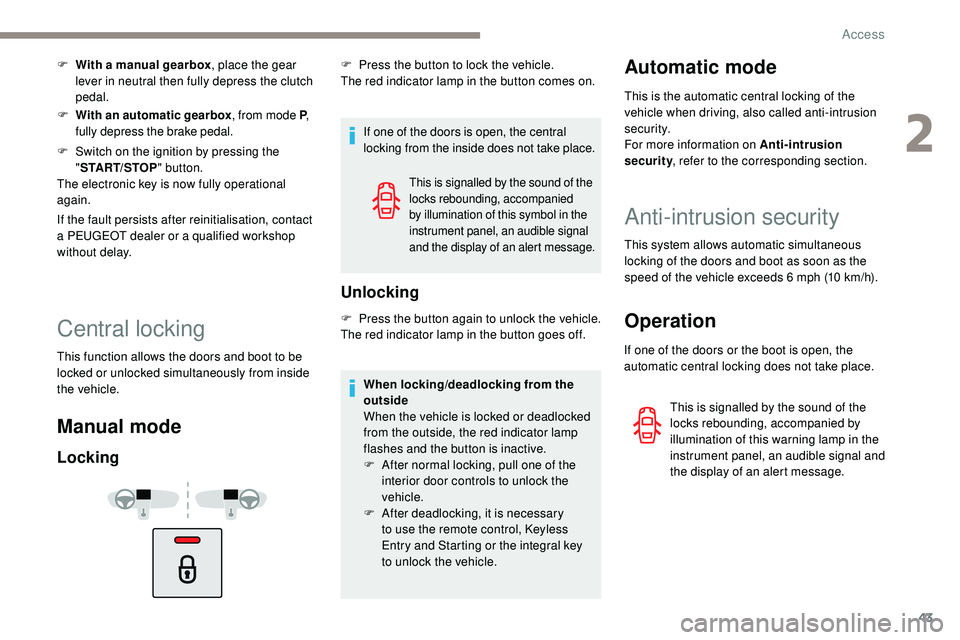
Locking
If one of the doors is open, the central
locking from the inside does not take place.
Unlocking
F Press the button again to unlock the vehicle.
The red indicator lamp in the button goes off.
This is signalled by the sound of the
locks rebounding, accompanied
by illumination of this symbol in the
instrument panel, an audible signal
and the display of an alert message.
F Press the button to lock the vehicle.
The red indicator lamp in the button comes on.
When locking/deadlocking from the
outside
When the vehicle is locked or deadlocked
from the outside, the red indicator lamp
flashes and the button is inactive.
F
A
fter normal locking, pull one of the
interior door controls to unlock the
vehicle.
F
A
fter deadlocking, it is necessary
to
use the remote control, Keyless
Entry and Starting or the integral key
to
unlock the vehicle.Automatic mode
This is the automatic central locking of the
vehicle when driving, also called anti-intrusion
s e c u r i t y.
For more information on Anti-intrusion
security, refer to the corresponding section.
Anti-intrusion security
This system allows automatic simultaneous
locking of the doors and boot as soon as the
speed of the vehicle exceeds 6 mph (10 km/h).
Operation
If one of the doors or the boot is open, the
automatic central locking does not take place.
This is signalled by the sound of the
locks rebounding, accompanied by
illumination of this warning lamp in the
instrument panel, an audible signal and
the display of an alert message.
2
Access
Page 49 of 320
47
With the selective unlocking activated:
- o pening the driver's door unlocks the
driver's door only (if the vehicle has not
already been completely unlocked),
-
o
pening one of the passenger doors
unlocks the rest of the vehicle.
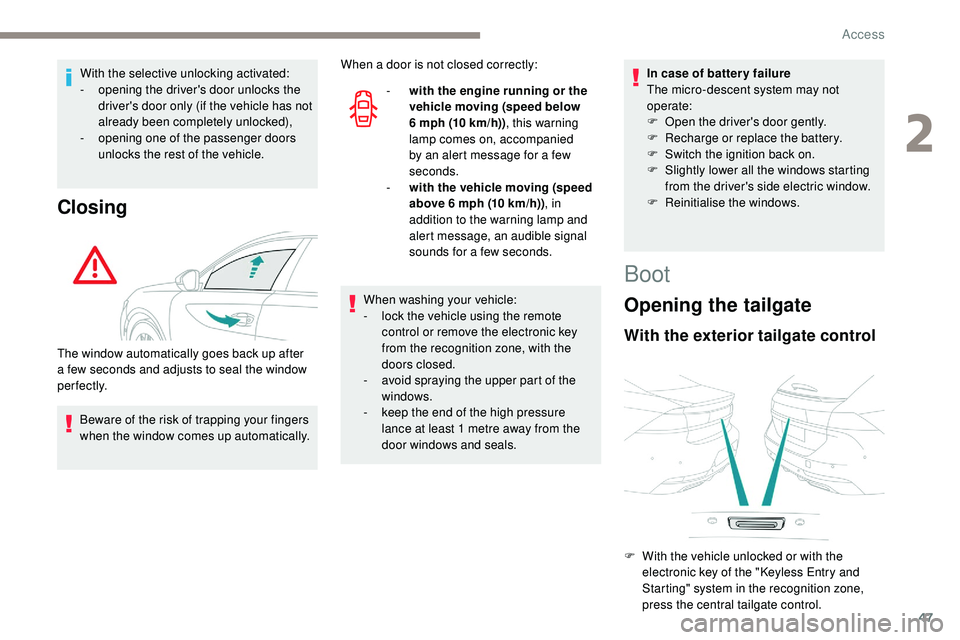
Closing
Beware of the risk of trapping your fingers
when the window comes up automatically. When a door is not closed correctly:
-
w
ith the engine running or the
vehicle moving (speed below
6 mph (10 km/h))
, this warning
lamp comes on, accompanied
by an alert message for a few
seconds.
-
w
ith the vehicle moving (speed
above 6 mph (10 km/h))
, in
addition to the warning lamp and
alert message, an audible signal
sounds for a few seconds.
When washing your vehicle:
-
l
ock the vehicle using the remote
control or remove the electronic key
from the recognition zone, with the
doors closed.
-
a
void spraying the upper part of the
windows.
- k eep the end of the high pressure
lance at least 1 metre away from the
door windows and seals.
The window automatically goes back up after
a few seconds and adjusts to seal the window
perfectly.
Boot
Opening the tailgate
With the exterior tailgate control
In case of batter y failure
The micro-descent system may not
operate:
F
O
pen the driver's door gently.
F
R
echarge or replace the battery.
F
S
witch the ignition back on.
F
S
lightly lower all the windows starting
from the driver's side electric window.
F
R
einitialise the windows.
F
W
ith the vehicle unlocked or with the
electronic key of the "Keyless Entry and
Starting" system in the recognition zone,
press the central tailgate control.
2
Access
Page 50 of 320
48
When selective unlocking is activated, the
electronic key must be close to the rear of
the vehicle.
The tailgate is not designed to hold a
bicycle carrier.
Closing the tailgate
F Lower the tailgate using the interior grips.
F R elease the grips and press down on the
outside of the tailgate to close it.
If the tailgate is not properly closed: In the event of a fault or difficulties felt in
manoeuvring the tailgate when opening
or closing it, have it quickly checked by a
PEUGEOT dealer or a qualified workshop
to stop this issue getting worse and so
as to not cause the tailgate to drop, and
serious injuries.
Back-up release
To manually unlock the boot in the event of a
battery or central locking failure.
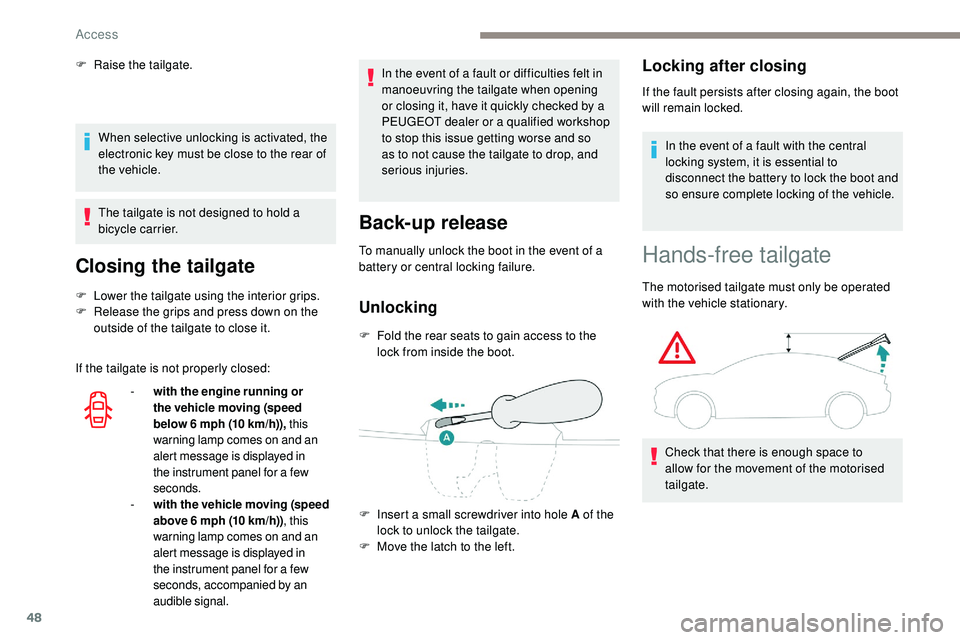
Unlocking
F Fold the rear seats to gain access to the
lock from inside the boot.
F
I
nsert a small screwdriver into hole A of the
lock to unlock the tailgate.
F
M
ove the latch to the left.
Locking after closing
If the fault persists after closing again, the boot
will remain locked.In the event of a fault with the central
locking system, it is essential to
disconnect the battery to lock the boot and
so ensure complete locking of the vehicle.
F
Ra
ise the tailgate.
-
w
ith the engine running or
the vehicle moving (speed
below 6
mph (10
km/h)), this
warning lamp comes on and an
alert message is displayed in
the instrument panel for a few
seconds.
-
w
ith the vehicle moving (speed
above 6 mph (10
km/h)) , this
warning lamp comes on and an
alert message is displayed in
the instrument panel for a few
seconds, accompanied by an
audible signal.
Hands-free tailgate
The motorised tailgate must only be operated
with the vehicle stationary.
Check that there is enough space to
allow for the movement of the motorised
tailgate.
Access
Page 88 of 320
86
Exterior lighting control
stalk
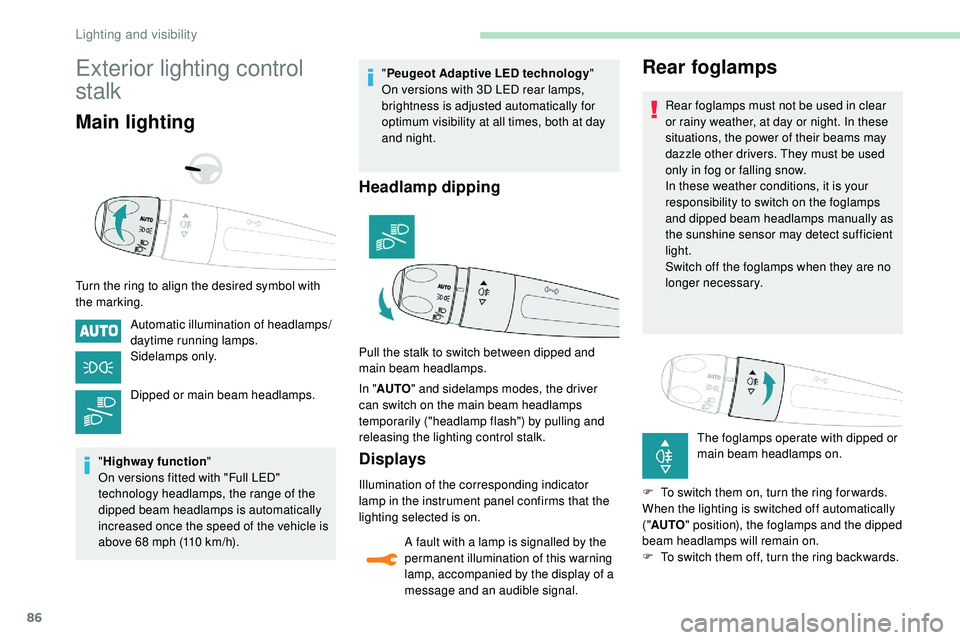
Main lighting
Turn the ring to align the desired symbol with
the marking.Automatic illumination of headlamps/
daytime running lamps.
Sidelamps only.
Dipped or main beam headlamps.
" Highway function "
On versions fitted with "Full LED"
technology headlamps, the range of the
dipped beam headlamps is automatically
increased once the speed of the vehicle is
above 68 mph (110 km/h). "
Peugeot Adaptive LED technology "
On versions with 3D LED rear lamps,
brightness is adjusted automatically for
optimum visibility at all times, both at day
and night.
Headlamp dipping
In " AUTO " and sidelamps modes, the driver
can switch on the main beam headlamps
temporarily ("headlamp flash") by pulling and
releasing the lighting control stalk.
Displays
Illumination of the corresponding indicator
lamp in the instrument panel confirms that the
lighting selected is on.
A fault with a lamp is signalled by the
permanent illumination of this warning
lamp, accompanied by the display of a
message and an audible signal.
Rear foglamps
Rear foglamps must not be used in clear
or rainy weather, at day or night. In these
situations, the power of their beams may
dazzle other drivers. They must be used
only in fog or falling snow.
In these weather conditions, it is your
responsibility to switch on the foglamps
and dipped beam headlamps manually as
the sunshine sensor may detect sufficient
light.
Switch off the foglamps when they are no
longer necessary.
The foglamps operate with dipped or
main beam headlamps on.
F
T
o switch them on, turn the ring for wards.
When the lighting is switched off automatically
(" AUTO " position), the foglamps and the dipped
beam headlamps will remain on.
F
T
o switch them off, turn the ring backwards.
Pull the stalk to switch between dipped and
main beam headlamps.
Lighting and visibility
Page 90 of 320
88
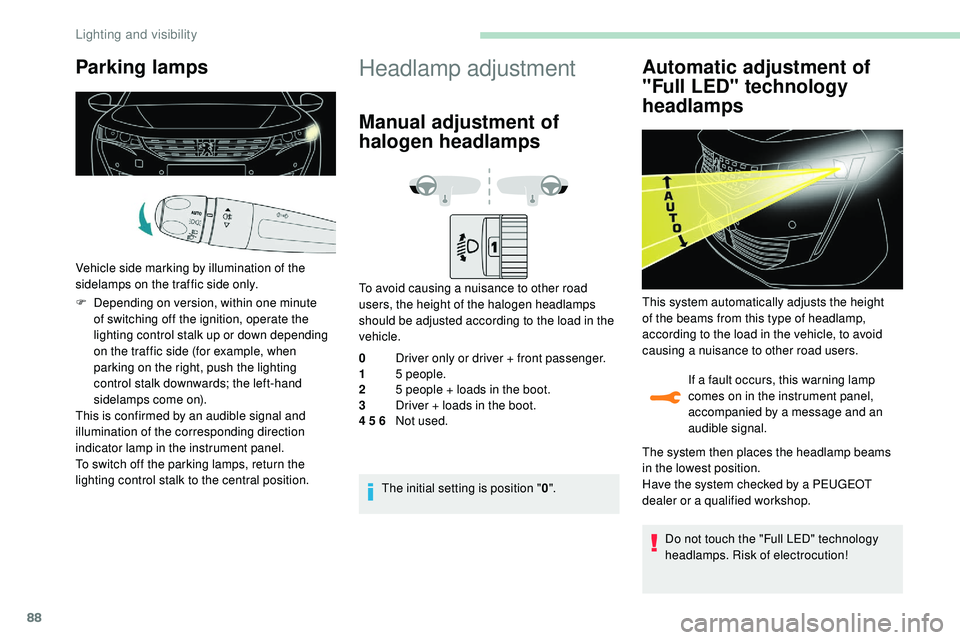
Parking lamps
Vehicle side marking by illumination of the
sidelamps on the traffic side only.
F
D
epending on version, within one minute
of switching off the ignition, operate the
lighting control stalk up or down depending
on the traffic side (for example, when
parking on the right, push the lighting
control stalk downwards; the left-hand
sidelamps come on).
This is confirmed by an audible signal and
illumination of the corresponding direction
indicator lamp in the instrument panel.
To switch off the parking lamps, return the
lighting control stalk to the central position.
Headlamp adjustment
Manual adjustment of
halogen headlamps
To avoid causing a nuisance to other road
users, the height of the halogen headlamps
should be adjusted according to the load in the
vehicle.
0 Driver only or driver + front passenger.
1 5 people.
2 5 people + loads in the boot.
3 Driver + loads in the boot.
4 5 6 Not used.
The initial setting is position " 0".
Automatic adjustment of
"Full LED" technology
headlamps
If a fault occurs, this warning lamp
comes on in the instrument panel,
accompanied by a message and an
audible signal.
This system automatically adjusts the height
of the beams from this type of headlamp,
according to the load in the vehicle, to avoid
causing a nuisance to other road users.
The system then places the headlamp beams
in the lowest position.
Have the system checked by a PEUGEOT
dealer or a qualified workshop.
Do not touch the "Full LED" technology
headlamps. Risk of electrocution!
Lighting and visibility
Page 91 of 320
89
Automatic illumination of
headlamps
When the ring is at the "AUTO" position and
a low level of ambient light is detected by a
sunshine sensor, the number plate lamps,
side
lamps and dipped beam headlamps are
switched on automatically, without any action
on the part of the driver. They can also come
on if rain is detected, at the same time as
automatic operation of the windscreen wipers.
As soon as the brightness returns to a
sufficient level or after the windscreen wipers
are switched off, the lamps are switched off
automatically.
Operating fault
In the event of a malfunction of the
sunshine sensor, the lighting comes
on, this warning lamp is displayed in
the instrument panel accompanied by
an audible signal and/or a message.
Contact a PEUGEOT dealer or a
qualified workshop.
Do not cover the sunshine sensor,
combined with the rain sensor and located
at the top centre of the windscreen behind
the rear view mirror; the associated
functions would no longer be controlled. In fog or snow, the sunshine sensor may
detect sufficient light. In this case, the
lighting will not come on automatically.
Guide-me-home lighting
Automatic
With the ring in the "
AUTO" position, if the
brightness is low, the dipped beam headlamps
come on automatically when the ignition is
switched off.
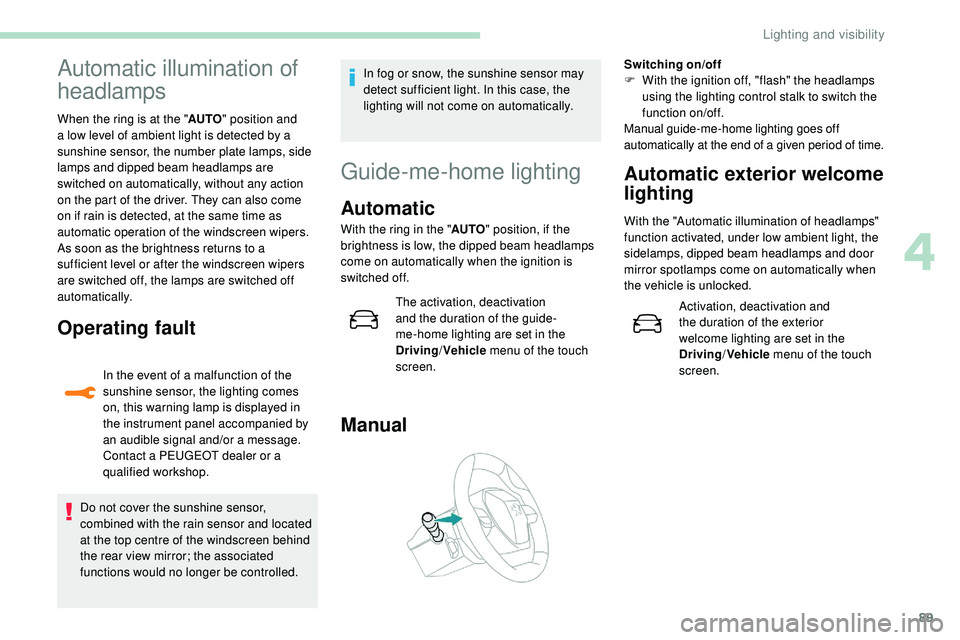
Manual
Switching on/off
F W ith the ignition off, "flash" the headlamps
using the lighting control stalk to switch the
function on/off.
Manual guide-me-home lighting goes off
automatically at the end of a given period of time.
Automatic exterior welcome
lighting
With the "Automatic illumination of headlamps"
function activated, under low ambient light, the
sidelamps, dipped beam headlamps and door
mirror spotlamps come on automatically when
the vehicle is unlocked.
Activation, deactivation and
the duration of the exterior
welcome lighting are set in the
Driving/Vehicle menu of the touch
screen.
The activation, deactivation
and the duration of the guide-
me-home lighting are set in the
Driving
/Vehicle menu of the touch
screen.
4
Lighting and visibility
Page 94 of 320
92
Clean the windscreen regularly,
particularly the area in front of the camera.
The internal sur face of the windscreen can
also become misted around the camera.
In humid and cold weather, demist the
windscreen regularly.
Do not allow snow to accumulate on the
bonnet or roof of the vehicle as this could
conceal the detection camera.
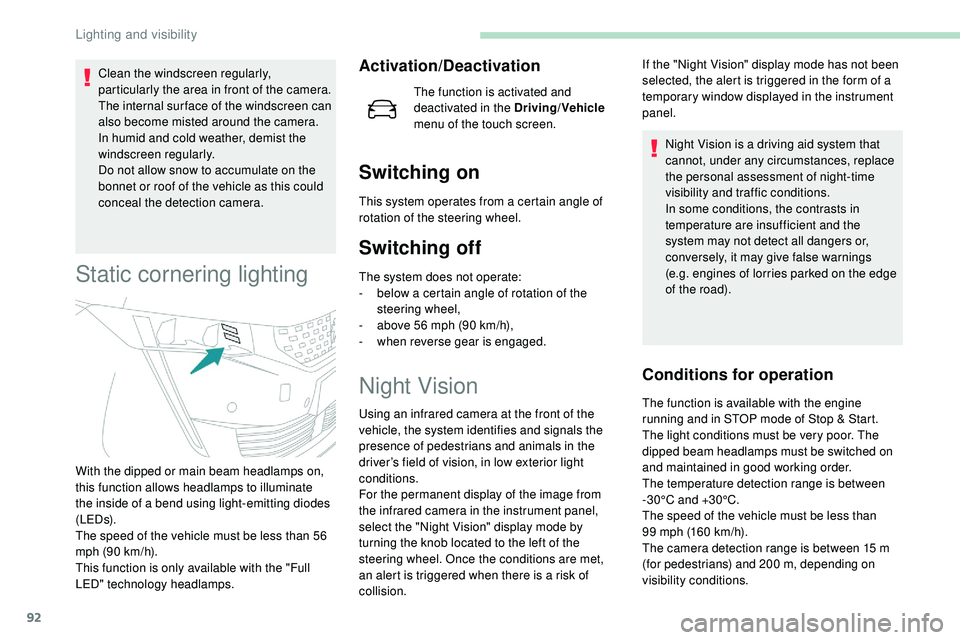
Static cornering lighting
Activation/Deactivation
The function is activated and
deactivated in the Driving/Vehicle
menu of the touch screen.
Switching on
This system operates from a certain angle of
rotation of the steering wheel.
Switching off
The system does not operate:
- b elow a certain angle of rotation of the
steering wheel,
-
a
bove 56 mph (90 km/h),
-
w
hen reverse gear is engaged.
Night Vision
Using an infrared camera at the front of the
vehicle, the system identifies and signals the
presence of pedestrians and animals in the
driver’s field of vision, in low exterior light
conditions.
For the permanent display of the image from
the infrared camera in the instrument panel,
select the "Night Vision" display mode by
turning the knob located to the left of the
steering wheel. Once the conditions are met,
an alert is triggered when there is a risk of
collision. Night Vision is a driving aid system that
cannot, under any circumstances, replace
the personal assessment of night-time
visibility and traffic conditions.
In some conditions, the contrasts in
temperature are insufficient and the
system may not detect all dangers or,
conversely, it may give false warnings
(e.g. engines of lorries parked on the edge
of the road).
Conditions for operation
With the dipped or main beam headlamps on,
this function allows headlamps to illuminate
the inside of a bend using light-emitting diodes
(LEDs).
The speed of the vehicle must be less than 56
mph (90 km/h).
This function is only available with the "Full
LED" technology headlamps. If the "Night Vision" display mode has not been
selected, the alert is triggered in the form of a
temporary window displayed in the instrument
panel.
The function is available with the engine
running and in STOP mode of Stop & Start.
The light conditions must be very poor. The
dipped beam headlamps must be switched on
and maintained in good working order.
The temperature detection range is between
-30°C and +30°C.
The speed of the vehicle must be less than
99
mph (160 km/h).
The camera detection range is between 15
m
(for pedestrians) and 200
m, depending on
visibility conditions.
Lighting and visibility