reverse Peugeot 508 2019 Owner's Guide
[x] Cancel search | Manufacturer: PEUGEOT, Model Year: 2019, Model line: 508, Model: Peugeot 508 2019Pages: 320, PDF Size: 10.09 MB
Page 194 of 320
192
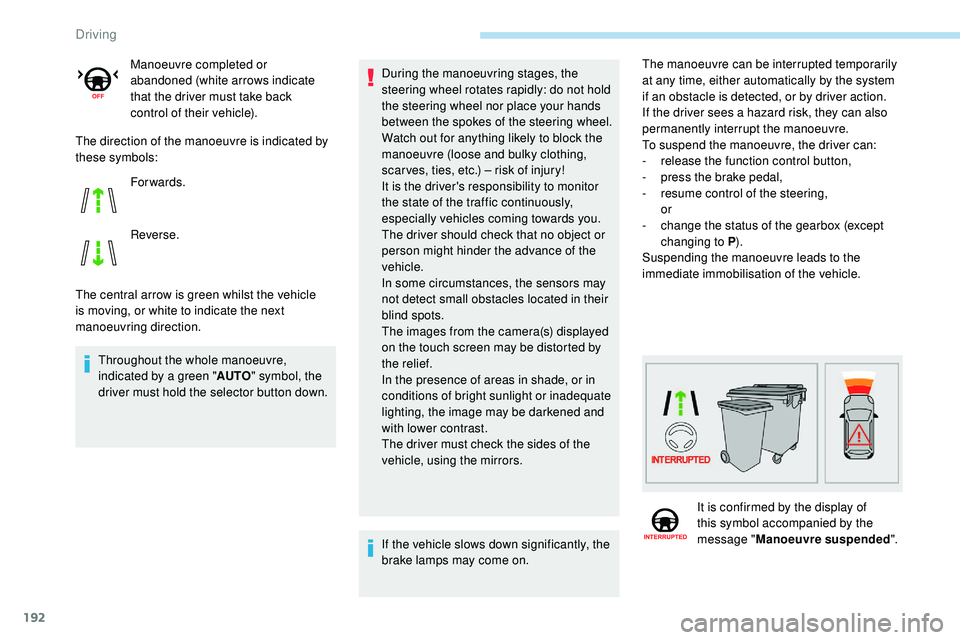
The direction of the manoeuvre is indicated by
these symbols:
The central arrow is green whilst the vehicle
is moving, or white to indicate the next
manoeuvring direction.Throughout the whole manoeuvre,
indicated by a green " AUTO" symbol, the
driver must hold the selector button down. Manoeuvre completed or
abandoned (white arrows indicate
that the driver must take back
control of their vehicle).
For wards.
Reverse.
During the manoeuvring stages, the
steering wheel rotates rapidly: do not hold
the steering wheel nor place your hands
between the spokes of the steering wheel.
Watch out for anything likely to block the
manoeuvre (loose and bulky clothing,
scar ves, ties, etc.) – risk of injury!
It is the driver's responsibility to monitor
the state of the traffic continuously,
especially vehicles coming towards you.
The driver should check that no object or
person might hinder the advance of the
vehicle.
In some circumstances, the sensors may
not detect small obstacles located in their
blind spots.
The images from the camera(s) displayed
on the touch screen may be distorted by
the relief.
In the presence of areas in shade, or in
conditions of bright sunlight or inadequate
lighting, the image may be darkened and
with lower contrast.
The driver must check the sides of the
vehicle, using the mirrors.
If the vehicle slows down significantly, the
brake lamps may come on. The manoeuvre can be interrupted temporarily
at any time, either automatically by the system
if an obstacle is detected, or by driver action.
If the driver sees a hazard risk, they can also
permanently interrupt the manoeuvre.
To suspend the manoeuvre, the driver can:
-
r
elease the function control button,
-
p
ress the brake pedal,
-
r
esume control of the steering,
or
-
c
hange the status of the gearbox (except
changing to P ).
Suspending the manoeuvre leads to the
immediate immobilisation of the vehicle.
It is confirmed by the display of
this symbol accompanied by the
message " Manoeuvre suspended ".
Driving
Page 226 of 320
224
Halogen bulbs
To ensure good quality lighting, check
that the bulb is correctly positioned in its
housing.
Front lamps
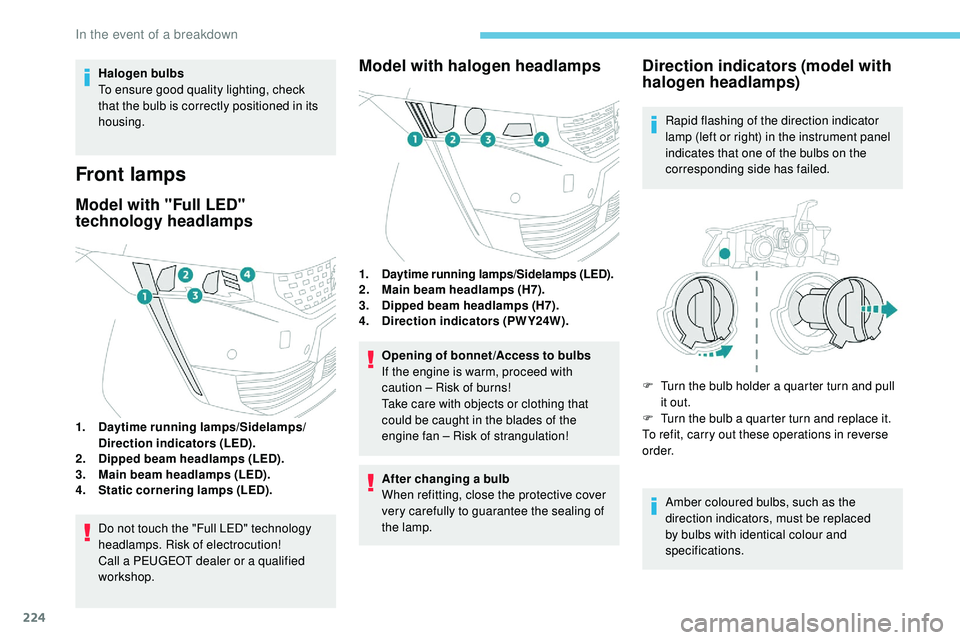
Model with "Full LED"
technology headlamps
1.Daytime running lamps/Sidelamps/
Direction indicators (LED).
2. Dipped beam headlamps (LED).
3. Main beam headlamps (LED).
4. Static cornering lamps (LED).
Do not touch the "Full LED" technology
headlamps. Risk of electrocution!
Call a PEUGEOT dealer or a qualified
workshop.
Model with halogen headlamps
1.Daytime running lamps/Sidelamps (LED).2.Main beam headlamps (H7).
3. Dipped beam headlamps (H7).
4. Direction indicators (PWY24W).
Opening of bonnet /Access to bulbs
If the engine is warm, proceed with
caution – Risk of burns!
Take care with objects or clothing that
could be caught in the blades of the
engine fan – Risk of strangulation!
After changing a bulb
When refitting, close the protective cover
very carefully to guarantee the sealing of
the lamp.
Direction indicators (model with
halogen headlamps)
Rapid flashing of the direction indicator
lamp (left or right) in the instrument panel
indicates that one of the bulbs on the
corresponding side has failed.
F
T
urn the bulb holder a quarter turn and pull
it out.
F
T
urn the bulb a quarter turn and replace it.
To refit, carry out these operations in reverse
o r d e r.
Amber coloured bulbs, such as the
direction indicators, must be replaced
by bulbs with identical colour and
specifications.
In the event of a breakdown
Page 227 of 320
225
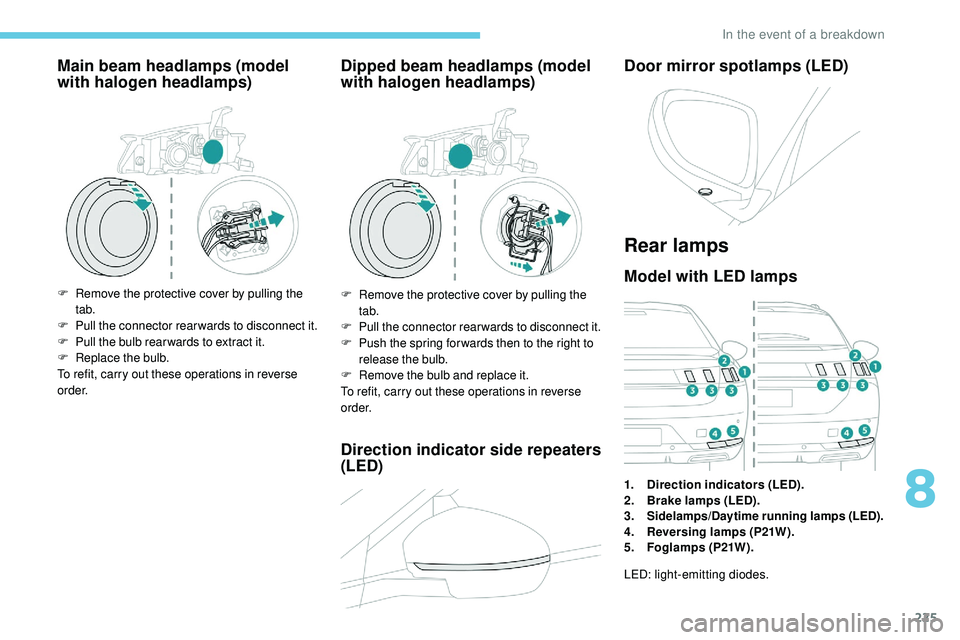
Main beam headlamps (model
with halogen headlamps)
F Remove the protective cover by pulling the tab.
F
P
ull the connector rear wards to disconnect it.
F
P
ull the bulb rear wards to extract it.
F
R
eplace the bulb.
To refit, carry out these operations in reverse
o r d e r.
Dipped beam headlamps (model
with halogen headlamps)
F Remove the protective cover by pulling the tab.
F
P
ull the connector rear wards to disconnect it.
F
P
ush the spring for wards then to the right to
release the bulb.
F
R
emove the bulb and replace it.
To refit, carry out these operations in reverse
o r d e r.
Direction indicator side repeaters
(LED) Door mirror spotlamps (LED)
Rear lamps
Model with LED lamps
1.
Direction indicators (LED).
2. Brake lamps (LED).
3.
Sidelamps/Daytime running lamps (LED).4. Reversing lamps (P21W).
5. Foglamps (P21W).
LED: light-emitting diodes.
8
In the event of a breakdown
Page 228 of 320
226
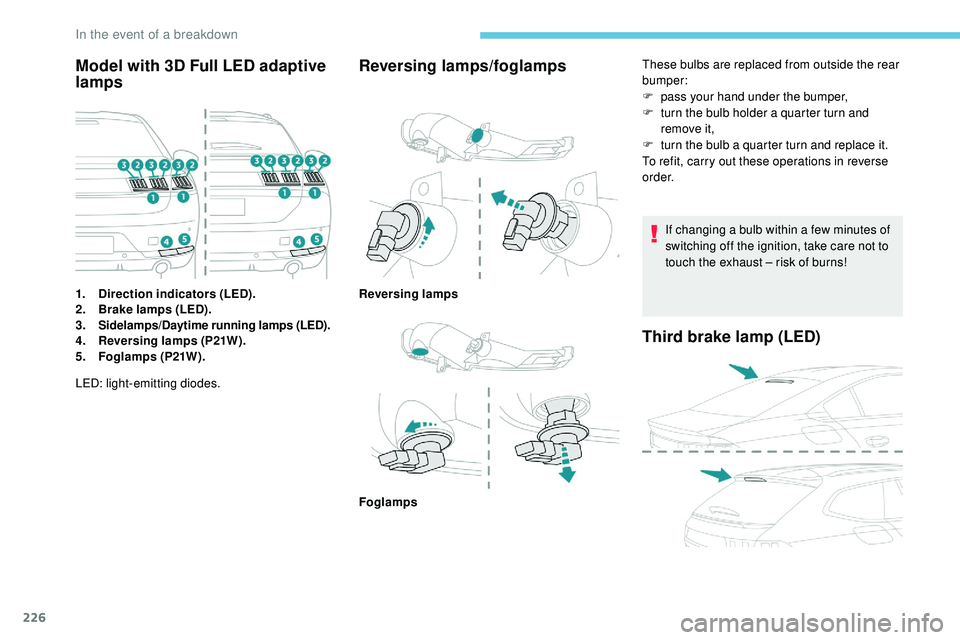
Model with 3D Full LED adaptive
lamps
1.Direction indicators (LED).
2. Brake lamps (LED).
3.
Sidelamps/Daytime running lamps (LED).4. Reversing lamps (P21W).
5. Foglamps (P21W).
Reversing lamps/foglamps
LED: light-emitting diodes. These bulbs are replaced from outside the rear
bumper:
F
p
ass your hand under the bumper,
F
t
urn the bulb holder a quarter turn and
remove it,
F
t
urn the bulb a quarter turn and replace it.
To refit, carry out these operations in reverse
o r d e r.
If changing a bulb within a few minutes of
switching off the ignition, take care not to
touch the exhaust – risk of burns!
Reversing lamps
Foglamps
Third brake lamp (LED)
In the event of a breakdown
Page 236 of 320
234
F Start the engine of the vehicle with the good battery and leave it running for a few
minutes.
F
O
perate the starter on the broken down
vehicle and let the engine run.
If the engine does not start straight away,
switch off the ignition and wait a few moments
before trying again.
F
W
ait for it to return to idle.
F
D
isconnect the jump lead cables in reverse
order .
F
R
efit the plastic cover to the (+) terminal,
if
your vehicle has one.
F
A
llow the engine to run for at least
30
minutes, by driving or with the vehicle
stationary, so that the battery reaches an
adequate state of charge.
If your vehicle has an automatic gearbox,
never try to start the engine by pushing
the vehicle.
Charging the battery using
a battery charger
For optimum ser vice life of the battery, it is
essential to maintain an adequate state of
charge.
In some circumstances it may be necessary to
charge the battery:
-
i
f you only use your vehicle for short
journeys,
-
i
f the vehicle is to be taken off the road for
several weeks.
Contact a PEUGEOT dealer or a qualified
workshop.
If you wish to charge your vehicle's battery
yourself, use only a charger compatible
with lead-acid batteries with a nominal
voltage of 12 V.
Follow the instructions provided by the
manufacturer of the charger.
Never reverse polarities.
It is not necessary to disconnect the
battery.
F
S
witch off the ignition.
F
S
witch off all electrical consumers (audio
system, lighting, wipers, etc.).
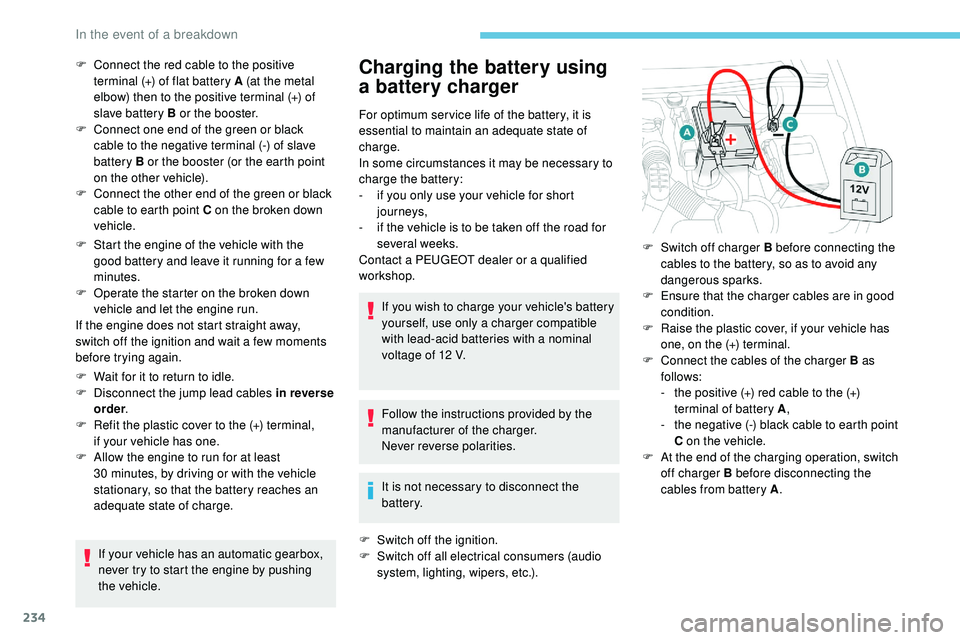
F
C
onnect the red cable to the positive
terminal (+) of flat battery A (at the metal
elbow) then to the positive terminal (+) of
slave battery B or the booster.
F
C
onnect one end of the green or black
cable to the negative terminal (-) of slave
battery B or the booster (or the earth point
on the other vehicle).
F
C
onnect the other end of the green or black
cable to earth point C on the broken down
vehicle.
F
S
witch off charger B before connecting the
cables to the battery, so as to avoid any
dangerous sparks.
F
E
nsure that the charger cables are in good
condition.
F
R
aise the plastic cover, if your vehicle has
one, on the (+) terminal.
F
C
onnect the cables of the charger B as
follows:
-
t
he positive (+) red cable to the (+)
terminal of battery A ,
-
t
he negative (-) black cable to earth point
C on the vehicle.
F
A
t the end of the charging operation, switch
off charger B before disconnecting the
cables from battery A .
In the event of a breakdown