brake Peugeot 508 Hybrid 2014 Owner's Manual
[x] Cancel search | Manufacturer: PEUGEOT, Model Year: 2014, Model line: 508 Hybrid, Model: Peugeot 508 Hybrid 2014Pages: 380, PDF Size: 10.94 MB
Page 4 of 380
.
.
508_en_Chap00a_sommaire_ed02-2014
Instrument panel 12
Indicator and warning lamps
1
4
ga
uges and indicators
2
6
tr
ip computer
3
1
to
uch screen
3
5
Setting the date and time
3
9
MonitoringOver view
e
co-driving
Remote control key 4
1
Alarm
52
el
ectric windows
5
4
Boot
56
Motorised tailgate (SW)
5
7
Sunroof
6
0
Panoramic sunroof (SW)
6
2
Fuel tank
6
3
Diesel misfuel prevention
6
4
Access
Front seats 6 6
Rear seats
7
1
Mirrors
7
3
Steering wheel adjustment
7
5
Interior fittings
7
6
Boot fittings (Saloon)
7
9
Boot fittings (SW)
8
0
Heating and Ventilation
8
4
Manual air conditioning
8
7
Dual-zone digital air conditioning
8
9
Quad-zone digital air conditioning
9
2
Switching off the air conditioning may result in some discomfort (humidity, misting).
9
3
Front demist - defrost
9
7
Rear screen demist - defrost
9
7
Programmable Heating / Ventilation
9
8
Comfort
Starting-switching off the engine 100
el
ectric parking brake
1
03
Manual parking brake
1
09
Manual gearbox
1
10
ge
ar shift indicator
1
11
Automatic gearbox
1
12
ele
ctronic gearbox
1
16
Stop & Start
1
20
Hill start assist
1
23
Head-up display
1
24
Blind spot sensors
1
26
Speed limiter
1
30
Cruise control
1
32
Parking sensors
1
34
Reversing camera
1
37
Driving
Lighting controls 138
Automatic illumination of headlamps
1
43
Headlamp adjustment
1
46
Additional headlamps
1
47
Wiper controls
1
49
Automatic rain sensitive wipers
1
51
Courtesy lamps
1
53
Interior mood lighting
1
54
Visibility
Contents
Page 9 of 380
7
44, 56, 57
70
52
126
6398
103
101 122
124
135 170 178
14 4
508_en_Chap00b_vue-ensemble_ed02-2014
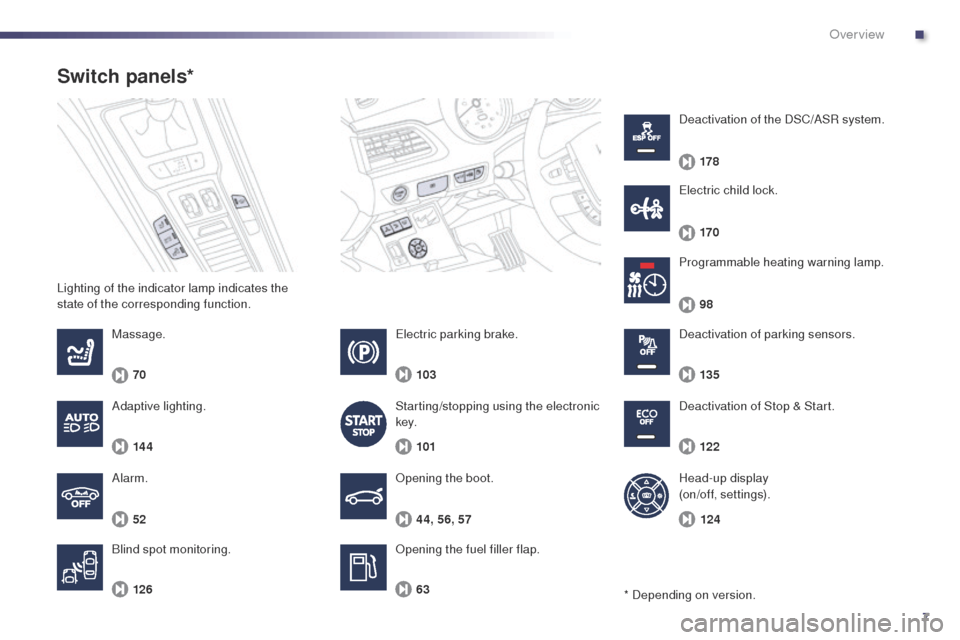
Lighting of the indicator lamp indicates the
state of the corresponding function.
Switch panels*
Opening the boot.
Opening the fuel filler flap.
Massage.
Alarm.
Blind spot monitoring. Programmable heating warning lamp.
el
ectric parking brake.
Starting/stopping using the electronic
key. Deactivation of Stop & Start. Deactivation of parking sensors.
el
ectric child lock.
Deactivation of the DSC/ASR system.
Adaptive lighting. Head-up display
(on/off, settings).
* Depending on version.
.
Over view
Page 10 of 380
8
508_en_Chap00b_vue-ensemble_ed02-2014
9. Fusebox.
10. F ront door window demisting/defrosting
vent.
11.
W
indscreen demisting/defrosting vent.
12 .
S
teering lock and starting with the key.
13.
S
tarting using the electronic key.
14 .
A
udio equipment steering wheel controls.
15.
W
iper / screenwash / trip computer stalk.
16.
C
entral locking and hazard warning
buttons.
17.
t
ou
ch screen (depending on version).
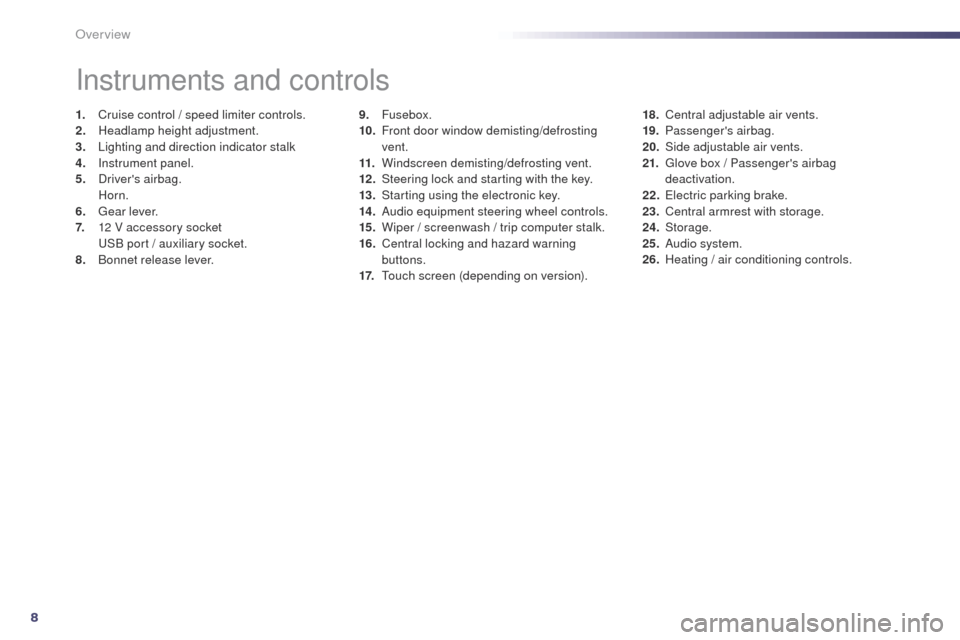
Instruments and controls
1. Cruise control / speed limiter controls.
2. Headlamp height adjustment.
3.
L
ighting and direction indicator stalk
4.
I
nstrument panel.
5.
D
river's airbag.
Horn.
6.
g
ea
r lever.
7.
1
2 V accessory socket
u
S
B port / auxiliary socket.
8.
B
onnet release lever. 18. C
entral adjustable air vents.
19. P assenger's airbag.
20.
S
ide adjustable air vents.
21.
g
l
ove box / Passenger's airbag
deactivation.
22.
e
l
ectric parking brake.
23.
C
entral armrest with storage.
24.
Storage.
25.
A
udio system.
26.
H
eating / air conditioning controls.
Over view
Page 12 of 380
10
eco-driving
eco-driving is a range of everyday practices that allow the motorist to optimise their fuel consumption and CO2 emissions.
Optimise the use of your gearbox
With a manual gearbox, move off gently and change up without waiting.
During acceleration change up early.
With an automatic or electronic gearbox, give preference to automatic
mode and avoid pressing the accelerator pedal heavily or suddenly.
th
e gear shift indicator invites you engage the most suitable gear: as
soon as the indication is displayed in the instrument panel, follow it
straight away.
For vehicles fitted with an electronic or automatic gearbox, this
indicator appears only in manual mode.
Drive smoothly
Maintain a safe distance between vehicles, use engine braking rather
than the brake pedal, and press the accelerator progressively. th ese
practices contribute towards a reduction in fuel consumption and CO
2
emissions and also helps reduce the background traffic noise.
If your vehicle has cruise control, make use of the system at speeds
above 25 mph (40 km/h) when the traffic is flowing well.
Control the use of your electrical
equipment
Before moving off, if the passenger compartment is too warm, ventilate it
by opening the windows and air vents before using the air conditioning.
Above 30 mph (50 km/h), close the windows and leave the air vents
open.
Remember to make use of equipment that can help keep the
temperature in the passenger compartment down (sunroof and window
blinds...).
Switch off the air conditioning, unless it has automatic regulation, as
soon as the desired temperature is attained.
Switch off the demisting and defrosting controls, if not automatic.
Switch off the heated seat as soon as possible.
Switch off the headlamps and front foglamps when the level of light
does not require their use.
Avoid running the engine before moving off, particularly in winter; your
vehicle will warm up much faster while driving.
As a passenger, if you avoid connecting your multimedia devices
(film, music, video game...), you will contribute towards limiting the
consumption of electrical energy, and so of fuel.
Disconnect your portable devices before leaving the vehicle.
eco-driving
Page 15 of 380
13
1
2
2
2
2
3
3
3
3
3
3
3
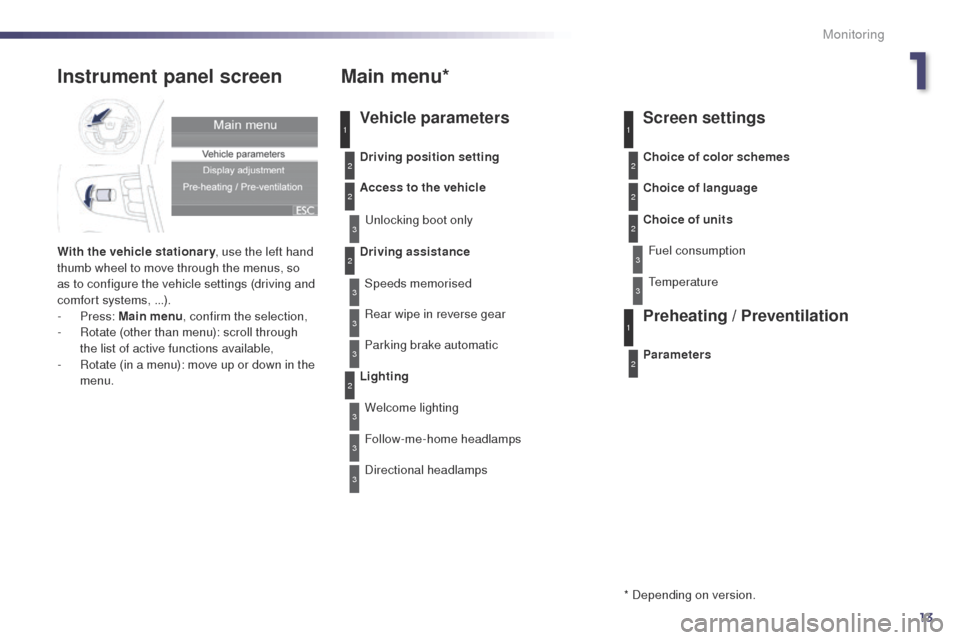
Instrument panel screen
With the vehicle stationary, use the left hand
thumb wheel to move through the menus, so
as to configure the vehicle settings (driving and
comfort systems, ...).
-
Press: Main menu , confirm the selection,
-
R
otate (other than menu): scroll through
the list of active functions available,
-
R
otate (in a menu): move up or down in the
menu.
Main menu*
Vehicle parameters Screen settings
Preheating / Preventilation
Driving position setting
Access to the vehicle
unl
ocking boot only
Driving assistance Speeds memorised
Rear wipe in reverse gear
Parking brake automatic
Lighting Welcome lighting
Follow-me-home headlamps
Directional headlamps Parameters Choice of color schemes
Choice of language
Choice of units
Fuel consumption
1
2
2
2
3
3
1
2
* Depending on version.
te
mperature
1
Monitoring
Page 18 of 380
16
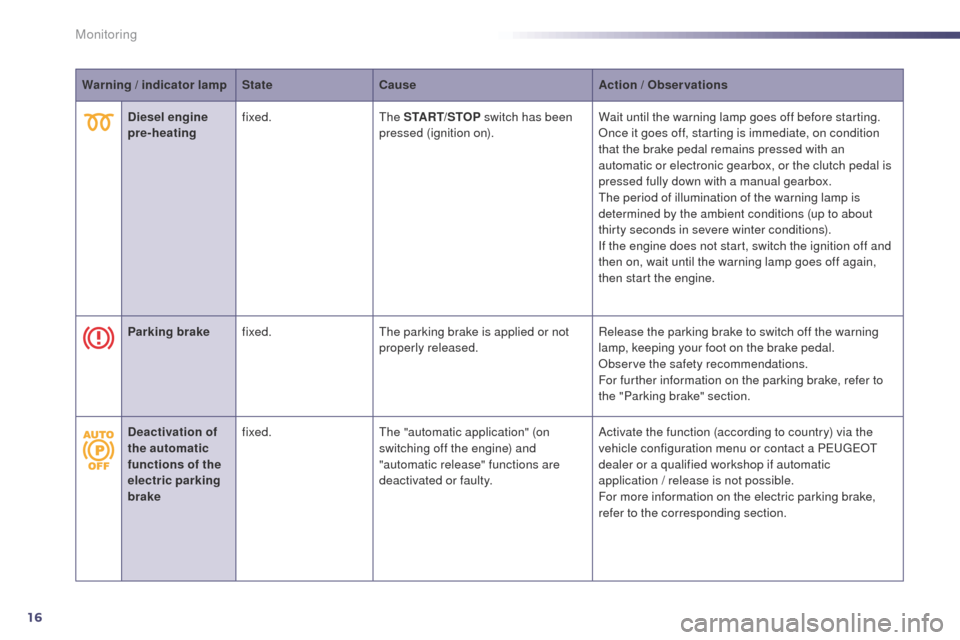
Warning / indicator lampStateCause Action / Observations
Diesel engine
pre-heating fixed.
th
e START/STOP switch has been
pressed (ignition on). Wait until the warning lamp goes off before starting.
Once it goes off, starting is immediate, on condition
that the brake pedal remains pressed with an
automatic or electronic gearbox, or the clutch pedal is
pressed fully down with a manual gearbox.
th
e period of illumination of the warning lamp is
determined by the ambient conditions (up to about
thirty seconds in severe winter conditions).
If the engine does not start, switch the ignition off and
then on, wait until the warning lamp goes off again,
then start the engine.
Parking brake fixed.
th
e parking brake is applied or not
properly released. Release the parking brake to switch off the warning
lamp, keeping your foot on the brake pedal.
Observe the safety recommendations.
For further information on the parking brake, refer to
the "Parking brake" section.
Deactivation of
the automatic
functions of the
electric parking
brake fixed.
th
e "automatic application" (on
switching off the engine) and
"automatic release" functions are
deactivated or faulty. Activate the function (according to country) via the
vehicle configuration menu or contact a P
e
uge
Ot
dealer or a qualified workshop if automatic
application
/ release is not possible.
For more information on the electric parking brake,
refer to the corresponding section.
Monitoring
Page 22 of 380
20
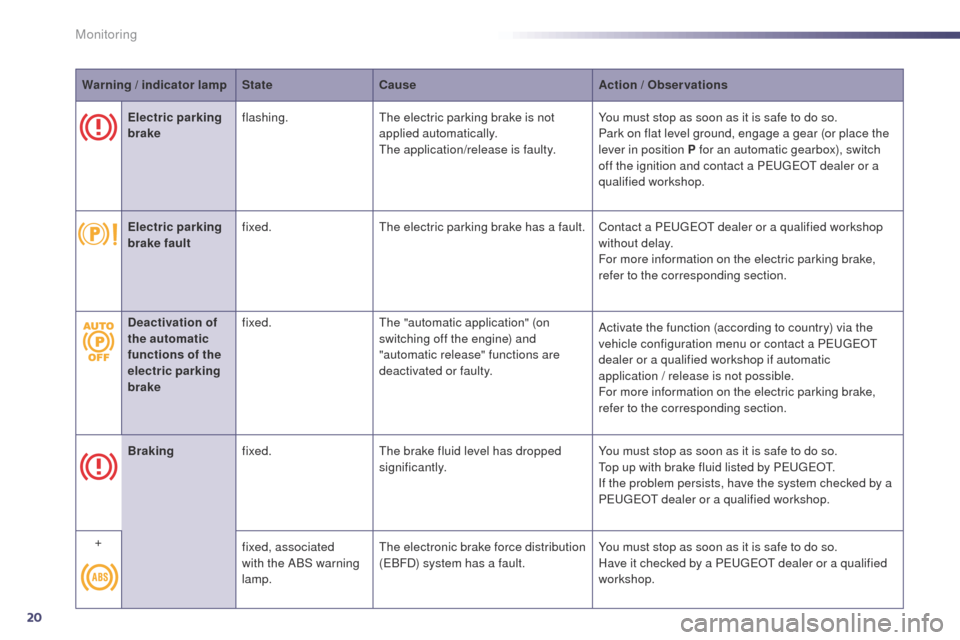
Warning / indicator lampStateCause Action / Observations
Electric parking
brake flashing.
th
e electric parking brake is not
applied automatically.
th
e application/release is faulty.You must stop as soon as it is safe to do so.
Park on flat level ground, engage a gear (or place the
lever in position P for an automatic gearbox), switch
off the ignition and contact a P
e
uge
Ot
dealer or a
qualified workshop.
Electric parking
brake fault fixed.
th
e electric parking brake has a fault. Contact a P
e
uge
Ot
dealer or a qualified workshop
without delay.
For more information on the electric parking brake,
refer to the corresponding section.
Braking fixed.
th
e brake fluid level has dropped
significantly. You must stop as soon as it is safe to do so.
to
p up with brake fluid listed by P
e
uge
Ot.
I
f the problem persists, have the system checked by a
P
e
uge
Ot
dealer or a qualified workshop.
+ fixed, associated
with the ABS warning
lamp.
th
e electronic brake force distribution
(
eB
FD) system has a fault.You must stop as soon as it is safe to do so.
Have it checked by a P
e
uge
Ot
dealer or a qualified
workshop.
Deactivation of
the automatic
functions of the
electric parking
brake
fixed.
th
e "automatic application" (on
switching off the engine) and
"automatic release" functions are
deactivated or faulty. Activate the function (according to country) via the
vehicle configuration menu or contact a P
e
uge
Ot
dealer or a qualified workshop if automatic
application
/ release is not possible.
For more information on the electric parking brake,
refer to the corresponding section.
Monitoring
Page 103 of 380
101
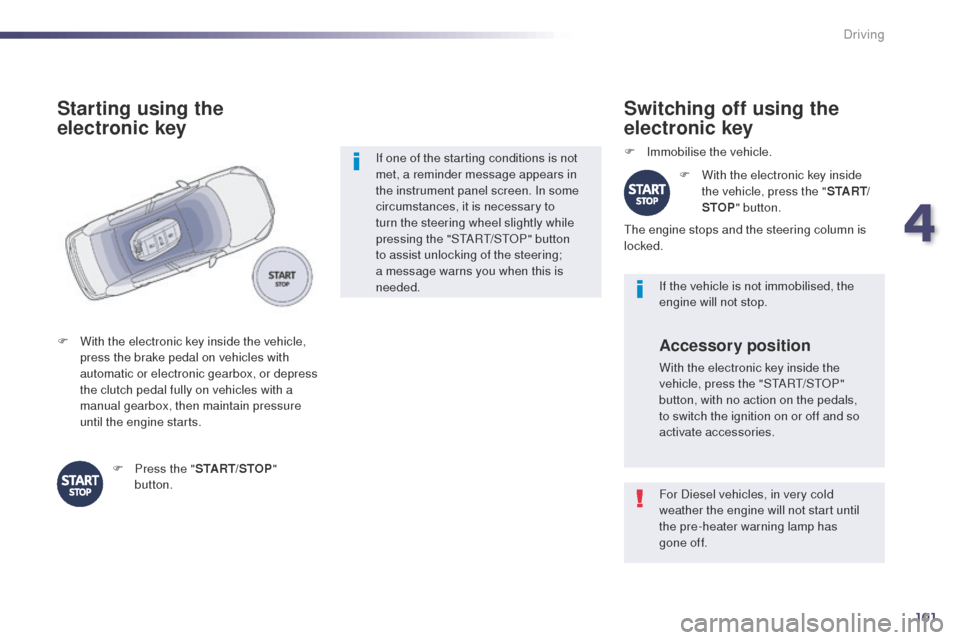
For Diesel vehicles, in very cold
weather the engine will not start until
the pre-heater warning lamp has
gone of f. If the vehicle is not immobilised, the
engine will not stop.
Switching off using the
electronic key
F Immobilise the vehicle.F
W
ith the electronic key inside
the vehicle, press the " S TA R T/
STOP " button.
th
e engine stops and the steering column is
locked.
Accessory position
With the electronic key inside the
vehicle, press the "StA Rt/ StO P"
button, with no action on the pedals,
to switch the ignition on or off and so
activate accessories.
If one of the starting conditions is not
met, a reminder message appears in
the instrument panel screen. In some
circumstances, it is necessary to
turn the steering wheel slightly while
pressing the "S
tA
R
t/
S
tO
P" button
to assist unlocking of the steering;
a message warns you when this is
needed.
F
W
ith the electronic key inside the vehicle,
press the brake pedal on vehicles with
automatic or electronic gearbox, or depress
the clutch pedal fully on vehicles with a
manual gearbox, then maintain pressure
until the engine starts.
Starting using the
electronic key
F Press the " START/STOP"
button.
508_en_Chap04_conduite_ed02-2014
4
Driving
Page 105 of 380
103
It is recommended that you do not
apply the parking brake in very cold
conditions (ice) and during towing
(breakdown, caravan...). Deactivate the
automatic functions and release the
parking brake manually.Before leaving the vehicle, check that
parking brake warning lamps in the
instrument panel and the control lever A
are on, not flashing.
th
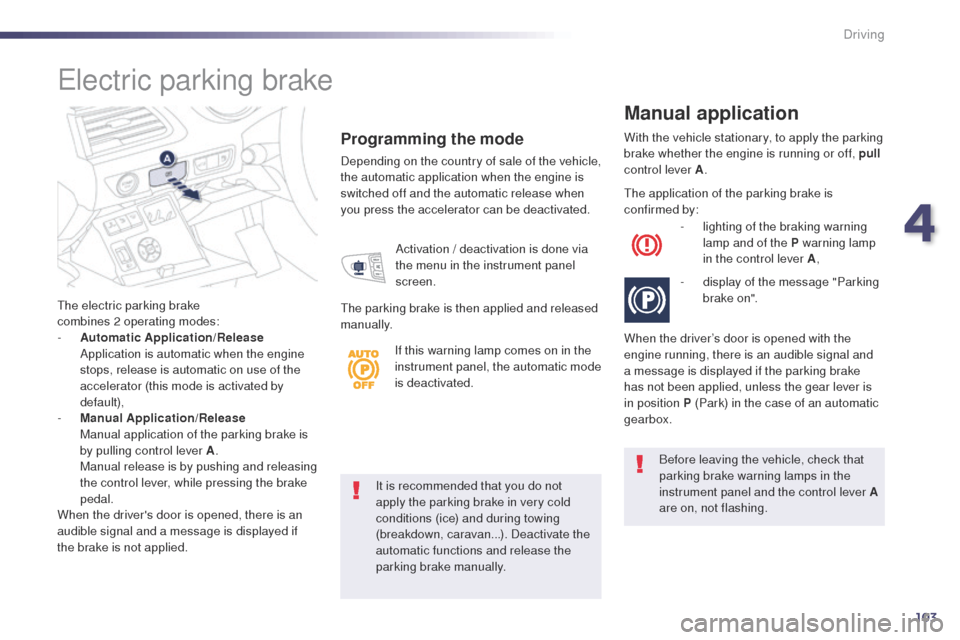
e electric parking brake
combines
2
operating modes:
-
A
utomatic Application/Release
A
pplication is automatic when the engine
stops, release is automatic on use of the
accelerator (this mode is activated by
default),
-
M
anual Application/Release
M
anual application of the parking brake is
by pulling control lever A .
M
anual release is by pushing and releasing
the control lever, while pressing the brake
pedal.
When the driver's door is opened, there is an
audible signal and a message is displayed if
the brake is not applied.
Programming the mode
Depending on the country of sale of the vehicle,
the automatic application when the engine is
switched off and the automatic release when
you press the accelerator can be deactivated. With the vehicle stationary, to apply the parking
brake whether the engine is running or off, pull
control lever A .
Manual application
Activation / deactivation is done via
the menu in the instrument panel
screen.
th
e parking brake is then applied and released
manually.
th
e application of the parking brake is
confirmed by:
-
l
ighting of the braking warning
lamp and of the P warning lamp
in the control lever A ,
-
d
isplay of the message "Parking
brake on".
When the driver’s door is opened with the
engine running, there is an audible signal and
a message is displayed if the parking brake
has not been applied, unless the gear lever is
in position P (Park) in the case of an automatic
gearbox.
electric parking brake
If this warning lamp comes on in the
instrument panel, the automatic mode
is deactivated.
4
Driving
Page 106 of 380
104
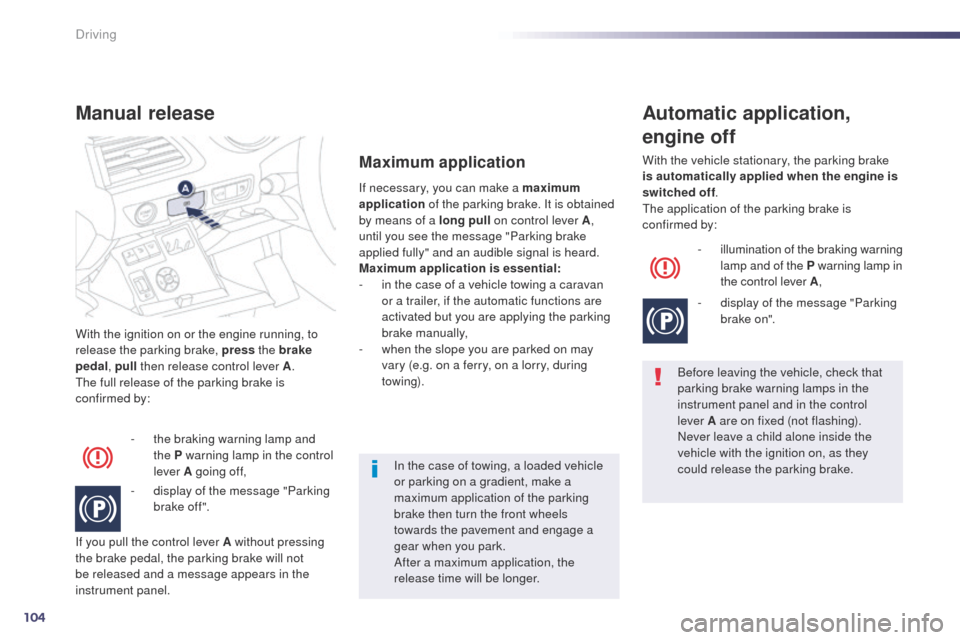
With the ignition on or the engine running, to
release the parking brake, press the brake
pedal , pull then release control lever A .
th
e full release of the parking brake is
confirmed by:
Manual release
- the braking warning lamp and the P warning lamp in the control
lever A going of f,
-
d
isplay of the message "Parking
brake of f ".
If you pull the control lever A without pressing
the brake pedal, the parking brake will not
be released and a message appears in the
instrument panel. If necessary, you can make a maximum
application
of the parking brake. It is obtained
by means of a long pull on control lever A,
until you see the message "Parking brake
applied fully" and an audible signal is heard.
Maximum application is essential:
-
i
n the case of a vehicle towing a caravan
or a trailer, if the automatic functions are
activated but you are applying the parking
brake manually,
-
w
hen the slope you are parked on may
vary (e.g. on a ferry, on a lorry, during
towing).
Maximum application
Before leaving the vehicle, check that
parking brake warning lamps in the
instrument panel and in the control
lever A are on fixed (not flashing).
Never leave a child alone inside the
vehicle with the ignition on, as they
could release the parking brake.
Automatic application,
engine off
- illumination of the braking warning lamp and of the P warning lamp in
the control lever A ,
-
d
isplay of the message "Parking
brake on".
With the vehicle stationary, the parking brake
is automatically applied when the engine is
switched off
.
th
e application of the parking brake is
confirmed by:
In the case of towing, a loaded vehicle
or parking on a gradient, make a
maximum application of the parking
brake then turn the front wheels
towards the pavement and engage a
gear when you park.
After a maximum application, the
release time will be longer.
Driving