spare wheel Peugeot 508 Hybrid 2014 Owner's Manual
[x] Cancel search | Manufacturer: PEUGEOT, Model Year: 2014, Model line: 508 Hybrid, Model: Peugeot 508 Hybrid 2014Pages: 380, PDF Size: 10.94 MB
Page 13 of 380
11
Limit the causes of excess consumption
Spread loads throughout the vehicle; place the heaviest items in the
bottom of the boot, as close as possible to the rear seats.
Limit the loads carried in the vehicle and reduce wind resistance (roof
bars, roof rack, bicycle carrier, trailer...). u
s
e a roof box in preference.
Remove roof bars and roof racks after use.
At the end of winter, remove snow tyres and refit your summer tyres.
Observe the recommendations on
maintenance
Check the tyre pressures regularly, when cold, referring to the label in
the door aperture, driver's side.
Carry out this check in particular:
-
b
efore a long journey,
-
a
t each change of season,
-
a
fter a long period out of use.
Don't forget the spare wheel and the tyres on any trailer or caravan.
Have your vehicle serviced regularly (engine oil, oil filter, air filter,
passenger compartment filter...) and observe the schedule of
operations recommended in the warranty and maintenance record.
When refuelling, do not continue after the third cut-off of the nozzle to
avoid any over flow.
At the wheel of your new vehicle, it is only after the first 1 800 miles
(3 000 kilometres) that you will see the fuel consumption settle down to
a consistent average.
.
Eco-driving
Page 81 of 380
79
508_en_Chap03_confort_ed02-2014
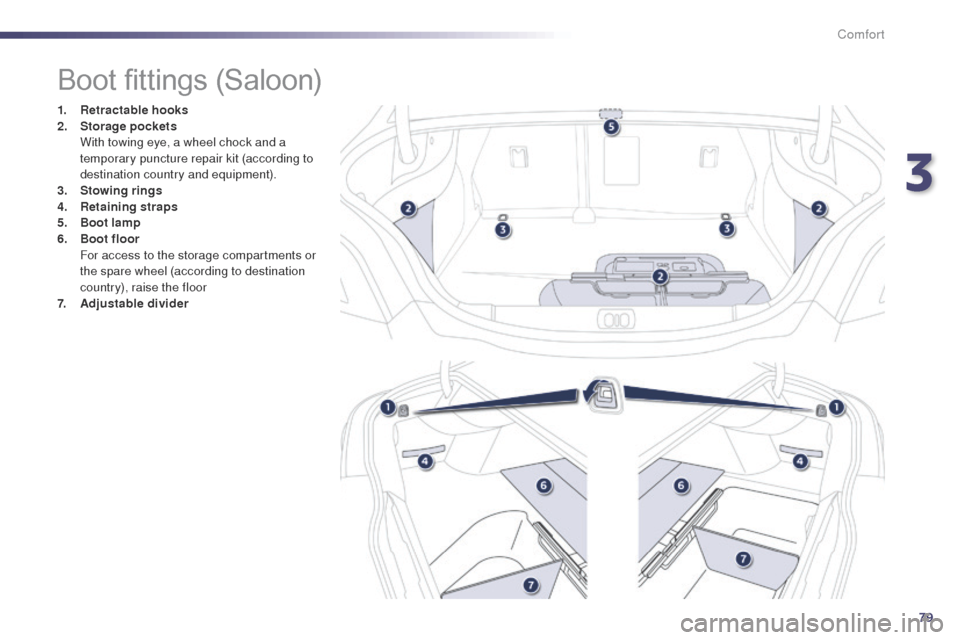
Boot fittings (Saloon)
1. Retractable hooks
2. Storage pockets
W
ith towing eye, a wheel chock and a
temporary puncture repair kit (according to
destination country and equipment).
3.
S
towing rings
4.
R
etaining straps
5.
B
oot lamp
6.
B
oot floor
F
or access to the storage compartments or
the spare wheel (according to destination
country), raise the floor
7.
A
djustable divider
3
Comfort
Page 82 of 380
80
508_en_Chap03_confort_ed02-2014
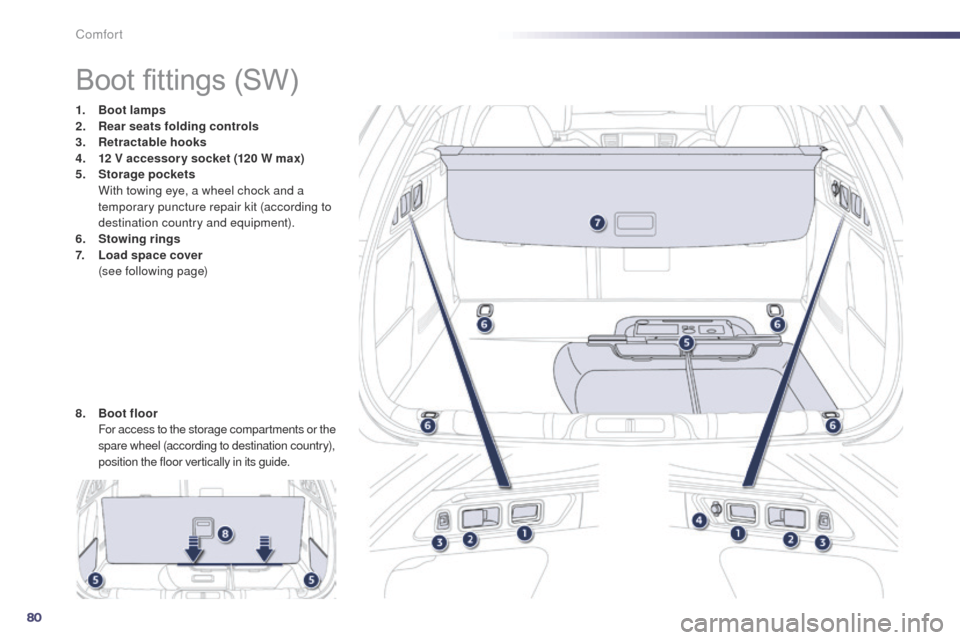
Boot fittings (SW)
1. Boot lamps
2. Rear seats folding controls
3.
R
etractable hooks
4.
1
2 V accessor y socket (120 W max)
5.
Sto
rage pockets
W
ith towing eye, a wheel chock and a
temporary puncture repair kit (according to
destination country and equipment).
6.
S
towing rings
7.
L
oad space cover
(
see following page)
8.
B
oot floor
F
or access to the storage compartments or the
spare wheel (according to destination country),
position the floor vertically in its guide.
Comfort
Page 176 of 380
174
508_en_Chap07_securite_ed02-2014
Tyre under-inflation detection
System which automatically checks the pressures of the tyres while driving.the system continuously monitors the pressures of the four tyres, as soon as the vehicle is moving.
th
e tyre under-inflation detection
system is an aid to driving which does
not replace the need for the driver to be
vigilant or to drive responsibly.
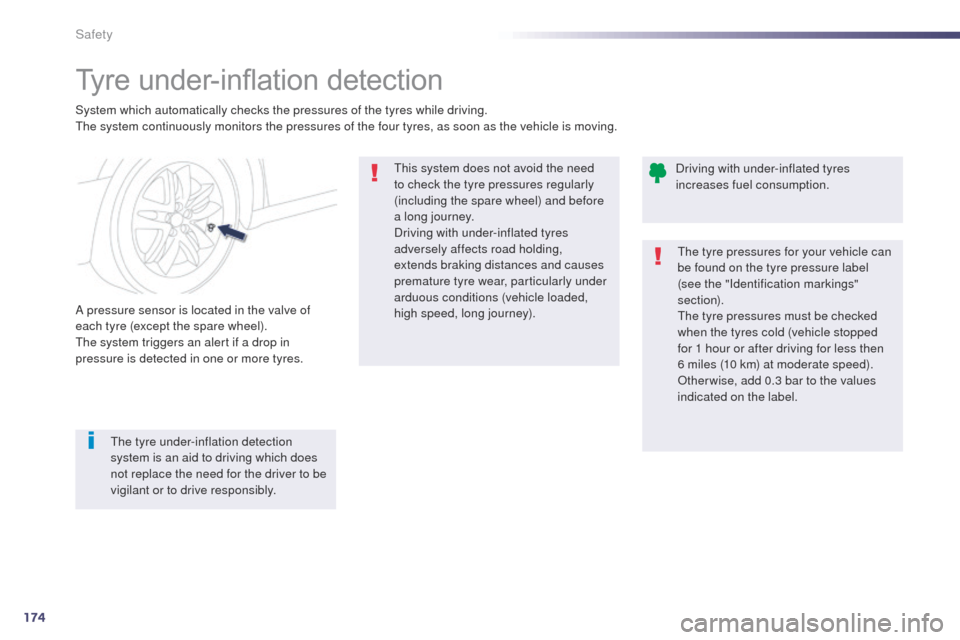
A pressure sensor is located in the valve of
each tyre (except the spare wheel).
th
e system triggers an alert if a drop in
pressure is detected in one or more tyres.
th
is system does not avoid the need
to check the tyre pressures regularly
(including the spare wheel) and before
a long journey.
Driving with under-inflated tyres
adversely affects road holding,
extends braking distances and causes
premature tyre wear, particularly under
arduous conditions (vehicle loaded,
high speed, long journey). Driving with under-inflated tyres
increases fuel consumption.
th
e tyre pressures for your vehicle can
be found on the tyre pressure label
(see the "Identification markings"
section).
th
e tyre pressures must be checked
when the tyres cold (vehicle stopped
for 1 hour or after driving for less then
6 miles (10 km) at moderate speed).
Other wise, add 0.3 bar to the values
indicated on the label.
Safety
Page 177 of 380
175
508_en_Chap07_securite_ed02-2014
the loss of pressure detected does not
always lead to visible deformation of the
tyre. Do not rely on just a visual check.
th
e alert is maintained until the tyre or
tyres concerned is reinflated, repaired
or replaced.
th
e spare wheel (space-saver type or a
steel rim) does not have a sensor.
Operating fault
the flashing and then fixed
illumination of the under-inflation
warning lamp accompanied by the
illumination of the "service" warning
lamp indicates a fault with the system.
th
is alert is also displayed when one or more
wheels is not fitted with a sensor (for example,
a space-saver or steel spare wheel).
go t
o a P
e
uge
Ot
dealer or a qualified
workshop
to have the system checked
or, following the repair of a puncture, to
have the original wheel, equipped with a
sensor, refitted.
Under-inflation alert
the alert is given by the fixed illumination
of this warning lamp, accompanied by
an audible signal, and depending on
equipment, the display of a message.
In the event of a problem on one of the tyres,
the symbol or the message appears, according
to equipment, to identify it.
F
R
educe speed, avoid sudden steering
movements or harsh brake applications.
F
S
top as soon as it is safe to do so.
F
I
f you have a compressor (the one in the
temporary puncture repair kit for example),
check the four tyre pressures when cold.
I
f it is not possible to check the tyre
pressures at the time, drive carefully at
reduced speed.
or
F
I
n the event of a puncture, use the
temporary puncture repair kit or the spare
wheel (according to equipment). Any tyre repair or replacement on a
wheel fitted with this system must be
carried out by a P
e
uge
Ot
dealer or a
qualified workshop.
If after changing a tyre, a wheel is not
detected by your vehicle (fitting snow
tyres for example), you must have the
system reinitialised by a P
e
uge
Ot
dealer or a qualified workshop.
In this case, monitoring of the tyre pressures is
not assured.
7
Safety
Page 194 of 380

192
508_en_Chap08_info-pratiques_ed02-2014
Changing a wheel
the tools are installed in the boot under the
f l o o r.
to g
ain access to them:
F
o
pen the boot,
F
p
osition the floor vertically (SW: in its
guide) for access to the tools.
Procedure for changing a faulty wheel for the spare wheel using the tools provided with the vehicle.
List of tools
All of these tools are specific to your
vehicle and can vary according to the level
of equipment. Do not use them for other
purposes.
1.
Wheelbrace.
F
or removing the wheel trim and removing
the wheel bolts.
2.
J
ack with integral handle.
F
or raising the vehicle. 3.
"
Bolt cover" tool.
F
or removing the bolt protectors (covers)
on alloy wheels.
4.
S
ocket for the security bolts (located in the
glove box).
F
or adapting the wheelbrace to the special
"security" bolts.
5.
A w
heel chock for immobilising the vehicle*.
6.
t
o
wing eye.
S
ee "
to
wing the vehicle".
Access to the tools
* Depending on country of sale or equipment.
Practical information
Page 195 of 380
193
508_en_Chap08_info-pratiques_ed02-2014
Wheel with trim
When refitting the wheel, refit the trim
starting by placing its notch facing the
valve and press around its edge with
the palm of your hand.
th
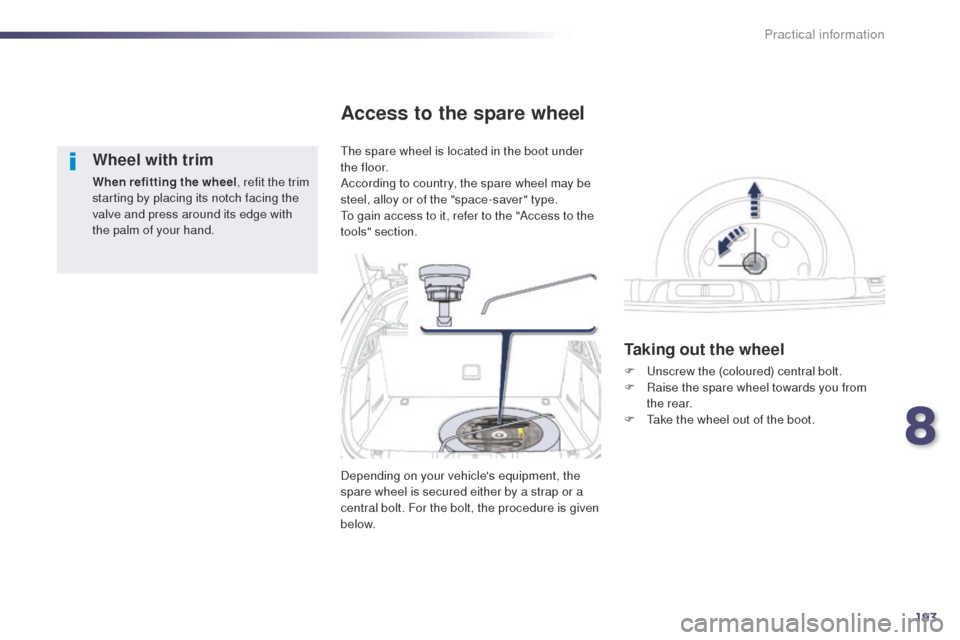
e spare wheel is located in the boot under
t h e f l o o r.
According to country, the spare wheel may be
steel, alloy or of the "space-saver" type.
to g
ain access to it, refer to the "Access to the
tools" section.
Access to the spare wheel
Taking out the wheel
F unscrew the (coloured) central bolt.
F R aise the spare wheel towards you from
the rear.
F
t
a
ke the wheel out of the boot.
Depending on your vehicle's equipment, the
spare wheel is secured either by a strap or a
central bolt. For the bolt, the procedure is given
below.
8
Practical information
Page 196 of 380

194
508_en_Chap08_info-pratiques_ed02-2014
Putting the wheel back in place
F Put the box back in place in the centre of the wheel and clip it.
F
P
ut the polystyrene storage box back in
place.
F
P
ut the wheel back in its housing.
F
un
screw the (coloured) central bolt by a
few turns then put it in place in the centre
of the wheel.
F
t
i
ghten fully until the central bolt clicks to
retain the wheel correctly.Tyre under-inflation
detection
the spare wheel (space-saver or steel
rim) does not have a sensor.
th
e punctured wheel must be repaired
by a P
e
uge
Ot
dealer or a qualified
workshop.
Practical information
Page 198 of 380
196
508_en_Chap08_info-pratiques_ed02-2014
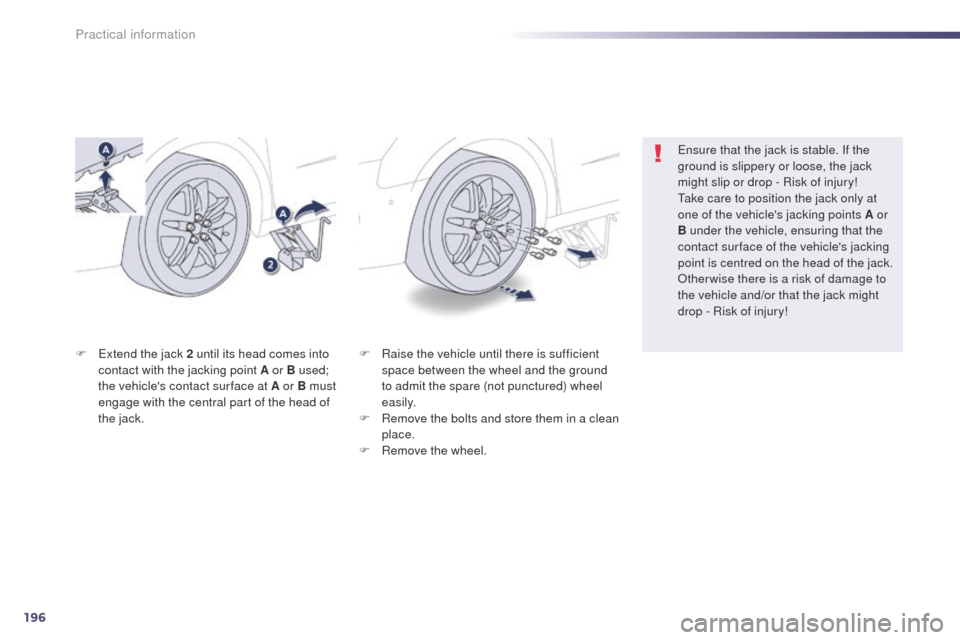
F Raise the vehicle until there is sufficient space between the wheel and the ground
to admit the spare (not punctured) wheel
easily.
F
R
emove the bolts and store them in a clean
place.
F
R
emove the wheel.
F
ex
tend the jack 2 until its head comes into
contact with the jacking point A or B used;
the vehicle's contact sur face at A or B must
engage with the central part of the head of
the jack.
en
sure that the jack is stable. If the
ground is slippery or loose, the jack
might slip or drop - Risk of injury!
ta
ke care to position the jack only at
one of the vehicle's jacking points A or
B under the vehicle, ensuring that the
contact sur face of the vehicle's jacking
point is centred on the head of the jack.
Otherwise there is a risk of damage to
the vehicle and/or that the jack might
drop - Risk of injury!
Practical information
Page 199 of 380

197
508_en_Chap08_info-pratiques_ed02-2014
Fitting a wheel
Fitting the "space-saver"
spare wheel
If your vehicle is fitted with alloy wheels,
when tightening the bolts on fitting, it
is normal to notice that the washers
do not come into contact with the
"space-saver" spare wheel. t
h
e wheel
is secured by the conical sur face of
each bolt.
After changing a wheel
to store the punctured wheel in the
boot correctly, first remove the central
c ove r.
When using the "space-saver" type
spare wheel, do not exceed 50 mph
(80
km/h).
Have the tightening of the bolts and the
pressure of the spare wheel checked
by a P
e
uge
Ot
dealer or a qualified
workshop without delay.
Have the punctured wheel repaired
and refitted to the vehicle as soon as
possible.
List of operations
F Put the wheel in place on the hub.
F S crew in the bolts fully by hand.
F
P
re-tighten the security bolt using the
wheelbrace 1 fitted with the security
socket
4.
F
P
re-tighten the other bolts using the
wheelbrace 1 o n l y.
8
Practical information