service Peugeot 807 2013 User Guide
[x] Cancel search | Manufacturer: PEUGEOT, Model Year: 2013, Model line: 807, Model: Peugeot 807 2013Pages: 234, PDF Size: 9.8 MB
Page 47 of 234
Steering wheel controls
EASE OF USE and COMFORT
3
45
Automatic "Follow-Me-Home"
lighting
With the ignition off, when you leave
your vehicle with the automatic
switching on of the lights function
activated
, the side lights and dipped
headlamps remain on for the selected
duration.
To deactivate or activate this
function, go to the display
confi guration menu.
The duration of the timed period must
also be set (15, 30, 60 seconds), via
the display confi guration menu.
Carry out these operations when the
vehicle is stationary.
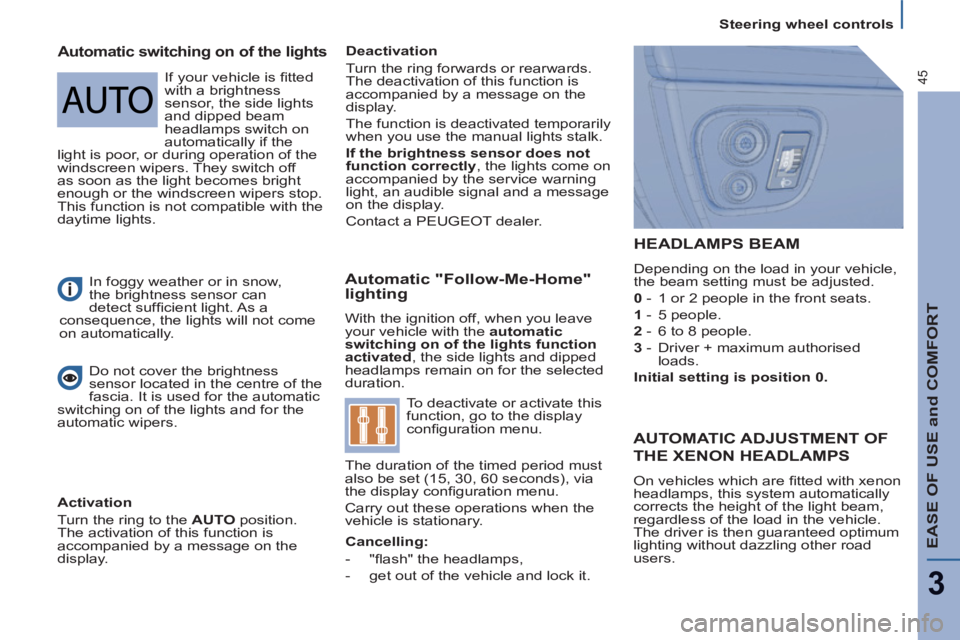
HEADLAMPS BEAM
Depending on the load in your vehicle,
the beam setting must be adjusted.
0
- 1 or 2 people in the front seats.
1
- 5 people.
2
- 6 to 8 people.
3
- Driver + maximum authorised
loads.
Initial setting is position 0.
In foggy weather or in snow,
the brightness sensor can
detect suffi cient light. As a
consequence, the lights will not come
on automatically.
Automatic switching on of the lights
Deactivation
Turn the ring forwards or rearwards.
The deactivation of this function is
accompanied by a message on the
display.
The function is deactivated temporarily
when you use the manual lights stalk.
If the brightness sensor does not
function correctly
, the lights come on
accompanied by the service warning
light, an audible signal and a message
on the display.
Contact a PEUGEOT dealer.
Do not cover the brightness
sensor located in the centre of the
fascia. It is used for the automatic
switching on of the lights and for the
automatic wipers.
Activation
Turn the ring to the AUTO
position.
The activation of this function is
accompanied by a message on the
display.
AUTOMATIC ADJUSTMENT OF
THE XENON HEADLAMPS
On vehicles which are fi tted with xenon
headlamps, this system automatically
corrects the height of the light beam,
regardless of the load in the vehicle.
The driver is then guaranteed optimum
lighting without dazzling other road
users.
Cancelling:
- "fl ash" the headlamps,
-
get out of the vehicle and lock it.
If your vehicle is fi tted
with a brightness
sensor, the side lights
and dipped beam
headlamps switch on
automatically if the
light is poor, or during operation of the
windscreen wipers. They switch off
as soon as the light becomes bright
enough or the windscreen wipers stop.
This function is not compatible with the
daytime lights.
Page 92 of 234
90
Driving safely
TYRE UNDER-INFLATION
DETECTION
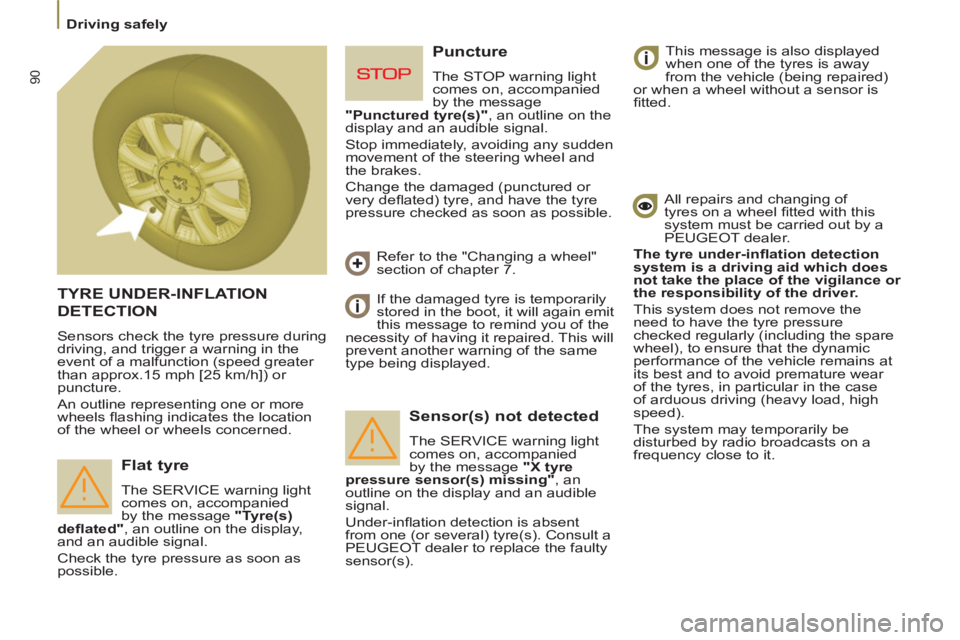
Sensors check the tyre pressure during
driving, and trigger a warning in the
event of a malfunction (speed greater
than approx.15 mph [25 km/h]) or
puncture.
An outline representing one or more
wheels fl ashing indicates the location
of the wheel or wheels concerned.
Flat tyre
The SERVICE warning light
comes on, accompanied
by the message "Tyre(s)
defl ated"
, an outline on the display,
and an audible signal.
Check the tyre pressure as soon as
possible. If the damaged tyre is temporarily
stored in the boot, it will again emit
this message to remind you of the
necessity of having it repaired. This will
prevent another warning of the same
type being displayed.
Sensor(s) not detected
The SERVICE warning light
comes on, accompanied
by the message "X tyre
pressure sensor(s) missing"
, an
outline on the display and an audible
signal.
Under-infl ation detection is absent
from one (or several) tyre(s). Consult a
PEUGEOT dealer to replace the faulty
sensor(s). This message is also displayed
when one of the tyres is away
from the vehicle (being repaired)
or when a wheel without a sensor is
fi tted.
All repairs and changing of
tyres on a wheel fi tted with this
system must be carried out by a
PEUGEOT dealer.
The tyre under-infl ation detection
system is a driving aid which does
not take the place of the vigilance or
the responsibility of the driver.
This system does not remove the
need to have the tyre pressure
checked regularly (including the spare
wheel), to ensure that the dynamic
performance of the vehicle remains at
its best and to avoid premature wear
of the tyres, in particular in the case
of arduous driving (heavy load, high
speed).
The system may temporarily be
disturbed by radio broadcasts on a
frequency close to it.
Puncture
The STOP warning light
comes on, accompanied
by the message
"Punctured tyre(s)"
, an outline on the
display and an audible signal.
Stop immediately, avoiding any sudden
movement of the steering wheel and
the brakes.
Change the damaged (punctured or
very defl ated) tyre, and have the tyre
pressure checked as soon as possible.
Refer to the "Changing a wheel"
section of chapter 7.
Page 110 of 234
108
Maintenance with TOTAL
Partners in performance and
protection of the environment
Innovation at the service of performance
The TOTAL Research and Development
teams develop lubricants for PEUGEOT
which satisfy the requirements of the
latest technical innovations incorporated in
PEUGEOT vehicles.
This ensures that you obtain the best
performance and the maximum engine life.
RECOMMENDS
Reduced exhaust emissions
TOTAL lubricants are formulated to optimise
the effi ciency of engines and the protection
of the emissions post-treatment systems.
It is crucial to observe the servicing
recommendations made by PEUGEOT to
ensure correct operation.
Page 116 of 234
11 4
Levels
Cooling system
Only use the fl uid recommended by the
manufacturer.
Otherwise, you risk seriously damaging
your engine.
When the engine is warm, the
temperature of the coolant is controlled
by the engine fan. As this fan can
operate with the ignition key removed
and because the cooling system is
pressurised, wait for at least one hour
after the engine has stopped before
carrying out any work.
Slacken the cap by 1/4 of a turn to
release the pressure to prevent any
risk of scalding. When the pressure
has dropped, remove the cap and top
up the level with coolant.
If fl uid has to be added frequently,
this indicates a failure which must be
checked by a PEUGEOT dealer as
soon as possible.
Power steering fluid level
The vehicle must be parked on level
ground with the engine cold. Unscrew
the cap integrated with the gauge and
check the level which must be between
the MIN and MAX marks. During regeneration of the particle
emission fi lter, relay noise may be
heard under the fascia.
If the message is still displayed and
the service warning light remains on,
contact a PEUGEOT dealer.
Diesel additive level (Diesel with
particle emission filter)
When this occurs with the engine
running, this is due to the start of
saturation of the particle emission fi lter
(exceptionally prolonged urban driving
conditions: low speed, long traffi c
jams, ...).
In order to regenerate the fi lter, you
are advised to drive at a speed of
more than 40 mph (60 km/h) as soon
as possible, when traffi c conditions
permit, for at least fi ve minutes (until
the message disappears and the
service warning light is switched off).
Topping up
The level must be between the MIN
and MAX marks on the expansion
bottle. If more than 1 litre of fl uid is
required to top up the level, have
the system checked by a PEUGEOT
dealer.
Windscreen wash and headlamp
wash level
For best quality cleaning and for your
safety, we would advise that you use
products of the PEUGEOT range.
To avoid ice forming, do not use water.
Topping up
It is imperative that this additive is
topped up by a PEUGEOT dealer
without delay.
Used oil
Avoid prolonged contact of used oil
with the skin.
Brake fl uid is harmful to health and
very corrosive.
Do not dispose of used oil, brake
fl uid or coolant into drains or onto
the ground but into the containers
dedicated to this use at PEUGEOT
dealerships. The minimum level of this
additive is indicated by
lighting of the service warning
light, accompanied by an
audible signal and a message
on the display.
Page 117 of 234
11 5
Checks
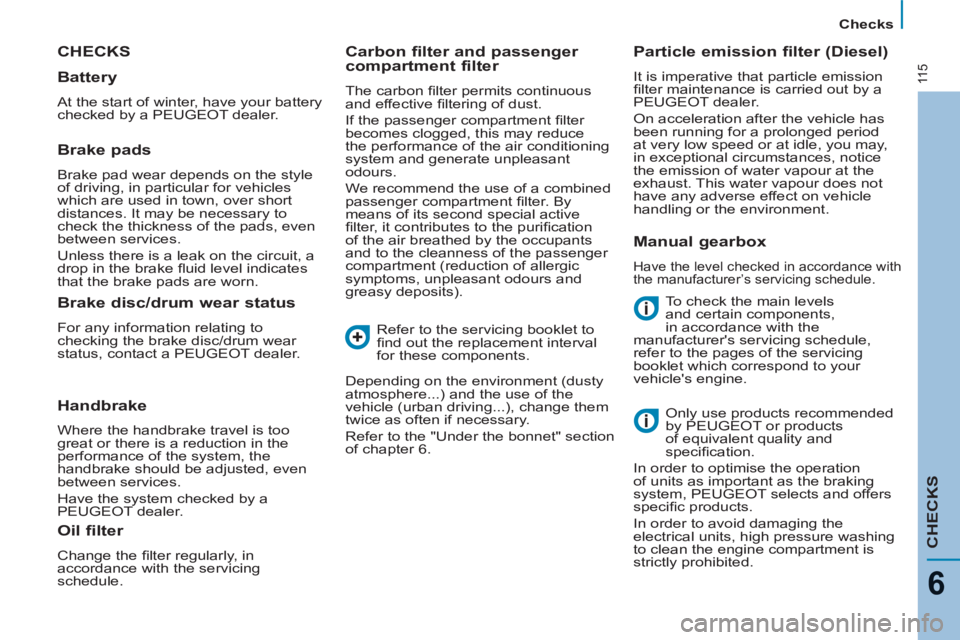
CHECKS
6
CHECKS
To check the main levels
and certain components,
in accordance with the
manufacturer's servicing schedule,
refer to the pages of the servicing
booklet which correspond to your
vehicle's engine.
Only use products recommended
by PEUGEOT or products
of equivalent quality and
specifi cation.
In order to optimise the operation
of units as important as the braking
system, PEUGEOT selects and offers
specifi c products.
In order to avoid damaging the
electrical units, high pressure washing
to clean the engine compartment is
strictly prohibited.
Oil filter
Change the fi lter regularly, in
accordance with the servicing
schedule. Refer to the servicing booklet to
fi nd out the replacement interval
for these components.
Depending on the environment (dusty
atmosphere...) and the use of the
vehicle (urban driving...), change them
twice as often if necessary.
Refer to the "Under the bonnet" section
of chapter 6.
Particle emission filter (Diesel)
It is imperative that particle emission
fi lter maintenance is carried out by a
PEUGEOT dealer.
On acceleration after the vehicle has
been running for a prolonged period
at very low speed or at idle, you may,
in exceptional circumstances, notice
the emission of water vapour at the
exhaust. This water vapour does not
have any adverse effect on vehicle
handling or the environment.
Battery
At the start of winter, have your battery
checked by a PEUGEOT dealer.
Brake pads
Brake pad wear depends on the style
of driving, in particular for vehicles
which are used in town, over short
distances. It may be necessary to
check the thickness of the pads, even
between services.
Unless there is a leak on the circuit, a
drop in the brake fl uid level indicates
that the brake pads are worn.
Brake disc/drum wear status
For any information relating to
checking the brake disc/drum wear
status, contact a PEUGEOT dealer.
Handbrake
Where the handbrake travel is too
great or there is a reduction in the
performance of the system, the
handbrake should be adjusted, even
between services.
Have the system checked by a
PEUGEOT dealer.
Carbon filter and passenger
compartment filter
The carbon fi lter permits continuous
and effective fi ltering of dust.
If the passenger compartment fi lter
becomes clogged, this may reduce
the performance of the air conditioning
system and generate unpleasant
odours.
We recommend the use of a combined
passenger compartment fi lter. By
means of its second special active
fi lter, it contributes to the purifi cation
of the air breathed by the occupants
and to the cleanness of the passenger
compartment (reduction of allergic
symptoms, unpleasant odours and
greasy deposits).
Manual gearbox
Have the level checked in accordance with
the manufacturer’s servicing schedule.
Page 152 of 234
9.12
05
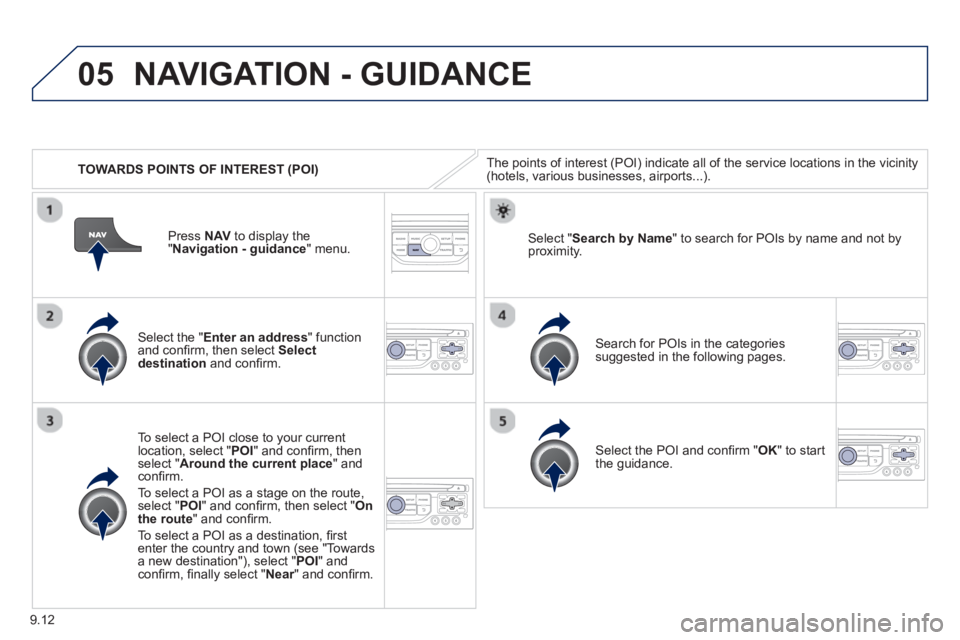
TOWARDS POINTS OF INTEREST (POI)
NAVIGATION - GUIDANCE
The points of interest (POI) indicate all of the service locations in the vicinity(hotels, various businesses, airports...).
Select the " Enter an address
" function
and confi rm, then select Select
destinationand confi rm.
To select a P
OI close to your currentlocation, select "POI" and confi rm, thenselect " Around the current place
" and confi rm.
To select a P
OI as a stage on the route,select " POI" and confi rm, then select " On
the route" and confi rm.
To select a P
OI as a destination, fi rst enter the country and town (see "Towards
a new destination"), select "POI" andconfi rm, fi nally select "Near" and confi rm.r
Search for POIs in the categories
suggested in the following pages.
Select " Search by Name
" to search for POIs by name and not byproximity.
Select the POI and confi rm " OK" to start
the guidance. Pr
ess NAV
to display the
"Navigation - guidance" menu.
Page 167 of 234
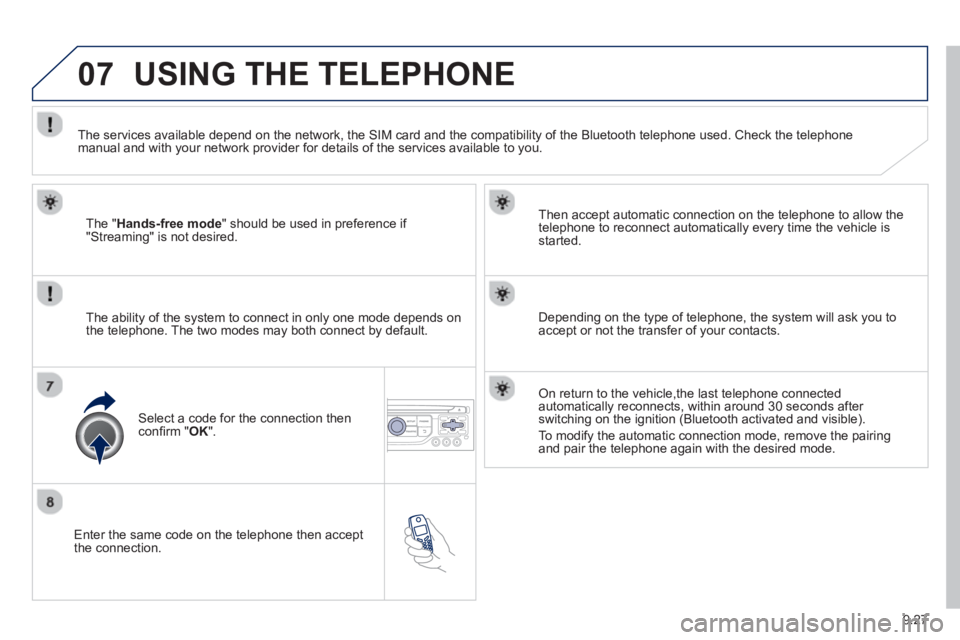
9.27
07
Enter the same code on the telephone then accept
the connection.
Then accept automatic connection on the telephone to allow the
te
lephone to reconnect automatically every time the vehicle is started.
The abilit
y of the system to connect in only one mode depends on
the telephone. The two modes may both connect by default.
USING THE TELEPHONE
The "Hands-free mode
" should be used in preference if "Streaming" is not desired.
The services available depend on the network, the
SIM card and the compatibility of the Bluetooth telephone used. Check the telephone manual and with your network provider for details of the services available to you.
Select a code for the connection thenconfi rm "OK".
Depending on the type of telephone, the system will ask you to
accept or not the transfer of your contacts.
On return to the vehicle,the last telephone connected
automatically reconnects, within around 30 seconds after switching on the ignition (Bluetooth activated and visible).
To modif
y the automatic connection mode, remove the pairingand pair the telephone again with the desired mode.
Page 173 of 234
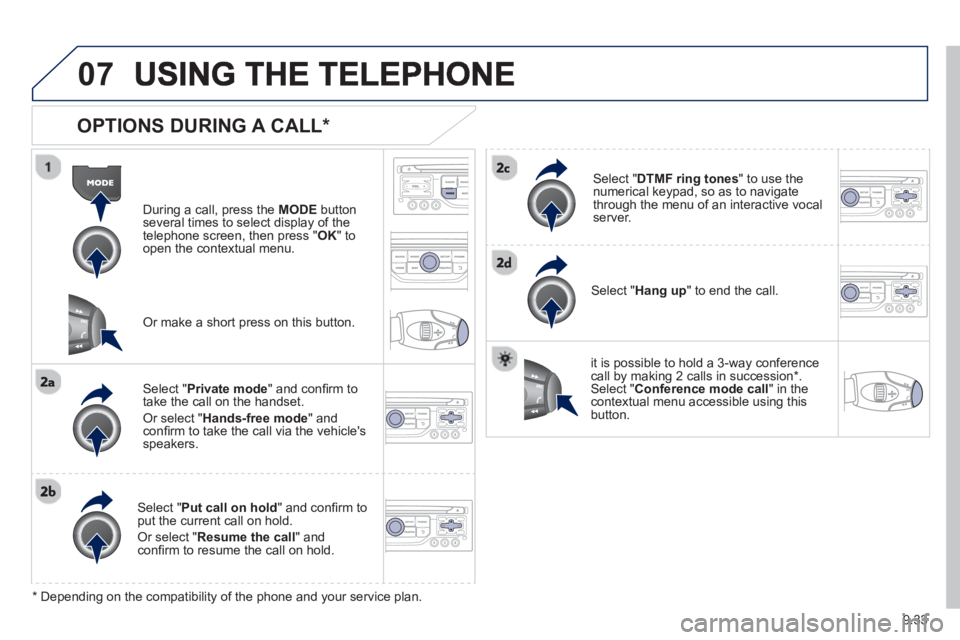
9.33
07
OPTIONS DURING A CALL *
During a call, press the MODE
button
several times to select display of the
telephone screen, then press " OK " to
open the contextual menu.
Select " Private mode
" and confi rm totake the call on the handset.
Or select " Hands-free mode" andconfi rm to take the call via the vehicle's
speakers.
Select " Put call on hold" and confi rm to put the current call on hold.
Or select " Resume the call" andconfi rm to resume the call on hold.
Select " DTMF ring tones
" to use thenumerical keypad, so as to navigate
through the menu of an interactive vocal server.
Select " Hang up " to end the call.
*
Depending on the compatibility of the phone and your service plan.
it is possible to hold a 3-wa
y conferencecall by making 2 calls in succession*. Select "Conferencemode call" in the contextual menu accessible using thisbutton.
Or make a short press on this button.
Page 211 of 234
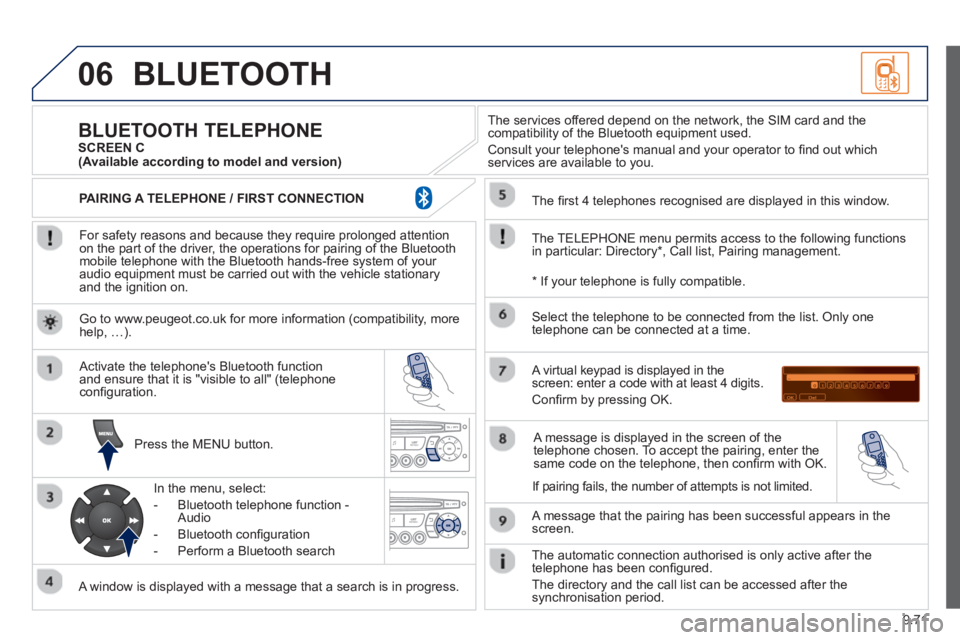
9.71
06BLUETOOTH
For safety reasons and because they require prolonged attentionon the part of the driver, the operations for pairing of the Bluetooth mobile telephone with the Bluetooth hands-free system of your
audio equipment must be carried out with the vehicle stationary
and the ignition on.
Pr
ess the MENU button.
A window is displayed with a message that a search is in progress.
Activate the telephone's Bluetooth
function
and ensure that it is "visible to all" (telephone confi guration.
In the menu, select:
- Bluetooth telephone
function -
Audio
- Bluetooth confi
guration
- P
erform a Bluetooth search
The services o
ffered depend on the network, the SIM card and thecompatibility of the Bluetooth equipment used.
Consult your telephone's manual and your operator to fi nd out which
services are available to you.
BLUETOOTH TELEPHONE SCREEN C
The TELEPH
ONE menu permits access to the following functions
in particular: Directory * , Call list, Pairing management.
The
fi rst 4 telephones recognised are displayed in this window.
A virtual ke
ypad is displayed in thescreen: enter a code with at least 4 digits.
Confi rm by pressing OK.
A messa
ge that the pairing has been successful appears in thescreen.
Select the telephone to be connected from the list.
Only one
telephone can be connected at a time.
A messa
ge is displayed in the screen of the
telephone chosen. To accept the pairing, enter the same code on the telephone, then confi rm with OK.
The automatic connection authorised is onl
y active after the
telephone has been confi gured.
The directory and the call list can be accessed a
fter thesynchronisation period.
(Available according to model and version)
*
If your telephone is fully compatible.
I
f pairing fails, the number of attempts is not limited. Go to www.peu
geot.co.uk for more information (compatibility, more help, …).
PAIRING A TELEPHONE / FIR
ST CONNECTION
Page 229 of 234
145
VISUAL SEARC
H
10
Environment
Limit the causes of excess consumption
Spread loads throughout the vehicle; place the heaviest
items in the bottom of the boot, as close as possible to the
rear seats.
Limit the loads carried in the vehicle and reduce wind
resistance (roof bars, roof rack, bicycle carrier, trailer...).
Use a roof box in preference.
Remove roof bars and roof racks after use.
At the end of winter, remove snow tyres and refi t your
summer tyres.
Observe the recommendations on maintenance
Check the tyre pressures regularly, when cold, referring to
the label in the door aperture, driver's side.
Carry out this check in particular:
- before a long journey,
- at each change of season,
- after a long period out of use.
Don't forget the spare wheel and the tyres on any trailer or
caravan.
Have your vehicle serviced regularly (engine oil, oil
fi lter, air fi lter...) and observe the schedule of operations
recommended by the manufacturer.
When refuelling, do not continue after the third cut-off of the
nozzle to avoid any overfl ow.
At the wheel of your new vehicle, it is only after the fi rst
1 800 miles (3 000 kilometres) that you will see the fuel
consumption settle down to a consistent average.