warning Peugeot Bipper 2011 Owner's Guide
[x] Cancel search | Manufacturer: PEUGEOT, Model Year: 2011, Model line: Bipper, Model: Peugeot Bipper 2011Pages: 180, PDF Size: 5.14 MB
Page 55 of 180
53
1
READY TO SET OFF
Gearbox and steering wheel
Reinitialisation
Turn the ignition key to the MAR
position.
Within ten seconds, the gear engaged should
appear in the instrument panel screen.
Otherwise, turn the ignition key to the
STOP
position and wait until the instrument
panel screen goes off.
Turn the ignition key to the MAR
position
again.
The illumination of this warning
lamp, accompanied by a message
in the instrument panel screen,
indicates incorrect use of the
gearbox by the driver.
With the ignition on, the flashing this warning
lamp, accompanied by an audible signal and
a message in the instrument panel screen,
indicates a fault with the gearbox.
Have it checked by a PEUGEOT dealer or a
qualified workshop.
If the problem persist, have the system
checked by a PEUGEOT dealer or a
qualified workshop.
Never select neutral N
while the vehicle
is moving.
Only engage reverse gear R
with the vehicle
immobilised and the brake pedal pressed.
You risk damaging the gearbox if you
press the accelerator and brake pedals
simultaneously.
Back-up mode - Slow move off
This procedure should be applied if pressing
the brake pedal is not recognised by the
system, or if the gearbox has fault on
starting the engine.
Press the brake pedal firmly.
Turn the ignition key to the AV V
position for
at least seven seconds.
The engine starts.
The system is in back-up mode; the gearbox
will not go beyond the 3 rd gear engaged and
automated mode is not available.
If the engine does not start, have the
system checked by a PEUGEOT dealer
or a qualified workshop.
Operating fault
In the event of a prolonged stop with
the engine running, it is recommended
that the gearbox be put into neutral
(position N
).
With the vehicle stationary, the engine
running and first, second or reverse
gear engaged, the gearbox changes to
neutral automatically, accompanied by
an audible signal, in the following
circumstances:
- no action on the accelerator or brake
pedals for at least 3 minutes,
- brake pedal applied for more than
10 minutes,
- driver's door opened and no action on the
accelerator or brake pedals for at least
1.5 seconds,
- a gearbox fault.
When towing your vehicle, ensure that
the gearbox is in neutral (position N
).
Page 56 of 180
Gearbox and steering wheel
HILL START ASSIST
An integral part of the ESP system, it
facilitates starting on a gradient by keeping
your vehicle immobilised temporarily
(approximately 2 seconds), the time it takes
to move your foot from the brake pedal to
the accelerator pedal.
This function is only active when:
- the vehicle is completely stationary, with
your foot on the brake pedal,
- the engine is running,
- the gradient is steeper than 5 %,
Operation
On a slope, with engine running and the
vehicle stationary, the vehicle is held
for a brief moment when you release the
brake pedal:
- provided you are in first gear or neutral
with a manual gearbox,
- provided you are in position A
or M
with
an electronic gearbox,
On a descending slope, with the vehicle
stationary, the engine running and reverse
gear engaged, the vehicle is held for a brief
moment when you release the brake pedal.
After 2 seconds, if the vehicle has not
moved off, the system is deactivated
automatically by gradually reducing the
brake pressure. During this phase, the
characteristic sound of brakes being
released will be heard, indicating the
imminent movement of the vehicle.
Do not leave the vehicle while it is
being held in the hill start assist phase.
If you need to leave the vehicle while the
engine is running, apply the parking brake
manually. Then ensure that the parking
brake warning lamp is on (not flashing) in
the instrument panel.
Operating fault
If a fault occurs with the system,
these warning lamps come on in
the instrument panel. Contact a
PEUGEOT dealer or a qualified
workshop to have the system
checked.
In STOP mode of Stop & Start, hill start
assist is inactive.
Page 57 of 180
55
1
READY TO SET OFF
Gearbox and steering wheel
- with a manual gearbox
, with the vehicle
stationary, put the gear lever into neutral,
then release the clutch pedal,
- with an electronic gearbox
, with the
vehicle stationary, hold the brake pedal
down.
Special cases: STOP mode unavailable
The STOP mode is not invoked when:
- the driver's door is open,
- the driver's seat belt is not fastened,
- the heated rear screen is on,
- the windscreen wiper is on fast wipe,
- reverse gear is engaged,
- some special conditions (battery
charge, engine temperature, particle
filter regeneration, braking assistance,
ambient temperature...) where the engine
is needed to assure control of a system.
In this case, a message appears
in the instrument panel screen,
accompanied by the "S"
warning
lamp, which flashes for a few
seconds, then goes off.
This operation is perfectly normal.
STOP & START
The Stop & Start system puts the engine
temporarily into standby - STOP mode -
during stops in the traffic (red lights, traffic
jams, or other...). The engine restarts
automatically - START mode - as soon as
you want to move off. The restart takes
place instantly, quickly and silently.
Perfect for urban use, the Stop & Start
system reduces fuel consumption and
exhaust emissions and offers the comfort of
complete silence when stationary.
Operation
Going into engine STOP mode
The "S"
warning lamp comes on
in the instrument panel and the
engine goes into standby: Automatic stopping of the engine is
only possible after the vehicle has
exceed a speed of about 6 mph (10 km/h),
to avoid repeated stopping of the engine
when driving slowly.
In the STOP mode Stop & Start, hill
start assist is inactive.
Never leave your vehicle with out first
turning off the ignition with the key.
Never refuel with the engine in STOP
mode; you must switch off the ignition
with the key.
Page 58 of 180
56
Gearbox and steering wheel
Special cases: START invoked
automatically
The START mode is invoked automatically
when:
- the vehicle's is free wheeling on a slope,
- the windscreen wiper is on fast wipe,
- the engine has been stopped for around
3 minutes with Stop & Start,
- some special conditions (battery charge,
engine temperature, braking assistance,
ambient temperature...) where the engine
is needed to assure control of a system.
Good practice
With a manual gearbox in STOP mode, if a
gear is engaged without fully depressing the
clutch pedal, restarting may not take place.
A warning lamp or message is displayed
in the instrument panel asking you to fully
depress the clutch pedal to allow restarting.
With the engine stopped in STOP mode,
if the driver unfasten's their seat belt and
opens a front door, the engine can only
be restarted using the ignition key. This is
indicated by an audible signal, accompanied
by flashing of the service warning lamp and
a message in the instrument panel screen.
If following an automatic restart in START
mode, the driver takes no action on the
the vehicle during the next 3 minutes, the
system stops the engine definitively.
The engine can then only be restarted using
the key.
Going into engine START mode
The "S"
warning lamp goes off and
the engine starts:
- with a manual gearbox
, depress the
clutch pedal,
- with an electronic gearbox
:
●
gear lever in position A
or M
, release the
brake pedal,
●
or engage reverse gear.
In this case, a message appears
in the instrument panel screen,
accompanied by the "S"
warning
lamp, which flashes for a few
seconds, then goes off.
This operation is perfectly normal.
In STOP mode, moving the gear lever
on an electronic gearbox starts the
engine, in anticipation of moving off.
If the engine stops automatically when
the vehicle is on a slope, as hill start
is only active with the engine running, it is
necessary to restart the engine by engaging
a forward gear and releasing the brake
pedal.
Page 59 of 180
57
1
READY TO SET OFF
Gearbox and steering wheel
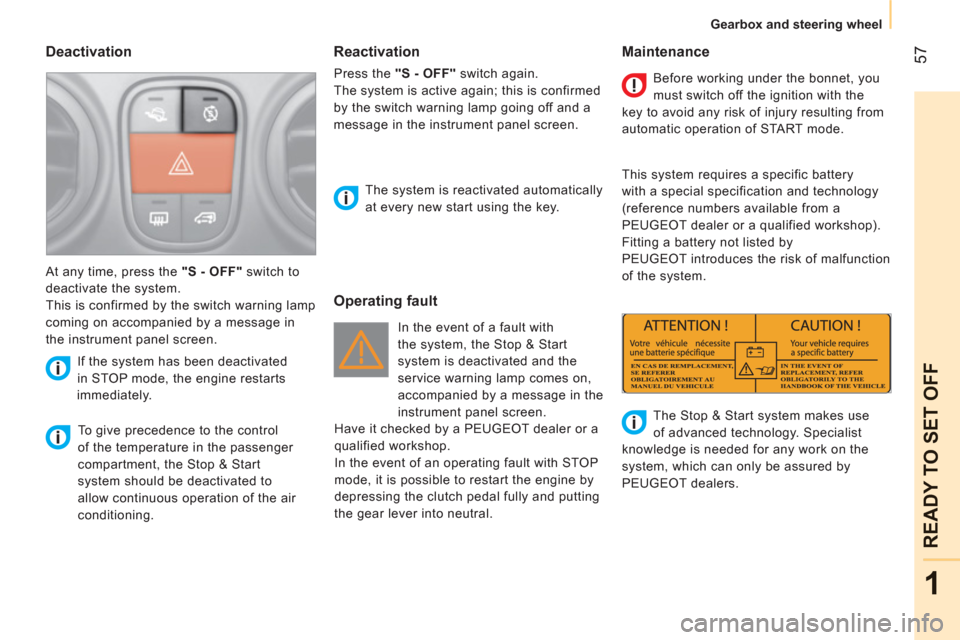
Deactivation
To give precedence to the control
of the temperature in the passenger
compartment, the Stop & Start
system should be deactivated to
allow continuous operation of the air
conditioning.
The system is reactivated automatically
at every new start using the key.
At any time, press the "S - OFF"
switch to
deactivate the system.
This is confirmed by the switch warning lamp
coming on accompanied by a message in
the instrument panel screen.
If the system has been deactivated
in STOP mode, the engine restarts
immediately.
Operating fault
Maintenance
In the event of a fault with
the system, the Stop & Start
system is deactivated and the
service warning lamp comes on,
accompanied by a message in the
instrument panel screen.
Have it checked by a PEUGEOT dealer or a
qualified workshop.
In the event of an operating fault with STOP
mode, it is possible to restart the engine by
depressing the clutch pedal fully and putting
the gear lever into neutral. Before working under the bonnet, you
must switch off the ignition with the
key to avoid any risk of injury resulting from
automatic operation of START mode.
This system requires a specific battery
with a special specification and technology
(reference numbers available from a
PEUGEOT dealer or a qualified workshop).
Fitting a battery not listed by
PEUGEOT introduces the risk of malfunction
of the system.
The Stop & Start system makes use
of advanced technology. Specialist
knowledge is needed for any work on the
system, which can only be assured by
PEUGEOT dealers.
Reactivation
Press the "S - OFF"
switch again.
The system is active again; this is confirmed
by the switch warning lamp going off and a
message in the instrument panel screen.
Page 72 of 180
70
Menu
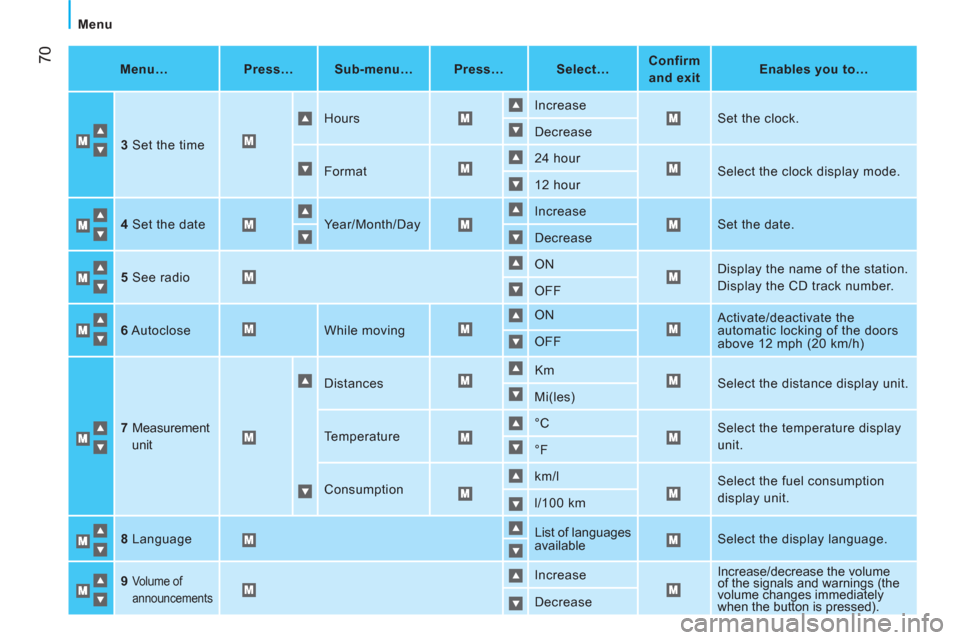
Menu…
Press…
Sub-menu…
Press…
Select…
Confirm
and exit
Enables you to…
3
Set the time Hours Increase
Set the clock.
Decrease
Format 24 hour
Select the clock display mode.
12 hour
4
Set the date Year/Month/Day Increase
Set the date.
Decrease
5
See radio ON
Display the name of the station.
Display the CD track number.
OFF
6
Autoclose While moving ON
Activate/deactivate the
automatic locking of the doors
above 12 mph (20 km/h) OFF
7 Measurement
unit Distances Km
Select the distance display unit.
Mi(les)
Temperature °C
Select the temperature display
unit.
°F
Consumption
km/l
Select the fuel consumption
display unit.
l/100 km
8
Language List of languages
available Select the display language.
9
Volume of
announcements
Increase Increase/decrease the volume
of the signals and warnings (the
volume changes immediately
when the button is pressed). Decrease
Page 74 of 180
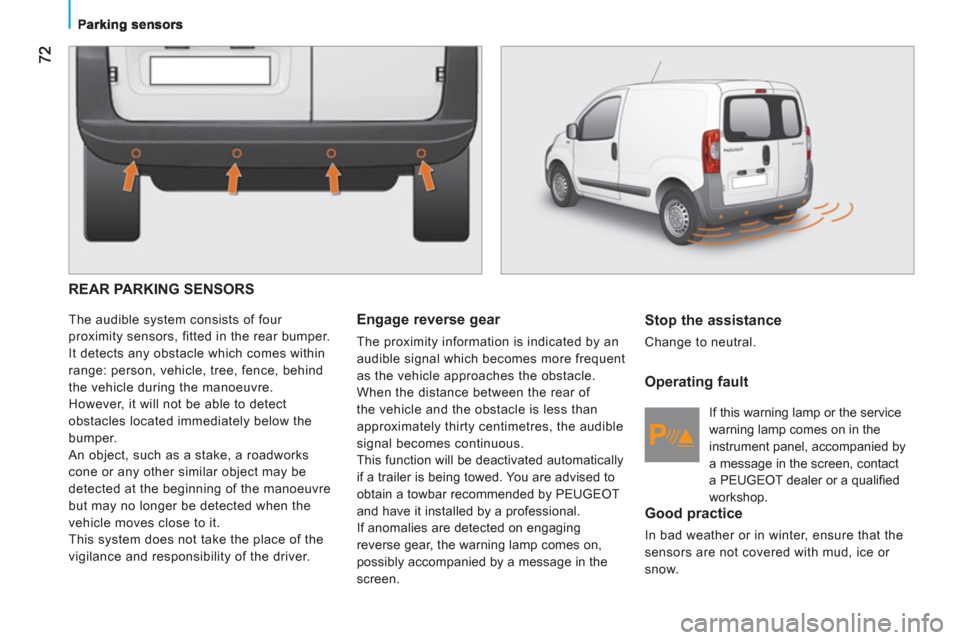
REAR PARKING SENSORS
The audible system consists of four
proximity sensors, fitted in the rear bumper.
It detects any obstacle which comes within
range: person, vehicle, tree, fence, behind
the vehicle during the manoeuvre.
However, it will not be able to detect
obstacles located immediately below the
bumper.
An object, such as a stake, a roadworks
cone or any other similar object may be
detected at the beginning of the manoeuvre
but may no longer be detected when the
vehicle moves close to it.
This system does not take the place of the
vigilance and responsibility of the driver.
Stop the assistance
Change to neutral.
Operating fault
If this warning lamp or the service
warning lamp comes on in the
instrument panel, accompanied by
a message in the screen, contact
a PEUGEOT dealer or a qualifi ed
workshop.
Good practice
In bad weather or in winter, ensure that the
sensors are not covered with mud, ice or
snow.
Engage reverse gear
The proximity information is indicated by an
audible signal which becomes more frequent
as the vehicle approaches the obstacle.
When the distance between the rear of
the vehicle and the obstacle is less than
approximately thirty centimetres, the audible
signal becomes continuous.
This function will be deactivated automatically
if a trailer is being towed. You are advised to
obtain a towbar recommended by PEUGEOT
and have it installed by a professional.
If anomalies are detected on engaging
reverse gear, the warning lamp comes on,
possibly accompanied by a message in the
screen.
7272
Page 115 of 180
11
3
5
SAFETY
Driving safely
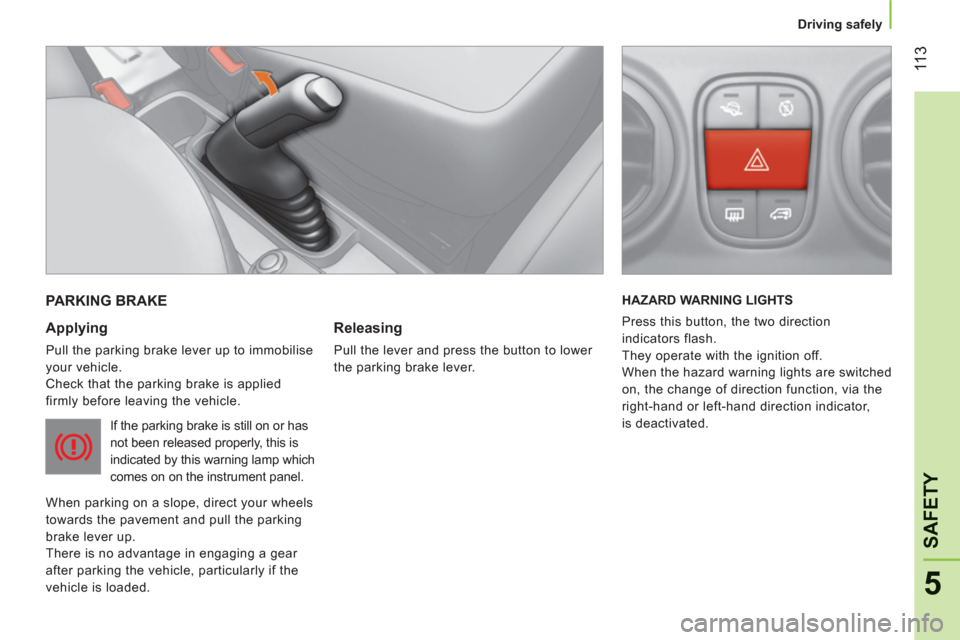
PARKING BRAKE
Applying
Pull the parking brake lever up to immobilise
your vehicle.
Check that the parking brake is applied
firmly before leaving the vehicle.
If the parking brake is still on or has
not been released properly, this is
indicated by this warning lamp which
comes on on the instrument panel.
When parking on a slope, direct your wheels
towards the pavement and pull the parking
brake lever up.
There is no advantage in engaging a gear
after parking the vehicle, particularly if the
vehicle is loaded.
Releasing
Pull the lever and press the button to lower
the parking brake lever. HAZARD WARNING LIGHTS
Press this button, the two direction
indicators flash.
They operate with the ignition off.
When the hazard warning lights are switched
on, the change of direction function, via the
right-hand or left-hand direction indicator,
is deactivated.
Page 116 of 180
11 4
Driving safely
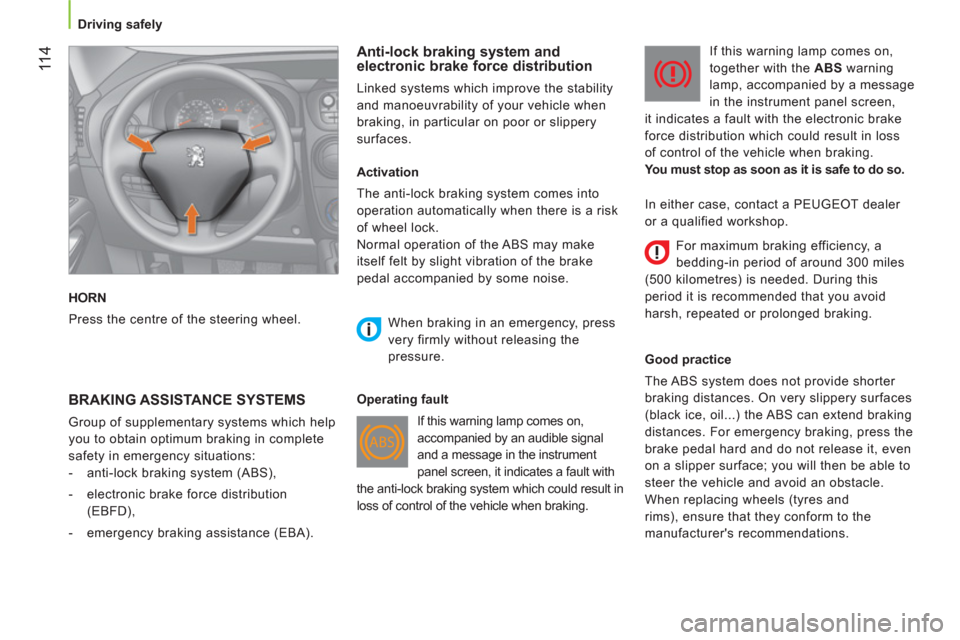
HORN
Press the centre of the steering wheel.
Anti-lock braking system and
electronic brake force distribution
Linked systems which improve the stability
and manoeuvrability of your vehicle when
braking, in particular on poor or slippery
surfaces.
BRAKING ASSISTANCE SYSTEMS
Group of supplementary systems which help
you to obtain optimum braking in complete
safety in emergency situations:
- anti-lock braking system (ABS),
- electronic brake force distribution
(EBFD),
- emergency braking assistance (EBA).
Activation
The anti-lock braking system comes into
operation automatically when there is a risk
of wheel lock.
Normal operation of the ABS may make
itself felt by slight vibration of the brake
pedal accompanied by some noise.
When braking in an emergency, press
very firmly without releasing the
pressure.
Operating fault
If this warning lamp comes on,
accompanied by an audible signal
and a message in the instrument
panel screen, it indicates a fault with
the anti-lock braking system which could result in
loss of control of the vehicle when braking. If this warning lamp comes on,
together with the ABS
warning
lamp, accompanied by a message
in the instrument panel screen,
it indicates a fault with the electronic brake
force distribution which could result in loss
of control of the vehicle when braking.
You must stop as soon as it is safe to do so.
Good practice
The ABS system does not provide shorter
braking distances. On very slippery surfaces
(black ice, oil...) the ABS can extend braking
distances. For emergency braking, press the
brake pedal hard and do not release it, even
on a slipper surface; you will then be able to
steer the vehicle and avoid an obstacle.
When replacing wheels (tyres and
rims), ensure that they conform to the
manufacturer's recommendations.
In either case, contact a PEUGEOT dealer
or a qualified workshop.
For maximum braking efficiency, a
bedding-in period of around 300 miles
(500 kilometres) is needed. During this
period it is recommended that you avoid
harsh, repeated or prolonged braking.
Page 117 of 180
11
5
5
SAFETY
Driving safely
Emergency braking assistance *
System which, in an emergency, enables
you to reach the optimum braking pressure
more quickly, thus reducing the stopping
distance. The emergency braking assistance
is an integral part of the ESP system.
Activation
It is brought into play by the speed at which
the brake pedal is pressed.
The effect of this is a reduction in the
resistance of the pedal and an increase in
braking efficiency.
When braking in an emergency, press firmly
without releasing the pressure.
Good practice
This system cannot be deactivated by the
driver.
*
Depending on country of sale.
TRAJECTORY CONTROL SYSTEMS
Electronic stability programme (ESP)
The electronic stability programme acts on
the brake of one or more wheels and on the
engine to keep the vehicle on the trajectory
required by the driver, within the limits of the
laws of physics.
Activation
The ESP system is activated automatically
each time the vehicle is started and cannot
be deactivated.
It comes into operation in the event of a grip
or trajectory problem.
Illumination of this warning lamp
and the warning lamp in the
"ASR OFF"
button, accompanied
by a message in the instrument
panel screen, indicates a fault with the ESP
system, which is deactivated automatically.
Have it checked by a PEUGEOT dealer or a
qualified workshop.
Anti-slip regulation (ASR) and engine
control (MSR)
Anti-slip regulation (also known as traction
control) optimises traction, avoiding wheel
spin by acting on the brakes of the driving
wheels and the engine.
Engine control is an integral part of the ASR
system and intervenes when a sudden gear
change is made or of one of the driving
wheels looses grip, by reducing engine
torque to avoid loss of stability of the
vehicle.
Activation
These systems are activated automatically
every time the vehicle is started.
In the event of a problem od adhesion or
trajectory, these systems come into play.
Deactivation
In exceptional conditions (starting a vehicle
which is bogged down, stuck in snow,
on soft ground...), it may be advisable to
deactivate the ASR system, so that the
wheels can spin freely and regain grip.
)
Press the "ASR OFF"
button, located in
the middle of the dashboard.
If the button's warning lamp comes
on, accompanied by a message in the
instrument panel screen, this indicates that
the ASR system is deactivated. This is indicated by flashing of this
warning lamp in the instrument
panel.
Operating fault