phone PEUGEOT BOXER 2003 User Guide
[x] Cancel search | Manufacturer: PEUGEOT, Model Year: 2003, Model line: Boxer, Model: Peugeot Boxer 2003Pages: 180, PDF Size: 1.86 MB
Page 60 of 180
05-05-2003
YOUR BOXER IN DETAIL
62
RDS SYSTEM Using the RDS function on the FM waveband The RDS (Radio Data System) enables you to continue listening to the same station, whatever frequency it is using for the
region you are going through. Select the "TA/AF"function from the "Radio" source menu by turning knob H, then press this knob repeatedly to activate
the AF function.
The corresponding symbol appears on the screen.
RDS station following
The display indicates the name of the station selected. The audio/telephone/GPS continuously searches for the transmitter which broadcasts the same programme with the best reception. T raffic information programme
Select the "TA/AF"function from the "Radio" source menu by turning knob H, then press the knob repeatedly to activate the
TA function.
The corresponding symbol appears on the display.
If the station is able to transmit traffic information, the symbol "TP"is displayed following activation of the TAfunction.
All traffic information bulletins will be given priority irrespective of the audio source in use (radio or CD).If you wish to interrupt a message, select the "TA/AF"function by turning knob H, then press this knob repeatedly to deac-
tivate the TAfunction.
The corresponding symbol appears on the display.Note: the traffic information volume is independent of the normal audio/telephone/GPS volume. You can set it during a mes-
sage by means of knob B.
Page 64 of 180
05-05-2003
YOUR BOXER IN DETAIL
66
TELEPHONE MODE This function is provided by a dual band GSM telephone (900 and 1800 MHz) incorporated in the audio/telephone/GPS. It is a "hands free" telephone. This function is provided by a microphone located next to the front courtesy light, the spea-
kers and a steering wheel control which permits access to most of the functions (the buttons on the audio/telephone/GPS control panel provide access to all of the functions). Displaying of the main "mobile telephone"type functions as well as consultation of the directories is via the multifunction
display.This function is active, irrespective of the position of the key.
Note: with the key in the accessories position (1 st
notch) or with the ignition on (2 nd
notch), this function will be cut off after
thirty minutes (Ecomony mode active).If a communication is under way at this time, it may be completed. Using the menus Press button Eto display the main menuand gain access to the main "Telephone functions", then to the various sub-
menus to reach the one required.
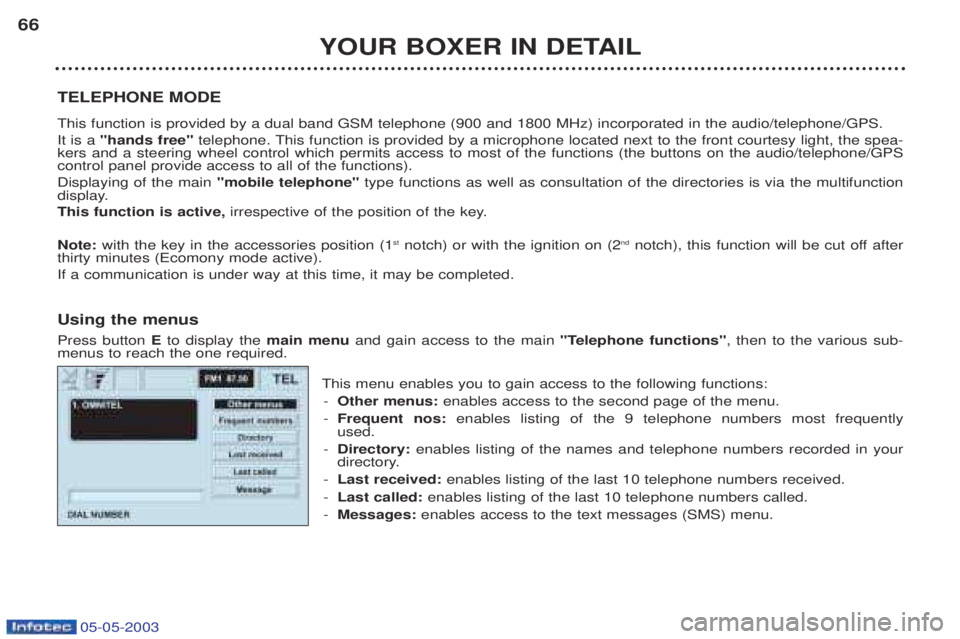
This menu enables you to gain access to the following functions:- Other menus: enables access to the second page of the menu.
- Frequent nos: enables listing of the 9 telephone numbers most frequently
used.
- Directory: enables listing of the names and telephone numbers recorded in your
directory.
- Last received: enables listing of the last 10 telephone numbers received.
- Last called: enables listing of the last 10 telephone numbers called.
- Messages: enables access to the text messages (SMS) menu.
Page 65 of 180
05-05-2003
YOUR BOXER IN DETAIL67
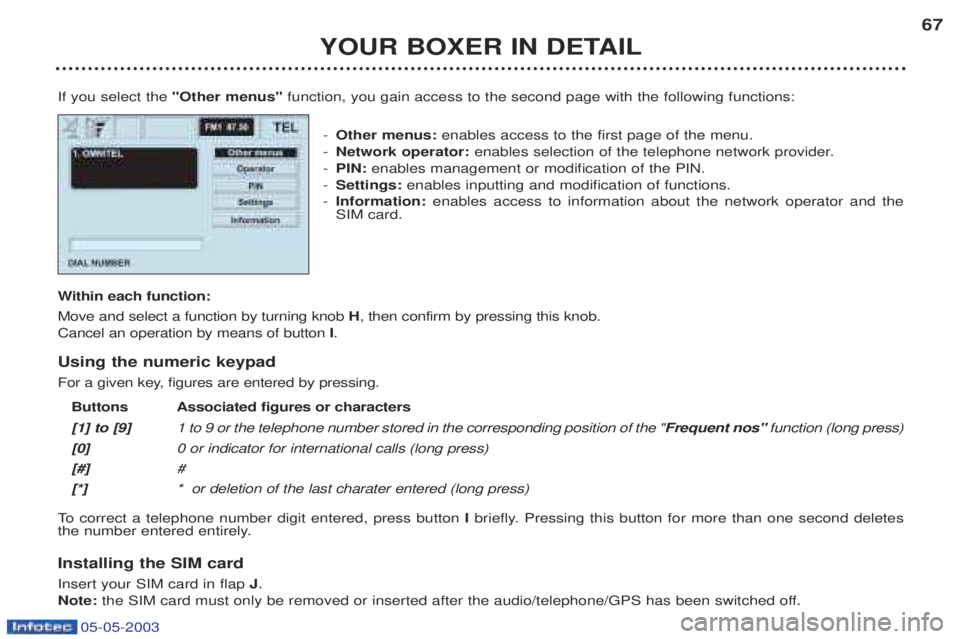
If you select the "Other menus" function, you gain access to the second page with the following functions:
- Other menus: enables access to the first page of the menu.
- Network operator: enables selection of the telephone network provider.
- PIN: enables management or modification of the PIN.
- Settings: enables inputting and modification of functions.
- Information: enables access to information about the network operator and the
SIM card.
W ithin each function:
Move and select a function by turning knob H, then confirm by pressing this knob.
Cancel an operation by means of button I.
Using the numeric keypad
For a given key, figures are entered by pressing. Buttons Associated figures or characters [1] to [9] 1 to 9 or the telephone number stored in the corresponding position of the " Frequent nos"function (long press)
[0] 0 or indicator for international calls (long press)
[#] #
[*] * or deletion of the last charater entered (long press)
To correct a telephone number digit entered, press button Ibriefly. Pressing this button for more than one second deletes
the number entered entirely.
Installing the SIM card Insert your SIM card in flap J.
Note: the SIM card must only be removed or inserted after the audio/telephone/GPS has been switched off.
Page 66 of 180
05-05-2003
YOUR BOXER IN DETAIL
68
Entering the PIN Enter your PIN using the numeric keypad and confirm by pressing knob Hor button
# to gain access to the network. Connection to the network is confirmed by the appea-
rance of the name of the network on the display. W arning: if you make three mistakes in succession when entering your PIN, your SIM
card will be blocked. To release it, you will have to enter the PUK code and a new PIN. Y ou will be provided with the PUK code by the vendor of your SIM card (entering of
the PUK code allows for 10 mistakes in succession, after this the SIM card is perma-nently unusable). Note: the PIN is requested each time the ignition is switched on, unless the PIN has
been stored or PIN protection is not activated on the SIM card.
Deactivation of the PIN request From the main menu, select "PIN"and enter your PIN, then select "Enable PIN search", then press knobH.
W arning: in this case, do not lose your SIM card, otherwise anyone who finds it will be able to make unlimited calls.
T elephone function screens
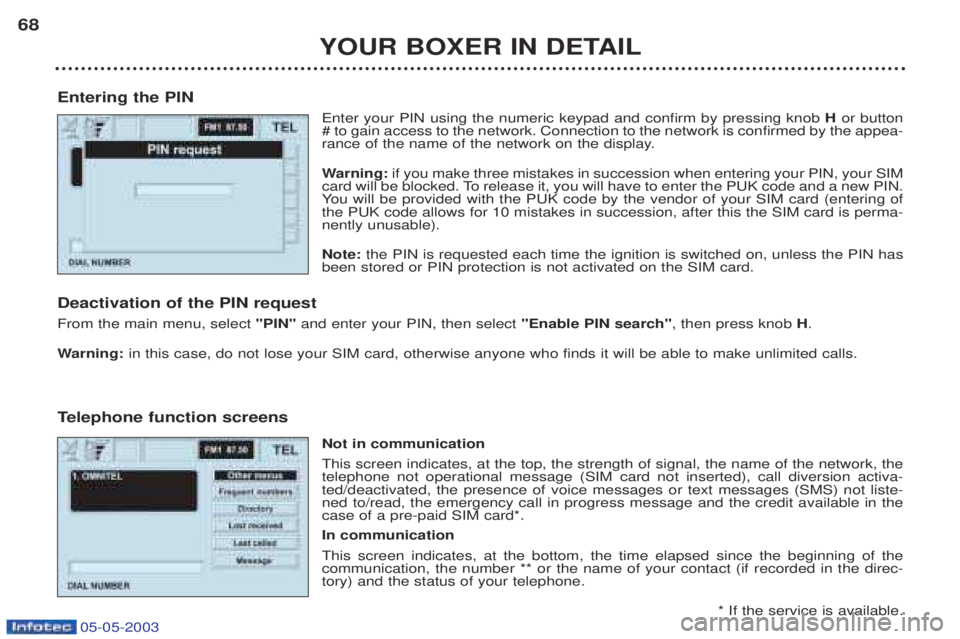
Not in communicationThis screen indicates, at the top, the strength of signal, the name of the network, the telephone not operational message (SIM card not inserted), call diversion activa-ted/deactivated, the presence of voice messages or text messages (SMS) not liste-ned to/read, the emergency call in progress message and the credit available in thecase of a pre-paid SIM card*. In communication This screen indicates, at the bottom, the time elapsed since the beginning of the communication, the number ** or the name of your contact (if recorded in the direc-tory) and the status of your telephone.
* If the service is available.
Page 67 of 180

05-05-2003
YOUR BOXER IN DETAIL69
Making a call Dialling a number Enter the number of your contact using the numeric keypad. Press button Oto call.
Calling from a directory Select the "Directory" function to gain access to all of the files containing a telephone number or "Last received" to gain
access to the list of the last ten incoming calls (if the number display option is active) or "Last called"to gain access to the
list of the last ten outgoing calls. Note: There are two directories, that of the audio/telephone/GPS and that of the SIM card. To consult the SIM directory, insert
your SIM card and enter your PIN.
Receiving a call When an incoming call is received, announced by a ring, you can choose to take it by pressing button Obriefly or the end
of the steering wheel control 7or refuse it by pressing button Ofor more than one second.
If you take the call, press button Oto end it.
Receiving a second call**
During a telephone call, it is possible to receive a second call. This second call is indicated by displaying the name of the caller (if recorded in the directory) and/or by the number of the caller (if the number display option is active) and the "Accept"
or "Refuse" options.
Select the " Accept" or "Refuse" option by turning knob H, then press this knob repeatedly to confirm.
Note: If you accept the second call, the previous call is placed on hold until the new call ends. If you refuse the second call,
the conversation in progress continues. ** If the option and service are available.
Page 68 of 180
05-05-2003
YOUR BOXER IN DETAIL
70
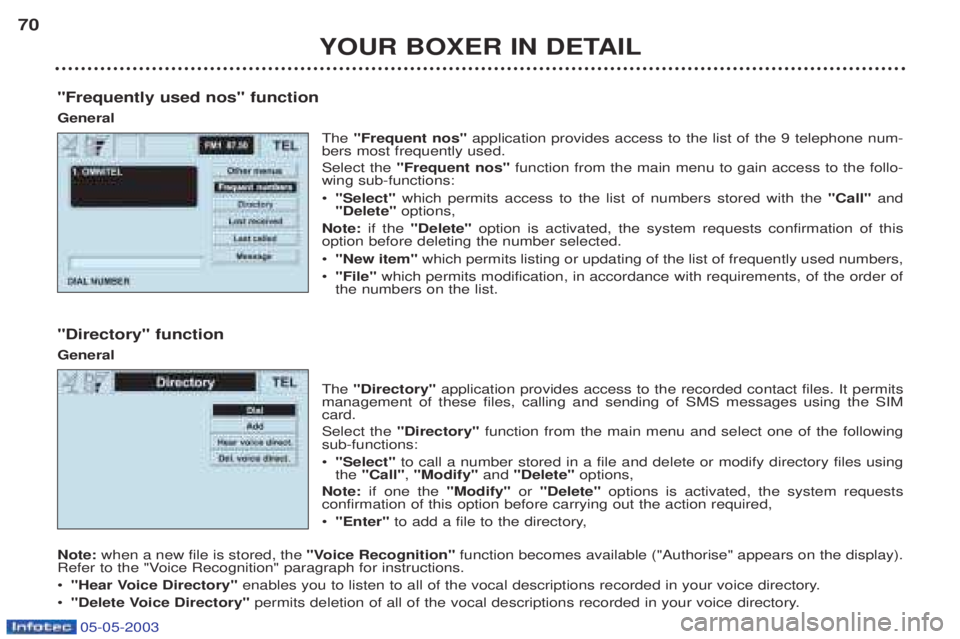
"Frequently used nos" function General The "Frequent nos" application provides access to the list of the 9 telephone num-
bers most frequently used. Select the "Frequent nos" function from the main menu to gain access to the follo-
wing sub-functions: ¥ "Select" which permits access to the list of numbers stored with the "Call"and
"Delete" options,
Note: if the "Delete" option is activated, the system requests confirmation of this
option before deleting the number selected.¥ "New item" which permits listing or updating of the list of frequently used numbers,
¥ "File" which permits modification, in accordance with requirements, of the order of
the numbers on the list.
"Directory" function General The "Directory" application provides access to the recorded contact files. It permits
management of these files, calling and sending of SMS messages using the SIM card. Select the "Directory" function from the main menu and select one of the following
sub-functions: ¥ "Select" to call a number stored in a file and delete or modify directory files using
the "Call" , "Modify" and "Delete" options,
Note: if one the "Modify"or "Delete" options is activated, the system requests
confirmation of this option before carrying out the action required,¥ "Enter" to add a file to the directory,
Note: when a new file is stored, the "Voice Recognition"function becomes available ("Authorise" appears on the display).
Refer to the "Voice Recognition" paragraph for instructions.¥ "Hear Voice Directory" enables you to listen to all of the vocal descriptions recorded in your voice directory.
¥ "Delete Voice Directory" permits deletion of all of the vocal descriptions recorded in your voice directory.
Page 69 of 180
YOUR BOXER IN DETAIL71
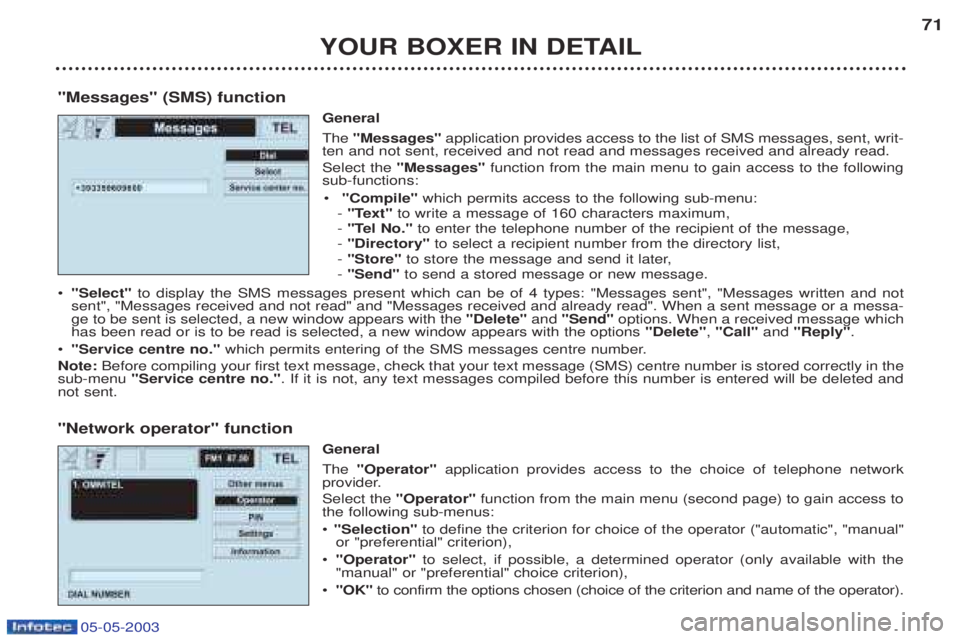
"Messages" (SMS) function General The"Messages" application provides access to the list of SMS messages, sent, writ-
ten and not sent, received and not read and messages received and already read. Select the "Messages" function from the main menu to gain access to the following
sub-functions:
¥ "Compile" which permits access to the following sub-menu:
- "Text" to write a message of 160 characters maximum,
- "Tel No." to enter the telephone number of the recipient of the message,
- "Directory" to select a recipient number from the directory list,
- "Store" to store the message and send it later,
- "Send" to send a stored message or new message.
¥ "Select" to display the SMS messages present which can be of 4 types: "Messages sent", "Messages written and not
sent", "Messages received and not read" and "Messages received and already read". When a sent message or a messa- ge to be sent is selected, a new window appears with the "Delete"and "Send" options. When a received message which
has been read or is to be read is selected, a new window appears with the options "Delete", "Call" and "Reply" .
¥ "Service centre no." which permits entering of the SMS messages centre number.
Note: Before compiling your first text message, check that your text message (SMS) centre number is stored correctly in the
sub-menu "Service centre no." . If it is not, any text messages compiled before this number is entered will be deleted and
not sent.
"Network operator" function General The "Operator" application provides access to the choice of telephone network
provider. Select the "Operator" function from the main menu (second page) to gain access to
the following sub-menus: ¥ "Selection" to define the criterion for choice of the operator ("automatic", "manual"
or "preferential" criterion),
¥ "Operator" to select, if possible, a determined operator (only available with the
"manual" or "preferential" choice criterion),
¥ "OK" to confirm the options chosen (choice of the criterion and name of the operator).
05-05-2003
Page 71 of 180

05-05-2003
YOUR BOXER IN DETAIL73
"Information" function General The "Information" application provides access to the information about the network
operator and the SIM card. Select the "Information" function from the main menu to display:
¥ the name and/or the abbreviation of the network operator,¥ the telephone number of the SIM card inserted (personal telephone number),¥ the electronic serial number of the system's telephone module. Note: not all SIM cards permit displaying of their own telephone number, you can
store it in the "Directory"application.
Assistance service
Press button L to display the "Information and assistance services" menu and select one of the following services:
¥ "Emergency 112" which enables you to contact the emergency call service.
¥ "Customer Contact Centre" which enables you to contact the PEUGEOT Customer Contact Centre directly.
If an incoming call is received while making an assistance call, only the ring is operational and you can accept or refuse the call.
If you accept the incoming call, the medical or road assistance call is ALWAYS made but the assistance centre
operator may encounter difficulties in contacting you as the telephone line is busy.
Page 72 of 180
05-05-2003
YOUR BOXER IN DETAIL
74
Emergency 112
In an emergency, select and confirm this function by pressing button Lto contact the emergency call service .
Before making a call of this type, the audio/telephone/GPS must detect a cell network. No security mode is required and, depending on the network, you do not have to insert your SIM card or enter your PIN.
PEUGEOT customer contact centre Select and confirm this function by pressing button Lto contact the PEUGEOT Customer Contact Centre and gain access
to the services offered (this type of call is suspended if an emergency call is made).
Page 73 of 180
05-05-2003
YOUR BOXER IN DETAIL75
V oice commands
The voice commands enable you to control a certain number of audio/telephone/GPS functions using pre-recorded words or expressions. The voice commands which you can send to the system are divided into two categories: - voice commands without voice identification which permit selection of the system's modes (TEL, RADIO, CD, ...),
- voice commands with voice identification which relate to the entering / recalling of names in the telephone directory
and/or navigation addresses.
Activation / Deactivation of the voice commands Press button Non the audio/telephone/GPS control panel or control 4on the steering wheel to activate or deactivate this
function. Notes: - in the absence of voice commands, this function will be deactivated after approximately ten seconds,
- if a voice command is not understood, a double bleep is emitted.
- the voice command operations are interrupted immediately if an incoming call is received; in this case, when the call ends, the entire operation must be repeated.
Example: to recall the radio station stored on button 3, the key words are: "Radio" "Memory" or"Station" "3" .
To use these key words, you must say the word "Radio", wait for the confirmation bleep, then say the word "Memory"or
"Station" , wait until the system asks "number please?", then end with the word "3", wait for the confirmation bleep which will
carry out the action requested.
List of recognisable commands available The voice commands (key words) which can be recognised by the system are organised into three levels (levels 1, 2 and 3). When a level 1 command is given, the system makes the level 2 commands available; when a level 2 command is given, the system makes the level 3 commands available. - the level 1 commands are the following:
"MEMO" / "RADIO" / "CD PLAYER" / "NAVIGATION" / "CALL" / "DIAL" / "REDIAL" / "PIN" / "DIRECTORY" / "INTERRUPT"