towing Peugeot Boxer 2008 Owner's Manual
[x] Cancel search | Manufacturer: PEUGEOT, Model Year: 2008, Model line: Boxer, Model: Peugeot Boxer 2008Pages: 154, PDF Size: 3.27 MB
Page 51 of 154
67
3
ERGONOMICS AND COMFORT
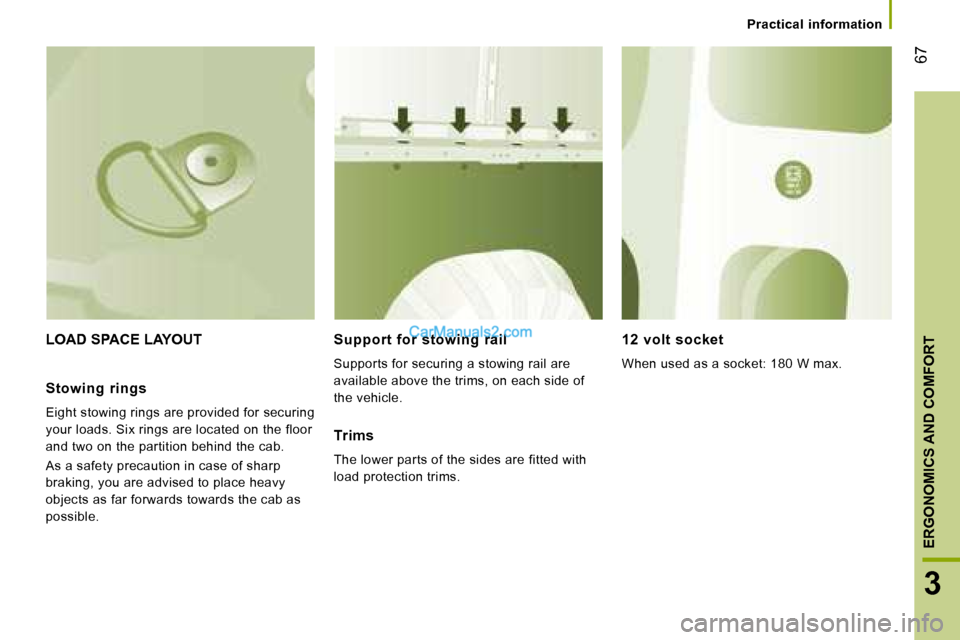
LOAD SPACE LAYOUTSupport for stowing rail
Supports for securing a stowing rail are
available above the trims, on each side of
the vehicle. 12 volt socket
When used as a socket: 180 W max.
Stowing rings
Eight stowing rings are provided for securing
your loads. Six rings are located on the floor
and two on the partition behind the cab.
As a safety precaution in case of sharp
braking, you are advised to place heavy
objects as far forwards towards the cab as
possible. Trims
The lower parts of the sides are fitted with
load protection trims. Practical information
Page 105 of 154
116
Towing a trailer
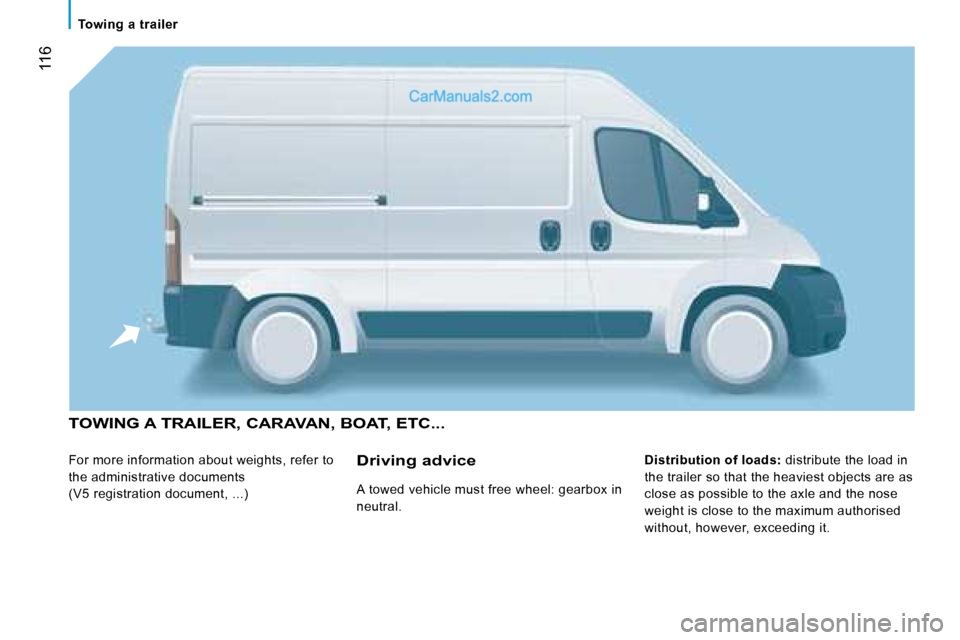
TOWING A TRAILER, CARAVAN, BOAT, ETC...
For more information about weights, refer to
the administrative documents
(V5 registration document, ...)Distribution of loads:
distribute the load in
the trailer so that the heaviest objects are as
close as possible to the axle and the nose
weight is close to the maximum authorised
without, however, exceeding it.Driving advice
A towed vehicle must free wheel: gearbox in
neutral.
Page 106 of 154
117
6
ACCESSORIES
Towing a trailer
Cooling: towing a trailer on a slope
increases the coolant temperature.
As the fan is electrically controlled, its
cooling capacity is not dependent on the
engine speed.
On the contrary, use a high gear to lower the
engine speed and reduce your speed.
In all cases, pay attention to the coolant
temperature. Tyres:
check the tyre pressures of the
towing vehicle (see the "Identification
features" section of chapter 9) and of
the trailer, observing the recommended
pressure.Towbar
We recommend the use of original
PEUGEOT towbars and their harnesses,
which have been tested and approved from
the design stage of your vehicle and that
the fitting of this equipment is entrusted to a
PEUGEOT dealer.
If this equipment is not fitted by a
PEUGEOT dealer, it is imperative that it
is fitted using the electrical pre-equipment
installed at the rear of the vehicle and
in accordance with the manufacturer ’s
instructions.
Good practice
In certain cases of particularly arduous
use (towing the maximum load up a steep
slope in high temperatures), the engine
automatically limits its power. In this
case, the automatic cutting off of the air
conditioning allows the engine power to be
recovered.
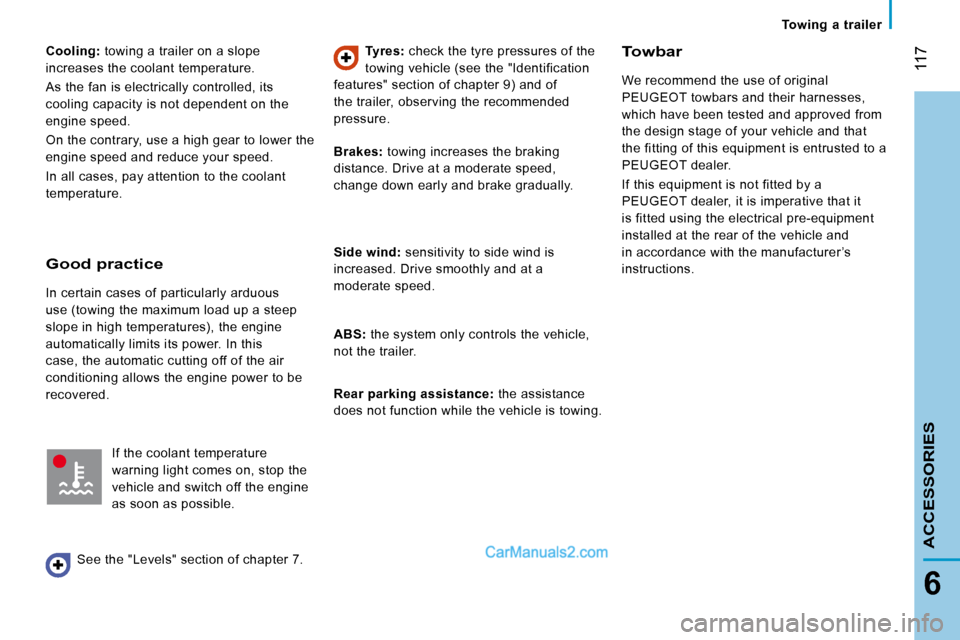
If the coolant temperature
warning light comes on, stop the
vehicle and switch off the engine
as soon as possible.
See the "Levels" section of chapter 7. Brakes:
towing increases the braking
distance. Drive at a moderate speed,
change down early and brake gradually.
Side wind: sensitivity to side wind is
increased. Drive smoothly and at a
moderate speed.
ABS: the system only controls the vehicle,
not the trailer.
Rear parking assistance: the assistance
does not function while the vehicle is towing.
Page 118 of 154
BA
E
CD
F
129
TROUBLESHOOTING
8
1. PARKING THE VEHICLE
As far as possible, park the vehicle on level,
stable and non-slippery ground.
Apply the handbrake, switch off the ignition
and engage first gear.
If possible, place a chock under the
wheel diagonally opposite the wheel to be
changed.
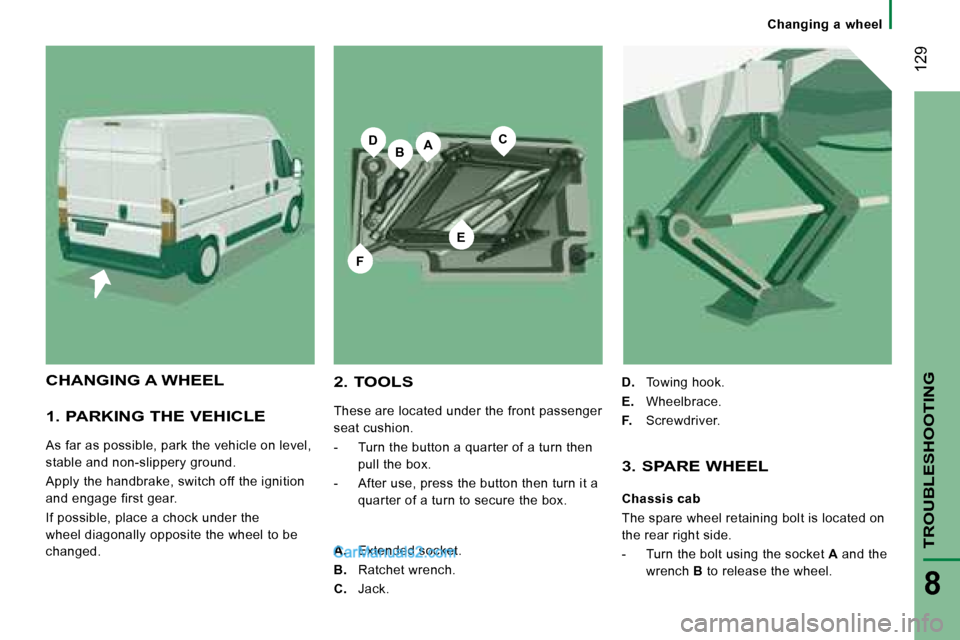
2. TOOLS
These are located under the front passenger
seat cushion.
- Turn the button a quarter of a turn then pull the box.
- After use, press the button then turn it a quarter of a turn to secure the box. D.
Towing hook.
E. Wheelbrace.
F. Screwdriver.
CHANGING A WHEEL
3. SPARE WHEEL
Chassis cab
The spare wheel retaining bolt is located on
the rear right side.
- Turn the bolt using the socket A
and the
wrench B to release the wheel.
A.
Extended socket.
B. Ratchet wrench.
C. Jack. Changing a wheel
Page 132 of 154
143
TROUBLESHOOTING
8
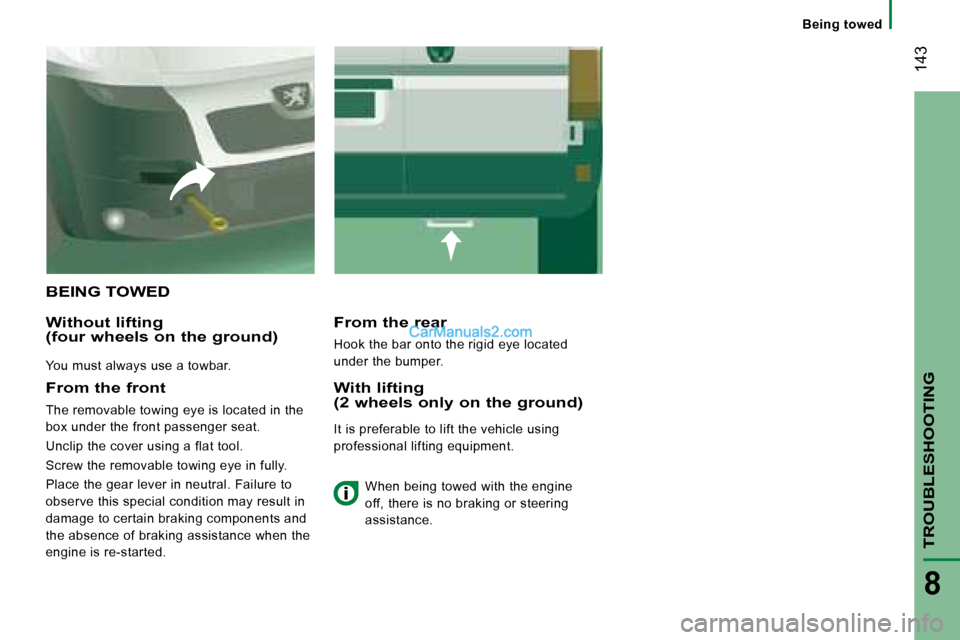
BEING TOWED
Without lifting
(four wheels on the ground)
You must always use a towbar.
From the rear
Hook the bar onto the rigid eye located
under the bumper.
From the front
The removable towing eye is located in the
box under the front passenger seat.
Unclip the cover using a flat tool.
Screw the removable towing eye in fully.
Place the gear lever in neutral. Failure to
observe this special condition may result in
damage to certain braking components and
the absence of braking assistance when the
engine is re-started.
With lifting
(2 wheels only on the ground)
It is preferable to lift the vehicle using
professional lifting equipment.When being towed with the engine
off, there is no braking or steering
assistance.
Being towed
Page 147 of 154
159
9
TECHNICAL DATA
Weights
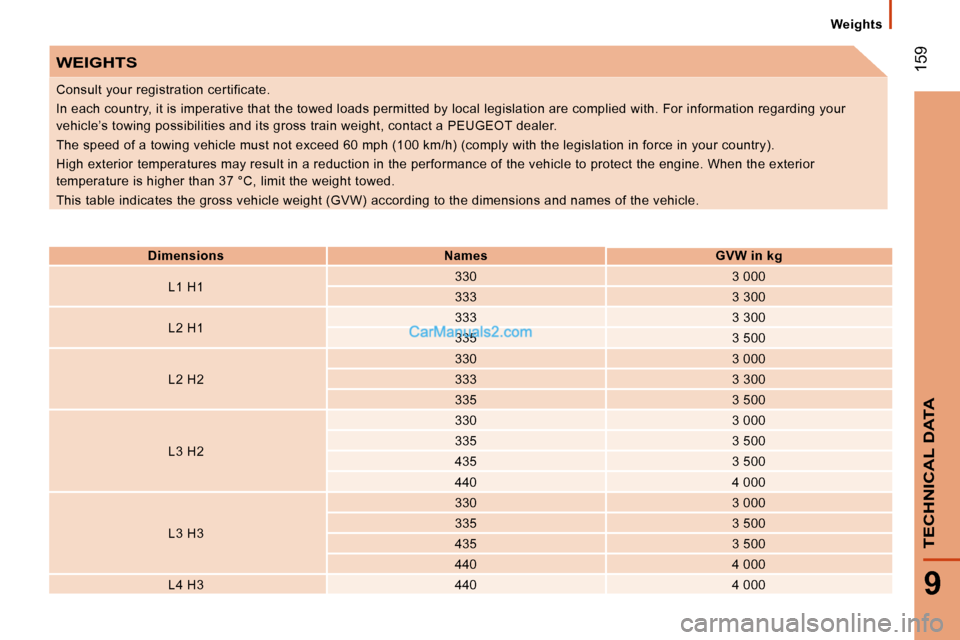
WEIGHTS
DimensionsNamesGVW in kg
L1 H1 330
3 000
333 3 300
L2 H1 333
3 300
335 3 500
L2 H2 330
3 000
333 3 300
335 3 500
L3 H2 330
3 000
335 3 500
435 3 500
440 4 000
L3 H3 330
3 000
335 3 500
435 3 500
440 4 000
L4 H3 4404 000
Consult your registration certificate.
In each country, it is imperative that the towed lo
ads permitted by local legislation are complied wit h. For information regarding your
vehicle’s towing possibilities and its gross train weight, contact a PEUGEOT dealer.
The speed of a towing vehicle must not exceed 60 mp h (100 km/h) (comply with the legislation in force in your country).
High exterior temperatures may result in a reductio n in the performance of the vehicle to protect the engine. When the exterior
temperature is higher than 37 °C, limit the weight towed.
This table indicates the gross vehicle weight (GVW) according to the dimensions and names of the vehic le.
Page 148 of 154
Weights
160
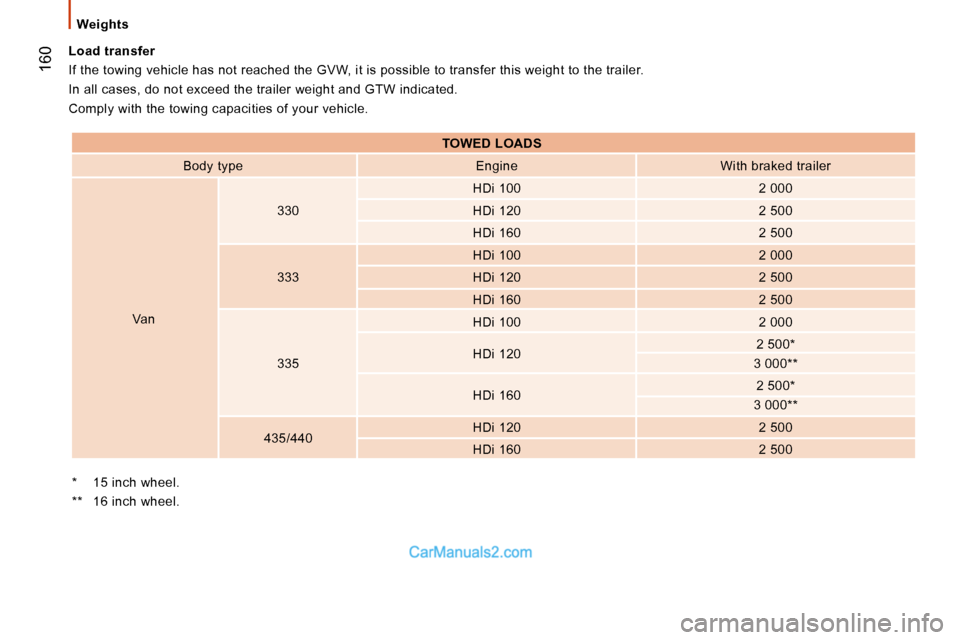
* 15 inch wheel.
** 16 inch wheel.
Load transfer
If the towing vehicle has not reached the GVW, it i
s possible to transfer this weight to the trailer.
In all cases, do not exceed the trailer weight and GTW indicated.
Comply with the towing capacities of your vehicle.
TOWED LOADS
Body type Engine With braked trailer
Van 330
HDi 100
2 000
HDi 120 2 500
HDi 160 2 500
333 HDi 100
2 000
HDi 120 2 500
HDi 160 2 500
335 HDi 100
2 000
HDi 120 2 500*
3 000**
HDi 160 2 500*
3 000**
435/440 HDi 120
2 500
HDi 160 2 500