temperature Peugeot Boxer 2012 Owner's Guide
[x] Cancel search | Manufacturer: PEUGEOT, Model Year: 2012, Model line: Boxer, Model: Peugeot Boxer 2012Pages: 184, PDF Size: 4.88 MB
Page 139 of 184
137
7
CHECK
S
Levels
Cooling system
Only use the fluid recommended by the
manufacturer. Otherwise, you risk seriously
damaging your engine. When the engine
is warm, the temperature of the coolant is
controlled by the engine fan. As this fan can
operate with the ignition key removed and
because the cooling system is pressurised,
wait for at least one hour after the engine
has stopped before carrying out any work.
Slacken the cap by 1/4 of a turn to release
the pressure to prevent any risk of scalding.
When the pressure has dropped, remove the
cap and top up the level with coolant.
If fluid has to be added frequently, this
indicates a failure which must be checked by
a PEUGEOT dealer as soon as possible.
Power steering fluid level
The vehicle must be parked on level ground with
the engine cold. Unscrew the cap integrated with
the gauge and check the level which must be
between the MIN
and MAX
marks.
Used oil
Avoid prolonged contact of used oil with the
skin.
Brake fluid is harmful to health and very
corrosive.
Do not dispose of used oil, brake fluid or
coolant into drains or into the ground but
into the containers dedicated to this use at
PEUGEOT dealerships (France) or to an
authorised waste disposal site.
Topping up
The level must be between the MIN
and
MAX
marks on the expansion bottle. If
more than 1 litre of fluid is required to top
up the level, have the system checked by
a PEUGEOT dealer.
Windscreen wash and headlamp
wash level
For best quality cleaning and to prevent
freezing, this fluid must not be topped up or
replaced with plain water.
Capacity of the reservoir: approximately
5.5 litres.
Page 141 of 184
139
7
CHECK
S
Checks
Particle filter system (Diesel)
An addition to the catalytic converter, this
filter makes an active contribution to the
preservation of air quality by the retaining
of the unburnt pollutant particles. Black
exhaust fumes are thus no longer emitted.
This filter, fitted to the exhaust system,
accumulates particles of soot. The engine
control unit manages the automatic
periodic elimination of the soot particles
(regeneration).
The regeneration procedure is invoked
according to the quantity of particles
accumulated and the driving conditions of the
vehicle. During this phase, you may notice
some unusual phenomena - increased idling
speed, cooling fan running, increase in smoke
and higher exhaust gas temperature - which
does not affect the operation of the vehicle or
the environment. After prolonged idling or driving at very low
speeds, you may occasionally notice water
vapour being emitted from the exhaust when
accelerating. This is of no consequence
to the running of the vehicle or to the
environment.
Because of the higher exhaust gas
temperature resulting from the normal
operation of the particle filter, it is
recommended that you do not park the
vehicle over inflammable materials (grass,
dry leaves, pine needles, ...) so as to avoid
any risk of fire.
Saturation/Regeneration
Operating fault
If this alert persists, do not ignore the
warning; it indicates that a fault has occurred
in the exhaust/particle filter system.
Have it checked by a PEUGEOT dealer.
This alert tells you that the particle filter
is starting to fill up (in conditions of urban
driving of exceptionally long duration: low
speeds, traffic jams etc.) .
To regenerate the filter, it is advised to
drive as soon as possible, when traffic
conditions and the law permit, at a speed
of at least 40 mph (around 60 km/h), with
an engine speed above 2 000 rpm for about
fifteen minutes (until the warning lamp and/
or the message disappears).
If possible, avoid switching off the engine
before the end of regeneration of the
filter; repeated interruptions could cause
premature deterioration of the engine oil. It
is not recommended to end regeneration of
the filter with the vehicle stationary. If there is risk of blockage of the
filter, this warning lamp comes on
in the instrument panel.
Page 143 of 184
14
1
7
CHECK
S
Fuel
Low fuel level
When the fuel tank level E
(Empty) is reached, this warning
lamp comes on. At this moment,
you have enough fuel left to
drive approximately 30 miles (50 km)
,
depending on the driving conditions, the
engine and the profile of the road. Fill up
without delay to avoid running out of fuel. The fuel tank must be filled with the engine
off
.
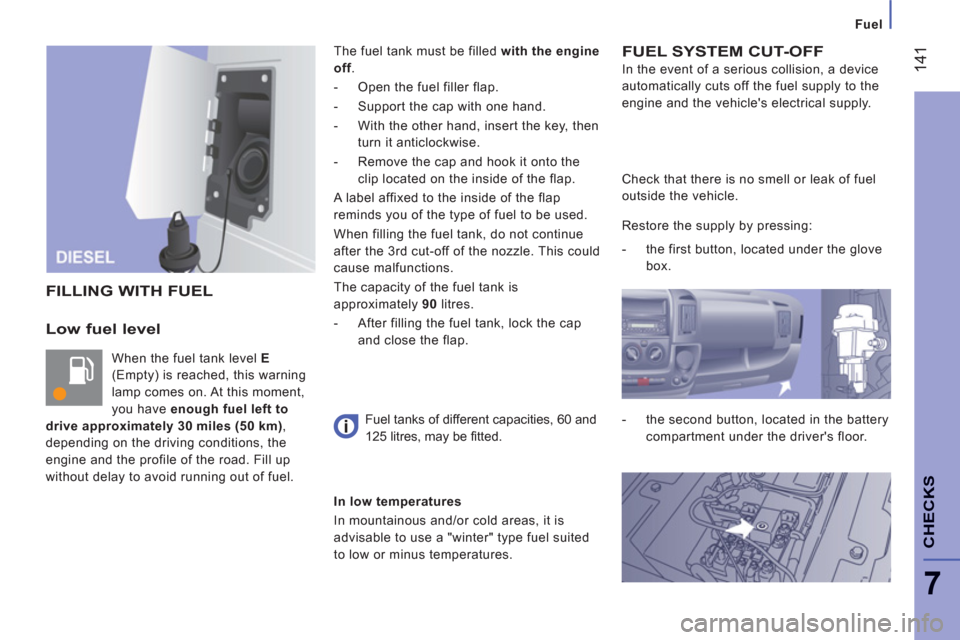
- Open the fuel filler flap.
- Support the cap with one hand.
- With the other hand, insert the key, then
turn it anticlockwise.
- Remove the cap and hook it onto the
clip located on the inside of the flap.
A label affixed to the inside of the flap
reminds you of the type of fuel to be used.
When filling the fuel tank, do not continue
after the 3rd cut-off of the nozzle. This could
cause malfunctions.
The capacity of the fuel tank is
approximately 90
litres.
- After filling the fuel tank, lock the cap
and close the flap.
FUEL SYSTEM CUT-OFF
In the event of a serious collision, a device
automatically cuts off the fuel supply to the
engine and the vehicle's electrical supply.
FILLING WITH FUEL
Fuel tanks of different capacities, 60 and
125 litres, may be fi tted. Check that there is no smell or leak of fuel
outside the vehicle.
Restore the supply by pressing:
- the first button, located under the glove
box.
- the second button, located in the battery
compartment under the driver's floor.
In low temperatures
In mountainous and/or cold areas, it is
advisable to use a "winter" type fuel suited
to low or minus temperatures.
Page 145 of 184
14
3
Battery
QUICK HELP
8
The batteries contain harmful
substances such as sulphuric acid and
lead. They must be discarded in accordance
with the provisions of the law and must not,
in any circumstances, be discarded with
household waste.
Take used batteries to a special collection
point.
It is advisable to disconnect the negative (-)
terminal of the battery if the vehicle is not to be
used for a period of more than one month.
Before disconnecting the battery, you
must wait for 2 minutes after switching off
the ignition.
Never disconnect a terminal when the
engine is running.
Never charge a battery without first
disconnecting the terminals.
Close the windows and doors before
disconnecting the battery.
After every reconnection of the battery,
switch on the ignition and wait 1 minute
before starting to allow the electronic
systems to be initialised. If slight difficulties
are experienced after this, please contact a
PEUGEOT dealer.
If the battery has been disconnected
for some time, it may be necessary to
reinitialise the following functions:
- the display parameters (date,
time, language, distance unit and
temperature unit),
- the radio stations,
- the central locking.
Some settings are cleared and must be
reprogrammed, consult a PEUGEOT.
If your vehicle is fitted with a tachograph or
an alarm, disconnection of the negative (-)
terminal of the battery (located under the
floor on the left-hand side, in the cab) is
recommended if the vehicle is not to be used
for a period of more than 5 days.
Page 170 of 184
168
Weights
WEIGHTS
Dimensions
Model
GVW in kg
L1 H1
330
3 000
333
3 300
L2 H1
333
3 300
335
3 500
L2 H2
330
3 000
333
3 300
335
3 500
L3 H2
330
3 000
335
3 500
435
3 500
440
4 000
L3 H3
330
3 000
335
3 500
435
3 500
440
4 000
L4 H2
335
3 500
L4 H3
435
3 500 Refer to your registration certificate.
In each country, it is imperative that the towed loads permitted by local legislation are complied with. For information regarding your
vehicle's towing possibilities and its gross train weight, contact a PEUGEOT dealer.
The speed of a towing vehicle must not exceed 60 mph (100 km/h) (comply with the legislation in force in your country).
High ambient temperatures may result in a reduction in the performance of the vehicle, to protect the engine. When the ambient
temperature is higher than 37 °C, limit the weight towed.
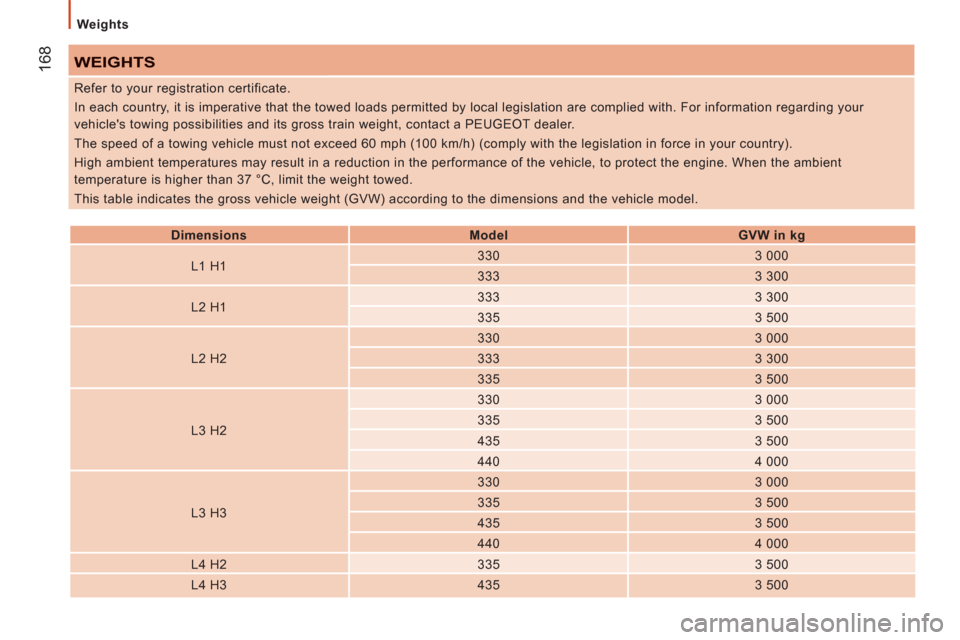
This table indicates the gross vehicle weight (GVW) according to the dimensions and the vehicle model.