mode Peugeot Boxer 2013 Owner's Guide
[x] Cancel search | Manufacturer: PEUGEOT, Model Year: 2013, Model line: Boxer, Model: Peugeot Boxer 2013Pages: 184, PDF Size: 4.53 MB
Page 136 of 184
134
Towing a trailer
Cooling:
towing a trailer on a slope
increases the coolant temperature.
As the fan is electrically controlled, its
cooling capacity is not dependent on the
engine speed.
On the contrary, use a high gear to lower the
engine speed and reduce your speed.
In all cases, pay attention to the coolant
temperature.
Tyres:
check the tyre pressures of the
towing vehicle (see the "Identification
markings" section of chapter 9) and of
the trailer, observing the recommended
pressures.
We recommend the use of original
PEUGEOT towbars and their harnesses,
which have been tested and approved from
the design stage of your vehicle and that
the fitting of this equipment is entrusted to a
PEUGEOT dealer.
If this equipment is not fitted by a PEUGEOT
dealer, it is imperative that it is fitted using
the electrical pre-equipment installed at the
rear of the vehicle and in accordance with
the manufacturer's instructions.
Good practice
In certain cases of particularly arduous
use (towing the maximum load up a steep
slope in high temperatures), the engine
automatically limits its power. In this
case, the automatic cutting off of the air
conditioning allows the engine power to be
recovered.
If the coolant temperature
warning lamp comes on, stop the
vehicle and switch off the engine
as soon as possible.
See the "Levels" section of chapter 7.
Brakes:
towing increases the braking
distance. Drive at a moderate speed,
change down early and brake gradually.
Side wind:
sensitivity to side wind is
increased. Drive smoothly and at a
moderate speed.
ABS:
the system only controls the vehicle,
not the trailer.
Rear parking sensors:
the system does not
operate while the vehicle is towing.
Page 137 of 184
Equipment
135
6
ACCESSORIE
S
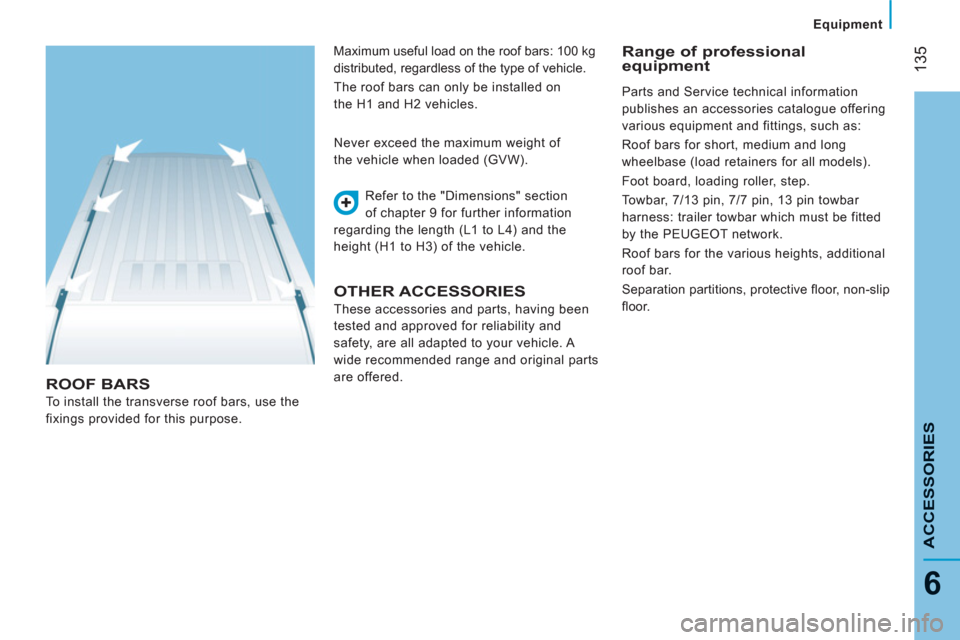
ROOF BARS
To install the transverse roof bars, use the
fixings provided for this purpose. Refer to the "Dimensions" section
of chapter 9 for further information
regarding the length (L1 to L4) and the
height (H1 to H3) of the vehicle. Never exceed the maximum weight of
the vehicle when loaded (GVW).
OTHER ACCESSORIES
These accessories and parts, having been
tested and approved for reliability and
safety, are all adapted to your vehicle. A
wide recommended range and original parts
are offered.
Range of professionalequipment Maximum useful load on the roof bars: 100 kg
distributed, regardless of the type of vehicle.
The roof bars can only be installed on
the H1 and H2 vehicles. Parts and Service technical information
publishes an accessories catalogue offering
various equipment and fittings, such as:
Roof bars for short, medium and long
wheelbase (load retainers for all models).
Foot board, loading roller, step.
Towbar, 7/13 pin, 7/7 pin, 13 pin towbar
harness: trailer towbar which must be fitted
by the PEUGEOT network.
Roof bars for the various heights, additional
roof bar.
Separation partitions, protective fl oor, non-slip
fl oor.
Page 139 of 184
137
7
Opening the bonnet
CHECK
S
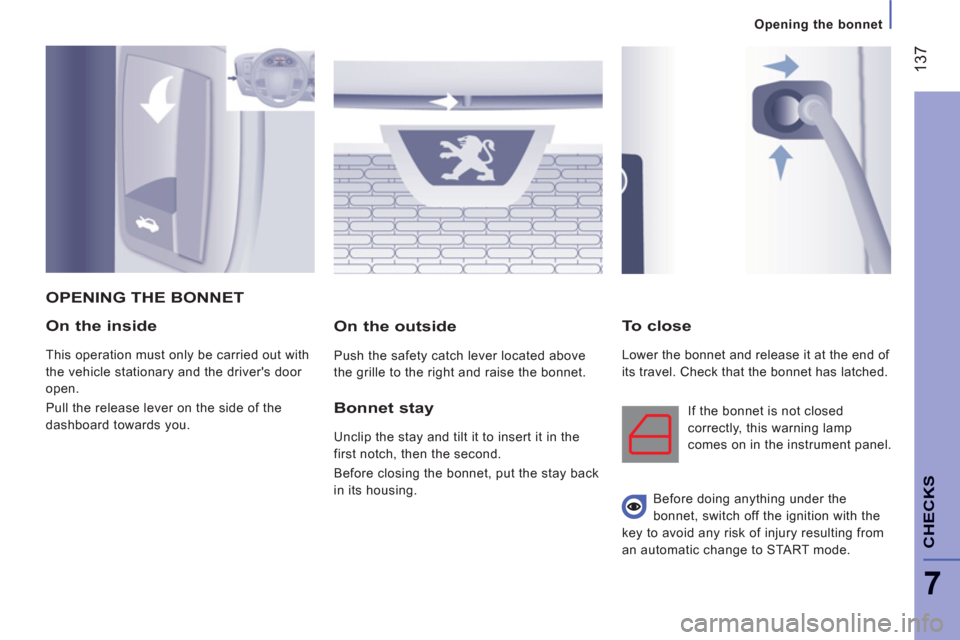
On the inside
This operation must only be carried out with
the vehicle stationary and the driver's door
open.
Pull the release lever on the side of the
dashboard towards you.
On the outside
Push the safety catch lever located above
the grille to the right and raise the bonnet.
To close
Lower the bonnet and release it at the end of
its travel. Check that the bonnet has latched.
OPENING THE BONNET
Bonnet stay
Unclip the stay and tilt it to insert it in the
first notch, then the second.
Before closing the bonnet, put the stay back
in its housing. If the bonnet is not closed
correctly, this warning lamp
comes on in the instrument panel.
Before doing anything under the
bonnet, switch off the ignition with the
key to avoid any risk of injury resulting from
an automatic change to START mode.
Page 146 of 184
Fuel
144
Low fuel level
When the fuel tank level E
(Empty) is reached, this warning
lamp comes on. At this moment,
you have enough fuel left to
drive approximately 30 miles (50 km)
,
depending on the driving conditions, the
engine and the profile of the road. Fill up
without delay to avoid running out of fuel. The fuel tank must be filled with the engine
off.
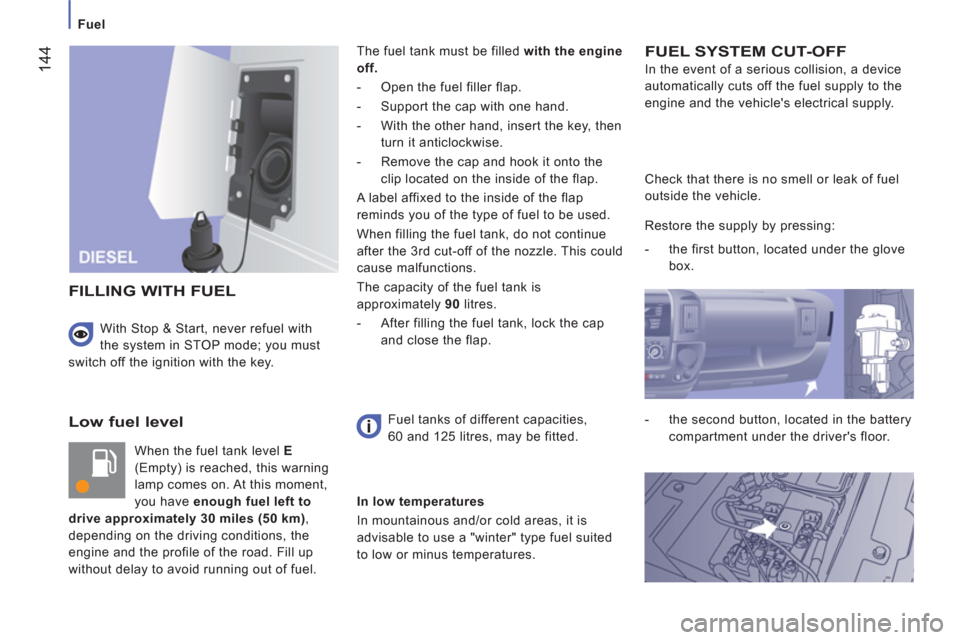
- Open the fuel filler flap.
- Support the cap with one hand.
- With the other hand, insert the key, then
turn it anticlockwise.
- Remove the cap and hook it onto the
clip located on the inside of the flap.
A label affixed to the inside of the flap
reminds you of the type of fuel to be used.
When filling the fuel tank, do not continue
after the 3rd cut-off of the nozzle. This could
cause malfunctions.
The capacity of the fuel tank is
approximately 90
litres.
- After filling the fuel tank, lock the cap
and close the flap.
FUEL SYSTEM CUT-OFF
In the event of a serious collision, a device
automatically cuts off the fuel supply to the
engine and the vehicle's electrical supply.
FILLING WITH FUEL
Fuel tanks of different capacities,
60 and 125 litres, may be fitted. Check that there is no smell or leak of fuel
outside the vehicle.
Restore the supply by pressing:
- the first button, located under the glove
box.
- the second button, located in the battery
compartment under the driver's floor.
In low temperatures
In mountainous and/or cold areas, it is
advisable to use a "winter" type fuel suited
to low or minus temperatures.
With Stop & Start, never refuel with
the system in STOP mode; you must
switch off the ignition with the key.
Page 174 of 184
172
Weights
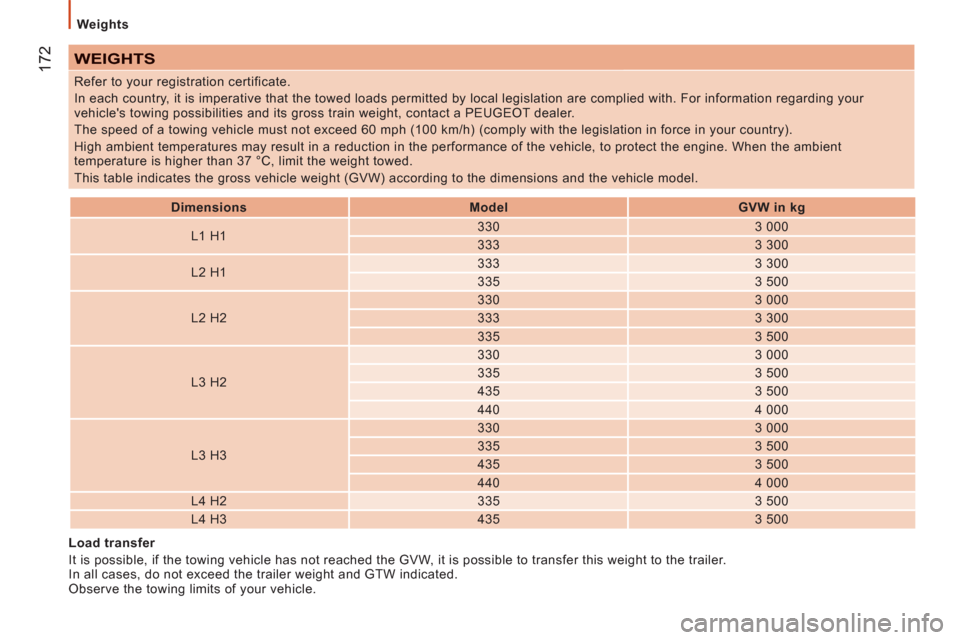
WEIGHTS
Dimensions
Model
GVW in kg
L1 H1
330
3 000
333
3 300
L2 H1
333
3 300
335
3 500
L2 H2
330
3 000
333
3 300
335
3 500
L3 H2
330
3 000
335
3 500
435
3 500
440
4 000
L3 H3
330
3 000
335
3 500
435
3 500
440
4 000
L4 H2
335
3 500
L4 H3
435
3 500 Refer to your registration certificate.
In each country, it is imperative that the towed loads permitted by local legislation are complied with. For information regarding your
vehicle's towing possibilities and its gross train weight, contact a PEUGEOT dealer.
The speed of a towing vehicle must not exceed 60 mph (100 km/h) (comply with the legislation in force in your country).
High ambient temperatures may result in a reduction in the performance of the vehicle, to protect the engine. When the ambient
temperature is higher than 37 °C, limit the weight towed.
This table indicates the gross vehicle weight (GVW) according to the dimensions and the vehicle model.
Load transfer
It is possible, if the towing vehicle has not reached the GVW, it is possible to transfer this weight to the trailer.
In all cases, do not exceed the trailer weight and GTW indicated.
Observe the towing limits of your vehicle.
Page 176 of 184
174
Exterior
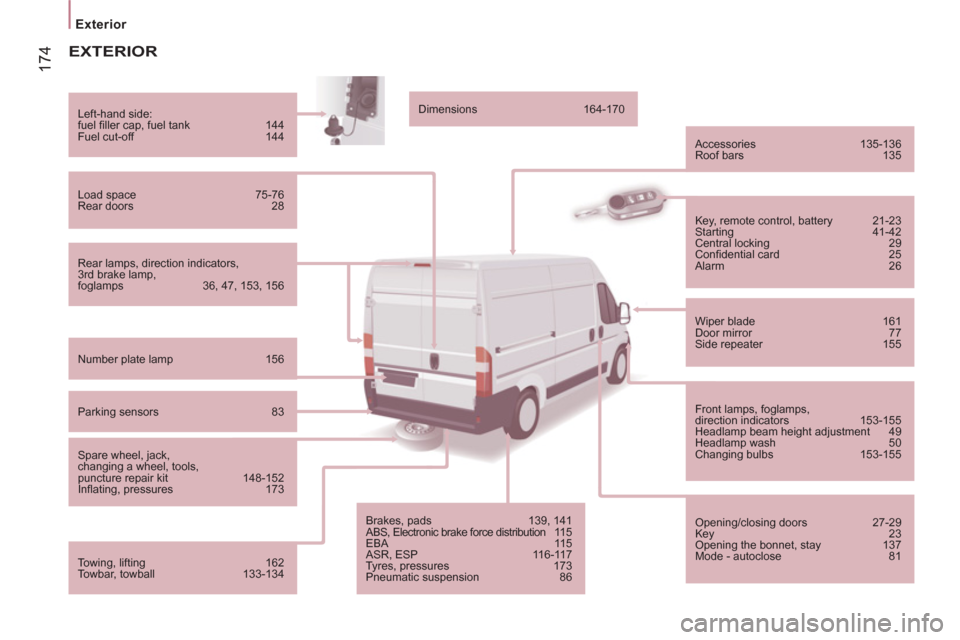
EXTERIOR
Rear lamps, direction indicators,
3 rd brake lamp,
foglamps 36, 47, 153, 156
Left-hand side:
fuel fi ller cap, fuel tank 144
Fuel cut-off 144
Load space 75-76
Rear doors 28
Number plate lamp 156
Parking sensors 83
Spare wheel, jack,
changing a wheel, tools,
puncture repair kit 148-152
Infl ating, pressures 173
Towing, lifting 162
Towbar, towball 133-134
Dimensions 164-170
Accessories 135-136
Roof bars 135
Brakes, pads 139, 141
ABS, Electronic brake force distribution 115
EBA 115
ASR, ESP 116-117
Tyres, pressures 173
Pneumatic suspension 86
Key, remote control, battery 21-23
Starting 41-42
Central locking 29
Confi dential card 25
Alarm 26
Wiper blade 161
Door mirror 77
Side repeater 155
Front lamps, foglamps,
direction indicators 153-155
Headlamp beam height adjustment 49
Headlamp wash 50
Changing bulbs 153-155
Opening/closing doors 27-29
Key 23
Opening the bonnet, stay 137
Mode - autoclose 81
Page 177 of 184
17
5
Instruments and controls
10
VISUAL SEARCH
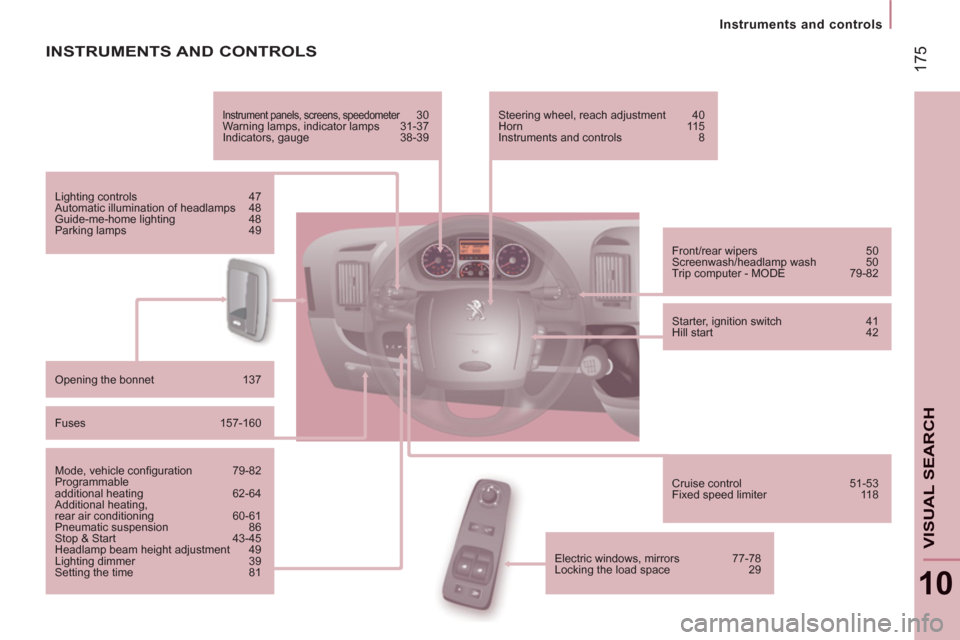
INSTRUMENTS AND CONTROLS
Instrument panels, screens, speedometer 30
Warning lamps, indicator lamps 31-37
Indicators, gauge 38-39
Lighting controls 47
Automatic illumination of headlamps 48
Guide-me-home lighting 48
Parking lamps 49
Opening the bonnet 137
Fuses 157-160
Mode, vehicle confi guration 79-82
Programmable
additional heating 62-64
Additional heating,
rear air conditioning 60-61
Pneumatic suspension 86
Stop & Start 43-45
Headlamp beam height adjustment 49
Lighting dimmer 39
Setting the time 81
Front/rear wipers 50
Screenwash/headlamp wash 50
Trip computer - MODE 79-82
Starter, ignition switch 41
Hill start 42
Cruise control 51-53
Fixed speed limiter 118
Steering wheel, reach adjustment 40
Horn 115
Instruments and controls 8
Electric windows, mirrors 77-78
Locking the load space 29