warning Peugeot Boxer 2013 Service Manual
[x] Cancel search | Manufacturer: PEUGEOT, Model Year: 2013, Model line: Boxer, Model: Peugeot Boxer 2013Pages: 184, PDF Size: 4.53 MB
Page 138 of 184
Equipment
136
Another range is also available, structured
around comfort, leisure and maintenance:
Anti-theft alarm, window etching, first aid
kit, high visibility safety jacket, rear parking
sensors, warning triangle, ...
Front seat covers compatible with aibags,
rubber mats, carpet mats, snow chains.
To prevent the mat from becoming caught
under the pedals:
- ensure that the mat and its fixings are
positioned correctly,
- never fit one mat on top of another. Audio equipment, hands-free system,
speakers, navigation, ... Trims, front mud flaps, rear mud flaps,
wooden floor, deflectors...
Installation of radiocommunication
transmitters
You are advised to contact a representative
of the PEUGEOT marque before installing
accessory radiocommunication transmitters
with external aerial on your vehicle.
The PEUGEOT Network will inform you of the
specifi cations (frequency waveband, maximum
output power, aerial position, specifi c
installation conditions) of the transmitters
which can be fi tted, in accordance with the
Motor Vehicle Electromagnetic Compatibility
Directive (2004/104/EC). Screenwash, interior and exterior cleaning
and maintenance products, replacement
bulbs, ...
The fitting of electrical equipment
or accessories which are not
recommended by Automobiles PEUGEOT
may result in the failure of your vehicle's
electronic system.
Please note this specific warning. You
are advised to contact a representative
of the Marque to be shown the range of
recommended equipment and accessories.
Depending on the country in which the
vehicle is sold or operated, it is compulsory
to have a high visibility safety jacket,
warning triangle and replacement bulbs
available in the vehicle.
Page 139 of 184
137
7
Opening the bonnet
CHECK
S
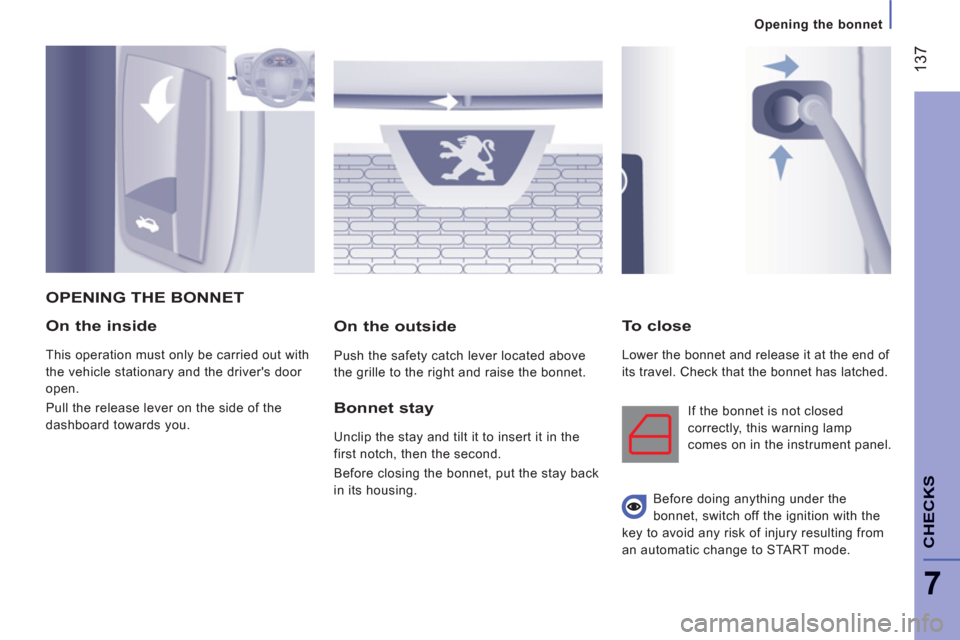
On the inside
This operation must only be carried out with
the vehicle stationary and the driver's door
open.
Pull the release lever on the side of the
dashboard towards you.
On the outside
Push the safety catch lever located above
the grille to the right and raise the bonnet.
To close
Lower the bonnet and release it at the end of
its travel. Check that the bonnet has latched.
OPENING THE BONNET
Bonnet stay
Unclip the stay and tilt it to insert it in the
first notch, then the second.
Before closing the bonnet, put the stay back
in its housing. If the bonnet is not closed
correctly, this warning lamp
comes on in the instrument panel.
Before doing anything under the
bonnet, switch off the ignition with the
key to avoid any risk of injury resulting from
an automatic change to START mode.
Page 141 of 184
Levels
139
CHECK
S
7
LEVELS
These regular maintenance operations
will keep your vehicle in good running
order. Ask for advice at a PEUGEOT dealer
or consult the servicing booklet enclosed in
the handbook pack. To maintain the reliability of engines and
emission control systems, the use of
additives in engine oil is prohibited.
Changing the brake fluid
The brake fluid must be changed at
the intervals stated, according to the
manufacturer's servicing schedule.
Use fluids recommended by the
manufacturer, which fulfil DOT4 standards.
The level must be between the MIN
and
MAX
marks on the reservoir.
If fluid has to be added frequently, this
indicates a failure which must be checked by
a PEUGEOT dealer as soon as possible. If you have to remove/refit the engine
style cover, handle it with care to avoid
damaging the fixing clips.
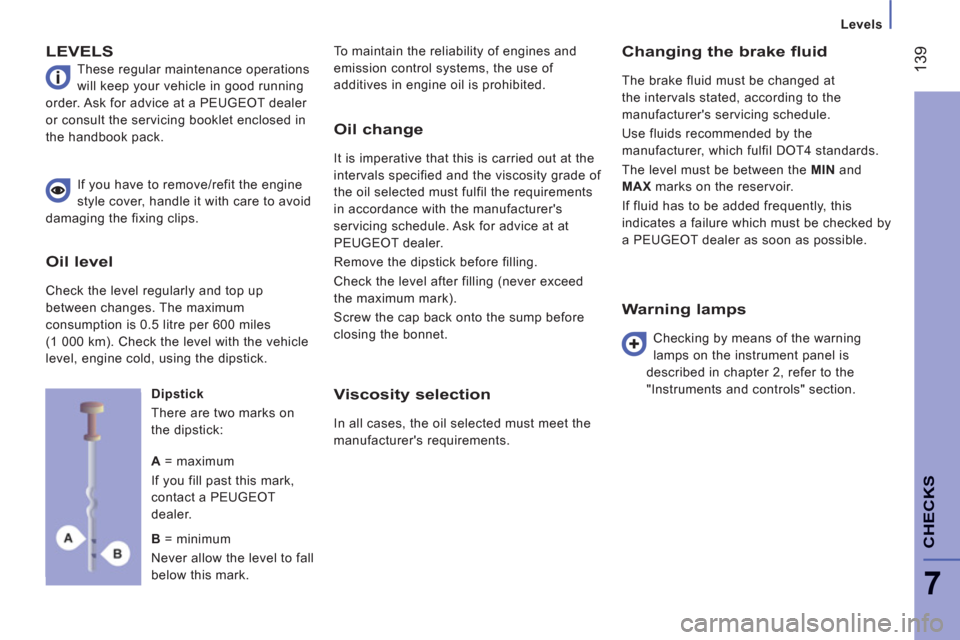
Dipstick
There are two marks on
the dipstick:
Oil change
It is imperative that this is carried out at the
intervals specified and the viscosity grade of
the oil selected must fulfil the requirements
in accordance with the manufacturer's
servicing schedule. Ask for advice at at
PEUGEOT dealer.
Remove the dipstick before filling.
Check the level after filling (never exceed
the maximum mark).
Screw the cap back onto the sump before
closing the bonnet.
Viscosity selection
In all cases, the oil selected must meet the
manufacturer's requirements.
Warning lamps
Checking by means of the warning
lamps on the instrument panel is
described in chapter 2, refer to the
"Instruments and controls" section.
A
= maximum
If you fill past this mark,
contact a PEUGEOT
dealer.
B
= minimum
Never allow the level to fall
below this mark.
Oil level
Check the level regularly and top up
between changes. The maximum
consumption is 0.5 litre per 600 miles
(1 000 km). Check the level with the vehicle
level, engine cold, using the dipstick.
Page 143 of 184
Checks
14
1
CHECK
S
7
CHECKS
Air filter and passenger compartment filter
A clogged passenger compartment filter
may reduce the performance of the
air conditioning system and generate
undesirable odours. The replacement
intervals for these components are indicated
in the servicing booklet.
Depending on the environment (dusty
atmosphere...) and the use of the vehicle
(urban driving...), change them twice as
often if necessary, refer to the "Under the
bonnet" section of chapter 7.
Manual gearbox
Have the level checked in accordance with
the manufacturer's servicing schedule.
To check the main levels and certain
components, in accordance with the
manufacturer's servicing schedule, refer to
the pages of the servicing booklet which
correspond to your vehicle's engine.
Only use products recommended by
PEUGEOT or products of equivalent quality
and specification.
In order to optimise the operation of units as
important as the braking system, PEUGEOT
selects and offers specific products.
In order to avoid damaging the electrical
units, high pressure washing to clean the
engine compartment is strictly prohibited.
Parking brake
Where the parking brake travel is too great
or there is a reduction in the performance
of the system, the parking brake should be
adjusted, even between services.
Have the system checked by a PEUGEOT
dealer. Bleeding the water contained inthe Diesel filter
If this warning lamp comes on,
bleed the filter, otherwise bleed
regularly each time the engine oil
is changed.
To drain the water out, unscrew the bleed
screw or the water in Diesel sensor, located
at the base of the filter. Leave open until
all of the water has been drained out. Then
tighten the bleed screw or the water sensor.
HDi engines use advanced technology. All
work requires a special qualification which is
guaranteed by a PEUGEOT dealer.
Battery
At the start of winter, have your battery
checked by a PEUGEOT dealer.
Brake pads
Brake pad wear depends on the style of
driving, in particular for vehicles which are
used in town, over short distances. It may
be necessary to check the thickness of the
pads, even between services.
Unless there is a leak on the system, a drop
in the brake fluid level indicates that the
brake pads are worn.
Brake disc/drum wear status
For any information relating to checking
the brake disc/drum wear status, contact a
PEUGEOT dealer.
Oil filter
Change the filter regularly, in accordance
with the servicing schedule.
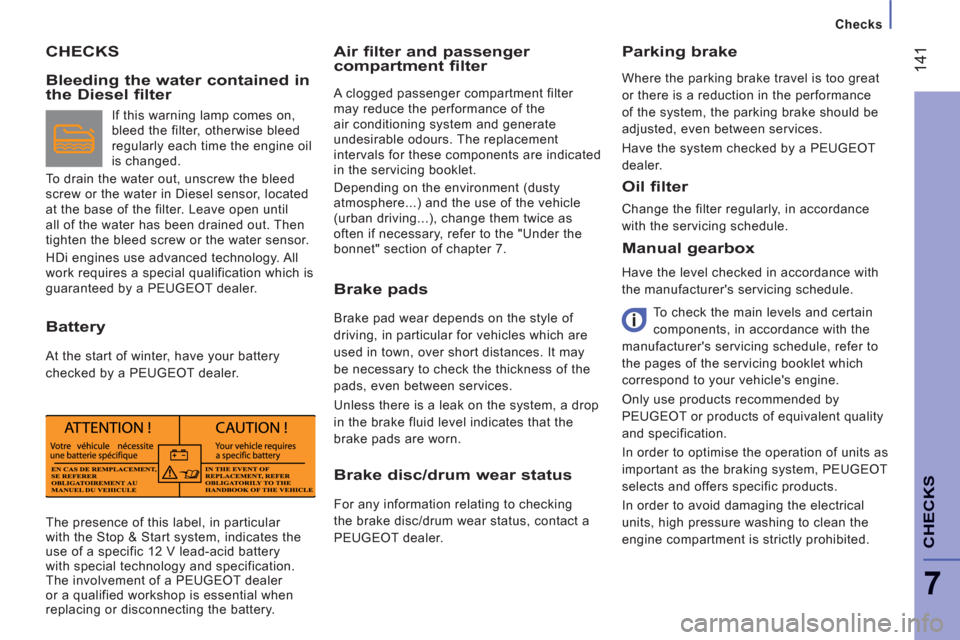
The presence of this label, in particular
with the Stop & Start system, indicates the
use of a specific 12 V lead-acid battery
with special technology and specification.
The involvement of a PEUGEOT dealer
or a qualified workshop is essential when
replacing or disconnecting the battery.
Page 144 of 184
Checks
142
Particle filter system (Diesel)
An addition to the catalytic converter, this
filter makes an active contribution to the
preservation of air quality by the retaining
of the unburnt pollutant particles. Black
exhaust fumes are thus no longer emitted.
This filter, fitted to the exhaust system,
accumulates particles of soot. The engine
control unit manages the automatic
periodic elimination of the soot particles
(regeneration).
The regeneration procedure is invoked
according to the quantity of particles
accumulated and the driving conditions
of the vehicle. During this phase, you
may notice some unusual phenomena -
increased idling speed, cooling fan running,
increase in smoke and higher exhaust gas
temperature - which does not affect the
operation of the vehicle or the environment. After prolonged idling or driving at very low
speeds, you may occasionally notice water
vapour being emitted from the exhaust when
accelerating. This is of no consequence
to the running of the vehicle or to the
environment.
Because of the higher exhaust gas
temperature resulting from the normal
operation of the particle filter, it is
recommended that you do not park the
vehicle over inflammable materials (grass,
dry leaves, pine needles, ...) so as to avoid
any risk of fire.
Saturation / Regeneration
Operating fault
If this alert persists, do not ignore the
warning; it indicates that a fault has occurred
in the exhaust / particle filter system.
Have it checked by a PEUGEOT dealer.
This alert tells you that the particle filter
is starting to fill up (in conditions of urban
driving of exceptionally long duration: low
speeds, traffic jams etc.)
To regenerate the filter, it is advised to drive
as soon as possible, when traffic conditions
and the law permit, at a speed of at least
40 mph (around 60 km/h), with an engine
speed above 2 000 rpm for about fifteen
minutes (until the warning lamp and/or the
message disappears).
If possible, avoid switching off the engine
before the end of regeneration of the
filter; repeated interruptions could cause
premature deterioration of the engine oil. It
is not recommended to end regeneration of
the filter with the vehicle stationary. If there is risk of blockage of the
filter, this warning lamp comes on
in the instrument panel.
Page 146 of 184
Fuel
144
Low fuel level
When the fuel tank level E
(Empty) is reached, this warning
lamp comes on. At this moment,
you have enough fuel left to
drive approximately 30 miles (50 km)
,
depending on the driving conditions, the
engine and the profile of the road. Fill up
without delay to avoid running out of fuel. The fuel tank must be filled with the engine
off.
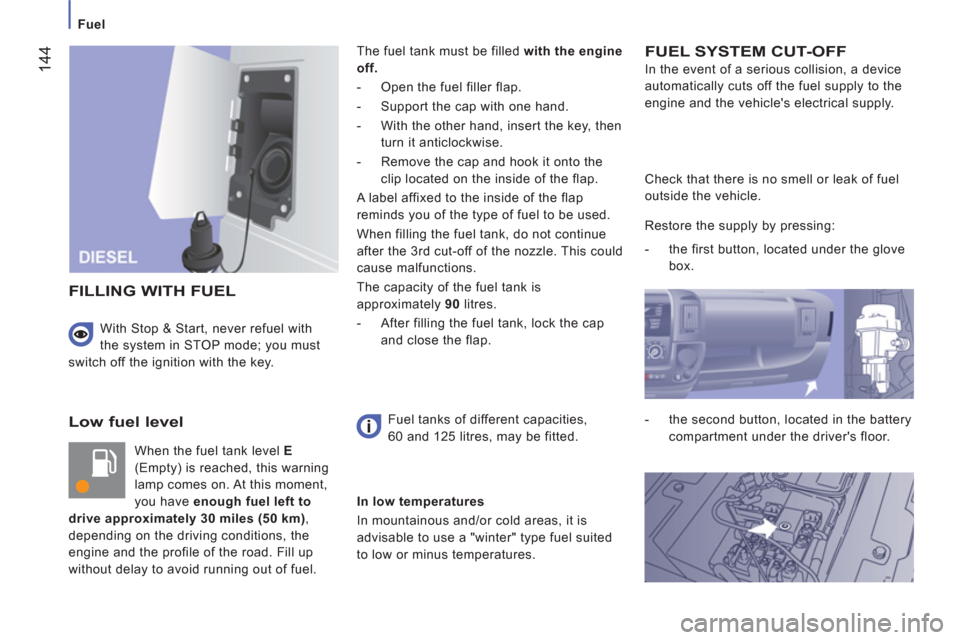
- Open the fuel filler flap.
- Support the cap with one hand.
- With the other hand, insert the key, then
turn it anticlockwise.
- Remove the cap and hook it onto the
clip located on the inside of the flap.
A label affixed to the inside of the flap
reminds you of the type of fuel to be used.
When filling the fuel tank, do not continue
after the 3rd cut-off of the nozzle. This could
cause malfunctions.
The capacity of the fuel tank is
approximately 90
litres.
- After filling the fuel tank, lock the cap
and close the flap.
FUEL SYSTEM CUT-OFF
In the event of a serious collision, a device
automatically cuts off the fuel supply to the
engine and the vehicle's electrical supply.
FILLING WITH FUEL
Fuel tanks of different capacities,
60 and 125 litres, may be fitted. Check that there is no smell or leak of fuel
outside the vehicle.
Restore the supply by pressing:
- the first button, located under the glove
box.
- the second button, located in the battery
compartment under the driver's floor.
In low temperatures
In mountainous and/or cold areas, it is
advisable to use a "winter" type fuel suited
to low or minus temperatures.
With Stop & Start, never refuel with
the system in STOP mode; you must
switch off the ignition with the key.
Page 150 of 184
Changing a wheel
14
8
1. PARKING THE VEHICLE
As far as possible, park the vehicle on level,
stable and non-slippery ground.
Apply the parking brake, switch off the
ignition and engage first gear.
Put on a high visibility vest and position the
warning triangle.
If possible, place a chock under the
wheel diagonally opposite the wheel to be
changed. 2. TOOLS
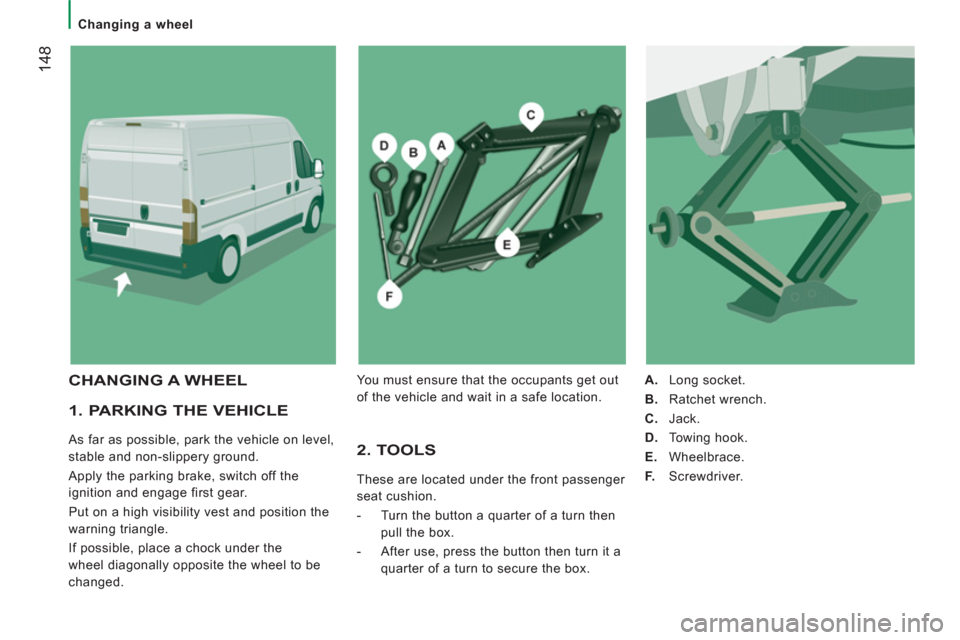
These are located under the front passenger
seat cushion.
- Turn the button a quarter of a turn then
pull the box.
- After use, press the button then turn it a
quarter of a turn to secure the box.
A.
Long socket.
B.
Ratchet wrench.
C.
Jack.
D.
Towing hook.
E.
Wheelbrace.
F.
Screwdriver.
CHANGING A WHEEL
You must ensure that the occupants get out
of the vehicle and wait in a safe location.
Page 177 of 184
17
5
Instruments and controls
10
VISUAL SEARCH
INSTRUMENTS AND CONTROLS
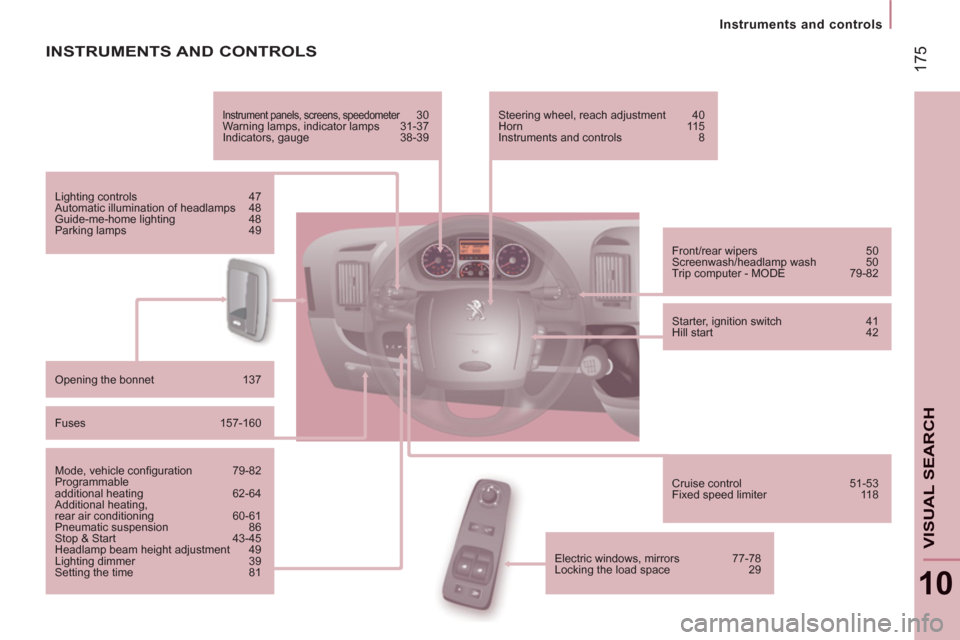
Instrument panels, screens, speedometer 30
Warning lamps, indicator lamps 31-37
Indicators, gauge 38-39
Lighting controls 47
Automatic illumination of headlamps 48
Guide-me-home lighting 48
Parking lamps 49
Opening the bonnet 137
Fuses 157-160
Mode, vehicle confi guration 79-82
Programmable
additional heating 62-64
Additional heating,
rear air conditioning 60-61
Pneumatic suspension 86
Stop & Start 43-45
Headlamp beam height adjustment 49
Lighting dimmer 39
Setting the time 81
Front/rear wipers 50
Screenwash/headlamp wash 50
Trip computer - MODE 79-82
Starter, ignition switch 41
Hill start 42
Cruise control 51-53
Fixed speed limiter 118
Steering wheel, reach adjustment 40
Horn 115
Instruments and controls 8
Electric windows, mirrors 77-78
Locking the load space 29
Page 178 of 184
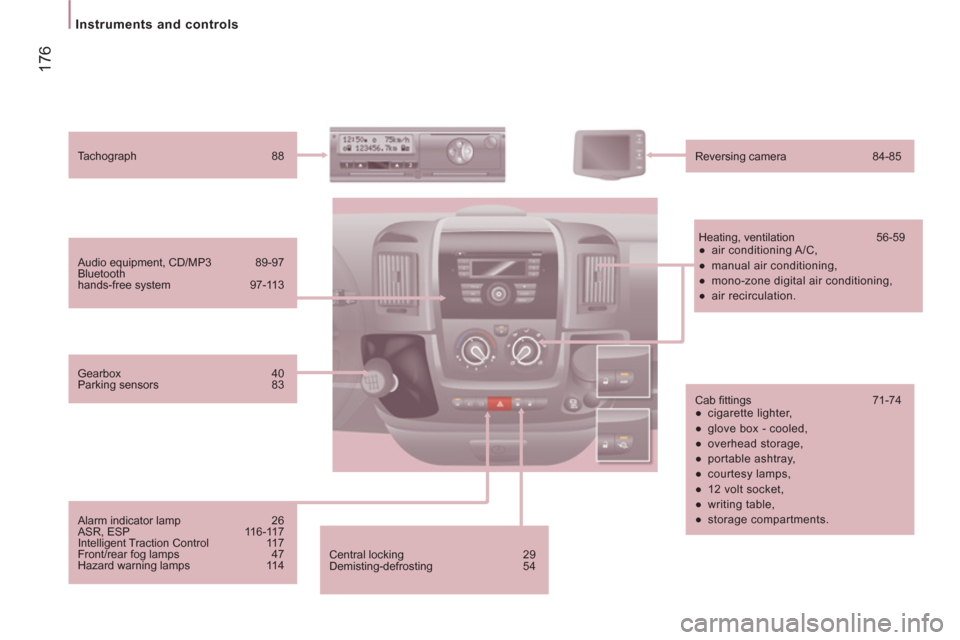
17
6
Instruments and controls
Central locking 29
Demisting-defrosting 54
Audio equipment, CD/MP3 89-97
Bluetooth
hands-free system 97-113
Tachograph 88
Reversing camera 84-85
Heating, ventilation 56-59
●
air conditioning A/C,
●
manual air conditioning,
●
mono-zone digital air conditioning,
●
air recirculation.
Cab fi ttings 71-74
●
cigarette lighter,
●
glove box - cooled,
●
overhead storage,
●
portable ashtray,
●
courtesy lamps,
●
12 volt socket,
●
writing table,
●
storage compartments.
Gearbox 40
Parking sensors 83
Alarm indicator lamp 26
ASR, ESP 116-117
Intelligent Traction Control 117
Front/rear fog lamps 47
Hazard warning lamps 114