steering wheel Peugeot Boxer 2014 - RHD (UK, Australia) User Guide
[x] Cancel search | Manufacturer: PEUGEOT, Model Year: 2014, Model line: Boxer, Model: Peugeot Boxer 2014Pages: 240, PDF Size: 7.88 MB
Page 65 of 240
63
3
EASE OF USE
and
COMFORT
Ventilation
Comfort value adjustment ring
The settings range between:
- increasing the interior ambient air temperature HI (High) which goes up to
to a maximum setting of 32,
- cooling the interior ambient air temperature LO (Low) which goes down
to a setting of 16.
Air distribution
A press illuminates the LED on the buttons
which distribute the air flow towards:
the windscreen and front side
window vents (demisting/
defrosting the windows),
the central and side vents (chest
and face),
the vents in the front and rear
areas (feet).
The combination of buttons permits
improvement of air distribution.
Air flow
Successive presses of this button
increase (+) or reduce (-) the
force of the air flow to the interior.
Intake of exterior air / Recirculation of interior air
When the LED is on, the air
recirculates inside the passenger
compartment to prevent the entry of exterior
odours and smoke. This position should be
temporary.
When the ambient air comfort level has been
reached, pressing the button switches the
LED off and reopens the exterior air intake.
Pressing the AUTO button also restores
the intake of exterior air. Returning to this
position permits renewal of the air in the
passenger compartment and demisting.
Pressing the AUTO button again restores
the FULL AUTO function.
Rapid Demisting / Defrosting
Pressing this control permits
rapid clearing of the windows.
The LED is on.
The system manages the air conditioning,
the flow and intake of air, the defrosting
of the rear screen and provides optimum
distribution of the air to the windscreen and
front side windows.
If your vehicle is fitted with additional
heating, switch it off to ensure rapid and
effective demisting/defrosting.
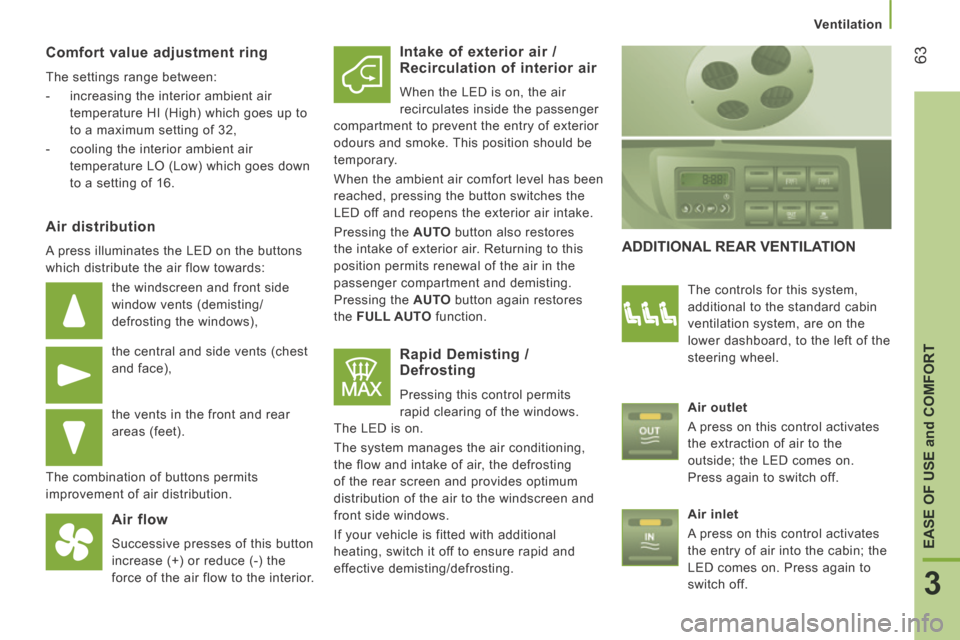
ADDITIONAL REAR VENTILATION
The controls for this system,
additional to the standard cabin
ventilation system, are on the
lower dashboard, to the left of the
steering wheel.
Air outlet
A press on this control activates
the extraction of air to the
outside; the LED comes on.
Press again to switch off.
Air inlet
A press on this control activates
the entry of air into the cabin; the
LED comes on. Press again to
switch off.
Page 86 of 240
84
Vehicle configuration
PERSONALISATION - CONFIGURATION
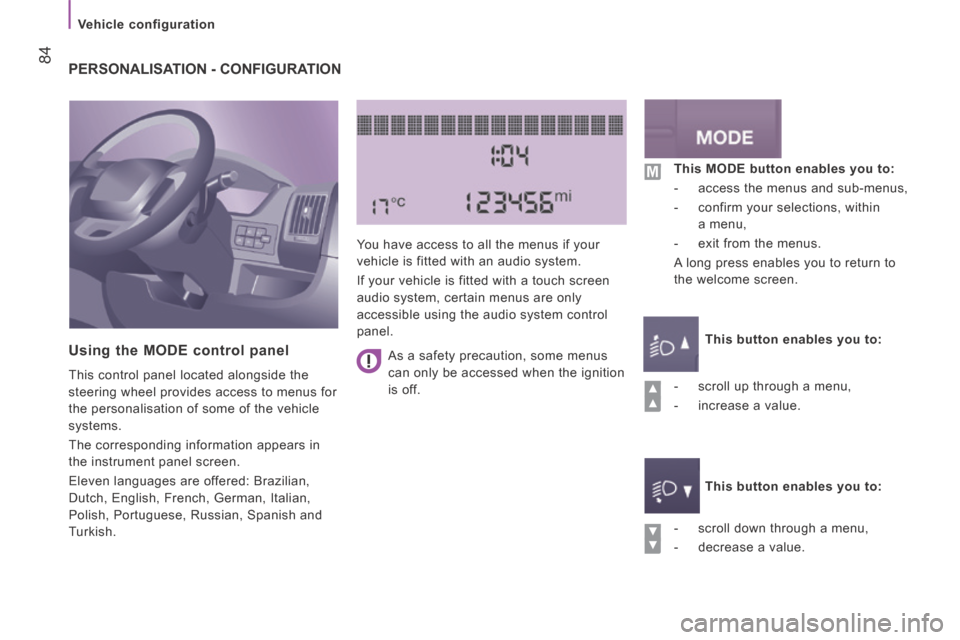
Using the MODE control panel
This control panel located alongside the
steering wheel provides access to menus for
the personalisation of some of the vehicle
systems.
The corresponding information appears in
the instrument panel screen.
Eleven languages are offered: Brazilian,
Dutch, English, French, German, Italian,
Polish, Portuguese, Russian, Spanish and
Turkish. You have access to all the menus if your
vehicle is fitted with an audio system.
If your vehicle is fitted with a touch screen
audio system, certain menus are only
accessible using the audio system control
panel.
- scroll down through a menu,
- decrease a value. This MODE button enables you to:
- access the menus and sub-menus,
- confirm your selections, within a menu,
- exit from the menus.
A long press enables you to return to
the welcome screen.
This button enables you to:
This button enables you to:
- scroll up through a menu,
- increase a value.
As a safety precaution, some menus
can only be accessed when the ignition
is off.
Page 98 of 240
96
Driving safely
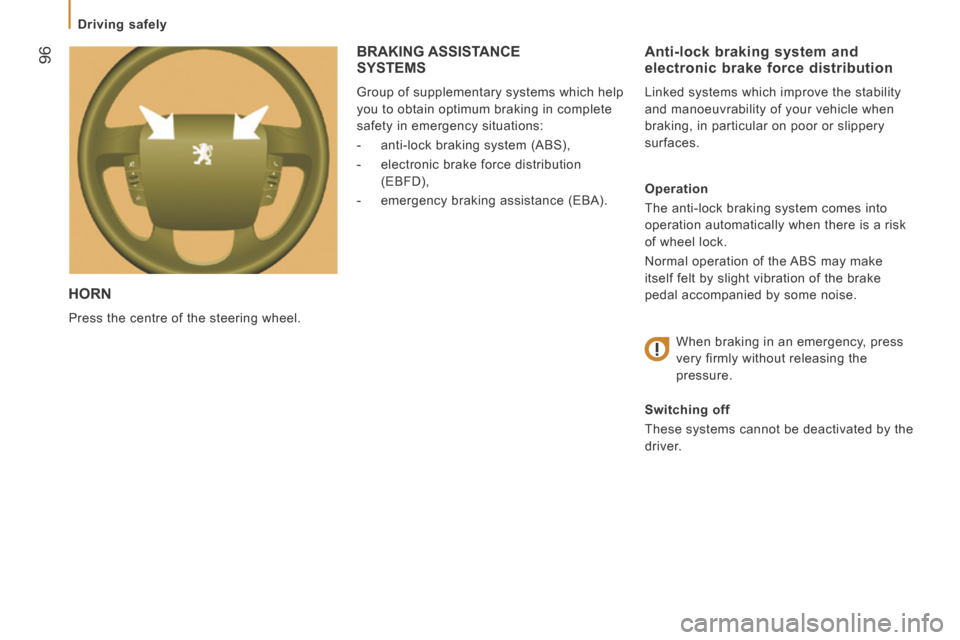
HORN
Press the centre of the steering wheel.
Anti-lock braking system and electronic brake force distribution
Linked systems which improve the stability
and manoeuvrability of your vehicle when
braking, in particular on poor or slippery
surfaces.
Operation
The anti-lock braking system comes into
operation automatically when there is a risk
of wheel lock.
Normal operation of the ABS may make
itself felt by slight vibration of the brake
pedal accompanied by some noise.
When braking in an emergency, press
very firmly without releasing the
pressure.
Switching off
These systems cannot be deactivated by the
driver.
BRAKING ASSISTANCE SYSTEMS
Group of supplementary systems which help
you to obtain optimum braking in complete
safety in emergency situations:
- anti-lock braking system (ABS),
- electronic brake force distribution (EBFD),
- emergency braking assistance (EBA).
Page 107 of 240
105
5
SAFETY
Airbags
GENERAL POINTS ON AIRBAGS
The airbags have been designed to optimise
the safety of the occupants in the event of
a serious collision; they work in conjunction
with the force limiting seat belts.
In the event of a serious collision, electronic
detectors record and analyse any abrupt
deceleration of the vehicle:
- in the event of a serious collision, the airbags are deployed instantly and
contribute towards better protection of
occupants of the vehicle; immediately
after the impact, the airbags rapidly
deflate so as to not hinder visibility or
the possible exit by the occupants,
- in the event of a less serious impact, an impact to the rear and in certain
conditions of rollover, the airbags are not deployed; the seat belts alone contribute
towards providing protection in these
situations.
Airbags only operate when the ignition is
switched on. Front airbags
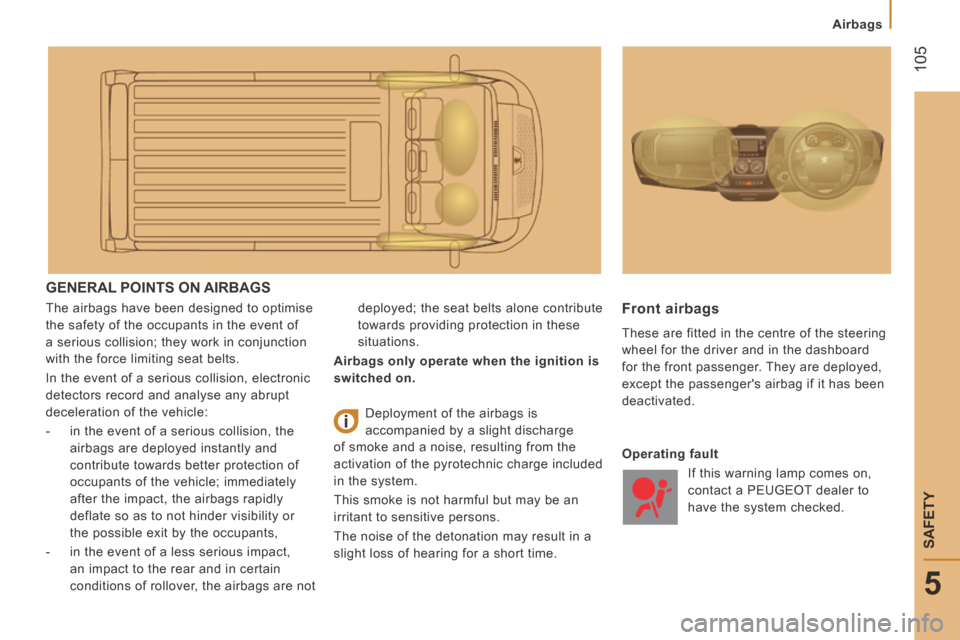
These are fitted in the centre of the steering
wheel for the driver and in the dashboard
for the front passenger. They are deployed,
except the passenger's airbag if it has been
deactivated.
Deployment of the airbags is
accompanied by a slight discharge
of smoke and a noise, resulting from the
activation of the pyrotechnic charge included
in the system.
This smoke is not harmful but may be an
irritant to sensitive persons.
The noise of the detonation may result in a
slight loss of hearing for a short time. Operating fault
If this warning lamp comes on,
contact a PEUGEOT dealer to
have the system checked.
Page 109 of 240
107
5
SAFETY
Airbags
Good practice
If your vehicle is fitted with front, lateral
and curtain airbags, in order for these to
be fully effective, observe the following
safety rules:
Wear a correctly adjusted seat belt.
Sit in a normal upright position.
Do not leave anything between the
occupants and the airbags (child, animal,
object...).
This could hamper the operation of the
airbags or injure the occupants.
All work on the airbag systems must be
carried out by a PEUGEOT dealer or a
qualified workshop.
After an accident or if the vehicle has been
stolen or broken into, have the airbag
systems checked.
Front airbags
Do not drive holding the steering wheel
by its spokes or resting your hands on the
centre part of the wheel.
Passengers must not place their feet on the
dashboard.
Smoke as little as possible; deployment of
the airbags can cause burns or the risk of
injury from a cigarette or pipe.
Never remove or pierce the steering wheel
or hit it violently.
Lateral airbags
Fit only approved covers on the front seats,
compatible with the deployment of lateral
airbags. For information on the range of
covers suitable for your vehicle, contact a
PEUGEOT dealer.
Do not fix or attach anything to the front seat
backs. This could cause injury to the chest
or arms when the lateral airbag is deployed.
Do not sit with the upper part of the body
any nearer to the door than necessary.
Curtain airbags
Do not fix or attach anything to the pillars or
the roof. This could cause injury to the head
when the curtain airbag is deployed.
Do not remove the bolts from the grab
handles installed on the roof, they play a
part in securing the curtain airbags.
Page 132 of 240
130
Fuel
FUEL SYSTEM CUT-OFF
After the collision and before restore
these supplies, check that there is no
fuel leak or sparks, to avoid the risk of fire. In the event of a collision, a device
automatically cuts off the fuel supply
from the engine and cuts off the vehicle's
electrical supply
It triggers operation of the hazard warning
lamps and courtesy lamps, and unlocking of
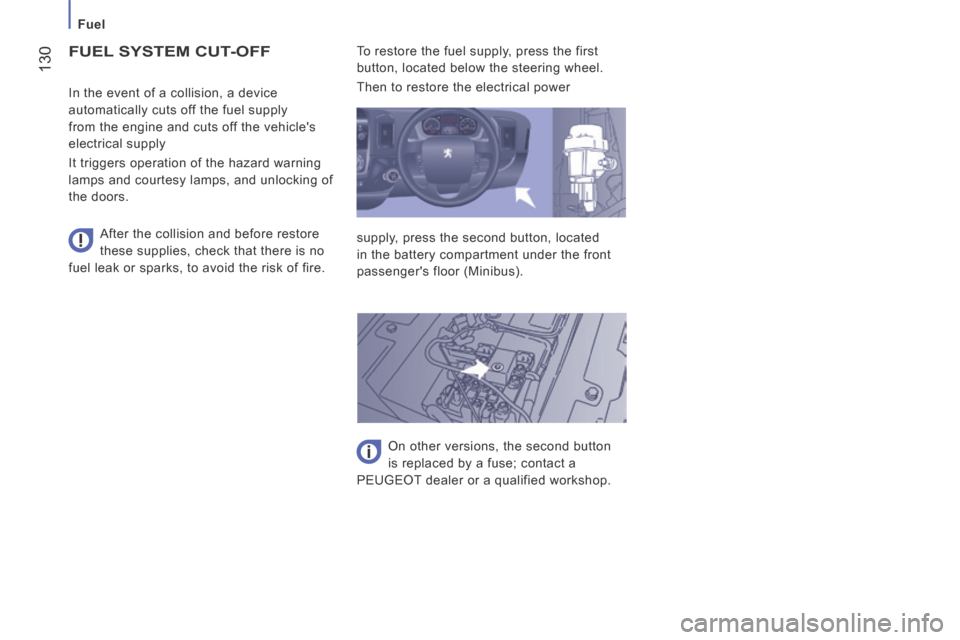
the doors. To restore the fuel supply, press the first
button, located below the steering wheel.
Then to restore the electrical power
supply, press the second button, located
in the battery compartment under the front
passenger's floor (Minibus).
On other versions, the second button
is replaced by a fuse; contact a
PEUGEOT dealer or a qualified workshop.
Page 142 of 240
140
Failed bulb or lamp
Halogen bulbs must be changed after
the headlamp has been off for several
minutes (risk of serious burns). Do not touch
the bulb directly with your fingers, use lint-
free cloths.
When each operation has been completed,
check the operation of the lamps.
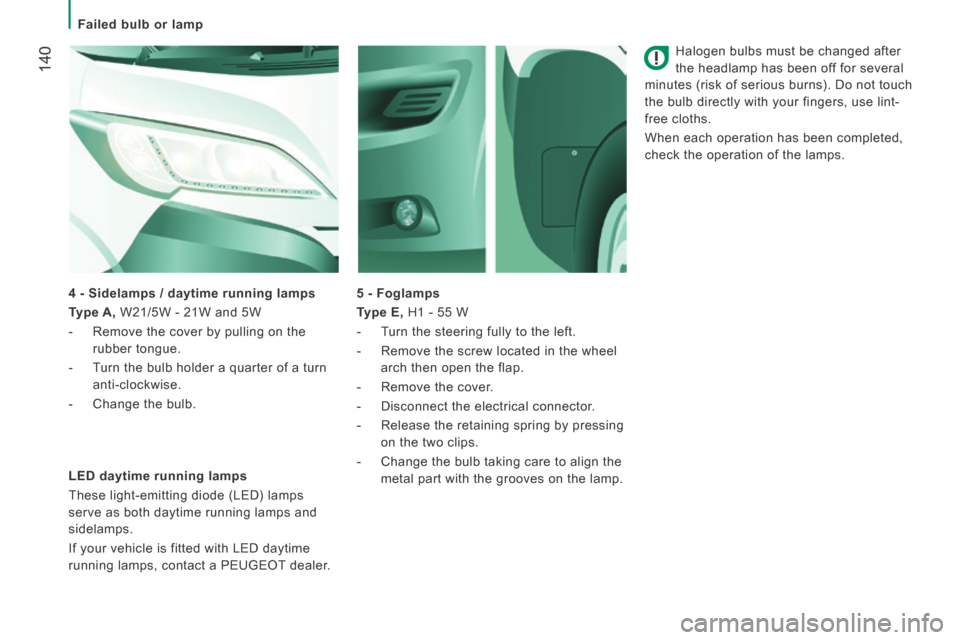
5 - Foglamps
Type E , H1 - 55 W
- Turn the steering fully to the left.
- Remove the screw located in the wheel arch then open the flap.
- Remove the cover.
- Disconnect the electrical connector.
- Release the retaining spring by pressing on the two clips.
- Change the bulb taking care to align the metal part with the grooves on the lamp.
LED daytime running lamps
These light-emitting diode (LED) lamps
serve as both daytime running lamps and
sidelamps.
If your vehicle is fitted with LED daytime
running lamps, contact a PEUGEOT dealer. 4 - Sidelamps / daytime running lamps
Type A
, W21/5W - 21W and 5W
- Remove the cover by pulling on the rubber tongue.
- Turn the bulb holder a quarter of a turn anti-clockwise.
- Change the bulb.
Page 152 of 240
150
Being towed or towing
TOWING
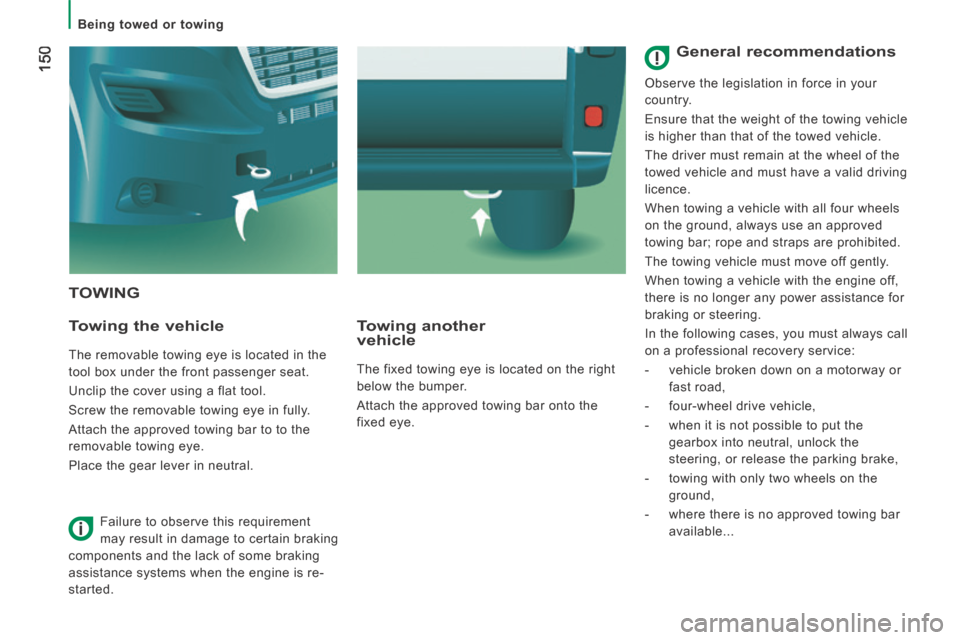
Towing the vehicle
The removable towing eye is located in the
tool box under the front passenger seat.
Unclip the cover using a flat tool.
Screw the removable towing eye in fully.
Attach the approved towing bar to to the
removable towing eye.
Place the gear lever in neutral.
Towing another vehicle
The fixed towing eye is located on the right
below the bumper.
Attach the approved towing bar onto the
fixed eye.
Failure to observe this requirement
may result in damage to certain braking
components and the lack of some braking
assistance systems when the engine is re-
started.
General recommendations
Observe the legislation in force in your
country.
Ensure that the weight of the towing vehicle
is higher than that of the towed vehicle.
The driver must remain at the wheel of the
towed vehicle and must have a valid driving
licence.
When towing a vehicle with all four wheels
on the ground, always use an approved
towing bar; rope and straps are prohibited.
The towing vehicle must move off gently.
When towing a vehicle with the engine off,
there is no longer any power assistance for
braking or steering.
In the following cases, you must always call
on a professional recovery service:
- vehicle broken down on a motorway or fast road,
- four-wheel drive vehicle,
- when it is not possible to put the gearbox into neutral, unlock the
steering, or release the parking brake,
- towing with only two wheels on the ground,
- where there is no approved towing bar available...
Page 209 of 240
 User Guide 10
10.43
These commands can be made from any screen page after pressing the voice\
recognition or telephone button located on the steering wheel, as long as there is no telephone call in progress.")
10
10.43
These commands can be made from any screen page after pressing the voice\
recognition or telephone button located on the steering wheel, as long as there is no telephone call in progress.
VOICE COMMANDS
Global voice commands
Level 1Level 2Level 3Comment
Help Provides generic help to the user by suggesting certain available commands.
Cancel Closes the current voice session.
Repeat Repeats to the user the last voice message spoken.
Voice tutorial Provides the user with detailed description of how to use the voice system.
Page 210 of 240
10
10.44
VOICE COMMANDS
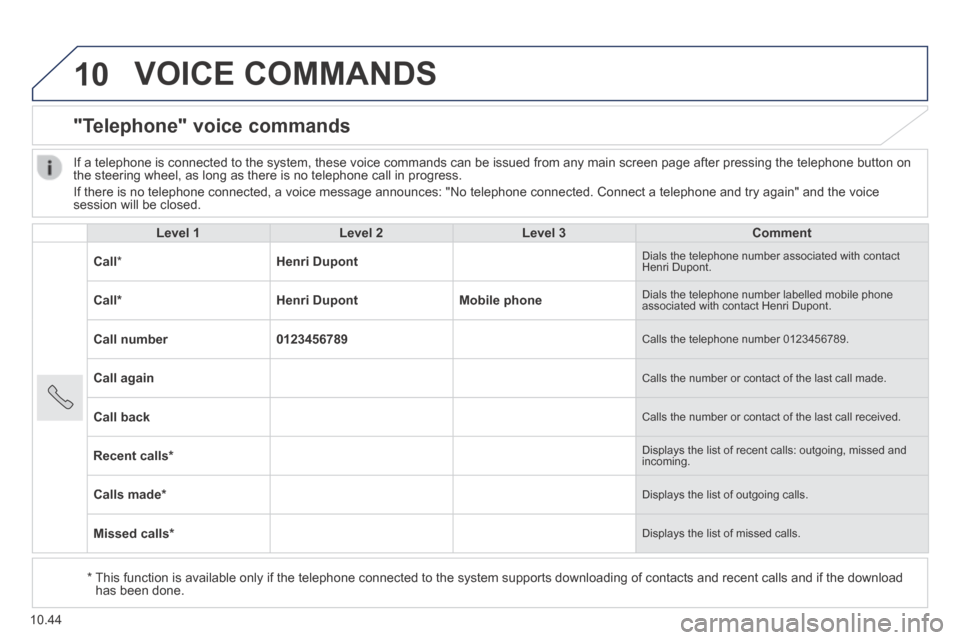
"Telephone" voice commands
Level 1Level 2Level 3Comment
Call * Henri Dupont Dials the telephone number associated with contact Henri Dupont.
Call * Henri DupontMobile phone Dials the telephone number labelled mobile phone associated with contact Henri Dupont.
Call number0123456789 Calls the telephone number 0123456789.
Call again Calls the number or contact of the last call made.
Call back Calls the number or contact of the last call received.
Recent calls * Displays the list of recent calls: outgoing, missed and incoming.
Calls made * Displays the list of outgoing calls.
Missed calls * Displays the list of missed calls.
If a telephone is connected to the system, these voice commands can be i\
ssued from any main screen page after pressing the telephone button on the steering wheel, as long as there is no telephone call in progress.
If there is no telephone connected, a voice message announces: "No telep\
hone connected. Connect a telephone and try again" and the voice session will be closed.
* This function is available only if the telephone connected to the system\
supports downloading of contacts and recent calls and if the download has been done.