tow Peugeot Boxer 2014 Owner's Guide
[x] Cancel search | Manufacturer: PEUGEOT, Model Year: 2014, Model line: Boxer, Model: Peugeot Boxer 2014Pages: 240, PDF Size: 8.98 MB
Page 124 of 240
122
Under the bonnet
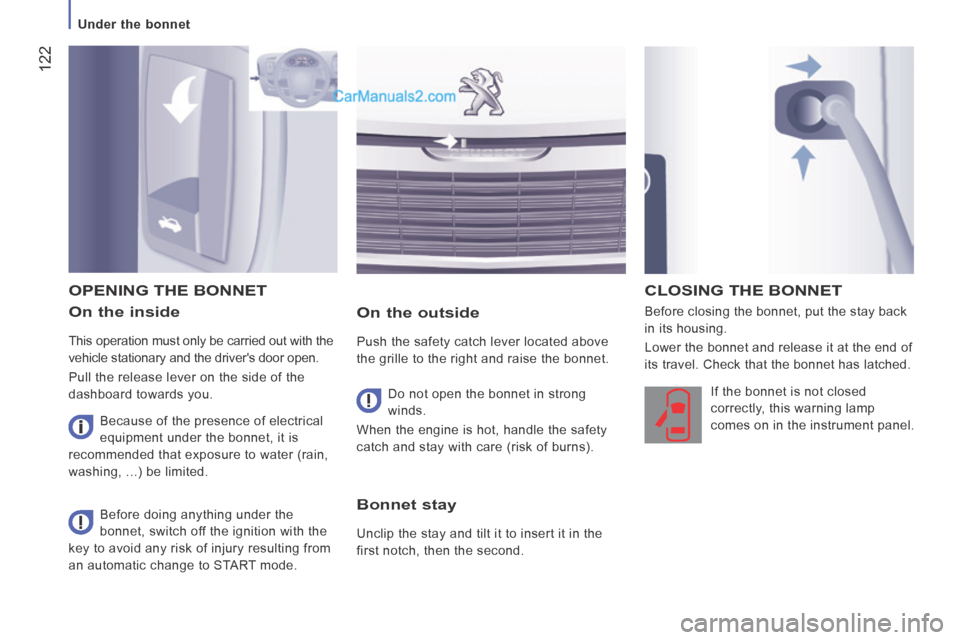
On the inside
This operation must only be carried out with the
vehicle stationary and the driver's door open.
Pull the release lever on the side of the
dashboard towards you.
On the outside
Push the safety catch lever located above
the grille to the right and raise the bonnet. Before closing the bonnet, put the stay back
in its housing.
Lower the bonnet and release it at the end of
its travel. Check that the bonnet has latched.
OPENING THE BONNET
Do not open the bonnet in strong
winds.
When the engine is hot, handle the safety
catch and stay with care (risk of burns). If the bonnet is not closed
correctly, this warning lamp
comes on in the instrument panel.
Before doing anything under the
bonnet, switch off the ignition with the
key to avoid any risk of injury resulting from
an automatic change to START mode.
CLOSING THE BONNET
Bonnet stay
Unclip the stay and tilt it to insert it in the
first notch, then the second.
Because of the presence of electrical
equipment under the bonnet, it is
recommended that exposure to water (rain,
washing, ...) be limited.
Page 129 of 240
Levels and checks
127
7
CHECKS
Manual gearbox
Have the level checked in accordance with
the manufacturer's servicing schedule.
Good practice
To check the main levels and certain
components, in accordance with the
manufacturer's servicing schedule, refer to
the pages of the warranty and maintenance
record which correspond to your vehicle's
engine.
Only use products recommended by
PEUGEOT or products of equivalent quality
and specification.
In order to optimise the operation of units as
important as the braking system, PEUGEOT
selects and offers specific products.
Oil filter
Change the filter regularly, in accordance
with the manufacturer's servicing schedule.
Brake pads
Brake pad wear depends on the style of
driving, in particular for vehicles which are
used in town, over short distances. It may
be necessary to check the thickness of the
pads, even between services.
Brake disc/drum wear status
For any information relating to checking
the brake disc/drum wear status, contact a
PEUGEOT dealer or a qualified workshop.
Parking brake
Where the parking brake travel is too great
or there is a reduction in the performance
of the system, the parking brake should be
adjusted, even between services.
Have the system checked by a PEUGEOT
dealer or a qualified workshop.
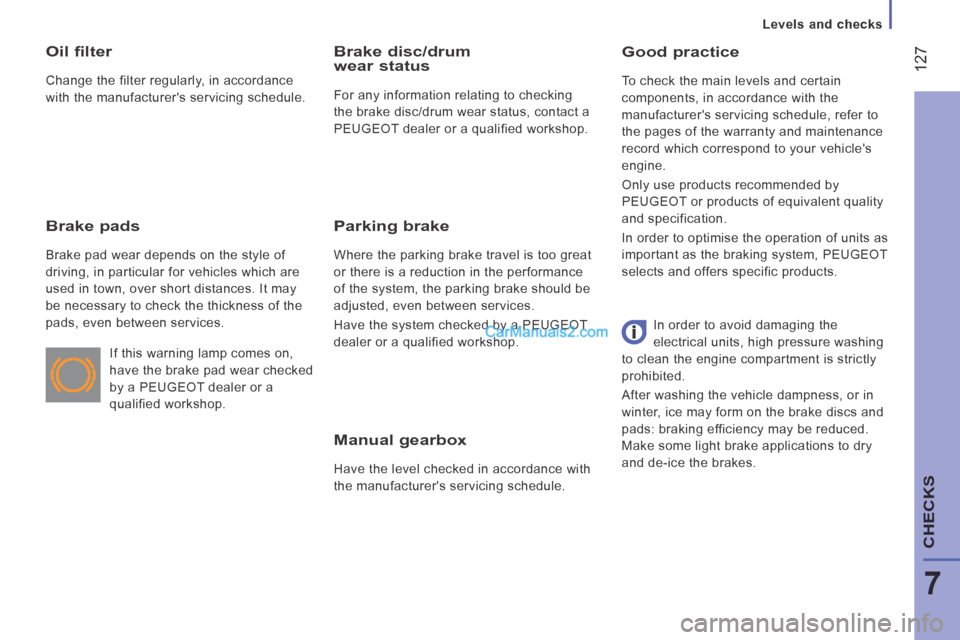
If this warning lamp comes on,
have the brake pad wear checked
by a PEUGEOT dealer or a
qualified workshop. In order to avoid damaging the
electrical units, high pressure washing
to clean the engine compartment is strictly
prohibited.
After washing the vehicle dampness, or in
winter, ice may form on the brake discs and
pads: braking efficiency may be reduced.
Make some light brake applications to dry
and de-ice the brakes.
Page 140 of 240
Failed bulb or lamp
138 When using a high pressure washer
on stubborn dirt, do not persist on
the headlamps, the lamps and their edges
to avoid damaging their lacquer finish and
seals.
CHANGING A BULB
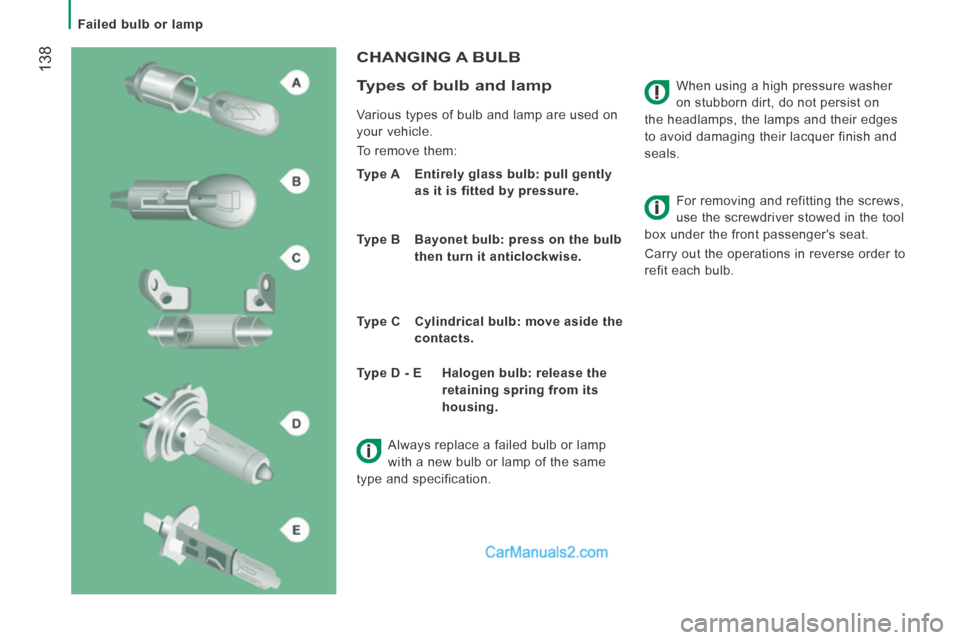
Types of bulb and lamp
Various types of bulb and lamp are used on
your vehicle.
To remove them:
Type A Entirely glass bulb: pull gently as it is fitted by pressure.
Type B Bayonet bulb: press on the bulb then turn it anticlockwise.
Type C Cylindrical bulb: move aside the contacts. For removing and refitting the screws,
use the screwdriver stowed in the tool
box under the front passenger's seat.
Carry out the operations in reverse order to
refit each bulb.
Type D - E Halogen bulb: release the retaining spring from its
housing.
Always replace a failed bulb or lamp
with a new bulb or lamp of the same
type and specification.
Page 141 of 240
Failed bulb or lamp
139
QUICK HELP
8
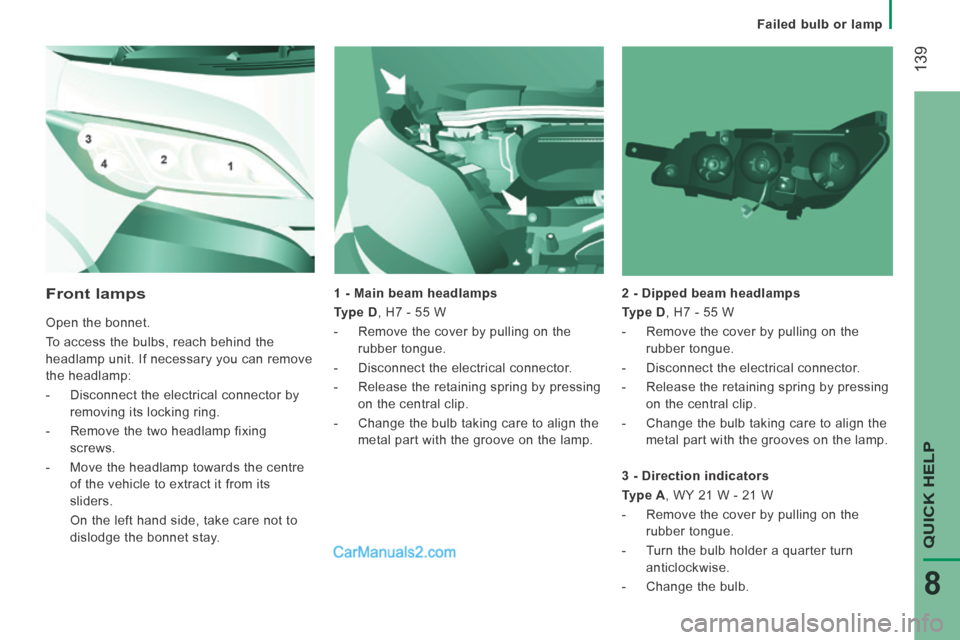
1 - Main beam headlamps
Type D , H7 - 55 W
- Remove the cover by pulling on the rubber tongue.
- Disconnect the electrical connector.
- Release the retaining spring by pressing on the central clip.
- Change the bulb taking care to align the metal part with the groove on the lamp. 2 - Dipped beam headlamps
Type D , H7 - 55 W
- Remove the cover by pulling on the
rubber tongue.
- Disconnect the electrical connector.
- Release the retaining spring by pressing on the central clip.
- Change the bulb taking care to align the metal part with the grooves on the lamp. Front lamps
Open the bonnet.
To access the bulbs, reach behind the
headlamp unit. If necessary you can remove
the headlamp:
- Disconnect the electrical connector by removing its locking ring.
- Remove the two headlamp fixing screws.
- Move the headlamp towards the centre of the vehicle to extract it from its
sliders.
On the left hand side, take care not to dislodge the bonnet stay. 3 - Direction indicators
Type A , WY 21 W - 21 W
- Remove the cover by pulling on the
rubber tongue.
- Turn the bulb holder a quarter turn anticlockwise.
- Change the bulb.
Page 147 of 240
Puncture
145
QUICK HELP
8
Parking the vehicle
As far as possible, park the vehicle on level,
stable and non-slippery ground.
Apply the parking brake, switch off the
ignition and engage first gear.
Put on a high visibility vest and position the
warning triangle on the road.
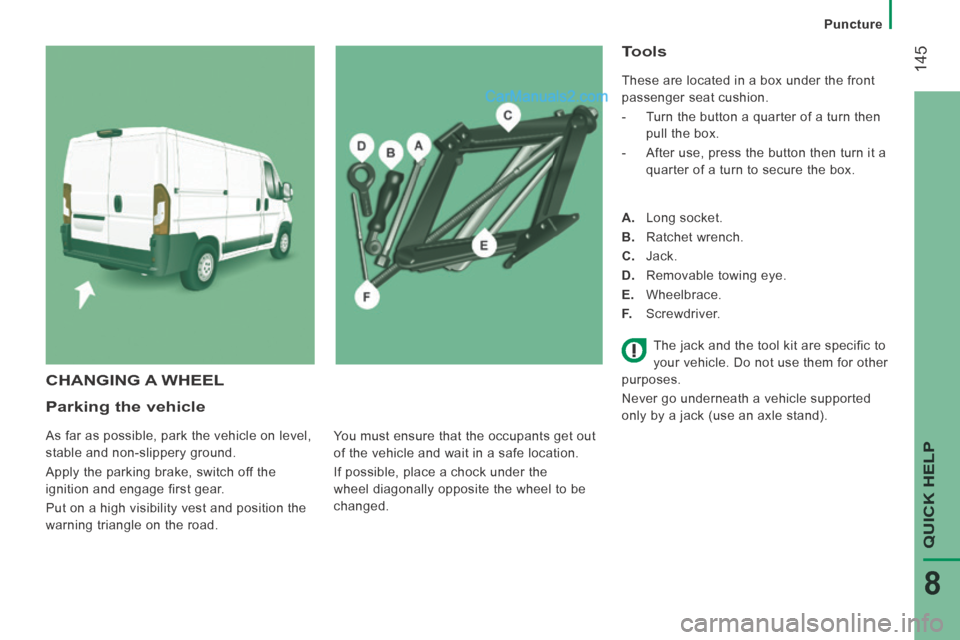
Tools
These are located in a box under the front
passenger seat cushion.
- Turn the button a quarter of a turn then pull the box.
- After use, press the button then turn it a quarter of a turn to secure the box.
A. Long socket.
B. Ratchet wrench.
C. Jack.
D. Removable towing eye.
E. Wheelbrace.
F. Screwdriver.
CHANGING A WHEEL
You must ensure that the occupants get out
of the vehicle and wait in a safe location.
If possible, place a chock under the
wheel diagonally opposite the wheel to be
changed. The jack and the tool kit are specific to
your vehicle. Do not use them for other
purposes.
Never go underneath a vehicle supported
only by a jack (use an axle stand).
Page 149 of 240
Puncture
147
QUICK HELP
8
Refitting the repaired wheel
Refitting the repaired wheel is the same as
fitting the spare wheel; don't forget to refit
the wheel trim. Refer to the "Technical data -
Identification markings" section for the
location of the tyre pressure label.
The spare wheel is not designed to be used
over long distances. Have the tightening
of the bolts and pressure of the spare
wheel checked by a PEUGEOT dealer or a
qualified workshop without delay.
Also, have the original wheel repaired and
refitted by a PEUGEOT dealer or a qualified
workshop as soon as possible.
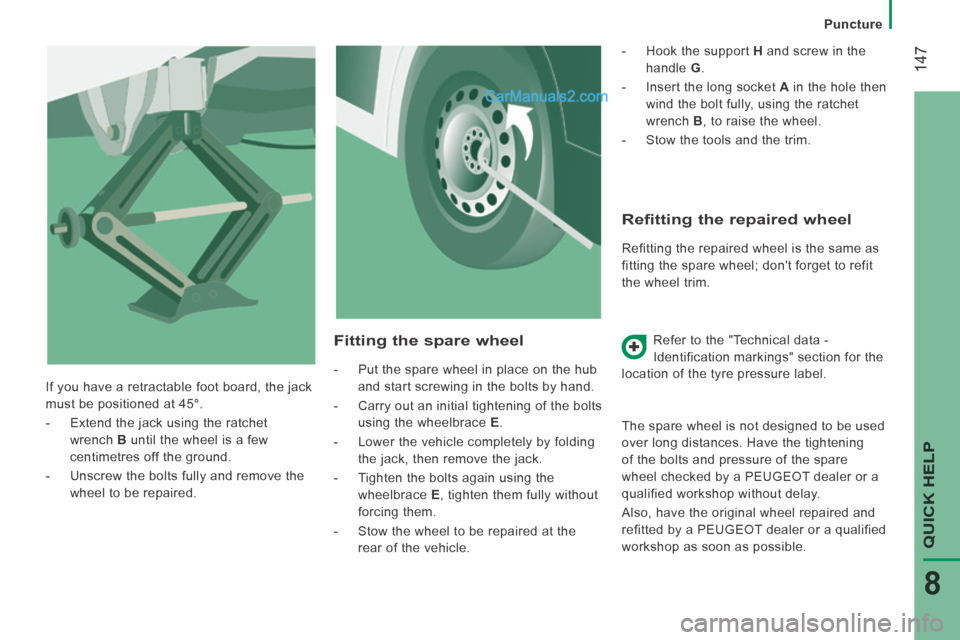
Fitting the spare wheel
- Put the spare wheel in place on the hub and start screwing in the bolts by hand.
- Carry out an initial tightening of the bolts using the wheelbrace E .
- Lower the vehicle completely by folding the jack, then remove the jack.
- Tighten the bolts again using the wheelbrace E , tighten them fully without
forcing them.
- Stow the wheel to be repaired at the rear of the vehicle. - Hook the support H
and screw in the
handle G .
- Insert the long socket A in the hole then
wind the bolt fully, using the ratchet
wrench B , to raise the wheel.
- Stow the tools and the trim.
If you have a retractable foot board, the jack
must be positioned at 45°.
- Extend the jack using the ratchet wrench B until the wheel is a few
centimetres off the ground.
- Unscrew the bolts fully and remove the wheel to be repaired.
Page 152 of 240
Being towed or towing
150
TOWING
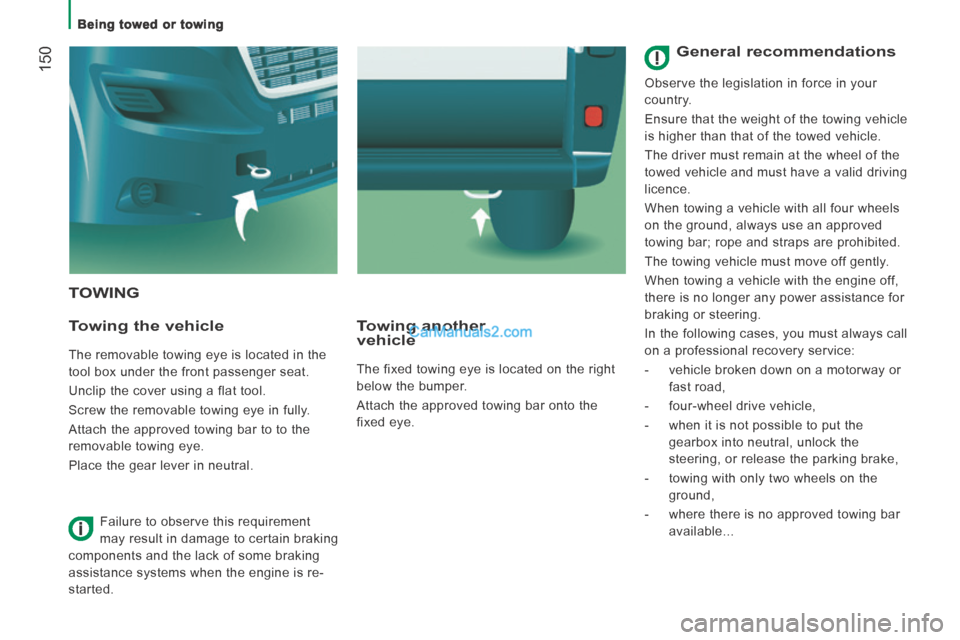
Towing the vehicle
The removable towing eye is located in the
tool box under the front passenger seat.
Unclip the cover using a flat tool.
Screw the removable towing eye in fully.
Attach the approved towing bar to to the
removable towing eye.
Place the gear lever in neutral.
Towing another vehicle
The fixed towing eye is located on the right
below the bumper.
Attach the approved towing bar onto the
fixed eye.
Failure to observe this requirement
may result in damage to certain braking
components and the lack of some braking
assistance systems when the engine is re-
started.
General recommendations
Observe the legislation in force in your
country.
Ensure that the weight of the towing vehicle
is higher than that of the towed vehicle.
The driver must remain at the wheel of the
towed vehicle and must have a valid driving
licence.
When towing a vehicle with all four wheels
on the ground, always use an approved
towing bar; rope and straps are prohibited.
The towing vehicle must move off gently.
When towing a vehicle with the engine off,
there is no longer any power assistance for
braking or steering.
In the following cases, you must always call
on a professional recovery service:
- vehicle broken down on a motorway or fast road,
- four-wheel drive vehicle,
- when it is not possible to put the gearbox into neutral, unlock the
steering, or release the parking brake,
- towing with only two wheels on the ground,
- where there is no approved towing bar available...
Page 162 of 240
Weights
160 WEIGHTS AND TOWED LOADS
Refer to your registration certificate and the vehicle's chassis plate.
In each country, it is imperative that the towed loads permitted by local legislation a\
re complied with. For information regarding your
vehicle's towing possibilities and its gross train weight, contact a PEU\
GEOT dealer.
The speed of a towing vehicle must not exceed 60 mph (100 km/h) (comp\
ly with the legislation in force in your country).
High ambient temperatures may result in a reduction in the performance o\
f the vehicle, to protect the engine. When the ambient
temperature is higher than 37 °C, limit the weight towed.
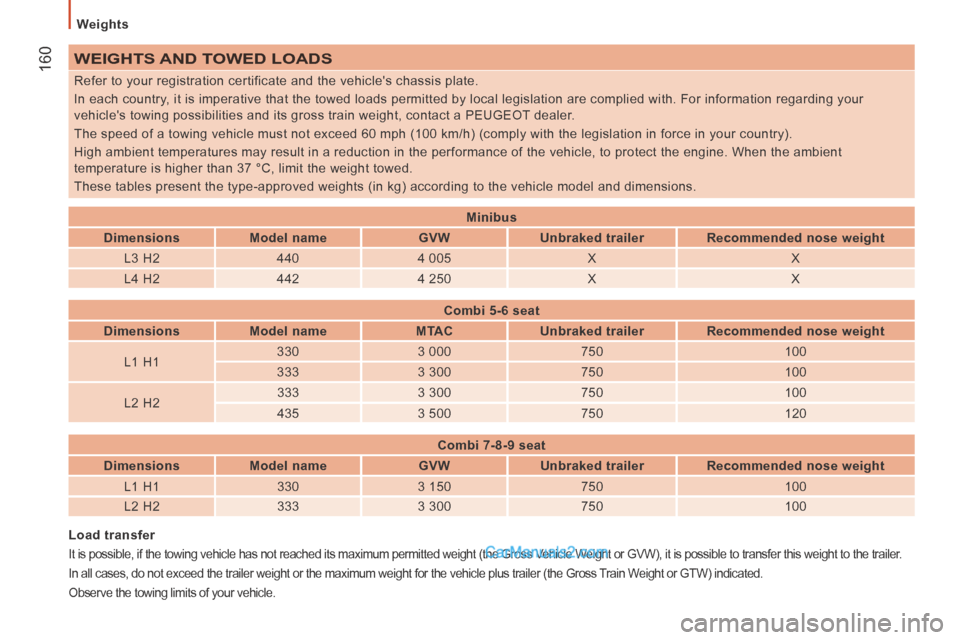
These tables present the type-approved weights (in kg) according to th\
e vehicle model and dimensions.
Load transfer
It is possible, if the towing vehicle has not reached its maximum permit\
ted weight (the Gross Vehicle Weight or GVW), it is possible to transfer this weight to the trailer.
In all cases, do not exceed the trailer weight or the maximum weight for\
the vehicle plus trailer (the Gross Train Weight or GTW) indicated.
Observe the towing limits of your vehicle.
Minibus
Dimensions Model name GVW Unbraked trailer Recommended nose weight
L3 H2 440 4 005 X X
L4 H2 442 4 250 X X
Combi 5-6 seat
Dimensions Model name MTAC Unbraked trailer Recommended nose weight
L1 H1 330
3 000 750 100
333 3 300 750 100
L2 H2 333
3 300 750 100
435 3 500 750 120
Combi 7-8-9 seat
Dimensions Model name GVW Unbraked trailer Recommended nose weight
L1 H1 330 3 150 750 100
L2 H2 333 3 300 750 100